J-B Weld Plastic Bonder
4.6Editor score
Two-part urethane system
Hard permanent bond
Sands after 30 minutes
Our guide compares the best glue for ABS plastic, including fast-setting super glues, durable epoxies, precision gels, and solvent cements for every repair
Choosing glue for ABS plastic is less about finding a strong general-purpose adhesive and more about matching the formula to the repair. ABS can respond well to cyanoacrylate, epoxy, polyurethane, and dedicated solvent cement, but each offers different control, curing behavior, appearance, and material compatibility.
The products in this guide were compared using their stated bonding materials, application method, cure time, temperature resistance, precision, and suitability for models, household items, 3D-printed parts, automotive trim, or pipe. The list includes liquid super glues, thick gels, two-part epoxies, a brush-applied ABS cement, and a pipe-oriented solvent cement.
Each review explains where that product stands out and where its design may be less convenient. The top selections include a versatile 3D-printing gel, a rugged two-part plastic bonder, and a professional ABS solvent cement, while ratings, availability, and prices can change over time.
4.6Editor score

4.7Editor score

4.6Editor score
This side-by-side comparison covers ten distinct ABS-bonding options, ranging from precise cyanoacrylate formulas to gap-filling epoxies and pipe solvent cement. The most important distinctions are substrate coverage, application control, cure time, finish, and whether the intended repair demands a quick cosmetic bond or a substantial structural repair.
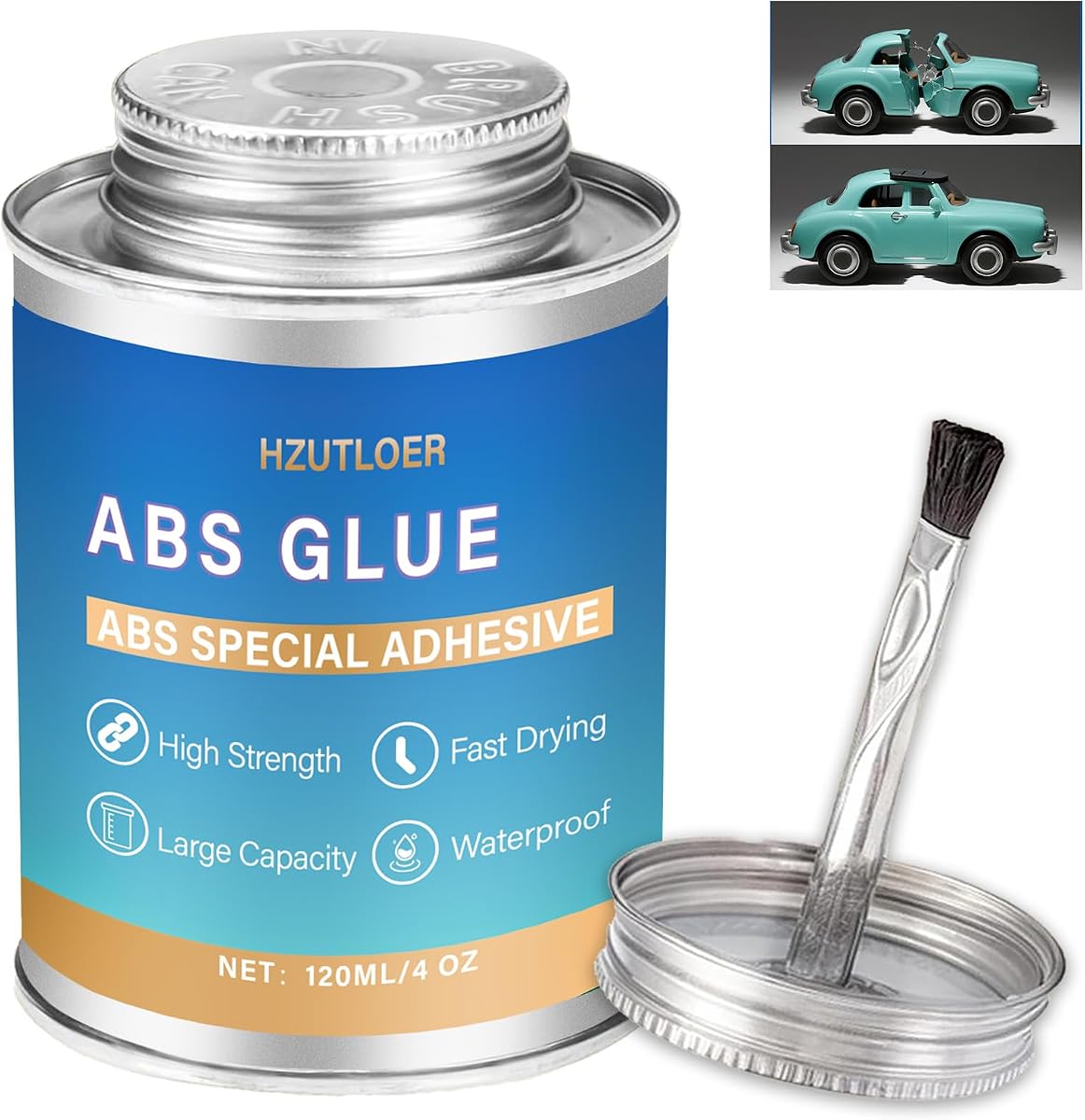


This brush-applied ABS super glue is a practical general repair adhesive, earning a 4.3 rating among customers. Its standout qualities are the 120 ml capacity, clear cured appearance, and ability to bond ABS and AS as well as rigid PVC and rigid PS. That combination makes it useful for household repairs, model crafts, and projects where more than one plastic may be involved.
We may earn a commission when you buy through this link, at no additional cost to you.
The built-in brush is the feature that most changes the application experience. Instead of trying to place tiny drops over a larger seam, the user can spread adhesive along the bond line, making it easier to cover the intended area evenly. The listed compatibility also extends the product beyond a single ABS-only use, while the transparent finish is particularly attractive for visible surfaces and small decorative parts.
The tradeoff is that a brush offers less pinpoint control than a micro-tip or precision nozzle. Care is still required around tight gaps, vertical assemblies, and moving parts because excess adhesive can spread beyond the joint. The listing also describes the glue as waterproof and heat resistant, but those claims should be evaluated against the demands of the specific project rather than treated as permission for extreme exposure.
This is a strong choice for someone who wants a larger container and a straightforward brush for everyday ABS repair. Choose it for broad household or model-craft work where neat coverage matters more than surgical placement. For intricate miniatures, 3D-printed seams, or a permanent structural bond, one of the more specialized precision or two-part options may be easier to control.
The fine-bristle brush makes it easier to lay down a controlled line across a seam. It is particularly helpful when covering a longer crack or bonding flat pieces where a narrow glue bead would need repeated applications.
The transparent result helps keep the adhesive from becoming the most noticeable feature of a repaired model, housing, or display piece. It is still advisable to remove uncured residue carefully from surrounding surfaces.
We may earn a commission when you buy through this link, at no additional cost to you.
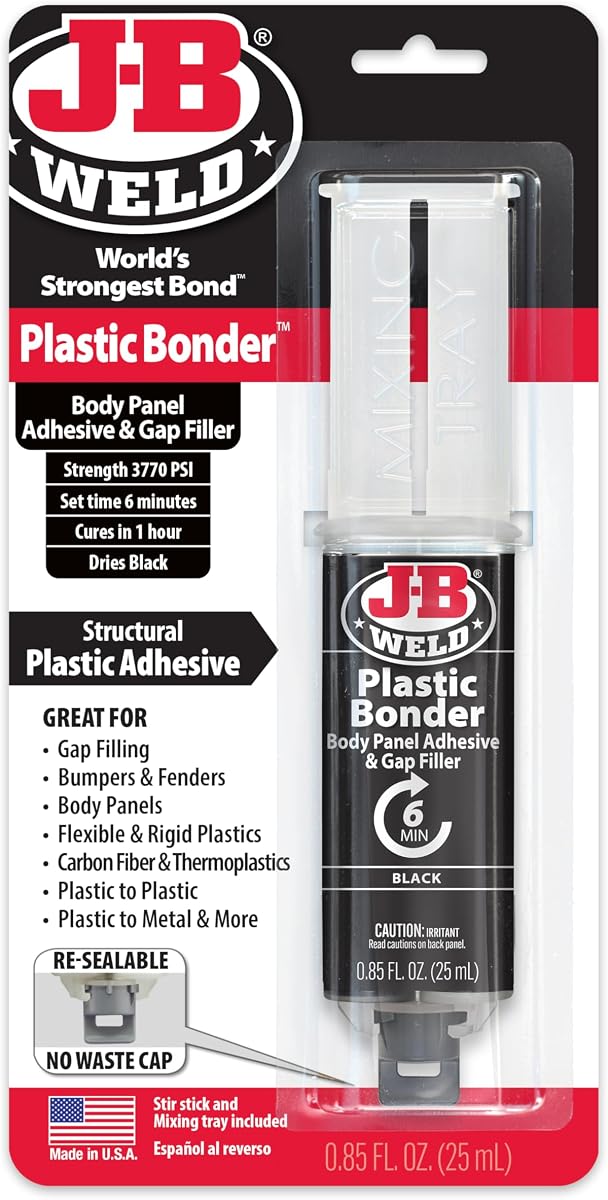
J-B Weld Plastic Bonder is a quick-set, two-part polyurethane adhesive system with a 4.6 rating. It is designed for strong, lasting repairs and can serve as both a plastic bonder and a gap filler. Its stated ability to work with thermoplastics, composites, coated metals, concrete, and other surfaces gives it broader project potential than a simple super glue.
We may earn a commission when you buy through this link, at no additional cost to you.
The 1:1 mixing ratio makes the process reasonably approachable, while the 15-minute set time offers a faster result than the longer cure associated with many epoxies. A listed tensile strength of 3,770 psi indicates a substantial cured bond, and the material can be sanded after 30 minutes. Those characteristics make it appealing for body-panel work, larger cracks, loose components, and repairs that may receive handling after curing.
The main compromise is that it is not a convenient one-step super glue. Mixing must be thorough, and the black color remains visible. This makes it less attractive for a transparent model seam but well suited to functional components, automotive trim, or projects where appearance is secondary to a hard, permanent repair. Outdoor suitability is stated, though exposed joints still deserve consideration of the material and environment.
Buy this adhesive when the repair needs more substance than a cosmetic cyanoacrylate bond and you are comfortable mixing two components. It is our premium pick for demanding ABS work, including larger gaps and parts that will be sanded or shaped after the initial cure. For tiny precision assemblies, a gel or thin super glue is easier to dispense.
The two-part polyurethane formula is the distinguishing advantage here. It cures into a hard permanent bond and offers more substance for substantial ABS components than a fast-setting liquid glue.
Because the product functions as an adhesive and gap filler, it can help bridge imperfectly aligned or slightly separated parts. That makes it more forgiving of a worn joint than a formula intended only for perfectly close surfaces.
We may earn a commission when you buy through this link, at no additional cost to you.
The 3D Printing Super Glue Gel has a 4.7 rating, making it the highest-rated option in this guide. It is optimized for filament-based projects and specifically identifies PLA, ABS, PETG, TPU, ASA, and nylon among its compatible materials. That broad filament focus is reinforced by features designed for post-processing, layer repairs, and functional printed parts.
We may earn a commission when you buy through this link, at no additional cost to you.
Its thick, no-drip formula is the key advantage. Rather than racing down a vertical seam or wicking away from the intended location, the gel remains where it is placed. The precision tip and anti-clog needle support controlled flow, while the large 1.76-ounce tube is intended for frequent repairs, prototyping, labs, and print farms that may consume adhesive more quickly than a small bottle would allow.
Durability is another advantage. The product is listed as resistant to temperatures up to 110°C and to humidity, making it relevant for mechanical fits, RC components, and outdoor-printed parts. The trade-off is that a thick adhesive is not a substitute for a gap-filling epoxy or a solvent cement. It works best when mating surfaces are brought together properly and the bead is kept to the area requiring support.
This is the most balanced pick for 3D-printing enthusiasts who repair ABS parts regularly. It provides better placement control than a thin super glue without the mixing requirements of a two-part epoxy. Consider it for layer splits, snapped supports, printed housings, and accurate assembly work, especially where a visible vertical run would be difficult to manage.
The no-drip consistency is especially useful on upright walls, angled joints, and detailed printed structures. It reduces the chance that a quick-setting adhesive will migrate into panel lines or lock nearby features.
The 1.76-ounce capacity suits repeated post-processing work and prototyping sessions. The anti-clog needle is intended to maintain cleaner flow across multiple uses, provided the tube is closed properly after application.
We may earn a commission when you buy through this link, at no additional cost to you.
J-B Weld PlasticWeld is a hand-mixable two-part epoxy putty for repairing and rebuilding ABS, PVC, CPVC, and other rigid or semi-flexible plastics. Its 4.3 rating reflects a practical balance of repair capability and handling. The product is particularly relevant when a broken ABS part needs more than a simple crack seal, such as a missing corner, damaged mounting area, or irregular joint.
We may earn a commission when you buy through this link, at no additional cost to you.
After kneading, the putty sets in 25 minutes and cures in three hours. Once cured, it can be molded, shaped, sanded, drilled, and cut, giving the user several ways to restore the original geometry. Its listed lap shear strength is 600 psi, and the cured formula can handle continuous temperatures up to 250°F and intermittent temperatures up to 300°F. Those specifications make it a more substantial repair option for functional parts.
The obvious trade-off is time and finish. This is not an instant cosmetic adhesive, and the off-white cured color may stand out on black or brightly colored ABS. Users must also knead the formula correctly to combine both parts thoroughly. Because it does not shrink, however, it can serve as a durable filler and rebuild material instead of relying on a thin glue line.
Choose PlasticWeld for damaged automotive trim, rigid housings, pipes, marine components, or other ABS repairs where a rebuildable, sandable result matters. It is less suitable for a nearly invisible model seam, but it is a strong candidate when broken edges need to be held together and the repair may later be drilled or shaped.
The putty format allows material to be pressed into a missing section or built up around a damaged edge. Once cured, it can be shaped to restore contours that a thin adhesive could not replace.
A repair that has cured for three hours can be sanded, cut, or drilled. This gives builders a path to a smoother final result instead of leaving a thick filler ridge untouched.
We may earn a commission when you buy through this link, at no additional cost to you.
Rectorseal 647L is a black, medium-body solvent cement specifically made to join ABS pipe and socket-type fittings. Its 4.6 rating reflects the narrow but confident position of the product: rather than advertising broad compatibility, it provides a professional formula for a defined ABS-plumbing application.
We may earn a commission when you buy through this link, at no additional cost to you.
The medium-body consistency is designed for superior gap-filling characteristics and reduced run-off. On black ABS pipe, the black cement also produces an excellent professional appearance. Approval for potable-water systems and compliance with ASTM D2535 make this a purpose-driven option for installers working with approved ABS pipe systems, rather than a general model glue.
The primary limitation is that solvent cement behaves very differently from instant super glue or epoxy. It is not a convenient product for tiny model seams, and its black finish makes it unsuitable for transparent or multicolored ABS objects. It is also unnecessary for simple toy cracks where a cyanoacrylate formula would be easier to control. Its value comes from performing a specific plumbing task with a formula designed for that exact use.
Choose Rectorseal 647L when joining black ABS pipe and compatible socket fittings, particularly for a professional or serious plumbing project. It is our budget pick because it delivers focused performance without asking users to pay for a general adhesive system. For household plastic models or visible household components, select one of the clear super glues or epoxies instead.
This cement is formulated around ABS pipe and socket-type fittings, including the gap-filling behavior required at those joints. That focus makes it more relevant than a broad super glue for qualified plumbing work.
The black color is designed to give a professional appearance on black ABS pipe. It avoids the visible finish associated with clear cement while remaining appropriate to the intended pipe color.
We may earn a commission when you buy through this link, at no additional cost to you.
ALECPEA Plastic Glue is a thin cyanoacrylate formula intended for ABS, PVC, PS, and common rigid plastics. It carries a 4.5 rating and addresses a frequent repair problem: a hairline split may look closed on the surface while remaining weak underneath. Its low viscosity uses capillary action to enter close-fitting seams and narrow housings.
We may earn a commission when you buy through this link, at no additional cost to you.
Three included dropper tips provide more control around small cracks, moving parts, model cars, toys, and miniature figures. The product sets in 15 seconds, which is useful when a quick repair is needed, but the instructions call for 12 hours of full curing before washing or loading the item. The thin, clear consistency also helps avoid the bulky ridge that a thicker adhesive could leave on a display piece.
Users must match the material before applying it. The listing specifically says it is not intended for PE, PP, PTFE, silicone, or highly flexible parts unless compatibility is confirmed. That limitation is important because a fast-setting cyanoacrylate can also be difficult to remove if it wicks into an incompatible surface. Testing an inconspicuous area and checking for coatings or plastic blends is sensible preparation.
This glue is a strong choice for small household parts, display models, figures, and hairline cracks where neatness matters. Its main limitation is the difference between quick handling strength and full cure. Use the initial set only as a reason to keep the parts aligned, not as permission to load or wash the repair immediately.
The thin formula is designed to move into narrow seams instead of forming a conspicuous bead over the top. That behavior makes it useful when the damaged pieces still fit together closely.
The three dropper tips help place adhesive in confined spaces and around detailed model features. They are particularly useful when avoiding overflow onto adjacent surfaces is important.
We may earn a commission when you buy through this link, at no additional cost to you.
WoldoClean Super Glue for Plastic is a clear, fast-setting cyanoacrylate adhesive with a 4.4 rating. Its stated compatibility extends across PVC, ABS, acrylic, plexiglass, vinyl, rubber, nylon, and polystyrene, while also allowing plastic-to-metal, wood, ceramic, glass, stone, or concrete bonding. That breadth gives it value for a household repair drawer where the exact material pairing is not known in advance.
We may earn a commission when you buy through this link, at no additional cost to you.
The 50-gram bottle uses a precise nozzle and an anti-clog cap. The recommended method is one thin drop followed by 30 seconds of pressure, which encourages efficient application on models, miniatures, RC parts, building bricks, toys, trim, eyeglass frames, garden furniture, and 3D-printed components. The cured adhesive is described as waterproof and heat resistant, which broadens its suitability for indoor and outdoor items.
As with other thin super glues, the product depends on close surface contact and careful dosing. A single uncontrolled bead can spread farther than expected, especially on smooth plastic. The material list is broad, but the product is still a cyanoacrylate rather than a universal bonding system, so unknown or flexible plastics deserve a compatibility test. The cap should be replaced promptly because residue inside the nozzle can obstruct future drops.
This is a practical general-purpose pick for makers who want one fast adhesive for several rigid plastics and occasional mixed-material assemblies. It is well suited to quick household and hobby repairs, while a thick gel is better for vertical surfaces and a two-part epoxy is better when substantial gap filling is required.
The broad material compatibility is useful when a project combines ABS with acrylic, metal, or another rigid component. It reduces the need to keep a separate adhesive for every common household pairing.
The precision nozzle encourages a small deposit, while the 30-second pressing period gives the quick-setting formula time to establish a bond. Closing the anti-clog cap after use helps protect the remaining adhesive.
We may earn a commission when you buy through this link, at no additional cost to you.
3D Print Thick Glue is a high-viscosity cyanoacrylate formula for PLA, ABS, PETG, TPU, and resin parts, with a 4.5 rating. It is designed for the uneven edges and rough layer lines commonly found in printed components, helping small gaps develop fuller surface contact without requiring the user to build up a very thick ridge.
We may earn a commission when you buy through this link, at no additional cost to you.
The thick consistency places a controlled bead rather than allowing the adhesive to wick rapidly down a model. This gives the user more command on upright walls, angled joints, broad edges, and assemblies that do not sit perfectly flush. Three applicator tips support precise placement around figure limbs, prop sections, model bases, prototype housings, and hard-to-reach edges.
The trade-off is its 45-second positioning time and 24-hour full cure, both longer than many liquid super glues offer. The finished bond is intended for normal display use and minor bumps, but the product description advises avoiding hinges or repeatedly flexed joints. Its clear appearance is helpful, although any squeeze-out can still interrupt clean panel lines and surface textures.
Choose this product for models, props, miniatures, architectural pieces, prototypes, and printed objects with slightly irregular mating surfaces. It is especially useful when a thin adhesive would race away from the joint. For a vertically demanding application, the 3D Printing Super Glue Gel is the more specialized selection, while this option remains a convenient thick formula with multiple tips.
Unlike a thin super glue, the high-viscosity formula is less likely to travel away from the intended seam. It gives the builder a little more time to position upright model sections before the bond develops.
The formula is intended to remain between imperfectly aligned surfaces and support better contact. That makes it useful for warped edges and rough printed seams that do not mate perfectly.
We may earn a commission when you buy through this link, at no additional cost to you.
Kuailaya ABS Cement is a brush-applied adhesive developed for rigid plastics, with special emphasis on ABS and AS. It has a 3.5 rating, the lowest in this group, but its stated features target demanding ABS bonding rather than general quick repairs. The product is advertised for ABS-to-ABS, ABS-to-PC, and ABS-to-acrylic combinations.
We may earn a commission when you buy through this link, at no additional cost to you.
Its defining claim is weld-level bonding strength after curing, accompanied by toughness that resists impact and delamination. The transparent cured layer is designed to avoid obvious whitening at the joint, making the formula suitable for visible model components. The built-in brush applies the cement smoothly and evenly while reducing waste and keeping adhesive away from the user's hands.
The application process is less immediate than a super glue. Users should apply the cement to one or both surfaces, wait 10 minutes, and then press the parts firmly together. Maximum bonding strength is stated to take 24 hours. These steps and the lower rating warrant a small test before committing an important part, particularly because the attractive strength and appearance claims are not a substitute for application instructions.
This cement is most compelling for rigid ABS model construction, visible ABS assemblies, and compatible ABS combinations where toughness and a transparent finish matter. It is a reasonable choice when a dedicated ABS formula is preferred over a general-purpose adhesive, but quick repairs and extremely precise miniature joints will be easier with a low-viscosity or gel cyanoacrylate.
The formula is developed around ABS, AS, PC, and acrylic pairings rather than an indiscriminate all-plastics claim. That focused compatibility can be useful for rigid model construction.
The colorless cured bond is intended to remain visually discreet and avoid whitening around the joint. This makes the cement more attractive for display models than an opaque gap filler.
We may earn a commission when you buy through this link, at no additional cost to you.
Plastic Glue 100g is a fast-setting adhesive designed for rigid plastic repairs, 3D-printed pieces, model cars, miniatures, crafts, and household components. Its 4.4 rating reflects a useful combination of large capacity and detailed application. The bottle includes six precision micro-tips, giving users several options for reaching tight gaps, corners, and small joints.
We may earn a commission when you buy through this link, at no additional cost to you.
Compatibility with PLA, ABS, PVC, and acrylic makes it appropriate for a broad range of model-making and home repair tasks. The quick-setting formula is intended to develop a durable bond in seconds, which is helpful when restoring broken or separated pieces. Its 100-gram bottle also provides more material than many small precision adhesives without moving into the much larger capacity of a solvent cement container.
The product data does not provide a specific full-cure time, heat limit, or detailed viscosity description. That makes it particularly important to follow the manufacturer's instructions and to avoid assuming the words heavy duty guarantee suitability for a high-temperature, load-bearing, or repeatedly flexed joint. As with other instant adhesives, small drops and careful alignment produce better results than flooding a seam.
This glue is a good all-around option for model builders and 3D-printing hobbyists who want several precision tips and broad rigid-plastic coverage. It is less specialized than the 3D gel, but the larger supply and multiple tips make it convenient for a range of small repairs. Use it for display models, assembly details, and household pieces that do not require a structural epoxy bond.
The range of micro-tips helps users apply small amounts in confined areas and around fine model details. This is useful for repairs where a standard bottle opening would dispense too much adhesive.
Compatibility with PLA, ABS, PVC, and acrylic covers common materials in printing, modeling, and household crafts. The formula is positioned for quick assembly and crack repair rather than long-duration structural filling.
We may earn a commission when you buy through this link, at no additional cost to you.
The right ABS adhesive depends on the job, the joint geometry, the required strength, and how much time the assembly can remain undisturbed. Review the product's stated substrate compatibility, application method, curing behavior, finish, and environmental claims before choosing.
A product labeled for plastic is not necessarily suitable for every grade or blend of ABS. Look for explicit ABS compatibility and note whether the repair involves ABS alone or a combination with PVC, AS, PC, acrylic, metal, or another substrate. Some listed formulas are intended for rigid plastics only, while others focus on pipe and fittings or 3D-printing filaments.
If the exact material is unknown, identify it before applying adhesive and test a concealed area. Avoid assuming that a flexible ABS part, coated surface, or mixed plastic can accept the same formula as a rigid, unpainted piece.
Thin liquid cyanoacrylate flows into close-fitting seams and can produce a discreet repair when the parts align well. A thick gel or putty remains in vertical joints, bridges small gaps, and rebuilds uneven edges more effectively. Medium-body solvent cement is designed around pipe sockets and controlled fitting assembly rather than delicate model seams.
Choose low viscosity for hairline cracks and tight joints, high viscosity for vertical surfaces or imperfect fits, and putty when material must be added and shaped. Do not select a thick formula merely for a larger perceived bond if the joint must remain visually flat.
Fast-setting super glues may gain handling strength in seconds but still require full curing before washing, loading, or exposing the repair to demanding conditions. Two-part epoxies and polyurethane systems generally require mixing and longer cure periods. A repair that cannot be clamped or held stationary for several minutes may be better served by a quick-setting cyanoacrylate.
Distinguish initial set from full strength. The ALECPEA product sets in 15 seconds but specifies 12 hours for full cure, while the thick 3D-print glue positions in 45 seconds and reaches full cure in 24 hours. Plan around the actual handling demands of the project.
Decorative repairs, model assembly, and household crack fixes may be adequately served by a cyanoacrylate. Repeatedly loaded, impact-prone, heat-exposed, or structurally important joints are better candidates for a two-part epoxy, polyurethane bonder, or purpose-built solvent cement. The J-B Weld products state notably higher strength figures, but the application still needs sound surface preparation.
Look for load, gap-filling, and temperature information rather than relying on labels such as heavy duty. Ensure the parts are clean, dry, and held in the correct alignment during the full cure period.
ABS often appears on visible surfaces, so application control can determine whether a repair looks professional. A built-in brush gives broad, even coverage; dropper tips suit narrow cracks; and micro-tips help protect fine model details. A thicker formula is generally easier to keep in one location but can create a raised bead if overapplied.
For narrow spaces, choose a fine tip and apply the smallest practical amount. For larger seams, a brush or gap-filling compound may be more efficient. Protect nearby surfaces and avoid spreading uncured glue across textured or painted areas.
Clear and transparent adhesives are usually preferable for display pieces, toys, and household objects. Black solvent cement blends well with black ABS pipe but would be conspicuous on a clear model. Off-white epoxy putty can also stand out on black or colored components, although it can be sanded and shaped after curing.
A discreet bond still requires careful work. Use enough adhesive to join the surfaces, but avoid a thick ridge that makes a small crack more noticeable. For cosmetic repairs, choose a low-viscosity clear formula and wipe away uncured overflow carefully.
If the repaired ABS item will encounter heat, sunlight, water, or outdoor conditions, compare the adhesive's stated limits with the actual exposure. Products in this guide list different thresholds, including up to 110°C for the 3D printing gel and higher continuous and intermittent temperatures for PlasticWeld when fully cured. A stated limit does not replace proper curing or joint preparation.
For pipe work, pay particular attention to potable-water approval and applicable specifications. The Rectorseal product is NSF approved and stated to exceed ASTM D2535, making it more relevant to qualified ABS pipe assembly than general household super glue.
A product that excels in a 3D-printing workshop may be awkward for black plumbing fittings, and pipe solvent cement may be destructive or visually inappropriate for a miniature. Professional applications require a formula designed for that substrate and joint, while hobby work often values a narrow tip, quick set, and clear finish.
Read the complete application instructions and identify the intended project before buying. The right choice is not necessarily the strongest adhesive; it is the adhesive that bonds the intended materials, reaches the required surface, cures within the available time, and leaves an acceptable finish.
Begin by identifying the plastic, removing dust, grease, and loose material, and testing the adhesive in a concealed area if the grade or coating is uncertain. For solvent cement, follow the pipe manufacturer's procedure carefully. For cyanoacrylate, apply only a small amount to one mating surface and align the pieces before the adhesive begins to set. Two-part epoxy and polyurethane products require thorough mixing in the stated ratio.
Hold the repair in the recommended position. A quick-setting super glue may need only seconds of pressure, while putty and structural adhesives require a longer set and full cure. Do not disturb a joint merely because the adhesive feels firm; handling strength and complete cure are different stages. Clamping, tape, or a fixture can help keep parts aligned without squeezing excess adhesive from the seam.
After curing, inspect the joint and remove any residue using a method appropriate to the surrounding surface. Store liquid super glues tightly closed and upright, keep solvent cement and uncured urethane products away from ignition sources, and retain epoxy components according to their instructions. Allow full curing before washing, loading, heat exposure, or placing the repaired ABS item under repeated stress.
The best glue depends on the repair. A cyanoacrylate gel is convenient for 3D-printed and model parts, a two-part epoxy or polyurethane bonder is stronger for substantial joints, and ABS solvent cement is appropriate for qualified pipe-and-fitting work. Always confirm that the adhesive is explicitly compatible with the exact ABS grade and the second material being joined.
Yes, several cyanoacrylate adhesives in this guide are intended to bond ABS, and they can be effective for quick household, model, and hobby repairs. Thin formulas suit close-fitting seams, while gels are better for vertical joints and imperfect surfaces. Apply sparingly, align immediately, and allow the stated full cure time before loading the repair.
Some products are formulated for multiple rigid plastics, but compatibility varies by formula. The ALECPEA glue lists ABS, PVC, and PS, while the WoldoClean formula includes ABS, PVC, acrylic, vinyl, rubber, nylon, and polystyrene. Do not assume compatibility with PE, PP, PTFE, silicone, highly flexible parts, or unknown plastic blends without testing.
Solvent cement is better suited to joining ABS pipe and socket-type fittings because it is formulated to fill the joint and create a professional connection. Super glue is more convenient for small models, toys, and household cracks. Using solvent cement for a delicate visible repair can be messy, while a thin super glue may not be appropriate for a demanding pipe joint.
Curing time varies substantially by product. Some cyanoacrylates set in seconds but need 12 or 24 hours for full cure, while J-B Weld Plastic Bonder sets in 15 minutes and PlasticWeld sets in 25 minutes before a three-hour cure. Follow the product-specific directions and do not treat an initial set as permission to wash, load, or stress the joint.
Yes, if the adhesive is compatible with ABS and the printed surface is prepared correctly. The 3D Printing Super Glue Gel and thick 3D Print Glue are specifically designed for printed parts, while other ABS-compatible options can repair layer splits or assemble rigid components. Remove loose material and avoid repeatedly flexing a repaired printed joint.
Use the smallest possible amount and choose a formula with a precision tip for narrow seams. Work on a protected surface, hold parts in alignment before application, and avoid touching the bonded area while it sets. For visible parts, a clear low-viscosity adhesive or a gel can reduce buildup, but uncured overflow should still be removed carefully before full cure.
In this guide, glue and cement can describe similar solvent-based or cyanoacrylate products, but their intended applications differ. One choice may emphasize quick bonding across models and household plastics, while a dedicated ABS solvent cement is engineered for pipe sockets, gap filling, and professional fittings. Always read the stated use rather than judging by the label alone.
The 3D Printing Super Glue Gel is the most versatile maker-oriented choice because its no-drip formula, precision tip, and broad filament compatibility control application on ABS and other printed materials. J-B Weld Plastic Bonder stands out for stronger structural work and gap filling, while Rectorseal 647L is the focused option for professional black ABS pipe and socket fittings.
Prioritize the requirements of the repair before the strength of the adhesive. Use a thin cyanoacrylate for close-fitting cosmetic cracks, a thick gel for vertical or uneven seams, putty for rebuildable damage, a two-part system for hard structural bonds, and solvent cement for compatible pipe work. Surface preparation, correct dispensing, proper alignment, and full cure are just as important as the product choice.
Ratings, product details, availability, and prices can change, so check the current listing before purchasing. Review the compatibility, cure instructions, application accessories, and environmental specifications to confirm that the adhesive remains suitable for your particular ABS project.