
Eastman 3-Prong Electric Range Cord
4.7Editor score
40-amp three-prong design
Six-foot cord length
UL-listed construction
Compare the best electric rangestove power cord replacement options by prong type, amperage, length, wire gauge, compatibility, and construction.
Replacing a damaged electric range power cord is more than a routine appliance accessory search. The correct wire count, plug configuration, amperage, and connector style must match the range, wall outlet, local electrical code, and the circuit’s capacity. This guide explains the differences among ten replacement cords so buyers can make a safer, more informed selection.
The products were compared using the specifications and compatibility details supplied for each cord, including length, conductor count, plug design, wire gauge, voltage and amperage ratings, terminal configuration, and stated brand compatibility. The list also includes general-purpose appliance cords to show why a nearby lookalike may not be suitable for an electric range.
Each review identifies the configuration that makes a cord distinctive and explains the practical situations in which it may fit. Ratings and product details can change over time, while marketplace prices also fluctuate, so shoppers should verify the range model, outlet, circuit, and current listing information before purchasing.
4.7Editor score

4.8Editor score

4.7Editor score
The table below places all ten cords side by side, emphasizing the specifications that determine compatibility: conductor count, plug configuration, amperage, length, gauge, and range-specific connection details. These products are not interchangeable simply because they all appear in the same category.


The Eastman 6 Feet Electric Range Cord, model 61273, combines a 40-amp rating with a four-prong plug configuration, making it a strong overall candidate for a standard modern electric range replacement. Its supplied rating is 4.8, the highest among this group, while the listed 125/250-volt rating and heavy wire combination support its suitability for a dedicated range circuit.
We may earn a commission when you buy through this link, at no additional cost to you.
The cord contains two 8-gauge conductors and two 10-gauge conductors. That construction is relevant because a range can draw substantial current, and buying a visually similar cord with lighter conductors would be an avoidable compatibility mistake. The four-conductor arrangement also corresponds to outlets that include a separate ground connection, while its six-foot length gives installers room to position the range without forcing the cable into a sharp bend.
Eastman states that the prong configuration is compatible with most major electric range brands. It also says the cord is designed to resist kinking and damage and that it is UL listed. Those claims make it a practical starting point, but they do not replace checking the range’s connection requirements, the outlet configuration, the circuit rating, and the terminal style on the appliance.
This is the most balanced recommendation for a shopper seeking a six-foot, 40-amp replacement with a four-prong wall plug. It suits many contemporary range installations, although it would not be appropriate for an appliance designed around a three-prong connection. Those with a matching four-wire setup should confirm the terminal arrangement and consult a qualified electrician if the existing plug, outlet, or appliance lead has been damaged.
The two 8-gauge and two 10-gauge wires are a key reason to look beyond the connector shape. Buyers should treat the listed conductor sizes as part of the electrical specification, not as a decorative detail, and should never substitute a lighter general-purpose appliance cord for a range connection.
Six feet provides useful positioning flexibility for many kitchens. The wall plug is designed for a four-prong outlet, so this model is best reserved for installations that already use that configuration and have a suitably rated circuit.
We may earn a commission when you buy through this link, at no additional cost to you.
The nVent GARDNER BENDER PS615143 is a heavy-duty replacement appliance cord rated for 15 amps at 125 volts and 1,875 watts. It has a 4.7 rating, 14/3 AWG construction, and a grounded NEMA 5-15 plug. Those are meaningful specifications for tools, motors, workshop equipment, and household appliances, but they clearly separate it from a full electric range cord.
We may earn a commission when you buy through this link, at no additional cost to you.
Its six-foot length offers enough reach for many repair situations, while the SJTW jacket is described as resistant to moisture, sunlight, abrasion, cracking, and fraying. The three-conductor format provides hot, neutral, and ground conductors, and the plug is intended for a standard grounded household outlet. That makes the cord genuinely versatile for equipment well below the current demands of an electric range.
The main limitation is not subtle: a 15-amp cord is not a substitute for a 40- or 50-amp range power supply. A range may have heating elements, controls, and other loads that exceed the capacity of this cord, and its NEMA 5-15 plug is not the dedicated high-current connector used for most ranges. Installing it would create a serious mismatch with the appliance and circuit.
Buyers looking for a range replacement should move to one of the 40-amp or 50-amp cords in this guide. This product is worth considering instead for a damaged power tool cord, motor, or smaller kitchen appliance that specifically calls for a 14/3 SJTW lead with a NEMA 5-15 plug. Its stated uses and electrical limits are clear, which makes it a sensible choice within its actual category.
The SJTW jacket gives this cord an advantage where moisture, sunlight, and daily abrasion may be concerns. It can serve repair projects around the house or shop while still remaining within its stated 15-amp duty.
Both the conductor size and plug configuration are lower-capacity than those used for electric ranges. Confirm that the equipment accepts a NEMA 5-15 connection before choosing this product, and never use it to extend or adapt a range connection.
We may earn a commission when you buy through this link, at no additional cost to you.
The Whirlpool PT400 is a genuine OEM replacement cord for compatible electric ranges and carries a 4.7 customer rating. Its key features are a four-foot length, a 40-amp four-prong design, and UL listing. The product information also lists several part numbers it replaces, which is particularly helpful when the original cord is no longer attached to the appliance.
We may earn a commission when you buy through this link, at no additional cost to you.
OEM compatibility is the central benefit. Whirlpool states that PT400 is engineered for its appliances and meets tested standards, offering greater assurance for buyers who want a manufacturer-associated replacement rather than a universal cord selected only by prong shape. Its black construction and stated four-prong design suit modern range installations that use a four-wire supply.
The four-foot length can be less forgiving than a six- or ten-foot cord when the outlet is positioned awkwardly or the range needs additional placement flexibility. It is also important to distinguish PT400 from the similarly named PT220, which uses a different wire and plug configuration. Checking the exact model and original part number remains essential before ordering.
PT400 is a strong recommendation for someone with a compatible Whirlpool range who wants a genuine OEM four-prong replacement and has a nearby outlet that can accommodate a four-foot lead. It is less suitable for another appliance brand or for a three-prong range. The listed replacement numbers provide a useful starting point, but the range model and existing connection should be confirmed before installation.
A genuine OEM part is especially useful when connector design, strain relief, and appliance-specific fit are important. The supplied cross-reference numbers help identify likely matches, but they should be checked against the range model and original wiring diagram.
The PT400 connects a compatible range to a four-prong wall outlet. Because the cord and outlet must agree in conductor count and current rating, a three-prong installation should not assume that this model will fit.
We may earn a commission when you buy through this link, at no additional cost to you.
The Whirlpool PT220 is a genuine OEM range cord with a 4.6 rating and a 40-amp, three-prong configuration. It measures four feet, uses three wire conductors with ring terminal connectors, and includes a right-angle plug. Those details position it as a range-specific option for appliances that use a three-wire connection.
We may earn a commission when you buy through this link, at no additional cost to you.
The right-angle wall plug is designed to let the range sit closer to the wall, making it useful in kitchens where a straight plug would project farther into the room. The three ring terminals offer a defined appliance-side connection, while adjustable strain relief helps support the cord where it enters the terminal area. The gray jacket and UL listing round out a practical, recognizable OEM package.
Compatibility is more nuanced than the word universal might suggest. The listed information says the cord is compatible with several major brands and identifies numerous part numbers it replaces, but the appliance-side terminals and three-wire design still need to be compared with the range. It is not interchangeable with a four-wire cord such as the Whirlpool PT400.
This is a sensible option for a compatible range with a three-prong outlet, a need for a right-angle plug, and a preference for a manufacturer-specific replacement. The four-foot length may be restrictive if the range must stand farther from the outlet. Confirming the model number, original part number, terminal layout, and outlet type can prevent an otherwise frustrating mismatch.
The right-angle connector changes how much clearance remains behind the range. In a tight kitchen, that geometry can be more useful than an extra inch of cable length, especially when the outlet is close to the wall.
Three ring terminals provide a specific appliance-side connection, and the listed adjustable strain relief is intended to support the lead near that connection. Buyers should compare the terminals and wiring instructions with their exact range before installation.
We may earn a commission when you buy through this link, at no additional cost to you.
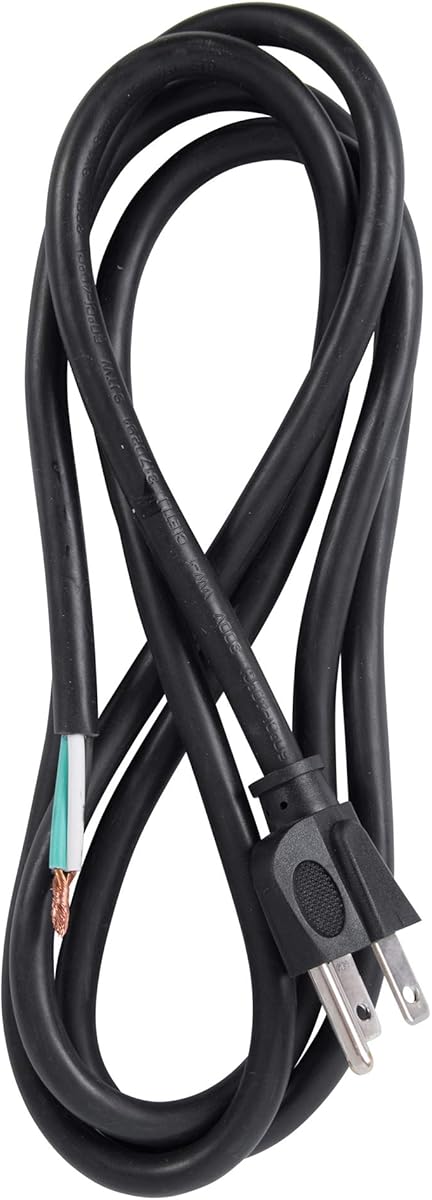
The Eastman 3-Prong Electric Range Cord, model 61269, is a 40-amp, three-wire range replacement with a 4.7 rating. It is six feet long, finished in gray, and rated for 125/250 volts. Its stated prong configuration is compatible with most major electric range brands, which makes it a straightforward option for the appropriate three-prong installation.
We may earn a commission when you buy through this link, at no additional cost to you.
The conductor arrangement consists of two 8-gauge wires and one 10-gauge wire. Eastman explains that the middle conductor is neutral and the two outside conductors are hot, giving buyers a clearer understanding of the three-wire layout. The cord is UL listed, and its stated design resists kinking and damage. It also includes strain-relief features intended to protect the terminal end.
The decisive issue is that this is a three-wire cord. It is appropriate for a range and outlet designed around that configuration, but it is not interchangeable with a four-prong cord. A modern installation should not have its grounding arrangement bypassed simply to make a three-prong product fit. If the existing outlet has four openings, the appliance requirements and local code should guide the decision.
For a compatible three-prong range, this Eastman cord offers a balanced combination of length, rating, conductor size, and stated range compatibility. It is also our value-focused pick because it fulfills the core range-cord role without adding a specialized premium feature. The best approach is to confirm the model, outlet, circuit, and terminal configuration before ordering.
The product information identifies the center wire as neutral and the outer wires as hot. Recognizing those roles is useful when a buyer needs to explain what configuration is already present in the range and outlet.
The six-foot length is longer than several four-foot OEM options in this guide. It can offer more room to position the appliance, although the cord must still be installed without sharp bends, pinching, or strain at the connection.
We may earn a commission when you buy through this link, at no additional cost to you.
The Cable Matters 4 Prong to 4 Wire Range Cord stands out with a ten-foot length and support for 30-, 40-, and 50-amp range outlets. It has a 4.7 rating, a straight-blade NEMA 14-50 plug, and 6 AWG plus 8 AWG conductors. Those are substantial specifications for a replacement cord intended for modern ovens and ranges.
We may earn a commission when you buy through this link, at no additional cost to you.
The stated compatibility covers major appliance brands including GE, Whirlpool, KitchenAid, Samsung, Frigidaire, and Kenmore. Ring terminals are provided for the appliance connection, while strain-relief brackets add support near the terminal block. The SDRT cable jacket is described as insulated thermoplastic construction rated up to 300 volts and 140 degrees Fahrenheit.
There is one important exclusion: the manufacturer says this cord is not for an L14-30 twist-lock or a three-prong 10-50 configuration. It is also not a universal solution for every high-current outlet, despite supporting several amperage levels. The wall receptacle, circuit, range, and terminal arrangement all need to align, and the product should not be used to alter an outlet or adapter configuration.
This is the premium pick for buyers who want a long cord, a 50-amp plug, and heavy conductors in one package. The ten-foot length is particularly helpful when the outlet is far from the desired range position, though it can be unnecessarily long for a tight installation. It is best for a standard four-wire, straight-blade NEMA 14-50 setup and not for twist-lock or three-prong range connections.
A ten-foot lead can make a relocated outlet unnecessary in some kitchens. It also gives an installer room to avoid an abrupt bend near the plug, provided the cord is routed safely and remains accessible for inspection.
The 6 AWG and 8 AWG conductor combination is the cord’s defining heavy-duty feature. Ring terminals and strain-relief brackets support installation, but the terminal arrangement still must match the appliance and be attached according to the range’s wiring guidance.
We may earn a commission when you buy through this link, at no additional cost to you.
The GE WX09X10007 is a five-foot, 40-amp, three-wire electric range cord with a 4.5 rating. It features a right-angle plug, UL listing, and wiring described by the manufacturer as 99.9 percent pure copper. The product is positioned as compatible with GE appliances, Whirlpool, LG, Samsung, and most major appliance brands.
We may earn a commission when you buy through this link, at no additional cost to you.
Five feet offers a middle ground between the shorter four-foot OEM leads and the longer six- and ten-foot options. Its right-angle plug allows the range to sit closer to the wall, potentially improving clearance in a narrow kitchen. The stated heavy-duty construction and UL listing support its use as a range-level replacement rather than a general appliance lead.
As with other three-wire cords, the missing conductor count is the primary constraint. It must match a three-prong outlet and a range designed for three-wire connection. The broad compatibility statement does not remove the need to inspect the terminal block, confirm the model, and ensure the circuit and receptacle are appropriate.
GE WX09X10007 is a good fit for a buyer who wants a right-angle plug, a moderate length, and stated compatibility across many range brands. It is less appropriate for a four-prong installation or an outlet positioned too far away for five feet. Checking the existing cord and outlet before purchase is the simplest way to avoid an incompatible configuration.
A right-angle plug projects less deeply from the receptacle than many straight plugs. That can create useful wall clearance and make a five-foot cord more practical in a narrow kitchen.
The stated 99.9 percent pure copper construction is intended to support consistent conductivity. Buyers should still judge the complete cord by its amperage, conductor count, insulation, certification, and fit rather than by one material claim alone.
We may earn a commission when you buy through this link, at no additional cost to you.
The GoGreen Power GG-27206 is a six-foot, four-wire range cord with a stated 50-amp maximum and a 4.5 customer rating. It uses 8/2 SRDT cable, is cETL listed, and is described as suitable for heavy-duty equipment up to 125/250 volts. Its length offers a useful balance between positioning flexibility and manageable cable size.
We may earn a commission when you buy through this link, at no additional cost to you.
The product description calls out a three-prong grounded plug and four terminal points at the appliance end. This can sound contradictory beside the four-wire description, so careful attention to the actual conductor arrangement and wall-plug configuration is essential. A range cord must connect to the correct wall receptacle without any improvised adapter or altered grounding path.
Its stated range use, 50-amp capacity, and four-terminal appliance connection make it relevant to modern high-current installations. However, compatibility cannot be determined by amperage alone. The range’s model, existing terminal layout, outlet type, circuit rating, and local electrical requirements all have to be considered before installation.
GG-27206 is a compelling option for a compatible four-wire, three-prong wall connection and a six-foot lead. It is less suitable for a four-prong wall outlet, an L14-30 twist-lock system, or any appliance whose terminal design does not match. The product is also manufactured in China and Vietnam, and the manufacturer provides recycling instructions on the packaging for buyers who want disposal information.
The stated 8/2 SRDT cable is the defining feature for buyers prioritizing current capacity and a heavy-duty profile. Its suitability still depends on matching the wall receptacle, range terminals, and circuit.
Six feet allows more positioning room than a four-foot cord without adding the extra length of a ten-foot lead. It may be a practical fit for a range that must stand slightly away from the outlet.
We may earn a commission when you buy through this link, at no additional cost to you.
The Supplying Demand 10 Foot Range Electrical Power Cord is a long three-prong replacement with a 4.8 rating. It measures 120 inches, is rated for 50 amps at 250 volts, and uses 6/2 and 8/1 gauge wires. Strain relief is included, adding support at the cord connection.
We may earn a commission when you buy through this link, at no additional cost to you.
The most obvious advantage is reach. A ten-foot lead can accommodate a range positioned farther from its outlet, particularly in rooms where rearranging the kitchen or adding a new receptacle is undesirable. Its stated 50-amp rating also makes it relevant for high-current range equipment, subject to the outlet and circuit agreeing with that capacity.
The manufacturer says its replacement parts are compatible with major brands but explicitly recommends verifying fitment for the specific model. That qualification matters for every range cord, especially one that must connect to appliance-side terminals. The three-prong wall configuration also rules it out for a four-prong outlet unless the entire electrical arrangement is appropriately designed and verified by a professional.
This cord is best for a compatible three-prong setup where long reach is the priority. Its 4.8 rating supports confidence in customer satisfaction, but ratings cannot establish electrical compatibility. Confirm the terminal design, conductor routing, outlet rating, circuit rating, and installation instructions before connecting the cord.
The 120-inch length is the standout feature. It offers considerable flexibility when the existing outlet is far from the range, though the cord should be routed to avoid damage and remain serviceable.
Included strain relief and the stated 6/2 and 8/1 wire combination support a heavy-duty installation. The appliance-side connection must still match the range and be completed according to its wiring diagram.
We may earn a commission when you buy through this link, at no additional cost to you.
The GE WX9X6 is a four-foot, three-prong range cord rated for 40 amps. It has a 4.1 customer rating, the lowest among the ten products reviewed, and its listed information is concise: four feet, three wires, and universal fit. It is a traditional range-cord format rather than a general appliance cord.
We may earn a commission when you buy through this link, at no additional cost to you.
A four-foot length works well when the wall outlet is directly behind or close to the range. The 40-amp rating corresponds with a common residential range-circuit capacity, while the three-prong plug and three-wire construction suit a compatible older-style connection. The product may be attractive to buyers who recognize the GE part number from their existing appliance.
The limited description leaves fewer details for comparison than most other products in this guide. It does not provide a long wire-gauge description, certification statement, terminal specification, or broad brand list in the supplied information. As a result, fit should be established from the existing cord, the appliance model, and the outlet rather than inferred from the word universal.
GE WX9X6 is a practical candidate for a compatible three-prong range with a nearby outlet. Its compact length can simplify a tight installation, although it offers little margin if the range must sit farther forward. Given the range of information provided, buyers should verify the model, conductor arrangement, circuit, and terminals before installation.
Four feet is most useful when the outlet and range are close together. It can reduce excess cable behind the appliance, but it leaves little room for repositioning the range away from the wall.
The supplied specifications are limited, making the original part number and existing connector arrangement especially important. A visually similar three-prong plug does not automatically confirm that the appliance-side cable is compatible.
We may earn a commission when you buy through this link, at no additional cost to you.
A compatible range cord must satisfy several linked requirements at once: the appliance connection, wall-plug format, conductor count, amperage, voltage, wire size, and circuit capacity. Comparing those details before shopping helps prevent an otherwise attractive cord from becoming an unsafe or incompatible purchase.
The wall plug must physically and electrically match the existing outlet. The range options in this guide include three-prong and four-prong configurations, along with products designed for straight-blade NEMA 14-50 service. Some are not compatible with an L14-30 twist-lock outlet, and a plug that merely fits the opening does not prove that the conductor arrangement and current rating are appropriate. Examine the receptacle, identify its configuration, and confirm the range manufacturer’s required supply before selecting a cord.
Three-wire and four-wire range cords serve different electrical arrangements. A four-wire cord commonly provides separate hot, neutral, and ground conductors, while a three-wire cord uses a different conductor scheme. The terminal block at the range must accept the cord’s conductors, and changing configurations by improvising connections can defeat grounding or create other hazards. Use the model number, existing cord, and appliance wiring diagram to establish the required conductor count rather than guessing from the outlet alone.
Range circuits commonly use higher current than ordinary household appliance outlets, and many range cords in this list are rated at 40 or 50 amps. The cord’s rating should be appropriate for the range and consistent with the branch circuit. A lower-rated general appliance cord, including the 15-amp NEMA 5-15 product reviewed here, is not a range substitute. A higher cord rating also does not authorize installing a heavier cord on a circuit that cannot support it.
Wire gauge affects the cord’s current-carrying capacity and physical heft. The options use combinations such as 8 and 10 AWG, 6 and 8 AWG, 8/2, 6/2 and 8/1, and 14/3. Lower numerical gauge numbers generally indicate heavier conductors, while the compound designations describe complete cable constructions. A range cord should not be substituted with a visibly thinner lead merely because the plugs or appliance ends appear alike.
The reviewed lengths range from four feet to ten feet. Four-foot cords suit ranges installed close to the outlet, six-foot cords offer additional placement flexibility, and ten-foot cords can reach a more distant receptacle. Longer is not automatically better: excess cable must still be routed safely behind the appliance without kinks, pinching, or strain. Measure the available distance and consider the range’s final position before choosing.
A straight plug projects outward from the receptacle, while a right-angle plug can let the range sit closer to the wall. The Whirlpool PT220, GE WX09X10007, and several other listed cords feature right-angle designs. This is useful in tight kitchens, but clearance alone does not determine compatibility. The plug type, rating, and conductor arrangement must still match the installation.
The range end of the cord may use ring terminals, a three-ring connector arrangement, or another appliance-specific connection. A universal wall plug does not guarantee that the terminal end will attach correctly. Compare the original cord, the number and type of terminals, the range model, and the manufacturer’s wiring diagram. If the existing terminal arrangement is unclear or has been altered, a qualified technician can identify the proper connection before the new cord is installed.
UL listing is stated for multiple options, while the GoGreen Power cord is described as cETL listed. Certification, strain relief, kink resistance, and jacket construction all contribute to a safer installation, but they do not eliminate the need to match electrical specifications. Look for products with clear certification information and documented conductor sizes, then avoid modifications, exposed splices, adapters, or improvised strain relief.
Begin by disconnecting the range from its electrical supply and confirming that the power source is safely off before touching the appliance connection. Remove the old cord only after identifying its conductor layout and checking the range model, replacement instructions, and local electrical requirements. Never remove or bypass grounding conductors to make a connector fit, and never assume a plug that physically enters an outlet is electrically compatible.
Connect the replacement cord exactly as directed by the appliance manufacturer. Match each conductor or ring terminal to the proper connection on the range, restore strain relief and any terminal cover, and ensure the cable is not pinched by the range housing. At the wall, insert the plug fully into a correctly configured and suitably rated outlet without using an adapter that changes the plug or grounding arrangement.
Route the cord so it is not compressed behind the range, exposed to a sharp edge, or placed where it could be walked on or pulled. Inspect it periodically for cracking, discoloration, damaged insulation, loose connections, or heat marks. Replace a damaged cord rather than repairing the insulation with tape or an unauthorized connector, and arrange professional service if the outlet, plug, wiring, or range terminals show damage.
Start with the range model number, the original part number, and the wall outlet configuration. The appliance should specify whether it needs a three-wire or four-wire cord, while the outlet and circuit must agree on amperage and plug type. Terminal style and conductor routing also matter, so the wiring diagram or manufacturer support is more reliable than appearance alone.
No. A three-prong plug cannot be inserted into a four-prong receptacle, and removing the grounding pin or altering the outlet to accommodate it is unsafe. A four-wire connection requires a cord and installation designed to provide the proper grounding path under applicable electrical requirements.
That depends on the range’s required cord and circuit arrangement, not only on the outlet amperage. A 50-amp receptacle normally requires a cord and conductors rated for that service, while the range manufacturer generally specifies the required supply. Have a qualified electrician confirm the circuit and any receptacle or plug changes.
The 14/3 AWG NEMA 5-15 cord in this guide is rated for 15 amps and 1,875 watts, which is not adequate as a range supply. Its durable SJTW construction makes it appropriate for supported tools, motors, and household appliances, but an electric range requires a high-current cord and matching dedicated circuit.
Measure from the wall outlet to the intended range position, allowing enough slack for installation without sharp bends. Four-foot cords suit close installations, while six- and ten-foot cords provide more positioning flexibility. The cord should not be stretched, kinked, pinched, or routed where it can be damaged.
An OEM cord can be advantageous when its part number and terminal arrangement exactly match the range. A well-specified universal cord can also be appropriate for a compatible installation, provided its plug, conductor count, wire size, amperage, voltage, and terminals all align. Never choose an OEM or universal label as a substitute for checking specifications.
Replacing a cord can involve high-current wiring at both the appliance and outlet, and mistakes may create shock, fire, or grounding hazards. A DIY installation is appropriate only if you understand the appliance wiring, local requirements, and the correct connection method. Otherwise, have a qualified electrician or appliance technician perform the work.
Disconnect it from the power supply and do not energize the range with a cracked, scorched, melted, or frayed cord. Inspect the plug, outlet, terminal block, and wiring for heat damage, because a failed cord can indicate a larger electrical issue. Replace the cord only after those components have been checked and the required connection has been confirmed.
The Eastman 6 Feet Electric Range Cord is the strongest all-around choice for a compatible four-prong, 40-amp installation because it combines a six-foot length, heavy conductors, broad stated compatibility, UL listing, and a 4.8 rating. The Eastman 3-Prong model is the value-focused option for an appropriate three-wire setup, while the Cable Matters cord is the premium choice for a 50-amp straight-blade configuration that benefits from its ten-foot reach.
The most important buying priority is not length or appearance but exact electrical agreement. Match the range model, appliance-side terminals, conductor count, wall plug, outlet type, amperage, voltage, wire gauge, and circuit. A cord should never be adapted to fit an incompatible outlet, and grounding conductors should never be removed, bypassed, or improvised.
Finally, confirm the current product details and marketplace pricing before ordering, since ratings, listings, and costs can change. If the existing outlet or appliance connection is damaged, or if there is any uncertainty about the required configuration, have a qualified electrician verify the installation before the replacement cord is connected.