
UGREEN Nexode 25000mAh 200W PD 3.1 TFT 3-Port Power Bank
4.3Editor score
200W combined output
Up to 140W per port
Detailed TFT display
Three-device charging
Discover the best high wattage power bank options by comparing capacity, laptop charging, ports, displays, portability, and travel readiness.
A high wattage power bank is built for more than topping up a phone. It can keep demanding laptops, tablets, cameras, and other USB-C devices running when a wall outlet is unavailable, making it especially valuable for travel, remote work, and long outdoor trips.
We compared all ten featured models by examining rated output, port selection, battery capacity, charging speed, displays, built-in cables, and practical travel considerations. The list covers compact laptop chargers, larger high-capacity banks, multi-port models, and a rugged ground-use option.
Each pick highlights a distinct balance of power and portability, from budget-friendly daily backups to premium models capable of serious multi-device output. Specifications and availability can change, so readers should confirm current details and prices with the retailer before purchasing.
4.3Editor score

4.6Editor score

4.3Editor score
This side-by-side comparison highlights the major differences in output, capacity, charging flexibility, displays, and travel suitability across all ten featured high wattage power banks.
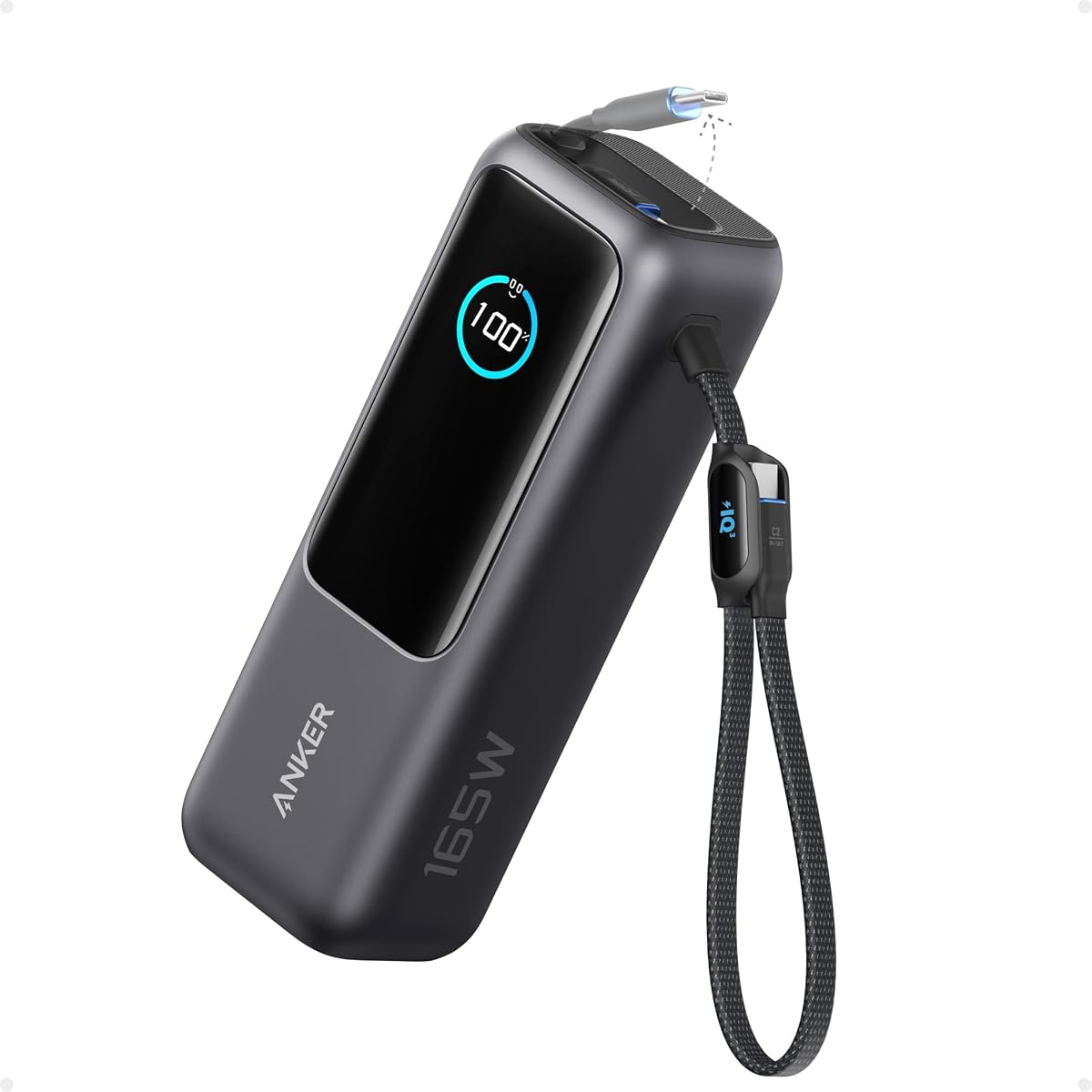


The Anker Laptop Power Bank combines 25,000mAh of capacity with 165W of aggregate output, giving it a notably balanced profile for travelers and remote workers. Its 4.4 rating reflects a broadly positive customer reception, while the standout attraction is the unusual presence of three USB-C ports that can each reach 100W.
We may earn a commission when you buy through this link, at no additional cost to you.
The built-in cable arrangement adds real convenience for travel. One retractable USB-C cable extends up to 2.3 feet and is rated to withstand 20,000 retractions, while a shorter 0.98-foot cable doubles as the carrying strap and is designed to tolerate more than 20,000 bends. That means a user can charge compatible USB-C devices without packing a separate cable, then attach the bank more securely to a bag.
Four devices can charge simultaneously through the dual built-in USB-C cables, a USB-A port, and another USB-C port. The bank can also recharge rapidly when connected to a 100W-or-higher charger. At the same time, its stated 100Wh compliance makes it suitable for airline carry-on use, subject to each carrier's current rules. The protective pouch and 18-month warranty round out the package.
Its main limitation is that three 100W ports and a 25,000mAh battery produce a relatively substantial unit. It also lacks the detailed display found on several premium competitors, so users must estimate remaining capacity indirectly. Even so, it offers one of the strongest combinations of laptop power, port flexibility, and travel-friendly convenience in this group.
This is the strongest overall choice for someone who regularly carries a laptop and several smaller devices, values a high-output USB-C port, and prefers built-in cables to loose accessories. It is especially useful for long-haul travel, remote work, and shared charging situations where one person needs to keep multiple devices operating.
With three 100W USB-C ports, the bank can serve demanding notebooks while also leaving capacity for phones, tablets, and accessories. The three independent 100W connections are particularly useful for travel desks where several devices may need power at the same time.
The retractable cable and strap-style short cable reduce cable clutter while making the bank easier to carry. Their stated bend and retraction endurance figures also address two common weak points in compact travel accessories.
We may earn a commission when you buy through this link, at no additional cost to you.
The UGREEN Nexode 145W is a compelling high wattage power bank for buyers who want laptop-class charging without moving to the most expensive models. Its 4.3 rating indicates solid customer reception, and the combination of 25,000mAh capacity, 145W total output, and a 140W maximum on USB-C1 supports demanding devices.
We may earn a commission when you buy through this link, at no additional cost to you.
PD3.1 and QC3.0 protocols enable fast charging across a broad device range. The listed compatibility includes MacBook, Dell XPS, HP Spectre, iPad, several iPhone generations, Galaxy S24, Switch, DJI products, and Steam Deck. UGREEN states that a 16-inch MacBook Pro can charge from 0% to 56% in 30 minutes under compatible conditions.
A digital display provides an at-a-glance view of remaining battery, and the two-way fast recharge design can replenish the bank while it is also charging a connected device. With a 65W PD charger, the battery can recharge in about two hours. A 20W adapter is reported to take up to six hours, so the charger used can materially affect downtime.
Achieving full performance requires a 65W-or-higher charging adapter and the included 5A USB-C cable or another certified 5A cable. Neither a wall adapter nor a laptop itself is included. Those requirements are reasonable for high-power charging, but they add preparation and may matter to travelers who want the smallest possible accessory bundle.
This is the best budget-oriented entry in the guide for anyone who needs credible laptop charging, three USB-C ports, and useful status information at a relatively accessible cost point. It is less suitable for people who need two simultaneous high-wattage laptops, extremely quick battery replenishment, or app-based power controls.
A 140W maximum on USB-C1 is enough to target demanding notebooks, while the 145W aggregate rating provides useful headroom for mixed charging. It offers a practical middle ground between ordinary travel banks and ultra-high-output professional models.
Full speed depends on a certified 5A cable and an appropriate PD charger. Keeping that cable accessible and selecting a sufficiently powerful adapter will prevent a portable reserve from becoming a slow emergency top-up.
We may earn a commission when you buy through this link, at no additional cost to you.
The UGREEN Nexode 200W TFT is built for users who need meaningful output from several connected devices at once. It has a 4.3 rating and combines 25,000mAh capacity with as much as 200W aggregate output. USB-C1 can deliver up to 140W, USB-C2 up to 100W, and the total reaches 200W when both are used together.
We may earn a commission when you buy through this link, at no additional cost to you.
That output makes it relevant to photographers, videographers, designers, and gamers who may carry more than one demanding device. It can charge three devices simultaneously, allowing a laptop, phone, and accessory to share the reserve. The headline output is total power rather than a guarantee that every port will always provide its individual maximum at the same time.
One of its most useful features is the color TFT display. It presents battery level, remaining time, input and output power, voltage, current, and other information with more detail than a simple numerical battery indicator. This helps users judge whether a device is receiving meaningful power and plan charging before the bank becomes depleted.
UGREEN states that the internal capacity remains above 80% after 1,000 charge-discharge cycles. The enclosure also includes multiple protections, real-time temperature detection, and heat dissipation features. These specifications address longevity and safety, although the larger form factor and lack of an explicit under-100Wh flight rating make it less convenient for air travel than several alternatives.
This premium model is a strong match for content professionals, power users, and anyone who values exact charging information. Choose it when simultaneous high-output charging and a detailed display matter more than compact size or straightforward airline carry-on approval. Users who travel frequently by air may prefer a more compact under-100Wh design.
Showing watts, voltage, current, remaining time, and battery status gives users a clearer picture than a four-LED indicator. It is particularly helpful when comparing several devices or deciding when to conserve the bank for a laptop.
The 140W and 100W USB-C connections can support a demanding primary device while another port serves a secondary one. A third port expands the bank into a practical shared charging station for workdays or group trips.
We may earn a commission when you buy through this link, at no additional cost to you.
The Anker Prime 300W is the most powerful model in this guide by aggregate output, pairing a 26,250mAh battery with up to 300W across two USB-C ports and one USB-A port. Its 4.6 rating reflects strong customer reception, while the output rating makes it suitable for professional equipment and two demanding laptops.
We may earn a commission when you buy through this link, at no additional cost to you.
Individual USB-C output reaches 140W when used with a 5A cable. Anker reports that a MacBook Pro with the M4 Pro can charge from zero to 50% in 27 minutes and an iPhone 16 Pro can reach 50% in 26 minutes. Its 300W total output is also presented as capable of keeping two MacBook Pro systems running at full speed under compatible conditions.
Recharging is a major strength. The 250W dual-port input can bring the bank to 50% in 13 minutes or 40% in 10 minutes according to internal testing. A smart display and companion app provide charging details, while the app can manually adjust output power. The package includes a 3.3-foot 240W USB-C cable and a travel pouch.
The 99.75Wh rating places it below the common 100Wh airline threshold and is described as TSA-approved, though travelers should still confirm airline rules. It is also not compatible with Starlink mini. These limitations are narrow, but they should be considered for specialized equipment or particular travel itineraries.
This is the pick for power users who want the highest aggregate output in the group, rapid self-recharging, and app-level control. It is especially compelling for creative professionals, mobile workstation users, and anyone running multiple laptops. Buyers who only need a lightweight phone backup will find its capacity and dimensions unnecessary.
At 99.75Wh, the battery remains below the stated 100Wh airline threshold while offering enough reserve for substantial device use. It therefore serves as more than an emergency phone charger for travelers who need laptop support away from an outlet.
The 250W dual-port input is unusually quick for a battery of this size. Users can restore a meaningful portion of the reserve during a coffee stop, layover, or short work break, provided they use suitable charging equipment.
We may earn a commission when you buy through this link, at no additional cost to you.
The Anker 20,000mAh Travel Essential is a more compact option that still crosses into high wattage territory. Its 87W total output can be distributed across three devices, with one device receiving up to 65W. A 4.5 rating makes it one of the better-rated products in the collection.
We may earn a commission when you buy through this link, at no additional cost to you.
Its integrated USB-C cable is the central convenience. The cable is stated to withstand more than 10,000 bends, reducing the chance of carrying a separate lead that might be lost or damaged. A listed size of 6.2 by 2.9 by 1.0 inches and weight of 15.5 ounces reinforce its travel-oriented positioning.
Performance claims focus on mixed-device use. A 14-inch MacBook Pro can reach 50% in under 40 minutes, while the built-in cable is reported to charge an iPhone 15 Pro to 58% or a MacBook Air to 52% in 30 minutes. With a 65W charger, the bank itself can fully recharge in approximately 1.5 hours.
The 20,000mAh capacity is smaller than the 25,000mAh to 27,600mAh batteries offered by many competing models, and 87W is modest beside 145W, 200W, and 300W options. That makes it better for a phone, tablet, and lightweight notebook than for sustained charging of two power-hungry laptops.
This model suits travelers who value simplicity and reduced cable clutter more than maximum output. It is a strong secondary laptop reserve for short trips, and its 20,000mAh capacity is described as airline approved. For heavy professional workloads, a higher-output model offers more flexibility.
The built-in USB-C lead eliminates the most common packing problem with portable chargers. It can be extended when needed and stored neatly against the body, making it convenient for quick top-ups at an airport, office, or campsite.
Up to 65W for one device and 87W across three outputs covers phones, tablets, and many ultraportable notebooks. The 20,000mAh capacity makes it a practical focused reserve rather than a full-day power station.
We may earn a commission when you buy through this link, at no additional cost to you.
The Liahomco 80,000mAh model offers an enormous stated capacity for situations where many small devices need prolonged support. It carries a 4.4 rating and is designed around phones, tablets, cameras, handheld consoles, fans, speakers, and other 5V USB devices rather than notebooks.
We may earn a commission when you buy through this link, at no additional cost to you.
Its charging hardware includes two 30W USB-A outputs, two 15W USB-A outputs, and a 20W USB-C output, allowing five devices to charge at once. Input is provided through a Micro-USB port at 18W and USB-C at 18W. PD and QC3.0 protocols are supported, and the stated smartphone charging figure reaches 60% in 30 minutes.
Physical design favors outdoor and group use. Textured side grips help prevent slipping, a non-slip pad supports upright placement, and the rubber lanyard can attach to backpack straps, tent hooks, or hanging rings. A digital display reports remaining power, which is useful when planning a long trip or outage.
The multi-protection system is listed as covering overheating, overcharging, overcurrent, over-discharge, and short-circuit conditions. Nevertheless, the product is explicitly not compatible with laptops. Its 80,000mAh capacity also places it far above normal airline limits, so it is better suited to road travel, camping, and ground-based emergency reserves.
Choose this bank for extended outdoor access to many low-power devices rather than laptop charging. It is a specialist capacity option with broad port compatibility and practical outdoor details. If your primary device is a notebook, choose one of the 65W or higher models instead.
The stated ability to provide numerous smartphone or tablet charges makes the bank useful for camping, long road journeys, and outages. Its five outputs reduce the need to rotate devices through a single port during a busy trip.
Grippy surfaces, a non-slip base, a lanyard, and a port cover are practical additions for outdoor use. The cover helps keep dust and sand away from connections, while the display helps users ration a large reserve.
We may earn a commission when you buy through this link, at no additional cost to you.
The NOBIS 187W combines 25,000mAh capacity with a 187W peak total output and a high-resolution TFT screen. Its 4.6 rating places it among the strongest customer-rated options here. It is designed for users who want granular charging information and control rather than a simple battery percentage.
We may earn a commission when you buy through this link, at no additional cost to you.
Two USB-C ports and one USB-A port provide maximum outputs of 100W, 65W, and 22.5W. The independent output architecture is intended to provide stable charging without voltage drop, speed reduction, or interference between connected devices. That makes the bank appropriate for a demanding primary device alongside phones, tablets, or accessories.
The screen shows battery level, remaining time, and input or output power, with adjustable brightness. NOBIS's app adds detailed metrics, battery-health information, and controls for distributing up to 187W of power. With a 100W-or-higher PD charger, the bank can recharge itself in about 45 minutes, though the appropriate charger is not listed as included.
A detachable USB-C-to-USB-C cable is incorporated into the carrying strap and supports both input and output. This reduces the need to carry a dedicated cable while giving users a longer connection when required. The stated design is comparable in size to a 550ml water bottle, balancing portability with substantial power.
This is a compelling choice for technical users and professionals who value app control, detailed telemetry, and high output across three ports. The need to use the app for some functions may be less appealing to buyers who prefer a simple standalone device, and the supplied information does not explicitly identify the model as airline approved.
The combination of a high-resolution display and app metrics gives users more control than conventional LED indicators. Battery health, live power, and distribution settings can help extend the useful life of both the bank and connected devices.
Separate maximum ratings allow a high-demand USB-C device to operate alongside lower-powered accessories. The stated design avoids mutual interference, which is useful for creative workdays and travel groups with mixed charging needs.
We may earn a commission when you buy through this link, at no additional cost to you.
The Anker Prime 220W has the highest customer rating in the collection at 4.7. It combines 20,100mAh of capacity with 220W total output across two USB-C ports and one USB-A port, delivering a strong combination of portability, charging speed, and customer satisfaction.
We may earn a commission when you buy through this link, at no additional cost to you.
A USB-C connection can provide up to 140W when paired with a 5A cable. Anker reports that this can charge a 16-inch MacBook Pro with the M4 Pro from zero to 50% in 28 minutes under internal testing. The 220W aggregate output is intended to keep an office setup running when several devices need power.
The 20,100mAh battery is rated at 72.36Wh and described as TSA approved, leaving more room under the common 100Wh airline threshold than the larger 26,250mAh Anker Prime. Recharging reaches 50% in 25 minutes with a 100W maximum USB-C input, making it convenient to restore during a short break.
The package includes a 3.3-foot 240W USB-C cable, a travel pouch, a welcome guide, and a 24-month warranty. A wall charger is not listed among the included items. The 20,100mAh capacity also provides less total energy than the 25,000mAh and 27,600mAh alternatives in this guide, which may matter for all-day or multi-day laptop work.
This is the top pick when customer rating, travel-friendly dimensions, and strong laptop output are the main priorities. It is well suited to business travel and mobile offices that need one dependable bank for a notebook plus smaller devices. Users who need maximum stored energy may prefer the 26,250mAh version of the Prime.
The 72.36Wh rating provides a comfortable margin below 100Wh while preserving 140W single-device charging. It is a balanced option for travelers who prioritize manageable size and fast laptop recovery.
A 100W input can restore half the bank in 25 minutes. That makes airport layovers and short work breaks enough time to prepare the unit for another period of mobile work.
We may earn a commission when you buy through this link, at no additional cost to you.
The 65W 40,000mAh Laptop Portable Charger is a substantial ground-use option with a 4.4 rating. Its 65W maximum output is capable of supporting a laptop when connected through a single port, while its 40,000mAh capacity provides more stored energy than most airline-friendly alternatives in this guide.
We may earn a commission when you buy through this link, at no additional cost to you.
The total rating is 154Wh, which exceeds the standard 100Wh airline limit, and the product is explicitly designed for ground use rather than air travel. Multi-port use activates smart power allocation, meaning users should not expect 65W from every connection at once. A five-amp USB-C cable with an E-Marker chip is required for full speed.
Physical durability is a major selling point. The impact-resistant shell surrounds an integrated handle, while a silicone cover shields the ports from dust and sand. The exterior is splash resistant but not submersible, making it suitable for road trips, job sites, and outdoor work where some weather exposure is likely.
An integrated LED flashlight offers three brightness levels and a seven-color ambient mode. The unit is also compatible with Steam Deck and ROG Ally, though output is reduced when the remaining capacity falls below 40%. This makes the bank useful for gaming accessories as well as notebooks.
This is a practical choice for people who need a large energy reserve, sturdy construction, and moderate laptop charging away from aviation constraints. It is not the right choice for flights, travelers who need to remain under 100Wh, or buyers who expect unrestricted 65W output while several devices are connected.
The impact-resistant shell, port cover, and splash-resistant finish are designed for outdoor work and travel where fine dust or occasional moisture may be present. The handle also makes the larger battery easier to transport.
The built-in flashlight adds practical value in outages, campsites, and roadside situations. Multiple brightness levels improve usefulness, while the ambient lighting mode offers a separate recreational function.
We may earn a commission when you buy through this link, at no additional cost to you.
The AOHI Future Starship combines the largest capacity in the collection with very high aggregate output. Its 27,600mAh battery is rated at 99.36Wh, placing it just below the stated 100Wh limit for airline carry-on use. It also offers 240W total output through dual USB-C and one USB-A port.
We may earn a commission when you buy through this link, at no additional cost to you.
USB-C1 can deliver up to 140W, while USB-C2 can provide up to 100W, allowing two laptops to charge under compatible conditions. The USB-A port supports up to 22.5W. AOHI states that a 16-inch MacBook Pro can charge from zero to 50% in 28 minutes, which makes the bank relevant to mobile professional workstations.
Both USB-C ports support up to 140W input or output, and the bank can recharge to 50% in around 30 minutes with a suitable 140W USB-C cable. That cable is included in the bottom of the packaging foam. The real-time digital display reports remaining capacity and active input or output power.
A three-stage LED charging indicator provides at-a-glance status through amber breathing, blue solid, and green solid modes. The battery uses automotive-grade cells, is stated to last beyond 1,000 charge cycles, and is protected by temperature control, heat dissipation, and 15 layers of built-in safety protection.
This model is ideal for travelers who need nearly the maximum flight-compatible capacity alongside enough output for a laptop and secondary devices. Its primary disadvantage is physical size: 27,600mAh is a large battery, so buyers should consider the weight of carrying it. It is a strong option for long-haul travel and high-output mobile work.
At 99.36Wh, the battery approaches the commonly cited 100Wh airline limit while retaining a large 27,600mAh capacity. This makes it one of the most travel-friendly options for users who need more stored energy than a typical compact bank.
Support for 140W input and output means the same high-rate USB-C connections can refill the bank or charge a device. This flexibility simplifies packing and helps reduce downtime between demanding work sessions.
We may earn a commission when you buy through this link, at no additional cost to you.
Choosing a high wattage power bank requires balancing stored capacity, usable output, device compatibility, recharge speed, and the physical limits of carrying extra battery weight. The following factors help narrow the field before you buy.
A large total wattage figure is only part of the story because the power bank must also allocate that output among connected devices. A model may advertise 200W or 300W across all ports while providing only 100W or 140W from any one connection. Check both numbers when a laptop will be charged alongside a phone, tablet, or second notebook. PD3.1 models commonly advertise high single-port output because demanding notebooks require more than the 100W offered by many conventional chargers.
Choose based on the most demanding device you intend to power, not only the headline total.
Capacity is measured in mAh, but watt-hours provide a more useful comparison when voltage and product design differ. A 20,000mAh unit may be sufficient for phone top-ups and shorter laptop sessions, while 25,000mAh to 27,600mAh models offer a larger reserve for long flights. The 80,000mAh model in this guide stores far more energy but is not intended for laptops or air travel. Consider how many devices you need to support and how long they must remain away from an outlet.
More capacity improves endurance but also increases weight, bulk, and charging time.
Many airlines use a 100Wh ceiling for portable batteries, and some carriers apply lower limits or additional approval procedures. Models explicitly rated below 100Wh, such as the 20,100mAh, 25,000mAh, and 27,600mAh options here, are more suitable for flights. Products above 100Wh should generally remain on the ground. Even within the limit, travelers should verify their airline's current policy and carry the battery in the required location.
Never assume that a high wattage output rating overrides the airline's energy limit.
USB-C is essential for modern laptops, but the number of USB-C and USB-A ports determines whether the bank can serve several devices at once. Look for PD3.1, PD, and QC compatibility when your equipment includes different manufacturers. Some portable gaming systems require reduced output or a particular connection mode, while high-end laptops may need a 5A USB-C cable for the stated maximum speed. The included cable and its rating should be checked before relying on a headline wattage.
Match connector shape, protocol, and cable requirements to every priority device.
A powerful output is only useful if the bank itself can be restored reasonably quickly. Input ratings range from 18W on the high-capacity outdoor model to 250W dual-port input on the 300W Anker Prime. Fast input allows meaningful recovery during a layover, lunch break, or work interval. A suitable wall charger and capable cable are usually required, and adapters are generally not included. Full-bank recharge time can remain long even when the input rate looks impressive because the final portion of charging is controlled more conservatively.
Prioritize strong input when you recharge the bank during short travel stops.
A simple percentage display confirms remaining capacity, while a detailed TFT screen can show live input and output power, voltage, current, and remaining time. That extra information helps users decide which device to connect and whether a cable is delivering the expected rate. App support can add battery-health monitoring and manual output controls, but it creates a dependency on compatible software. Buyers who value immediate standalone information should favor a display, while minimalist users may prefer a simpler bank.
More detailed readouts are useful for power users and troubleshooting.
Integrated cables reduce packing clutter and help prevent a lost or damaged lead. Retractable designs improve portability, and a cable that doubles as a strap can make a large bank easier to carry. However, built-in cables cannot always support the highest output, and proprietary or unusual connectors remain necessary for some older devices. A removable 5A or 240W-rated cable is valuable when maximum laptop charging matters. Check whether a pouch, wrist strap, or high-speed cable is included.
Choose integrated cables for convenience and removable cables for flexibility.
A bank that supports a notebook and several devices will usually be larger than a phone-only model. The 80,000mAh and 40,000mAh options are particularly heavy, while the 20,000mAh Anker travel model is the most compact of the laptop-capable choices. Outdoor buyers may value textured grips, lanyards, port covers, splash resistance, and flashlights more than a small display. Always balance those features against the inconvenience of carrying extra weight on every journey.
The most capable bank is only useful if you are willing to carry it.
Before the first trip, fully charge the power bank with a compatible wall adapter and inspect the housing, ports, and cables. Read the device instructions to understand the supported protocols and whether a particular port is required for maximum laptop output. For models with a display or app, configure the viewing options and verify that the app recognizes the bank before you depend on it away from an outlet.
Connect only one cable at a time unless the product explicitly supports simultaneous high-output charging. Match the cable to the device and use the highest-rated compatible cable when charging a notebook. A basic USB-C cable may carry power but not the full rated wattage, while a 5A cable with an E-Marker chip is necessary for the highest performance on certain models. Avoid using damaged cables or adapters with exposed contacts.
Store the unit in a cool, dry place away from direct sunlight and extreme heat. Do not use it in wet conditions beyond its stated rating, and do not submerge any model. Recharge the bank periodically during long storage, inspect it for swelling or damage, and stop using it if the casing becomes unusually hot, distorted, or smells abnormal. Check current airline, venue, and workplace rules before transporting the battery.
The appropriate wattage depends on the laptop and its charger. Many modern notebooks benefit from 65W to 100W, while performance models may accept 140W or more. Check the manufacturer's requirements and verify that the power bank's chosen USB-C port can deliver the necessary output on its own. Charging two high-wattage laptops may reduce the available rate at each port.
Some models can charge two laptops, but the total output is shared among connected devices. The 300W Anker Prime, 240W AOHI, and 200W UGREEN are designed with combinations that include two substantial USB-C outputs. A smaller 65W or 87W model is better suited to one notebook plus low-power accessories. Confirm the individual port limits and device requirements.
Milliamp-hours describe battery charge, while watt-hours combine voltage and capacity to estimate stored energy. Two banks with the same mAh rating can have different energy totals if their internal voltages differ. For airline rules and cross-product capacity comparisons, watt-hours are generally more useful. Always check the product's stated Wh rating when flying.
The result usually depends on the device, cable, wall adapter, battery temperature, and the stage of charging. A basic cable may not carry high wattage, and a low-power adapter can bottleneck input. The bank may also reduce output when multiple devices are connected, when the battery is near its limits, or when it is being recharged at the same time.
Many airlines permit portable batteries up to 100Wh in carry-on baggage, but policies can vary and may change. Models below the limit are generally easier to travel with, yet travelers should confirm current carrier rules. Power banks are often prohibited or restricted in checked luggage, and the terminal may require approval for higher-capacity devices.
For basic charging, a standard USB-C cable may be sufficient. A 5A cable with an E-Marker chip is needed to reach the highest output on certain 100W and 140W laptop-capable models. Using an undersized cable can prevent a bank from reaching its advertised speed, so check the cable requirements in the product documentation.
A display is convenient for quick, standalone information such as battery percentage and live charging output. App controls add deeper metrics, battery-health information, and output adjustment, but they require compatible software and sometimes a connection or setup. A detailed display is sufficient for many travelers, while app control may be more useful to professional power users.
Some models support two-way charging, allowing the bank to charge connected devices while it is being recharged. The UGREEN Nexode 145W explicitly supports this behavior, and other bidirectional models may also offer it. Output can be reduced while the bank is charging, so check the product instructions if uninterrupted maximum performance is important.
The Anker Prime 300W stands out for maximum aggregate output, extremely fast 250W input, and app-based controls, while the UGREEN Nexode 200W TFT offers a strong premium mix of multi-device power and detailed readouts. The UGREEN Nexode 145W provides the most approachable balance of laptop-class charging, capacity, and useful display features.
Prioritize individual port output and cable requirements when charging a laptop, then consider capacity based on the length of your trip. Below 100Wh is essential for air travel, while heavier ground-use models can provide far greater endurance. Built-in cables, app support, displays, and rugged details should be secondary to device compatibility, energy limits, and the amount of weight you can comfortably carry.
Before purchasing, verify the current specifications, included accessories, airline rules, and retailer details because product designs and availability can change. Current prices also fluctuate, so compare the complete feature set rather than selecting solely on cost. The right high wattage power bank is the one that delivers the power you need within the travel and portability limits you actually face.