
12 Way Marine Fuse Block with LEDs
4.8Editor score
Twelve circuit diagnostic LEDs
Thirty-six blade fuses included
Water-resistant locking cover
Our 12V Fuse Panel for Boat guide compares ten marine fuse blocks, comparing circuits, capacity, fault indicators, busbars, covers, and installation features.
A 12V fuse panel for a boat brings branch circuits together in one organized, serviceable location. A quality panel should provide proper circuit protection, reliable connections, corrosion resistance, useful fault indicators, and enough protection from splashes, dust, and accidental contact to suit its installation environment.
This guide compares ten fuse blocks using the specifications and features listed for each product. The comparison covers circuit count, supported fuse types, total and per-circuit capacity, grounding options, diagnostic lighting, protective covers, included accessories, voltage compatibility, and installation considerations relevant to marine electrical systems.
Each review explains who benefits most from a particular design and where trade-offs may apply. The Blue Sea Systems panel stands out for its established marine-oriented design, while several alternatives emphasize LED diagnostics, bundled accessories, higher total capacity, or convenient voltage monitoring. Prices and availability can change, so check current listings before buying.
4.8Editor score

4.8Editor score

4.4Editor score
The comparison below places all ten panels side by side, focusing on the electrical capacity, circuit organization, diagnostic features, grounding provisions, protective design, and package contents that matter most when organizing a boat's 12V electrical system.




The Blue Sea Systems ST Blade Fuse Block is a 12-circuit panel with a 4.8 rating and a clear marine-oriented feature set. It supports standard ATO or ATC blade fuses, integrates a negative bus, and carries a listed total capacity of up to 100 amps. That combination makes it especially relevant for boats that need several protected accessory circuits arranged in one accessible location.
We may earn a commission when you buy through this link, at no additional cost to you.
Its strongest feature is the integrated negative bus. Instead of relying on a separate ground distribution point, installers can consolidate return connections with the branch circuits. The panel also accepts ring or snap-fork terminals, which gives flexibility when matching conductors and existing terminal styles. Tin-plated copper buses and durable fuse clips are designed to resist corrosion and maintain conductivity in demanding automotive or marine environments.
The clear cover adds more than basic physical protection. Its push-button latch helps keep the wiring area covered, while recessed label areas make circuit identification more orderly. Integrated spare-fuse storage is a thoughtful maintenance convenience, particularly useful on a boat where several blade-fuse sizes may be needed. The main compromise is that this product does not advertise individual LED fault indicators, so locating a failed branch may require a tester or fuse-by-fuse inspection.
This is a strong recommendation for a boat owner who values a straightforward, established panel design, corrosion-conscious construction, and a built-in ground bus. It is especially suitable when the installation plan includes multiple medium-current circuits and the owner prefers a clean panel without diagnostic electronics. Verify wire sizing, fuse selection, and mounting location against the boat's electrical design before installation.
The negative bus places ground connections close to the protected circuits, reducing clutter and centralizing the panel's return connections. Ring or snap-fork terminal acceptance also makes it easier to work with different conductor terminations.
The latched clear cover protects the fuse positions while preserving visibility. Recessed labeling areas and built-in spare-fuse storage help make inspections and repairs more organized.
We may earn a commission when you buy through this link, at no additional cost to you.
The DaierTek 12 Way Fuse Block is a feature-rich 12-circuit marine panel rated 4.6 among the products in this comparison. It supports ATO and ATC blade fuses, provides positive and negative sides, and is rated for up to 100 amps total and 30 amps per circuit. A red warning light illuminates when the corresponding fuse is blown, allowing the failed branch to be identified without testing every position blindly.
We may earn a commission when you buy through this link, at no additional cost to you.
The package is unusually comprehensive. It includes six fuses at each of six amperage ratings, covering 5A, 10A, 15A, 20A, 25A, and 30A. It also provides two main power terminals, 24 device terminals, and labels for the cover. That assortment can streamline a new installation because the installer has a range of common fuse ratings available from the outset.
The push-lock protective cover helps prevent wiring from interfering with the fuse positions and adds protection against the mess associated with multiple loose conductors. Its stated maximum operating voltage is 32V DC, so it accommodates both nominal 12V and 24V systems. The downside is that the extensive bundle adds items the installer may not need, while the diagnostic system remains limited to identifying which fuse has opened.
Choose this panel when fast fault location and a broad selection of included terminals and fuses are priorities. It is well suited to builders assembling a multi-accessory boat system, provided the included hardware matches the planned wiring method. As always, select each fuse rating from the actual load requirements rather than choosing based solely on availability.
A dedicated red light for each position makes a blown fuse easier to locate. This is particularly useful in a crowded boat compartment where several circuits enter a compact panel.
Six amperage ratings, device terminals, power terminals, and labels create a ready-to-install package. This reduces the need to source several common accessories separately.
We may earn a commission when you buy through this link, at no additional cost to you.
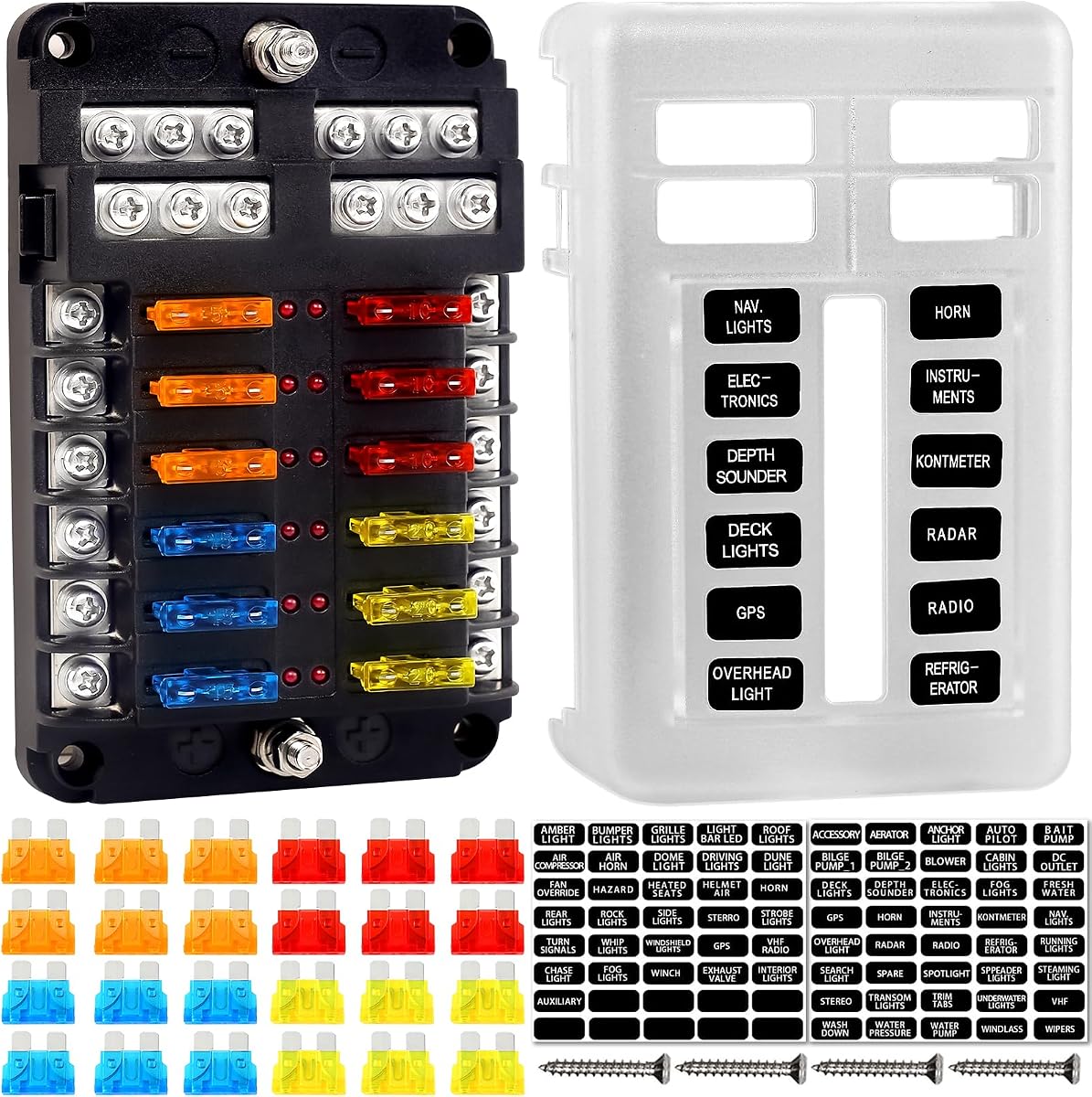
This generic 12 Way Fuse Block combines a 4.8 rating with extensive functionality, making it a strong all-around option. It provides 12 dedicated fuse positions, 12 wiring locations, per-circuit red LEDs, a grounding busbar, and a push-lock protective cover rated to IP53. It operates across 12–24V DC and supports 100 amps total with up to 30 amps per circuit.
We may earn a commission when you buy through this link, at no additional cost to you.
The installation kit includes 36 blade fuses: six each at 5A, 10A, 15A, 20A, 25A, and 30A. It also includes 24 heat-shrink terminals, two insulation sleeves for each terminal type, heat-shrink tubing, and an installation manual. Tin-plated copper main terminals support conductivity and corrosion resistance, while the diagnostic LEDs make an open fuse easier to locate.
A buyer should still inspect the terminology and specifications carefully. The listing describes the cover as water resistant to IP53 rather than fully waterproof, which is appropriate to expect for a protected but not fully sealed marine panel. It also does not provide live voltage monitoring, so owners who want a numerical battery reading must obtain that information separately.
This is a compelling choice for a new boat installation that needs several accessory circuits, helpful fault indicators, and a broad hardware bundle. It is less suited to someone who requires a documented high-capacity design or a fully sealed enclosure. Confirm that the terminals, conductor sizes, and fuse ratings match the boat before energizing the system.
Each branch has its own red indicator, making the location of an open fuse visible at a glance. Identification stickers add a second layer of organization for the connected device.
Thirty-six fuses, heat-shrink terminals, sleeves, and tubing cover common blade-fuse installation needs. The bundled parts make this especially practical for a first-time panel build.
We may earn a commission when you buy through this link, at no additional cost to you.
The WUPP 12 Circuit Fuse Panel has a 4.7 rating and provides a balanced feature set for boat electrical upgrades. It supports 12–32V DC, handles up to 100 amps continuously across the panel, and allows up to 30 amps per branch. Each of the 12 loads has an LED that illuminates when its fuse blows or a short is detected.
We may earn a commission when you buy through this link, at no additional cost to you.
Nickel-plated copper busbars and fuse pieces are designed for conductivity and corrosion resistance, including in saltwater environments. The base is made from flame-retardant PBT with high mechanical strength and heat resistance. A transparent cover helps protect the panel from splashes, while 12 grounding positions encourage cleaner wire organization than scattered inline fuse holders.
The product includes 24 blade fuses in 5A, 10A, 15A, and 20A ratings, along with labels and mounting screws. One nuance worth understanding is that the diagnostic circuit can produce a small residual voltage reading even without a failed fuse. The listing explains this as an expected effect of internal LED circuitry rather than leakage or a safety problem.
This panel is a good fit for owners who want LEDs, a ground bus, and a broad voltage range without moving to a much higher-capacity design. It is less appropriate if a digital battery-voltage display is a priority. When choosing fuse ratings, use the load's required rating and avoid upsizing a fuse beyond what its circuit and conductor can safely handle.
Twelve grounding positions keep return wiring grouped with the protected circuits. This supports a more orderly installation and reduces reliance on multiple separate holders.
The flame-retardant PBT base is designed to retain mechanical strength across changing temperatures. Nickel-plated copper parts complement the housing with durable conductivity.
We may earn a commission when you buy through this link, at no additional cost to you.
The Cyrico 12 Circuit Fuse Block offers 12 circuits, a 100A total rating, and up to 30A per circuit. Its 4.7 rating reflects a well-rounded design that combines a compact housing with a ground bus, individual fault indicators, and a protective PC cover. It is intended for 12V and 24V automotive and marine wiring.
We may earn a commission when you buy through this link, at no additional cost to you.
Its busbars and fuse clips use nickel-plated copper for conductivity and corrosion resistance. The PBT and PC materials provide insulation, mechanical strength, heat resistance, and flame resistance. Twist-lock screws and self-tapping mounting screws are designed to make the installation process straightforward, while the compact body can be useful where compartment space is limited.
An LED illuminates at the affected position when a fuse blows, and the cover includes labels for identifying connected devices. The panel also includes extra blade fuses in different amperage ratings. Its principal limitation is that the description refers to a waterproof cover and splash protection without providing a specific IP certification, so it should not be assumed to offer the same verified ingress rating as an explicitly certified enclosure.
This is a strong option for a boat with a compact electrical compartment and several low- to moderate-current accessory circuits. It offers the practical convenience of LEDs without adding a display that might be unnecessary. Choose it when space, organization, and quick fault identification are more important than a documented voltage monitor.
Twelve independent slots fit multiple protected circuits into one compact housing. This is helpful in boats where every available inch of compartment space matters.
PBT and PC construction provides insulation and thermal resistance. Nickel-plated copper busbars and clips support stable conductivity in a damp marine setting.
We may earn a commission when you buy through this link, at no additional cost to you.
The Snlazp 12V Fuse Block provides 12 circuits using standard middle-size ATO or ATC blade fuses. It has positive and negative sides, a 100A total capacity, a 30A per-circuit limit, and a maximum operating voltage of 32V DC. Those specifications make it a broadly compatible option for conventional 12V and 24V boat circuits.
We may earn a commission when you buy through this link, at no additional cost to you.
A red LED lights immediately when the associated fuse blows. This is paired with multifunction identification stickers intended to help the owner locate the appliance connected to each circuit. The PBT housing is described as mechanically strong, insulated, heat resistant, and flame resistant, with an emphasis on reducing the risk of cracking, deformation, or combustion under operating temperatures.
The package contains 25 blade fuses divided across five ratings: 5A, 10A, 15A, 20A, and 25A. It also includes a safety clip, two sticker sheets, four screws, and 24 terminals. This provides a useful starting assortment, although 30A fuses are not included even though the panel supports that maximum per-circuit rating.
Choose the Snlazp panel for a straightforward installation where LED fault indication and supplied terminals matter. It works well for new builds that need a manageable number of accessory circuits. A boat requiring a certified waterproof enclosure, a voltage display, or unusually high total current would need a more specialized panel.
Each positive terminal has a corresponding negative side, making it easier to organize both supply and return wiring. This can produce a cleaner finished installation.
Red warning LEDs identify an open branch, while included stickers help map each position to a connected device. Together they shorten routine troubleshooting.
We may earn a commission when you buy through this link, at no additional cost to you.
The Kohree 12 Way Marine Fuse Block has a 4.7 rating and one of the clearest enclosure-protection claims in this group. It is listed with an IP66 rating, along with CE certification, and uses a clear PC cover intended to resist splashes and dust. Its 12 circuits and 100A total capacity suit broad branch-circuit distribution.
We may earn a commission when you buy through this link, at no additional cost to you.
Each position has an LED that lights when the corresponding fuse blows, helping owners identify short circuits or other faults without removing every fuse. Maximum current is 30A per circuit, and maximum operating voltage is 32V DC. The PBT housing is described as mechanically strong, heat resistant, and flame resistant, while the clear cover allows the diagnostic lights to remain visible.
Thirty fuses are included, with five each at 5A, 7.5A, 10A, 15A, 20A, and 25A. The 7.5A option is useful for circuits with more specific requirements than the standard assortment. Labels, screws, and a safety clip complete the package. The panel does not include 30A fuses despite supporting up to that current per branch.
This panel is a sensible recommendation when ingress protection is a leading concern and an installer wants both LED diagnostics and a documented certification. It is less compelling for someone seeking a live voltage display or a higher-capacity architecture. Position the panel where it can benefit from its cover, and avoid treating an IP66 rating as a substitute for sound wiring and correct fusing.
The stated IP66 rating provides clearer protection expectations than generic splash-resistant language. A clear PC cover lets users inspect the LEDs without opening the enclosure.
The included assortment includes 7.5A fuses alongside more common ratings. This gives owners a useful option for loads that need finer current protection.
We may earn a commission when you buy through this link, at no additional cost to you.
The Qidoe 300A Blade Fuse Block is the high-capacity option in this guide. It has a 4.4 rating, 12 standard ATC or ATO fuse positions, dual positive power inputs, and a negative busbar. Its listed maximum current is 40A per circuit and 300A per panel, while maximum working voltage is 60V DC.
We may earn a commission when you buy through this link, at no additional cost to you.
Dual positive inputs can simplify the connection of multiple supply feeds into a common distribution panel. Individual LEDs illuminate at the position of a blown fuse, providing fast branch-level fault identification. The transparent cover protects against splashes and dust and uses thumbscrews for access, while dedicated spare-fuse slots keep backup fuses close at hand.
The PBT body is described as mechanically strong, insulated, heat resistant, and flame resistant. The main consideration is that the stated branch maximum is 40A, so it uses a different protection architecture from the panels limited to 30A. The product's wide power and voltage claims should be treated as design specifications rather than a reason to install oversized fuses; each branch still needs protection matched to its load and wire.
This is the premium pick for owners building a larger distribution system, adding multiple battery or supply feeds, or anticipating higher aggregate loads. The 4.4 rating is the lowest in the comparison, so buyers should pay particular attention to installation quality and compatibility. Its key advantage is expanded electrical capacity, not a superior diagnostic display.
Two positive power inputs provide more ways to feed the common bus. This is useful for larger systems that may use separate supply sources or a more complex battery arrangement.
Up to 40A per branch and 300A total differentiates this panel from the more common 30A-per-circuit models. Correct conductor and fuse selection remains essential at these higher limits.
We may earn a commission when you buy through this link, at no additional cost to you.
The 12 Way Fuse Block with Display is differentiated by a high-precision LED screen that shows real-time battery voltage from 5V to 32V. It operates over a 12–32V DC range and includes a red indicator for each circuit. This combination gives owners both system-level voltage information and branch-level fault identification.
We may earn a commission when you buy through this link, at no additional cost to you.
The housing is described as eco-friendly material with high mechanical strength, insulation, heat resistance, and flame retardancy. The LED screen is rated to operate stably for 20,000 hours at an ambient temperature of 25°C. DIY labels support clear identification of each device line, while the panel is designed for cars, motorcycles, trucks, boats, tractors, automotive modifications, and RVs.
Unlike most competing panels, the supplied information does not explicitly state total current capacity or maximum current per circuit. That omission makes it harder to compare this model confidently with the 100A and 300A designs in the guide. Owners should verify those limits with the manufacturer before fitting conductors or selecting branch fuses.
The display makes this panel appealing for a boat owner who wants to watch battery voltage without carrying a separate meter to the fuse location. It is particularly useful during troubleshooting or monitoring of a partially charged system. It is less compelling for a basic installation where a simpler panel with plainly stated current ratings better matches the available space and needs.
The live display provides immediate battery-voltage information over a 5–32V range. That makes unusual system voltage easier to notice without bringing a separate meter to the panel.
Per-circuit red lights identify an open fuse, while the screen provides broader power-system context. Combining the two can make fault diagnosis more systematic.
We may earn a commission when you buy through this link, at no additional cost to you.
The SOYOND 12 Volt Fuse Block combines 12 circuits with a listed 300A total panel capacity and up to 30A per circuit. Its 4.7 rating makes it one of the stronger products in the comparison. A negative busbar, red warning lights, and a damp-proof cover form the core of a practical marine-oriented design.
We may earn a commission when you buy through this link, at no additional cost to you.
The busbars and fuse clips use nickel-plated copper for conductivity and corrosion resistance. The PBT housing is described as resistant to breakage, deformation, burning, and short circuits across changing temperatures. When a fuse blows, the corresponding red LED illuminates, allowing the owner to identify the affected circuit and address the short or other fault.
The package includes 24 fuses: six each at 5A, 10A, 15A, and 20A. It also includes two label sheets and four screws. Unlike some panels in the guide, the listing does not state a formal IP rating for the cover, so buyers seeking a quantified ingress-protection standard should investigate other options. The cover's damp-proof construction still offers useful protection for typical installations.
This panel is a good value-oriented option for a boat that may outgrow a basic 100A panel but only needs 30A maximum branch protection. It works well for cars, boats, RVs, golf carts, and motor homes. Verify the actual load distribution and ensure the boat's supply wiring is appropriate for the panel's stated total capacity before installation.
A 300A total rating gives this panel more headroom than the common 100A design. The 30A branch limit still keeps individual circuit protection easy to reason about.
An integrated negative bus simplifies ground connections, and each position has a warning light. Together they support a cleaner, more serviceable installation.
We may earn a commission when you buy through this link, at no additional cost to you.
Choosing a boat fuse panel involves balancing circuit count, safe current limits, environmental protection, diagnostic functions, grounding, and the physical space available. Use the listed specifications as a starting point, then compare them with the loads and installation conditions on your particular boat.
Start by listing every accessory that needs an individually protected circuit, including navigation lights, pumps, electronics, refrigeration, lighting, charging equipment, and any systems added later. A 12-circuit panel provides room for a substantial mix of loads, but unused positions should remain available rather than being assigned beyond their electrical needs. Consider whether additional circuits could be handled by a separate subpanel rather than making one central box excessively crowded.
Choose enough positions for present and foreseeable loads, but do not overfill the panel. Future expansion is easier when the initial design leaves clear space, appropriate conductor pathways, and accessible fuse positions.
The listed total capacity and per-circuit maximum are different limits. Most products support up to 30A on an individual branch and either 100A or 300A across the panel, while the Qidoe model lists 40A per branch. Check the largest loads and their starting characteristics rather than adding every circuit's nameplate draw and assuming the total will never be reached simultaneously.
Prioritize a panel whose branch limit matches the fuse sizes and wire sizes appropriate for your system. Higher capacity is not automatically better; protection depends on a correctly coordinated circuit.
Standard ATO and ATC blade fuses are widely used in 12V and 24V DC installations. All ten products are described as accepting these middle-size blade formats, which makes replacement fuses easier to find. Check the included assortment, since packages range from 24 to 36 fuses and may not contain every rating you intend to use.
Use the amperage rating specified for each load and its wiring, not merely the panel's maximum. Having a range of spare ratings onboard helps, but the correct fuse must still be selected deliberately.
A negative bus or grounding bus consolidates return connections and can make a boat's wiring easier to inspect. The Blue Sea Systems, WUPP, Cyrico, Qidoe, and SOYOND panels explicitly include a negative bus, while several other models also describe positive and negative sides. Compare the number and type of grounding positions with the conductor terminations used throughout the boat.
A built-in bus is convenient, but it is not a substitute for sound grounding to the boat's electrical reference point. Ensure connections are secure, conductors are correctly sized, and corrosion protection remains intact.
Most panels provide a red LED that lights when the associated fuse blows. This can save considerable time compared with visually checking every blade, particularly in a crowded compartment. The WUPP model notes that its diagnostic circuitry may produce a small residual reading on sensitive test equipment even when no fuse has failed, so installers should understand that behavior before troubleshooting.
One product adds a live voltage display, which is useful for monitoring battery status. LEDs remain more important for routine branch identification, while a display adds system-level information rather than replacing individual fuse checks.
Boat compartments can experience spray, humidity, dust, and occasional splashes. A clear or transparent locking cover helps prevent accidental contact and keeps wiring away from fuse positions. The Kohree panel lists an IP66 rating, and the 12 Way Fuse Block with LEDs states IP53 protection. Other products use terms such as waterproof, damp-proof, splash resistant, or water resistant without supplying a formal rating.
Treat specific IP claims more clearly documented than generic wording. Also consider the panel's location, whether a fully sealed enclosure might be necessary, and whether the cover can be opened conveniently for inspection in damp conditions.
Most panels accept a 12–24V DC working range, which covers common boat electrical systems. The SOYOND product is described for 12–24V applications, the 300A Qidoe model lists a maximum working voltage of 60V DC, and the display-equipped model supports 12–32V while showing measurements from 5–32V. Verify the intended system voltage and the protection required for any atypical installation.
Nominal compatibility alone does not guarantee suitability. Consider every connected device, wiring method, and environmental requirement before choosing the panel.
Terminal compatibility matters when connecting the panel to existing conductors. Some packages include two main power terminals, 24 device terminals, heat-shrink sleeves, and heat-shrink tubing, while the Blue Sea Systems panel accepts ring or snap-fork terminals. Mounting screws, twist-lock terminals, and self-tapping screws are also listed among the available installation features.
Measure the compartment before buying and check cable bend space, cover clearance, and access to the fuse positions. A panel is easier to maintain when it can be opened and inspected without removing surrounding equipment.
Before installation, disconnect the battery and identify the intended source connection, ground point, and load for every fuse position. Route appropriately sized marine conductors away from sharp edges and moving parts, keep positive and negative wiring orderly, and confirm that each load's fuse rating matches both the device and the conductor protecting it.
Mount the panel in a dry, accessible location where the cover can open without being obstructed. Use the specified mounting hardware and verify that terminals are tightened to the manufacturer's instructions. Connect loads to their assigned positions, fit the appropriate fuses, apply the supplied labels, and inspect for loose strands or accidental contact before restoring power.
After energizing the panel, test each protected circuit and confirm that the expected equipment operates. Periodically open the cover to look for discoloration, heat, corrosion, loose terminals, damaged insulation, or moisture. Replace a blown fuse only after identifying the underlying fault, use the same correct rating, and keep spare fuses in the panel's storage area or another protected location.
Most owners choose a 12-way panel because it can organize a broad range of accessory circuits while leaving space for future expansion. The correct current capacity depends on the loads, conductor sizes, supply wiring, and whether multiple feeds are used. A panel with 100A total capacity may suit many conventional installations, while a 300A design offers more aggregate headroom for larger systems.
ATO and ATC fuses share the middle blade format but differ in physical dimensions, so they are not automatically interchangeable in every holder. All products in this guide are described as accepting ATO or ATC blade fuses, but installers should still check the actual fuse and holder dimensions. Use the fuse format and amperage specified by the panel manufacturer and the protected circuit.
A red LED normally illuminates when the corresponding fuse has opened, helping you locate the failed branch quickly. It can also signal a short circuit or another fault that caused the fuse to interrupt power. Some diagnostic circuitry can produce a small residual reading even when the fuse is intact, so use an appropriate test procedure when confirming a failure.
A negative bus is not universally required, but it makes ground distribution more organized and accessible. It allows multiple return conductors to terminate in one defined location instead of relying on a loose collection of connections. The correct ground arrangement must still match the boat's electrical design and use suitable conductors and hardware.
Only if the panel's listed operating voltage includes 12V and the connected loads are compatible with the system's actual voltage. Most panels in this comparison support 12–24V DC. The key is to follow the lower and upper voltage limits, fuse ratings, conductor sizes, and manufacturer guidance rather than relying on the fuse block's physical design alone.
Choose a location that is as dry as practical, protected from impact, easy to inspect, and large enough for the cover and wiring to operate without obstruction. Avoid sharp edges, moving components, and areas where water routinely collects. Even a well-designed panel should not be treated as a substitute for sealing penetrations, protecting conductors, and maintaining a dry installation.
An immediate trip can indicate a reversed connection, a shorted circuit, an incorrectly wired load, or a fuse that is too small for the load's startup demand. Disconnect power and check the wiring and each branch rather than repeatedly replacing the fuse. Confirm conductor size, fuse rating, polarity, grounding, and the connected equipment before energizing the panel again.
Inspection should be part of routine maintenance and particularly important after heavy rain, a flooding event, battery work, or electrical modifications. Look for corrosion, moisture, heat discoloration, damaged insulation, loose terminals, and signs of overloaded conductors. Keep the panel closed when possible and confirm that every fuse position still serves the circuit shown by its label.
The Blue Sea Systems ST Blade Fuse Block is the strongest general recommendation for its twelve-circuit layout, integrated negative bus, corrosion-conscious construction, and flexible terminal options. The 12 Way Fuse Block with LEDs is an attractive budget-oriented alternative when diagnostics and a generous accessory bundle matter, while the Qidoe 300A model leads the premium group for expanded capacity and dual positive inputs.
For most buyers, the deciding factors should be the actual loads, the documented capacity, grounding arrangement, environmental exposure, and ease of maintenance rather than the number of accessories in the box. LED indicators are especially useful in a crowded boat compartment, and a voltage display can help owners monitor system condition. In every case, the fuse rating must match both the load and its conductor.
Product specifications, availability, and prices can change, so review the current listing and manufacturer instructions before ordering. Confirm the voltage range, terminal style, mounting space, included fuses, and installation environment. A careful match between the panel and the boat's electrical plan is the foundation of a dependable, serviceable marine fuse system.