
MOZA SRP2 Pedals Set
4.5Editor score
100 kg load cell brake
25 standard brake configurations
Aerospace-grade aluminum construction
Our guide compares the best Racing Wheel with Load Cell Pedals for SIM Racing, covering braking precision, adjustability, construction, and compatibility.
Load cell pedals measure the force applied to a pedal rather than relying only on its angle or travel. That distinction can make braking more realistic and consistent in racing simulations, especially when fine modulation matters. The best sets combine a responsive sensor, convincing resistance, solid construction, practical adjustment options, and compatibility with the platforms you use.
We compared the ten products in this guide using their supplied specifications, focusing on load cell performance where stated, sensor technology, resistance systems, adjustment ranges, pedal layout, materials, software support, and platform compatibility. The list includes complete pedal sets, pedal-and-wheel systems, and modular options that require an upgrade for load cell braking.
Each review explains the strongest reasons to consider that model, along with any limitations apparent from its specifications. Ratings are included as reference information rather than as a substitute for hands-on evaluation. Retail availability, configuration details, and current offers can change, so confirm the latest product information before purchasing.
4.5Editor score

4.6Editor score
4.7Editor score
The comparison below highlights the major differences in sensor design, brake force, pedal layout, resistance options, construction, and compatibility, helping you identify the most suitable setup for your racing style and equipment.


The Fanatec CSL Elite Pedals V2 is a two-pedal set centered on a new load cell brake system, contactless Hall sensors for the clutch and throttle, and a generous range of physical adjustments. Its 4.6 rating reflects a broadly capable package, particularly for racers who want precise braking input without moving beyond the well-established Fanatec ecosystem.
We may earn a commission when you buy through this link, at no additional cost to you.
The brake system can measure up to 90 kg of force on the pedal plate, while the load cell sensor itself is rated above 200 kg. Elastomer stacks provide the initial resistance, and included 65, 75, and 85 Shore elastomers can be changed without tools. A metal spring is also included for drivers who prefer a stiffer preload, making it possible to tune the pedal for different vehicles and driving habits.
The pedal position can shift sideways along the heel rest, the rubber pedal covers detach, and the set can be configured for two-pedal use. RJ12 is the recommended connection for compatible Fanatec bases, while USB permits standalone PC operation. The main compromises are that no baseplate is listed, and console functionality depends on the appropriate licensed Fanatec base rather than being automatic.
This is an excellent recommendation for PC racers using a Fanatec wheel and for console drivers who already own a compatible licensed base. It combines a capable load cell, contactless peripheral sensors, and unusually accessible resistance adjustment in a compact package. Buyers wanting the closest match should also confirm that their existing base supports the connection and mounting arrangement.
The load cell brake measures the force applied to the pedal plate, allowing games to respond to pressure rather than simple pedal position. This gives drivers a better basis for trail braking, release control, and maintaining consistent braking pressure during a long stint.
Tool-free elastomer changes make it convenient to move between softer and firmer setups without rebuilding the pedal. The supplied metal spring adds another useful degree of control for drivers who want a sharper initial response.
We may earn a commission when you buy through this link, at no additional cost to you.
The MOZA SRP2 Pedals Set provides a two-pedal brake-and-throttle solution built around a 100 kg load cell. It pairs sensor fusion and adjustable resistance with CNC-machined aerospace-grade aluminum and high-strength steel, earning a 4.5 rating and making it a strong option for drivers building a focused two-pedal racing setup.
We may earn a commission when you buy through this link, at no additional cost to you.
The supplied elastomer and multi-hardness spring arrangement creates 25 standard brake-feel configurations. An optional Performance Kit expands that range to more than 1,000 setups for drivers seeking highly responsive, F1- or LMP1-style feedback. The brake sensor is designed to deliver accurate response, while combining angle and force data gives the pedal more nuanced input information.
Adjustment extends beyond resistance. Two-stage pedal-face angles of 10 and 25 degrees accommodate different driving positions, while pedal spacing can move by 15 millimeters in either direction. Height adjustment covers a 36 millimeter range. These ergonomic controls are valuable if your default stance feels cramped, or if heel-to-toe braking becomes uncomfortable over time.
Choose this set if you race primarily with brake and throttle and want a capable load cell pedal without moving into a three-pedal or full wheel bundle. It is particularly appealing for drivers who value configuration freedom and durable metal construction. The absence of a clutch and the need for an optional kit for the broadest tuning range are the principal trade-offs.
The 100 kg brake load cell provides direct force measurement, while the standard spring and elastomer package already supports 25 distinct setups. That combination gives new sim racers room to adapt the pedal without starting with an unnecessarily complicated configuration.
Adjustable face angle, spacing, and height make the set easier to fit around different leg lengths and preferred racing positions. These controls can reduce ankle strain and help the pedals sit naturally beneath the wheel.
We may earn a commission when you buy through this link, at no additional cost to you.
The SIMSONN PRO X Ultra P3-H3 is a three-pedal load cell and hydraulic system aimed at drivers who want extensive control over resistance, input curves, and physical positioning. Its 4.7 rating reflects a feature-rich design that combines brake, throttle, and clutch with sophisticated signal processing and configurable lighting.
We may earn a commission when you buy through this link, at no additional cost to you.
The brake uses an adjustable hydraulic resistance rod with eight levels, plus 60HA, 70HA, and 80HA elastomers and ten spacers for varied force curves. Load cell components provide linear measurement across the pedals, while the controller uses two independent 32-bit processors, a dedicated 16-bit high-resolution analog-to-digital converter, and three differential signal amplification chips. Three-channel simultaneous sampling is designed to improve response and stability around motion systems and other electronics.
SIMSONN Manager expands the control surface with nonlinear output curves, dead zones, and brake curves that can be saved as profiles. RGB lighting can display pressure information and synchronize with other SIMSONN devices. The pedals can also be moved along multiple axes and individually adjusted for height, angle, travel, and force response, while a dual-bearing design supports smooth movement.
This model is best for PC racers who want a three-pedal setup and actively tune their inputs. It is particularly compelling for anyone using a motion seat or haptic reactor because the product is designed to reduce interference and supports related hardware. Confirm that the included configuration and baseplate-free format suit your cockpit before ordering.
The dedicated manager software lets users reshape pedal outputs rather than relying entirely on the default linear response. Saved profiles make it easier to retain separate setups for different cars, from forgiving road vehicles to competition cars that demand precise pressure control.
Simultaneous sampling and differential signal handling are designed to maintain stable input around motors and motion equipment. For a cockpit with a haptic reactor or four-axis seat, this electrical architecture may be more valuable than adding a few visible buttons.
We may earn a commission when you buy through this link, at no additional cost to you.
The Thrustmaster Raceline Pedals III is a modular three-pedal system built around frictionless H.E.A.R.T. sensors, adjustable resistance, and a fully metal construction. Its 3.9 rating is the lowest in this roundup, largely because the load cell brake is not included and requires a separate upgrade kit.
We may earn a commission when you buy through this link, at no additional cost to you.
The immediate pedal set uses Hall effect sensing for throttle, brake, and clutch, with three pressure-adjustment notches and multiple springs included. Resistance can therefore be changed according to the vehicle and personal preference. Non-slip support pads help keep the unit stable on a racing cockpit or on hardwood, carpet, or tile, which is useful before the system is mounted permanently.
The key feature for anyone researching load cell pedals is the ability to add the separately sold Raceline Pedals Upgrade Kit later. That module introduces pressure-sensitive load cell braking without requiring the entire pedal set to be replaced. The modular approach makes this an attractive starting point for Thrustmaster users who may want a conventional setup at first and more realistic braking later.
Choose the Raceline Pedals III if future expandability matters more than having load cell technology immediately. It is also a practical option for drivers building a Thrustmaster ecosystem across PC, PS5, or Xbox. Ensure that the upgrade kit is included in your final setup if immediate load cell braking is essential to your goal.
Starting with Hall effect pedals and adding load cell braking later spreads the cost of a full setup over time. It also lets new drivers learn the pedal mechanics before moving to a pressure-sensitive brake.
Non-slip support pads reduce the chance of the pedal unit moving during aggressive inputs. That makes the set usable on several floor surfaces while preserving the option to mount it in a dedicated racing frame.
We may earn a commission when you buy through this link, at no additional cost to you.
The SIMSONN Plus X Black P3-H3 is a three-pedal hydraulic set designed around a progressive brake feel, an upgraded control box, and extensive damping adjustment. Its 4.4 rating makes it a noteworthy option for PC racers who prioritize natural resistance and software-defined input curves.
We may earn a commission when you buy through this link, at no additional cost to you.
The hydraulic brake technology is intended to slow pedal movement in both directions and reproduce nonlinear, progressive feedback similar to a real braking system. New elastomer materials provide smoother operation, while 60HA, 70HA, and 80HA elastomers and thirteen spacers create many possible damping combinations for different vehicle classes.
SIMSONN Manager supports nonlinear output curves, dead zones, and brake curves, and configurations can be saved for later use. The upgraded control box includes three vibration-module ports compatible with SIMSONN VAM, VAM RPO, and VAM Neo vibration motor products. High-strength steel construction and dual-bearing movement round out the physical design.
This set is a strong fit for Windows PC users who want brake, throttle, and clutch pedals with detailed resistance tuning. It can pair effectively with a haptic reactor to make braking events more immersive. However, the supplied specifications describe a hydraulic system rather than confirming a load cell brake, so it should not be treated as a direct substitute for the explicitly load cell-equipped sets in this guide.
A hydraulic mechanism can make the brake build resistance progressively instead of moving against a simple spring. That behavior closely supports the sensation of managing a heavy brake pedal during sustained pressure.
Three dedicated vibration-module ports make the control box easier to integrate with compatible SIMSONN hardware. This adds another dimension to racing feedback without changing the fundamental pedal layout.
We may earn a commission when you buy through this link, at no additional cost to you.
The SIMSONN PRO X Ultra P2-H2 is a two-pedal brake-and-throttle set combining load cell sensing with an adjustable hydraulic brake. Its 5.0 rating is the highest stated among the reviewed products, although ratings alone do not reveal how a specific setup will feel in an individual cockpit.
We may earn a commission when you buy through this link, at no additional cost to you.
The brake includes an adjustable hydraulic resistance rod with eight levels. Supplied 60HA, 70HA, and 80HA elastomers, together with ten spacers, allow multiple force-curve combinations. The load cell provides linear force measurement, and a six-chip processing architecture supports simultaneous sampling, a dedicated 16-bit high-resolution converter, and differential signal amplification.
SIMSONN Manager offers nonlinear output curves, dead zones, and saved brake-curve profiles. RGB lighting can present pedal pressure and synchronize with other SIMSONN devices. Individual pedal height, angle, travel, and force response can be adjusted, while the baseplate allows movement in four directions for more precise positioning.
This is a compelling recommendation for PC racers who prefer two pedals but want load cell braking, hydraulic resistance, and advanced software control. It may also appeal to users of motion or haptic equipment because of the interference-resistant electronics. Those wanting a clutch pedal should choose the three-pedal P3-H3 version instead.
The P2-H2 keeps the layout focused on brake and throttle while retaining load cell measurement and hydraulic adjustment. This makes it easier to compare with conventional two-pedal sets without giving up detailed braking control.
Dedicated processing, high-resolution conversion, and simultaneous sampling support stable communication in an advanced setup. The design is especially relevant when a wheel, seat, and haptic device all operate near the pedal controller.
We may earn a commission when you buy through this link, at no additional cost to you.
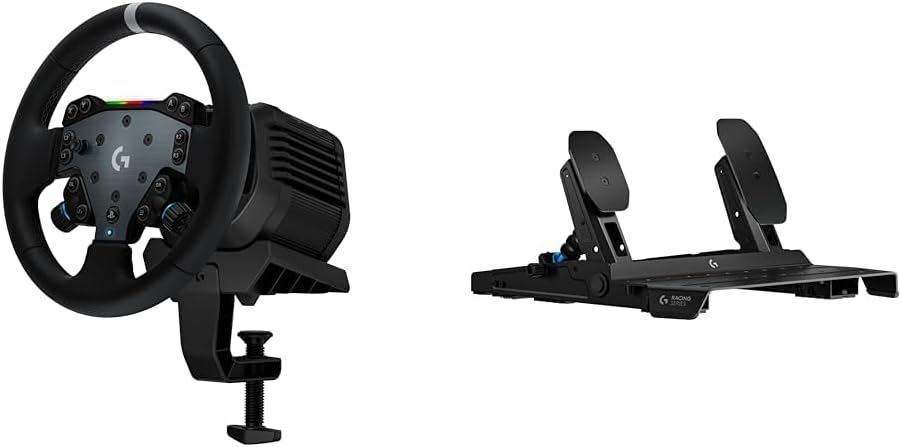
The Logitech G RS50 Racing Wheel System is a complete high-end package containing an eight Nm direct drive base, modular wheel hub, 11-inch round wheel, and three-pedal set with a 75 kg load cell brake. Its 4.7 rating and broad platform support make it the standout all-in-one choice in this guide.
We may earn a commission when you buy through this link, at no additional cost to you.
The round wheel is designed for rapid rotation, with a fuller grip profile and high-performance silicone leather that suits rally and drift use. Its hub includes 13 console-specific buttons, adjustable paddle shifters for rims up to 12 mm wide, and a quick-release mechanism for changing wheels. The base works with compatible Logitech G RS or PRO wheels.
The pedal set uses a 75 kg force load cell for the brake and Hall effect accelerator and clutch sensors for precise, contactless input. Pedal positions can be adjusted on the frame, helping drivers position the brake and accelerator according to their preferred racing posture. The result is a system designed around both realism and modularity.
Choose the RS50 when you want a complete wheel, base, and pedal package rather than adding components separately. It is particularly well suited to PC, PS5, and PS4 racers who want a round wheel for drifting or rally-inspired driving while retaining a conventional racing layout. Confirm that the included components meet your display, cockpit, and platform needs.
The eight Nm direct drive base and 11-inch round wheel provide a coherent package from the beginning. This reduces the need to match separate components and gives the cockpit a wheel shape suited to quick, frequent steering inputs.
The quick-release hub and compatible base design make wheel swapping straightforward. Drivers can retain the base and pedals while experimenting with different rim diameters, grips, and driving styles as their setup evolves.
We may earn a commission when you buy through this link, at no additional cost to you.
The MOZA SR-P is a compact brake-and-throttle pedal set featuring a 100 kg load cell, a hybrid brake design, an organ-style accelerator, and 15-bit magnetic encoders. It is explicitly designed for PC use and offers a more focused two-pedal alternative to larger three-pedal systems.
We may earn a commission when you buy through this link, at no additional cost to you.
The 100 kg load cell is the central attraction, providing direct measurement of braking force for the kind of pressure-sensitive control sought by load cell users. The hybrid brake combines mechanical braking feel with electronic force measurement, while the magnetic encoders are designed to provide fine resolution for the accelerator and related pedal positions.
The organ-style accelerator places the throttle in a vertical arrangement rather than the horizontal layout used by many pedal sets. This can feel more natural to drivers who prefer the layout found in some performance cars, though it may require adjustment if you are accustomed to a conventional sequential pedal arrangement.
This model makes sense for PC racers who want a dedicated load cell brake, prefer two pedals, and appreciate the accelerator's vertical orientation. It may be particularly attractive for GT, touring-car, and road-racing setups where a sequential accelerator layout feels natural. The comparatively brief published specifications mean buyers should check the current package details carefully.
The organ-type throttle offers a distinct visual and ergonomic layout for racers who prefer sequential-style positioning. It can improve access to the accelerator while leaving the brake in a familiar location.
Fifteen-bit magnetic encoders support precise detection of pedal movement. Combined with the load cell brake, this creates a mix of angular input for the accelerator and force-based measurement for the brake.
We may earn a commission when you buy through this link, at no additional cost to you.
The MOZA SRP2 Racing Simulator Load Cell Pedals combine a 100 kg load cell with a 15-bit angle sensor, CNC-machined aluminum, and high-strength steel. Their 5.0 rating makes them one of the strongest customer-rated options in the guide, particularly for racers who want force and angle information in a two-pedal set.
We may earn a commission when you buy through this link, at no additional cost to you.
The standard elastomer and multi-hardness spring system provides 25 brake-feel configurations. An optional Performance Kit expands the available settings to more than 1,000 and is positioned for F1- and LMP1-style responsiveness. Sensor fusion combines the load cell's force information with the high-resolution angle measurement to create a detailed braking input.
The physical design is particularly adaptable. Pedal-face angles can be set to 10 or 25 degrees, spacing changes by 15 millimeters in either direction, and height adjustment covers a 36 millimeter range. Those controls allow the pedals to be aligned with your seat, wheel, and preferred leg position rather than forcing one universal position.
Buy this version if your racing setup uses only brake and throttle and you value physical configuration as much as sensor technology. It is a strong match for competitive sim racers who may move between different vehicle types. A clutch-equipped alternative would be necessary for three-pedal racing, and the broadest feel changes require the optional performance package.
The load cell measures braking pressure while the angle sensor tracks pedal position. Combining those inputs can give the simulator a more complete picture of the driver's action than either measurement could provide alone.
Wide spacing and height controls, combined with two face-angle options, make it easier to build a comfortable racing posture. Ergonomic alignment can also reduce the strain associated with heel-to-toe braking.
We may earn a commission when you buy through this link, at no additional cost to you.
The MOZA R21 Racing Bundle combines a 21 Nm direct drive base, GS V2P wheel, and CRP2 load cell pedals with clutch. Its 200 kg load cell and extensive tuning options place it among the most technically ambitious products in this guide, making it a complete solution for high-end sim racing setups.
We may earn a commission when you buy through this link, at no additional cost to you.
The R21 base uses a flat-wire motor designed for smooth, consistent force feedback and reduced cogging, while the listed 21 Nm of torque is intended to deliver substantial force through demanding steering inputs. The software layer includes MOZA's New Force Feedback Algorithm for tuning the wheel's behavior and response.
The CRP2 pedals use CNC-machined aerospace-grade aluminum, a carbon fiber heel plate, a 200 kg load cell, and a 15-bit angle sensor. Up to 1,764 customization options allow drivers to adapt the brake from road-car behavior toward highly specialized F1-level setups. The accompanying 300 mm GT-style wheel provides a large, full-featured racing format.
Choose this bundle if you are building a serious, self-contained cockpit rather than adding one component at a time. The three-pedal layout, clutch, large wheel, and high-capacity brake suit drivers pursuing a broad range of racing disciplines. Its scale and complexity may be excessive for a new player, but it offers a clear technical path for a long-term enthusiast setup.
The 200 kg load cell provides a broad operating range for strong braking inputs. That capacity is particularly relevant to competition-oriented vehicles and drivers who use a high pedal position.
The direct drive base, GT wheel, and clutch-equipped load cell pedals cover the main elements of a serious racing setup in one coordinated package. This can simplify initial assembly while leaving extensive room for later tuning.
We may earn a commission when you buy through this link, at no additional cost to you.
The right load cell pedal set depends on how you drive, which platforms you use, and how much control you want over resistance and input curves. Sensor technology, construction, layout, and integration options deserve careful consideration before you buy.
A load cell converts pressure applied to the brake into an electronic signal that the simulator can interpret as braking force. The stated capacity should comfortably exceed the force you expect to use, while the usable range and force curve matter more than a headline number alone. In this guide, listed brake load cells range from 75 kg to 200 kg, with the Fanatec unit also specifying an exceptionally high sensor rating.
Force measurement is only one part of the braking experience. Springs, elastomers, spacers, and hydraulic rods determine how quickly resistance builds and where the pedal sits in its travel. The MOZA SRP2 provides 25 standard configurations, the SIMSONN PRO X Ultra includes eight hydraulic levels and several elastomer choices, and the Fanatec offers three Shore hardness options plus a metal spring. Look for a system with enough adjustment to match different cars and personal strength.
Load cells are used mainly for the brake, while throttle and clutch pedals commonly rely on optical, magnetic, or contactless electronic sensors. Hall effect sensors avoid physical contact and reduce wear, while magnetic encoders can provide high angular resolution. The SIMSONN PRO X Ultra also uses a dedicated high-resolution converter and simultaneous multi-channel sampling, which may benefit complex electronic environments.
Two-pedal sets keep the cockpit uncluttered and may suit road, GT, and rally racing. Three-pedal layouts add clutch control for sequential and manual-transmission cars. Face angle, spacing, height, and travel are also important because a precise sensor cannot compensate for an uncomfortable position. The MOZA SRP2 offers face-angle choices, spacing adjustment, and a 36 millimeter height range, while SIMSONN provides broad multi-axis positioning.
Pedals experience repeated, high-energy inputs, so material strength and smooth movement are major durability concerns. CNC-machined aluminum, high-strength steel, thick brake load-bearing sections, and multi-bearing arrangements appear across the strongest products in this list. Dual-bearing systems can help maintain consistent movement, while thicker brake components are particularly relevant in a load cell assembly that must withstand substantial force.
Digital output curves can make a physical pedal easier to control or more closely resemble a particular car. Dead zones, nonlinear brake curves, and saved profiles are useful for switching between road and competition vehicles. SIMSONN Manager provides the most detailed software features in this group, including curve configuration, dead-zone adjustment, pressure-reactive lighting, and reusable profiles.
Check whether the set works as a standalone PC device, requires a specific base, or supports console platforms. Fanatec offers RJ12 and USB connectivity, the Logitech package covers PS5, PS4, and PC, and several pedal-only products focus on PC. Modular systems offer another kind of future-proofing: the Thrustmaster Raceline Pedals III can accept a separate load cell brake upgrade, while the Logitech hub allows wheel swapping.
The supplied configuration should match your available floor space and mounting method. Some sets include no baseplate, while complete systems provide a wheel and pedals that may still need a dedicated rig. Advanced setups should also account for electrical interference from direct drive motors, motion seats, and haptic devices. Pedal controllers with multi-channel sampling, differential signal handling, and dedicated vibration ports are better suited to that environment.
Begin with a compatible wheel base, cockpit, or stable floor arrangement and install the pedals according to the manufacturer's instructions. Connect the set using its supported RJ12, USB, or base-specific connection, then install the required control software if available. Before entering a race, verify that the brake, throttle, and clutch move freely and that the game recognizes every axis without unwanted reversing or drifting.
Set the pedals for comfort before focusing on performance. Adjust the face angle, spacing, height, and travel so your heel remains planted and your foot can reach the brake naturally. If the set has adjustable elastomers, springs, spacers, or hydraulic rods, begin with a moderate setting, drive in a controlled environment, and make small changes while recording what each modification feels like.
For safe operation, use the simulator's calibration tools when prompted and recheck the brake input after moving a pedal or changing resistance. Keep the baseplate stable, avoid dragging it across smooth flooring, and keep liquids and debris away from the sensor mechanisms. Clean the pedal faces with a soft, dry cloth, inspect fasteners periodically, and update the control software when improvements are released.
Load cell brakes measure the pressure applied to the pedal rather than relying only on the pedal's angle or travel. That can produce more realistic braking behavior, particularly during trail braking and delicate pressure adjustments. The quality of the result still depends on resistance design, calibration, software support, and the simulator's interpretation of the input.
No. Load cells are especially useful for the brake, where force-based control is valuable, while Hall effect or magnetic sensors are common and effective for throttle and clutch inputs. A strong pedal set can combine both approaches. Choose based on how you race, your desired feel, and the adjustment tools provided by the manufacturer.
No. Direct drive describes the wheel's force-feedback motor, while load cell technology describes how the pedals measure input. Most direct drive wheels can work with conventional pedals. Adding load cell braking can improve realism, but compatibility with the base, cockpit, and simulator is more important than the presence of a direct drive motor.
Two-pedal sets are more common in GT, touring car, rally, and open-wheel racing, where clutch control may be unnecessary or controlled separately. If you regularly drive manual road cars or need clutch modulation for launches, a three-pedal set may be more appropriate. You can still use a two-pedal set in some manual-transmission simulations if the game permits clutchless shifting.
Start with a comfortable physical position, then adjust spring or elastomer resistance in small increments. Use the simulator's brake curve to shape the relationship between input pressure and braking demand. Avoid making several large changes at once, because it becomes difficult to identify which adjustment improved the result or introduced a problem.
Most modern sets use software-based calibration and may prompt you to press and release each pedal during setup. Recheck calibration after changing pedal spacing, travel, resistance, or sensor orientation. If inputs appear reversed, drift unexpectedly, or remain at a nonzero value, consult the current software instructions and the manufacturer's troubleshooting guidance.
Compatibility depends on the complete electronics and connection arrangement. Some products emphasize noise immunity, multi-channel sampling, and support for vibration hardware, while others provide standard USB or base-specific connections. Confirm both electrical and physical compatibility before installation, particularly when the controller will sit near direct drive motors and motion equipment.
The Fanatec CSL Elite Pedals V2 is the most balanced standalone recommendation, combining a load cell brake, contactless throttle and clutch sensors, and straightforward resistance changes. The MOZA SRP2 is a particularly compelling two-pedal option with 25 standard configurations and extensive positioning controls, while the Logitech G RS50 offers the most complete premium wheel, base, and pedal package.
Prioritize the details that match your driving: pressure measurement for the brake, adjustable resistance for comfort, a layout suited to your favorite cars, and controls that prevent fatigue. Software profiles are especially useful for switching between road and competition vehicles, while robust electronics matter when a motion seat or haptic system is part of the cockpit.
Before ordering, verify connector support, platform compatibility, included components, and the exact pedal configuration. Product listings and retailer offers can change, so check the current manufacturer details and latest listing information to make sure the set you choose still provides the features covered in this guide.