
Renogy 100W Flexible Solar Panel
4.4Editor score
240-degree bendable design
One-tenth-inch panel thickness
Roof and curved-surface friendly
Explore the best flexible solar panels for RV rooftops, comparing output, flexibility, weather resistance, efficiency, installation needs, and system compatibil
Flexible solar panels offer RV owners an appealing way to generate electricity without adding rigid glass modules, heavy mounting hardware, or a large rooftop footprint. The best units balance usable power, low weight, bendability, outdoor durability, and compatibility with common RV battery systems, but the right choice depends heavily on roof shape and available space.
This guide compares ten flexible solar panel products for RV rooftops using their stated power ratings, cell efficiency, flexibility, construction, environmental resistance, installation features, and system compatibility. It covers single panels, matching sets, and higher-output arrays for campers, vans, boats, trailers, and larger RVs.
Each review identifies the strongest reason to consider the product while also noting practical limitations or missing details. The picks range from a compact 100W option to larger 400W and 800W configurations, and product availability, incentives, warranties, and prices can change, so readers should confirm current specifications before purchasing.
4.4Editor score
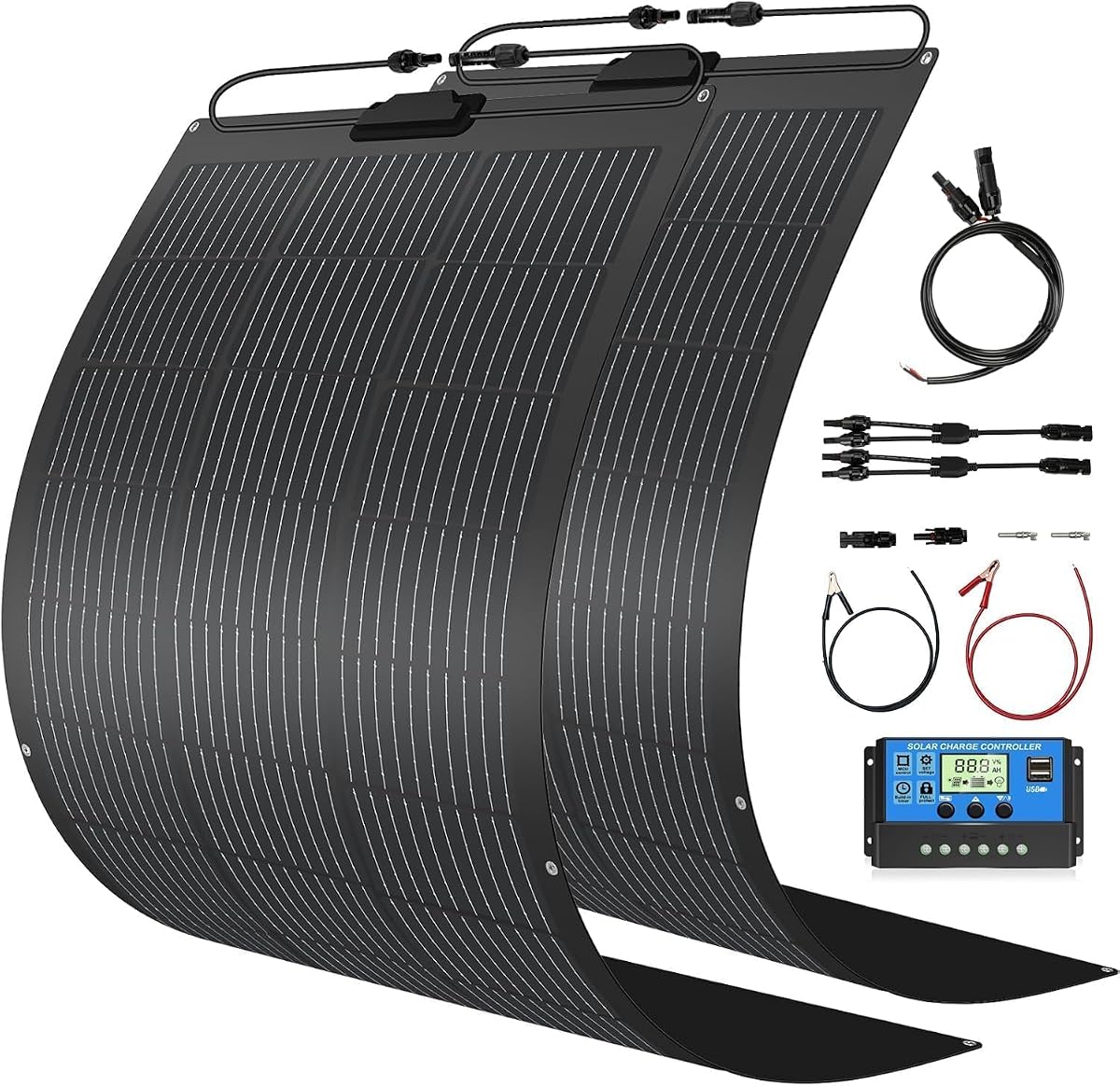
5.0Editor score

4.8Editor score
The table below compares all ten panels by configuration, stated power, efficiency or key technology, and major installation or durability features. Specifications are based on the supplied product information and should be confirmed for compatibility with a particular RV roof, charge controller, and battery bank.

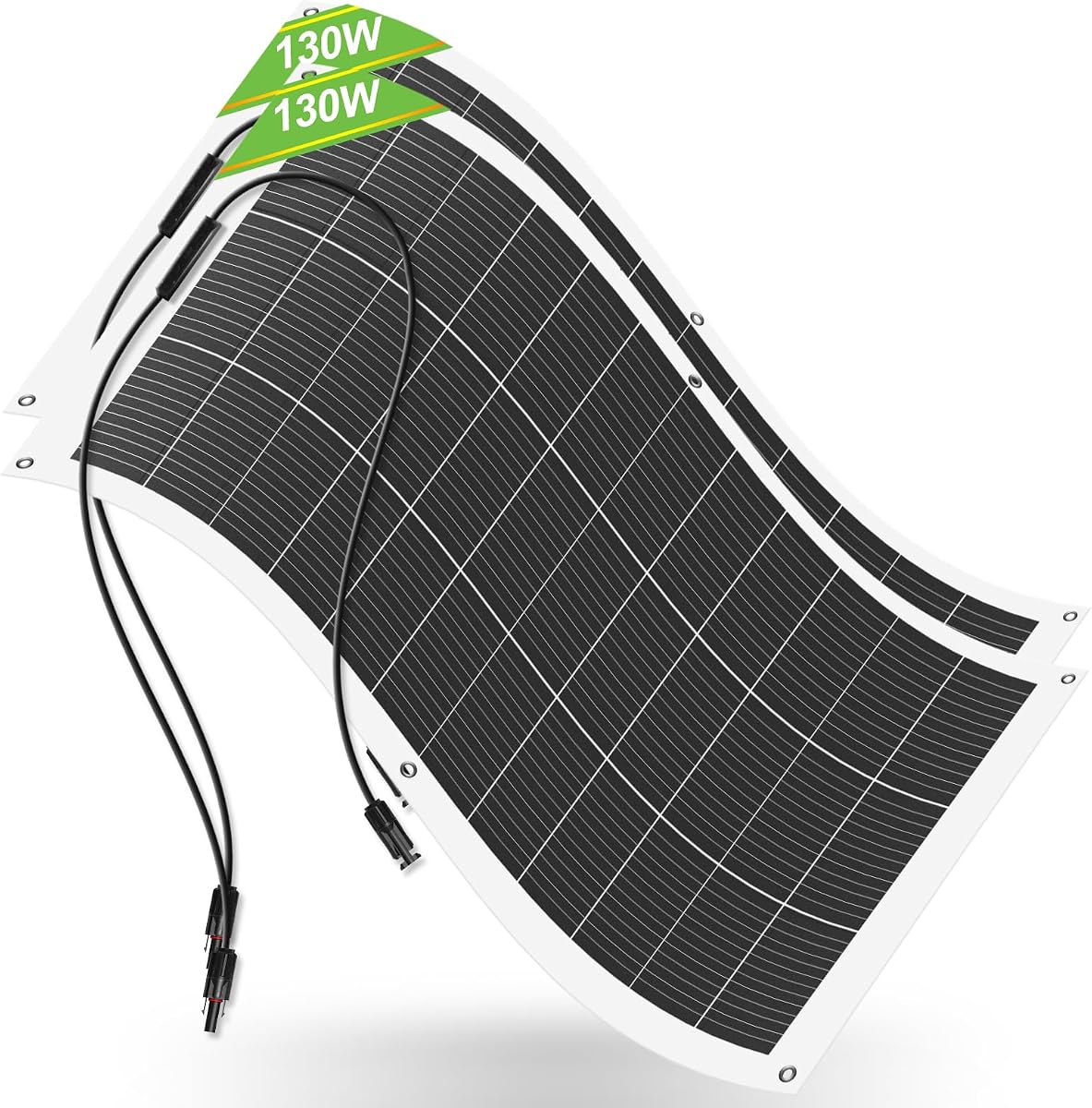

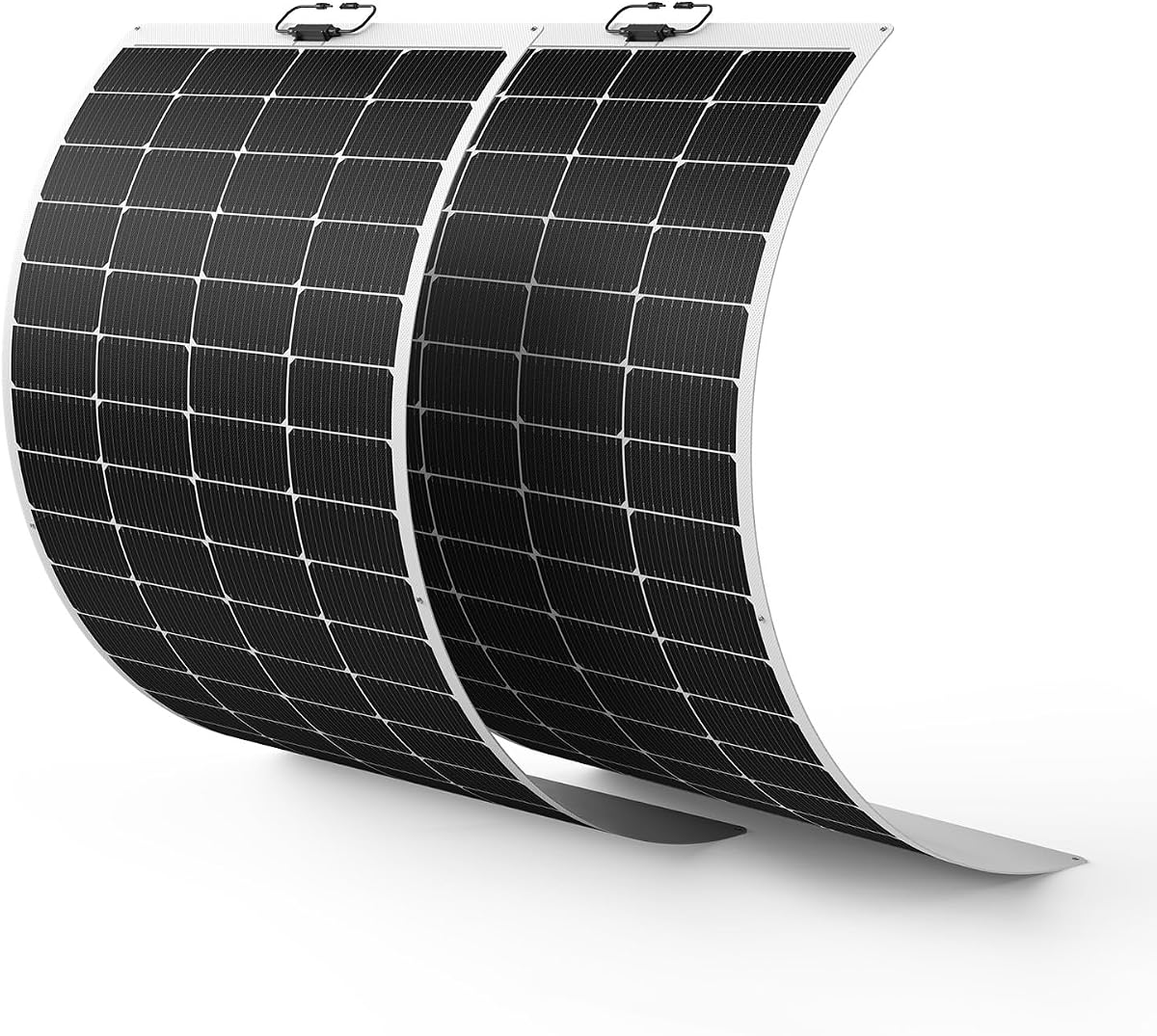


The Renogy Flexible Solar Panel 100 Watt is a compact, approachable option for RV owners who want to begin collecting solar energy without installing a large rigid array. It carries a 4.4 rating and stands out for its 240-degree bendability, extremely thin construction, and stated ability to withstand demanding rooftop conditions. The panel is particularly relevant for curved roofs, campers, trailers, and other vehicles where conventional glass modules may be awkward to position.
We may earn a commission when you buy through this link, at no additional cost to you.
One of its most useful characteristics is how little attention it demands during installation. The panel is described as approximately one-tenth of an inch thick and 70% lighter than conventional panels, reducing both the visual impact and the load placed on the roof. It can conform to a rounded RV roof or another smooth, curved surface without requiring a large elevated mounting frame. That makes it a practical option for travelers who value a low-profile setup.
The product information also gives the panel meaningful environmental credentials. It is tested for wind loads up to 2400 Pa and snow loads up to 5400 Pa, making its construction more reassuring for year-round rooftop exposure than appearance alone would suggest. The trade-off is that 100W is a modest output for an RV, so it may maintain smaller loads or supplement another charging source rather than independently run a demanding energy system.
This is a sensible choice for a smaller camper, a weekend trailer, a van with limited roof space, or an RV owner building a system gradually. It is less appropriate for someone expecting one panel to power large appliances continuously. Subject to matching the panel with a suitable charge controller and battery configuration, the Renogy 100W panel offers an established-looking combination of flexibility, low weight, and rooftop durability.
Its 240-degree bend and ultra-thin lamination let it follow curved RV surfaces more closely than a rigid module. The low profile can also preserve more headroom and reduce the visual prominence of the installation.
Stated wind and snow-load figures offer useful reassurance for outdoor installation. As with any panel, the roof surface, adhesive or fasteners, and sealant still need careful preparation.
We may earn a commission when you buy through this link, at no additional cost to you.
The 800W Solar Panel Kit is the highest-total-output product in this guide and one of the strongest choices for a larger RV energy system. It earns a 5.0 rating, pairs two 400W flexible monocrystalline panels, and states efficiency above 24%. Rather than forcing one module to cover the roof, the kit uses two panels, giving installers more flexibility in placement and making it easier to distribute output across usable rooftop areas.
We may earn a commission when you buy through this link, at no additional cost to you.
The panels use ETFE construction with stated UV resistance and better light transmission than PET-based surfaces. Each weighs 4.4 pounds and is only 0.1 inch thick, helping limit roof load and visual bulk. Their 30-degree bend capability is more restrained than the 240- or 270-degree figures associated with some competitors, so they are best suited to gently curved areas rather than tight compound curves.
System compatibility is a major strength. The kit is described as suitable for 12V and 24V lead-acid and LiFePO4 batteries, with compatibility stated for Renogy and Victron controllers. An IP68 rating, salt-spray corrosion resistance, and a temperature tolerance of 248°F or 120°C strengthen its outdoor and marine positioning. The manufacturer also provides a two-year materials-and-craftsmanship warranty and states that the panels retain 80% output after 25 years.
This kit is a compelling match for RV owners with substantial energy needs, such as refrigeration, lighting, CPAP equipment, or an actively used off-grid living space. Its total output can be meaningful, but the two panels still need an appropriately sized controller, safe series or parallel configuration, and enough battery capacity to accept the energy. For a roof with limited flat space or sharp curvature, the lower bend rating deserves careful attention before purchase.
Two flexible 400W modules offer a substantial collection area without the weight and elevated profile of comparable glass systems. The distributed format can also make layout and cable routing easier on larger roofs.
Support for 12V and 24V systems makes the kit relevant to both typical lead-acid and LiFePO4 installations. Correct controller sizing and battery-bank configuration remain essential to safe operation.
We may earn a commission when you buy through this link, at no additional cost to you.
This 200W semi-flexible panel combines a claimed 25% cell efficiency with a 180- to 240-degree bend range, making it relevant for curved RV roofs, boats, and van exteriors. Its 3.4 rating is the lowest among the ten products listed, so prospective buyers should interpret its strong specifications alongside more limited customer feedback or overall satisfaction than the higher-rated alternatives.
We may earn a commission when you buy through this link, at no additional cost to you.
The panel uses monocrystalline cells and a durable ETFE coating with a scratch-resistant polymer surface. It is rated IP67 for water and dust resistance and is specified to operate from -20°C to 65°C. Pre-drilled mounting holes, a thin profile, and a stated ability for one-person installation simplify the physical setup on an RV roof, although the necessary controller and cable routing still require planning.
At 200W, it offers more useful collection capacity than an entry-level 100W panel while remaining simpler to mount than the two-panel configurations in this list. However, its bend range is less accommodating than the 270-degree ECO-WORTHY and ZETAWALE options. The product information also does not identify the exact panel weight, warranty duration, connector standard, or detailed electrical specifications, which are important details to verify before finalizing a purchase.
The panel may suit a traveler who prioritizes stated efficiency and a moderate amount of charging capacity on a curved roof. It is less convincing for buyers who place the strongest emphasis on customer ratings, established installation details, or flexible placement around highly contoured surfaces. Confirm the physical dimensions, cable length, and connector type, then compare those details with your available roof area and charge controller.
The claimed 25% efficiency and 180- to 240-degree flexibility target roofs where rigid panels would be difficult to position. This makes it more useful as a moderate-output single panel than as a complete high-demand system.
The IP67 rating and broad temperature specification are encouraging, but the lower product rating warrants checking recent customer feedback and warranty details. Installation quality will also influence long-term outdoor performance.
We may earn a commission when you buy through this link, at no additional cost to you.
The ECO-WORTHY two-panel set stands out for its stated 270-degree maximum bend, one of the most accommodating specifications in the guide. The title identifies the set as two 130W panels with a combined 260W rating, and the 4.2 rating supports the general appeal of a lightweight, highly adaptable design for curved RV roofs, boats, trailers, and irregular surfaces.
We may earn a commission when you buy through this link, at no additional cost to you.
The panels are described as only 0.1 inch thick and 6.28 pounds in total, offering a 70% weight reduction compared with traditional glass panels. Installation flexibility is another strength: six metal-reinforced holes allow attachment with adhesive, silicone, double-sided tape, cable ties, or Velcro. That range of methods helps accommodate different roof materials and whether the owner wants a temporary or more permanent setup.
The junction box is IP68 rated and includes built-in diodes, while the set includes a pair of 2.9-foot cables for series or parallel connections. The listed output wording is inconsistent, however: while the title states 260W for two 130W panels, the product description refers to 520Wh per panel and 1040Wh with two. Those are different units from rated watts, and the figures should be treated carefully rather than interpreted as additional panel capacity.
This set is a good candidate for RV owners who need to navigate a rounded roof and value multiple mounting options. Its output is suitable for supplementing batteries or running moderate loads, but buyers with larger requirements may need more panels. Verify the actual dimensions, electrical data, cable length, and included installation hardware before ordering, and ensure any adhesive is approved for the specific RV roof and weather conditions.
A 270-degree bend allows the panels to follow more sharply contoured surfaces than conventional modules. This can make a larger usable portion of a curved RV roof available for collection.
Metal-reinforced holes and several suggested attachment methods make the panels adaptable to temporary or semi-permanent layouts. The final method should still provide secure attachment without damaging the roof membrane.
We may earn a commission when you buy through this link, at no additional cost to you.
The ECO-WORTHY 400W HJT set brings together two 200W flexible panels using N-type solar cells and 18-busbar technology. Its 4.5 rating reflects a strong combination of modern cell design, stated 25% conversion efficiency, and a clean all-black appearance. It is particularly attractive for RV owners who want a sizable rooftop system without the visual bulk associated with conventional framed modules.
We may earn a commission when you buy through this link, at no additional cost to you.
The 18-busbar arrangement uses more numerous, thinner busbars than a conventional 12BB design. The manufacturer says this improves power output and lowers the risk of microcracks. An ETFE surface offers over 95% light transmittance, helping the panel capture available sunlight while providing a durable outer layer. Together, the two panels provide a stated 400W combined rating.
Installation details are straightforward: four rust-resistant metal grommets, six stainless-steel zip ties per panel, and the option to glue the rear surface to a suitable mounting area. A built-in blocking diode is intended to prevent reverse current and reduce the chance of the battery discharging through the panels at night or in low light. The product listing does not provide a specific bend angle, panel weight, IP rating, or comprehensive operating and warranty data.
This set is a good match for an RV owner who values efficiency, battery protection, and a coordinated visual finish. It may be less immediately suitable for a highly contoured roof because the bend limit is not stated. Before purchase, verify the dimensions, connector type, cable length, weight, and required charge controller, and confirm that the roof surface is appropriate for the intended attachment method.
N-type cells and closely spaced 18-busbar wiring form the technical core of this set. The stated benefits are improved collection and a lower risk of small cell cracks compared with older busbar arrangements.
The all-black finish can blend well with dark RV roofs and other modern installations. Appearance should be considered alongside bend limits, weight, and mounting requirements when judging overall fit.
We may earn a commission when you buy through this link, at no additional cost to you.
The ZETAWALE Arch Pro is the most feature-focused premium option in this guide, pairing a 200W rating with N-type 16BB monocrystalline cells, stated 25% efficiency, and an advanced anti-shading bypass-diode design. Its 4.8 rating is the highest among the ten products, which makes it an especially compelling candidate for an RV roof where trees, vents, antennas, or other structures may cast intermittent shadows.
We may earn a commission when you buy through this link, at no additional cost to you.
The bypass-diode system is designed to isolate shaded cells, helping reduce hot-spot risk and power loss when only part of the panel is illuminated. That is a meaningful distinction in real-world RV use, where a rigid panel in one uninterrupted plane may preserve output better than a low-profile flexible panel laid over a shaped roof. The panel also weighs 7.94 pounds and bends up to 270 degrees, giving it an excellent combination of low mass and shape accommodation.
Construction uses ETFE and fiberglass rather than a conventional PET surface, with stated scratch resistance, self-cleaning behavior, impact resistance, and suitability for marine and off-grid environments. The panel is described as compatible with 12V batteries and capable of supporting 24V or 48V off-grid systems, but the exact configuration and charge-controller requirements must be confirmed for the RV's battery architecture. Pre-attached 2.95-foot cables, hanging holes, and adhesive or sealant mounting simplify setup.
The Arch Pro is best suited to an owner who wants a single panel with advanced shading management, high bendability, and premium cell technology. It may be less suitable for someone who needs a two-panel package and expects every necessary cable or controller to be included, since the information focuses on the panel and flexible mounting options. Check connector type, exact dimensions, battery configuration, and current warranty terms before ordering.
Advanced bypass diodes can bypass shaded cell groups, reducing hot-spot risk and helping preserve output when shadows cross part of the surface. This feature is especially relevant on complex RV roofs.
The ETFE fiberglass construction, N-type cells, and 16BB wiring target durability and efficient collection. The claimed 25% efficiency is among the highest figures stated in this comparison.
We may earn a commission when you buy through this link, at no additional cost to you.
The Callsun 400W set uses two flexible 200W panels with a distinctive white backsheet designed to reflect excess heat. It has a 4.4 rating and is positioned for large RVs, catamarans, sheds, and other installations where a light-colored, low-profile array can complement the surrounding surface. The heat-reflective design also gives it a practical reason to stand apart from conventional black panels.
We may earn a commission when you buy through this link, at no additional cost to you.
Each panel offers up to 240 degrees of flexibility, allowing the set to conform to curved yacht, RV, or boat-deck surfaces. Premium ETFE coating and multi-layer bonding are described as resisting hail, yellowing, and cracking, while the set is stated to weigh 50% less than rigid panels. An IP68 junction box, Grade A+ materials, and a five-year warranty add to the outdoor and ownership considerations.
The manufacturer states that the array can generate as much as 2kWh per day under ideal conditions. That figure should be understood as a best-case energy estimate rather than a guaranteed daily result, since actual production depends on sunlight, panel angle, temperature, shading, orientation, and system losses. The panels support series and parallel configurations for 12V or 24V applications, making them adaptable to different battery-bank and portable-power-station arrangements.
This set is a strong option for owners of a large RV or boat with a light roof color who value heat management and coordinated appearance. The supplied package includes two panels, connection cables, a user manual, warranty information, and customer support. Before installation, check the actual dimensions and cable length, plan where the voltage and current ratings will be sent, and use a controller appropriate for the full array.
The reflective backsheet is intended to reduce heat buildup and associated efficiency loss. The clean white appearance also suits boats and white RV roofs where visual coordination matters.
Series and parallel options allow the two panels to be matched to different 12V or 24V power arrangements. The correct arrangement should follow the panel and controller instructions rather than assumptions based only on total wattage.
We may earn a commission when you buy through this link, at no additional cost to you.
The BLUETTI two-panel set is designed primarily for the BLUETTI RVSolar 48V system while remaining usable with other setups. It includes two 100W flexible panels, two pairs of parallel connection cable, and a user manual. Its 4.5 rating and 23.4% stated efficiency make it a polished option for travelers who already use BLUETTI power equipment or want a straightforward portable-panel package.
We may earn a commission when you buy through this link, at no additional cost to you.
Both panels use MONO PERC cells and feature a 240-degree bend for curved RV roofs, boats, and camping tents. The IP67 rating covers resistance to water, dust, and corrosion, supporting outdoor and marine use. Their relatively light construction allows fast setup with adhesive, hooks, or ties, and the drill-free options are especially helpful for rooftop tents, balconies, or temporary installations.
The standard solar connector improves compatibility with BLUETTI solar generators and other brands, while the included parallel cables simplify the basic connection. The stated 200W combined capacity is less than several higher-output sets in this guide, so the package is more appropriate for supplementing a battery bank or portable power station than replacing a substantial fixed rooftop system. Buyers should also confirm whether their portable power station accepts the panel's input range directly or requires additional interface equipment.
The set is a good fit for an RV owner who values recognizable power-station integration, straightforward accessories, and a low-profile panel design. It is less compelling when the primary goal is to run high-draw appliances throughout a multi-day trip without substantial stored energy. Review connector voltage and current specifications, the target power station's solar-input limits, and the proper series or parallel arrangement before installation.
The set's connection details and stated focus on the RVSolar 48V system make it convenient for existing BLUETTI users. Standard solar connectors broaden its relevance beyond a single ecosystem.
Adhesive, hooks, and ties offer several installation routes, making the panels useful for temporary travel setups. Secure attachment and roof-surface compatibility remain the installer's responsibility.
We may earn a commission when you buy through this link, at no additional cost to you.
The Renogy 200W Flexible Solar Panel provides a middle ground between a small starter module and a large multi-panel system. It has a 4.1 rating and is built for curved RV roofs, trailers, vans, and other mobile applications. Its stated 240-degree bend, low weight, and all-black glare-free appearance make it a familiar-looking choice for owners who value a discreet rooftop upgrade.
We may earn a commission when you buy through this link, at no additional cost to you.
Half-cut PERC cell technology is used to improve light capture and electrical performance. Renogy states an average daily production of 800 to 1000Wh depending on solar availability, providing a more useful energy context than wattage alone. The exact result will vary with weather, orientation, temperature, shading, wiring, and charge-controller efficiency, so it should be treated as a typical availability-dependent estimate rather than a guarantee.
Environmental specifications are solid for a flexible panel. The junction box and solar connectors carry an IP67 waterproof rating, while the panel is stated to withstand 2400 Pa of wind and 5400 Pa of snow load. It includes pre-drilled mounting holes and 27.6-inch 12 AWG solar connector cables, which should make routing to a controller more convenient than a very short lead would.
This single 200W panel works well for supplementing a battery bank, keeping smaller loads topped up, or beginning a larger system with room to add another module later. The main drawback is that no cell-efficiency percentage is supplied, so the panel cannot be compared directly with the 23.4% to 25% figures advertised by several competitors. Buyers should also examine recent feedback, dimensions, and included mounting hardware before deciding.
A 200W rating offers a meaningful increase over the 100W class while retaining a simpler one-panel format. It can serve as the foundation of a modular system or a modest standalone supplement.
Pre-drilled holes and 27.6-inch cables simplify attachment and initial routing. The stated wind and snow ratings add confidence for exposed rooftop use when mounting is completed correctly.
We may earn a commission when you buy through this link, at no additional cost to you.
The Xantrex Solar Max Flex Panel is a 110W flexible module with a clear marine emphasis. Its 4.0 rating places it near the lower end of customer satisfaction in this comparison, but the underlying design addresses several practical needs: a low-profile format, moisture protection, and a peel-and-stick installation method that eliminates drilling during the initial mounting process.
We may earn a commission when you buy through this link, at no additional cost to you.
Its mesh-grid cell technology is described as providing more than 2,000 points of contact per cell. According to the product information, that precision-engineered structure supports long-lasting performance in difficult weather. The polyolefin encapsulate forms a barrier against moisture entering the panel layers and against module corrosion in humid and salt-mist environments, making the construction especially relevant to coastal travel and marine installations.
Installation is the panel's most distinctive practical feature. The adhesive backing can be peeled and pressed into place, offering a fast, tool-free option that may appeal to RV travelers who do not want permanent holes. Although the mounting process itself is simple, the roof must be clean, dry, and compatible with the adhesive, and the panel still needs an appropriate controller and cable connection. A 110W rating is modest compared with the 200W and 400W options in this guide.
The Xantrex is most appropriate for a small camper, trailer, or marine application where low weight, a streamlined adhesive installation, and moisture resistance outweigh the need for greater collection capacity. Potential buyers should confirm the exact panel dimensions, connector type, voltage and current specifications, and warranty terms. It is also worth checking how removable the installation will be and whether the roof surface is approved for prolonged adhesive bonding.
The peel-and-stick format can reduce installation time and avoid permanent drilling. Surface preparation and environmental exposure still determine how securely the panel remains attached.
Polyolefin encapsulation is intended to protect internal layers from moisture and corrosion in humid or salt-mist environments. This focus makes the panel relevant to boats and coastal RV routes.
We may earn a commission when you buy through this link, at no additional cost to you.
A useful rooftop purchase depends on more than headline wattage. Consider the RV's roof geometry, available sunlight, battery voltage, controller capacity, expected loads, and the amount of maintenance and visual impact the owner is willing to accept.
Choose capacity that complements the battery bank and expected use, not simply the largest number available.
Measure the roof and match each panel's permitted bend to the real contours.
Map every obstruction and plan the complete panel and cable layout before mounting.
Verify voltage, current, connectors, and controller limits before connecting any panel.
Use efficiency to compare similarly sized panels, not as the only measure of system quality.
Choose good bypass-diode protection and place panels where roof shadows are minimized.
Prioritize proven outdoor materials, sealed junctions, and stated environmental ratings.
Use an approved roof-safe method and inspect the installation throughout the travel season.
Before installation, identify the panel voltage and current requirements, locate the battery bank and charge controller, and measure the roof area where sunlight is least obstructed. Clean and dry the mounting surface thoroughly, inspect it for damage, and arrange the panels so cables can reach the controller without crossing sharp edges or creating strain at the connections. Follow the manufacturer's wiring diagram for series or parallel operation and confirm that the selected controller can safely handle the array's maximum input.
Attach each panel using the method approved for the RV roof. For adhesive or sealant installations, observe the stated curing and preparation requirements rather than attaching the panel immediately and driving onto the roof. For grommet or zip-tie methods, use compatible hardware and check that the panel cannot lift at the edges, where wind can create suction. Route protected cables, provide strain relief near each panel, and keep connectors accessible for inspection.
During use, monitor charging performance and compare it with the expected contribution from available sunlight. A large reduction in output may indicate shading, a poor connection, an undersized controller, or a battery issue rather than an immediate panel failure. Periodically clean the surface with a soft, non-abrasive method, remove accumulated dirt and bird deposits, inspect sealant and attachment points, and look for discoloration, cracking, corrosion, or cable damage. Address problems early and consult the manufacturer when a product behaves outside its expected specifications.
Flexible panels can use efficient monocrystalline, PERC, N-type, or HJT cells, and several products in this guide state efficiencies of 23.4% to 25%. Their real output can differ because of roof temperature, partial shading, orientation, installation quality, and controller losses. They are especially useful when roof curvature limits rigid-panel placement.
Yes, when the roof surface is clean, dry, structurally sound, and compatible with the chosen attachment method. The panel manufacturer and RV roof manufacturer may both have relevant instructions. Adhesive, sealant, grommets, hooks, and ties are among the methods shown in these listings, but the safest option depends on the roof material and whether the installation is permanent or temporary.
The correct amount depends on the appliances used, daylight hours, travel patterns, battery capacity, and how much energy must be stored for cloudy periods. Start with a realistic daily energy estimate, then compare it with expected solar production. A larger flexible array can help, but it must be matched with a capable charge controller and battery bank.
These labels refer to the nominal system or battery voltage, and each requires compatible charge controllers, wiring, and panel configurations. Connecting a panel or array outside its permitted input range can cause inadequate charging or damage. The BLUETTI set is specifically designed for the RVSolar 48V system, while other products in the guide state support for 12V and 24V arrangements.
Yes, a solar charge controller is needed to regulate charging and manage the panel's connection to the battery bank. The controller must match the array's voltage, current, and intended battery chemistry. Some listings mention compatibility with particular controller brands, but the complete system should be sized using verified electrical specifications rather than the product name alone.
Bending should remain within the manufacturer's stated limits, and the panel should not be folded sharply or repeatedly around a tight edge. Measure the curvature and choose a model with an appropriate bend rating. Flexible construction reduces installation constraints, but it does not make the cells immune to excessive stress or point loading.
Use only attachment materials and methods approved for the specific roof surface. Prepare the area according to the panel manufacturer's instructions, keep sealant away from drains and vents, and avoid sharp debris beneath the panel. Inspect attachment points and seals periodically because wind movement and temperature changes can gradually weaken a connection.
Series and parallel connections are possible when the panels have compatible ratings and the chosen charge controller supports the resulting voltage and current. The included cables on some sets are designed for these arrangements. Follow the manufacturer's diagrams and verify connector polarity before energizing the system, particularly when combining panels from different sets.
The strongest overall choice is the 800W two-panel kit for its combination of substantial rated output, 24%-plus cell efficiency, low panel weight, 12V and 24V compatibility, and a stated 25-year output warranty. The ZETAWALE 200W Arch Pro stands out for premium construction and advanced partial-shading protection, while the Renogy 100W panel remains a practical, lightweight starting point for a smaller installation.
Before buying, prioritize roof fit, controller and battery compatibility, realistic energy needs, and secure attachment. A smaller panel that fits cleanly, receives good sunlight, and works with the existing electrical system may be more valuable than a larger one that creates routing, shading, or weight problems. Confirm dimensions, connector standards, bend limits, warranty terms, and all included accessories from the current listing.
Product specifications, incentives, warranties, and prices can change over time, so check the latest manufacturer and retailer information before ordering. A complete RV solar installation includes the panels, an appropriately sized charge controller, a capable battery bank, safe cabling, and sound roof attachment rather than panels alone.