
UGREEN Dock & NVMe Stand
4.5Editor score
11-in-1 port selection
8TB NVMe support
10Gbps USB expansion
Our Mac Mini M4 Dock guide compares ten stands and hubs for storage, displays, USB expansion, cooling, card access, power, and everyday setup for users.
A Mac mini M4 dock can transform a compact desktop computer into a more practical workstation by adding storage, displays, card readers, and everyday USB connectivity. The best choice depends on your monitors, peripherals, workflow, and whether you value a simple stand or a feature-rich hub.
We compared the ten products using the supplied specifications, focusing on Mac mini compatibility, storage support, port selection, display capabilities, data speeds, power requirements, cooling design, physical footprint, and included accessories. The list covers dedicated M4 stands as well as broader Thunderbolt docking stations.
Each pick highlights a distinct approach, from a well-rounded all-in-one hub to a premium multi-drive enclosure and a nostalgic display-equipped workstation. Product ratings and specifications can change, and market prices fluctuate, so readers should verify the latest listing details before purchasing.
4.5Editor score

4.8Editor score
4.5Editor score
The comparison below places each dock's storage, connectivity, display, and practical features side by side, making it easier to identify the model that matches a particular Mac mini M4 workspace.


The 4URPC Mac mini M6, M5 Pro, M4 Dock combines a physical stand, an M.2 NVMe enclosure, display outputs, USB expansion, memory-card slots, and audio in one enclosure. Its 4.8 rating is the highest among the listed products, and the 13-in-1 design stands out for combining nearly every major dock category in a single package.
We may earn a commission when you buy through this link, at no additional cost to you.
Storage is handled by a built-in enclosure supporting M.2 NVMe drives in 2230, 2242, 2260, and 2280 formats, with capacity listed up to 8TB and transfer speeds up to 10Gbps. The USB selection includes two USB-A 3.2 ports, two USB-A 2.0 ports, and one USB-C 2.0 port. DisplayPort supports 4K at 144Hz, while HDMI supports 4K at 60Hz, giving the product a useful balance of high-refresh and dual-screen potential.
The main qualification is that the enclosure is empty and supports NVMe rather than SATA SSDs. Display capabilities also depend on the Mac mini configuration, macOS display support, cables, and whether the additional outputs are combined with the computer's built-in HDMI or Thunderbolt connections. Despite those limits, the wide port selection and integrated stand make this a strong general-purpose choice.
Choose the 4URPC dock when you want one accessory to handle local storage, multiple displays, card transfers, USB peripherals, and desktop organization. It is particularly attractive for editors, photographers, developers, and multitaskers who prefer fewer separate adapters. Among the ten choices, it offers the strongest all-around feature balance for a Mac mini M4.
The integrated NVMe enclosure eliminates the need for a separate drive adapter while preserving the Mac mini's elevated desk position. Its mix of 10Gbps and legacy USB ports also makes it practical to connect fast storage alongside keyboards, mice, printers, and other everyday accessories.
DisplayPort offers a high-refresh 4K mode, while HDMI provides a second output for a conventional 4K monitor. Working alongside the Mac mini's native ports can create a multi-display arrangement suited to timelines, reference material, communications, and document-heavy workflows.
We may earn a commission when you buy through this link, at no additional cost to you.
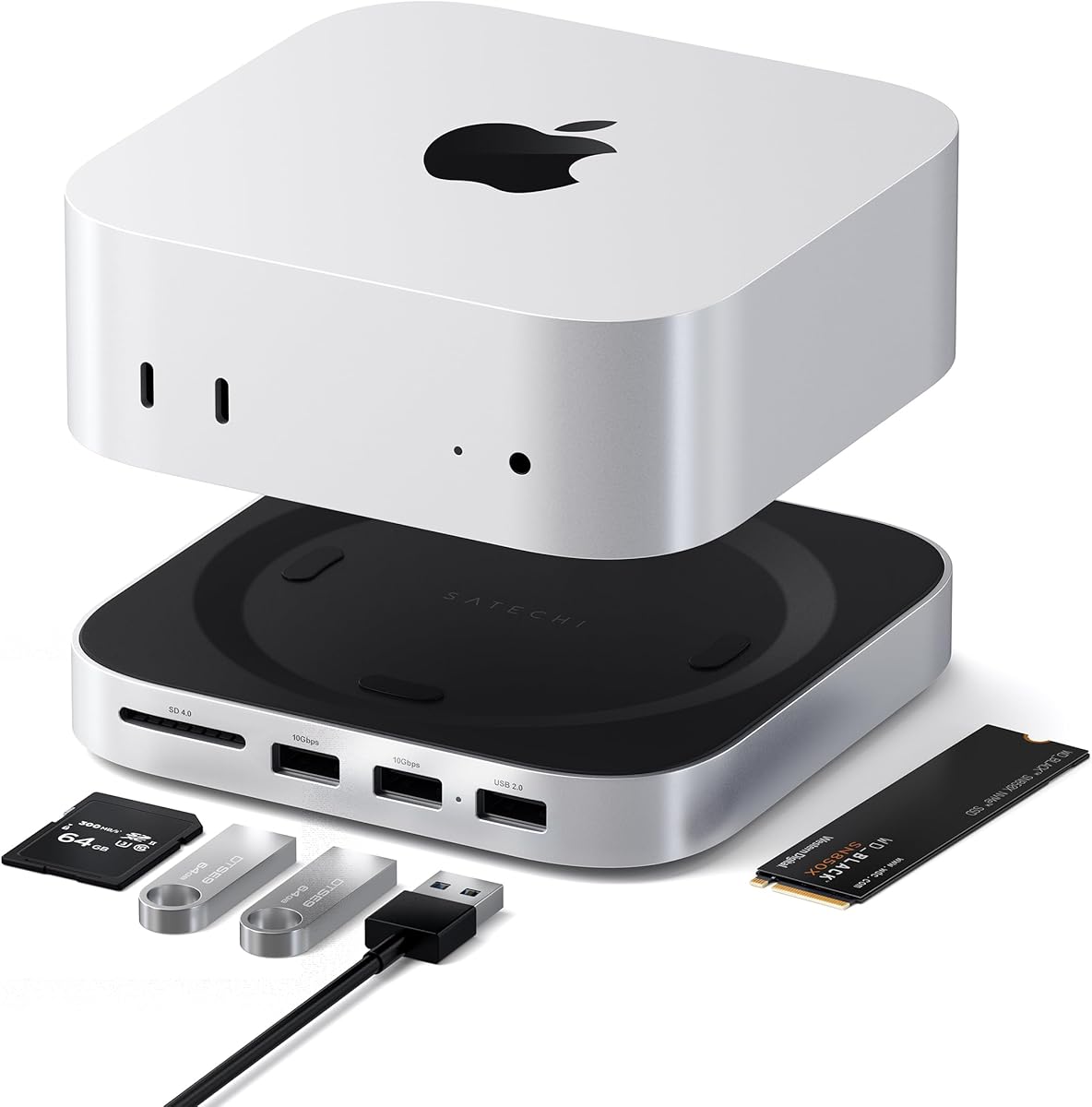
The Satechi Mac mini M6, M5 Pro, M4 Hub & Stand is a polished, compact option for users who want a refined stand with fast front-facing connectivity and local SSD expansion. It carries a 4.5 rating and is built around an aluminum enclosure, a recessed top, and a deliberately organized selection of five front ports.
We may earn a commission when you buy through this link, at no additional cost to you.
Its M.2 NVMe enclosure accepts 2230, 2242, 2260, and 2280 drives up to 4TB, with data transfer listed at up to 10Gbps. The front panel includes two USB-A 3.2 ports supporting up to 10Gbps, one USB-A 2.0 port, and a UHS-II SD card reader capable of up to 312MB/s. That combination is particularly useful for photographers and video editors who regularly move media cards.
The main drawback is that the product does not include a dedicated display output, so it serves primarily as a hub, stand, and storage enclosure rather than a complete display dock. Its compatibility notes also exclude SSDs with heatsinks and double-sided drives. These restrictions are understandable for the enclosure design but should be checked before buying a drive.
This Satechi model is best for a tidy desk where build quality, front access, a fast card reader, and simple SSD expansion matter more than monitor connectivity. It also includes a screw, screwdriver, thermal pad, and manual, and the manufacturer backs it with a two-year limited warranty. For those priorities, it is an especially polished choice.
Putting the most frequently used connections on the front reduces cable clutter and makes everyday accessories easier to attach. The restrained five-port layout avoids the congestion that can accompany larger hubs while still covering high-speed storage, basic peripherals, and memory-card transfers.
Heat-dissipating bottom vents and a recessed top are intended to preserve airflow around the Mac mini. The 5-inch-square aluminum footprint keeps the setup compact, while the supplied thermal pad and installation hardware support a straightforward enclosure setup.
We may earn a commission when you buy through this link, at no additional cost to you.
The UGREEN Mac mini Dock DP Hub is built for users who want a high-refresh external display while also gaining local SSD storage and a broad collection of USB connections. Its 4.4 rating reflects a capable general-purpose design, with the supplied specifications highlighting DisplayPort performance and a 10Gbps data path.
We may earn a commission when you buy through this link, at no additional cost to you.
The central display feature is the dock's DisplayPort output. The specifications state that the M4 supports 4K at 144Hz and the M4 Pro can reach 4K at 240Hz. A second screen can be connected through the Mac mini's built-in HDMI or Thunderbolt capabilities. The hub also provides 10Gbps USB-A and USB-C connections, SD and TF card slots, and an audio connection.
Storage support extends to 8TB through an M.2 NVMe enclosure accepting 2230, 2242, 2260, and 2280 drives. As with the other empty enclosures in this roundup, an SSD must be purchased separately. The dock has only one dedicated display output, so users seeking several outputs directly from the dock will need to use the Mac mini's native connections.
This UGREEN model makes the most sense for a high-refresh creative or gaming-oriented desk where DisplayPort is the preferred display interface. It also works well for photographers and editors who want card readers and fast USB without a separate collection of adapters. Its main caveat is that the multi-screen experience depends on a mixed dock-and-Mac connection strategy.
The advertised 144Hz M4 mode can make detailed timelines, motion graphics, and fast-paced interfaces feel more responsive. The 240Hz M4 Pro capability gives compatible owners an additional advantage, provided the monitor, cable, and application all support the selected mode.
USB-A and USB-C data connections make the enclosure practical for external media, compact storage, and accessories that still rely on traditional USB. SD and TF readers add another path for moving media, while the integrated stand helps reduce desk clutter.
We may earn a commission when you buy through this link, at no additional cost to you.
The UGREEN Mac mini Dock & Stand offers an unusually broad set of connections for a dedicated Mac mini accessory, earning a 4.5 rating. It combines an NVMe enclosure, an 11-port hub, a card reader, a short connection cable, and an elevated stand in a single enclosure designed for the Mac mini M4 family.
We may earn a commission when you buy through this link, at no additional cost to you.
The port list includes three 10Gbps USB-A 3.2 ports, two 5Gbps USB-A 3.0 ports, two 10Gbps USB-C 3.2 ports, and a UHS-I SD/TF reader listed at up to 170MB/s. The storage bay accepts NVMe drives in 2230, 2242, 2260, and 2280 sizes and supports up to 8TB. Power can come from the Mac mini or an external adapter, with the latter recommended for heavier multi-device use.
The chief limitation is the absence of a dedicated display output, making this more of a connectivity and storage dock than a monitor hub. Users also need to supply their own NVMe SSD. The generous mix of USB-A and USB-C is nevertheless useful because many accessories still rely on USB-A, while newer devices increasingly favor USB-C.
This is a strong selection for a Mac mini M4 owner who needs many peripherals, local high-speed storage, card access, and a compact stand but does not need an additional monitor connection. It balances portability, flexibility, and workspace organization particularly well, making it a practical choice for many home offices and creative desks.
The combination of five USB-A ports and two USB-C data ports covers older peripherals, modern accessories, and high-speed storage without requiring repeated adapters. Separate 5Gbps and 10Gbps USB-A options also help buyers match each device to an appropriate connection.
The dock can draw power from the Mac mini for a simpler setup or use an external adapter when several high-bandwidth devices are connected. That flexibility is useful for users who may move between a light desk setup and a more demanding workstation.
We may earn a commission when you buy through this link, at no additional cost to you.
The ACASIS 40Gbps Mac mini Dock & Stand is the most elaborate storage-focused model in the group. It supports two M.2 NVMe drives, a 40Gbps host connection, dual DisplayPort outputs, three 10Gbps USB-A ports, and SD/TF 4.0 readers. Its 3.9 rating is the lowest listed, but its specifications target demanding professional workflows.
We may earn a commission when you buy through this link, at no additional cost to you.
In RAID 0 mode, the dual-bay enclosure can combine up to 16TB and reach 2869MB/s according to the supplied information. Other modes provide up to 8TB at 1594MB/s. A 65W power adapter supports self-powered operation, which reduces the risk of disconnection, display issues, or drive failure when several components are active.
The product's two DisplayPort outputs support 4K at 144Hz on a single display or dual 4K at 60Hz displays. Two automatically activated cooling fans and side vents are designed to maintain a safe operating temperature near 60 degrees Celsius. These are meaningful advantages for sustained storage work, although the added complexity and power requirements make setup more involved than a simple single-drive hub.
Choose this ACASIS dock when local capacity, RAID flexibility, and high-speed storage are central to your work. It suits editors working with large media libraries, developers testing multiple volumes, and technically confident users who understand RAID modes. Those wanting a simpler one-bay setup may find one of the other enclosures easier to manage.
Two drive bays separate this model from most integrated enclosures and allow more capacity or RAID configurations. The listed 40Gbps host link and RAID 0 throughput are particularly relevant to large project files, though the actual result depends on the drives, file system, and workload.
Dual silent fans and an aluminum chassis are intended to control heat during prolonged storage activity. Self-powered operation through the included 65W adapter is especially important when the dock is driving displays, readers, and multiple peripherals at the same time.
We may earn a commission when you buy through this link, at no additional cost to you.
The Raycue 10-in-1 Dock is a compact stand-and-hub solution that emphasizes everyday connectivity, local NVMe expansion, and a compact footprint. Its 4.3 rating reflects a balanced accessory, and the supplied specifications describe a 10-port layout with both high-speed data and charging options.
We may earn a commission when you buy through this link, at no additional cost to you.
Its storage bay accepts M.2 NVMe drives up to 8TB in 2230, 2242, 2260, and 2280 formats, with transfer speeds up to 10Gbps. Connectivity includes two 10Gbps USB-A ports, two 5Gbps USB-A ports, one 10Gbps USB-C data port, a separate USB-C charging port, a UHS-II SD/TF reader listed at 170MB/s, and a 3.5mm audio jack.
A distinctive detail is the use of conductive paint intended to shield against 5GHz Wi-Fi interference. Bottom ventilation and a recessed top support heat dissipation, while the 20cm short cable helps keep the desk tidy. The product lacks a dedicated display output, so additional displays must use the Mac mini's built-in HDMI or Thunderbolt connections.
The Raycue dock is a good match for a Mac mini M4 user who wants a small hub, a local high-speed drive, and a neat desktop. It is especially practical when USB-C charging, card transfers, and wireless stability are priorities. Those needing direct video outputs should choose a display-equipped alternative instead.
The stand integrates storage, card access, charging, audio, and five USB data connections without requiring several separate boxes. Its short cable and recessed Mac mini placement are particularly useful where desk depth is limited or visual clutter matters.
Conductive shielding is intended to reduce interference with 5GHz wireless connections, a concern in densely equipped desks. Ventilation openings and the recessed top help manage heat as storage and multiple peripherals are used together.
We may earn a commission when you buy through this link, at no additional cost to you.
The ACASIS Mac mini Dock & Hub with 2-Bay NVMe SSD Enclosure is a strong all-round option for users who want two-drive storage and a conventional 4K display connection. Its 4.6 rating is the second highest in the roundup, and the supplied specifications indicate a balanced mix of storage, USB, display, power, and cooling features.
We may earn a commission when you buy through this link, at no additional cost to you.
The enclosure supports two NVMe SSDs and up to 16TB in RAID 0, while other modes offer up to 8TB at 474MB/s. The host connection is listed at 40Gbps, which provides ample link bandwidth for the enclosure and attached accessories. An included 65W power adapter enables stable self-powered operation and reduces potential drive or display disconnections.
Display output is provided through HDMI at up to 4K and 60Hz, rather than DisplayPort. Three USB-A 3.2 ports deliver 10Gbps performance, and the SD/TF 3.0 readers support up to 104MB/s. Two automatic fans and side vents help manage heat, making the design appropriate for sustained use with multiple drives.
This ACASIS model is a good option for creators who want redundant local volumes, a large working set, or the flexibility to use separate project and archive drives. Its simpler display output makes it more immediately approachable than a dual-DisplayPort dock, although it may be less attractive for users who want high-refresh computer-driven gaming.
Separate drives can serve different purposes, such as active projects and archival media, while RAID 0 can combine capacity for very large files. The included thermal pad, screwdrivers, and snap support installation inside the enclosure.
The HDMI output supports 4K at 60Hz for a single high-resolution monitor, which suits many editing, design, and office setups. Additional displays can be connected through the Mac mini's native Thunderbolt or HDMI capabilities when required.
We may earn a commission when you buy through this link, at no additional cost to you.
The UGREEN 8-in-1 Thunderbolt 4 Docking Station is a broader desktop dock rather than a dedicated Mac mini stand. It combines three Thunderbolt 4 ports, three 10Gbps USB-A ports, Gigabit Ethernet, display support, and host charging in a compact unit. Its 4.3 rating makes it a capable choice for expanding more than just a Mac mini M4.
We may earn a commission when you buy through this link, at no additional cost to you.
Thunderbolt 4 operates at up to 40Gbps, with one upstream connection and three downstream ports. Display configurations include dual 4K at 60Hz or a single 8K at 30Hz on supported systems. The product is also compatible with Thunderbolt 3, USB4, and USB-C devices, and it includes an 85W charging capability when paired with the supplied 140W GaN adapter.
Mac display support depends on the chip generation. MacBook systems with Pro or Max M-series chips can extend two 4K displays or one 4K display, while basic M-series systems are listed as supporting one 4K display at 60Hz. The dock is compatible with the Mac mini, but it is not compatible with the 2018 Intel Mac mini according to the supplied information.
This dock is ideal for a Mac mini M4 user who prioritizes bandwidth, networking, charging, and compatibility across multiple computers. It can also serve a laptop or tablet, making it more versatile than a fixed-form Mac mini enclosure. The trade-off is the absence of a raised stand and integrated local storage.
Three downstream Thunderbolt 4 connections support a broad range of high-speed storage, displays, docks, and accessories. The 40Gbps bandwidth is particularly useful when a workflow involves several demanding peripherals rather than only basic USB devices.
Compatibility with Thunderbolt 4, Thunderbolt 3, USB4, and USB-C systems makes this useful beyond the Mac mini. It can also act as a charging hub for compatible laptops, reducing the number of desk accessories needed in a mixed-device workspace.
We may earn a commission when you buy through this link, at no additional cost to you.
The RayCue Mac mini M6, M5 Pro, M4 Dock combines an aluminum stand, an M.2 drive enclosure, an HDMI output, USB expansion, card readers, charging, and audio. Its 4.3 rating reflects a useful general-purpose design, while the ability to accept both NVMe and SATA M.2 drives distinguishes it from several enclosures in the roundup.
We may earn a commission when you buy through this link, at no additional cost to you.
The storage section supports M.2 NVMe and SATA drives in 2230, 2242, 2260, and 2280 sizes, with capacity listed up to 8TB. Its HDMI output supports 4K at 60Hz for mirroring or extending a display. The data connections include 10Gbps USB-A and USB-C options alongside two 5Gbps USB-A ports, a dedicated USB-C charging port, SD and TF readers, and a 3.5mm audio connection.
Because the product has only one HDMI output, it directly supports one external monitor. Additional displays would need to be connected through the Mac mini's own ports. The supplied instructions also recommend connecting the rear USB-C charging port when using hard drives, reducing the likelihood of disconnection in a bus-powered setup.
Choose the RayCue dock if you want flexible M.2 drive compatibility, a 4K display, and a clean aluminum stand in one accessory. It is well suited to a general productivity desk, a compact media workstation, and users who have an older SATA M.2 drive alongside a newer NVMe model. Its limitations become relevant primarily for high-refresh or multi-display work.
Supporting both NVMe and SATA M.2 drives is useful for people upgrading from an older enclosure or maintaining a mixed drive collection. Capacity of up to 8TB makes the bay appropriate for project media, scratch files, and local backups.
The 4K60Hz HDMI connection covers a common office, creative, and entertainment resolution. USB-C charging, card readers, and an audio jack fill out the hub functions without requiring the computer's built-in ports for every peripheral.
We may earn a commission when you buy through this link, at no additional cost to you.
The M5 Retro Dock Station is the most unconventional entry in the roundup because it adds a built-in 5-inch display to a Mac mini dock. The 1280×720 screen can show notifications, monitoring applications, lyrics, a clock, photos, or other secondary information. Its 4.4 rating and retro Macintosh-inspired styling make it appealing to buyers who value character as well as utility.
We may earn a commission when you buy through this link, at no additional cost to you.
The product offers a 14-in-1 hub with USB-C, USB-A, 8K DisplayPort, HDMI input, SD and microSD readers, and an audio jack. A built-in M.2 NVMe enclosure supports 2230, 2242, 2260, and 2280 drives up to 8TB and is described as fanless. The Mac mini slides directly into the dock, helping reduce cable clutter and desk space.
Two versions are described: a 10Gbps USB-C model and a planned Thunderbolt 5 model with 80Gbps bandwidth. The supplied information states that the Thunderbolt 5 version was scheduled for an October launch, so buyers should confirm its current availability. The built-in screen's 1280×720 resolution is suitable for secondary information rather than detailed color-critical editing.
This dock is best for a creative, compact, or entertainment desk that benefits from a small status display and a deliberately retro-modern appearance. It can also work with compatible MacBook, Windows, and Android devices that support DisplayPort. It is less suitable as the primary editing monitor, but it succeeds as a distinctive multi-purpose workstation accessory.
The 5-inch display can reduce interruptions by keeping notifications, app status, or media information visible beside the main monitor. At roughly 290 PPI, it is crisp enough for compact interface elements, though its HD resolution is not intended to replace a full-size production display.
The classic enclosure references early Macintosh styling while incorporating modern storage, display, and USB connections. Integrating the Mac mini into the body also creates a more complete workstation appearance than a conventional rectangular hub.
We may earn a commission when you buy through this link, at no additional cost to you.
The right Mac mini M4 dock depends on the devices you need to connect, the displays you already own, your storage plan, and how much desk space you want to preserve. These factors help separate a practical daily hub from a specialized workstation accessory.
Begin by checking the dock's stated Mac mini compatibility and physical fit. Most of the dedicated stands in this guide are listed for M4, M5 Pro, and M6 configurations, while the broader Thunderbolt dock is compatible with Mac mini but not the 2018 Intel model. Product titles can contain several supported generations, so verify that your exact computer is included rather than assuming every recent Mac mini uses the same enclosure.
In short, match the model and form factor first, then confirm that every promised port, display mode, and accessory will actually be accessible with your Mac mini.
Consider both the capacity you need now and the type of drive the enclosure accepts. Most products support M.2 NVMe drives up to 8TB, while the two ACASIS dual-bay models support up to 16TB in RAID 0. The RayCue HDMI Dock also supports SATA M.2 drives, which can be useful if you already own that format. Note that the SSD is generally not included.
Choose single-bay models for simplicity and dual-bay models for larger libraries, separate project volumes, or RAID flexibility. Always check exclusions for heatsinks, double-sided drives, or unsupported formats.
Display requirements are among the most important compatibility checks. The 4URPC dock provides DisplayPort and HDMI, the UGREEN DisplayPort Dock uses DisplayPort for high-refresh output, the ACASIS dual-bay model uses HDMI, and the RayCue HDMI Dock has one HDMI port. Dedicated stands without video outputs, including the main UGREEN and Satechi options, rely on the Mac mini's built-in ports for displays.
Prioritize the connector and resolution your monitors require. For high-refresh use, look for the stated DisplayPort modes; for standard 4K productivity, HDMI 4K60Hz may be sufficient. Then plan how any remaining displays will connect.
A useful dock should have enough ports of the correct type and speed for your actual accessories. Legacy keyboards, mice, printers, and capture devices often need USB-A, while modern storage, docks, and high-bandwidth accessories may require USB-C. Speeds range from USB 2.0 to 10Gbps data connections, and the Thunderbolt 4 option raises host bandwidth to 40Gbps.
List your wired peripherals before buying, including any device that already occupies a Mac mini port. Favor a balanced selection rather than choosing on total port count alone.
Photographers and video editors should compare reader formats and stated transfer speeds. The Satechi stand includes a UHS-II SD reader listed at up to 312MB/s, while several UGREEN and RayCue models provide SD and TF readers around 170MB/s. The ACASIS options also include card slots, with the 40Gbps model described as using SD/TF 4.0 readers at up to 312MB/s.
Choose a reader that matches your media and workflow. Higher stated speed is useful for large media files, but the computer, card format, file system, and individual card performance can also influence real-world transfer times.
Power delivery becomes important when a dock supports multiple displays, two storage drives, high-speed USB devices, or a laptop charging function. Some products can operate from the Mac mini, while the dual-bay ACASIS models include a 65W adapter for self-powered operation. The RayCue HDMI Dock also recommends its rear charging connection when hard drives are used.
Do not assume bus power will handle every workload. For demanding setups, favor a model with explicit external power and a cooling design, such as vents, a recessed top, thermal pads, or automatic fans.
A Mac mini dock changes the computer's physical position, cable routing, and overall desk appearance. Dedicated stands generally keep the Mac mini elevated and aligned with the hub, while short cables reduce visible clutter. The RayCue 10-in-1 model uses a 20cm cable, the UGREEN stand includes a 4cm short cable, and the Retro Display Dock integrates the Mac mini into a larger vintage-inspired body.
Choose the form that suits your workspace. A compact aluminum stand is easier to blend into a minimalist office, while the Retro Display Dock functions as a visible centerpiece as well as a technical accessory.
Installation hardware and support can make a meaningful difference in a stand-based enclosure. The Satechi model includes a screw, screwdriver, thermal pad, manual, and a two-year limited warranty. Both ACASIS dual-bay docks include a 40Gbps cable, power adapter, PD cable, screwdrivers, SSD snap, thermal pad, and manual, along with stated repair or replacement coverage for qualifying defects.
Check the box contents before ordering, especially if you require a particular cable, adapter, or installation tool. Warranties and included accessories can also distinguish otherwise similar products.
Start by placing the dock on a stable, level surface and reviewing its compatibility notes. Install the Mac mini carefully, connect the dock with its supplied cable, and add an NVMe or SATA M.2 drive only when the dock is powered down. If the enclosure requires a thermal pad, screw, or snap, install those components according to the manual rather than forcing the drive or cover into place.
Connect displays through the dock or the Mac mini's native outputs, then attach storage, card readers, audio equipment, and USB accessories. Use external power when the product instructions recommend it, particularly with multiple drives, several high-speed peripherals, or a hard drive in the RayCue HDMI Dock. Check display resolution and refresh rate in macOS after connecting a monitor, and confirm the selected output in system display settings.
For daily care, keep vents and card slots free of dust and avoid stacking the Mac mini or accessories in a way that blocks airflow. Never insert or remove SSD modules while a powered dual-bay enclosure is active. Disconnect the dock before changing storage hardware, and use the provided troubleshooting guidance if a display, drive, or connection fails to appear.
No. The enclosures in this roundup are generally sold without an M.2 SSD, so you need to purchase a compatible drive separately. Most support NVMe drives in 2230, 2242, 2260, and 2280 formats, while the RayCue HDMI Dock also supports SATA M.2 drives. Check heatsink and double-sided drive exclusions before purchasing.
No. Multi-monitor support varies substantially across the list. The 4URPC, UGREEN DisplayPort, and ACASIS products provide dedicated display outputs, but other hubs rely on the Mac mini's built-in HDMI and Thunderbolt ports. Even with a multi-port dock, exact resolutions and refresh rates depend on the Mac mini model, macOS, connected displays, and cables.
It depends on the dock and workload. Some models can draw power from the Mac mini, while dual-bay ACASIS docks include a 65W adapter for stable self-powered operation. The RayCue HDMI Dock recommends connecting its rear USB-C power port when using a hard drive. Follow the included instructions whenever the manufacturer specifies external power.
The main differences are physical connector shape and device compatibility, not the stated maximum data rate in these docks. USB-A suits many keyboards, mice, and legacy accessories, while USB-C supports newer devices, power delivery, and compact high-speed storage. Choose a dock with a mix of both when your equipment includes older and newer peripherals.
It can improve workflows that depend on fast local storage, such as editing large media, moving project files, or maintaining a local scratch library. It does not increase the processing speed of the Mac mini itself. Actual performance depends on the SSD, file system, application behavior, thermal conditions, and how quickly the source files are accessed.
Compatibility varies. The Satechi enclosure specifically lists double-sided drives and SSDs with heatsinks as incompatible, while other products use different enclosure designs. Check the full drive restrictions for the exact model, and avoid assuming that every M.2 NVMe drive will physically fit or operate correctly.
Yes. The supplied specifications list the Mac mini as compatible, while also noting that the 2018 Intel Mac mini is excluded. The dock provides Thunderbolt 4, USB-A, Gigabit Ethernet, display, and charging functions, but it is a conventional desktop dock rather than an elevated Mac mini stand with an integrated SSD enclosure.
First confirm that the dock has the exact display connector your monitor requires, then verify the supported resolution and refresh rate. You should also account for the Mac mini's native HDMI or Thunderbolt connection, macOS display support, cable quality, and whether the dock requires external power. This prevents a mismatch between the dock's advertised features and the final multi-screen setup.
The 4URPC 13-in-1 Dock is the strongest all-around option, combining 8TB NVMe expansion, extensive USB connectivity, card readers, audio, and both DisplayPort and HDMI. The UGREEN Dock & NVMe Stand stands out for its broad and accessible port mix, while the Satechi NVMe Hub Stand offers refined aluminum construction, fast front access, and a UHS-II reader.
Prioritize the features your setup genuinely needs. Multi-drive storage matters for large media libraries, high-refresh display outputs matter for specialized visual work, and a simple card reader plus USB hub may be enough for a clean productivity desk. Also consider power requirements, cooling, drive restrictions, and whether the dock's footprint suits your workspace.
Ratings, product availability, included accessories, and market prices can change over time, so check the current listing before making a final decision. Comparing the exact Mac mini model, monitor connectors, peripherals, and storage format against the product's specifications will help you choose a dock that remains useful rather than merely feature-heavy.