
8FT 16/2 Tool Power Cord
4.5Editor score
Eight-foot flexible replacement cord
Compatible with table saws
Rated for ten to fifteen amps
Explore the best power cord replacement for table saw options, comparing gauge, length, grounding, plug type, construction, and tool compatibility.
A damaged table saw power cord can interrupt a project, conceal internal wear, and create an avoidable electrical hazard. A suitable replacement should match the saw’s voltage, current requirements, connector configuration, and grounding arrangement while providing enough length and flexibility for safe operation.
The products in this guide are compared using their stated wire gauges, conductor counts, plug configurations, lengths, electrical ratings, jacket materials, and compatibility details. The list includes general-purpose cords, heavy-duty grounded pigtails, polarized two-wire options, and a saw-specific Skilsaw replacement.
Each review explains where the cord is strongest, which installation details deserve attention, and who should consider it. Ratings reflect the supplied customer feedback, while product specifications and compatibility claims remain subject to manufacturer details; prices and availability can change over time.
4.5Editor score

5.0Editor score
4.7Editor score
This side-by-side comparison highlights the key differences in conductor count, gauge, length, plug arrangement, and stated tool compatibility so buyers can identify a plausible replacement without overlooking the electrical requirements of their table saw.


The 6FT 12/3 SJT Heavy Duty Replacement Power Cord for Tools & Appliances is the most broadly convincing option in this guide. It carries a 5.0 rating and is explicitly described as suitable for table saws, while its three-conductor, twelve-gauge construction offers reassuring capacity for a workshop machine that may draw substantial current.
We may earn a commission when you buy through this link, at no additional cost to you.
Its core advantages are practical rather than decorative. The pure copper conductors, fifteen-amp capacity, and 110–125V rating make the cord appropriate for demanding 120V equipment, while the standard NEMA 5-15 plug supports a familiar grounded connection. A reinforced cord root and abrasion-resistant SJT jacket target the bending, pulling, and impact that occur when a saw cord is moved around a bench.
There are trade-offs. At six feet, it may provide less reach than the eight- and ten-foot choices, and the stripped pigtail requires wiring rather than offering a fully molded tool-side connection. Those points are acceptable for a table saw positioned near a dedicated outlet, especially when stronger conductor capacity and grounding are priorities.
This is the strongest all-around choice for a DIYer or professional workshop that needs a general replacement cord without tying the purchase to one saw brand. Buyers should still compare the original saw wiring, terminal arrangement, and nameplate requirements before installation, but the listed electrical specifications make this a logical first candidate.
The twelve-gauge, three-conductor format gives this cord more carrying capacity than the lighter alternatives in the list. That distinction can matter on a table saw equipped with a larger motor or operated for extended periods, provided the saw itself is rated within the cord’s fifteen-amp capacity.
The NEMA 5-15 plug and bare pigtail give the installer a conventional grounded setup. The open end is useful for matching the saw’s internal terminals, but the wiring should be completed correctly and according to the manufacturer’s instructions.
We may earn a commission when you buy through this link, at no additional cost to you.
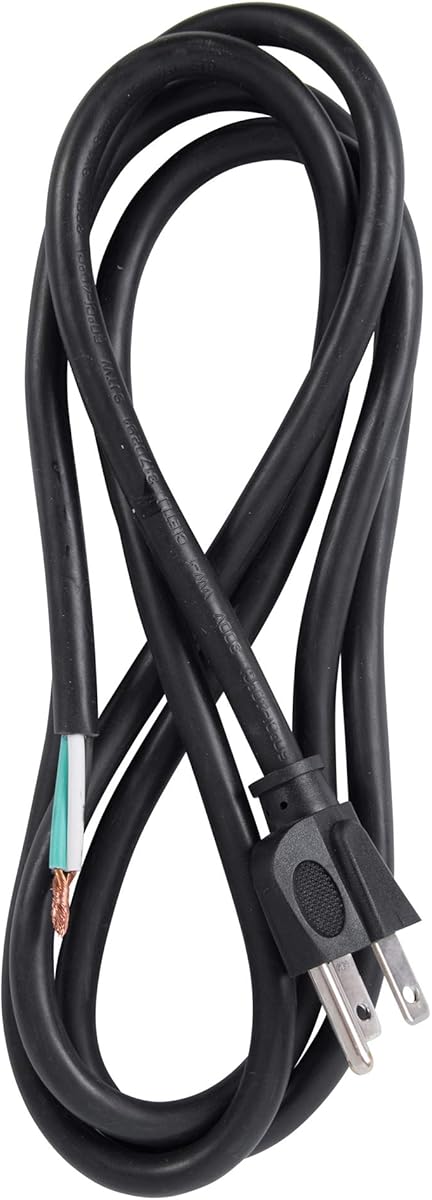
The 8FT 16/2 Power Cord Replacement is a budget-oriented option with a 4.5 rating. It is advertised for an unusually broad collection of tools and appliances, including table saws, making it a convenient candidate for users who want one replacement cable for several pieces of workshop equipment.
We may earn a commission when you buy through this link, at no additional cost to you.
Its eight-foot length gives the saw more freedom to move than a six-foot cord, while the molded 115V construction is presented as a simple way to restore a machine with a damaged lead. The stated ten-to-fifteen-amp range and minimum 1,100-watt capacity provide useful context, although buyers should ensure the table saw does not exceed the cord’s rating.
The main limitation is its 16/2 construction. It has fewer conductors and a lighter gauge than the 12/3, 14/3, and heavy-duty grounded options. Grounding configuration is not made as explicit in the supplied description, so a buyer should check the original cord and plug carefully rather than assuming the replacement will be interchangeable.
For a modest workshop, a smaller saw, or a secondary tool where the listed electrical demands remain comfortably within the cord’s specifications, this is a sensible economical selection. For a high-current table saw or a location where a grounded cable is essential, one of the heavier three-conductor cords may be the wiser investment.
The listed applications extend well beyond table saws to drills, sanders, vacuums, miter saws, and other common workshop machines. That broad scope makes the cord more versatile for a multi-tool repair kit.
A universal-looking replacement still has to match the saw’s connector and conductor arrangement. Comparing the plug, wire count, and internal terminals before purchase can prevent a frustrating return or an incorrect connection.
We may earn a commission when you buy through this link, at no additional cost to you.
The 95104L Heavy-Duty Replacement Power Cord is a 4.5-rated, model-specific option for numerous Skilsaw worm drive models. Its eight-point-two-foot length, three bare wires, and three-prong arrangement make it relevant when the saw in question belongs to the listed compatibility group.
We may earn a commission when you buy through this link, at no additional cost to you.
This cord stands apart because the package includes a saw cord guard and provides specific model references. The installation guidance also recommends photographing the original connections and paying close attention to wire routing, which reflects the reality that a visually similar cord may still require careful reassembly.
Compatibility is the decisive limitation. The listed saws are worm drive models rather than general table saws, so this should not be selected for a table saw merely because both products are cutting tools. The supplied information also describes equal insulation thickness as a feature intended to reduce leakage and insulation breakdown, but it does not provide a table-saw-specific amperage figure.
It is a strong choice for a compatible Skilsaw owner who wants a model-specific replacement and includes the guard. For an actual table saw, consider it only after confirming that the model, connector, wire routing, and electrical requirements are identical to the machine being repaired.
The product lists models including SPT78W, SPT70WM, SPT78MMC, SPT77W, SPT77WM, SPT77WML, SPT70V, SPT55, and HD77-02. Precise model checking is more reliable than assuming every similarly styled saw uses the same cord.
A separate saw cord guard adds useful installation support. Photographing the original wire layout remains a sensible precaution because retaining that layout can simplify reassembly and reduce connection errors.
We may earn a commission when you buy through this link, at no additional cost to you.
The 10ft 14 Gauge 3 Prong Heavy Duty Replacement Power Supply Cord combines a 4.7 rating with a lengthy, grounded configuration. Its ten-foot length is the longest among the listed products, giving a table saw more freedom to move when the outlet is not directly beside the machine.
We may earn a commission when you buy through this link, at no additional cost to you.
The fourteen-gauge, three-conductor cable is rated for fifteen amps and described as UL approved, with a 300V, VW-1, 105-degree SJT construction. Fine-stranded copper is intended to support flexibility and reliable power transfer, while the three-wire grounded arrangement is well suited to tools that use a standard NEMA 5-15 outlet.
This pigtail is less convenient than a molded replacement because the bare end has to be connected to the saw’s internal leads. Its stated thickness of 0.37 inches may also create routing considerations around compact switch housings. Neither issue undermines the cable’s value, but both deserve attention before ordering.
This is an attractive option for a table saw set farther from an outlet or for users who prioritize reach and a clearly stated heavy-duty rating. It also works well for broader workshop use, including grinders and appliances, provided each connected device remains within the cord’s electrical limits.
Ten feet can make a meaningful difference when a saw shares an outlet with other equipment or sits on a mobile stand. It reduces the need for extension cords and helps keep the power lead out of walking paths and around moving stock.
The stated UL approval, temperature rating, wire gauge, and conductor count provide a clearer specification profile than many general-purpose replacements. Those details remain useful when matching the cable to a table saw’s manufacturer requirements.
We may earn a commission when you buy through this link, at no additional cost to you.
The 6.5FT 18 AWG Power Tool Replacement Cord is a 4.6-rated alternative distinguished by its rubber construction. The jacket is described as resistant to heat, oil, weather, and wear, while retaining flexibility in cold and hot conditions—useful characteristics in garages and active workshops.
We may earn a commission when you buy through this link, at no additional cost to you.
The pre-stripped ends simplify connection to the tool, and a matching rubber strain-relief boot reinforces the point where the cable experiences the most pulling and bending. The product emphasizes Makita and Craftsman saw compatibility, although its broader construction can suit other equipment when dimensions and electrical requirements align.
The main concern is the eighteen-gauge wire, which is the lightest construction in this guide. It offers less theoretical current capacity than twelve- and fourteen-gauge grounded alternatives. The supplied information does not give a specific amperage figure for this product, so the table saw’s own requirements should determine whether it is appropriate.
It is most compelling for a smaller saw with a low draw, a repair involving a matching connector, or a user who values flexibility and strain relief over maximum conductor bulk. The compact six-point-five-foot length may also make internal routing easier than a longer cable.
Rubber is highlighted as a better-suited material for certain harsh conditions than ordinary PVC. Its stated resistance to heat, oil, moisture, abrasion, and temperature extremes makes it appealing for mobile tools and garage environments.
The reinforced boot protects the transition between the cord and tool, where repeated movement can fatigue the conductors. Correct positioning helps preserve that protection after the saw is reassembled.
We may earn a commission when you buy through this link, at no additional cost to you.
The 2 PCS 6FT 18AWG Power Tool Cord package is a 5.0-rated choice that includes two six-foot replacement cords. That makes it convenient for a workshop with more than one damaged tool or for keeping a spare on hand, particularly when miter saws, drills, and other common equipment are also in service.
We may earn a commission when you buy through this link, at no additional cost to you.
Both cords use flexible SJT cable with durable black insulation, and the product is described as oil and water resistant. The polarized two-prong plug is designed to support consistent orientation, while the stated ten-to-fifteen-amp range and 1,625-watt capacity offer a clear capacity framework for compatible tools.
The two-conductor design is the decisive caveat. Without a ground conductor, it should not be assumed appropriate for a table saw that originally used a grounded three-wire cord. Eighteen-gauge wire is also lighter than the heavier alternatives, so users should avoid stretching its application beyond the manufacturer’s current and temperature guidance.
For a compatible ungrounded tool, this package offers useful value and a spare. It can also work for a table saw only if the original cord was two-wire, the saw’s manufacturer permits that configuration, and the electrical load remains safely within the cord’s ratings.
The two-pack format reduces the need to buy another replacement after the next cord is cut or pinched. It is especially practical for users maintaining several portable tools with compatible connectors.
A polarized plug controls orientation but does not create a protective ground. If the saw has a three-prong receptacle or a grounding screw, a two-wire replacement may be electrically and structurally inappropriate.
We may earn a commission when you buy through this link, at no additional cost to you.
The 8-Feet 16/2 Replacement Power Supply Cord is a 4.7-rated option centered on installation convenience. It features pre-cut connectors at the ends, allowing a straightforward swap when the tool’s connector matches, and the description positions it for table saws among many other workshop devices.
We may earn a commission when you buy through this link, at no additional cost to you.
Its eight-foot length balances reach and compactness, while the injection-molded 115V construction is described as sturdy, moisture resistant, and resistant to aging. The ten-to-fifteen-amp current range and minimum 1,100-watt load establish a basic capacity envelope for compatible equipment.
As with the other 16/2 options, conductor count and gauge are the main limitations. The product data does not clearly specify whether the supplied connection includes grounding, and a two-conductor cable is not a drop-in substitute for a three-conductor grounded table saw lead. The saw’s manual and original wiring are therefore essential references.
This cord is best for a compatible table saw with a matching pre-molded connection, especially when quick replacement matters more than maximum conductor size. The 4.7 rating and stated testing make it a credible general workshop option, but electrical fit should take priority over convenience.
Pre-cut connectors remove much of the terminal work associated with a bare pigtail. The repair can be quicker and less error-prone when the new connector exactly matches the saw’s factory-style lead.
The listed applications include drills, miter saws, circular saws, sanders, grinders, vacuums, compressors, motors, and lighting equipment. That flexibility makes it a practical addition to a multi-tool maintenance inventory.
We may earn a commission when you buy through this link, at no additional cost to you.
The 9.8FT Replacement Power Cord 664463-0 is the highest-rated cord in this comparison at 4.8. It combines a fairly substantial fourteen-gauge conductor with nearly ten feet of length, making it an interesting option for a table saw that previously used a polarized two-wire connection.
We may earn a commission when you buy through this link, at no additional cost to you.
The polarized US-style plug helps maintain consistent orientation, and the cord includes rubber strain relief to protect the connection from pulling and flexing. The manufacturer states that the insulation thickness has been tested for leakage and breakdown concerns and that the construction meets OEM standards.
Its key limitation is the two-wire design. Despite the heavier gauge, a polarized two-prong plug does not provide equipment grounding, so this is not an automatic choice for a grounded table saw. The connector also needs to be verified; a similar plug shape does not guarantee that the internal lead and strain relief will fit the saw’s housing.
It is a strong choice for a compatible ungrounded saw because of its length, gauge, and strong customer feedback. For a grounded machine, select a three-conductor 14/3 or 12/3 alternative instead. In either case, compare the original connector and follow the tool manufacturer’s replacement instructions.
The fourteen-gauge wire gives this option more carrying capacity than typical eighteen-gauge replacement cords. That can be advantageous when the load is within its rating, even though the absence of a ground conductor remains the deciding limitation.
The 9.8-foot length provides ample distance between the saw and outlet. It can improve positioning flexibility and reduce the need to stretch an extension cord across a busy workshop floor.
We may earn a commission when you buy through this link, at no additional cost to you.
The 95104L for SKILSAW Saw Replacement Cord is a 4.3-rated option aimed at a specific group of helical- and worm-drive saws. Its 8.1-foot length, three bare wires, and three-prong plug are paired with fourteen-gauge construction, giving it a more substantial profile than the lighter general-purpose cords.
We may earn a commission when you buy through this link, at no additional cost to you.
The listed compatibility includes SPT77W, SPT77WM, SPT77WML, SPT78W, SPT70WM, SPT78MMC, SPT70V, SPT55, and HD77-02. The product is described as having undergone strict quality testing for lasting performance, and its three-wire configuration provides a grounded option for a compatible saw.
As with the other Skilsaw-specific cord, the machine must match the stated model group. Although the construction is rugged, the lowest rating in this guide—though still solidly positive—suggests a buyer should pay close attention to the detailed listing and connector dimensions. Bare-wire pigtail installation also requires care to preserve the original routing.
This is a practical choice for a compatible Skilsaw owner, not a general table saw option. Its fourteen-gauge grounded construction could be attractive for a saw with matching specifications, but model confirmation is essential. For other table saws, the longer three-conductor choices in this guide provide more directly stated applications.
The three-wire pigtail and three-prong plug offer a grounded structure for compatible equipment. The fourteen-gauge conductors also provide a useful middle ground between compact eighteen-gauge cords and the maximum capacity of the twelve-gauge selection.
The product guidance appropriately recommends replacing a cord that has been cut, scratched, internally damaged, or fitted with a broken plug. Continuing to operate a saw with compromised wiring can increase the risk of shock and should not be treated as a temporary maintenance issue.
We may earn a commission when you buy through this link, at no additional cost to you.
The nVent GARDNER BENDER PS615143 is a 4.7-rated premium choice for buyers who want a well-documented, heavy-duty replacement cord. Its fourteen-gauge, three-conductor SJTW construction supports up to fifteen amps at 125 volts and 1,875 watts, specifications that are unusually clear for this product category.
We may earn a commission when you buy through this link, at no additional cost to you.
The grounded NEMA 5-15 plug and pigtail end fit a conventional repair arrangement. The weather-resistant jacket is designed to withstand moisture, sunlight, abrasion, cracking, and fraying, making the cable suitable for indoor workshops as well as exposed repair environments. Applications include motors, workshop tools, kitchen appliances, and other 120V equipment.
The six-foot length is the main positional drawback, and the pigtail end must be connected to the tool. A branded product may also cost more than generic alternatives, but the stated electrical limits, SJTW jacket, and grounded construction provide a clearer basis for a premium comparison. Packaging may say Bergen because of a branding transition, while the product design and specifications remain unchanged.
For a table saw that uses a grounded three-prong connection and stays within the stated current and wattage limits, this is a refined premium choice. It is particularly attractive for users who value a recognized manufacturer and a clearly stated outdoor-capable jacket rather than a minimal generic repair lead.
The stated fifteen-amp, 125-volt, and 1,875-watt limits make it straightforward to compare this cord with a table saw’s nameplate data. Staying within those limits is an essential part of selecting a safe replacement.
The weather-resistant jacket adds useful protection in garages, outdoor work areas, and locations where sunlight or moisture may reach the cable. It also reinforces the cable against the abrasion and cracking common around mobile workshop equipment.
We may earn a commission when you buy through this link, at no additional cost to you.
Choosing a replacement power cord for a table saw requires balancing electrical capacity, grounding, connector compatibility, cord length, jacket durability, and safe installation rather than focusing on any single specification.
Wire gauge determines how much current a cable can carry without excessive voltage drop or heat buildup. In this list, 18 AWG is the lightest construction, 16 AWG is intended for lower-to-moderate loads, and 12/3 or 14/3 cables provide greater headroom. Check the table saw’s nameplate current, motor configuration, and the manufacturer’s required cord specification before making a choice.
The replacement should not be rated below the operating requirements of the saw. More copper is not automatically better in every installation, but it becomes important when a motor draws high current, operates for long periods, or sits on a shared circuit with other heavy workshop equipment.
A three-conductor cord includes hot, neutral, and ground conductors, while a two-conductor cord omits the protective ground. Most grounded table saws use a three-prong connection, and replacing that setup with a two-wire lead can remove an important safety feature. Never assume a polarized two-prong plug is equivalent to grounding.
Match the replacement’s conductor count to the original equipment whenever possible. If the saw has a three-prong receptacle, grounding screw, or manufacturer-specified grounded lead, prioritize a three-wire pigtail with a compatible NEMA 5-15 plug.
A replacement must fit both the wall outlet and the saw. Pigtails provide flexibility because the installer can connect the conductors to the saw’s terminals, but molded tool-side connectors can be faster if their shape, pin arrangement, and strain relief exactly match the original.
Compare photographs and measurements rather than relying only on the product category. Verify whether the connector enters the tool housing in the same orientation, whether a switch or strain-relief assembly must be retained, and whether the cable diameter can pass through the existing opening.
Most household table saws operate on 120V nominal power, but the exact voltage markings and current requirements can vary by model. A replacement should be used only within its listed electrical ratings. The ten-foot fourteen-gauge cord is described as 15 amps and 300V, while the premium six-foot cord is specified at 15 amps, 125 volts, and 1,875 watts.
Wattage is a useful cross-check because it combines voltage and current into the amount of power the cable can deliver. If the saw’s requirements are unclear, consult its manual or a qualified electrician rather than estimating from the cord’s physical thickness alone.
Cord length affects positioning, reach, and cable management. Six-foot options are compact and easier to route inside narrow tool housings, while eight-, 9.8-, and ten-foot cords offer more freedom between the saw and outlet. The best length is the shortest one that still allows the saw to sit safely without pulling the cable taut.
Extra length can encourage users to stretch the cord across walking areas. A more manageable cable may be preferable to a longer one, especially when a proper grounded outlet can be positioned closer to the saw.
SJT, SJTW, and rubber-style jackets offer different balances of flexibility, abrasion resistance, and environmental resistance. The rubber option in this guide is highlighted for remaining flexible in temperature extremes, while the SJTW premium cord emphasizes resistance to moisture and sunlight. Flexible construction is especially helpful during tool movement and repeated bending.
Consider how the cord is handled, dragged, coiled, and exposed to dust, oil, or weather. A tougher jacket can improve longevity, but it cannot compensate for a gauge, connector, or grounding arrangement that does not match the saw.
The point where the cable meets the tool experiences repeated bending and pulling. A molded strain relief or reinforced boot can protect the conductors, while a quality pigtail allows the installer to reproduce the original wire routing without imposing stress on the terminals.
Before installation, photograph the original connections and note which conductor goes to each terminal. Secure the cable so it does not bear weight when the tool is moved, and avoid creating sharp bends immediately at the strain-relief section.
Model-specific cords can be convenient when the saw is listed, as with the two 95104L Skilsaw options, but they are not automatically suitable for other machines. General-purpose replacements often list a wide range of tools, yet those lists do not replace checking connector dimensions and electrical ratings.
For a compatible model-specific cord, verify the complete model designation and included components. For a universal-looking option, compare the original cord’s conductor count, gauge, length, plug, and tool-side connection before ordering.
Begin by unplugging the table saw and verifying that the outlet is de-energized before removing any wiring. Photograph the original cord, terminals, connectors, and wire routing. Compare the new cord’s conductor count, plug, cable diameter, and electrical ratings with the original before making changes.
Follow the saw manufacturer’s wiring diagram, or seek qualified electrical assistance if the terminal markings are unclear. Connect the corresponding conductors, secure them as directed, and preserve the original strain relief and wire path. Avoid twisting bare conductors together without an appropriate connection method, and do not leave an exposed copper connection inside the tool housing.
After installation, inspect the repair for loose strands, pinched insulation, exposed copper, and strain on the terminals. Reassemble the switch, connector cover, and strain-relief components before energizing the saw. Route the cable away from blades, sharp edges, moving stock, and standing water, and replace it immediately if the jacket, plug, or conductors become damaged.
The correct cord depends on the saw’s voltage, current, grounding, connector, and manufacturer specifications. Most residential table saws use a 120V system and may require a grounded three-conductor lead, but the saw’s nameplate and manual are the authoritative sources. Match or exceed the required electrical capacity without exceeding any connector or tool limitation.
It is generally not advisable unless the saw manufacturer explicitly allows that configuration. A two-prong cord lacks a protective ground, while a three-prong connection may be part of the saw’s safety design. If the original cord was three-wire, replace it with a compatible grounded cord or have a qualified electrician assess the installation.
A 14 AWG cable generally has greater current-carrying capacity and is a better choice when the table saw’s requirements support it. An 18 AWG replacement is more appropriate for lighter loads or tools designed for that construction. Always follow the saw manufacturer’s stated cord specification rather than choosing solely by appearance.
A cord should let the saw sit in a safe working position without being stretched or pulled taut. Six feet can suit a saw near an outlet, while eight to ten feet may provide better flexibility in a larger shop. The best length is the shortest one that provides safe reach and avoids extension cords across the floor.
A DIY installation may be manageable for someone with basic wiring knowledge if the saw’s manual provides clear instructions and the replacement matches its requirements. Photographing the original connections, identifying each wire, and preserving the strain relief are important. If the terminals are unclear, the saw has unusual wiring, or the replacement changes grounding, consult a qualified electrician.
Common causes include pinching between the saw and a wall, cutting or abrasion from sharp edges, repeated bending near the tool housing, pulling during use, and age-related jacket cracking. Internal conductor damage can exist even when the outer jacket looks intact. Replace a cord that is cut, scorched, cracked, excessively flexible, or no longer reaches safely.
Yes, strain relief helps protect the conductor-to-tool connection from bending and pulling. It may be integrated into a molded tool-side connector, supplied as a separate boot, or built into the saw housing. The new cord should follow the original routing and terminate at the strain relief so that the cable is not repeatedly flexed at the terminals.
Only if the connector, conductor count, wire gauge, voltage, current rating, and internal connection arrangement are compatible. The mere fact that two products are saws does not make their cords interchangeable. Model-specific listings should be treated as a starting point for comparison, with the actual machine and its manual controlling the decision.
The 6FT 12/3 SJT Heavy Duty Cord is the strongest overall choice because it combines a five-star rating, substantial three-conductor construction, a grounded NEMA 5-15 plug, and explicit table saw compatibility. The 8FT 16/2 Tool Power Cord is the budget choice for compatible applications, while the nVent GARDNER BENDER cord is the premium pick for its clearly documented electrical limits and weather-resistant SJTW jacket.
Prioritize the table saw’s original wiring before considering length, convenience, or brand. Confirm voltage, current, wattage, conductor count, grounding, plug type, and connector dimensions. A heavier cable is not useful if it cannot fit the tool, and a convenient molded connector is not a bargain if it changes the grounding arrangement or exceeds the saw’s requirements.
Finally, confirm the current listing, manufacturer information, included accessories, and availability before purchasing because specifications and prices can change. The right replacement restores safe, predictable power delivery while preserving the saw’s original electrical design, and it should arrive with enough length and routing flexibility for a tidy workshop installation.