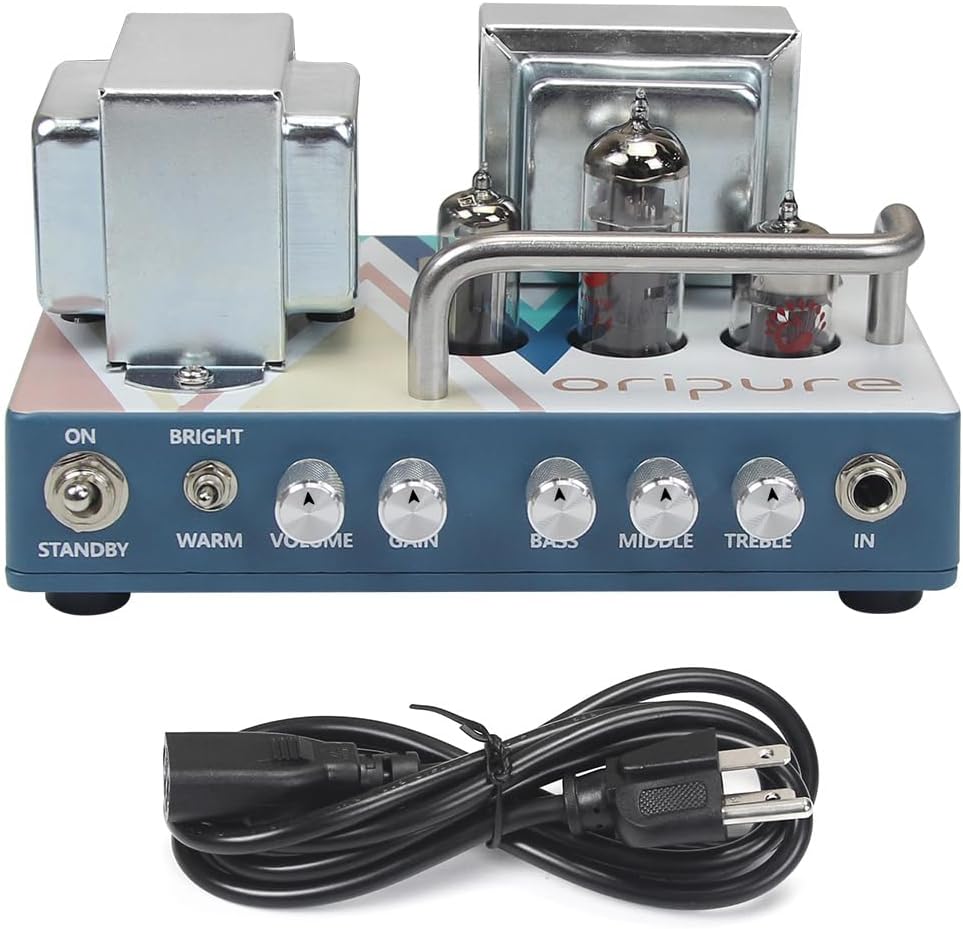
OriPure OA-H05
4.2Editor score
Compact five-watt head
Single-ended output stage
Detailed tone controls
Our Low Wattage Tube Amps guide compares ten compact, low-output tube amplifiers, highlighting tone, control options, connectivity, build, and ideal use cases.
Low wattage tube amps appeal to guitarists who want expressive dynamics, harmonic character, and manageable volume without sacrificing the organic response associated with vacuum-tube design. A compact five-watt model can sound rich at home, while slightly higher-output models can cover rehearsals and small stages. The best choice depends on tone, room volume, speaker compatibility, and how much control the player needs.
We compared all ten products using their supplied specifications, focusing on output power, tube configuration, control layout, speaker or source connectivity, included features, and intended application. The list includes dedicated guitar combos and heads, compact hybrid designs, and tube-based home-audio amplifiers. This distinction matters because a home stereo amplifier and a guitar amplifier serve very different roles even when both use low-output vacuum tubes.
Each review explains the product's strongest qualities, practical limitations, and likely audience, while the comparison table makes the core differences easier to scan. The leading choices are the Bugera V5 INFINIUM for a balanced guitar-amp package, the OriPure OA-H05 for focused low-wattage design, and the Oldchen EL34 for premium single-ended home amplification. Product availability and pricing change, so confirm current details before purchasing.
4.2Editor score

4.6Editor score

4.5Editor score
This side-by-side overview covers ten tube-based amplifiers and highlights their power, tube configuration, principal controls, connectivity, and most appropriate application. Five models target electric guitar directly, while the others serve home audio, compact practice, or hybrid amplification needs.



The Bugera V5 INFINIUM is the most complete conventional guitar amplifier in this group, combining a five-watt Class-A tube design, an eight-inch Turbosound speaker, reverb, and a power attenuator in one package. Its 4.6 rating reflects a generally favorable reception, while the combination of an EL84 power tube and 12AX7 preamp tube gives it a traditional valve-amp foundation suited to clean blues and crunch.
We may earn a commission when you buy through this link, at no additional cost to you.
Its principal strength is straightforward usability. A guitarist can connect an instrument and begin playing without separately sourcing a cabinet, while the power attenuator provides a way to reduce output for lower-volume situations. The vintage-inspired preamp and Class-A power stage should appeal to players seeking harmonic richness and touch-sensitive response rather than a feature-heavy solid-state practice amp.
The fixed speaker and limited connectivity mean it is less flexible than a modern head-and-cabinet system. Players who need extensive effects, digital recording connections, or speaker-cabinet flexibility may eventually want a different route. Within a small five-watt combo, however, these limitations are understandable, and the integrated design remains highly practical for home practice and recording.
This is the pick for most guitarists seeking a low-wattage tube amp in a ready-to-use format. It offers a more complete and refined solution than a basic practice head, yet it remains appropriately restrained for domestic use. For players who prioritize traditional response, built-in speaker convenience, and straightforward operation, the V5 INFINIUM is the strongest general choice here.
The five-watt Class-A output is small enough for close-range practice, yet the power attenuator gives players additional control when they need an even quieter level. This makes the V5 adaptable to apartments, studios, and other shared spaces.
The EL84 power tube and 12AX7 preamp create a conventional valve-amp signal path. That heritage-oriented design favors interaction, harmonics, and the broad range from purring blues tones to crunch.
We may earn a commission when you buy through this link, at no additional cost to you.
The Fender 68 Custom Vibro Champ is a five-watt tube guitar amplifier built around a single 6V6 power tube and two 12AX7 preamp tubes. With a 4.4 rating and Fender's recognizable design, it stands out for players who value a traditional amplifier identity as much as they value low output. The speaker format reinforces its boutique, focused character.
We may earn a commission when you buy through this link, at no additional cost to you.
Its control set is more granular than that of many compact tube amps. Volume, treble, bass, reverb, speed, and intensity give the player meaningful influence over both the core voice and the reverb environment. Speed changes the character of the reverb sweep, while intensity adjusts its depth, making it possible to move from a subtle glow to a pronounced vintage ambience.
The 6V6-based output stage is a notable alternative to the common EL84 arrangement. Tone character is ultimately subjective, but using a different power-tube family gives the amplifier a potentially distinct response. The trade-off is that it does not offer the digital features, loop, or wireless connectivity found on several contemporary compact models.
Choose the Vibro Champ if you want a compact tube amp with carefully presented vintage styling, detailed reverb controls, and a classic power-tube format. It is especially appropriate for blues, classic rock, and clean-to-edge-of-breakup playing. Its five-watt output makes it best suited to intimate rooms rather than stages that require greater headroom.
Separate speed and intensity controls make the internal reverb more useful than a simple on-or-auxiliary effect. The player can shape the decay and depth without reaching for an external pedal.
The single 6V6 power tube and pair of 12AX7 preamp tubes create a valve layout that feels traditional and distinctive. It is an appealing choice for players interested in classic amplifier character.
We may earn a commission when you buy through this link, at no additional cost to you.
The Bugera T5 INFINIUM packages a five-watt Class-A guitar-amp head with onboard reverb and no built-in speaker. Its 4.3 rating indicates a favorable but not flawless reception, and the head-only format makes it a more flexible alternative to a combo. Guitarists can pair it with the speaker and cabinet configuration that best suits their room and tone.
We may earn a commission when you buy through this link, at no additional cost to you.
Its five-watt Class-A architecture emphasizes the interaction commonly sought from small tube amps. The included reverb adds atmosphere without requiring a floor pedal, while the compact format leaves more room on a desk, shelf, or studio setup. It is a sensible option for someone who already owns a suitable guitar cabinet or wants to make that upgrade independently.
The obvious compromise is that a head is not a complete starter system. New players without a suitable cabinet must account for the additional space, connection needs, and overall setup. The supplied data also does not list digital connectivity or an effects loop, so those conveniences should not be assumed from the product category alone.
The T5 INFINIUM is a strong recommendation for a guitarist who values the focused response of a small Class-A tube head and already has, or plans to choose, a compatible speaker cabinet. It delivers a practical balance of traditional tone, compactness, and modular setup, without trying to be a full modern digital amplifier.
Because no speaker is built in, the player can select a cabinet according to tonal preference, available space, and practice environment. This also makes the head suitable for building a more permanent studio or rehearsal system over time.
Onboard reverb provides a convenient way to add space to clean and lightly driven tones. It is especially useful for practice, recording experiments, and quick setup changes.
We may earn a commission when you buy through this link, at no additional cost to you.
The OriPure OA-H05 is a compact five-watt all-tube guitar head that emphasizes tonal control and a traditional single-ended architecture. It carries a 4.2 rating, with separate gain and volume controls, a bright/warm switch, and high, middle, and low EQ. That control density is unusually useful in a small amplifier.
We may earn a commission when you buy through this link, at no additional cost to you.
Its handcrafted output transformer is designed with paper insulation and grain-oriented silicon steel. According to the supplied specifications, those construction choices are intended to improve high-frequency response, low-frequency performance, and transparency. The single-ended output stage keeps the tubes continuously working, supporting a warm, earlier-style distortion character that many players find musically engaging.
There are trade-offs. The amplifier has a single channel, so players cannot switch between fundamentally different voice structures without changing settings or using external effects. It also requires a separate speaker cabinet, and the supplied specifications do not mention digital connectivity. Those constraints make it less convenient for players wanting an all-in-one modern practice system.
The OA-H05 is a compelling budget-focused choice for a guitarist who wants substantial control in a true five-watt tube head. It offers both a BRIGHT/WARM switch and conventional three-band EQ, providing a wider adjustment range than many miniature amps. The aluminum casing and 8-ohm or 16-ohm outputs further support its role as a compact, flexible guitar head.
Gain, volume, three-band EQ, and a bright/warm switch allow the OA-H05 to cover a wide tonal range. This makes it useful for both clean-leaning practice and more focused overdrive settings.
The single-ended stage is intended to preserve a warmer, less modern form of distortion. Its handcrafted transformer and aluminum enclosure give the compact head a more considered construction story than a bare-bones practice box.
We may earn a commission when you buy through this link, at no additional cost to you.
The Fosi Audio MC331 is a tube-based integrated home-audio amplifier rather than a guitar amplifier. It combines a DAC, preamplifier, stereo power amplifier, headphone output, Bluetooth, and several wired inputs in a compact enclosure. Its 4.4 rating makes it one of the stronger-rated products in the group, although its purpose is home listening rather than instrument amplification.
We may earn a commission when you buy through this link, at no additional cost to you.
Connectivity is the major selling point. Bluetooth, USB, coaxial, optical, and RCA inputs allow it to serve computers, phones, CD players, and turntables with built-in phono preamplification. A pre-out and 3.5 mm headphone connection broaden its usefulness further, while the remote provides convenient bass and treble adjustment from a listening position.
The stated maximum output is 105 watts per channel into 4 ohms, which is much higher than the low-wattage tube amps in the traditional sense. The chassis appearance and replaceable-tube design create a vintage visual and tonal theme, but it should not be compared directly with a five-watt guitar amplifier. Its wattage figure also represents a maximum rather than a typical sustained listening level.
This is the right selection for someone who wants a compact, connected tube amplifier for speakers and headphones, not a guitar player shopping for an instrument amplifier. It can function as the central component of a modern home-audio system while providing the aesthetic appeal of visible tubes and a VU meter. For guitar applications, look instead to a purpose-built guitar head or combo.
The combination of wireless and wired inputs makes the MC331 unusually versatile for a compact home system. It can serve as the central connection point for a phone, computer, television audio, or other line-level source.
Visible tubes, a VU meter, replaceable-tube design, and remote adjustment combine a retro aesthetic with modern convenience. The unit is designed to minimize desktop space while offering pre-out and headphone flexibility.
We may earn a commission when you buy through this link, at no additional cost to you.
The Oldchen EL34 is a premium, hand-wired single-ended Class-A integrated amplifier rated at 10 watts per channel. Its 4.5 rating places it among the most well-regarded products here. It is intended for home listening with bookshelf or floor-standing speakers rather than for electric guitar, but its low-output valve design fits the broader appeal of compact, low-wattage amplification.
We may earn a commission when you buy through this link, at no additional cost to you.
Construction is a central selling point. Point-to-point wiring, Teflon-insulated silver-plated wiring, a custom-wound output transformer using Japanese Z11 silicon steel, an ALPS potentiometer, Black Gold capacitors, and a CLC inductor filter collectively emphasize signal integrity and build quality. The stated noise floor of 0.5 to 1 mV also supports the product's claim of a quiet background.
The main limitation is speaker sensitivity. Its 10-watt-per-channel output is described as suitable for speakers with sensitivity of 88 dB or higher. Less-sensitive or large floor-standing models may not reach practical volume levels cleanly. It also lacks the source switching and digital connectivity expected from many modern home-audio components, and it is not equipped for guitar-level inputs.
For an audiophile building a compact stereo system, the EL34 offers an attractive combination of low output, traditional topology, and detailed construction. It is best suited to warm, intimate listening with efficient speakers and listeners who value internal workmanship. Guitarists should treat it as a home-audio product and select a dedicated instrument amplifier instead.
The point-to-point layout is intended to minimize interference and preserve signal purity. Teflon silver-plated wiring and the hand-wired internal organization make the amplifier appealing to buyers who value construction details.
Ten watts per channel is meaningful in a single-ended tube design, but it must be matched carefully to the speakers. Models with 88 dB or greater sensitivity are identified as suitable, allowing meaningful low-volume listening without requiring enormous amplifier power.
We may earn a commission when you buy through this link, at no additional cost to you.
The JOYO ZOMBIE is a miniature 20-watt tube head aimed at guitarists who want a portable practice amplifier with several modern conveniences. Its 4.2 rating reflects a solid but unexceptional customer reception. The head measures only 163 by 110 by 140 millimeters and weighs approximately 1.2 kilograms, making it notably easier to move than a full-size combo.
We may earn a commission when you buy through this link, at no additional cost to you.
The supplied 12AX7 preamp tube gives the signal path a tube character, while gain, tone, and volume controls keep operation approachable. A fixed loop, 8- or 16-ohm speaker-output selection, and included power supply make it practical for a compact practice rig. Bluetooth playback can provide backing tracks, and the 3.5 mm headphone jack allows quieter practice without requiring a separate silent-running cabinet.
Its simplicity is the main trade-off. Only one preamp tube is specified, the control set lacks a full three-band EQ, and there is no built-in speaker. A guitarist who wants detailed tone sculpting, multiple channels, or a fully self-contained cabinet will need to look elsewhere. The output is also higher than the strictest low-wattage range, though its physical scale remains compact.
The ZOMBIE is a good match for a guitarist who values portability, quiet headphone practice, and wireless backing tracks more than deep feature control. It can also function as a compact head for a familiar speaker cabinet. For students, apartment practice, and travel, its combination of tube character and connected convenience is especially useful.
The headphone output provides an alternative to playing through a speaker at full level. This makes the head useful in late-night practice and shared living environments.
Its compact dimensions simplify storage and transport. The choice of 8- or 16-ohm speaker outputs, included power supply, and Bluetooth support broaden the options available in a small practice setup.
We may earn a commission when you buy through this link, at no additional cost to you.
The Orange Rocker 15 is a 15-watt, all-tube combo built around a single 10-inch speaker. Its 3.3 rating is the lowest among the listed products, so prospective buyers should interpret the supplied customer feedback cautiously. Nevertheless, the specification sheet contains useful features: two channels, power attenuation, and an effects loop.
We may earn a commission when you buy through this link, at no additional cost to you.
Compared with a five-watt practice combo, the Rocker 15 provides more output and a larger speaker. The power attenuator can reduce the effective level, giving players some ability to manage volume, while the effects loop allows external pedals to sit after the preamp and before the power stage. This can suit guitarists who want more conventional amplifier-routing options.
Its output and speaker make it less of a dedicated low-wattage bedroom combo, and its 15-watt rating does not translate into unlimited stage capability. A tube amplifier at this level may still be louder than expected in a reflective room. The lower customer rating also makes it especially important to examine current owner comments and confirm the latest product details before deciding.
The Rocker 15 is worth considering for a guitarist who wants more output than a five-watt combo, appreciates Orange styling, and needs a two-channel format with an effects loop. It is less compelling as the first choice for extremely quiet practice. For those priorities, the Bugera V5 or Fender Vibro Champ offer more focused low-wattage packages.
The effects loop places external time-based and modulation effects in a position commonly preferred by experienced guitarists. It expands the amplifier's usefulness without requiring a completely separate signal chain.
The built-in attenuator gives the player an option when the full 15-watt output is more than the room requires. It still occupies more space and produces more output than the smallest tube combos in the group.
We may earn a commission when you buy through this link, at no additional cost to you.
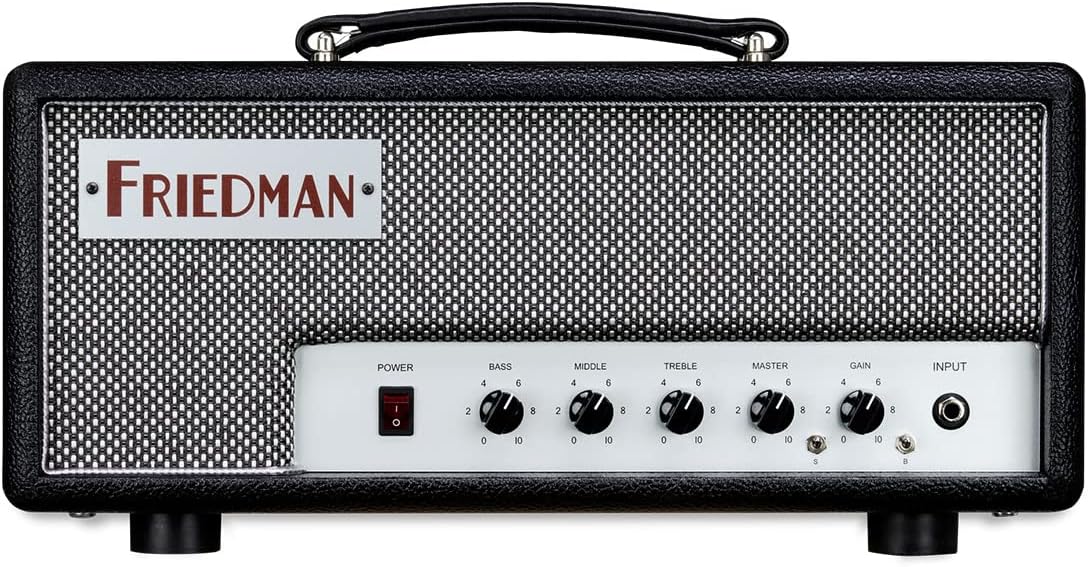
The Friedman Little Sister is a 20-watt, one-channel all-tube guitar head with a 5.0 customer rating. Although its rated output places it above the strictest low-wattage models, it remains a relatively compact approach compared with many stage-oriented tube heads. The supplied data highlights custom transformers, a bright switch, three-band EQ, and an S-switch.
We may earn a commission when you buy through this link, at no additional cost to you.
The two switching options provide useful ways to alter the amplifier's basic voice. The bright control offers an alternate tonal path, while the S-switch adds another form of circuit shaping. Paired with a three-band equalizer, these features give the player a respectable amount of control despite the one-channel architecture. Custom transformers are another important differentiator in a head of this size.
The main limitation is that a separate speaker cabinet is required, and the 20-watt output may be more than necessary for a quiet apartment. It is better suited to a controlled rehearsal room, studio, or small stage than to strict low-volume practice. Its listed simplicity also means there is no evidence of built-in effects, digital connectivity, or multiple channels.
For a guitarist who wants a focused boutique-style head and already owns a suitable cabinet, the Little Sister is an attractive option. Its perfect rating should be considered alongside the limited number of features and the need to build the complete rig. It is a specialist tool for players who prefer a clear control layout and classic tube-head character over a broad feature list.
The bright switch and S-switch provide alternate voicing choices that can be useful when moving between cleaner and more aggressive playing. These controls complement the three-band EQ without turning the head into a complex multi-channel amplifier.
Custom transformers and a one-channel format focus attention on the core amplifier voice. The result appeals to players who already understand cabinet choice and want a purpose-built head rather than a general-purpose practice system.
We may earn a commission when you buy through this link, at no additional cost to you.
The JOYO Bantamp Vivo Mini is a compact 20-watt hybrid amplifier with a 12AX7 tube, clean and overdrive modes, and Bluetooth connectivity. Its 4.3 rating places it in the middle of the group. It is designed for guitar practice and small-room use, with a wireless feature that makes it convenient for playing along with a phone or streaming source.
We may earn a commission when you buy through this link, at no additional cost to you.
The 12AX7 tube contributes to the amplifier's character while the hybrid topology keeps the overall design compact and approachable. Clean and overdrive modes give new players a simple starting point, and the available 8- or 16-ohm speaker outputs make it adaptable to different cabinets. Bluetooth avoids the need to route a phone through a separate input device.
Because it is a hybrid model, it should not be compared directly with the all-tube Bugera, Fender, OriPure, Orange, and Friedman products. The tube is only one part of the signal path, and the supplied specifications do not describe the degree to which users can modify its voicing. There is also no built-in speaker stated, so a cabinet is still necessary.
The Vivo Mini is a practical choice for a guitarist who wants compact size, wireless playback, and simple tonal switching. It is particularly suitable for apartment practice, dorm-room setups, and portable practice rigs. Players seeking authentic all-tube architecture and deeper control should instead consider one of the dedicated five-watt tube heads or combos.
Wireless playback removes a common obstacle to regular practice by simplifying how a phone connects to the amplifier. It also supports lessons, backing tracks, and reference recordings without additional adapters.
The 12AX7 tube adds traditional coloration to an otherwise compact hybrid platform. It offers a middle path for players who value a visible tube and organic response without committing to a larger all-tube amplifier.
We may earn a commission when you buy through this link, at no additional cost to you.
Choosing a low-wattage tube amplifier involves balancing tone, room volume, hardware format, controls, and intended application. Guitar amps, hybrid practice heads, and home-audio tube amplifiers may look similar in a product listing, but they use different inputs and connect to different equipment.
Begin by deciding whether the amplifier will drive an electric guitar, power passive home speakers, or serve as a compact practice system. Guitar amplifiers need instrument-level inputs, speaker outputs, and tone controls designed around electric-guitar frequency ranges. Home-audio amplifiers expect line-level sources and passive speakers with suitable impedance and sensitivity. The Fosi Audio MC331 and Oldchen EL34 are home-audio models, while the other products are intended for guitar amplification.
Low output is not identical across products. A five-watt guitar combo is designed for intimate practice, whereas a 10-watt-per-channel home amplifier can behave very differently depending on speaker efficiency. The 15- and 20-watt guitar heads offer more headroom, but they may still be too loud in a small room. Compare rated output with amplifier topology, speaker efficiency, attenuation, and listening distance rather than treating wattage as the only measure of capability.
The supplied tube complement provides useful clues about design intent. An EL84 power tube and 12AX7 preamp are common in compact guitar amplifiers, while a 6V6 and two 12AX7s form the basis of the Fender Vibro Champ. The Oldchen uses EL34C power tubes with 6SN7GT preamp tubes in a single-ended Class-A layout. Tube selection can influence harmonic character and power behavior, but it does not determine quality by itself.
A combo integrates the amplifier electronics and speaker, making it simpler to own and transport. A head requires a separate cabinet, adding cost and setup complexity but allowing the player to choose or change the speaker. The Bugera V5 and Orange Rocker 15 are combos, while the Bugera T5, OriPure OA-H05, JOYO ZOMBIE, Friedman Little Sister, and JOYO Bantamp Vivo Mini are heads. Consider available space, transportation, and whether you already own a suitable cabinet.
A minimal gain, tone, and volume layout can be ideal for beginners, while experienced players may want three-band EQ, bright switches, alternate voicing switches, and a well-organized preamp. Reverb controls and effects loops add convenience, but they do not replace the need for a good core sound. The Fender Vibro Champ offers speed and intensity controls for reverb, whereas the OriPure and Friedman provide dedicated tone shaping.
Bluetooth, headphone outputs, and digital audio inputs can make practice more convenient, although they are less central on many traditional tube guitar amplifiers. The JOYO ZOMBIE and Bantamp Vivo Mini include Bluetooth, and the Bantamp Vivo Mini offers clean and overdrive modes. The Fosi Audio MC331 provides the broadest source selection, including Bluetooth, USB, optical, coaxial, RCA, pre-out, and headphone connections.
Speaker compatibility determines whether the amplifier can play cleanly at a useful level. Check the required impedance and the manufacturer's wattage guidance. For home audio, compare the amplifier's 4-ohm or 8-ohm terminals with the speaker specification and use sensitivity as a guide to achievable volume. For guitars, match the head's output selection to the cabinet impedance and ensure the cabinet can handle the amp's output.
Build quality can influence long-term reliability, serviceability, and perceived tonal quality, but it should be considered alongside usability. The OriPure highlights a handcrafted transformer and aluminum casing, while the Oldchen emphasizes point-to-point wiring and premium internal components. Practical features such as built-in reverb, attenuation, headphone output, and included power supplies can deliver more everyday value than a long list of unconnected controls.
Place the amplifier on a stable, level surface with ventilation around its chassis, and keep speakers or cabinets clear of the heat produced by the tubes. Before connecting a guitar or switching the amplifier on, confirm that output and speaker-impedance settings are compatible. For home-audio models, use properly shielded interconnects and power the amplifier before changing sources. Headroom and warm-up are important for tube equipment, so allow the tubes to reach a normal operating condition before judging the final sound.
Set the guitar volume appropriately, start with gain, tone, and master volume at conservative levels, and raise the controls gradually. Use the simplest signal path possible at first, then add pedals or effects one at a time so you can hear what each change contributes. Use the built-in attenuator when a lower level is needed, but avoid operating the amplifier continuously at an unusually low setting if the manufacturer does not recommend it. Never leave an unattended tube amplifier running, and unplug it before changing tubes or making internal adjustments.
Keep the unit clean, dry, and away from dust, pets, and direct sunlight. Wipe the exterior with a soft, dry cloth rather than spraying cleaner onto the tubes or controls. Inspect cables and connectors periodically, and have tube or hardware concerns addressed by a qualified technician. Store the amplifier in its original or suitable protective cover, allow it to cool before moving it, and verify the correct replacement tubes and any fuse requirements in the product documentation.
A five-watt tube amp is generally appropriate for close-range home practice because its lower output can provide useful musical dynamics without approaching the level of a high-powered stage amplifier. A nearby reflective wall or hard floor can make the perceived volume higher than expected. Headphone outputs, where available, provide an even quieter alternative. For small rehearsals or covering a band, consider a higher-output model with attenuation.
A tube head contains the amplifier electronics but not a speaker, so it must be connected to a compatible guitar cabinet. A combo includes the speaker and is therefore more self-contained and convenient. Heads offer greater flexibility over speaker choice and can suit players building a permanent rig, while combos are easier for beginners, travel, and straightforward home practice.
Yes, low-wattage tube amps are often well suited to recording because they can be run at musically useful levels without excessive room noise. A model with a built-in speaker may be captured with a microphone, while a head can also be recorded through a cabinet or a load-safe recording setup. Confirm the manufacturer's microphone-placement and recording recommendations before operating at high levels.
It depends on the stage, monitoring system, and playing style. A five-watt amp may be enough for a very small, well-monitored venue, but a 15- or 20-watt model offers more headroom and can handle louder passages more comfortably. Stage monitors, an in-ear system, and a drummer's output can make the stage volume much greater than the amplifier's rating suggests.
No. The Fosi Audio MC331 and Oldchen EL34 are designed for line-level home-audio sources and passive speakers, not electric-guitar-level signals. They also do not have the tone-shaping controls, input impedance, and speaker characteristics required for guitar amplification. Choose a dedicated guitar combo or head for an instrument.
A power attenuator reduces the amplifier's output level without changing the gain structure in the same way as simply turning down the master volume. This often preserves more of the preamp's character and harmonic response at lower listening levels. The Bugera V5 and Orange Rocker 15 are identified as having power attenuation, making them useful for more controlled practice and recording.
The 12AX7 is the most frequently listed preamp tube in the group, appearing in guitar models from Bugera, Fender, OriPure, and JOYO. EL84 power tubes are used by the Bugera V5 and OriPure, while the Fender uses a 6V6 and the premium Oldchen uses EL34C power tubes. These layouts offer different power, response, and harmonic characteristics.
Check the head's supported impedance, the cabinet's impedance, and its power-handling rating. Never connect a head to a cabinet below its required impedance, and do not exceed the cabinet's safe power range. For a home-audio tube amplifier, use the specified 4-ohm or 8-ohm terminals and confirm that the speakers are efficient enough to produce adequate volume.
The Bugera V5 INFINIUM is the most versatile all-in-one guitar choice, pairing a five-watt Class-A amplifier with an eight-inch speaker, reverb, and attenuation. The Fender 68 Custom Vibro Champ stands out for detailed reverb controls and a 6V6-based voice, while the OriPure OA-H05 gives head-based players a focused five-watt design with unusually useful tone controls. Each serves a different style of home practice setup.
For connected practice, the JOYO ZOMBIE Mini Head offers Bluetooth, a headphone output, and compact construction. The JOYO Bantamp Vivo Mini is a simpler hybrid alternative, while the Orange Rocker 15 and Friedman Little Sister serve players seeking more output or a boutique head format. If your priority is home audio rather than guitar, examine the Fosi Audio MC331 or the premium hand-wired Oldchen EL34 instead.
Before buying, verify the amplifier type, speaker requirements, controls, connectivity, and current product specifications. Availability and pricing can change, and promotional offers should be checked at the time of purchase. Choosing the correct low-output format, matching it to your room, and considering how you will actually use it will lead to the most satisfying result.