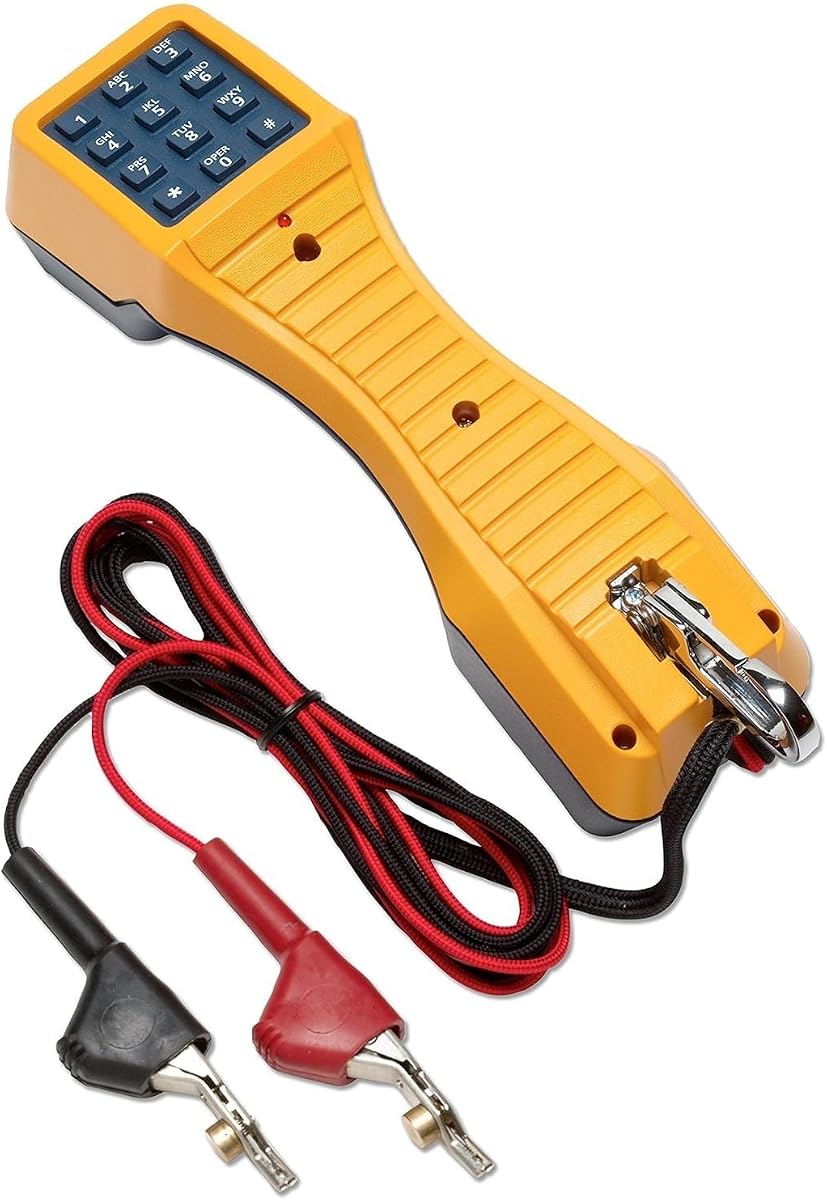
Fluke Networks TS19 Telephone Test Set
4.6Editor score
Detects dial tone and polarity
Places and receives test calls
Supports tone and pulse dialing
Uses high-impedance monitoring
Our Analog Telephone Line Tester guide compares ten models for call testing, tone detection, monitoring, polarity checks, tracing, and field use.
An analog telephone line tester helps technicians diagnose conventional voice lines, identify wiring faults, detect dial tone, place test calls, and monitor active connections. The right tool depends on whether you need a simple outlet checker, a portable butt set, or a professional analog telephone instrument with data-safe monitoring and multiple dialing modes.
We compared the ten products by examining their documented functions, connection options, monitoring capabilities, dialing support, construction details, and intended field applications. The list includes basic cable and line testers, dedicated landline test phones, clip-based butt sets, and a tone generator and probe kit for broader wiring work.
Each review explains the features that distinguish its selected model, along with practical limitations implied by the available specifications. Our top picks represent the strongest options for premium field work, professional monitoring, and flexible wire tracing, while prices and availability can change.
4.6Editor score

5.0Editor score

4.4Editor score
The comparison below organizes every product by its primary line-testing role, connection style, dialing support, and monitoring features, making it easier to match a tool to residential troubleshooting or professional field service.


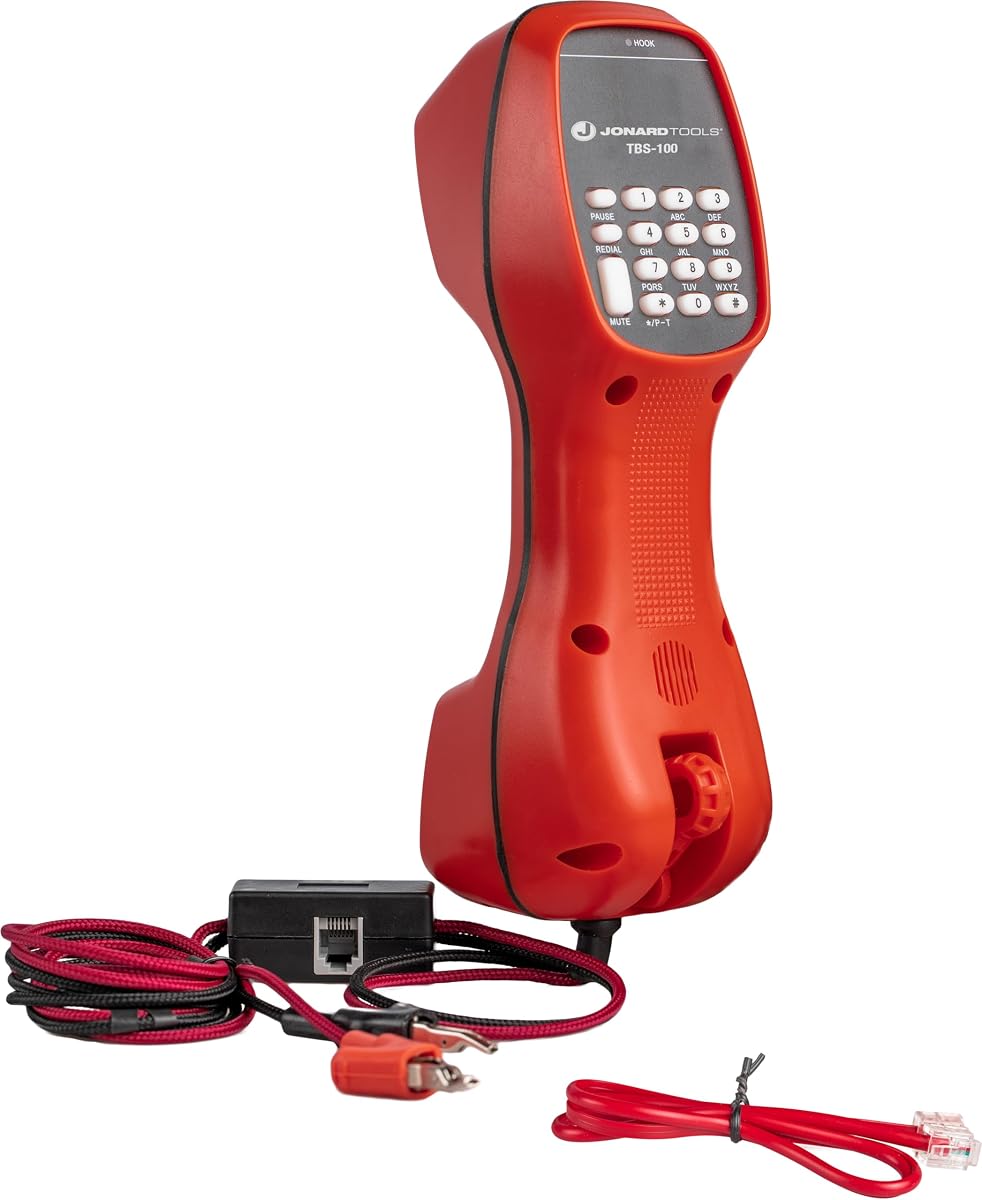


This telephone line network cable tester is designed around the practical idea that technicians should be able to connect to different exterior line interfaces without carrying several unrelated adapters. Its 4.4 rating reflects a generally useful feature set, while the inclusion of three types of receiving exterior line plugs gives it an advantage over simpler models restricted to one connection format.
We may earn a commission when you buy through this link, at no additional cost to you.
The tester can display incoming caller information and supports an outgoing dialing workflow. To receive caller identification information, the supplied instructions call for applying to the local telephone office to activate caller ID service. Once the line is connected, the device offers on/off and hangup controls, a working indicator, and a receiving-line function that can facilitate line resumption after encountering a busy tone.
The trade-off is that this model depends more heavily on a functioning telephone service and carefully followed operating procedures than a basic continuity or wiring tester. The documentation also contains language and formatting irregularities, which may make the controls less immediately clear. A user familiar with analog test phones will likely find the workflow understandable, but a first-time technician should keep the instructions nearby.
This is a sensible choice for installers or repair workers who encounter varied line sockets and want a single compact unit for incoming-call checks and outbound call testing. It is less compelling for tracing individual conductors because the documented feature set focuses on telephone functions and service-level operation rather than detailed wire mapping. For broad connector coverage in a lightweight field tool, however, it stands out.
Three exterior line plug options are the defining advantage. That variety can reduce the need to carry separate adapters when moving between line-access sockets or other connection points encountered during installation and repair work.
The incoming-call display adds information beyond basic line continuity. Users can view caller details when the relevant service has been activated, while the working indicator and receiving-line controls support practical call-status checks.
We may earn a commission when you buy through this link, at no additional cost to you.
The C019 is a dedicated analog telephone test set aimed at technicians who need to check a line, place a call, and review incoming identification information from one portable device. Its 4.3 rating indicates a solid but not exceptional user reception, and its strongest documented feature is support for both FSK and DTMF caller ID systems.
We may earn a commission when you buy through this link, at no additional cost to you.
Call handling is supported through dedicated on/off and hangup buttons, while last-number redial provides a convenient way to repeat a recent dialed number. The included set offers three types of line plugs for connecting to different telephone line interfaces. Those features make it more directly focused on field service than a general-purpose wire tracer.
Its limitations follow from the same specialization. There are no documented pin-to-pin wire mapping, tone-generation, or dedicated data-safe monitoring functions. The available product information also provides fewer operational details than users might want when dealing with uncommon line conditions, so hands-on familiarity with analog test phones is likely helpful.
Choose the C019 when your routine involves checking telephone line faults and confirming basic call functions across varied connections. It is a practical alternative to a bare outlet tester because it can make calls, redial, and present caller ID information. Technicians who need signal tracing or deeper conductor-level analysis should consider a more specialized instrument.
Supporting FSK and DTMF gives the C019 broader usefulness for incoming-call identification than a tester limited to one signaling method. That can be valuable when service conditions or regional networks differ.
On/off, hangup, and redial controls cover the most common test-phone actions. The result is a tool centered on checking whether a line can accept and make calls rather than a multi-function cable diagnostic system.
We may earn a commission when you buy through this link, at no additional cost to you.
The Jonard Tools TBS-100 is a compact analog butt set for field technicians who need to test telephone lines through either an RJ11 connection or clipped conductors. Its 3.9 rating is the lowest among the products compared, so buyers should weigh its construction and connection options carefully against the more feature-rich alternatives.
We may earn a commission when you buy through this link, at no additional cost to you.
Documented functions cover dial tone detection, placing and receiving calls, and both tone and pulse dialing. An integrated RJ11 switchbox permits direct testing, while angled bed-of-nails clips provide secure access to terminated conductors. The package includes an RJ11 test cord and an extra fuse, giving the user several connection methods in one kit.
The waterproof housing is a meaningful advantage for technicians working in damp utility spaces, closets, exterior service points, or other variable conditions. Against that benefit, the product's documented feature set is less extensive than that of the Jonard TBS-200, which adds prominent talk, ring, and monitor modes, high-impedance monitoring, and voltage protection.
The TBS-100 is best for users who value a durable, straightforward butt set and frequently work around both RJ11 jacks and exposed line connections. It is a sensible field-oriented choice, but professionals who need active-line monitoring or more advanced safety features may prefer the newer TBS-200. The included fuse and weather-resistant case reinforce its practical service focus.
A waterproof housing is particularly valuable when the tester must be carried to outdoor terminals, crawl spaces, damp closets, or other service environments where moisture is a practical concern.
The RJ11 switchbox and ABN clips provide complementary access methods. Technicians can move from a standard modular connection to a terminated conductor without relying on an entirely different test device.
We may earn a commission when you buy through this link, at no additional cost to you.
The Fluke Networks TS19 is a professional analog telephone test set with a 4.6 rating and a clear focus on the functions field technicians need when investigating active voice lines. It detects dial tone and polarity, can place and receive calls, and supports both DTMF tone and pulse operation.
We may earn a commission when you buy through this link, at no additional cost to you.
Its standout feature is high-impedance DataSafe operation in monitor mode. That mode is valuable when a technician needs to observe a line with less risk of interfering with data, conversations, or other signals. The combination of call placement, call reception, polarity detection, and multiple dialing formats makes the TS19 more versatile than a simple outlet or cable checker.
Angled bed-of-nails clips make the instrument practical for working at terminated lines, where modular plugs are unavailable or inconvenient. The trade-off is that this is a premium-oriented choice and may be more than a homeowner needs for a basic dead-line or reversed-pair diagnosis. In addition, a tool labeled DataSafe is primarily designed around analog telephone service and should not be assumed to certify compatibility with every modern network technology.
Professionals who regularly test voice circuits, verify polarity, and need to monitor lines without excessive disturbance will find the TS100's documented feature set well aligned with the task. Among the traditional test sets in this guide, it is one of the most balanced premium options. Homeowners and occasional users can generally accomplish basic outlet checks with a smaller dedicated tester.
Monitoring in a high-impedance mode helps a technician listen or observe without unnecessarily influencing the circuit. This is particularly useful when a line may carry data or remain in active service during diagnostics.
Dial tone detection, polarity identification, outgoing and incoming call testing, and both tone and pulse dialing give the TS19 the core capabilities expected from a dedicated analog butt set.
We may earn a commission when you buy through this link, at no additional cost to you.
This Landline Test Phone Line Set is designed for telecommunications checks where portability and basic telephone functions matter. It has a 4.2 rating and emphasizes a lightweight, computer-lab-friendly format, along with FSK and DTMF caller ID, real-time date display, flash and redial functions, and an in-use indicator.
We may earn a commission when you buy through this link, at no additional cost to you.
The automatic caller ID identification is a notable convenience. Rather than limiting the tool to a basic dial-tone check, it can display identification information and support routine call-control functions. Flash can help navigate the call flow of some analog services, while redial reduces repetitive entry during a test sequence.
Its capabilities are less comprehensive than those of professional butt sets. There is no documented tone-and-pulse dial support, high-impedance monitoring, polarity detection, or clip-based test cord specification. The product appears best suited to line surveys and straightforward service checks rather than deep troubleshooting of a live network.
The alligator clip set and portable form should appeal to technicians who move between line locations and need a lightweight test phone. Buyers who mainly need to know whether a standard outlet has dial tone, ring voltage, and correct line assignments may find a dedicated outlet tester more direct. For basic call-oriented diagnostics, this model provides a practical set of controls in a compact package.
The emphasis on a smart, lightweight design makes the set easier to carry from a desk, cabinet, or line-access location. That portability is useful for survey work where repeated connection checks are more important than benchtop measurement.
Automatic FSK and DTMF identification, flash, and redial reduce the effort needed to confirm basic line functionality. These features make it more useful than a tester that only confirms a tone is present.
We may earn a commission when you buy through this link, at no additional cost to you.
The Southwire P700 is a focused phone outlet tester rather than a general-purpose analog test phone. Its 4.5 rating is strong for a compact diagnostic tool, and the documented feature set targets exactly the conditions most often checked at a standard wall outlet: line assignment, voltage, dead lines, and reversed wiring.
We may earn a commission when you buy through this link, at no additional cost to you.
Quick Line Identification helps distinguish Line 1 from Line 2, which is useful when a customer reports that a second number, fax line, or paired voice service is not operating correctly. The tester also detects AC ring voltage and identifies dead or reversed lines, providing several useful indicators in a single pass.
The primary limitation is scope. Unlike the Fluke and Jonard butt sets, the P700 does not document outgoing call placement, incoming call reception, tone or pulse dialing, or high-impedance monitoring. It is a diagnostic instrument for the outlet and wiring environment, not a complete substitute for a telephone service test set.
For electricians, installers, property maintenance teams, and homeowners who need to verify standard telephone outlet wiring, the P700 is arguably the most focused choice in the guide. Its compact construction also makes it easy to keep in a tool bag. Technicians who need to test carrier services and conduct live calls should choose a dedicated butt set instead.
Dead and reversed line detection targets two common wiring problems that can leave a telephone jack looking physically normal but electrically incorrect. Quick Line Identification adds clarity when a multi-line outlet is involved.
AC ring voltage detection helps determine whether the line is presenting an active ringing signal. This gives a more informative result than a simple continuity test when a technician is checking an installed outlet.
We may earn a commission when you buy through this link, at no additional cost to you.
The S4 Phone Line Tester Kit stands out in this comparison with a 4.8 rating, the highest among the ten listed products. It is a feature-rich analog butt tester focused on call testing, caller ID, phone line detection, number replay, and a real-time date and time display.
We may earn a commission when you buy through this link, at no additional cost to you.
Its strongest technical feature is automatic FSK and DTMF call-information identification. The specifications also describe a maximum of eight-bit and twelve-bit number groups for FSK, alongside separate DTMF group capacity, allowing the tester to present more detailed calling information than a basic caller-display unit. The last-group dial number replay function recalls recent information for repeat checks.
The 4.8 rating should be considered alongside what the tool does not document. It does not claim high-impedance monitoring, polarity detection, tone-and-pulse dialing, or a complete wire-mapping capability. The numerical group descriptions also require some interpretation, so they may matter more to experienced users than to someone seeking a straightforward dead-line indicator.
This kit is a compelling choice for technicians who regularly verify caller ID and call signaling and value a detailed, automatically recognized display. It also suits users who appreciate having the current time shown during extended diagnostic sessions. For monitoring an existing conversation without disruption, a high-impedance professional butt set is the more appropriate selection.
Automatically identifying FSK and DTMF information simplifies the check compared with a tester that requires manual interpretation. The display is designed to make incoming call data immediately available for verification.
Support for multiple number groups and a built-in real-time clock creates a more informative display during repeated call tests. Last-number replay helps technicians repeat a previous test without entering the sequence again.
We may earn a commission when you buy through this link, at no additional cost to you.
The Klein Tools VDV500-705 is not a traditional analog butt set, but it is one of the most useful selections for tracing telephone and other low-voltage wiring. Its 4.4 rating reflects broad utility, and the combination of a tone generator, probe, wire mapping, multiple cable formats, and a work light makes it unusually versatile.
We may earn a commission when you buy through this link, at no additional cost to you.
The analog generator applies a traceable signal to open-ended, non-active low-voltage wires. A separate probe follows that signal, while the included alligator clips simplify attachment to unterminated conductors. An RJ45-to-RJ45 cable supports connectivity and pin-to-pin mapping, and the probe includes a work light for dark installation areas.
The important limitation is that the tool is intended for low-voltage, non-active wiring. It should not be confused with a telephone instrument that detects dial tone, checks polarity, places a call, or monitors an active line. Users who need those functions still need a dedicated butt set, such as one of the Fluke or Jonard models in this guide.
The VDV500-705 earns its place as the best budget pick for installers and low-voltage technicians who need to identify conductors, trace a route, or map a cable beyond the wall outlet. Its broader compatibility with Ethernet, telephone, coax, speaker, video, and data wiring gives it more long-term utility than a single-purpose line indicator.
The generator and probe help identify a particular route in open-ended, non-active low-voltage wiring. Alligator clips make it possible to connect without needing a modular plug at the point being investigated.
Support for numerous cable standards, pin-to-pin mapping, adjustable probe volume, and an illuminated probe tip lets the kit serve as a general low-voltage wiring tool rather than an accessory for one connector type.
We may earn a commission when you buy through this link, at no additional cost to you.
This Fluke Networks TS19 version combines the established TS19 telephone test-set functions with banana jack connections to alligator clips. It shares a 4.6 rating with the ABN-clip version and offers one of the most complete professional feature sets among the traditional analog test phones in this comparison.
We may earn a commission when you buy through this link, at no additional cost to you.
Core line functions include dial tone detection, polarity identification, outgoing call placement, incoming call reception, and both DTMF tone and pulse operation. High-impedance DataSafe monitoring supports observation of live lines with less risk of disturbing conversations or signals. The model also indicates polarity while in talk mode and provides last-number redial.
The connection format is the main point of comparison with the other TS19 listing. Banana jacks leading to alligator clips can be convenient for field access, but technicians whose standard method relies on angled bed-of-nails clips may find the other version more convenient for particular line terminals. As with any premium instrument, the purchase may also exceed the requirements of a basic residential check.
This model is a strong option for service technicians who want a full analog telephone test set, frequent call placement, and high-impedance monitoring in one device. It is especially attractive when alligator-clip access is the preferred connection method. Users needing only outlet identification should use a simpler tester, while professionals requiring live-line observation will appreciate the added monitoring capability.
Polarity detection is useful before placing a call, while polarity indication in talk mode helps confirm that the line remains correctly oriented during active use. This makes the test set more informative than a tone-only device.
Call placement, call reception, both dialing formats, and last-number redial cover common field-test actions. High-impedance monitoring adds a less disruptive way to inspect an active circuit.
We may earn a commission when you buy through this link, at no additional cost to you.
The Jonard Tools TBS-200 is the most feature-focused professional analog line tester in the guide, and it holds a perfect 5.0 rating. It combines dial tone detection, call placement and reception, tone and pulse dialing, high-impedance monitoring, protected connections, and three direct modes accessible from the handgrip.
We may earn a commission when you buy through this link, at no additional cost to you.
Talk, Ring, and Monitor modes make the operating logic clear for field work. A technician can move directly among the basic functions required for a voice line, while the high-impedance monitoring mode helps observe lines without disturbing data, conversations, or other signals. This combination is particularly valuable for professionals who may encounter active circuits rather than isolated, disconnected wiring.
Safety and durability receive explicit attention. Built-in voltage protection is designed to guard against excess voltage and transient ringer signals, while angled bed-of-nails clips provide stable contact with terminated conductors. These details make the TBS-200 appropriate for demanding service work, although the protection and monitoring design also place it in a more specialized purchasing category than a simple outlet tester.
For professional technicians, the TBS-200 offers the strongest overall balance of calling, monitoring, connection security, and protective features in this list. It is the most convincing choice when line preservation and live diagnosis matter more than basic outlet status. A homeowner can diagnose reversed or dead lines with a smaller tool, but serious field service is where this model's capabilities become most valuable.
Putting the three primary line functions on the handgrip reduces the need to navigate a more complicated interface. Technicians can select the behavior appropriate to the current test without carrying separate tools.
High-impedance monitoring is the TBS-200's defining feature for active-line work. It allows a technician to observe conversations, data, or signals while minimizing interference with the circuit under investigation.
Voltage and transient-ringer protection add a defensive layer when connecting to unfamiliar lines, and the angled ABN clips help maintain a secure electrical connection. These details support repeated field use.
We may earn a commission when you buy through this link, at no additional cost to you.
The right analog telephone line tester depends on the line environment, the diagnoses you need to make, and the type of connections you encounter. Use the following factors to narrow the field before choosing between an outlet checker, a cable tracer, or a full professional butt set.
Start by separating outlet verification from service testing. A basic outlet tester is appropriate when the question is whether Line 1 or Line 2 is assigned correctly, whether a pair is dead, or whether ring voltage is present. A butt set is more appropriate when you need dial tone, polarity, call placement, call reception, or monitoring. A tone generator and probe becomes valuable when the task involves finding a route through bundled or unterminated wiring rather than merely checking a socket.
If a customer line may remain active while you work, high-impedance monitoring deserves careful attention. A monitor function lets a technician observe an operating line with less chance of disturbing the conversation, data, or signaling on that circuit. The Fluke TS19 variants and Jonard TBS-200 explicitly document this behavior. An ordinary tone-only tester does not offer equivalent insight, and a wire tracer should only be used on the low-voltage, non-active wiring described in its instructions.
Professional analog lines may be addressed through tone, also called DTMF, or pulse dialing. The TBS-100, both Fluke TS19 versions, and the TBS-200 explicitly support both modes. Other dedicated test phones may emphasize caller ID, flash, and redial without documenting full pulse support. Knowing which signaling method the affected line requires helps prevent a misleading diagnosis in which the tool appears to work correctly with one system but fails with another.
Connection method is often more important than an extra display feature. Modular RJ11 connections suit common wall and equipment jacks, while alligator clips and angled bed-of-nails clips reach terminated conductors. The C019 and the first product in the list offer multiple exterior line plug choices. The Jonard models use ABN clips, and one Fluke version uses banana jacks leading to alligator clips. Choose the interface that matches the terminals and adapters already present in your service workflow.
Caller ID support can confirm whether calling information reaches the test location. FSK and DTMF dual-system support appears on the C019, Landline Test Phone Set, and S4 Phone Line Tester Kit, making those models relevant for installation and call-signal checks. The S4 adds more detailed number-group capacity and automatic recognition. If your work focuses on wire status rather than call information, a simpler tester may provide the answer more directly.
Field tools are exposed to moisture, impact, cables, cramped work areas, and changing temperatures. The TBS-100 specifically advertises a waterproof housing, while the TBS-200 emphasizes durable construction and voltage protection. Neither claim eliminates the need for sensible storage and care, but both are relevant when work occurs outdoors, in utility rooms, or around unfinished wiring. A compact model also matters if you carry it between outlets throughout the day.
An analog line tester should be used only with the line type and connection method described by its manufacturer. The TBS-200 includes protection against excess voltage and transient ringer signals, which is reassuring but does not make every unknown circuit safe. A tracer such as the VDV500-705 is specifically for open-ended, non-active low-voltage wires. Technicians should isolate circuits when required and never assume a low reading means the line is safe to touch.
A large display is helpful only when it supports a task you regularly perform. A technician doing outlet inspections may value Southwire's quick Line 1 and Line 2 identification more than a caller display. A network installer tracing cable may prioritize alligator clips, adjustable probe volume, and wire mapping. A service technician handling active analog lines may prioritize monitoring, polarity, dialing modes, and protected clip connections over a clock or call log.
Before testing, identify the line, confirm that it is safe for the selected tool, and inspect the tester cord, clips, plugs, and housing. A dedicated analog butt set should be connected according to its manual, with the appropriate modular plug, alligator connection, or ABN clip. For a tone generator and probe, use only open-ended, non-active low-voltage wiring, separate conductors when practical, and establish the recommended grounding connection to improve signal detection.
Begin with a non-disruptive check. Look for dial tone, inspect voltage or ring status, and confirm line assignment or polarity where the instrument supports those functions. If the tool offers Talk, Ring, and Monitor modes, choose the mode that matches the test rather than placing a call on a line you only intend to observe. For a tracer, adjust the probe volume, listen for the injected tone, and map conductors pin to pin when that is part of the diagnosis.
After use, disconnect the line before storing the device, wipe away dirt and moisture, and inspect the cord and connector for damage. Store a butt set with its cord arranged to prevent sharp bends, keep clip tips protected, and avoid leaving a test set connected to a live circuit. A tone generator and probe should also be stored separately from moisture and heavy impact, with accessories returned to the case or kit so the next job is not delayed by a missing lead.
An analog telephone line tester checks conventional voice-line conditions such as dial tone, polarity, wiring status, ring voltage, and call functions. A full butt set may also place and receive calls, support tone and pulse dialing, and monitor an active line. Simpler outlet testers focus more narrowly on identifying dead, reversed, or incorrectly assigned lines.
No. An outlet tester is generally designed to diagnose wiring or voltage at a standard telephone connection, while a butt set provides a broader collection of telephone-service functions. A butt set may make calls, test polarity, and monitor active circuits. If you only need to check Line 1, Line 2, and ring voltage at an outlet, a dedicated outlet tester can be simpler.
High-impedance monitoring allows a tester to observe a line without significantly loading or disturbing its signals. That makes it useful for checking active conversations, data, or other circuit activity. It is a key reason to choose a professional monitor-capable butt set rather than applying a tone tracer to an active line.
The correct choice depends on the line and the test procedure. Many professional butt sets support both DTMF tone and pulse dialing, which is useful across varied analog services. A tester limited to one method may not provide a valid result on a line configured for the other, so confirm the signaling requirement before diagnosing a failed call.
It depends on the tracer's instructions, but a general analog tone generator is usually intended for open-ended, non-active low-voltage wiring. The Klein VDV500-705 is specifically described for that application. For an active line, use a telephone test set with an appropriate high-impedance monitoring function instead.
Both provide clip-style access to a telephone line, but their physical designs and intended contact methods differ. Angled bed-of-nails clips are shaped for a secure grip on terminated conductors, while alligator clips can attach to suitable accessible contacts. The choice should match the connectors, conductors, and working space encountered at the test location.
Caller ID is valuable when the test includes verifying incoming call information or the signaling path associated with caller display service. It is less important for a task limited to dead-line, reversed-pair, or voltage diagnosis. Models with automatic FSK and DTMF identification are most relevant for technicians who regularly test those services.
Disconnect it from every line, clean off dirt and moisture, and inspect the cord and connectors before storage. Protect clip tips and arrange the test cord without sharp bends. Keep the instrument away from excessive heat, moisture, and impact, and return all leads to the kit so accessories remain available for the next job.
The Fluke TS19 with ABN clips stands out as the best premium choice for technicians who need dial tone detection, polarity checks, call functions, and high-impedance monitoring in a traditional test set. The Jonard TBS-200 takes the professional feature set further with dedicated Talk, Ring, and Monitor modes, protected connections, and high-impedance operation, earning the Editor's Choice distinction.
The most important decision is the nature of the work. Choose the Southwire P700 for outlet-level wiring diagnosis, the C019 or S4 for caller-oriented line checks, and the Klein VDV500-705 for tracing and mapping low-voltage conductors. For active analog lines and a broad professional workflow, prioritize monitoring, polarity, both dialing modes, and the connection style you can use safely in the field.
Availability and pricing can change, so check the current listing and included accessories before purchasing. Confirm that the line type, connector arrangement, and test functions match your actual service tasks rather than choosing solely by the largest feature list. The right instrument should make the next diagnosis faster, clearer, and safer.