
WAVLINK 3 Bank 15A
4.9Editor score
Three independent charging channels
Fifteen amps combined output
Wide battery chemistry support
Our Marine Battery Chargers guide compares ten onboard and maintenance models for battery-bank capacity, charging modes, waterproofing, safety, installation
Marine battery chargers are built for the demanding environments found on boats, from constant vibration and salt-laden air to sudden temperature changes and persistent moisture. A useful onboard charger should fit your electrical layout, charge each battery type correctly, and provide dependable protection without requiring constant attention.
We compared the following chargers by bank count, total and per-bank output, supported battery chemistries, waterproof construction, temperature compensation, diagnostic features, repair functions, mounting approach, and maintenance capability. The list includes dedicated onboard chargers, multi-bank units, and a compact maintainer suitable for smaller or supplemental systems.
Each review highlights the most useful strengths and realistic trade-offs based on the supplied specifications. Ratings and product details reflect the listed marketplace information, while pricing changes frequently. Readers should confirm current specifications, compatibility, installation requirements, and current prices before purchasing.
4.9Editor score

4.7Editor score
4.8Editor score
The comparison covers dedicated boat chargers and compact maintenance units across bank count, charging output, battery support, environmental protection, and specialist features, making it easier to match a charger to a particular onboard electrical system.




The NOCO GENPRO10X2 is a two-bank, 20-amp onboard marine charger with a 4.7 rating. It stands out for its compact proportions, independent controls, sealed IP68 enclosure, and unusually broad recovery features, making it a strong general recommendation for boats with a starter bank and a house or auxiliary bank.
We may earn a commission when you buy through this link, at no additional cost to you.
Each bank can be configured independently for 12V flooded or maintained lead-acid, AGM, lithium, or repair operation. An integrated thermal sensor adjusts charging for ambient conditions, while dead-battery support begins at one volt and Force Mode can attempt charging from zero volts. The simplified mounting system permits secure installation in any orientation, and the anti-vibration backing helps reduce shock and noise.
The main limitation is bank count. Owners with three or four battery groups will need a more elaborate multi-bank charger, and lithium use still depends on selecting the correct mode and installing appropriate battery protection where required. The listed package includes 72-inch DC leads with eyelets, a 72-inch Type-B AC cable, and mounting hardware, which helps reduce the need for extra termination parts.
This is a strong recommendation for a two-bank boat that values repair capability, temperature awareness, and flexible mounting. It is less appropriate for larger electrical systems requiring three or more separately controlled outputs. Buyers should verify cable reach, battery chemistry, and available installation space before ordering.
Separate mode controls allow each bank to suit a different battery type without forcing the entire system into one charging profile. That flexibility is useful when a boat combines a starter battery, a deeply cycled house bank, and lithium auxiliary storage.
The IP68 sealing, temperature sensing, and anti-vibration mounting system address the moisture, heat, cold, and movement that regularly challenge electronics installed inside a boat.
We may earn a commission when you buy through this link, at no additional cost to you.
The 10X3 30A Marine Charger is a three-bank, 12-volt onboard unit rated at 10 amps per bank and carrying a 4.5 rating. Its defining advantage is the combination of three separately controlled outputs, automatic repair, diagnostic warnings, and a sealed IP68 housing in a straightforward boat-focused package.
We may earn a commission when you buy through this link, at no additional cost to you.
The three banks can operate simultaneously and can be set independently for SLA or AGM lead-acid, lithium, or calcium batteries. A five-grid power display shows charging progress, while the automatic repair indicator begins the repair process without separate operation. Diagnostic coverage includes overvoltage, a bad-battery warning, overtemperature, and reverse connection, giving owners useful feedback when setup or battery conditions require attention.
Although the headline rating is 30 amps, the charger delivers 10 amps per bank, so the total output is divided among connected battery groups. It is also important to follow the supplied warning to use the charger in a well-ventilated area. The package includes clips, connectors, spare fuses, screws, a bag, and a manual, providing a broad installation kit.
This model is well suited to boats with three distinct battery banks that need independent chemistry selection. It may not be ideal for a large house bank that needs a concentrated boost, but for balanced charging across starter, house, and auxiliary batteries, the independent controls and diagnostic suite are compelling.
Three banks suit common arrangements involving a starter battery, a house bank, and an auxiliary battery. Independent mode buttons prevent one battery type from forcing a compromise on the others.
Warnings for reverse connection, overvoltage, excessive heat, and a bad battery help identify likely setup or battery issues. The charge-level display adds a simple indication of charging progress.
We may earn a commission when you buy through this link, at no additional cost to you.
The ProMariner ProSport HD is a waterproof, three-bank onboard charger rated at 20 amps, with a 4.5 rating. It differentiates itself through distributed-on-demand charging, microprocessor-controlled precision, a heavy-duty three-surface heat sink, and an expanded LED display that provides unusually clear operating information.
We may earn a commission when you buy through this link, at no additional cost to you.
Distributed-On-Demand Technology allows available amperage to shift toward one battery or a combination of batteries according to demand. This can make the 20-amp total more useful than a rigidly divided system when only some banks need attention. The upper, lower, and rear-facing heat sink supports cooling and sustained charging, while the LED interface shows charge mode, system status, individual battery status, and battery type.
The listed information does not emphasize the same deep-discharge recovery or zero-volt charging functions found on the NOCO and other repair-oriented models. Prospective buyers should also verify the exact battery chemistries and accessories required for their system. As the ProSport HD replaces an earlier ProMariner ProSport model, existing installation dimensions and connector arrangements deserve checking before replacing a current unit.
This charger is a compelling match for a three-bank boat where charging demand varies between banks and clear status feedback is important. It is particularly relevant for owners who value controlled current distribution and robust cooling over a broad catalog of recovery modes.
Distributed current is a practical feature on boats with banks of different sizes or duties. Available power can shift toward the battery or batteries that need it instead of remaining confined to a fixed allocation.
The tri-surface extruded heat sink is designed to move heat away from the electronics from several directions, helping the charger maintain its rated constant-current output in a demanding onboard environment.
We may earn a commission when you buy through this link, at no additional cost to you.
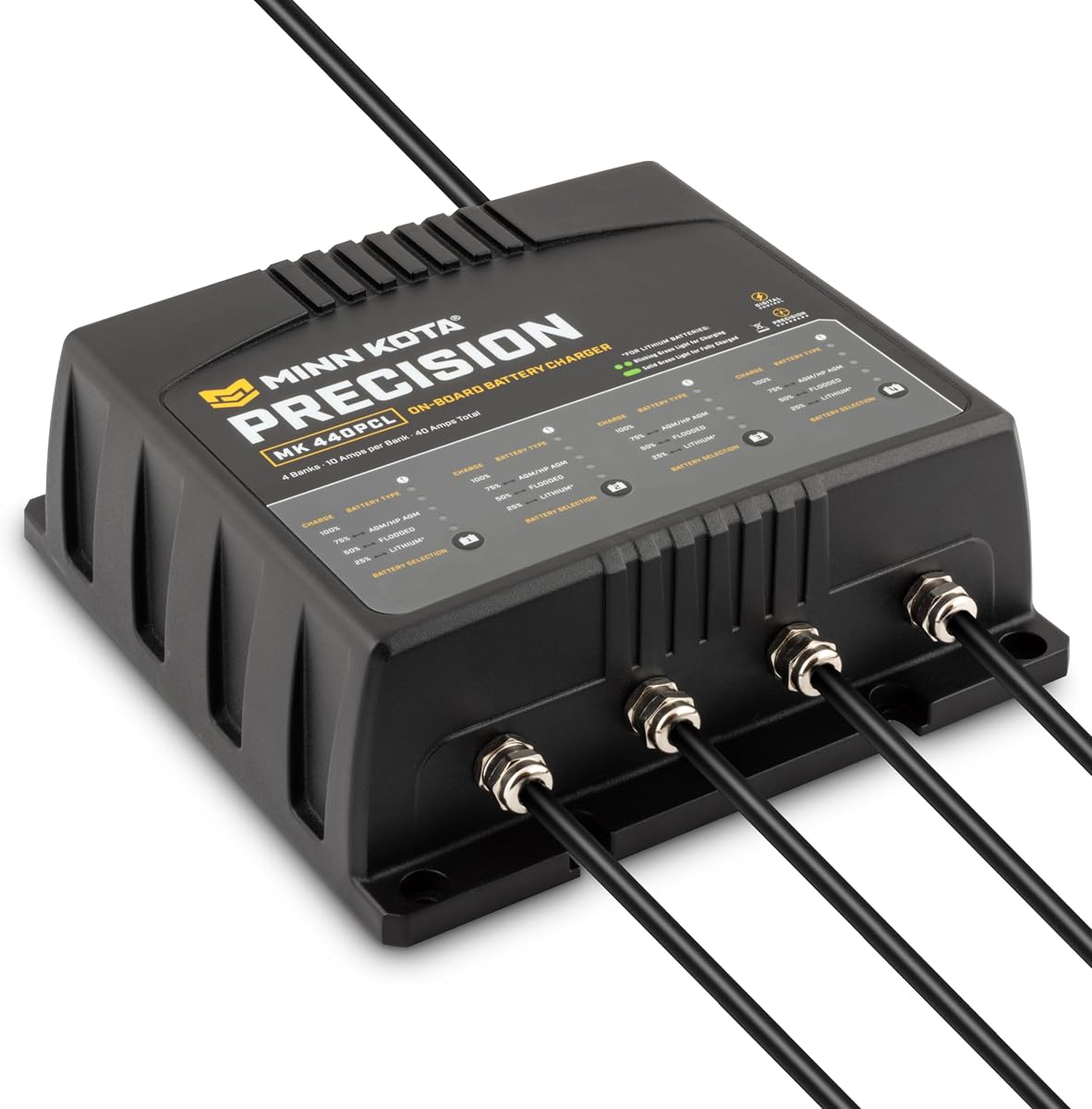
The Minn Kota Precision MK-440PCL is a four-bank onboard charger with 10 amps available per bank and a 4.8 rating. It is the most capable premium option in this group for boats with several battery groups because every bank can be assigned a different supported chemistry.
We may earn a commission when you buy through this link, at no additional cost to you.
Owners can independently select 12V AGM, flooded lead-acid, gel, or lithium LiFePO4 for each bank. The microprocessor-based controller manages voltage and current through the charging cycle, while automatic temperature compensation adjusts for environmental swings and low-line voltage. LED indicators report charge stage, maintenance status, errors, and full-charge completion, providing a clear view of system operation.
A notable feature is automatic equalization and maintenance for flooded lead-acid batteries, with a push-button option for a more rigorous cleaning cycle intended to help extend battery life and performance. The tradeoff is that four-bank capability adds installation complexity and may be unnecessary for a smaller vessel. Buyers should also account for the space, wiring, and breaker requirements of a larger charger.
This is the recommended choice for a larger boat with starter, house, auxiliary, and reserve battery banks, especially when those banks use different chemistries. It is less compelling for a simple two-battery layout, but for a complex system it offers the most flexible bank management in the roundup.
Four separately configurable outputs offer a practical way to manage a sophisticated onboard network without forcing every battery into the same charge profile.
Automatic equalization and maintenance are intended for flooded lead-acid batteries, while the push-button cycle provides a more thorough cleaning procedure when conditions call for it.
We may earn a commission when you buy through this link, at no additional cost to you.
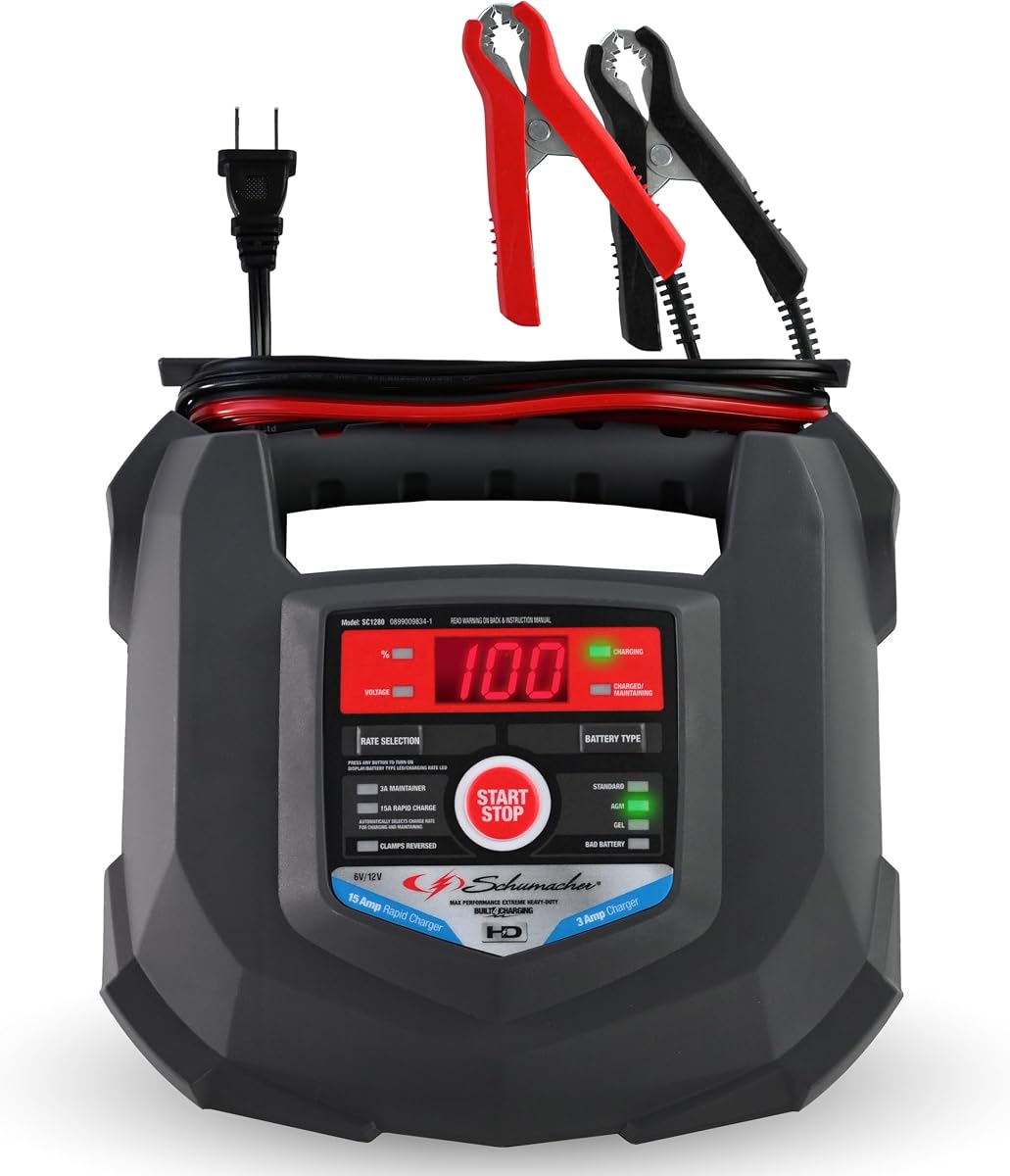
The Schumacher SC1280 is a 4-in-1, 15-amp battery charger and maintainer with a 4.6 rating. Although it is designed more broadly for cars, motorcycles, ATVs, trucks, SUVs, and boats, its flexibility makes it a useful option for a small boat or a battery that needs occasional maintenance outside a permanently installed system.
We may earn a commission when you buy through this link, at no additional cost to you.
The unit can charge, maintain, test, and restore batteries. It supports standard, AGM, gel, and deep-cycle batteries, uses microprocessor control with automatic voltage detection, and provides multi-stage charging algorithms. A desulfation mode is included for addressing sulfation, while automatic 6V and 12V detection reduces the need to manually configure the basic operating voltage.
Its major limitation is that it is a single-bank maintenance charger rather than a purpose-built multi-bank marine unit. It therefore does not offer the same sealed onboard construction, independent bank selection, or marine diagnostic suite as most dedicated products in this list. The package is also basic, consisting of the charger and a user manual.
The SC1280 is a sensible pick for a smaller vessel with one principal battery, seasonal storage, or a need for a portable charger that works across several types of vehicles and equipment. It is less appropriate for a boat with multiple independently charged banks or a requirement for permanent waterproof installation.
The SC1280 supports 6V and 12V batteries and several common chemistries, allowing it to serve an entire garage or a mixed collection of marine and automotive equipment.
Its combination of maintenance, testing, and desulfation functions is particularly useful for batteries that sit unused for long periods or need routine care between trips.
We may earn a commission when you buy through this link, at no additional cost to you.
The 5X3 15A Marine Charger is a three-bank onboard unit rated at 5 amps per bank and carrying a 4.8 rating. It offers an accessible way to maintain three 12-volt batteries simultaneously, with independent mode selection, an IP68 enclosure, and a suite of protective diagnostics.
We may earn a commission when you buy through this link, at no additional cost to you.
Each bank can be assigned to SLA or AGM lead-acid, lithium, or calcium operation. The charger includes automatic repair activation, a five-grid power display, and warnings for overvoltage, a bad battery, excessive temperature, and reverse connection. Its integrated thermal sensor adjusts output to reduce overcharging in hot conditions and undercharging in cold conditions.
The key trade-off is charging speed. At 5 amps per bank, this model is better suited to smaller battery groups and routine maintenance than aggressive recovery of large discharged banks. It also carries the same ventilation warning as the higher-output 10X3 model. The included bag, manual, spare fuses, clips, connectors, and screws make the package reasonably complete.
This charger is a good fit for a three-battery boat with modest daily electrical loads and a need for independent control. It can maintain starter, house, and auxiliary groups effectively, while owners with large deep-cycle banks or frequently depleted batteries may prefer a higher-current model.
The three-channel arrangement is useful for common small-boat layouts, while 5 amps per bank offers a measured approach to routine charging and maintenance.
Reverse-polarity, overvoltage, bad-battery, and temperature warnings provide actionable feedback during setup and routine operation.
We may earn a commission when you buy through this link, at no additional cost to you.
The NOCO GENIUS2D is a compact, direct-mount 2-amp onboard charger and maintainer with a 4.6 rating. It is best suited to a single 12-volt lead-acid battery rather than a modern multi-bank boat electrical system, but its recovery features and compact installation make it a useful supplemental option.
We may earn a commission when you buy through this link, at no additional cost to you.
The unit supports AGM, gel, SLA, VRLA, flooded, maintenance-free, deep-cycle, marine, and RV batteries. Its snap-fit bracket and truss-head screws allow secure placement near the battery. An integrated thermal sensor adjusts charging for hot or cold conditions, while dead-battery operation begins at one volt and Force Mode attempts recovery from zero volts.
The 2-amp output is intentionally modest, so this is principally a maintainer for a smaller or lightly used battery rather than a rapid recovery charger. It also lacks the lithium-mode selection and multi-bank controls that make the larger GENPRO10X2 more versatile. The package includes 24-inch AC and DC cables, an eyelet-terminal lead, a mounting bracket, and screws.
Choose the GENIUS2D for a compact boat, a dedicated reserve battery, or a simple installation where one lead-acid bank needs reliable maintenance. It is a less suitable choice for lithium banks, large deep-cycle batteries, or vessels requiring simultaneous charging of several groups.
The direct-mount format minimizes space requirements, making the unit convenient for small compartments, dedicated reserve batteries, and simple electrical layouts.
One-volt charging, zero-volt Force Mode, and pulse-based sulfation reversal make the GENIUS2D more capable than a basic maintainer for neglected batteries.
We may earn a commission when you buy through this link, at no additional cost to you.
The 10X3 30A Smart Charger is a three-bank, 30-amp marine charger with a 4.6 rating. It offers one of the most extensive feature sets in the group, including nine-stage charging, three recognition modes, diagnostics, automatic repair, forced charging, and an IP68 enclosure.
We may earn a commission when you buy through this link, at no additional cost to you.
Each of the three outputs operates independently at up to 10 amps and supports SLA or AGM, lithium, and calcium battery types. The charger uses segmented smart charging and automatic temperature compensation to adjust current and voltage in stages. Its repair indicator starts automatic maintenance, while diagnostic alerts cover overvoltage, bad batteries, excessive temperature, and reverse connection.
For severely depleted batteries between zero and one volt, the charger uses a slow recovery process lasting roughly one to two hours. Manual forced charging begins by holding the Mode button for five seconds. The stated operating range extends from approximately -40°C to 60°C, and the package includes dual-pin adapters, battery clips, an extended DC cable, mounting screws, and a manual.
This model is a good candidate for owners who want extensive controls and recovery options across three battery banks. The tradeoff is a more complicated feature set that requires careful setup, and the slow recovery process is not a substitute for immediate boost charging.
The segmented charging logic adjusts current and voltage as battery status changes, providing more granular control than a basic bulk-and-maintenance process.
The forced-charge function and slow low-voltage recovery process are intended for batteries that have fallen below the detection threshold of ordinary chargers.
We may earn a commission when you buy through this link, at no additional cost to you.
The WAVLINK 3 Bank 15A is a 12-volt IP68 onboard charger with a 4.9 rating, the highest listed rating among these products. It combines three independent channels, 5 amps per channel, broad battery support, and extensive safety protections in a fixed-install marine design.
We may earn a commission when you buy through this link, at no additional cost to you.
The charger works with SLA, AGM, flooded, maintenance-free, calcium, and LiFePO4 batteries from 15Ah to 150Ah. Each channel runs independently, which is valuable for boats using starter and house battery sets. Multi-stage logic adjusts current and voltage according to battery status, while a 72-hour timer limits excessive charging and automatic stop shuts charging off at full voltage.
Repair functions include desulfation and a mandatory mode for batteries down to zero volts, although the compulsory recovery behavior means users should follow the manual carefully. Reverse-polarity, overheat, overvoltage, overcurrent, and short-circuit safeguards provide useful layers of protection. The unit is sealed against dust and moisture and is designed for permanent year-round onboard installation.
This is our budget recommendation for a three-bank system because it combines a high rating with IP68 sealing, independent channels, and a broad operating range. Its 5-amp-per-channel output is the main limitation, making it better for routine maintenance and moderate battery sizes than rapid recovery of large banks.
Each of the three charging channels operates separately, allowing starter, house, and auxiliary batteries to be maintained without sharing a single control sequence.
Reverse-polarity, overheat, overvoltage, overcurrent, and short-circuit safeguards make the sealed design better suited to unattended or year-round installation.
We may earn a commission when you buy through this link, at no additional cost to you.
The Minn Kota MK 330D is a three-bank, 10-amps-per-bank digital onboard marine charger with a 4.7 rating. It focuses on established essentials: automated multi-stage charging, temperature compensation, waterproof construction, and clear LED feedback.
We may earn a commission when you buy through this link, at no additional cost to you.
The microprocessor-based controller adjusts voltage and current throughout the charging cycle, while a temperature sensor compensates for changing ambient conditions. LED indicators communicate charge stage, maintenance mode, errors, and full-charge completion. Its waterproof, shock-resistant, and vibration-resistant construction is appropriate for installation in a working marine environment.
A clear restriction is that the listed specifications state that gel battery compatibility is not supported. It also does not advertise the detailed zero-volt recovery, forced charging, or automatic repair functions found in several newer competitors. Buyers should confirm the lead-acid and other battery types they intend to use before finalizing the installation.
The MK 330D is a sensible choice for a conventional three-bank lead-acid system that values stable charging, thermal compensation, and a recognizable marine-focused design. It is less suitable for a mixed battery installation that includes gel batteries or requires an advanced recovery mode.
Digital control continuously manages voltage and current, reducing the need for manual intervention and helping keep charging consistent across three banks.
Waterproof, shock-resistant, and vibration-resistant construction addresses the physical stresses placed on an onboard charger in a moving vessel.
We may earn a commission when you buy through this link, at no additional cost to you.
The right charger depends on the number and chemistry of installed batteries, available space, typical electrical load, recovery needs, and whether the unit will remain permanently onboard. These factors should be evaluated before comparing output ratings or extra features.
Start by counting the battery groups that must be charged independently. A one-bank maintainer may suit a small craft with a single battery, while common larger boats use separate starter, house, and auxiliary banks. Two-bank units cover simpler dual setups, while three- and four-bank chargers provide more granular control. Independent bank selection matters when connected batteries use different charging profiles or serve very different duties.
Choose a bank count that matches the installation without unnecessary complexity. Extra outputs can be useful for expansion, but they may add wiring, mounting, and configuration demands.
Compare both total charging current and the amount available to each battery bank. A 30-amp three-bank unit may provide 10 amps per bank, while a 15-amp version may provide 5 amps each. A bank with large deep-cycle batteries or repeated depletion generally benefits from more current, while a small reserve battery can usually be maintained with less. Comparing the charger with battery capacity and the boat's average load helps prevent oversizing or undercharging.
More current is not automatically better. Select enough power for the largest battery group and daily electrical demand while avoiding unnecessary size, heat, and installation demands.
Confirm whether the charger supports every chemistry in the boat, including flooded lead-acid, AGM, gel, sealed lead-acid, calcium, and lithium LiFePO4 if present. Some products use separate selectors for each bank, while others auto-detect the battery type. A wrong profile can cause poor charging or unsafe battery behavior, so compatibility is more important than a long list of secondary features.
Use the exact mode specified by the battery manufacturer. Do not assume a general lithium label is appropriate for every lithium chemistry or installation.
Permanent onboard chargers face moisture, salt, dust, vibration, and temperature changes. An IP68 rating provides a strong indication of dust and water protection, while marine-oriented construction should also address corrosion, heat dissipation, and secure mounting. Review the enclosure, cable strain relief, connection system, and operating-temperature range. A sealed unit is especially important in a compartment where spray, condensation, or standing water is possible.
For fixed installation, prioritize a fully sealed marine-rated design and secure vibration-resistant mounting over a lightweight housing that is easier to move but less suited to the environment.
Battery charging requirements change as ambient temperatures shift. A charger with an integrated thermal sensor can reduce charging in hot conditions and increase it in cold conditions, helping prevent overcharging or undercharging. This is especially valuable for boats exposed to wide seasonal changes. Temperature compensation is particularly helpful for long-duration maintenance at a dock, where the charger may remain connected for extended periods.
Look for automatic compensation rather than a manual adjustment that must be reset for each season. The sensor should be positioned as part of the charger rather than requiring a separate remote accessory.
Diagnostic warnings for reverse connection, overvoltage, excessive temperature, a bad battery, overcurrent, and short circuits help identify installation or battery problems. Recovery functions such as automatic repair, desulfation, low-voltage charging, and forced mode can be valuable for neglected batteries. They are not substitutes for a sound battery, however, and aggressive recovery modes should be used only after basic wiring and battery-condition checks.
Prioritize clear fault reporting and safe automatic cutoff. Extra recovery modes are useful when they are well documented, but dependable everyday charging matters more than an extensive collection of seldom-used functions.
Check the available compartment space, cable length, mounting hardware, connector type, and ease of reading the status indicators. A direct-mount unit is convenient for a single battery, while a multi-bank charger needs enough room for wiring and heat dissipation. LED displays can show charge stage, individual battery status, errors, and completion. A clear display is useful for routine checks without opening electrical panels or using a separate application.
Match the mounting method and included hardware to the boat. Verify that the supplied cables and connectors reach the intended battery locations without creating sharp bends, strain, or exposed connections.
A quality charger moves through controlled charging stages rather than applying one constant output indefinitely. Microprocessor-based control can manage voltage and current based on battery condition, and an automatic stop can end charging once the battery reaches full voltage. These functions improve convenience during extended maintenance and reduce the chance of a boat battery sitting in an overcharged state at the dock.
Prioritize automatic multi-stage operation, temperature compensation, and a full-charge indication. These daily-use functions usually matter more than a headline recovery rating.
Begin by identifying each battery's chemistry, voltage, capacity, and role. Select the correct mode for every connected bank, confirm positive and negative connections, and use the supplied fuses, clips, or eyelet terminals as intended. Mount the charger in a protected, ventilated location with the required clearance, then route cables away from sharp edges, moving components, hot exhaust areas, and standing water.
Connect the charger to the appropriate shore-power source and observe the indicators during the first charging cycle. Review the fault notifications for reverse polarity, overheating, excessive voltage, or a poor battery connection. If a bank is deeply discharged, use the appropriate recovery mode only after checking the battery and wiring. Allow the charger to complete its programmed stages rather than interrupting it unnecessarily, and investigate unusual charging behavior rather than assuming the display will correct it.
For ongoing care, keep the housing sealed and free of salt residue, inspect cable insulation and connections, and tighten hardware that may have loosened from vibration. Clean the surrounding compartment, preserve cable strain relief, and check the charger after severe weather or maintenance work. Use ventilation during operation, follow the charger manual, and periodically compare the bank status with an independent battery check. Replace damaged cables or connectors rather than adapting questionable wiring.
Yes, if the charger has enough independent banks and suitable total output for the battery groups connected to it. A 30-amp three-bank charger commonly supplies up to 10 amps to each bank, while a 15-amp three-bank model supplies up to 5 amps per bank. Each bank should have its own correctly selected charging mode, and large battery capacities should be checked against the available per-bank current.
A trickle charger is primarily intended to maintain one battery at a low charging rate. A marine battery charger usually offers multi-stage control, multiple banks, battery-type selection, temperature compensation, and stronger diagnostic or recovery functions. The NOCO GENIUS2D in this roundup is compact and maintainer-focused, while most of the other products are designed as more complete onboard charging systems.
It is strongly recommended for permanent installation because boats encounter rain, spray, condensation, salt, and humidity. A charger with an IP68 enclosure and marine-oriented construction is better suited to those conditions than a basic open-frame maintainer. Installation still matters: the charger should be mounted securely, protected from extreme heat, and used in a ventilated area as directed.
Some multi-bank chargers allow an independent mode for each bank, so different battery chemistries can be connected separately. The two-bank NOCO GENPRO10X2 and three-bank units with independent selectors support this type of arrangement. Even when a charger recognizes both lead-acid and lithium, the correct mode must be selected for every bank, and lithium batteries may require additional protection not supplied with the charger.
The correct current depends on the largest connected bank, its capacity, how deeply it discharges, and how quickly it needs to recover. A charger with 5 to 10 amps per bank works well for many routine-maintenance setups, while larger or frequently depleted deep-cycle banks may benefit from more. Comparing the charger output with the battery's recommended charging current is the safest way to avoid undercharging or excessive heat.
Many modern marine chargers are designed for extended or continuous onboard operation because they automatically manage voltage and current as battery status changes. The exact manual instructions should still be followed, and the surrounding area must remain ventilated. Periodic inspection of connections, cables, indicators, and battery condition remains important even when the charger is managing the battery automatically.
Temperature compensation changes charging behavior according to the ambient temperature detected by the charger's sensor. It can lower charging output in hot conditions to reduce overcharging and adjust it in cold conditions to prevent undercharging. This is especially useful for boats exposed to significant seasonal temperature changes or left connected to shore power for long periods.
Start with the connections and confirm that positive and negative leads are not reversed. Check whether the selected chemistry matches the installed battery and whether the terminals are clean and secure. Then verify the battery's condition with an independent tester, because a warning can reflect a poor connection or damaged battery rather than a charger failure. Follow the charger's manual before using a repair or forced-charge function.
The NOCO GENPRO10X2 is the strongest all-around choice for a typical two-bank installation because it combines independent modes, recovery tools, temperature compensation, and secure IP68 construction. The WAVLINK 3 Bank 15A stands out as the budget pick for three-channel maintenance, while the Minn Kota Precision MK-440PCL is the premium option for boats that need four independently configured battery banks.
Prioritize the number of banks, per-bank current, and correct battery chemistry before comparing convenience features. Temperature compensation, automatic multi-stage charging, clear diagnostics, secure mounting, and marine-grade sealing determine how well a charger can support the battery day after day. Very large deep-cycle banks, mixed chemistries, or a complex four-group system may justify a higher-output or four-bank model.
Marketplace ratings and specifications provide a useful starting point, but boat layouts and battery requirements vary considerably. Confirm the installer's recommended amperage, cable reach, connector type, ventilation needs, and charger dimensions before buying. Current prices and product details can change, so review the latest listing and compare the complete package at the time of purchase.