
Tapo Smart Plug P110M
4.4Editor score
Matter-certified multi-platform support
Detailed energy consumption statistics
User-defined overcharge thresholds
Programmable energy-use schedules
Our Smart Plug with Energy Monitor guide compares ten smart plugs for accurate tracking, automation, safety, compatibility, and ease of use.
Smart plugs with energy monitors bring together remote appliance control, usage tracking, scheduling, and potentially lower household electricity consumption. A capable model can reveal standby losses, show when a device is drawing power, and automate routines, but differences in network support, safety features, and energy history can make one model better suited than another.
This guide compares ten popular smart plugs with energy monitoring across key considerations such as metering depth, app controls, voice-platform compatibility, Matter support, load ratings, automatic shutoff functions, and setup requirements. The list covers Tapo, Govee, Emporia, Kasa, meross, TOPELER, and other options in two- and four-pack configurations.
Each review identifies the feature that makes the product most suitable for a particular household or smart-home setup. Ratings and specifications reflect the supplied product information, while practical trade-offs are considered without claiming hands-on testing. Amazon prices and promotions change frequently, so readers should confirm current availability and terms before purchasing.
4.4Editor score

4.6Editor score
4.5Editor score
This side-by-side comparison highlights the strongest differences among the ten plugs, including Matter compatibility, historical monitoring, Bluetooth support, load limits, safety functions, and voice-control options.


The Tapo P115 combines approachable energy tracking with several genuinely useful automation and protection features, earning a 4.5 rating among this guide's selections. Its clear statistics and charts make it easier to understand what a connected appliance consumes, while the four-pack format gives users a practical way to monitor several devices throughout the home.
We may earn a commission when you buy through this link, at no additional cost to you.
Its standout benefit is the combination of energy visibility and automatic responses. The plug can estimate energy-bill costs from single or periodic readings, schedule high-consumption equipment for off-peak operation, cut power when a device reaches a user-defined low-battery limit, and shut down if consumption exceeds an overload threshold. Voice control through Alexa and Google Assistant complements the Tapo app for remote switching and monitoring.
The trade-offs are mostly about ecosystem breadth rather than core performance. The supplied information does not list Matter certification, so buyers invested in Apple Home or SmartThings should verify compatibility before committing. It also mentions Alexa and Google Assistant but not Siri, meaning the voice-control choice is narrower than it is for some Matter-oriented alternatives.
This is a strong recommendation for users who want understandable charts, scheduling, charging management, and dependable 15A switching without committing to a more complex platform. It is particularly suitable for lamps, fans, humidifiers, chargers, entertainment equipment, and other connected loads where visibility can reveal unnecessary standby consumption.
The P115's charts and energy estimates turn raw consumption into information that can be acted on. Users can compare devices, examine single or periodic readings, and place controllable appliances on schedules that align operation with periods when electricity rates are more favorable.
Automatic charging cutoffs and overload shutoff add practical safeguards beyond ordinary on-and-off control. These functions are useful for connected batteries and appliances that may draw more power than expected, although users still need to select suitable thresholds for each device.
We may earn a commission when you buy through this link, at no additional cost to you.
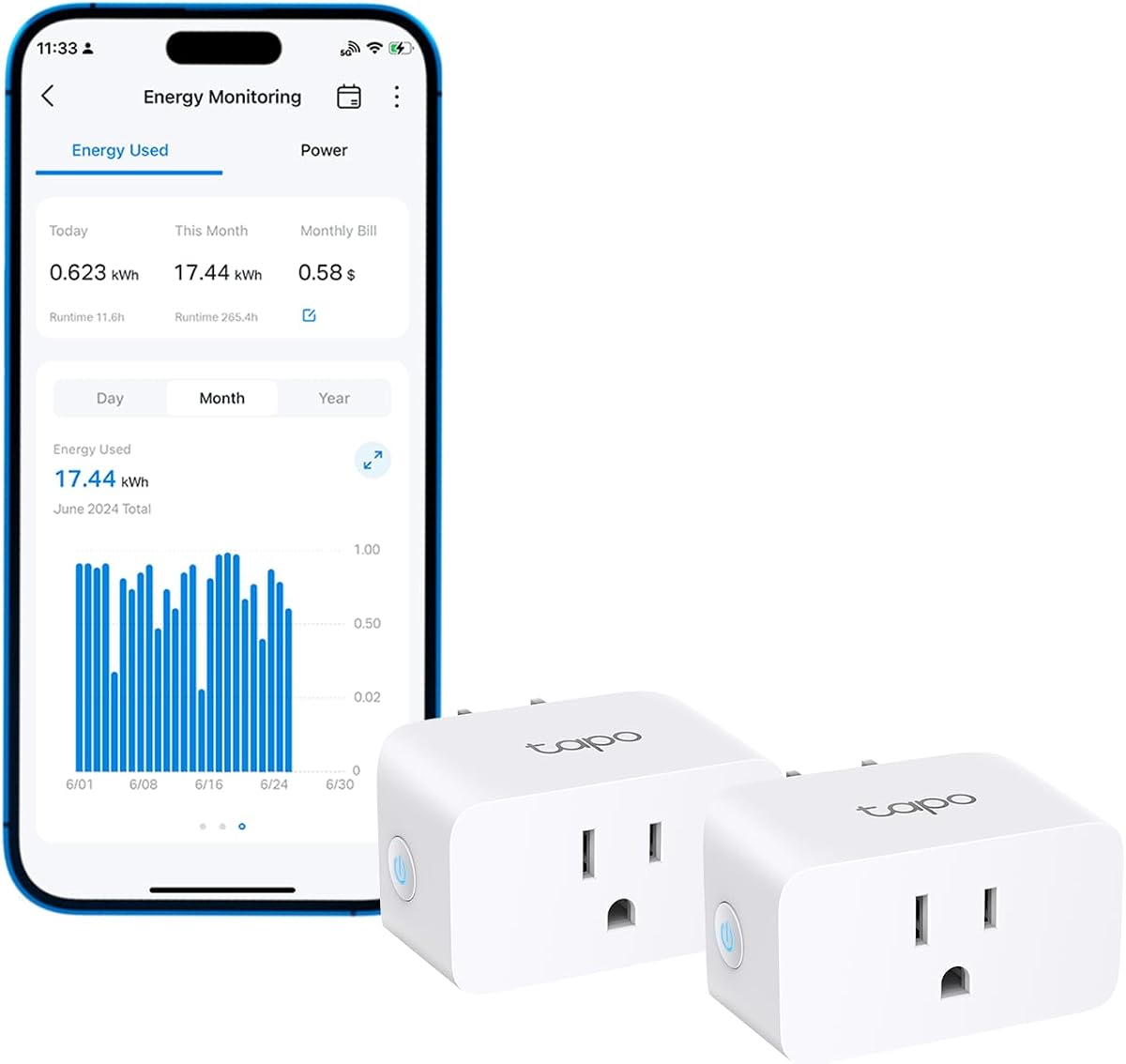
The Tapo P110M is the most versatile premium entry in this list, combining Matter certification with energy monitoring and a 15A rating. Its 4.4 rating reflects a well-rounded feature set, particularly for households that want to manage connected plugs through Apple HomeKit, Amazon Alexa, Google Home, or Samsung SmartThings rather than depend on a single brand ecosystem.
We may earn a commission when you buy through this link, at no additional cost to you.
Energy management is a major strength. The plug provides in-depth statistics and clear visuals, supports single and periodic energy readings, and can integrate billing information for cost visualization. Scheduled operation can move high-consumption appliances toward off-peak periods, while configurable cutoffs and durations help prevent overcharging and excessive current draw.
The principal compromise is that broad compatibility does not make every installation effortless. Users still need an appropriate Matter-capable setup, and voice assistants must be linked through the Tapo app. The four-pack may also be more than a small-apartment user needs, but for several rooms it reduces the need to source matching plugs individually.
This P110M is an excellent choice for energy-conscious smart-home users who value platform flexibility. It suits those who want detailed consumption information, automatic power management, and Matter's broader interoperability without giving up familiar Tapo app controls.
Matter certification allows the plug to participate in ecosystems built around major smart-home platforms. That flexibility is particularly valuable for people who may switch assistants or already use products from several brands and want a consistent way to control compatible devices.
In-depth statistics, clear visuals, and billing-system integration make this model more useful than a plug that only reports instantaneous status. The information can help users identify persistent consumption and decide which appliances deserve automated scheduling.
We may earn a commission when you buy through this link, at no additional cost to you.
The Govee Smart Plug with Energy Monitoring carries the highest listed rating in this comparison at 4.6. It tracks real-time power, current, and voltage through the Govee Home App, and the availability of daily, weekly, monthly, and up-to-one-year history makes it especially attractive for users who want more than an on-or-off indicator.
We may earn a commission when you buy through this link, at no additional cost to you.
Connectivity is unusually flexible for this category. It connects by both WiFi and Bluetooth, giving users an alternate local connection path while still providing remote appliance control through the app. Detailed minute-by-minute schedules, group controls, sharing, and voice commands through Alexa or Google Assistant round out a capable everyday smart plug.
The most important limitation is that it requires 2.4GHz WiFi and does not support 5GHz networks. Matter is not mentioned in the supplied specifications, so households centered on Apple Home or SmartThings should not assume interoperability without checking current product documentation. The listed 15A, 120V rating makes it suitable for higher-power appliances, including a coffee maker.
For users who prioritize comprehensive energy history and flexible connection methods, the Govee is a strong recommendation. It is well suited to households that want to compare consumption over time, automate several appliances, and use either app-based or voice control.
Daily, weekly, monthly, and one-year views make it possible to look beyond a single reading. Longer histories can reveal seasonal patterns, recurring standby use, and changes in how frequently a connected appliance operates.
Bluetooth support complements WiFi control and can simplify local interaction with the plug. As with every smart-home device, the exact behavior depends on the current app and network configuration, so users should confirm that their intended controls work with their own router and smartphone.
We may earn a commission when you buy through this link, at no additional cost to you.
The Emporia Energy Monitoring Smart Plug offers a direct, approachable way to monitor and control ordinary household devices. It has a 4.0 rating, the lowest listed among these ten products, but its core functions cover the essentials: energy visibility, remote switching, timers, schedules, and voice control through Alexa and Google Home.
We may earn a commission when you buy through this link, at no additional cost to you.
The four-pack is suited to lights, fans, lamps, humidifiers, and other everyday appliances. Built-in scheduling automates operation, while the Emporia app provides remote status checks and switching. Energy monitoring helps users identify wasteful standby consumption and can potentially extend the useful life of connected products by reducing unnecessary on-time.
Load limits are the main consideration. Although the title includes 15A, the supplied specifications state a 10A maximum continuous load and allow a 15A peak load for up to one hour per day. That distinction matters for high-draw appliances and should be checked carefully before use. The plug also requires 2.4GHz WiFi and cannot connect to 5GHz networks.
Emporia is a sensible choice for users focused on straightforward energy monitoring and automated routines rather than advanced load protection or Matter interoperability. It is best suited to everyday lower-draw equipment where remote control and dependable scheduling matter most.
Built-in on-and-off schedules are useful for appliances that follow a predictable daily routine. A coffee maker, humidifier, or lamp can operate without continuous manual intervention, while remote checks help confirm whether a device is currently running.
The distinction between continuous and peak loading is more important than the headline amperage alone. Users should reserve higher loads for compatible equipment and avoid treating a short-term maximum as permission for sustained high-power operation.
We may earn a commission when you buy through this link, at no additional cost to you.
The AiSeek Smart Plug Outlet with Energy Monitoring combines a 4.3 rating with a compact four-pack format, real-time power and energy tracking, and flexible automation. It is a practical option for households that want to manage multiple small appliances through one app and prefer a straightforward SmartLife-based setup.
We may earn a commission when you buy through this link, at no additional cost to you.
Timers and schedules can automatically shut down connected devices after a set period, helping reduce consumption when equipment is left on. Group control and sharing make it easier to manage several plugs at once or grant access to other household members. The compact form is intended to avoid taking up unnecessary outlet space, while a 1800W, 15A capacity rating covers many common household appliances.
Safety provisions include FCC certification, fire-resistant materials, and protection against short circuits and overloads. The product works through the SmartLife app and supports Alexa and Google Assistant, but users must first connect the plug to SmartLife and add the assistant through third-party services. Direct Alexa pairing is not supported, which adds a setup step.
This is a good choice for users who want multi-plug coverage, compact controls, and detailed scheduling in a familiar app. It may be less attractive for buyers seeking Matter, Bluetooth, automatic charging cutoff, or a broader range of assistant platforms.
Managing several plugs individually can become unnecessarily complicated. Group control consolidates common actions, while sharing gives household members or other permitted users an easier route to operate the connected equipment.
Alexa and Google Assistant support is available, but the setup process routes through the SmartLife app. Users should follow the stated third-party-service steps rather than expecting the plug to connect directly to an assistant.
We may earn a commission when you buy through this link, at no additional cost to you.
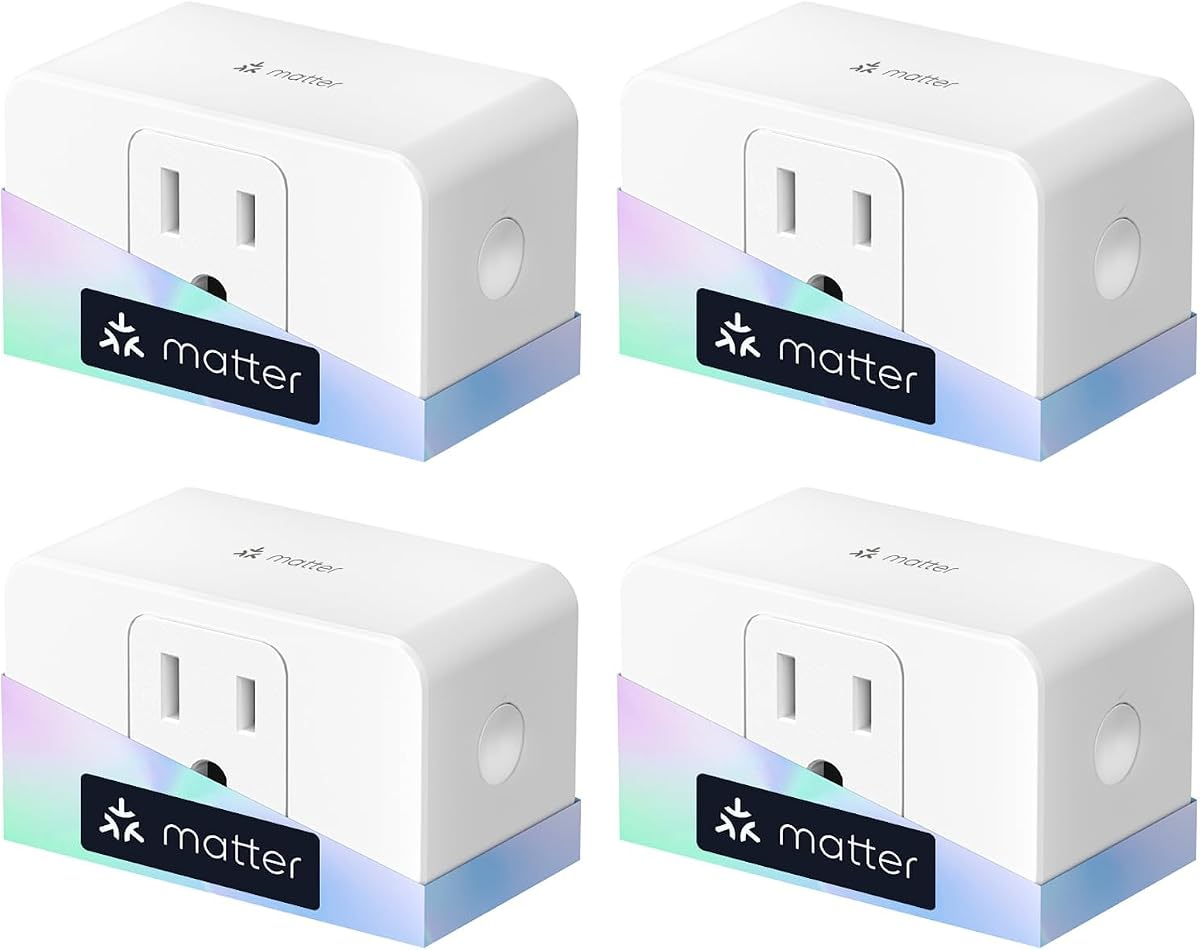
The Kasa KP125MP4 is a strong choice for a Matter-centered smart home that values energy tracking and local control. It carries a 4.3 rating, supports major Matter-certified platforms, and can track consumption over time so users can identify patterns rather than relying on a simple on-or-off state.
We may earn a commission when you buy through this link, at no additional cost to you.
Its most compelling technical benefit is Matter's smooth LAN control. Compatible devices in the local network can communicate directly, allowing a Matter switch or sensor to control a Matter bulb without a specific forwarding device. Once configured, local communication can continue even if the home internet goes offline, subject to the user's platform and device setup.
The plug also supports the Kasa app, Siri, Amazon Alexa, Google Assistant, and Samsung SmartThings. Its compact body is designed to avoid blocking adjacent outlets, and the supplied specifications note UL-certified flame-retardant construction along with a two-year limited warranty. Users must still confirm whether their selected platform requires a Matter-compatible hub.
For households that want energy history without giving up local-network responsiveness, the KP125MP4 is a compelling option. The four-pack works especially well for broad room coverage, while smaller users can consider the two-pack version for a more focused installation.
Matter LAN control can keep compatible devices communicating directly on the home network. That architecture reduces dependence on a cloud route for basic device-to-device actions and can preserve local control when internet access is unavailable.
The compact design is useful where outlet space is limited. Buyers can monitor several appliances without each plug taking up as much room as a larger outlet adapter, although actual clearance should always be checked in the intended location.
We may earn a commission when you buy through this link, at no additional cost to you.
The two-pack version of the Tapo P115 delivers a 4.5 rating and the same core energy-monitoring experience as the larger set, making it a sensible focused choice for buyers who only need to monitor two important appliances. It offers clear statistics, intuitive charts, cost estimation, scheduling, voice control, and automatic shutdown features.
We may earn a commission when you buy through this link, at no additional cost to you.
Its monitoring tools track energy use and can visualize costs from both single and periodic readings. Programmable schedules can operate high-consumption devices during periods with lower rates. For battery-powered products, the plug can stop charging once the user-defined low-battery threshold is reached, while its auto-shutoff responds when a connected device uses too much power.
The trade-off is coverage rather than functionality. Two plugs may be perfect for a home office or entertainment area but insufficient for whole-home monitoring. Matter is not included in the supplied feature list, and the named voice platforms are Alexa and Google Assistant rather than the wider Matter ecosystem.
This model is an excellent budget-minded recommendation for users who want the Tapo P115's useful safeguards and reporting without purchasing a larger pack. It is particularly appropriate for two appliances with meaningful standby draw or a schedule that could benefit from automatic control.
The best monitoring strategy begins with the appliances most likely to waste energy or benefit from automation. Two well-chosen locations can provide useful evidence without the complexity of controlling a large collection of plugs.
Automatic cutoff at a chosen battery level can reduce unnecessary charging time and help prevent overcharging. The threshold should be selected carefully for the connected product and its charging requirements.
We may earn a commission when you buy through this link, at no additional cost to you.
The Kasa KP125MP2 gives buyers a focused two-pack version of Kasa's Matter-compatible energy monitor. With a 4.3 rating, it supports the same important qualities as the four-pack model: consumption tracking, Matter platform integration, smooth local-area control, app access, and multiple voice-assistant options.
We may earn a commission when you buy through this link, at no additional cost to you.
Tracking energy use over time helps users understand when connected devices operate and how much they consume. Matter compatibility broadens the number of platforms that can manage the plug, including Apple Home, Amazon Alexa, Google Home, and Samsung SmartThings. Once configured, compatible devices can communicate directly on the LAN without requiring a specific forwarding device.
The two-pack format is both a strength and a limitation. It is easier to deploy selectively in a kitchen, office, or entertainment area, but it cannot provide the room-by-room coverage of the larger Kasa set. Users also need a compatible ecosystem, and the exact hub requirements depend on the platform they select.
This is a strong recommendation for users who want Matter, local control, and energy history without maintaining a large collection of plugs. It is also a sensible choice for testing a Matter-based energy-monitoring routine in two high-value locations before expanding coverage.
A two-pack can serve as a focused pilot for home energy awareness. Users can track two representative appliances, evaluate the app's reports, and determine whether broader automation would be useful.
The free Kasa app supports direct management, while Siri, Alexa, Google Assistant, and SmartThings voice control provide hands-free alternatives. Compatibility across supported Matter platforms lets users choose the interface that best fits their household.
We may earn a commission when you buy through this link, at no additional cost to you.
The TOPELER 15A Smart Plug with Energy Monitor provides a 4.1 rating and a useful combination of dual-mode connectivity, detailed real-time measurements, and app-based reporting. Its two-pack format makes it accessible for controlling a pair of appliances while supplying enough information to understand their consumption.
We may earn a commission when you buy through this link, at no additional cost to you.
The plug can track real-time power, current, and voltage through the Smartlife app, then present daily, weekly, and monthly reports. Those views help users identify usage patterns and waste. It also supports timers, remote operation, and voice commands through Alexa and Google Assistant after the appropriate Smartlife linking steps are completed.
Dual-mode connectivity is its defining convenience. The plug supports 2.4GHz WiFi and Bluetooth, and users can reportedly continue controlling devices locally through Bluetooth if the WiFi connection is unavailable. It is ETL and FCC certified, uses fire-resistant materials, and carries a 1800W, 15A rating for common household appliances.
TOPELER is a practical recommendation for buyers who value flexible connection methods and straightforward reports. It is less compelling for users who require Matter, wider voice-platform support, automatic load cutoffs, or the highest rating in the group.
The local Bluetooth path can be valuable during a temporary WiFi outage because users do not have to depend entirely on a remote network route. This makes the plug more adaptable to changing home connectivity conditions.
Daily, weekly, and monthly reports show consumption at different levels of detail. Short-term views reveal recent changes, while monthly trends can help determine whether an appliance's operating pattern is producing persistent unnecessary use.
We may earn a commission when you buy through this link, at no additional cost to you.
The meross Matter Smart Plug stands out for combining energy monitoring with a privacy-focused local-control approach. Its 4.4 rating and Matter multi-platform support make it appealing to users who want Apple Home, Alexa, Google Home, or SmartThings compatibility alongside real-time power data and historical usage information.
We may earn a commission when you buy through this link, at no additional cost to you.
The built-in power meter reports real-time consumption, while the Meross app provides historical data for understanding usage patterns. A standout feature is the absence of registration and data tracking, combined with direct access that does not rely on cloud infrastructure. The plug can remain available for local control even when the internet is offline.
Setup is simplified for Echo users through Matter device discovery, provided the purchase account matches the Echo account. Traditional Matter pairing remains available in other situations. There are important requirements: Matter over WiFi works only with 2.4GHz and IPv6 networks, Thread is not supported, a Matter-compatible hub is required for the selected platform, and the phone must run a sufficiently recent operating system.
meross is a strong recommendation for privacy-conscious users who understand modern smart-home infrastructure requirements. The combination of local control, no registration, historical energy data, and broad Matter support distinguishes it from simpler app-dependent plugs.
The stated lack of registration and data tracking offers a privacy-oriented alternative to account-centered cloud services. Users can still obtain real-time readings and historical energy information through the Meross app while retaining direct local access.
Compatibility involves more than simply supporting the Matter standard. The plug requires a compatible hub, a 2.4GHz IPv6 network for Matter over WiFi, and a recent mobile operating system, so buyers should confirm their infrastructure before installation.
We may earn a commission when you buy through this link, at no additional cost to you.
The best energy-monitoring plug balances accurate usage visibility with safe switching, dependable app controls, useful automation, and compatibility with the home network. Buyers should evaluate load ratings, data history, platform support, and local-control behavior before choosing a model.
Always match the connected load to the lower relevant limit. A higher peak allowance should not be treated as a continuous operating rating.
Choose the reporting depth that matches your goals: quick checks, scheduling decisions, or long-term trend analysis.
Verify both the app and voice platform you already use before buying, especially if you expect Matter compatibility.
Confirm 2.4GHz support, hub needs, and offline behavior before installation to avoid setup surprises.
Use repeatable schedules for recurring routines and timers for bounded tasks that only need to run once.
Prioritize documented protection and certification over unspecified claims, and use the manufacturer's instructions.
Set charging and current thresholds according to the connected product's requirements, not just the plug's maximum rating.
Start with high-draw or frequently forgotten appliances, then expand only if ongoing reports justify it.
Begin by confirming that the connected appliance is compatible with the plug's continuous load rating. Check the manufacturer's power requirements, ensure the outlet provides appropriate grounding, and position the plug where it will not be pinched, overheated, covered, or exposed to moisture. Plug the appliance into the smart plug before pairing the plug with its app.
Install the appropriate manufacturer's app and connect the plug to a supported 2.4GHz WiFi network. Matter-based products may also require a compatible hub, an IPv6 network, and recent mobile software. Complete the app's pairing steps, name the plug after its location or appliance, and then verify that its on-and-off state matches the physical status.
After basic control works, review energy readings under normal operating conditions. Set schedules, timers, charging limits, or overload thresholds only after understanding the connected device's normal consumption. Check live power, current, voltage, and historical reports, and use the app's group features if several plugs serve related routines. Disconnect the appliance before removing the plug, and keep the housing dry, undamaged, and free of dust buildup.
They can help identify waste, but the plug does not reduce consumption by itself. Energy reports reveal which devices consume power, while schedules and remote switching make it easier to turn them off. The actual reduction depends on how users configure those tools and change their habits.
Most of the listed products specify 2.4GHz WiFi support, and the Emporia, AiSeek, and TOPELER explicitly do not support 5GHz networks. Other models do not clearly state 5GHz compatibility in the supplied information. Users should check current product documentation or use a router configured for a compatible 2.4GHz network.
Matter is not essential for basic metering, timers, or app-based control, but it can improve compatibility across smart-home platforms. The Tapo P110M, Kasa models, and meross plug support Matter, allowing use with major platforms when the required hub, network, and device configuration is available.
Only if the specific plug supports that sustained load and the appliance otherwise meets its requirements. The Emporia model has a 10A continuous maximum, even though it allows a higher peak load for a limited duration. Several other plugs are rated for 15A or 1800W, but users should verify the exact specifications and manufacturer guidance.
It depends on the model and control method. Govee and TOPELER support Bluetooth, and Matter products can offer local LAN communication under compatible conditions. Some app, voice, history, or setup features may still require internet access, so offline behavior should be confirmed for the particular platform.
The Tapo P115 and P110M can cut power when a connected device reaches a user-defined low-battery limit. This can prevent charging from continuing past the selected threshold, but the feature should be configured for the device's requirements and should not replace the manufacturer's own charging protections.
Start with appliances that draw meaningful standby power, run continuously, or benefit from scheduling. Two plugs can provide a focused entry point, while a four-pack is more useful for coverage across several rooms. The best quantity depends on your outlets, connected devices, and how consistently you will review and adjust the reports.
Depending on the model, a plug may show real-time power, current, voltage, on-and-off status, estimated costs, and historical usage. Some support daily, weekly, monthly, or year-long reports, while others include bill integration or visualizations for identifying high-consumption periods.
The Govee Smart Plug is the strongest choice for detailed history because it tracks real-time power, current, and voltage and provides daily, weekly, monthly, and one-year views. The Tapo P110M takes the lead for premium Matter compatibility and advanced power management, while the two-pack Tapo P115 offers an accessible way to get clear charts, charging cutoff, overload shutoff, and scheduling for two selected devices.
Prioritize the factors that affect your specific routine: sustained load for the appliance, historical reporting for energy awareness, Matter for ecosystem flexibility, Bluetooth or local control for network resilience, and automatic thresholds for devices that need charging management. A smaller targeted set of plugs is often more useful than a large collection if the same locations and schedules can cover the appliances that matter most.
Before purchasing, confirm the plug's continuous load rating, network requirements, app compatibility, and supported voice platforms. Amazon prices, discounts, and product availability can change, so readers should review the current listing and latest manufacturer documentation at the time of purchase.