
TopTes PT177
4.6Editor score
Pocket-sized propane sniffer
Audible and visual escalation
Thirty-second auto-calibration
This propane leak detector for RV guide compares ten portable and installed alarms by detection range, probe reach, alerts, power, and RV fit for 2026.
Propane leak detection in an RV requires more than a general smoke alarm because stored and piped LPG can accumulate in enclosed, low, or poorly ventilated spaces. The most useful tools combine sensitive gas sensing with audible and visual alerts, while probe length and installation requirements determine how easily a leak can be located.
We compared ten portable sniffer-style detectors and permanently installed RV alarms based on the supplied specifications, including supported gases, alarm response, detection range, probe reach, power source, display information, included accessories, and RV-specific features. The list covers both pinpoint inspection tools and always-on protection systems.
Each review explains where the product stands out, what trade-offs may matter, and which RV owner or maintenance task it best suits. Product availability, promotions, and prices can change, so readers should confirm the current listing and verify that an alarm matches their RV wiring, installation space, and inspection habits.
4.6Editor score

4.6Editor score

4.5Editor score
The comparison below separates handheld leak finders from permanently installed RV alarms, making it easier to match probe access, numerical readouts, power requirements, and installation style to a particular trailer, motorhome, or camper.



The TopTes PT520A is a portable gas leak detector built around a flexible 17-inch gooseneck, making it one of the most versatile inspection tools in this roundup. It carries a 4.6 rating and is specifically described as suitable for propane, methane, butane, natural gas, LPG, and other combustible gases. Its principal advantage is the ability to search beneath appliances, around pipe joints, and inside service areas without immediately placing the operator's face beside a suspected leak.
We may earn a commission when you buy through this link, at no additional cost to you.
The gooseneck provides access to tight spaces while the sensor should still be moved to approximately 1–5 centimeters from the suspected source. The stated response time is 0.5 seconds, and seven colored bars plus a 75 dB alarm escalate as concentration rises. A 50–10,000 ppm methane-based range gives the tool more headroom than compact detectors limited to 1,000 ppm, which is useful when working around a suspected leak rather than checking a single accessible fitting.
The detector is not entirely hands-free, and it must warm up for 30 seconds in clean air before use. Its three AAA batteries, mute control, selectable auto power-off, and included protective case make it convenient to maintain. As with any combustible-gas instrument, the flexible probe must be handled carefully, and the warm-up should occur where no gas is present so the initial calibration is not compromised.
This is the strongest general-purpose recommendation for RV owners because it combines a long inspection reach, rapid alerts, a broad supported-gas list, and a large stated detection range. It suits owners who service regulators, stove plumbing, refrigerator systems, or storage connections themselves and want more pinpointing capability than a basic pocket sniffer provides.
The 17-inch gooseneck can bend around cabinets, valves, and appliance bases where a short sensor would be difficult to position. This makes the PT520A more useful for follow-up inspections after a fixed alarm has identified a general area that needs closer investigation.
A 0.5-second response, seven colored concentration bars, and a 75 dB alarm provide several ways to interpret a developing leak. The visual scale is particularly helpful in noisy or poorly illuminated campgrounds where hearing alone may be less convenient.
We may earn a commission when you buy through this link, at no additional cost to you.
The TopTes PT199 is a pocket-sized combustible-gas sniffer intended for locating sources rather than measuring a permanently installed system's condition. Its 4.6 rating reflects a well-regarded product, while the included batteries, storage bag, and manual make it easy to keep in an RV maintenance kit. The detector is listed for natural gas, methane, propane, butane, LPG, and other combustible sources.
We may earn a commission when you buy through this link, at no additional cost to you.
Its 0.5-second alarm response is quick for a portable instrument. Both an audible alarm and visual indication respond to detected gas, the alarm becomes more intense as concentration increases, and the LCD turns red at high gas levels. A 50–1,000 ppm methane-based detection range is suitable for close inspection, and the recommended working distance of 1–5 centimeters is consistent with checking fittings directly.
The main limitation is that the PT199 has no extended probe, so it may be less convenient where the suspected source is behind an appliance or inside a narrow cavity. Its upper range is also lower than that of the PT520A and PT760. The device compensates with a simple, pocketable design, a non-slip surface, low-battery indication, and automatic shutoff after five minutes of inactivity.
RV owners who want a small tool for checking exposed hose connections, quick-dispenser fittings, and accessible stove joints will find the PT199 easy to carry and operate. It is less compelling for difficult service spaces where a gooseneck or telescoping probe would allow safer and more precise inspection.
The compact body and supplied drawstring bag make the PT199 convenient for routine checks around the RV. It can be kept in a cabinet with basic tools and removed when a connection, regulator, or appliance needs inspection.
A red screen and increasingly strong audio alarm make results easy to understand without learning a complex interface. The 0.5-second response is particularly useful during close-range checks of accessible fittings.
We may earn a commission when you buy through this link, at no additional cost to you.
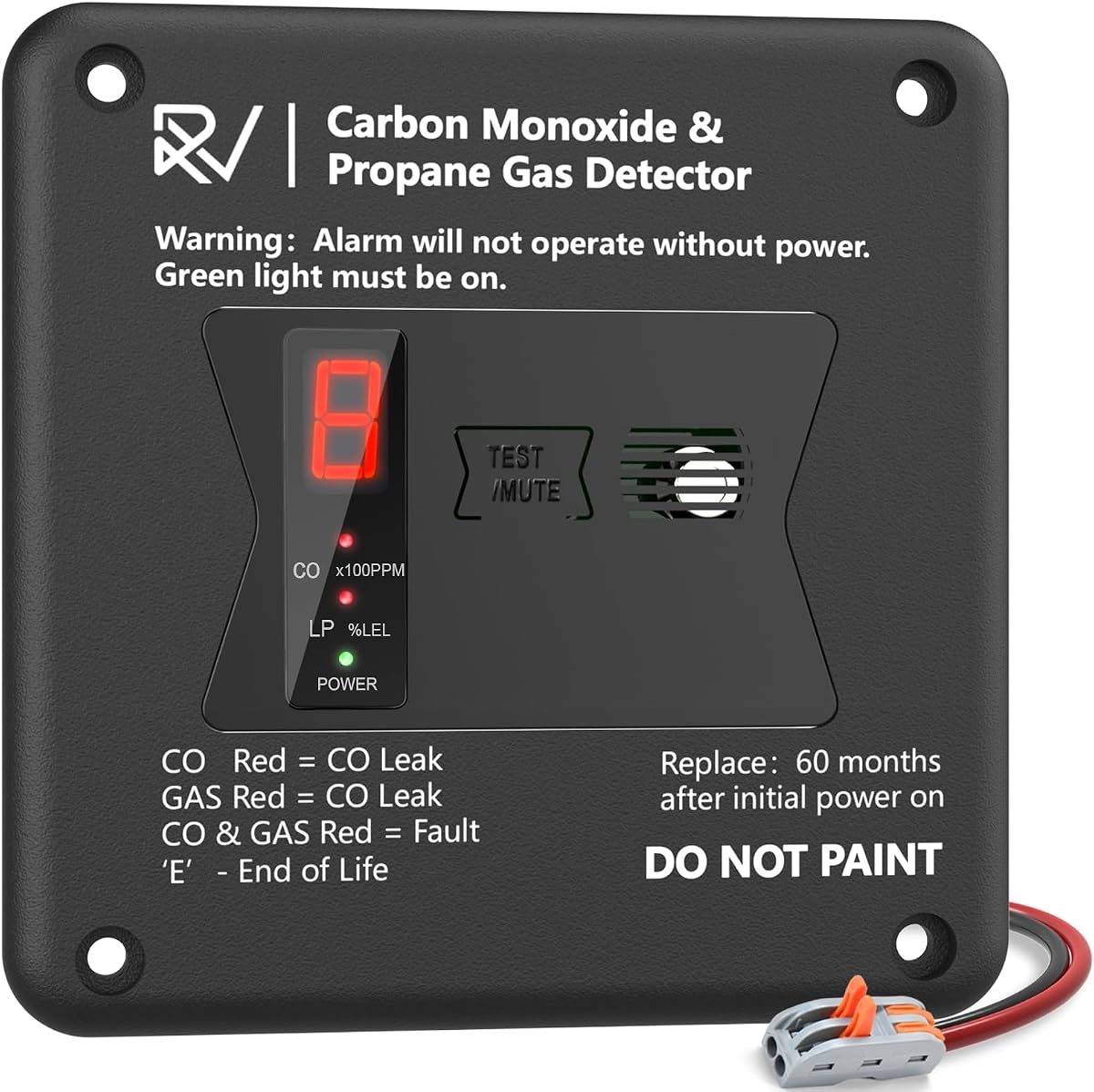
The R503 Flush Mount is a permanently installed RV detector rather than a handheld sniffer. Designed for motorhomes, travel trailers, motor coaches, and truck campers, it uses two independent sensors for carbon monoxide and combustible gas. Its 4.6 rating and compatibility references to the 31011 style make it especially relevant to owners considering a replacement for an existing RV alarm.
We may earn a commission when you buy through this link, at no additional cost to you.
The detector operates on 12V DC with a stated tolerance of plus or minus 20 percent. Its digital LED display indicates carbon monoxide level and confirms when the CO and gas sensors are active. The product title also identifies a 100 dB alarm, which is designed to provide a conspicuous warning inside a trailer or motorhome. Lever-nut connectors are included to simplify wiring compared with wrapped or taped connections.
This is not a tool for finding a tiny leak at a specific valve. Instead, it is a monitoring alarm intended to remain in service and warn occupants when dangerous conditions occur. Installation requires attention to the stated face-cover dimensions, wall cutout, and screw-hole spacing. Those measurements should be checked before ordering, particularly in a customized interior or an older installation with unusual clearances.
The R503 is best for owners who want a combined CO and combustible-gas alarm permanently installed in an RV. Its flush profile, digital status display, loud warning, and replacement-oriented mounting details make it a practical choice for new installations or upgrades, provided the RV's electrical system and available wall space are compatible.
Independent CO and combustible-gas sensors let the unit monitor two important RV hazards in a single location. This can simplify equipment selection and reduce the number of separate devices mounted in a compact living area.
The listed 31011-compatible screw spacing and included lever-nut connectors help owners replace a familiar alarm style. The wall cutout should still be measured because exterior trim, wall layers, and cabinet backing can affect fit.
We may earn a commission when you buy through this link, at no additional cost to you.
The TopTes PT205 distinguishes itself from simple sniffer-style products by displaying gas concentration as a percentage of the Lower Explosive Limit. It has a 4.6 rating and is intended for home and RV use, including propane, butane, methane, ethane, LPG, natural gas, coal gas, gas fuel, and liquefied natural gas. That combination of supported gases and numerical information makes it useful for more structured leak assessment.
We may earn a commission when you buy through this link, at no additional cost to you.
The stated range is 1–10 percent LEL, equivalent to 100–5,000 ppm when based on methane. A visual bar graph rises as gas concentration increases, the LCD turns red at high levels, and an audible alarm provides a second warning. Detection can trigger within 0.5 seconds. A 30-second countdown keeps the owner informed while the unit calibrates in clean air before the inspection begins.
The pen-shaped format, pocket hook, non-slip texture, and included storage bag support regular use. Two AAA batteries are supplied, while a low-battery indicator and automatic power-off help reduce maintenance concerns. The PT205 lacks a long probe, so it is better suited to accessible connections than deep cabinet spaces. Its LEL readings are based on methane calibration, which should be considered when interpreting results across different gases.
This is a good choice for RV owners who want more information than a simple beep and want to track changes during a close inspection. It combines compact storage, fast alerts, and a numerical LEL display without becoming a permanently installed alarm. It works best as part of a broader leak-checking routine rather than a replacement for required fixed safety equipment.
A percent LEL display gives useful context that a simple alarm cannot. The figure represents proximity to the lower explosive limit according to the detector's stated methane-based scale, allowing an owner to watch whether readings change as the sensor is moved closer.
The on-screen warm-up countdown confirms when the unit is ready. Performing that process in clean air helps ensure that the initial calibration is not distorted by gas already present in the area being inspected.
We may earn a commission when you buy through this link, at no additional cost to you.
The TopTes PT177 is a straightforward portable gas sniffer that prioritizes portability, straightforward controls, and a modest feature set. Its 4.6 rating is strong for an entry-oriented product, and the supplied specification identifies it for LPG, methane, ethane, propane, butane, natural gas, coal gas, and other combustible gases. That makes it relevant to routine checks around RV appliances and gas connections.
We may earn a commission when you buy through this link, at no additional cost to you.
The device completes a 30-second auto-calibration in clean air before use. It can trigger an alarm within approximately 0.5–3 seconds, after which five red LEDs and a 75 dB audible warning become more intense as concentration rises. A pocket clip and included drawstring storage bag make it easy to carry or keep in a maintenance drawer. Two AAA batteries are also included.
Its limitations are important. There is no numerical LEL readout, and the sensor itself is not mounted on a probe, so it must be brought directly to an accessible point. The unit automatically powers off after five minutes without operation or detection, which conserves energy but may be inconvenient if an inspection is paused for another reason. A flashing power indicator warns when voltage drops below 2.4 volts.
The PT177 is the best budget pick for owners who want a simple way to check exposed propane fittings and appliance connections without paying for a display or extendable probe. It offers a practical balance of portability and alert capability, while owners with difficult-to-reach systems should consider a model with a probe.
The PT177 covers the basic needs of a portable combustible-gas sniffer without adding a numerical display or telescoping assembly. It is a sensible first inspection tool for accessible hoses, regulators, and appliance connections around an RV.
Five LEDs and a 75 dB alarm provide a simple indication of increasing gas concentration. That visual escalation remains useful in a confined compartment where an owner may need to observe the detector while moving it toward a suspected fitting.
We may earn a commission when you buy through this link, at no additional cost to you.
The TopTes PT210S occupies a useful middle ground between a basic pocket sniffer and a long-probe detector. It has a 4.6 rating, supports propane, natural gas, methane, and butane, and adds a short probe for better positioning around fittings. Its two-digit display shows the current reading in percent LEL, while its stated range covers 1–10 percent LEL or 100–5,000 ppm based on methane.
We may earn a commission when you buy through this link, at no additional cost to you.
The detector can identify gas in 0.5 seconds. The screen turns red, bar graphs rise, and a 75 dB buzzer sounds, with both visual and audible warnings becoming more serious as the reading increases. Dual-mode operation offers high-sensitivity and low-sensitivity settings, which can be useful when moving from a general search to a close inspection. An automatic five-minute shutdown preserves battery life, and a low-battery indicator flashes below 2.5 volts.
The four-inch probe is an improvement over direct sensing but not enough for deep cabinets or long service runs. Users must also understand the difference between sensitivity modes to interpret the readings correctly. The anti-slip body supports one-handed handling, and the included bag, multilingual manual, and two AAA batteries make the package ready for regular use.
The PT210S is a strong choice for RV owners who want a numerical reading but do not need the reach of the PT520A or PT760. Its compact form, short probe, and dual sensitivity make it particularly useful for cabinet edges, appliance bases, and exposed plumbing where some extra positioning distance is helpful.
The four-inch probe gives the sensor room to move around the edge of an appliance or around a fitting while keeping the device compact. It is a practical middle ground for routine maintenance without the storage demands of a long gooseneck.
High- and low-sensitivity modes let an operator begin with broader searching and then use a more focused setting around a suspected source. The change in mode should be understood before comparing readings across different parts of the RV.
We may earn a commission when you buy through this link, at no additional cost to you.
The TopTes PT760 is the most feature-rich portable detector in the group. It has a 4.5 rating and combines a rechargeable Type-C power system, a 12-inch extendable stainless-steel probe, a percent LEL display, and a built-in flashlight. The probe and light are especially relevant in an RV, where regulators, hoses, storage areas, and cabinet spaces can be dark or difficult to see.
We may earn a commission when you buy through this link, at no additional cost to you.
The sensor supports LPG, methane, ethane, propane, butane, natural gas, coal gas, and gas fuel. It responds audibly and visually within 0.5 seconds, with tone frequency and screen color changing as gas concentration rises. The stated range is 1–20 percent LEL, or 100–10,000 ppm, which is the broadest LEL span among the handheld models listed.
A 30-second preheat countdown appears on the screen. Once inspection is complete, the probe retracts to create a compact unit that fits in the included protective case. Low-battery and automatic power-off functions are included. One trade-off is that the rechargeable battery must be kept charged, unlike models that accept common replaceable AAA cells, and the extended metal probe should be handled without sharp bending.
The PT760 is the premium choice for owners who perform frequent inspections, work in poorly lit compartments, or want one tool that combines numerical information with improved access. It is also a strong travel companion because it folds down for storage, although buyers should establish a charging routine before relying on it for an urgent check.
The 12-inch stainless-steel probe can reach into narrow spaces, inside pipes, and behind cabinets. Retracting it afterward preserves the portability of a pocket-oriented detector while giving the operator more reach than shorter probes.
The built-in flashlight helps the operator see fittings, pipe runs, and labels in poorly illuminated compartments. It reduces the need to carry a separate light during a leak inspection, where managing multiple tools can be inconvenient.
We may earn a commission when you buy through this link, at no additional cost to you.
The TopTes PT299 uses an adjustable rod to place the sensor near difficult-to-reach propane sources without requiring the owner to bring the entire detector body directly against the leak point. It has a 4.6 rating and is listed for propane, methane, natural gas, LPG, gasoline, and other combustible leaks. The product is specifically described as suitable for pipelines, storage tanks, fireplaces, basements, and RVs.
We may earn a commission when you buy through this link, at no additional cost to you.
The rod extends from 2.20 to 6.30 inches, giving the operator more positioning flexibility than a direct-sensing unit while remaining more compact than a long flexible gooseneck. Detection produces a visual and audible response in 0.5 seconds. Nine analog bars rise with concentration, the display turns red, and a 75 dB buzzer helps guide the user toward the source. The stated range is 1–10 percent LEL, or 100–5,000 ppm based on methane.
A 30-second preheat countdown and low-battery alert help organize use, while a selectable five-minute automatic shutdown protects the batteries. The package includes two AAA batteries and a storage bag. Unlike the PT205, it does not present a numerical concentration reading, so the user relies on the bar scale and alarm intensity rather than a precise displayed value.
The PT299 fits owners who need moderate extra reach but do not require a numerical LEL reading or rechargeable power. It is especially practical for tracing a leak around a storage tank connection, fireplace, pipe run, or other RV service area where direct contact would be inconvenient.
Extending the rod allows the sensor to approach a suspected source while the main body remains farther away. This helps the operator work around pipework and storage areas without repeatedly bringing the detector into the immediate vicinity of a leak.
Nine ascending analog bars and a red screen provide an intuitive concentration trend. Although less precise than a numerical LEL display, the scale is useful for comparing locations and moving gradually toward a stronger reading.
We may earn a commission when you buy through this link, at no additional cost to you.
The Safe T Alert 20 Series Mini LP Gas Alarm is a permanently installed propane alarm built specifically for RV use. It carries a 4.7 rating, the highest customer rating among the products in this guide, and its surface-mount case is intended for travel trailers, fifth wheels, truck campers, and folding campers. It is designed to provide ongoing warning rather than locate a leak with a handheld probe.
We may earn a commission when you buy through this link, at no additional cost to you.
The alarm activates below 25 percent LEL for propane or methane. A mute button allows safe ventilation, while the rapid-recovery sensor reactivates the warning if propane levels remain dangerous. It operates on 12V DC at 75 mA, providing protection without replaceable batteries. The circuitry is designed to conserve power for long-term RV use, which is important for an always-connected installation.
Its compact dimensions are 3.5 inches wide by 2.5 inches high by 1.25 inches deep, and an included mounting bracket simplifies installation in tight areas. The listed operating range of -40 to +158 degrees Fahrenheit reflects its focus on harsh and variable RV conditions. Owners still need to select an appropriate location and route the twelve-volt wiring safely.
The Safe T Alert is a strong choice for an RV requiring a fixed LP alarm, especially where space is limited. Its high rating, RV-focused construction, recovery behavior, and broad temperature range make it more specialized than the portable detectors. It should complement, not replace, a portable sniffer used to pinpoint the source after an alarm.
Unlike a handheld tool that must be switched on and carried to a suspected source, a surface-mounted alarm remains connected to the RV's electrical system. That makes it better suited to continuous monitoring while the vehicle is occupied or stored.
The stated -40 to +158 degree Fahrenheit operating range suits the broad environmental conditions encountered by recreational vehicles. This feature makes the alarm more purpose-built for an RV cabinet or service area than a typical household detector.
We may earn a commission when you buy through this link, at no additional cost to you.
The Kidde Carbon Monoxide + Explosive Gas Alarm offers a familiar alternative to permanently wired RV alarms. It has a 4.5 rating and combines carbon-monoxide monitoring with explosive-gas detection for natural gas and propane. Unlike the purpose-built RV units in this guide, it installs by plugging into a standard 120V outlet, so its suitability depends on whether an appropriate outlet is available in the RV.
We may earn a commission when you buy through this link, at no additional cost to you.
A 9-volt backup battery provides continued protection during a power outage. The digital display shows the carbon-monoxide level being sensed or displays the word GAS when explosive gas is present. An 85 dB alarm announces either hazard, while LED status indicators provide a quick visual indication of the unit's condition. Peak Level Memory records the last time carbon monoxide was detected or the unit was tested.
The key advantage is installation simplicity. There is no need to connect the alarm to a low-voltage wiring circuit, which may appeal to owners of a travel trailer or motorhome with usable wall outlets. The trade-off is that an outlet may not exist near the ideal propane monitoring location, and a power cord can be less tidy than a concealed twelve-volt installation.
This Kidde alarm is best considered where standard household-style installation is practical and both carbon monoxide and explosive-gas warnings are desired. It should not be selected on the assumption that it is RV-specific; instead, confirm outlet availability, placement guidance, and local safety requirements before installation.
The plug-in format eliminates hardwiring and can simplify setup in an RV that already has a suitable 120-volt receptacle. Placement should still follow the manufacturer's guidance and account for the movement of gas from its source.
The 9-volt backup battery keeps the warning system operating when the connected power source is interrupted. This is useful during outages, although regular battery checks remain necessary.
We may earn a commission when you buy through this link, at no additional cost to you.
The right propane leak detector for an RV depends on whether you need a portable sniffer for maintenance, a permanently installed alarm for continuous monitoring, or both. Sensor capability, access, alerts, power, and installation constraints should guide the decision.
A portable gas leak detector is used during an active inspection to locate a suspected leak. These products may include a probe, visual concentration scale, or numerical LEL display, but they generally require the owner to turn them on and move them around the system. A fixed alarm remains installed and operates continuously through the RV's electrical system. Fixed models are better for monitoring an occupied trailer, while portable units are better for servicing a suspected connection and tracing its source.
Choose a portable sniffer for maintenance and a fixed alarm for ongoing protection. Many RV owners ultimately need both types because an installed detector identifies danger but does not necessarily show the exact leaking fitting.
A detector intended for an RV should explicitly identify propane or LPG among its supported gases. Some models also cover methane, natural gas, butane, ethane, gasoline vapor, or other fuels. Multi-gas support is useful in an RV because a cooking appliance, refrigerator, space heater, or storage connection may involve different fuel sources. Check the listed detection gases rather than assuming that a product labeled as a natural-gas detector will respond identically to propane.
Prioritize explicit propane support, then consider whether other gases appear in your RV. Broader compatibility is helpful, but accurate use still depends on following the calibration and warm-up instructions.
Detection range indicates the concentration span over which the sensor is designed to operate. The portable models in this guide cover ranges from 50–1,000 ppm to as much as 50–10,000 ppm on a methane basis. Some display a numeric percent LEL value, while others rely on colored bars or LED segments. A numerical readout can make it easier to compare readings while moving toward a source, but a bar-based unit may be sufficient for a simple go-or-no-go inspection.
Look for a range that fits the intended task and understand whether the quoted ppm values are based on methane. Prioritize a numerical LEL display when comparing gas concentration over time; choose visual escalation when simplicity and lower information demands are more important.
Probe length determines how closely the sensor can be positioned around a suspected leak. Direct-sensing models require the entire unit near the fitting, while the PT205, PT210S, PT299, PT520A, and PT760 provide progressively more flexible or extendable access. Longer probes are especially helpful beneath appliances, behind cabinets, around storage tanks, and inside narrow pipe runs. They also allow the main body to remain farther from the suspected source.
Match probe reach to the spaces you expect to inspect. For routine exposed-connection checks, a direct sniffer may be adequate; for deep cabinets or concealed plumbing, choose a four-inch probe, a telescoping rod, or a long gooseneck.
An RV can be noisy, and a warning may need to be noticed from another part of the trailer. Every listed product provides audible or visual indication, while the strongest portable models combine both. Audible alarms in this roundup range from 75 dB to 100 dB for the models that specify a level, and the Kidde unit uses an 85 dB alarm. Visual indicators include red screens, colored concentration bars, numerical readings, and LEDs showing sensor or operating status.
Look for escalating alerts rather than a single static indication. A louder alarm and rising visual scale make concentration changes easier to recognize quickly, especially in confined compartments or noisy campsites.
Portable units generally use replaceable AAA batteries, except for the rechargeable PT760. Replaceable cells are convenient for travel because owners can carry spares, while a rechargeable unit is easier to keep ready when stored near a charging point. Fixed alarms require permanent power. The R503 and Safe T Alert use 12V DC, while the Kidde model uses a 120V outlet and a 9-volt backup battery. Confirm that the RV's wiring or outlet arrangement supports the selected design.
Match power to the intended role. Choose battery or rechargeable power for a handheld inspection tool, and verify wiring, cutout dimensions, and mounting style for any permanently installed alarm.
Most portable sensors in this group require approximately 30 seconds of warm-up or auto-calibration. PT199, PT205, PT299, and PT760 show a countdown, while the PT520A and PT177 also specify a clean-air warm-up. This step should take place in an area known to be free of gas, because calibrating in contaminated air can produce unreliable results. The PT177 additionally requires initial operation in a gas-free environment.
Build the warm-up period into every inspection routine. Never switch on the detector beside a suspected leak and immediately rely on the reading; move to clean air, let calibration finish, and then begin the search.
RV environments include vibration, temperature changes, limited wall space, and stored fuel systems. The Safe T Alert is explicitly designed for RV use and specifies a broad operating temperature range. The R503 offers a flush-mounted format and dimensions intended for RV installation. Portable tools should have a stable grip and enough battery or recharge life for a full inspection. A fixed detector also needs an appropriate location within the alarm's installation guidance and protected wiring.
Check the physical environment before ordering. Measure wall openings, consider seasonal temperatures, and make sure a handheld detector can be stored securely without its probe or batteries being damaged.
Begin every portable inspection in a clean, gas-free location. Install the specified batteries or fully charge the unit, then power it on and allow the stated 30-second warm-up or calibration to finish. Read the manual, confirm that the unit reaches its normal operating display, and do not rely on readings obtained before the warm-up is complete.
Approach the suspected propane system gradually with the sensor held approximately 1–5 centimeters from fittings where the product instructions specify that distance. Move slowly around hoses, regulators, valves, connectors, appliance bases, and storage areas. Watch the visual indicators and listen for alarm escalation; if a strong response occurs, stop, move away from the area, ventilate when safe, and follow the RV manufacturer's shutdown and service procedures.
For a fixed alarm, follow the manufacturer's placement, wiring, and testing instructions exactly. Confirm compatible power, secure the mounting bracket, and check the indicator after installation. Replace batteries in handheld devices according to the low-battery warning, keep the sensor opening free of dust and debris, and store long probes retracted in their case so they are not bent or damaged.
Yes, if the listed detection gases include propane and the operating instructions cover the environment where it will be used. Many portable units in this roundup are marketed for both homes and RVs. For a permanently installed alarm, choose it primarily according to its power source, mounting requirements, temperature range, and RV-specific certification rather than a general home-use label alone.
A portable sniffer is switched on, warmed up, and moved around suspected fittings to locate the source of a leak. A fixed alarm stays installed and warns occupants when it detects a dangerous concentration. The sniffer is primarily a maintenance tool, while the fixed alarm provides continuous monitoring, so many owners benefit from using both.
The sensor needs time to stabilize and calibrate before it can provide meaningful readings. Performing the warm-up in clean air prevents existing gas from interfering with the initial process. The PT205, PT299, and PT760 display a countdown, while the other portable products also specify a warm-up or calibration period that should be observed.
LEL means Lower Explosive Limit, and the displayed percentage indicates the gas concentration relative to that limit. A rising percentage generally indicates a more serious condition, but the readings in these products are commonly based on methane. The value should be used as an indication during inspection rather than as a substitute for manufacturer safety instructions.
A long probe is usually better when the suspected source is behind an appliance, inside a cabinet, or around a pipe. It lets the operator position the sensor accurately without placing the main body close to the leak point. A compact sniffer remains adequate for exposed connections and is easier to carry, so the best choice depends on the RV's access and the owner's inspection habits.
Testing should be especially thorough before departure, after extended storage, and whenever connections, hoses, regulators, or appliances have been disturbed. Follow the RV manufacturer's recommended maintenance schedule and the alarm or detector's instructions. If a strong reading or persistent alarm occurs, stop the inspection, avoid switching electrical equipment, ventilate if safe, and consult qualified service personnel.
No, not when continuous warning is needed. A portable detector only operates while someone has switched it on and is actively checking the system, whereas a fixed alarm remains on duty. A properly installed fixed alarm should be complemented by a portable sniffer for maintenance and pinpointing leaks rather than being replaced by one.
Many RV alarms are designed for 12V DC because that is the vehicle's common low-voltage system. The R503 and Safe T Alert in this guide use 12V DC, whereas the Kidde model uses a standard 120V outlet with a 9-volt backup battery. Confirm the available power, wire size, grounding or connection requirements, and the detector's installation instructions before purchasing.
The TopTes PT520A is the strongest overall portable option because its 17-inch gooseneck, 0.5-second response, seven-bar escalation display, and broad detection range combine flexibility with useful concentration feedback. The TopTes PT177 is the best budget choice for accessible fittings, while the rechargeable TopTes PT760 is the premium option for owners who want an extendable stainless-steel probe, numerical LEL information, and a built-in flashlight.
For ongoing protection, the Safe T Alert 20 Series and R503 Flush Mount are more appropriate because they remain installed and operate from the RV's 12V DC system. The Safe T Alert is specifically engineered for RV environments, whereas the R503 combines CO and gas sensing in a replacement-oriented flush-mount design. The Kidde alarm is worth considering where a standard outlet is available, but it is not presented as an RV-specific product.
Regardless of the model selected, the right detector must be operated according to its instructions, calibrated in clean air, and used as part of a broader propane-safety routine. Check current product availability, promotions, and prices before purchasing, and confirm compatibility with the RV's fuel system, wiring, mounting space, and required alarm locations.
