
Retevis Ailunce HS4
4.5Editor score
Ten-meter multi-mode operation
SSB, CW, AM, and FM
Adjustable RF gain
Dual-watch channel monitoring
Starter Ham Radio Base Station guide compares ten mobile and fixed-station options for dual-band, SSB, GMRS, power, controls, and features.
A starter ham radio base station should combine capable radio hardware, practical controls, and a straightforward path from mobile operation to a permanent installation. The best choice depends on local band availability, licensing, antenna plans, available power, and whether voice, data, weather alerts, or long-range SSB communication are your priorities.
We compared all ten products by examining supported bands and operating modes, transmit power, memory and display features, audio accessories, programming options, installation requirements, and suitability for fixed-station use. The list includes dual-band transceivers, a 10-meter SSB/CW radio, a VHF mobile, a GMRS alternative, a CB radio, and one essential mounting accessory.
Each numbered review explains the product's strongest traits, limitations, and ideal operator. The top selections recognize the most balanced overall radio, a feature-rich premium option, and a value-oriented choice. Product configurations and current prices can change, so confirm the latest listing, regional rules, included accessories, and required power supplies before purchasing.
4.5Editor score

4.5Editor score
4.2Editor score
The table below highlights the most important distinctions among the ten selections, including radio type, supported bands, output power, display, and installation role. Because several products serve different markets or applications, it is more useful to compare intended functions than to assume every unit serves as a conventional amateur-radio base station.


The Retevis RT95 Dual Band Mobile Radio combines a compact mobile chassis with enough controls and connectivity to function as a sensible fixed installation. Its 4.5 rating reflects a well-rounded package, but the stronger appeal comes from the combination of dual-band monitoring, direct VFO tuning, a 200-channel memory, and a bright rotatable display. It offers the most versatile balance in this guide for users who want one radio for both mobile and base-station work.
We may earn a commission when you buy through this link, at no additional cost to you.
The two-band design covers 2 meters and 70 centimeters, allowing the operator to monitor both VHF and UHF activity. A 180-degree rotatable TFT screen is particularly useful in a vehicle because the radio can be mounted in more than one orientation. The microphone and front panel have illumination for nighttime operation, while adjustable brightness helps control glare in direct light. Built-in speakers support clear monitoring, and RCA output permits connection to an external vehicle audio system.
Programming flexibility is a major strength. VFO mode allows frequencies and channel parameters to be adjusted without a computer, while CHIRP compatibility supports importing and exporting channel information. CTCSS, DCS, DTMF, five-tone, power settings, and 200 stored channels make it adaptable to repeaters, clubs, travel, and emergency communication. A built-in cooling fan supports sustained high-power operation, and the product description also notes shockproofing, dustproofing, and voltage protection.
The important limitation is that it is not a complete installed base station. A suitable 13.8-volt, 10-amp power source is required for full output, and the supplied information does not state that this source is included. The microphone gain and display menu also reward careful adjustment, especially in noisy vehicle environments. Even so, the RT95 is straightforward to recommend for a new operator who wants a feature-rich mobile radio that can move indoors without changing the radio.
The RT95's compact dimensions and vehicle-ready construction make it suitable for a truck, Jeep, RV, or mobile installation. The same radio can be placed on a desk or shelf at home when paired with an appropriate stable power supply and antenna.
CHIRP compatibility makes the radio more approachable for users who want repeatable channel layouts. VFO tuning also provides a practical fallback for quick field changes without connecting it to a computer.
We may earn a commission when you buy through this link, at no additional cost to you.
This Retevis RT95 listing is another version of the same broad mobile-radio platform, and it carries a 4.5 rating for a familiar reason: the radio packs dual-band operation and a large collection of practical functions into a compact enclosure. It is especially relevant to drivers, travelers, and clubs that need reliable VHF and UHF monitoring in a vehicle or field setting.
We may earn a commission when you buy through this link, at no additional cost to you.
The radio covers 2 meters and 70 centimeters and can change bands from the microphone, reducing the need to reach the front panel. A 200-channel memory stores local repeaters, simplex channels, and travel destinations. VFO mode permits direct parameter changes without a computer, and the listed CHIRP support gives programmers a familiar way to import and export configurations. The rotatable TFT LCD and multi-level brightness control remain important advantages for changing installations.
VOX lets operators transmit hands-free, a useful feature while driving, although responsible use still requires focusing on the road. The radio and microphone both have built-in speakers, while microphone gain can be adjusted through firmware to improve weak signals. Additional functions include CTCSS, DCS, DTMF, five-tone, alarm, all-call, automatic number identification, remote kill, and remote wake. These extras make the radio attractive to operators who want more than basic channel selection.
As a fixed station, the RT95 needs a suitable 13.8-volt, 10-amp supply, which is not included. It also shares many traits with the first RT95 kit, so buyers should compare the exact current package contents and warranty rather than assuming every listing is identical. For someone who values VOX, expanded remote-control functions, and microphone-operated band selection, this version is a strong, flexible choice.
Quick microphone-controlled band changes and VOX reduce visual and physical interaction while traveling. The illuminated keypad and compact construction are especially useful in a vehicle-mounted installation.
The 200-channel memory and remote-control functions provide room for repeater groups, clubs, and travel plans. CHIRP support remains the practical route for organizing a larger channel list.
We may earn a commission when you buy through this link, at no additional cost to you.
The Retevis Ailunce HS4 is the most unconventional radio in this group, and its 4.5 rating is supported by a feature set oriented toward 10-meter SSB, CW, AM, FM, and PA operation. It targets operators who want more than conventional local repeater voice contacts and want a mobile-style radio that can also become a dedicated home station.
We may earn a commission when you buy through this link, at no additional cost to you.
Its key attraction is the variety of modes. USB and LSB support long-distance communication, CW provides a highly efficient way to work distant stations, and FM, AM, and PA broaden the unit's usefulness. The product description calls out high-power transmission, stable long-range performance, and improved signal penetration. Six labeled frequency bands—A through F—each provide 60 channels, creating a flexible selection of operating areas without depending solely on one local channel plan.
Audio and interference controls receive unusual attention. Adjustable RF gain, noise reduction, and automatic squelch can improve intelligibility in noisy environments. Dual watch allows two channels to be monitored at once, while a large backlit LCD, VFO tuning knob, and VOX support easier operation. SWR monitoring and voltage protection for 13.8–15.9 volts are especially valuable for mobile installations where antenna condition and electrical supply can change.
There are clear trade-offs. A 10-meter radio does not cover the VHF and UHF bands found in several dual-band competitors, and a proper home power supply is required for fixed operation. The stated dimensions are also larger than the compact mobile units. For an operator interested in SSB, CW, DX work, and one versatile ten-meter installation, however, the HS4 offers the strongest specialized feature set in this guide.
Ten-meter conditions can change quickly, so a radio supporting SSB, CW, AM, and FM gives operators multiple ways to work available stations. Dual watch also helps protect awareness of important channels.
Adjustable RF gain, automatic squelch, and noise reduction can make weak or noisy signals more intelligible. These controls are particularly useful in vehicles and during long-distance operating sessions.
We may earn a commission when you buy through this link, at no additional cost to you.
The BTECH UV-50X2 is a 50-watt dual-band mobile radio with a 4.1 rating and a strong emphasis on multi-channel reception and accessory compatibility. It is a good fit for operators who want one radio to monitor several VHF or UHF channels, use established audio equipment, and move between vehicle and office installations.
We may earn a commission when you buy through this link, at no additional cost to you.
Its standout feature is its ability to operate like multiple radios. One 144 MHz or 430 MHz band serves as the main transmit and receive band, while the radio can watch up to three other frequencies or channels. It can also be configured for simultaneous VHF-to-VHF or UHF-to-UHF monitoring, reducing the need for separate receiving devices. This makes it useful for public-service teams, monitoring volunteers, clubs, and emergency communications groups.
The second-generation microphone port adds audio input and output through RJ45, and the included K1 adapter opens access to a broad range of aftermarket audio accessories. The kit includes a speaker microphone, DC cable, radio and microphone brackets, mounting hardware, and a user guide. That package reduces the need to source basic installation pieces immediately, although the recommended RPS-30M power supply and PC04 programming cable remain separate accessories.
Its main drawback is that a complete fixed-station setup is not included. The optional supply must be chosen carefully, and a computer programming cable is needed for convenient configuration beyond front-panel controls. The 4.1 rating is still solid for a feature-rich radio that can handle mobile work and serious multi-channel listening. It is a particularly attractive choice for users who value audio flexibility and simultaneous monitoring over a color display.
The ability to watch three additional frequencies or channels makes the UV-50X2 useful for coordinated teams and busy repeater areas. Same-band monitoring configurations add flexibility without requiring a second radio.
RJ45 audio input and output, together with the included K1 adapter, allow the radio to work with a wide selection of established accessories. This is valuable for operators who already own compatible microphones, speakers, or interface boxes.
We may earn a commission when you buy through this link, at no additional cost to you.
The ABBREE AR-8118 is a high-power GMRS mobile radio rather than an amateur-radio transceiver, but it earns a place for travelers, overlanders, and families seeking long-range voice communication and weather alerts. Its 4.1 rating is supported by a concise 25-watt design, 200 channels, and straightforward controls.
We may earn a commission when you buy through this link, at no additional cost to you.
The biggest convenience is dual-PTT operation. Operators can press the side-mounted control on the radio body or use the handheld microphone, giving them a choice depending on mounting position. VOX provides hands-free transmission, and a large screen helps with menu navigation. ABBREE programming software can configure parameters, with a programming cable included in the package. The radio is also designed for use with vehicle power through the supplied cigar-style adapter.
NOAA weather-alert support gives the unit a clear safety role beyond ordinary group communication. It can provide real-time emergency updates and severe-weather warnings while users are traveling. The stated communication range of roughly 10 to 30 kilometers is highly dependent on terrain and antenna setup, so it should be treated as a conditional figure rather than a guarantee. Repeater capability further improves the value for users who have access to compatible infrastructure.
The critical distinction is that GMRS is not a substitute for licensed amateur radio. Licensing, equipment authorization, channel rules, and calling conventions differ, and the unit should not be represented as a ham-radio transceiver. The product also produces a ticking sound while dual watch scans between channels A and B; the supplied information advises disabling that function if the sound is unwanted. For the correct users and use case, it is a capable communications package with valuable emergency features.
NOAA alerts can deliver severe-weather information directly through the radio. That makes the AR-8118 useful for road trips, camping, and remote areas where regular updates are not always immediately available.
The radio-body and microphone PTT controls make the unit easy to operate from different positions. VOX adds another option for hands-free use where appropriate and safe.
We may earn a commission when you buy through this link, at no additional cost to you.
The Retevis MA1 is a dual-band mobile transceiver with a specialized mission: acting as a cross-band repeater that can relay traffic beyond the radio's normal direct reach. Its 3.9 rating is the lowest among these selections, but that figure does not capture the importance of the cross-band feature for clubs, expedition teams, and operators working around terrain or building obstructions.
We may earn a commission when you buy through this link, at no additional cost to you.
The cross-band relay can function much like a signal tower, bouncing calls between VHF and UHF so that two stations separated by mountains, dense buildings, or other difficult terrain can remain in contact. Advanced receiver filters help separate desired signals from unwanted noise, while transmit noise cancellation reduces engine noise and sirens that could obscure a transmitted message. Those features are especially relevant in vehicles and emergency or public-service settings.
Its reversible flip panel protects connectors and controls from bumps while giving the installer more options for display orientation. The upgraded bracket is designed to improve installation stability and durability. Beyond conventional communications, the radio supports FM and AM reception and receive-only aircraft-band monitoring, which can add situational awareness without turning it into an aviation transmitter.
The lower rating suggests a narrower overall appeal, and buyers should evaluate the receiver, controls, and programming experience carefully for their intended use. Flight tracking is receive-only, not a transponder, and the product does not replace certified aviation equipment. Still, for an operator seeking a portable cross-band repeater with noise control and durable mounting, the MA1 has a clear identity that more conventional dual-band radios do not.
Cross-band repeating can bridge stations that cannot hear each other directly. This is valuable in mountainous areas, dense urban zones, and temporary events where one elevated radio can serve a group.
TX noise cancellation helps keep engine noise and sirens from overwhelming transmitted speech. Advanced receive filtering supports the same practical goal by improving intelligibility in noisy environments.
We may earn a commission when you buy through this link, at no additional cost to you.
The AnyTone AT-588Max is built around a simple, powerful proposition: high-output 2-meter operation for licensed amateur-radio users. Its 4.3 rating and up-to-70-watt capability make it attractive to operators who want a serious VHF mobile or fixed station with modern noise and display controls.
We may earn a commission when you buy through this link, at no additional cost to you.
The radio operates on 144–148 MHz and provides selectable high, medium, and low output. That range is important because actual radio coverage depends on terrain, antenna installation, and repeater availability rather than transmit power alone. A properly tuned antenna remains essential, but the high-power option can help a station access distant repeaters or communicate over challenging line-of-sight paths. It is also usable in fixed-station service when paired with an appropriate supply and antenna.
Separate five-level transmit and receive noise-reduction settings provide unusually fine control over vehicle and background noise. The display is adjustable across 32 brightness levels, useful for both daylight and nighttime operation, while a selectable cooling fan and heat sink help manage heat during demanding use. Programmable channels can be named, and repeater offsets, CTCSS, DCS, DTMF, two-tone, and five-tone functions are supported.
Its limitations are important. This is a VHF-focused radio, so operators wanting 70-centimeter capability need a different choice. Custom PC programming requires compatible software and an optional PC50 cable. Air-band AM reception is receive-only and should not be treated as authority to transmit outside amateur frequencies. For a VHF-focused operator who prioritizes output power, configurable noise reduction, and polished display control, the AT-588Max is a compelling specialist.
The available 70-watt output gives VHF operators a strong option for accessing repeaters and extending point-to-point communications. High, medium, and low power settings help match transmission to local conditions.
Independent transmit and receive settings allow each direction of a conversation to be adjusted for the environment. This is useful in vehicles where alternator, engine, and road noise can dominate weak signals.
We may earn a commission when you buy through this link, at no additional cost to you.
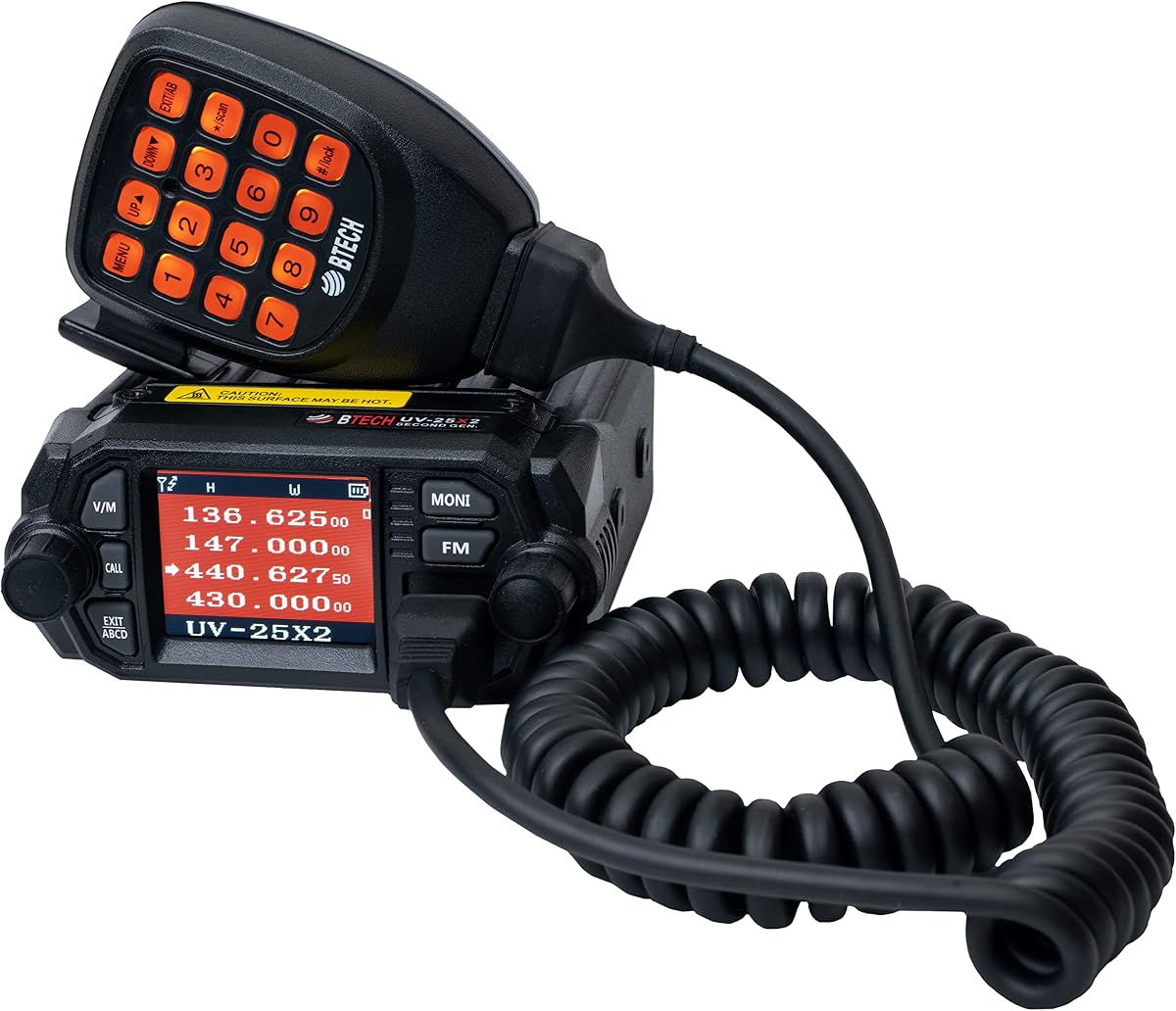
The BTECH UV-25X2 is a compact 25-watt dual-band radio that delivers the core features of a capable mobile transceiver without expanding into a large enclosure. Its 4.2 rating makes it the value-focused selection in this guide, particularly for new operators who want VHF and UHF capability and a straightforward path to a home station.
We may earn a commission when you buy through this link, at no additional cost to you.
Like the UV-50X2, it can use 144 MHz or 430 MHz as the main transmit and receive band while watching up to three other frequencies or channels. It can also support simultaneous VHF-to-VHF or UHF-to-UHF monitoring. This multi-function design is useful for local repeaters, travel destinations, and teams that need awareness of several channels without carrying a second receiver.
The second-generation RJ45 microphone port supports audio input and output, and the included K1 adapter makes it compatible with a wide selection of aftermarket audio equipment. The package contains a speaker microphone, DC cable, radio and microphone brackets, mounting hardware, and a user guide. These included pieces simplify initial setup, while the small chassis should be easier to accommodate than a larger high-power radio.
The trade-off is reduced output relative to the UV-50X2. A new operator should also account for the separate RPS-30M home power supply and recommended PC04 programming cable. Even with those additions, the UV-25X2 remains a versatile and approachable dual-band platform. It is a strong recommendation for local repeater work, emergency preparation, and operators who prioritize a small footprint over maximum transmit power.
The UV-25X2 preserves both VHF and UHF operation in a mini mobile format. That makes it convenient for vehicles and tight indoor installations where a full-size radio would be inconvenient.
RJ45 audio connections and the supplied K1 adapter open the door to established microphone and speaker accessories. Operators can therefore tailor the audio setup instead of remaining limited to the supplied equipment.
We may earn a commission when you buy through this link, at no additional cost to you.
The universal stand mount bracket is not a radio and cannot transmit or receive, but it earns a place because installation hardware is one of the most overlooked parts of building a starter base station. With a 4.7 rating, it is the highest-rated item here and a useful companion to several of the mobile transceivers in the guide.
We may earn a commission when you buy through this link, at no additional cost to you.
The bracket fits ham-radio transceivers, CB radios, receivers, transmitters, scanners, and two-way base radios. It is listed for use with Universal, Cobra, AnyTone, Galaxy, Stryker, and RCI equipment, and it supports small, medium, and full-size mobile transceivers. That broad fit makes it easier to move a radio from a crowded desk to a shelf, stand, or another elevated position where the display and controls are easier to reach.
A stable mount can also improve usability during programming or extended monitoring. The description notes that if the transceiver's internal speaker is bottom-mounted, the bracket can eliminate the need for a separate external speaker. This does not change radio performance directly, but it can simplify desk arrangements and keep controls accessible.
Compatibility is not universal in the strictest sense. The bracket will not work with Ranger or Galaxy transceivers that have bottom-mounted power amplifiers, and buyers should compare the radio's controls, connectors, and body shape with the listed requirements. It also comes without a transceiver, power supply, antenna, or cable. As an installation accessory rather than a starter radio, it is best considered alongside one of the transceivers rather than instead of one.
Lifting the radio above the desktop makes front-panel controls easier to see and reach. It also creates a cleaner station when cables run behind the radio rather than across the working surface.
Users should confirm the model's body shape, control layout, and any bottom-mounted amplifier before buying. The stated Ranger and Galaxy exception shows why visual and dimensional comparison matters.
We may earn a commission when you buy through this link, at no additional cost to you.
The Cobra 29 NW is a classic 40-channel CB radio designed primarily for road communication, emergency access, and straightforward vehicle use. Its 4.6 rating reflects a well-established feature set, easy controls, and useful night illumination. It is not an amateur-radio base station, but it serves a closely related communication need for travelers who do not hold an amateur license.
We may earn a commission when you buy through this link, at no additional cost to you.
The radio provides all 40 CB channels and immediate access to emergency Channel 9, along with Channel 19. These quick-access functions are important because CB communication does not depend on cellular or satellite networks. Dual AM and FM modes provide more compatibility with different users, while the 9-foot microphone cable can reach from the radio in a larger vehicle while reducing excess cable clutter.
NightWatch illumination improves the radio's visibility after dark and includes a variable dimmer for different preferences. The SWR calibration function helps users identify an antenna problem after branches or other objects affect the antenna, while an illuminated indicator alerts the operator when the antenna should be checked. Adjustable receiver sensitivity and RF gain can reduce static and background noise without unnecessarily sacrificing reception.
The main limitation is the radio's 4-watt output, which is much lower than the high-power mobile transceivers in this guide. Coverage will therefore be more local, though terrain and antenna placement still matter. It also operates on CB channels and should never be modified or treated as an amateur transceiver. For road travelers, emergency preparedness, and no-license monitoring, the 29 NW remains approachable and purpose-built.
Instant Channel 9 access reduces the time needed to reach the standard emergency CB channel. The full 40-channel set supports broader monitoring and contact with other road users.
NightWatch illumination makes the display and controls easier to identify in darkness. The dimmer setting allows users to balance visibility with comfort during nighttime driving.
We may earn a commission when you buy through this link, at no additional cost to you.
A useful starter radio should match your license, local spectrum, antenna plans, and operating style. Before comparing output power or display features, confirm that the radio supports the frequencies and modes you are legally able to use and that your installation can supply clean, stable power.
Choose the band and mode that match your actual operating plans, not merely the number of features on a listing.
Treat power as only one part of the coverage equation, and give the antenna and operating environment equal attention.
Use a stable, correctly sized DC supply, and confirm that the required power supply is not included before completing the purchase.
Prioritize a display you can read quickly and controls you can operate without navigating an unnecessarily complex menu.
Choose the radio whose programming workflow matches your technical comfort and your need to change frequencies away from a computer.
Use the included microphone when possible, but select the radio with the best audio accessory path for custom vehicle or base-station installations.
Plan the antenna and physical installation early, because mounting and antenna decisions can be more important to real-world performance than minor display differences.
Confirm licensing and regulatory requirements before buying, and select a product that is actually legal and suitable for your intended communications role.
Start with a compatible regulated power supply, the correct antenna, and a secure mount. Before transmitting, install the antenna, inspect its coax connection, set a sensible low power level, and confirm that the radio receives correctly. Read the manual, identify emergency and programming functions, and save a backup of the programmed channels before changing the memory.
When transmitting, keep the antenna unobstructed, use a matching power level, and allow brief pauses between transmissions. On VHF or UHF, an appropriate installed antenna and favorable terrain matter far more than raw wattage. If reception is noisy, adjust squelch, RF gain, and any noise-reduction settings gradually rather than suppressing all noise before the desired signal arrives.
For long-term care, keep the radio and power supply in a dry, ventilated location, inspect coax and connectors, and avoid placing papers or objects over cooling fans. Do not open the case while connected to power. Periodically check mounting screws, display readability, microphone condition, and the effectiveness of the SWR or voltage-protection indicators, and follow current local operating rules whenever frequencies or equipment configurations change.
Usually, yes. Mobile radios are designed primarily for vehicle power and generally need a regulated 13.8-volt DC source for safe indoor use. Some listings explicitly state that the required supply is not included, while others recommend a specific model. Confirm the radio's input voltage, current draw, connector type, and ventilation needs before buying a separate supply.
A mobile radio can be an excellent first base station because many models are compact, rugged, and easy to install on a shelf. Their main limitation is that antenna, power, and cooling accessories may need to be added separately. A proper power supply and a well-installed antenna are essential if you expect reliable operation.
A dual-band radio covers both VHF and UHF amateur bands, while a single-band unit is limited to one segment. The AT-588Max focuses on 2-meter VHF, whereas the RT95 and BTECH models cover VHF and UHF. Local activity and the repeaters you want to reach should determine which approach is more useful.
No. GMRS, CB, and amateur radio operate under different rules, use different channel plans, and involve different equipment authorization requirements. The ABBREE AR-8118 and Cobra 29 NW can be useful for travel or no-license communication, but they do not provide the frequencies or amateur-radio privileges available through a licensed transceiver.
It matters a great deal. A high-powered radio cannot overcome a poorly tuned, obstructed, or poorly positioned antenna. Height, clear surroundings, feed-line quality, and matching all influence results. Begin with a reputable antenna suited to the selected band, follow the radio and antenna instructions, and check SWR before normal operation.
You can generally select and transmit on channels without one, but programming makes channel organization, naming, and repeater configuration much easier. The BTECH listings recommend a PC04 cable, and the AT-588Max supports custom PC programming with an optional PC50 cable. Check the current package contents because programming support and included cables vary by product.
No. The universal bracket is only a mounting accessory. It can support many ham, CB, scanner, and two-way radios, but it does not transmit, receive, amplify signals, or supply power. It is useful for improving the stability and accessibility of a mobile-radio installation.
Verify that the radio is operating on frequencies and modes allowed for your license and location, and confirm the displayed frequency before each transmission. Install a correctly matched antenna, check SWR, begin with low power if the manual recommends it, and make sure the station and any repeater identify correctly. Regulatory details vary by country, so local rules always take priority.
The Retevis RT95 stands out as the most balanced overall choice, offering dual-band operation, a rotatable TFT display, VFO tuning, CHIRP compatibility, and a large memory in a mobile-friendly design. The Ailunce HS4 is the specialized premium choice for 10-meter SSB and CW work, while the compact BTECH UV-25X2 offers a practical dual-band foundation for new operators who want broad functionality without a large radio.
Prioritize the bands and modes you will actually use, then budget for a stable DC supply, a suitable antenna, and dependable mounting. If your interest is conventional amateur communications, the RT95 family and BTECH radios are the most directly relevant choices. The AT-588Max serves high-power VHF needs, the MA1 specializes in cross-band repeating, and the GMRS and Cobra radios should be considered as separate no-license communication products.
Before buying, compare the latest package contents and required accessories, confirm regulatory compatibility, and review current product configurations. Product availability, bundled equipment, and current prices can change, so check the live listing and manufacturer documentation before making a final selection.