
Tapo Smart Water Leak Detector
4.6Editor score
Rapid one-second leak response
Top and bottom sensor probes
Three-plus year battery life
IP67 water-resistant housing
Our Smart Water Leak Detector Sensor guide compares 10 options for accuracy, alerts, connectivity, placement, and whole-home water protection.
Smart water leak detector sensors can turn a hidden drip into an early warning before moisture becomes expensive damage. A useful model should detect water quickly, produce an unmistakable alert, work reliably in damp locations, and integrate cleanly with the rest of your home monitoring setup.
This guide compares ten smart leak detectors across detection design, audible alarms, app notifications, wireless range, hub requirements, power options, water resistance, and installation flexibility. It covers Wi-Fi, Zigbee, Bluetooth, and Thread systems, including kits with multiple sensors, gateways, and extended sensing cables.
Each review explains the product's strongest benefits, practical limitations, and best-fit buyer. Ratings reflect the supplied customer feedback rather than hands-on testing, while current availability and pricing can change, so shoppers should verify the latest listing details before buying.
4.6Editor score
4.5Editor score

4.6Editor score
The comparison below highlights the detection methods, connectivity, alert systems, environmental protection, and installation options that distinguish these ten smart water leak detector sensors.


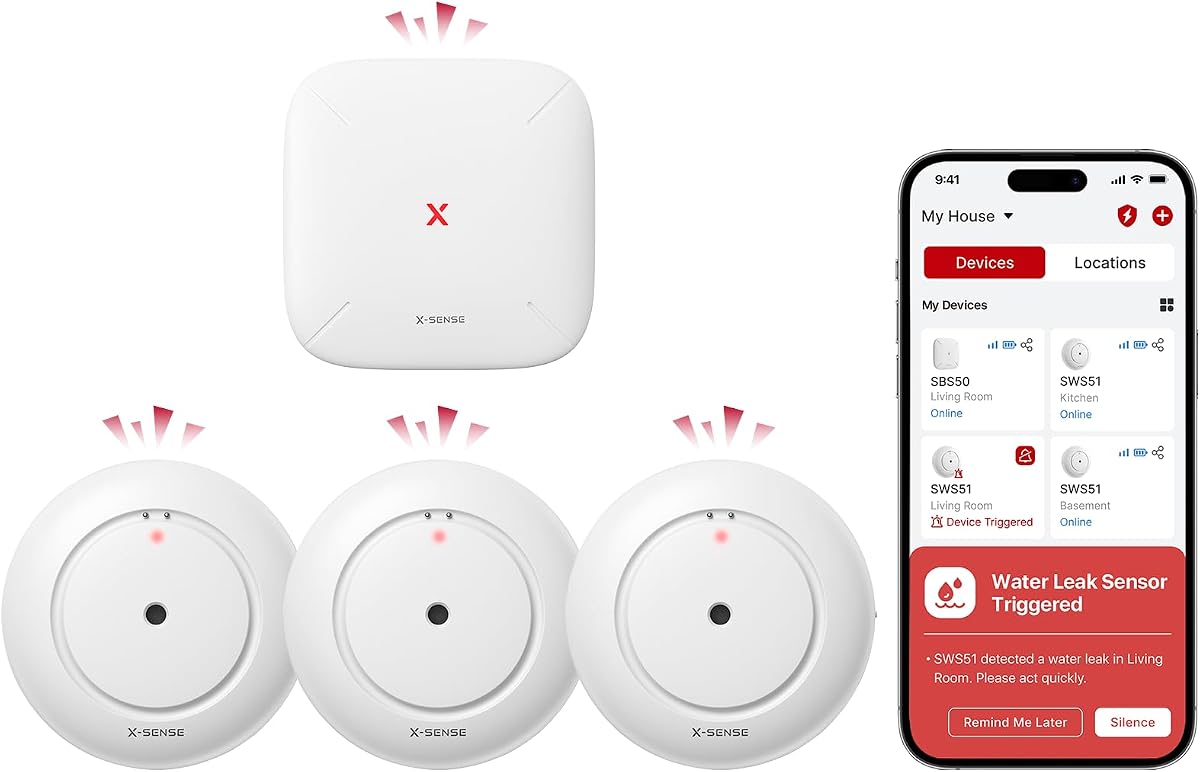
The X-Sense SWS54 is a balanced whole-home monitoring kit with a 4.5 customer rating. Its three sensors, dedicated base station, six-probe layout, and dual 120 dB alarms make it a strong choice for households that want audible and phone-based warnings across several vulnerable areas.
We may earn a commission when you buy through this link, at no additional cost to you.
Detection coverage is the first notable strength. Two upper probes can identify dripping water, while four lower probes sense pooling water as shallow as 0.4 mm. The sensors and base station sound together, improving awareness in kitchens, laundry rooms, garages, basements, and utility spaces where a single nearby alarm might be missed.
The system also supports flexible monitoring. Its stated open-area range reaches 1,804 feet, app notifications can reach as many as 12 users, and reminder options can postpone an active alert for 10 or 30 minutes or as long as 2, 6, or 12 hours. The IP66 housing suits damp environments, although it should not be interpreted as permission to submerge the sensor.
This is the most versatile option in the guide for large homes, particularly when a central base can serve several separated leak points. The main compromise is dependence on 2.4 GHz Wi-Fi and a base station, plus the need to plan sensor placement around walls and building materials that can reduce real-world range.
Overall, the SWS54 earns the top position because it combines thoughtful probe placement, powerful dual alarms, generous stated range, and useful app controls without requiring a broader smart-home ecosystem. It is an especially attractive choice for buyers seeking a complete multi-point kit rather than a single sensor.
The mix of upper and lower probes helps the kit catch both drips and shallow pooling. That versatility makes it useful around washing machines, dishwashers, water heaters, sump pumps, toilets, sinks, and refrigerators rather than limiting it to a single failure mode.
Sounding both the local sensor and base station creates redundant audible coverage. Phone notifications, shared user access, and adjustable reminders add remote visibility, which is useful when an alert occurs while everyone is away from the monitored area.
We may earn a commission when you buy through this link, at no additional cost to you.
The Tapo T300 combines a 4.6 rating with one of the fastest stated response times in this category. It can trigger its siren in as little as one second, making it a compelling budget pick for users who already own compatible Tapo smart-home equipment.
We may earn a commission when you buy through this link, at no additional cost to you.
Six sensitive probes are divided between the top and bottom of the device. This arrangement allows it to register drips and pooled water, while the adjustable 90 dB local alarm provides immediate household notification. The T300 can also trigger the connected hub's alarm, extending audible coverage to another part of the home.
Phone notifications report leaks and low battery status, while two replaceable AAA batteries are rated for up to three years under TP-Link laboratory conditions. Actual service life varies with use and environment. Its IP67 rating also gives it a useful degree of protection for humid and dusty locations.
The key limitation is ecosystem dependence. Buyers without a Tapo Hub should factor in the cost and setup of that additional device, while those with an existing hub benefit from a straightforward expansion of their system. It is not intended to connect independently to a home Wi-Fi network.
For existing Tapo users or buyers seeking an inexpensive first sensor, the T300 delivers excellent speed, compact protection, and long battery life. It is the best budget choice in this guide, particularly when its hub requirement does not represent an additional investment.
The stated one-second trigger reduces the waiting period between moisture detection and an audible warning. Early notification can give occupants more opportunity to stop a supply line, move possessions, or investigate pooling before the situation worsens.
The T300 fits neatly into an existing Tapo setup, shares access through the associated app, and can use the hub to extend its audible alert. It is a sensible way to add leak coverage to kitchens, bathrooms, basements, and utility rooms.
We may earn a commission when you buy through this link, at no additional cost to you.
The Moen Flo Detector is a three-pack of Wi-Fi-enabled water and moisture sensors rated 4.6 by customers? No: the supplied rating is 3.6, the lowest in this list, but its integration with the Moen Smart Water Network and optional Flo Smart Water Monitor and Shutoff gives it a distinct whole-home role.
We may earn a commission when you buy through this link, at no additional cost to you.
Each detector can operate as a standalone monitoring device, while multiple units can be connected for broader coverage. Smartphone notifications provide remote awareness, and the included extension cable with Remote Sensing Disc extends detection up to 48 inches into tight spaces that a conventional flat probe may not reach.
The accessory cable is especially useful behind appliances, within cabinetry, and beside concealed plumbing. That flexibility can improve placement accuracy compared with relying only on a small floor-level sensor, while the three-pack provides enough units to cover several common leak sources.
Its limitations are tied to ecosystem and configuration. The strongest automated water-control experience requires the Flo Smart Water Monitor and Shutoff sold separately, and the relatively low 3.6 rating suggests some buyers may have encountered satisfaction or compatibility concerns. Buyers wanting only a simple audible alarm may find the product more complex than necessary.
The Moen system is best for homeowners already committed to Moen's smart-water platform or considering an automatic shutoff. Its extension cable and multi-sensor approach offer practical advantages, but the final decision should account for the need for separate Flo hardware and the less favorable customer feedback.
The 48-inch extension cable and Remote Sensing Disc allow the detector to reach locations where a compact probe may miss pooled water. This makes the system more adaptable around appliance hoses, recessed plumbing, and other constrained points.
Connecting to the separately sold Flo Smart Water Monitor and Shutoff can add automatic water-flow control. That capability goes beyond notification-only monitoring and may be valuable in properties where an unattended leak could continue for an extended period.
We may earn a commission when you buy through this link, at no additional cost to you.
The X-Sense SWS0A41 is built around placement flexibility. Its sensors measure only 0.7 inches thick and 3 inches in diameter, making them easier to slide beneath appliances, beside pipes, or into narrow gaps than bulkier leak alarms. The kit receives a 4.5 customer rating.
We may earn a commission when you buy through this link, at no additional cost to you.
Four sensors accompany a base station that sounds up to 100 dB when any sensor detects water. A red flashing light provides a visual cue, and app notifications cover remote awareness. Top and bottom probes can detect water as shallow as 0.4 mm as well as drips arriving from above.
The app adds more than a basic on-or-off status screen. Users can adjust the base alarm volume, mute alerts, inspect alarm history, test the device, receive low-battery notices, and share access. Temporary reminder periods range from 10 minutes to 12 hours, allowing a user to acknowledge a warning without eliminating the monitoring record.
Its 1,700-foot stated range in open areas is useful for outbuildings and distant corners, although walls and floors can reduce that distance. The 100 dB base alarm is powerful but slightly less forceful than the 120 dB system in the first-ranked kit.
The SWS0A41 is a strong choice for buyers with cramped installation points or a need for more sensors than the SWS54. It combines a slim footprint with four sensor units, a clear visual indicator, and mature app controls, making it particularly useful for comprehensive placement without a large base.
The 17 mm thickness can make a meaningful difference behind washers, inside vanity cabinets, and beneath fixed appliances. A sensor that physically fits the risk area is more likely to be installed and maintained correctly than a bulkier alternative.
Alarm history, testing, battery notices, sharing, and adjustable reminder timers help distinguish an active leak from a lingering alert. These controls are especially useful for households that want remote visibility without constant, repetitive notifications.
We may earn a commission when you buy through this link, at no additional cost to you.
The RUIKORING WD71 three-pack is a flexible Tuya Smart-based system with a 4.5 rating. It combines compact sensors, an included gateway, local and remote alarms, and a stated capacity for as many as 24 sensors, making it appealing to buyers who expect to expand coverage over time.
We may earn a commission when you buy through this link, at no additional cost to you.
Each WD71 uses two upper probes and four lower probes. At least two lower probes must be activated to reduce false alarms, while the upper sensors can respond to dripping water. The local alarm reaches 120 dB, and the gateway's alarm reaches 90 dB, with separate volume adjustments available in the app.
Installation flexibility is another strength. The sensors are 1.1 inches thick and 2.8 inches in diameter, fit in narrow corners, and can be reused after drying. IP66-rated construction suits splash-prone locations. Up to two years of battery life is stated, and a low-battery alarm helps support maintenance.
The most important constraint is communication distance. The stated range is 328 feet in open areas but typically around 150 feet indoors, so the gateway must be positioned carefully. Push notifications through Tuya Smart are free, while optional SMS and phone-call services involve a third-party publisher and may carry separate charges.
For households already using Tuya Smart or wanting a scalable gateway architecture, the WD71 offers strong flexibility. Buyers should verify their network supports 2.4 GHz Wi-Fi, understand the potential third-party messaging fees, and ensure the gateway has a practical path to each sensor.
A gateway capacity of 24 sensors lets buyers start with three units and add protection near plumbing, appliances, and utility equipment later. The architecture is well suited to larger monitoring plans without requiring a separate ecosystem for each detector.
The app can automatically arm or disarm sensors, which is helpful when alarms would be disruptive during normal nighttime hours. Separate volume settings for the sensor and gateway let users preserve an audible warning while reducing unnecessary noise.
We may earn a commission when you buy through this link, at no additional cost to you.
The Aeotec SmartThings Water Leak Sensor is a 4.5-rated Zigbee device aimed at automation-focused households. It combines moisture detection with temperature monitoring and can trigger other connected devices to shut off water flow or electronics when unusual conditions are detected.
We may earn a commission when you buy through this link, at no additional cost to you.
That automation capability gives it a different role from straightforward phone-and-siren sensors. SmartThings routines can use the leak or temperature readings to initiate broader protective actions, potentially reducing exposure to continuing water or electrical damage. Users can choose between illuminated alerts and siren alerts.
The sensor is designed for placement under sinks, refrigerators, washing machines, and similar indoor locations. Its operating range is 32 to 104 degrees, and its Zigbee communication distance is generally 50 to 130 feet depending on the home's construction. It works with an Aeotec Smart Home Hub, a Samsung SmartThings Hub Gen 3, or other compatible Zigbee hubs.
The trade-offs are ecosystem dependence and environmental limitations. A separate hub is required, range is more modest than the long-range Wi-Fi kits, and the product is intended for indoor use only. Homeowners with extensive SmartThings automations may find that trade worthwhile, while others may prefer a simpler self-contained system.
The Aeotec sensor is best for users who already operate a compatible SmartThings or Zigbee setup and want leak data to participate in whole-home routines. It is less attractive as a first detector for someone seeking direct Wi-Fi connectivity or guaranteed outdoor-area use.
Connecting water and electrical safeguards to a triggered routine can reduce damage after a leak is detected. The ability to act on moisture events makes the sensor useful as part of a broader monitored system rather than a stand-alone alarm.
Temperature monitoring can flag abnormal conditions in sensitive areas. Buyers should still observe the stated operating range and ensure the device is used in a suitable indoor environment.
We may earn a commission when you buy through this link, at no additional cost to you.
The TECKNET Wi-Fi Water Leak Detector offers a relatively simple way to add smart leak monitoring. It has a 4.2 rating, includes two sensors and four AAA batteries, and connects directly to a 2.4 GHz Wi-Fi network without requiring a dedicated hub.
We may earn a commission when you buy through this link, at no additional cost to you.
Each sensor has two top probes and four bottom probes, allowing it to recognize leaks from several directions. The built-in siren reaches 120 dB and supports adjustable volume, while the Tuya Smart app provides instant push notifications when water is detected.
IP67-rated construction and a stated battery life of up to two years make the detectors suitable for humid areas such as kitchens, laundry rooms, basements, and spaces near water heaters. Low-battery reminders reduce the chance that a sensor becomes ineffective without notice.
The package contains fewer sensors than many competing multi-sensor kits, and the product only supports 2.4 GHz Wi-Fi. Instant app notifications are included, but optional SMS and phone-call alerts depend on a third-party subscription service, so buyers should distinguish between included and premium messaging features.
TECKNET is a good fit for someone seeking direct Wi-Fi operation and a loud local alarm without buying a hub. Its uncomplicated setup and two included sensors are practical for targeted coverage, although larger homes may need to add compatible units.
The sensor connects to the Tuya Smart app over 2.4 GHz Wi-Fi, reducing the number of devices required for basic monitoring. This makes the system approachable for buyers who do not want to maintain a dedicated smart-home hub.
A 120 dB siren is difficult to overlook in a utility room or basement, and adjustable volume allows some control over household disruption. The visual test button, low-battery alarm, and flashing indicator help with everyday maintenance.
We may earn a commission when you buy through this link, at no additional cost to you.
WaterWatcher is a specialized leak alarm rated 4.6 by customers. Rather than competing primarily on phone notifications, it stands out through the ability to turn off a compatible appliance automatically and keep that appliance off until a user manually resets the device.
We may earn a commission when you buy through this link, at no additional cost to you.
This interruption-and-reset behavior is a serious safety feature for equipment such as dehumidifiers, aquariums, hydroponics systems, washing machines, and well pumps. The manual reset prevents a temporary wet event from automatically reactivating the protected equipment before the underlying problem has been addressed.
The sensor is described as capable of detecting very small water traces and as pure-water capable, which distinguishes it from some leak sensors designed primarily for conductive liquids. Its appliance-focused approach may be especially useful in specialized installations where leakage could damage the device itself.
This is not presented as a conventional app-connected smart-home sensor, so buyers seeking remote notifications, shared access, and smart-home routines will find the feature set narrower. The manual reset also means a response is required; it does not automatically restore operation after the water disappears.
WaterWatcher is best for owners protecting individual appliances or operating sensitive water-dependent equipment. Its five-year warranty and support add confidence, while the manual safety reset provides a clear, deliberate response to detected moisture.
When water is detected, the unit can keep the connected appliance off. This is useful where continued operation could cause greater damage, damage the protected equipment, or create an unsafe electrical condition.
Requiring a manual reset means an alert cannot disappear merely because the surface dries. Owners must inspect the area and consciously restore operation, which is especially helpful in installations where a brief moisture event should still be investigated.
We may earn a commission when you buy through this link, at no additional cost to you.
The Smart Wi-Fi Water Leak Detector kit holds the highest supplied customer rating in the list at 5.0. It includes two sensors, one Wi-Fi gateway, and two AAA batteries, with a design aimed at straightforward monitoring across kitchens, basements, sinks, laundry areas, and other likely leak locations.
We may earn a commission when you buy through this link, at no additional cost to you.
Each sensor combines two stainless-steel strips for detecting drips from pipes or drains with four bottom probes for standing water on floors. Both detection methods work simultaneously, and the sensor can sound an adjustable alarm up to 110 dB. This front-and-bottom arrangement gives the kit useful directional coverage.
The gateway connects to 2.4 GHz Wi-Fi and binds to the Tuya Smart app, sending real-time notifications when a leak occurs. After the initial connection, the sensors are automatically associated with the setup. Multiple volume levels allow the owner to balance a useful warning with nighttime or living-area noise sensitivity.
IP66-rated materials and a rust-resistant coating support use in high-humidity spaces, and the sensors can be reused after drying. The trade-offs are the need for a gateway and Tuya Smart app, support for 2.4 GHz Wi-Fi only, and a two-sensor package rather than a larger multi-sensor kit.
With a perfect supplied rating, this product has the strongest apparent customer satisfaction, although ratings alone do not prove every household will have identical results. It is a compelling choice for buyers who value flexible app monitoring and a loud, reusable sensor in a compact gateway-based system.
Real-time push notifications make the system useful while occupants are away. The gateway handles network communication, allowing sensor placement to be organized around leak risks rather than restricted to locations with strong direct Wi-Fi reception.
The IP66-rated construction and rust-resistant coating are appropriate for basements, under sinks, beside pipes, and near washing machines. Reusability after drying makes the kit more practical for seasonal or occasional leak-risk areas.
We may earn a commission when you buy through this link, at no additional cost to you.
Eve Water Guard is a premium smart leak detector with a 4.6 rating and a distinctly different design. Rather than relying only on a compact probe, it includes a 6.5-foot sensing cable that can monitor a broad area and be extended to as much as 490 feet.
We may earn a commission when you buy through this link, at no additional cost to you.
The cable is particularly effective around appliances, beneath sinks, along bathroom floors, and beside water pipes. A 100 dB siren and red flashing warning provide immediate local signals, while notifications reach a compatible iPhone, iPad, or Apple Watch for remote awareness.
It joins a Thread network automatically and supports Bluetooth, while HomeKit compatibility allows a straightforward Apple smart-home experience. No separate bridge or Eve gateway is required. As a router node, it can also help extend the stability and reach of the connected Thread network.
The trade-off is platform focus. Eve requires an iPhone or iPad running a recent version of iOS or iPadOS, so the product is not a neutral choice for households centered on Android, Alexa, or another ecosystem. The extended cable also needs careful routing to avoid presenting a trip hazard.
Eve Water Guard is the top premium choice for Apple Home users, particularly where a cable can cover more area than a small sensor puck. Its local-first approach, no-cloud design, Thread support, and strong siren make it a sophisticated option for privacy-conscious smart-home owners.
A 6.5-foot cable can follow a water line, trace the edge of a floor, or surround an appliance. Extension capability makes it feasible to build a broad detection perimeter where a compact sensor would cover only one small spot.
The sensor operates without Eve cloud, registration, or tracking, and it does not depend on a separate bridge. For compatible Apple users, this supports direct control, privacy, and easy integration with HomeKit automations.
We may earn a commission when you buy through this link, at no additional cost to you.
The right smart water leak detector depends on where water could collect, how you want to be notified, and the smart-home equipment already in your home. Compare sensing geometry, connectivity, alarm behavior, and installation requirements before making a choice.
A compact leak sensor commonly uses conductive probes on its top and bottom to identify dripping and pooled water. Six-probe models can catch more than one type of leak, while cable-based sensors cover a much larger perimeter. Top and bottom sensing is particularly useful under appliances, where a leak may fall from a hose connection or gather in a shallow puddle.
Choose a sensor whose sensing geometry matches the actual risk. Use compact probes beneath sinks, washers, refrigerators, and water heaters; consider a cable sensor for bathrooms, utility rooms, and broad floor areas. Check the stated shallow-water sensitivity, but also account for the surface texture and whether the sensor can be positioned at the lowest point.
An audible alarm remains important even when a phone is nearby or an automation system is active. Products in this guide range from an adjustable 90 dB built-in siren to dual 120 dB sensor-and-base alerts. The base station may provide louder coverage because it can be placed in a more convenient location than each sensor.
Prioritize a warning loud enough for the intended space. Bedrooms and living areas may benefit from adjustable or muteable volume, while basements, garages, and utility rooms benefit from maximum output. Remember that an audible alarm supplements remote notifications rather than replacing them.
Several systems connect directly to a 2.4 GHz Wi-Fi network, while others require a Tapo, SmartThings, or compatible Zigbee hub. Hub-based systems can fit neatly into an established ecosystem and may support advanced routines, but they create another device to configure and maintain. Direct Wi-Fi models reduce hardware requirements but depend on network availability.
Confirm the required platform before buying. Check whether your home actually provides 2.4 GHz Wi-Fi, whether the product supports your existing hub, and whether the brand's app is available for your preferred phone. Apple Home, Tuya Smart, SmartThings, and Moen systems are not automatically interchangeable.
Stated wireless range is usually measured in open areas and may fall substantially once walls, floors, and appliances intervene. Products with a separate base or gateway can place the network bridge near a router while sensors occupy more distant leak-risk areas. Range figures alone do not indicate whether communication will be reliable in a particular home.
Map the building before choosing a long-range model. Pay special attention to basements, detached garages, and thick masonry walls. A gateway with a stated 150-foot indoor reach may need to sit centrally, while a sensor claiming more than 1,000 feet outdoors may still encounter interference from the home's structure.
An IP rating indicates resistance to dust and water under specified test conditions. IP66 and IP67 options are suitable for damp rooms, splashes, and humid utility spaces, but ratings are not blanket permission to submerge a sensor. The device must also be positioned so its probes can detect water without permanently floating above the surface.
Match the rating to the location rather than choosing the highest number. Indoor bathroom and basement coverage may require stronger resistance, while a protected indoor cabinet can work with a less demanding model. Always follow the manufacturer's placement and operating instructions.
Battery-powered sensors avoid wiring and are easy to relocate, but they need periodic attention. Stated battery life ranges from approximately two years for several Tuya-based products to up to three years for the Tapo T300, with actual results varying by environment and use. Low-battery notifications and test buttons make upkeep easier.
Consider how often you can access each location. Sensors beneath heavy appliances or in crawlspaces may be inconvenient to check, making a long stated battery life and remote low-battery warning particularly valuable. Replace batteries on a schedule and test each unit after servicing.
Useful app features include leak history, low-battery warnings, device testing, shared household access, alarm controls, and reminder timers. These functions help users distinguish an unresolved leak from an acknowledged event. Some messaging options, including SMS or phone calls, may require a third-party subscription and should not be confused with standard push notifications.
Look for controls that fit your routine. Temporary mute reminders can prevent constant disruption while a leak is being addressed, and alarm history provides useful records. Remote access is not a substitute for a loud local siren, especially when household members are sleeping or the app may not be opened promptly.
The most advanced detector is not useful if it cannot fit the vulnerable location. Ultra-slim pucks suit narrow gaps behind appliances, while cable-based systems need safe routing along floors and walls. Keep sensors where they can detect pooled water and avoid placing them where routine movement dislodges them.
Plan for cleaning, drying, battery changes, and periodic testing. Verify that a sensor can be removed without moving the connected appliance and that its probes can be dried properly after an event. A written placement plan covering appliances, plumbing fixtures, and likely pipe routes is more useful than placing sensors randomly.
Begin by identifying the water risks in your home, including washing-machine hoses, refrigerator lines, dishwashers, water heaters, toilets, sump pumps, bathroom plumbing, and any pipes that pass through basements or utility spaces. Choose sensor locations where pooled water is likely to collect, and confirm that each unit can physically fit before installing it.
Connect the sensor or gateway according to its platform. Download the required app, connect to the specified 2.4 GHz Wi-Fi network if applicable, add the device, and configure notifications, shared access, volume, and reminder preferences. For hub-based systems, pair the sensor with the compatible hub and verify that alert automations or linked alarms appear as intended.
Test every unit after setup and then periodically. Use the test button or app test function, confirm that the phone notification arrives, and listen for the expected siren at the sensor or base. After cleaning and drying a wet sensor, check the batteries and repeat the test before returning it to service. Never ignore an alert until the source has been inspected.
It depends on the model. Some connect directly to a 2.4 GHz Wi-Fi network and use an app for remote notifications, while Tapo, SmartThings, and other systems require a compatible hub or gateway. Before purchasing, check the product's connectivity requirements and confirm that your existing smart-home platform supports it.
Place sensors near common leak sources and at low points where water can pool. Good locations include beneath sinks, washing machines, dishwashers, refrigerators, water heaters, toilets, sump pumps, and exposed pipes. A cable-based model may work better around a larger bathroom floor or along a pipe run, while compact probes are convenient under appliances.
Some products are designed to detect very shallow pooling, including the X-Sense sensors that specify detection at 0.4 mm. Actual performance can vary with water chemistry, probe condition, surface texture, humidity, and sensor orientation. Place the unit so its probes can make direct contact with water rather than relying on a damp surface alone.
Most sensors only alert you and do not shut off the supply. The Moen model can connect to a separately sold Flo Smart Water Monitor and Shutoff, and the WaterWatcher is designed to interrupt power to a compatible appliance. If automatic shutoff is important, confirm that the complete water-control system supports it.
Both ratings indicate strong resistance to dust and water, but they are not the same. IP66 is designed to withstand powerful water jets, while IP67 allows temporary immersion under specified conditions. Neither rating guarantees unlimited exposure, so follow the manufacturer instructions and use the sensor only in its intended environment.
Test each sensor shortly after installation and then on a regular schedule, such as monthly, while also following the manufacturer's guidance. Replace batteries as prompted, clean the probes, and confirm that both the local alarm and remote notification work. Testing is especially important after moving a sensor or changing your Wi-Fi network.
A sensor's radio signal may be weakened by concrete, masonry, metal, and other dense materials. Products with a central base or gateway are better suited to buildings where the sensor itself cannot maintain a strong direct connection. Check stated indoor range, position the gateway centrally, and test signal quality in every intended location.
Multiple sensors are usually recommended because plumbing failures can occur in many separate areas and a single unit cannot cover an entire home. A three-pack or four-pack can cover major appliances, while compact sensors can be added near secondary risks such as toilets, sinks, water heaters, sump pumps, and basement pipes.
The X-Sense SWS54 is the strongest all-around option because it combines three sensors, six-probe detection, dual 120 dB alarms, long stated range, and useful app controls. The Tapo T300 is the best budget choice for compatible homes, while the Eve Water Guard is the most premium pick for Apple users who value cable sensing and local-first operation.
Prioritize the ecosystem you already use, the locations that need protection, and the type of warning that will prompt action. Hub systems can support deeper automation, direct Wi-Fi products reduce setup complexity, and cable sensors can cover a wider physical area. Lowest possible cost should not outweigh reliable app access, audible coverage, and a maintenance plan.
Before buying, verify the current product listing, network requirements, included accessories, dimensions, battery details, and warranty terms. Product features, bundles, app services, and current prices can change, so shoppers should confirm the latest information directly on the retailer's product page.