
Tapo C101
4.4Editor score
1080P indoor video
MicroSD local recording
Person and cry detection
Two-way audio
Our expert guide compares the 10 best security cameras with local storage, covering video quality, offline recording, power options, detection, and ease of use.
Security cameras with local storage give property owners a practical way to record and review footage without making cloud storage a requirement. The strongest systems combine dependable recording, useful alerts, clear night imagery, and flexible installation, whether the priority is a single indoor room or a complete outdoor property.
We compared the ten cameras in this guide on local recording capacity, image quality, night performance, detection features, power options, audio, connectivity, weather resistance, and overall ease of use. The list includes wired indoor models, weather-resistant cameras, and larger solar-powered systems designed for broader coverage.
Each pick highlights a different balance of capabilities, from straightforward indoor monitoring to expandable outdoor systems with home hubs and cross-camera tracking. Ratings and configurations can change over time, so readers should verify current features, storage compatibility, and product availability before making a purchase.
4.4Editor score
4.5Editor score

4.9Editor score
The comparison below highlights each camera's resolution, recording method, power source, and most important distinguishing feature. It covers both simple single-camera options and multi-camera systems designed for local, subscription-free storage.


This four-camera system offers one of the strongest overall combinations of local recording, outdoor flexibility, and modern detection features. Its 4.5 rating reflects a well-rounded package, but the defining advantage is the included 128GB home hub, which keeps encrypted recordings locally and supports loop recording for as much as three months depending on activity and system conditions.
We may earn a commission when you buy through this link, at no additional cost to you.
The cameras deliver 4MP footage with color night vision reaching approximately 65 feet. Six LED lights and a 360-degree pan-and-tilt design give the system meaningful coverage around yards, driveways, entrances, and other outdoor areas. Automatic motion tracking, cross-camera event tracking, human detection, adjustable sensitivity, and activity zones help make the footage easier to organize and review.
Each camera includes an 8000mAh battery and a 5W solar panel, eliminating the need to run power cables during installation. Dual-band 2.4GHz and 5GHz Wi-Fi support can improve compatibility with modern routers, while a built-in microphone and speaker provide two-way communication. The trade-off is that a hub-based installation requires initial pairing and router connection, and actual solar performance depends on sunlight, placement, weather, and camera activity.
This is an appropriate choice for buyers who want broad outdoor coverage without depending on a recurring cloud-storage plan. It is particularly compelling for properties where several entrances, side yards, or driveway positions need monitoring. Buyers should confirm that their Wi-Fi network and placement plan support the cameras before installation, but for a capable all-in-one local-storage system, this is the guide's strongest overall recommendation.
The included home hub stores encrypted recordings locally and supports loop recording, so routine footage review does not require a paid cloud plan. The stated capacity of up to three months varies with camera count, event frequency, and recording settings, making it a practical advantage for buyers seeking predictable long-term storage.
Pan-and-tilt cameras can cover broad areas without a fixed narrow field of view. Auto tracking, synchronized cross-camera events, human detection, and two-way audio add useful ways to follow activity and communicate with visitors from the associated app.
We may earn a commission when you buy through this link, at no additional cost to you.
The Tapo C120 is a compact wired camera that brings 2K QHD detail and local microSD recording to a relatively accessible package. Its 4.3 rating reflects a capable device for apartments, patios, porches, and other modest coverage areas, particularly for people who want more than a basic indoor monitor.
We may earn a commission when you buy through this link, at no additional cost to you.
An IP66 rating allows the camera to tolerate rain, dust, and demanding outdoor conditions, while the magnetic base makes placement on railings, frames, and other metal surfaces straightforward. The Starlight sensor supports color night vision, two spotlights provide additional illumination, and an invisible infrared mode offers monitoring up to 30 feet without visible red lighting.
AI-based person, pet, and vehicle detection works without a subscription, and users can customize which events trigger alerts. Full-duplex two-way audio creates a natural speaking experience for checking on children, speaking with delivery personnel, or interacting with pets. The main limitations are the need for a wired power connection, use of the 2.4GHz Wi-Fi band, and the fact that a microSD card is not included.
This camera is best for a buyer seeking one compact unit that can function indoors or outdoors and store recordings locally without a recurring fee. Buyers should check TP-Link's current microSD compatibility guidance before purchase. For straightforward placement, capable detection, and flexible night viewing, the C120 delivers a balanced package.
The C120's weatherproof construction expands its use beyond climate-controlled rooms. It is equally suited to a covered porch, patio, garage, or exterior entry, provided the installer can provide a suitable wired power source.
Recordings can remain on a microSD card of up to 512GB, while person, pet, and vehicle detection remains available without a subscription. This makes the camera appealing for users who want meaningful event filtering and local retention in a single compact unit.
We may earn a commission when you buy through this link, at no additional cost to you.
The Kasa EC71 is a 1080P indoor pan-and-tilt camera that earns its place through broad room coverage and an approachable feature set. Its 4.4 rating sits among the stronger entries in the guide, and the camera can rotate 360 degrees horizontally and 113 degrees vertically to reduce the blind spots common in fixed indoor cameras.
We may earn a commission when you buy through this link, at no additional cost to you.
Motion tracking follows moving objects or people, while the Patrol Mode scans selected regions on a schedule. Motion and person detection generate immediate notifications, and baby crying detection adds value for parents. The EC71 also supports two-way audio for checking on children, pets, or household activity from the app.
Footage can be recorded continuously to a microSD card of up to 256GB, with cloud storage offered separately for additional services. Infrared night vision reaches approximately 30 feet, while 1080P full HD recording provides enough detail for routine indoor monitoring. As an indoor-only wired model, it cannot handle exposed outdoor locations, and some optional cloud features require Kasa Care.
The EC71 suits renters, pet owners, and parents who want a camera that can follow activity around a room. It is also a sensible choice for anyone who already uses Alexa or Google Home because compatible screens can display the live feed. For affordable indoor flexibility and dependable local recording, it remains one of the guide's strongest options.
The pan-and-tilt mechanism, adjustable patrol intervals, and automatic tracking let the camera cover areas that a stationary unit may miss. This is especially useful in playrooms, living spaces, and rooms where pets or family members regularly move.
Person detection, baby crying alerts, night vision, and two-way audio cover common household monitoring needs. The camera also works with compatible voice assistants, making it convenient to check the live stream on a larger display.
We may earn a commission when you buy through this link, at no additional cost to you.
The Tapo C101 is a straightforward 1080P indoor camera focused on the features many households use most: local recording, person and baby monitoring, night vision, and two-way communication. Its 4.4 rating indicates a well-regarded entry-level option, while the lack of subscription-based requirements for core detection makes it approachable.
We may earn a commission when you buy through this link, at no additional cost to you.
The camera records to a microSD card of up to 512GB, which is sold separately, or can be connected to Tapo Care when cloud storage is desired. Motion, person, and baby crying detection trigger app notifications without additional fees. An integrated IR system provides night visibility up to 30 feet, preserving useful detail in a dark nursery, hallway, or pet area.
Two-way audio allows users to speak to family members or pets, while the built-in siren provides a simple way to issue a warning. Compatibility with Alexa and Google Home makes the live feed available on supported displays. Its main limitations are the fixed camera angle, indoor-only design, and lack of an included storage card.
The C101 is an excellent recommendation for a buyer who wants a basic indoor camera without paying for cloud storage to access essential detection features. It works particularly well as a baby monitor, dog camera, or entry-hall camera. Choose it over the EC71 when simple fixed coverage and a built-in siren matter more than motorized tracking.
Local microSD recording and no-cost motion, person, and baby cry notifications cover the essentials without requiring Tapo Care. This makes the C101 a practical choice for users who prefer to manage storage directly.
Full-duplex-style two-way communication and the built-in siren make it possible to check in, soothe a child, speak to a pet, or issue a warning. The fixed view is best aimed at a specific crib, room corner, or doorway.
We may earn a commission when you buy through this link, at no additional cost to you.
The aosu 2K Solar Security Cameras Wireless Outdoor System offers a large six-camera package for buyers who want extensive property coverage. Its 4.1 rating is still competitive, though it trails the strongest options in the guide. The central attraction is the combination of solar power, local storage, and a camera count suited to larger homes or expansive outdoor areas.
We may earn a commission when you buy through this link, at no additional cost to you.
The split solar panel design separates the panel from the camera body, allowing the panel to be placed where sunlight is better while the camera captures the desired angle. aosuBase provides unified management and local recording, with expansion to a 1TB microSD card. The card is not included, so buyers must account for that separately when planning storage.
The app can display four camera feeds simultaneously. Camera-to-camera tracking groups a person's movement across multiple views into a single timeline, which can simplify event review. PIR and AI human detection help limit irrelevant notifications, while color night vision, active deterrence through light and sound, and an IP65 weather rating support outdoor deployment.
This kit is a compelling choice for buyers who want a broad initial installation with room to add more cameras. Solar charging and detection performance depend on placement, lighting, distance, and configuration, so careful positioning remains important. The system is best for aosuBase users who value a large outdoor package and local timeline-based review more than a single-camera simplicity.
The separate solar panel can be positioned for better sunlight without changing the camera's viewing direction. This flexibility is useful around trees, fences, and buildings where a conventional integrated panel might receive inconsistent light.
Camera-to-camera tracking connects related appearances from different views, while four simultaneous feeds give users a broader picture of activity. These functions are particularly useful for monitoring several approaches to the same property.
We may earn a commission when you buy through this link, at no additional cost to you.
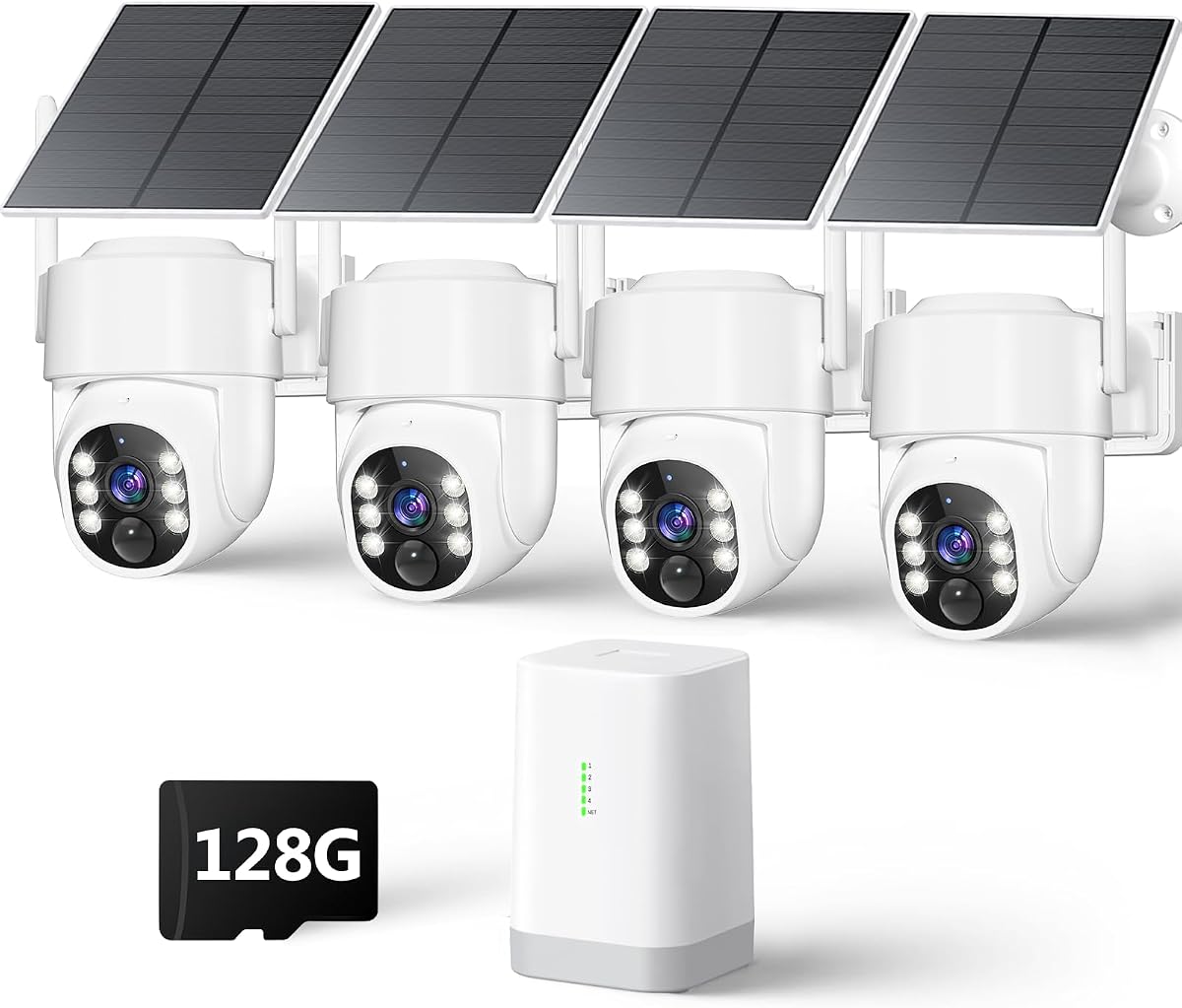
This Truisee-branded four-camera kit provides 4MP recording, 128GB hub storage, and solar operation without a mandatory recurring fee. Its 4.5 rating puts it among the highest-rated choices, and the system is built for properties that need more than one outdoor viewing position.
We may earn a commission when you buy through this link, at no additional cost to you.
The home hub supports encrypted local storage with loop recording for up to three months, according to the supplied information. Each camera offers 360-degree rotation, color night vision up to 65 feet, PIR-based human detection, adjustable sensitivity, and two-way audio. An IP66 rating and operating range from -4°F to 122°F strengthen its outdoor credentials.
Cross-camera follow allows tracking to move between cameras, and multiple live views can be managed through the Truisee app. The hub may connect by Wi-Fi or Ethernet, while cameras use dual-band 2.4GHz and 5GHz connectivity. The principal configuration note is that auto-tracking is off by default and must be enabled in the app.
This system is a strong contender for buyers who want sharp outdoor footage, flexible camera placement, and local storage across four areas. It is especially useful where running Ethernet to every camera would be inconvenient but reliable hub connectivity is available. Users should account for the hub's central role and enable tracking during setup.
The home hub keeps recordings together and can connect through Wi-Fi or Ethernet, giving installers some flexibility in how the central unit reaches the router. Camera-to-camera following then helps preserve context as a subject moves through the property.
A 4MP sensor, color night vision reaching approximately 65 feet, and an IP66 enclosure create a useful combination for dark exterior areas. The stated temperature range also allows the cameras to serve as year-round outdoor monitoring tools in varied climates.
We may earn a commission when you buy through this link, at no additional cost to you.
This no-monthly-fee system is the most feature-dense premium entry in the guide, combining four 4MP cameras with a 500GB hard-drive recorder. Its 4.9 rating is the highest among the listed products, reflecting an ambitious package for buyers who want considerable local capacity and a system that can grow to as many as ten cameras.
We may earn a commission when you buy through this link, at no additional cost to you.
The included 500GB hard drive provides a substantial base for local recordings, while a TF card slot supports an additional card of up to 128GB, although that card is not included. The NVR-style architecture keeps the system organized, and dual-band 2.4GHz and 5GHz connectivity is designed to handle distance and obstacles more reliably than a single-band camera.
Each camera provides 4MP footage, full-color night vision to approximately 65 feet, a 355-degree horizontal rotation range, and a 90-degree vertical tilt. PIR and AI human detection support adjustable sensitivity, two-way audio enables direct communication, and six LED lights support a sound-and-light response when someone enters a defined zone. Solar panels and 8000mAh batteries remove the need for camera power cables.
This system is intended for owners who want a more complete outdoor installation and are comfortable managing a multi-camera setup. It offers the strongest combination of included storage and expandable camera count, but it is also more complex than a single indoor camera. The trade-off is justified for buyers who prioritize local capacity, centralized management, and active deterrence over minimal setup.
The 500GB hard drive gives the system more included local storage than the other kits in this comparison. That makes it attractive for households that want room to review several days of footage or maintain recordings without depending on a monthly cloud subscription.
A configurable light-and-sound alarm can activate when a stranger enters a defined detection zone. Combined with instant notifications, two-way communication, and color night imagery, this adds several layers of response beyond passive recording.
We may earn a commission when you buy through this link, at no additional cost to you.
The youkey Indoor Camera with Magnetic Bottom combines 2K resolution, flexible placement, and continuous local recording in a compact plug-in design. Its 4.3 rating places it among the stronger compact options, and the magnetic bottom makes the camera particularly easy to reposition.
We may earn a commission when you buy through this link, at no additional cost to you.
Installing a microSD card of up to 512GB enables continuous recording, while an optional cloud service can store important moments. The supplied information also mentions a 90-day cloud trial. Day-and-night monitoring includes clear infrared night vision, live viewing, playback, and detection for people, pets, and general motion.
The magnetic base works on metal surfaces such as refrigerators and shed frames, and the manufacturer also describes indoor placement on porches or eaves. Setup requires plugging in the camera, connecting it to a 2.4GHz network, and following instructions in the Youkey Life app. Voice control through Alexa or Google Home provides a convenient way to open the live feed on a compatible display.
This camera is a good fit for users who want higher indoor resolution than 1080P without moving to a wired outdoor model. Its biggest limitations are the need for continuous power, the absence of 5GHz Wi-Fi, and the fact that the largest storage card is not included. Choose it for compact, repositionable monitoring with straightforward local recording.
The 2K sensor provides more spatial detail than a standard 1080P camera, which can help when a user needs to recognize smaller objects in a room. Its small housing and magnetic mounting make it easier to adjust than a large fixed camera.
With a compatible microSD card, the camera can record continuously instead of relying only on event clips. Cloud access remains optional, allowing buyers to prioritize local retention and review directly through the app.
We may earn a commission when you buy through this link, at no additional cost to you.
The Tapo C121 closely follows the design logic of the C120 while offering another strong option in the 2K QHD category. Its 4.3 rating and IP66 construction make it a credible choice for users who need one camera to handle both interior and protected exterior locations.
We may earn a commission when you buy through this link, at no additional cost to you.
The 4MP sensor records at 2K QHD resolution, while a Starlight sensor and two spotlights support color night vision. Users can switch to invisible infrared mode for night monitoring up to 30 feet, which is useful when visible lighting would be disruptive. The magnetic base enables quick attachment to metal railings, frames, and similar surfaces.
AI-powered detection identifies people, pets, and vehicles without a subscription, and alerts can be customized to focus on relevant objects. Full-duplex two-way audio supports natural communication with children, visitors, or delivery personnel. Local storage supports microSD cards up to 512GB, with Tapo Care available as a separate cloud option.
The C121 is a strong recommendation for buyers prioritizing 2K detail, smart detection, and indoor-outdoor flexibility in one unit. Its limitations are shared with most compact cameras in this category: a wired power source, 2.4GHz-only networking, and no included storage card. Check the current TP-Link compatibility list before buying a card.
The combination of 2K QHD recording and an IP66 enclosure makes the C121 suitable for protected outdoor positions as well as regular indoor rooms. Its sensor preserves detail that may be useful when identifying people or objects in a wider scene.
Person, pet, and vehicle detection can operate without a paid subscription. Customized alerts reduce the need to open the app for every movement, while full-duplex audio provides a quick way to communicate with someone in view.
We may earn a commission when you buy through this link, at no additional cost to you.
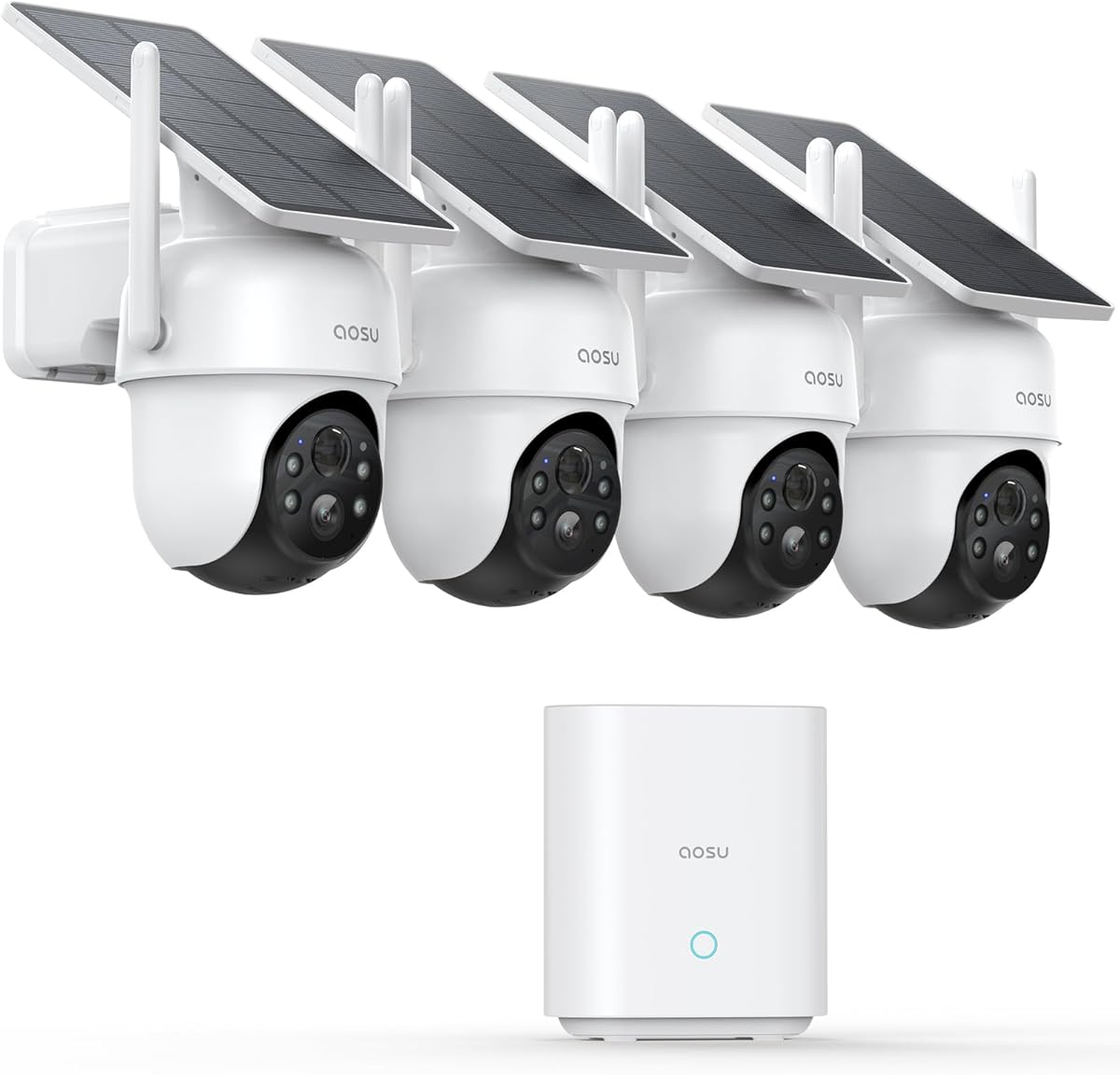
The aosu D1 Classic 4-Cam Kit offers four solar-powered outdoor cameras, local hub recording, and cross-camera management. Its 4.3 rating reflects a capable system that is especially attractive to buyers who want a ready-made multi-camera installation without a mandatory subscription.
We may earn a commission when you buy through this link, at no additional cost to you.
The aosuBase hub includes 32GB of local storage and supports loop recording for up to four months under the conditions described in the supplied information. Recordings are encrypted and remain available even if a camera is damaged or lost, providing a useful separation between physical equipment and stored footage.
The app can display four live streams simultaneously and relate matching events from different cameras. Each outdoor camera provides 360-degree pan-and-tilt coverage, automatic motion tracking, and 3MP daytime recording. Four LED lights provide additional illumination for color night vision, while the integrated solar panel supports operation with approximately three hours of daily sunlight under favorable conditions.
This kit is best for users who prioritize the number of cameras, local event review, and solar convenience over maximum resolution or storage capacity. The 32GB hub is smaller than those in several competing systems, so long-term retention planning is important. Even so, it provides a balanced four-camera package for a broad property.
A bundled four-camera kit simplifies the process of covering several exterior priorities. The pan-and-tilt units and solar panels reduce the need for fixed directional cameras and power cabling at each location.
Simultaneous four-area viewing and cross-camera tracking make it easier to understand how one event unfolds across a property. The system also supports one-click control of multiple cameras from the aosuBase app.
We may earn a commission when you buy through this link, at no additional cost to you.
The right camera depends on where it will be mounted, how footage should be stored, and how much control you want over recording. Reviewing these factors before buying can prevent storage incompatibilities, weak Wi-Fi coverage, and unnecessary system complexity.
Local storage takes several forms. Basic indoor cameras usually use a microSD card, while larger outdoor systems may include a home hub with built-in memory, an NVR-style hard drive, or both. The listed capacities range from a 32GB hub to 500GB of hard-drive storage and microSD support as large as 1TB in one system. Actual retention depends on the number of cameras, recording mode, video quality, motion frequency, and whether the system loops over older footage.
Check the required card type, maximum supported capacity, and manufacturer compatibility list before ordering. Some products explicitly state that the card is not included, and cards of different speeds or formats may behave differently. A larger card is useful for continuous recording, while a hub-based system is more convenient for buyers managing several cameras.
Resolution is only one part of useful image quality. The guide includes 1080P indoor cameras, 2K and 3MP outdoor models, and 4MP systems that also offer color night imagery. Starlight sensors, infrared night vision, visible spotlights, and LED-assisted color viewing can make a major difference when identifying a person or vehicle after dark.
Choose based on the size of the area and the distance from the camera to the subject. A higher-resolution camera is more useful across a driveway or yard, while 1080P is often sufficient for a small room. Pay attention to the stated night range and the availability of invisible infrared mode when visible lighting could be disruptive.
Indoor cameras are optimized for clean, dry spaces and often omit weather ratings. Models such as the Tapo C120 and C121 carry an IP66 rating, while the aosu kits and other solar cameras are designed for exposed exterior positions. An IP rating provides useful evidence of resistance to dust and water, but placement under an eave or other shelter can still improve longevity.
For outdoor systems, also consider operating temperature, sunlight exposure, and the distance to the nearest router. Indoor-only models may offer pan-and-tilt movement but cannot handle rain or dust. Do not assume a camera advertised for a porch is automatically suitable for an exposed wall unless its listed rating supports that use.
Wired cameras offer a consistent power connection and can use 2.4GHz Wi-Fi for video without complex cabling to each unit. Plug-in indoor cameras are similarly simple. Solar cameras remove power cables from the camera positions, but their performance depends on panel placement, seasonal sunlight, weather, and how often activity triggers the cameras.
A hub can simplify the network connection by receiving camera feeds and handling local storage. Check whether the hub connects by Wi-Fi only or also accepts Ethernet, and locate it near the router if signal strength is limited. The system should be installed where the user can safely maintain the hub, battery, and storage device.
Basic motion alerts can be triggered by leaves, insects, shadows, or moving vehicles. AI-based person detection, adjustable sensitivity, and configurable activity zones can make notifications more useful. Several products also identify pets, vehicles, packages, or baby crying without requiring a paid plan for the core detection function.
Detection quality is affected by distance, lighting, camera angle, and environmental conditions. Avoid promising perfect accuracy when a product description says performance may vary. Place cameras to cover the relevant approach, test sensitivity after installation, and use zones to exclude roads, trees, or frequently active areas.
Two-way audio allows a homeowner to speak with a delivery person, comfort a pet, or warn someone near the property. Full-duplex models are designed to support a more natural speaking experience. Active deterrence goes further by using lights, sounds, or an alarm when a person enters a defined area.
Tracking can make a pan-and-tilt camera more useful, but it must be enabled and configured correctly. Cross-camera following helps preserve context when someone moves from one camera's field of view to another. Consider these features together with privacy concerns, particularly when recording public areas or recording audio around neighbors.
Every product in this guide is designed around an app for live viewing, playback, alerts, and configuration. Several also support Alexa or Google Home, allowing a live feed to appear on a compatible screen. Voice control is convenient, but it is a secondary feature rather than a replacement for checking the app's storage status and event history.
Users with an established smart-home ecosystem should verify compatibility before purchase. It is also important to determine whether optional cloud features require a subscription, even when local storage is available. The most suitable system is one whose app is dependable on the user's preferred devices and supports the alerts they actually need.
Begin by mapping the areas that matter most, such as primary entrances, driveways, side yards, nurseries, or pet areas. Check Wi-Fi coverage from each camera position before drilling holes, and confirm that the home hub or router will have a stable connection. For wired models, plan a safe route for the power cable and avoid placing cords where they can be pinched or exposed.
Install the storage medium before configuring the cameras. Format the microSD card in the manufacturer's recommended application, or initialize the hard drive and hub according to the manual. Assign each camera a clear name, set the date and time, and create activity zones that match the important part of its view. Test motion sensitivity, human detection, night illumination, and two-way audio during both daylight and darkness.
For solar systems, position each panel where it receives the strongest available sunlight and adjust the camera independently. Review footage periodically, confirm that loop recording is functioning, and maintain enough free storage for stable recording. Clean lenses gently, keep the hub ventilated, inspect cables and seals, and update the camera firmware through the official app whenever updates are offered.
Local storage means the primary recordings are retained on a microSD card, built-in hub memory, or an attached hard drive rather than being dependent on a cloud subscription. Some products also offer optional cloud services for remote access or additional features, so buyers should review the app's privacy settings and account for any cloud features they activate. Local retention also continues to depend on the physical device functioning and the storage being properly configured.
Choose a microSD card that appears on the camera manufacturer's current compatibility list and meets its stated speed, format, and capacity requirements. The products in this guide support cards ranging from 256GB to 512GB, but the acceptable card specifications can differ between models. Formatting the card in the recommended app before installation helps reduce the risk of recording errors.
Solar cameras can remain reliable, but their performance depends on panel placement, sunlight, temperature, camera activity, and battery condition. A panel positioned under trees, a heavily shaded wall, or a roof that receives little winter light may charge more slowly. The stated sunlight requirements should be treated as guidance rather than a guarantee, and users should inspect the battery level through the app during seasonal changes.
Several cameras in this guide, including the Kasa EC71 and youkey camera, support continuous local recording when a compatible card is installed. Other systems may be designed primarily around event-based clips or hub-managed recordings. Buyers who need uninterrupted coverage should confirm the recording-mode options in the manual rather than assuming that every local-storage camera records continuously.
Capacity varies substantially by system. The aosu 2K Solar kit is presented as a six-camera option that can expand, the aosu D1 Classic includes four cameras, and the 500GB hard-drive system supports expansion to as many as ten cameras. Other choices in the guide are single-camera products. Check camera count, hub capacity, Wi-Fi limitations, and storage requirements before building a larger installation.
Local recording is one of the main advantages of these products, but setup and remote viewing commonly require an internet connection and the manufacturer's app. Once configured, cameras with local storage can retain footage without a paid cloud plan, although users may not be able to access live streams remotely or receive notifications while disconnected. Exact offline behavior varies, so it is best to confirm the manufacturer's requirements before installation.
MicroSD storage keeps recordings on a card inside or near an individual camera and works well for a single indoor unit. Hub-based storage centralizes recordings from several cameras in a home base, which can make multi-camera management and event review easier. A larger hard drive may also retain more footage than a small card, making hub storage useful for users who want broader coverage without a recurring cloud fee.
Only if the specific model has an appropriate weather-resistance rating and the installation follows the manufacturer's guidance. The Tapo C120 and C121, for example, carry IP66 protection and are described for indoor or outdoor use. Standard indoor models such as the Tapo C101 and Kasa EC71 should remain in dry, protected locations because moisture or dust can damage their electronics.
The 4MP Wireless Outdoor 4-Cam Kit is the strongest all-around choice because it combines a 128GB local hub, four solar cameras, 4MP color night vision, and cross-camera tracking. The Tapo C101 is the simplest budget-oriented option, while the 500GB HDD Solar Camera System stands out for premium storage capacity and expansion to as many as ten cameras.
Prioritize the storage method that matches your setup: microSD for a single indoor camera, a hub for several cameras, or a hard drive for higher-capacity outdoor recording. Image resolution, night performance, power requirements, detection behavior, and the reliability of the app are equally important. A higher-resolution camera cannot compensate for poor placement, while an elaborate system offers little value if Wi-Fi cannot reach the intended locations.
Before purchasing, verify the current card or drive requirements, check the latest app features, confirm compatibility with your smart-home platform, and plan the mounting positions. Ratings and product configurations can change, and prices also fluctuate, so compare the current offer, included storage, and support terms before making a final decision.