
LASER TREE 10W Module
4.4Editor score
10W optical output
Integrated air assist
Built-in FAC system
Multi-hole mounting pattern
This Diode Laser Module guide compares 10 options by power, wavelength, focus, installation, safety features, and ideal DIY projects for confident purchasing.
Diode laser modules range from compact red pointers to high-output blue engraving systems, making them useful for indicator projects, alignment, craft work, and machine upgrades. A strong choice depends on wavelength, optical output, beam shape, electrical requirements, and the safety features included with the module.
The products in this guide were compared using their stated specifications, intended applications, installation requirements, and customer ratings. The list covers low-power dot and line modules alongside engineered laser cutter and engraver modules with FAC, air assist, cooling, and mounting hardware.
Each review explains the module's strongest benefits, practical limitations, and likely user, while the comparison table highlights the core differences. Prices and availability can change, so compare the current listing details against your machine requirements before purchasing.
4.4Editor score

4.6Editor score

4.3Editor score
The comparison covers low-power pointer and alignment modules, line and dot diodes, and high-output engraving systems, with the specifications most relevant to electrical compatibility, beam output, material work, and installation.




The LASER TREE 4W Laser Engraver Module is a 450nm blue-violet engraving module rated at 4W optical output. It holds a 4.3 customer rating and stands out for its adjustable 20–50mm focus, compact 35 by 35 by 99.6mm size, and compatibility with PWM-controlled engravers, CNC machines, and 3D printers.
We may earn a commission when you buy through this link, at no additional cost to you.
Its original diode and built-in FAC are intended to improve stability, efficiency, and focused beam quality. The listed cutting performance reaches 1–2mm of plywood in one pass, while the broad material list includes MDF, wood, paper, leather, bamboo, plastic, rubber, alumina, and stainless steel. The module also supports 5V PWM modulation through a pluggable XH2.54 three-pin connection.
The main qualification is that this is a module rather than a complete engraving machine, and it is not automatically compatible with every driver or machine model. The listing specifically notes that compatibility must be checked before installation. It also lacks an integrated air-assist system, so users may need to provide their own airflow for cleaner cutting or engraving results.
This is a sensible choice for a builder who wants substantial engraving output in a compact package and can verify voltage, current, pinout, and mounting requirements. It suits DIY machine upgrades and replacement projects better than a ready-made enclosure. Buyers should also use appropriate eye protection and verify material compatibility before every job.
The adjustable 20–50mm focus gives users room to tune the spot for engraving or shallow cutting. This is useful when switching among wood, paper, leather, and other materials with different depths and surface finishes.
The 12V input, three-pin plug, and PWM support provide useful integration options, but the seller warns that not every machine accepts the module directly. Confirm the driver voltage, control signals, and physical clearances before buying.
We may earn a commission when you buy through this link, at no additional cost to you.
The HiLetgo 10-Pack 650nm Red Dot Laser Head is an affordable group of ten 5V, 5mW diode heads with leads and a 6mm outer diameter. It has a 4.3 customer rating and targets maker projects rather than industrial engraving, including leveling instruments, ground instruments, remote light controls, and long-distance laser communication experiments.
We may earn a commission when you buy through this link, at no additional cost to you.
Its straightforward 650nm red output is among the most visible visible-spectrum diode colors, which makes it useful for alignment, alignment-style indicators, and basic DIY experiments. The stated operating temperature range is -10°C to +40°C, and the pack quantity gives makers enough components for several builds, prototypes, or replacement stock.
This is a bare laser head rather than a finished device, so it does not include a power supply, driver circuit, housing, or engineered focus adjustment comparable to the engraving modules in this guide. Its 5mW output is also far below the power needed for material removal. Users must provide suitable electronics and avoid directing the beam toward people, aircraft, vehicles, or reflective surfaces.
The HiLetgo pack is best for educational electronics, low-cost indicators, and multiple microcontroller-driven experiments. It is our budget pick because the quantity and low operating voltage offer useful flexibility without approaching the complexity of a machine-mounted optical system. Check polarity and electrical requirements before connecting each head.
Ten included heads make it easier to build several indicators or retain spares for prototypes. That quantity is particularly useful for classroom, workshop, and maker experiments where damaged or failed components are common.
The module is best treated as a component rather than a complete product. Appropriate current regulation, wiring, enclosure design, and safety measures need to be added according to the project.
We may earn a commission when you buy through this link, at no additional cost to you.
The 650nm Red Diodes 2-Pack is a small set of 5mW red line laser modules. Its 4.1 customer rating reflects a straightforward option for makers seeking a line-shaped beam, and the listing identifies a 650nm wavelength, 5mW output, line laser configuration, and diode module construction.
We may earn a commission when you buy through this link, at no additional cost to you.
Line output can be valuable in alignment guides, alignment fixtures, craft templates, and experimental displays where a narrow reference line is more useful than a round dot. Shipping two modules allows a maker to use one for alignment and retain another, build matching pairs, or have a spare on hand.
The product information is limited compared with the higher-powered engraving modules, and no detailed voltage, current, dimensions, focus range, or mounting method is provided. As a result, it is important to inspect the actual component and its documentation before connecting it to a circuit. The low 5mW output also makes it unsuited to cutting wood or plastics.
Choose this pack when the defining feature you need is a compact red line rather than material-processing power. It is particularly suitable for DIY alignment and indicator experiments. Treat the listing as a component-level purchase, and obtain the electrical details needed for safe operation before use.
A projected line can make positioning easier than a small point because the user can see the relationship between the beam and the work surface. This makes the modules useful for experimental guides and alignment fixtures.
Because the published specifications are brief, inspect the leads, identify the connection requirements, and confirm the operating current from the component documentation. Do not assume it matches every other 5mW diode.
We may earn a commission when you buy through this link, at no additional cost to you.
The GM532-50 Green 2-Pack provides two dot-style 532nm green diode modules with solder wires. It carries a 4.2 customer rating and is intended for DIY green laser products, with the seller stating that its 532nm output is brighter than a comparable 520nm source.
We may earn a commission when you buy through this link, at no additional cost to you.
Green light is often easier for the human eye to perceive than red at the same general output level, which can make these modules useful for experiments, alignment points, indicators, and demonstrations. Two units allow users to create a paired system or retain a spare while the supplied solder wires support direct integration into a circuit.
The listed product has an important cold-weather behavior: below 15°C, it needs approximately two to ten seconds of preheating. That delay should be included in automated systems rather than treating the laser as immediately stable. It is also a component-level module, so power regulation, heat management, enclosure design, and safety controls remain the builder's responsibility.
This two-pack is best for makers who specifically want green dot modules and can accommodate a short warmup period. It is not an engraving or cutting module, and the stated 5mW class is intended for light display, alignment, and point-projector applications. Buyers should confirm that a 532nm source suits their project's visibility and safety requirements.
The 532nm beam provides a highly visible green point that can be easier to follow in many environments. That makes the modules attractive for alignment and instructional experiments where a clear reference point is valuable.
In temperatures below 15°C, allow two to ten seconds of preheating. This is especially important for automated tests that measure output immediately after activation.
We may earn a commission when you buy through this link, at no additional cost to you.
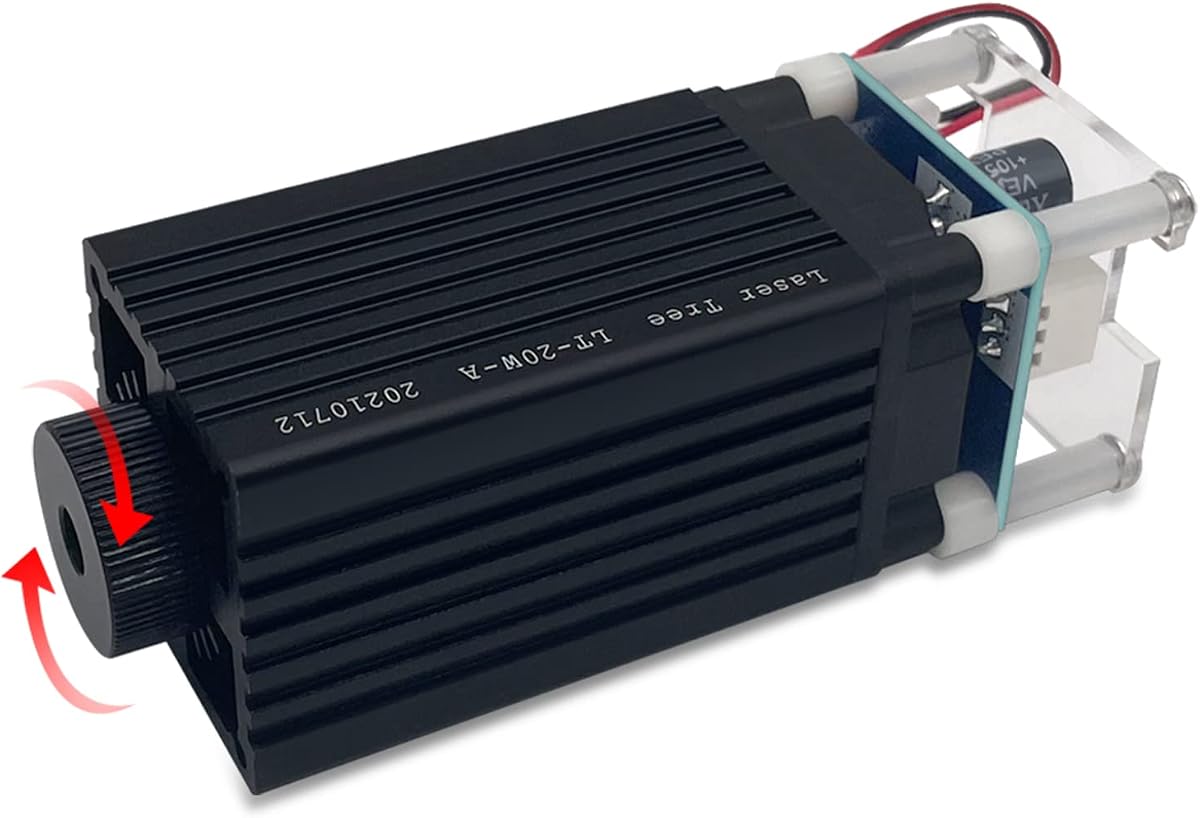
The LASER TREE 10W Output Module is a high-power blue-violet laser engraving upgrade with a 4.4 customer rating. It combines 10W of stated optical output with an integrated air-assist system, built-in FAC, removable blue-light filtering eye cover, cooling fan, mounting plates, adapter board, protective window, cable, and tool.
We may earn a commission when you buy through this link, at no additional cost to you.
The seller reports engraving 304 stainless steel at speeds up to 300mm/s with a 45mm focus length and cutting 8mm plywood in one pass at 1.5mm/s under the stated conditions. The FAC is designed to reduce the focused beam size and increase power density, while the metal air nozzle is intended to reduce resistance and support cleaner, deeper cuts.
This module offers substantially more capability than low-power pointer products, but it also demands correct mounting, ventilation, eye protection, and compatible control hardware. The package includes an adapter board, although the listing specifically identifies the product as a 12V model and advises matching the module to the machine driver. High output does not make every material safe or practical to process.
It is the premium choice here for a serious DIY engraver or cutter builder who wants substantial power and a coordinated set of accessories. Users should also consider facility requirements and local operating rules, verify the 12V configuration, and build an enclosure that contains the beam and debris.
The built-in air nozzle and air-assist arrangement help clear material during cutting and engraving, which can improve edge clarity and make the module more practical for repeated machine work than a bare optical head.
The included adapter, focus plates, eye cover, spare protective window, input cable, and tool reduce the number of separate accessories needed. Buyers should still verify electrical compatibility and secure the module to the machine frame.
We may earn a commission when you buy through this link, at no additional cost to you.
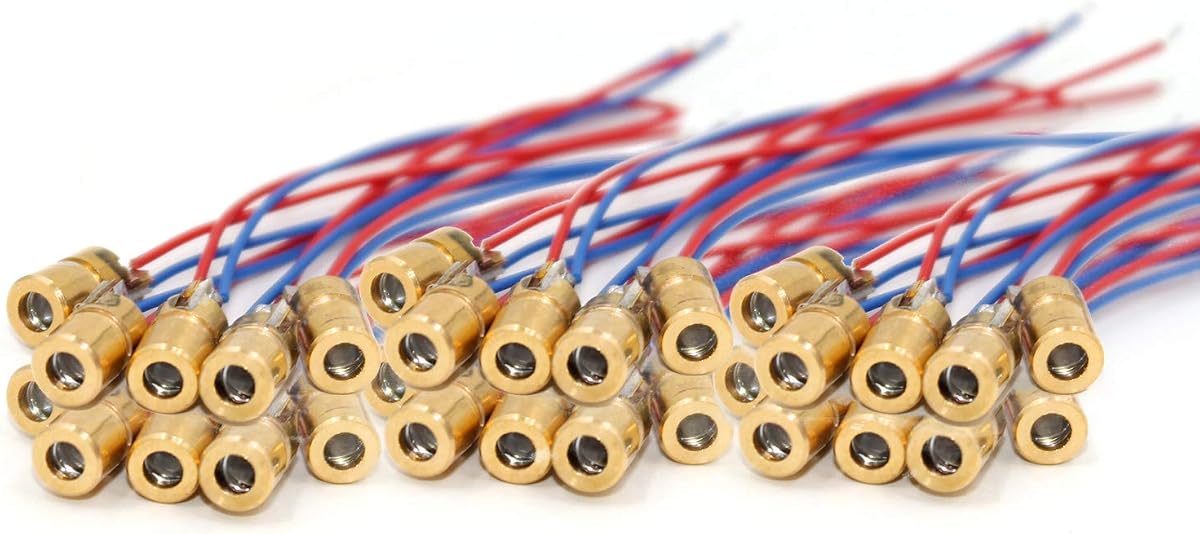
The 30-Pack Mini 650nm Laser Diode is a high-volume component set with a 4.6 customer rating, the highest rating among the products in this guide. Each 6mm diode has a stated 5mW output, 650nm wavelength, 5V operating voltage, 9cm total length, and dot-shaped output.
We may earn a commission when you buy through this link, at no additional cost to you.
The listing positions the set for homemade laser pointers, water-level meters, ground meters, long-range monitor controls, and laser communication experiments. It explicitly cites compatibility with Arduino, Raspberry Pi, and other microcontrollers, making the pack attractive for educational circuits, classroom builds, and repeated prototyping.
The current must remain below 20mA, so the components should not be connected directly to a microcontroller pin without an appropriate driver and power arrangement. The copper-and-plastic construction also means these are small, unenclosed laser heads rather than finished consumer devices. Despite the quantity, the 5mW output is intended for pointing and experimental tasks, not engraving or cutting.
For workshops or families that need a dependable stock of inexpensive diode components, this is one of the strongest choices in the roundup. Its high rating, large count, and microcontroller focus make it particularly suitable for structured learning projects. Add current-limiting circuitry, safe aiming hardware, and suitable eye protection before energizing the beam.
Thirty modules provide enough stock for many students, repeated experiments, and replacement units. The 9cm length and standard 5V context also simplify planning around common maker platforms.
The operating current must stay below 20mA. Use a suitable driver and regulated supply rather than powering the diode directly from an unprotected microcontroller output.
We may earn a commission when you buy through this link, at no additional cost to you.
The 405nm Violet Purple Diode Module is a focusable 5mW industrial dot module designed for DC 3–5V operation. It has a 3.8 customer rating and differs from the more common 650nm red modules by producing violet light at a shorter wavelength.
We may earn a commission when you buy through this link, at no additional cost to you.
The key functional detail is the adjustable front cap. The seller explains that the spot may not initially appear as a clean dot and can be adjusted to produce the desired shape at different distances. That makes the module useful for specialized indicators, positioning references, and experimental displays where a controlled point is required.
The listing provides fewer operating and mechanical details than several competing products. It does not specify the body dimensions, current requirement, housing material, or detailed mounting options in the supplied information. As a result, users should inspect the product and verify the electrical requirements before integration. It also provides only 5mW output, so it is not a material-processing tool.
This violet module is best for a project that specifically benefits from a 405nm point rather than a red or green beam. Its focus adjustment adds practical value, but the lower rating and sparse specifications call for more verification than a fully documented module. Use suitable containment and eye protection appropriate for the beam wavelength.
The front cap allows the user to tune the appearance of the point. Adjust it at the distance where the module will be used, since the desired visual result can change with working distance.
A 405nm source serves specialized applications where red or green would be less suitable. Confirm that the project benefits from the visible violet point and that the full optical system can be safely enclosed.
We may earn a commission when you buy through this link, at no additional cost to you.
The AENBUSLM 40W Laser Module is a mid-high-output engraving module with a 4.6 customer rating. It combines a 40W machine power specification with 5.5W of stated optical output, built-in air assist, a 12,000 rpm cooling fan, and a built-in FAC for compressed focusing.
We may earn a commission when you buy through this link, at no additional cost to you.
The seller reports engraving 304 stainless steel at up to 800mm/s with a 45mm focus length and cutting 5mm plywood in one pass at 60–100mm/s. It also claims that the original diode and FAC improve focus, penetration, and precision. The multi-hole rear mounting pattern is designed to fit different DIY laser stands, CNC routers, engraving machines, cutters, and 3D-printer-style frames.
Electrical compatibility is a meaningful strength because the listing supports both 12V and 24V systems. Nevertheless, this is a Class 4 module, and output specifications do not replace a safe enclosure, filtered viewing window, interlocks, suitable eyewear, ventilation, and trained operation. The manufacturer also notes a power reduction at full output, so results should be assessed using actual machine performance.
We selected this as the editor's choice because it balances high output, cooling, air assist, FAC, mounting flexibility, and voltage compatibility in a broadly usable package. It is a compelling option for builders who want more capability than a low-power module without moving directly to the most powerful model. Verify pinout, driver limits, and cooling clearance before installation.
The built-in fan is specified at 12,000 rpm and is intended to manage heat around the diode. Preserve airflow around the module and monitor temperature during long engraving or cutting sessions.
Support for 12V and 24V systems, together with the multi-hole mounting pattern, makes the module easier to incorporate into different frames. The control system and connector requirements still need to be verified before assembly.
We may earn a commission when you buy through this link, at no additional cost to you.
The 650nm DOT Diode Generator 2-Pack includes two red laser modules with a stated 5mW output and adjustable front focus. It has a 3.8 customer rating and targets laser test tools, concentric locating, medical-equipment locating, signal-equipment projects, and general DIY work.
We may earn a commission when you buy through this link, at no additional cost to you.
The 3–5V operating range provides flexibility for simple electronics, while the adjustable front section helps users obtain a clean point at a selected distance. Two modules offer practical value for paired tests, alignment references, or spare stock, and the red output is suitable for applications where a visible dot is needed.
The listing does not describe a complete laser system. Users must add a suitable power source and current regulation, and they must consider heat, enclosure, aiming, and eye safety. The lower rating may reflect the limited feature set or the component-level nature of the package rather than a specific defect, but the available information simply does not provide enough detail to assess either explanation conclusively.
Choose this two-pack for compact alignment or signaling experiments when a 3–5V red dot is sufficient. It is less appropriate for engraving, and buyers who require a documented enclosure, controls, or verified focus range may prefer a more fully specified module. Inspect the units and confirm electrical details before integrating them.
Adjusting the front of the laser head allows the point to be tuned at the intended working distance. This helps in alignment tasks where a small, defined reference point is more useful than a broad beam.
The 3–5V input range can simplify integration with low-voltage maker electronics, but a correct driver is still required. Add a regulated supply and suitable protection rather than powering the diode indiscriminately.
We may earn a commission when you buy through this link, at no additional cost to you.
The GM532-50 Green DOT is a single 532nm, 5mW green diode module with solder wires. It carries a 3.9 customer rating and is intended for DIY green laser products, with the seller noting that 532nm is brighter than 520nm in the stated comparison.
We may earn a commission when you buy through this link, at no additional cost to you.
The green dot is useful for indicators, alignment, demonstrations, and other applications where a highly visible point source is needed. Solder wires support direct connection to a designed circuit, while the single-unit format makes this a straightforward option when a builder needs only one module and does not want to manage a multi-piece pack.
The product's cold-weather behavior is the most important operational note. Below 15°C, the module needs approximately two to ten seconds of preheating, so timing and control logic should account for that delay. It is also an unenclosed component with no power supply or driver included, and the published information does not give a complete mechanical or electrical specification sheet.
This module is best for a single-purpose green point project where the builder is comfortable designing the surrounding electronics. It is less attractive for users who want a tested, enclosed pointer or high-output engraving capability. Confirm wiring, current requirements, warmup behavior, and safety provisions before putting the beam into service.
A single unit keeps procurement simple for a dedicated indicator or demonstration. It is also easier to integrate than a large multipurpose laser kit when only a green dot is required.
Below 15°C, allow two to ten seconds of preheating before relying on stable output. This matters for automated positioning systems and quick-response experiments.
We may earn a commission when you buy through this link, at no additional cost to you.
Choosing a diode laser module starts with the job: visible alignment, a point or line indicator, DIY electronics, or powered engraving and cutting. The correct wavelength, beam shape, electrical requirements, thermal design, mounting method, and safety provisions should match that intended use.
Optical output is one of the clearest distinctions in this category. The HiLetgo, green, violet, red-line, and dot products are 5mW modules intended for pointing, alignment, and experiments, while the engraving modules offer 4W, 5.5W, and 10W optical outputs for deeper engraving and cutting. A high-output module is not automatically suitable for a small electronics project, and a low-power pointer cannot replace an engraving system.
Match power to the task. Choose a low-power component for indicators and choose a higher-output module only when the material, machine frame, cooling, and safety system can support it.
The listed wavelengths span 405nm violet, 450nm blue-violet, 532nm green, and 650nm red. Red is common for general alignment, green provides strong human-eye visibility, blue-violet is widely used for material processing, and violet serves specialized indicator or experimental needs. Beam shape also matters because dot, line, and engraving outputs are not interchangeable.
Select the wavelength and beam shape around the application rather than choosing on appearance alone. Verify that the receiving material and viewing system work well with the chosen output.
Low-power modules commonly operate around 5V or a 3–5V range, while the LASER TREE 4W and 10W modules are specified for 12V input. The AENBUSLM 5.5W module supports 12V and 24V systems. High-current devices also require a driver capable of handling their specified input, along with suitable connectors and stable power delivery.
Check voltage, current, pin configuration, and modulation requirements before buying. The listing even notes that many machine brands and models exist and that not every module is plug-and-play.
Focus has a direct effect on mark width, detail, and cutting ability. The 4W module provides a stated 20–50mm adjustment range, the violet and red dot modules have adjustable fronts, and the high-power FAC systems are designed to produce a compressed focal spot. Line modules serve alignment applications but generally do not offer the same cutting profile as a focused engraving beam.
Look for a focus method that suits the work area and allows fine adjustment. A stable focal plane and adequate clearance between the lens and the material are especially important for repeated machine jobs.
Air assist helps remove smoke, loose particles, and combustion debris from the active cutting point, supporting cleaner edges and more consistent work. Cooling is equally important because electrical diodes become less reliable when operated at elevated temperatures. The 10W and 5.5W engraving modules include air-assist hardware, while the 5.5W model also specifies a 12,000 rpm fan.
For high-power engraving, prioritize modules with integrated airflow and cooling, and ensure the machine does not obstruct their vents. Add independent exhaust and filtration where appropriate.
A diode module must be held at a consistent distance and angle from the work surface. The 4W module uses a compact 35 by 35 by 99.6mm body, while the higher-output LASER TREE and AENBUSLM products use multi-hole rear mounting patterns. The green and red components with solder wires suit a different kind of integration, one based on custom electronics rather than a moving gantry.
Compare the physical dimensions, mounting holes, cable direction, and available frame space. A mechanically stable mount is essential because movement changes focus and can damage the lens or workpiece.
Laser safety depends on wavelength, optical power, beam path, reflections, and the ability to contain the beam. The 4W module specifically instructs users to wear appropriate safety glasses, while the 10W package includes a removable eye cover and spare protective window. The engraving modules are listed as Class 4 products, requiring a properly engineered enclosure and controlled operating procedure.
Never rely on the included accessories as a complete safety system. Use an enclosure, filtered viewing window, controlled access, suitable eye protection, secure power connections, and a plan for fire and fume management.
The 10W LASER TREE package includes a driver adapter, eye protection cover, spare protective window, three-pin input cable, tool, and focus fixing plates. Smaller components often include only leads, leaving the user to source a driver, housing, and connectors. After-sales support can also be significant when integrating a module into an unfamiliar machine, particularly because pinouts and driver requirements vary.
Count the full accessory set rather than comparing the laser head alone. A package with an appropriate adapter, mounting hardware, and protection can simplify assembly, while bare components offer more customization for experienced builders.
Begin by identifying the module's wavelength, output power, voltage, current, pinout, and required cooling. Connect the power and control lines with the system powered off, use a compatible driver, and verify polarity before energizing the diode. For machine-mounted engraving modules, secure the unit to a rigid frame and set the correct focus height before running a test pattern on an appropriate sacrificial material.
Always test at the lowest practical power and shortest sensible exposure. Low-power diode projects should be aimed at a controlled target and kept away from reflective surfaces, while engraving modules should operate inside a properly enclosed and interlocked machine. Confirm material compatibility, provide adequate ventilation, and keep combustible materials, solvents, and unsuitable plastics away from the work area.
For care, keep the lens clean and free of smoke residue, allow cooling fans to operate, and preserve unobstructed airflow around high-power modules. Clean with an appropriate lens-safe method rather than touching the optical surface. Monitor the output for instability, check connectors for heat or discoloration, and stop operation if the module becomes unusually hot, the spot changes shape unexpectedly, or the cooling system stops working.
A 5mW diode module is a low-power point or line source intended mainly for alignment, indicators, and electronics experiments. A 4W module is an engineered engraving and shallow-cutting component that requires stronger electronics, cooling, beam containment, and appropriate safety controls. They serve very different purposes and should not be treated as interchangeable.
The 4W, 5.5W, and 10W modules are described as capable of engraving smooth stainless steel and ceramics, while the 5.5W listing also states that mirror stainless steel can be engraved directly. The exact result depends on the specific alloy, finish, focus, power, speed, and machine settings. Test on scrap material before processing a finished piece.
FAC refers to the focusing arrangement used in the listed high-output modules. The product descriptions say it compresses the beam at focus, increasing power density and supporting finer engraving, faster processing, and stronger penetration. It does not remove the need for correct focus, cooling, air assist, or safe machine enclosure.
No. Compatibility depends on the frame, mounting arrangement, driver board, control signals, voltage, current, and available clearance. The listings describe the modules as suitable for many DIY machines, but also caution that not every brand and model is plug-and-play. Confirm the electrical and physical requirements before purchasing.
The green module listings state that in winter, when the temperature is below 15°C, the module needs approximately two to ten seconds of preheating. Builders should allow that settling time before taking measurements or relying on consistent output, particularly in automated tests or systems that react immediately after activation.
Even low-power visible lasers should never be treated as harmless to the eyes. Beam exposure and reflections can cause injury, especially when the beam is concentrated, viewed directly, or used at close range. Use proper containment, avoid reflective targets, keep the beam below eye level, and select eyewear appropriate for the wavelength and optical output.
Choose a dot module when you need a single reference point, an indicator, or a positioning signal. Choose a line module when alignment across a surface or a straight reference is more useful. Neither is a substitute for a focused high-power engraving module when the task involves marking or cutting materials.
Use the voltage and current specified by the seller, then confirm that your driver can safely supply that load. The 5mW components generally work around 5V, the 4W module uses a 12V input, and the 5.5W module supports 12V and 24V configurations. A connector match alone does not guarantee electrical compatibility.
The AENBUSLM 5.5W module is the editor's choice for a balanced combination of optical output, air assist, cooling, FAC, and voltage compatibility. The LASER TREE 10W module stands as the premium option for makers who need the highest listed optical output and a substantial accessory package, while the HiLetgo 10-pack is the budget choice for low-power electronics and alignment projects.
Prioritize the job before the output figure. Low-voltage dot and line modules are best for indicators, alignment, and demonstrations; high-output modules are relevant only when the machine, cooling, material, controls, and enclosure are prepared for engraving or cutting. Electrical compatibility and safe beam containment deserve as much attention as beam brightness.
Finally, check the current listing, package contents, technical details, and availability before ordering. Product configurations can change, and prices and terms vary over time. Use the comparison table to narrow the field, then verify the module against the exact machine and project you intend to build.