
Handeful Grip Strength Tester
4.6Editor score
Strain gauge measurement system
Nineteen user profiles
Adjustable curved handle
Large LCD display
Battery-powered operation
Compare the best digital grip strength tester options for accuracy, capacity, profiles, displays, comfort, and training features in this practical 2026 guide.
A digital grip strength tester turns hand performance into a clear, repeatable measurement, making it useful for athletes, rehabilitation professionals, seniors, and anyone tracking fitness. The best device combines dependable readings, an easy-to-read display, a comfortable adjustable handle, and enough memory to compare results over time.
We compared the ten products in this guide using their stated sensors, measurement ranges, resolution, profile storage, displays, handle designs, and included training equipment. The list covers standalone dynamometers, test-and-train bundles, higher-capacity models, and three-in-one kits designed for measurement, resistance work, and finger conditioning.
Each review explains who the product suits, which features set it apart, and where its limitations may matter. Ratings and specifications reflect the supplied product information, while availability and prices can change, so check the current listing before deciding which digital grip strength tester fits your goals.
4.6Editor score

4.6Editor score

4.7Editor score
This side-by-side comparison highlights maximum measurement capacity, display type, profile storage, and whether each option includes resistance-training equipment. It is designed to make it easier to narrow the field according to measurement needs, user tracking, portability, and training goals.
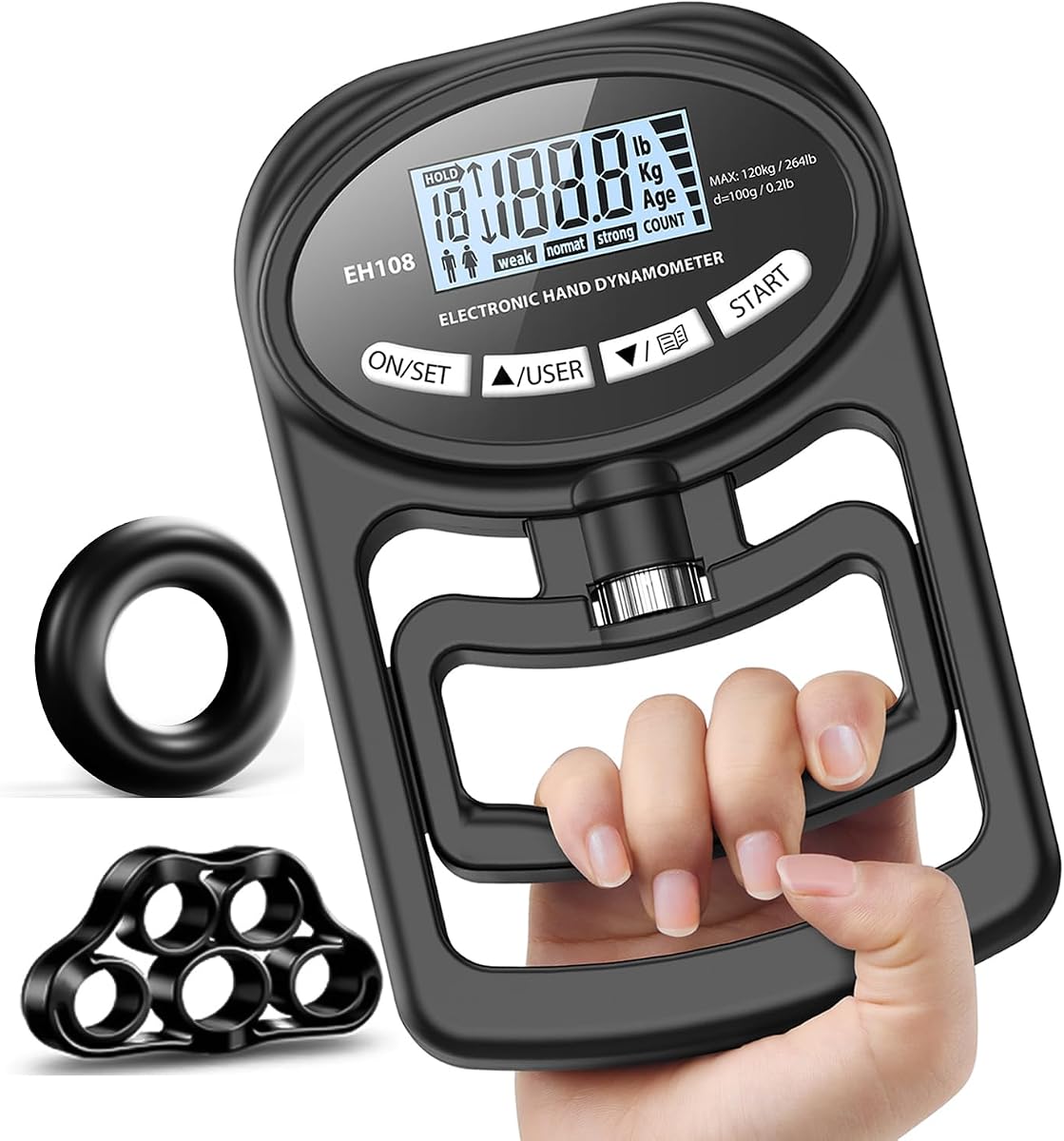


The Handeful Grip Strength Tester is a capable standalone dynamometer with a 4.6 rating and an unusually useful combination of features for its category. It measures up to 198 pounds, or 90 kilograms, using a high-precision strain gauge sensor with divisions of 0.2 pounds or 0.1 kilograms. Its large LCD places the result, user information, grip status, and saved maximum together for quick reference.
We may earn a commission when you buy through this link, at no additional cost to you.
The strongest feature is its profile system. Up to 19 users can be stored with age and gender information, making this a practical choice for a family, school group, sports team, or clinic that repeatedly tests the same people. An adjustable curved plastic handle adds another layer of versatility by allowing users with different hand sizes to find a more secure position, although buyers should confirm that its stated internal dimensions suit their hands.
Its limitations are straightforward. A 198-pound ceiling is lower than the 265-, 396-, 400-, and 440-pound capacities offered by several competitors, so extremely strong users may approach its upper limit sooner. It also measures but does not provide resistance training, which means a separate grip trainer may be needed for athletes who want to perform targeted strengthening work.
Despite those trade-offs, this is an excellent choice for home fitness, introductory training, school testing, and routine progress monitoring. People who want a straightforward digital grip strength tester without paying for a large kit receive a precise sensor, multi-user memory, an easy-to-read display, and comfortable handle adjustment in one focused device.
Nineteen stored profiles let a household, team, or classroom compare results over time. The display also recalls a maximum value, while weak, normal, and strong grip levels provide a quick interpretation of each reading.
The curved adjustable handle is designed to produce a secure and comfortable grip. Check the listed internal size before purchasing, particularly if you have a very small or very large hand.
We may earn a commission when you buy through this link, at no additional cost to you.
The 265lb/120kg Grip Strength Tester is a polished, versatile option with a 4.6 rating. Its defining convenience is a backlit LCD, which makes readings easy to see in a dim clinic, home room, or evening training environment. The device measures up to 265 pounds and is stated to be accurate within 0.2 pounds, equivalent to 0.1 kilograms, providing useful precision for routine assessment.
We may earn a commission when you buy through this link, at no additional cost to you.
The adjustable handle and non-slip surface make setup straightforward. Rather than forcing every tester into the same position, users can turn the knob to find a fit that feels secure, which is especially valuable when athletes, teenagers, and adults share a device. The stated uses span physical therapy, senior hand-health monitoring, sports training, climbing, and tennis, giving the tester a broad practical audience.
Compared with several profile-based models, however, the supplied information does not mention multi-user memory. If your priority is logging results for a whole family, team, or clinic, that omission is worth considering. This product also focuses on measurement rather than supplying a resistance trainer, so it may be less convenient as a complete test-and-train package.
Its strongest advantages are the backlit screen, 265-pound capacity, adjustable non-slip design, FDA registration, and two-year warranty. It is a strong recommendation for anyone who values immediate readability, consistent measurements, and straightforward operation in home, clinical, or athletic settings.
The backlit LCD is especially valuable when lighting is inconsistent. Users can see the result immediately rather than moving to a brighter area or relying on a difficult-to-read screen.
The adjustable handle and secure grip surface help different users obtain a stable testing position. This makes the model well suited to clinics and households that do not use one fixed-size device.
We may earn a commission when you buy through this link, at no additional cost to you.
This Grip Strength Tester with Trainer offers a broader 3-in-1 approach, earning a 4.4 rating while combining a digital dynamometer, finger expander, and palm ring. The measurement device reaches 265 pounds with 0.1-kilogram divisions, allowing users to establish a baseline and then support grip development with dedicated training tools rather than relying on the dynamometer alone.
We may earn a commission when you buy through this link, at no additional cost to you.
The profile system is one of the most useful elements. It records up to 19 users, includes age and gender, and automatically displays incremental changes from the previous test. That direct comparison feature is valuable for teens, adults, and seniors who want visible evidence of improvement. The included gripper is described as suitable for working both hands simultaneously, while the finger and palm tools broaden the type of conditioning available.
As with any multi-piece system, fit and setup require more thought. The finger expander and palm ring are mechanical accessories whose comfort can depend on hand dimensions, and the package may take longer to organize than a standalone dynamometer. The supplied details also do not identify a backlit display, so visibility in dark conditions is less certain than it is with dedicated backlit models.
This kit is a compelling option for users who want measurement and training in the same purchase. It is especially attractive for home athletes, climbers, wrestlers, gymnasts, and anyone rebuilding hand strength, provided the smaller accessories feel comfortable during use.
The dynamometer supplies the objective result, while the gripper, finger expander, and palm ring create varied training options. That combination is more versatile than a device intended only to display a number.
The profile system records age, gender, and prior grip values, then presents the difference from the last test. This makes trends easier to understand without manually comparing every reading.
We may earn a commission when you buy through this link, at no additional cost to you.
This electronic hand dynamometer and grip trainer combines measurement with resistance work in a 4.6-rated package. Its strain gauge sensor can measure up to 400 pounds, giving it enough capacity for many serious fitness users. More importantly, the included trainer provides adjustable resistance from 11 to 132 pounds, allowing the training load to be matched to a measured starting point.
We may earn a commission when you buy through this link, at no additional cost to you.
The smart counter turns the trainer into more than a basic spring gripper. It shows how many squeezes have been completed, while the tester records up to 19 profiles and displays a user code, age, gender, grip value, and grip status. Together, these features support a useful workflow: measure the current level, select a suitable resistance, train, count the repetitions, and then check the next measurement.
Both pieces feature ergonomic handles and adjustment knobs, which helps with comfort and load selection. The trade-off is that this is a larger system than a simple dynamometer and may be unnecessary for someone interested only in occasional measurement. The information also does not mention a backlit display, so buyers who test in low light may want to verify screen visibility.
It is well suited to strength-oriented users who want the dynamometer and trainer to function as a coordinated system. The broad resistance range, high measurement capacity, profile tracking, and repetition counter make it a particularly practical choice for progressive grip work.
The measured grip result can guide resistance selection, and the trainer's counter records completed squeezes. This creates a repeatable test-train-measure cycle rather than leaving the two tools disconnected.
A 400-pound measurement ceiling offers additional headroom over common 198- and 265-pound models. The trainer also provides meaningful load, reaching up to 132 pounds for users who need progressive resistance.
We may earn a commission when you buy through this link, at no additional cost to you.
The GD DYNO-200 is the premium selection in this guide, with a 4.7 rating and the highest listed measurement capacity at 440 pounds. It is built around an S45C carbon steel body, a material chosen for strength and resistance to wear. That construction gives the device a distinctly robust feel and makes it a logical choice for strong athletes or users who expect frequent handling.
We may earn a commission when you buy through this link, at no additional cost to you.
The operating concept is refreshingly simple: hold the ergonomic dynamometer and squeeze to obtain a measurement. Its compact format also makes it easier to carry to a gym, training session, or competitive venue. The product includes a grip challenge, with detailed instructions referenced in the manual, adding a goal-oriented element for people who enjoy pursuing a personal maximum.
The supplied information does not mention multi-user profiles, automatic previous-result comparisons, or a particularly elaborate screen. Those omissions make it less obviously suited to shared clinical administration than some 19-profile rivals. It also requires two AAA alkaline batteries, which are not included, so buyers should plan for that small additional requirement.
For someone seeking a rugged, high-capacity, no-frills digital grip strength tester, the DYNO-200 is a leading option. Its steel construction, 440-pound range, ergonomic handle, and portability make it particularly appealing to advanced grip athletes, rock climbers, wrestlers, and users who prioritize durability over extensive record keeping.
The 440-pound maximum and S45C carbon steel body give this model more strength-oriented character than typical home dynamometers. It is intended to withstand demanding grips while remaining portable enough for regular travel or training.
A straightforward squeeze-to-measure design reduces setup time. The device avoids the complexity of multi-user menus, which can be an advantage for athletes who want quick readings during a workout.
We may earn a commission when you buy through this link, at no additional cost to you.
The FitBeast Grip Strength Trainer Kit is a 4.5-rated three-in-one system that combines a digital tester, an adjustable hand gripper, and a finger exerciser. Its resistance trainer spans 10 to 160 pounds, one of the broadest stated ranges among the kits in this guide. The range supports gradual progression from foundational hand work to more advanced conditioning.
We may earn a commission when you buy through this link, at no additional cost to you.
The digital tester provides instant readings and is described as displaying weekly improvements, allowing users to see changes with real numbers instead of relying entirely on perceived effort. The system stores up to 19 profiles, and the trainer includes a counter for completed squeezes. Together, these functions are useful for families, therapists, and training partners who want to monitor several people and compare progress.
Its main drawback is that the supplied specifications do not state the digital tester's maximum capacity or measurement resolution. Those details are central when selecting a dynamometer for accurate tracking, so buyers should consult the current product listing or manual before assuming it meets a particular requirement. The three-piece format also takes up more storage space than a single meter.
For users seeking a broad home training package, the kit offers an attractive balance of measurement, adjustable resistance, and finger conditioning. It is especially suitable for progressive hand strengthening, general fitness, and rehabilitation-oriented routines where multiple exercise options and shared progress tracking matter.
The trainer's 10-to-160-pound adjustment range supports gradual load changes as grip improves. That makes the system useful both for users rebuilding foundational strength and for more experienced athletes adding resistance.
Instant digital readings, weekly improvement information, and a repetition counter make training changes easier to notice. The design is especially engaging when multiple family members or training partners use stored profiles.
We may earn a commission when you buy through this link, at no additional cost to you.
The WESTHEY Digital Hand Dynamometer has the highest listed rating in the group at 5.0 and combines that strong reception with a comprehensive feature set. It measures up to 396 pounds, or 180 kilograms, with 0.1-kilogram screen resolution. The large backlit LCD displays grip values, user information, battery status, and weak, normal, or strong strength indicators.
We may earn a commission when you buy through this link, at no additional cost to you.
Its 19-profile memory makes it especially attractive for clinics, fitness centers, families, and trainers. The adjustable ergonomic handle is designed for men, women, seniors, teenagers, and athletes, allowing the grip position to be adapted to different users. This combination of clear feedback, multi-user storage, and handle flexibility covers many of the reasons people purchase a digital dynamometer.
The absence of an included resistance trainer means it focuses on assessment rather than complete training. It may also be important to distinguish screen resolution from the underlying measurement resolution, because only the latter is stated here. Buyers who require a specified technical standard should review the manual and current product documentation before making a professional purchasing decision.
This model is a strong all-around recommendation for readable measurements, shared tracking, and broad user suitability. It is particularly useful for rehabilitation, senior hand-health monitoring, climbing, tennis, golf, baseball, and general fitness testing, while its 396-pound capacity accommodates stronger users better than lower-capacity alternatives.
Strength-status indicators accompany the numerical reading, while backlighting improves visibility in dim conditions. These details can make the result more useful during frequent or time-sensitive testing.
Nineteen profiles support repeat testing across households, teams, and clinics. Combined with an adjustable handle, the design allows different users to retain personal records without repeatedly changing devices.
We may earn a commission when you buy through this link, at no additional cost to you.
The TIPRE 396lbs/180kg is a 4.5-rated dynamometer focused on presenting detailed comparison data. Its high-precision sensor measures up to 396 pounds with 0.2-pound or 0.1-kilogram divisions. A large LCD shows gender, age, grip value, fluctuation status, the difference from the previous result, and a power level, giving users more context than a bare numerical readout.
We may earn a commission when you buy through this link, at no additional cost to you.
The device supports up to 19 user profiles and records each user's maximum grip value. Automatic comparison with the last recorded result is particularly useful for monitoring rehabilitation programs, sports development, and general fitness. A curved adjustable handle helps users with different hand sizes achieve a more secure and comfortable testing position.
This is a measurement-first product, with no resistance trainer listed among the supplied features. It also does not specify a backlit display, so those who need to read the screen in low light should verify its visibility. The range of on-screen information may take slightly longer for a new user to understand, although the automatic previous-result comparison reduces manual work.
TIPRE is well matched to people who want to understand how a result changes, not merely see the current maximum. It works well for home users, schools, sports groups, and clinical programs where repeatable profiles and compact portable equipment are more important than bundled resistance tools.
The screen presents user information, grip status, power level, and change from the last test together. This gives a fuller picture of performance and reduces the need to remember previous readings.
The compact body and adjustable handle support testing in homes, schools, sports settings, and clinics. Saved profiles are especially useful when a group returns to the same device for repeated assessments.
We may earn a commission when you buy through this link, at no additional cost to you.
This Electronic Grip Strength Tester Set pairs a 400-pound digital dynamometer with an adjustable hand gripper offering 11 to 132 pounds of resistance. Its strain sensor uses 0.2-pound or 0.1-kilogram divisions, and the large LCD combines user code, age, gender, grip value, grip status, saved maximum, and weak, normal, or strong indicators.
We may earn a commission when you buy through this link, at no additional cost to you.
The set is designed around detailed team progress tracking. It stores up to 19 profiles, recalls the previous test for each profile, and indicates whether current hand strength has increased or decreased. The trainer includes a mechanical counter, so users can log repetitions without charging another electronic component. The materials listed include ABS for the dynamometer and PP, TRP, and stainless steel for the trainer.
A notable packaging choice is that no printed manual is included. Instead, the manufacturer provides an electronic manual accessible through a QR code and the product listing's safety documents. This reduces paper use, but it does add a small inconvenience for users who prefer offline instructions. A backlit screen is also not stated in the supplied information.
Overall, this is a capable test-and-train package for physiotherapists, occupational therapists, athletic trainers, teams, and home users. It offers enough capacity for demanding readings, progressive resistance, multi-user records, and a counter, making the set particularly useful when measuring and training are equally important.
Each of the 19 profiles can retrieve its prior result and show whether strength has risen or fallen. That makes the device convenient for repeated group testing without maintaining separate paper records.
The trainer's mechanical repetition counter does not depend on charging. It offers a simple way to track sets while keeping the training accessory independent from the digital meter's power requirements.
We may earn a commission when you buy through this link, at no additional cost to you.
The 396lbs/180kg Grip Strength Tester Trainer earns a 4.9 rating and combines a digital dynamometer with an adjustable trainer, additional grip-training equipment, profile storage, and a repetition counter. The trainer's resistance spans 11 to 132 pounds, while the digital tester supports measurements up to 396 pounds. This makes it a balanced package for both progressive training and objective assessment.
We may earn a commission when you buy through this link, at no additional cost to you.
Progress tracking is central to the design. Up to 19 user profiles allow family members, clients, or teammates to maintain individual records, and the tester logs weekly gains with instant readouts. The built-in counter tracks each squeeze, adding a useful training metric alongside the digital strength result. Together, these elements make the system appealing to users who want evidence that their training is producing change.
The exact digital measurement resolution and backlight status are not stated in the supplied details, so buyers should verify them if those specifications are priorities. The multi-accessory format also requires more storage and may feel more elaborate than a standalone dynamometer. People who only need occasional measurements may find that extra equipment unnecessary.
For a user seeking a well-rounded system, this kit offers the most important elements in one coherent package: a high-capacity tester, adjustable resistance, repeated-squeeze counting, multi-user records, and ergonomic handling. Its 4.9 rating also makes it one of the strongest-rated options included in the guide.
The tester stores individual profiles and weekly gains, while the trainer counts squeezes. These two forms of feedback make it possible to monitor both strength trends and training volume.
The 11-to-132-pound trainer range can be adjusted as foundational strength improves. A 396-pound tester adds useful measurement headroom for users working toward greater personal records.
We may earn a commission when you buy through this link, at no additional cost to you.
The right digital grip strength tester should match your users, training style, and required measurement range. Capacity, display clarity, memory, handle comfort, included accessories, and care requirements all influence how useful the device will be over time.
Choose a maximum capacity that comfortably exceeds the strongest expected user rather than matching it exactly. Capacities in this group range from 198 pounds to 440 pounds. The Handeful model is sufficient for many general users, while the 265-, 396-, and 400-pound options provide more headroom for advanced athletes. The GD DYNO-200 reaches 440 pounds, making it the most suitable for very strong grips and dedicated strength athletes.
A generous ceiling prevents the device from becoming a limiting factor during progress. It also reduces the need to replace a lower-capacity tester once a user becomes stronger. Capacity alone does not establish accuracy, so consider the stated sensor and divisions alongside the maximum figure.
Look for a defined measurement division, sensor type, and accuracy claim rather than relying on maximum capacity alone. Several products state 0.1-kilogram or 0.2-pound divisions, while others provide a maximum range without detailed resolution information. For routine fitness tracking, consistent readings are generally more important than displaying unnecessary decimal places.
For professional or research-oriented use, verify the technical documentation and intended application before purchase. Consistent technique matters too: a repeatable test position, a relaxed starting grip, and a controlled squeeze can be as valuable as small numerical increments.
A large LCD makes the main result easy to find, while a backlight improves visibility in dim rooms and clinics. The best displays place the grip value, user information, and strength status together. Some models also show the difference from the previous result, which reduces the effort required to monitor change.
Decide whether you need only a current score or a full progress log. Backlighting, strength categories, user details, and prior-result comparisons are useful additions, but they can add menu complexity. Simple one-number operation may be preferable for quick workouts, while detailed screens suit repeated assessments.
Profile storage is valuable whenever more than one person uses the same device. Nineteen profiles are supported by several models, allowing users to retain personal maxima and compare results over time. The FITBEast, WESTHEY, and TIPRE devices also emphasize automatic changes or strength evaluations, which can make progress easier to interpret.
If one athlete or family member will use the tester, memory may not influence the decision. If a clinic, school, or team shares a device, verify how profiles are created, selected, and recalled before relying on the system for regular record keeping.
The handle affects both comfort and the consistency of a test. An adjustable grip allows the user to position the device naturally, which may help produce more repeatable results. Curved and non-slip designs are intended to reduce movement during a hard squeeze, while ergonomic shapes should distribute pressure more comfortably.
Check the stated dimensions before buying, particularly for very small or very large hands. If prolonged squeezing is uncomfortable, adjust the grip position and avoid unnecessary force. A device that feels awkward can produce inconsistent efforts, so comfort should not be treated as a minor cosmetic preference.
A standalone dynamometer is often sufficient for baseline testing and periodic progress checks. Test-and-train bundles add more value when the goal is to strengthen the hands between measurements. The Grip Strength Tester with Trainer includes a finger expander and palm ring, while several other kits combine a digital meter with an adjustable hand gripper.
Resistance ranges differ substantially, from 10 or 11 pounds up to 132 or 160 pounds. More resistance is not automatically better; beginners and rehabilitation users may need a low starting load, while advanced users benefit from greater adjustment. Choose training tools that feel comfortable and suit the intended program.
Consider where testing will occur. A compact device is convenient for a gym bag, travel, or a mobile therapist, while a boxed multi-component kit is better suited to a dedicated training area. Most of the digital testers use AAA batteries, and the GD DYNO-200 requires two AAA alkaline batteries that are not included. Battery availability and replacement planning are simple but important details.
A non-rechargeable mechanical counter, as included with one trainer, can be convenient because it does not need charging. Still, the complete set should be checked for batteries, included accessories, and setup requirements before use.
Warranty and regulatory details can influence confidence in a purchase. The 265lb/120kg model is listed as FDA registered and backed by a two-year warranty, which may appeal to professional or frequent users. Other products emphasize construction, included accessories, or challenge features instead. These claims are not interchangeable, so compare them according to your needs.
Documentation matters when operating a multi-function device. One set ships without a printed manual and provides an electronic version through a QR code and online product documents. Ensure the instructions are available and comfortable for intended users, particularly in a professional environment where standardized procedures may be required.
Before the first test, install the batteries with the correct polarity, adjust the handle to a comfortable position, and confirm that the user profile contains the correct information. Learn the display, including how to record a maximum and view the difference from a previous result. If using a trainer, begin with a low resistance setting and avoid forcing the grip.
For each measurement, sit or stand comfortably, relax the arm and hand, and allow the dynamometer to rest in a natural position. Squeeze smoothly and consistently until the device records the result rather than jerking or twisting. Keep the wrist neutral, avoid using the other hand to assist, and repeat the test according to the same procedure to make comparisons meaningful.
Store the unit in a dry area, keep the handle and sensor free of dirt, and wipe it with a soft, lightly damp cloth when needed. Do not immerse the electronic tester, and follow the manufacturer's battery and cleaning guidance. Remove batteries during long periods of nonuse if appropriate, and regularly check that the display, adjustment mechanism, and training accessories remain in good working order.
A digital grip strength tester converts the force of a hand squeeze into a numerical reading, usually displayed in pounds or kilograms. Athletes use it to monitor performance in climbing, wrestling, gymnastics, tennis, golf, and other activities, while therapists and individuals use it to follow rehabilitation or general hand-strength progress. Repeated testing is most meaningful when the position and method stay consistent.
No. A higher ceiling is useful for very strong users and advanced athletes, but most people can benefit from a model whose range comfortably covers their expected readings. A 198-pound tester may suit many general users, while options above 265 pounds provide more headroom. Capacity should be considered alongside handle comfort, display quality, memory, and intended application.
The number needed depends on who will use the device. One or two users can manage with a standalone model, while families, schools, clinics, and teams benefit from storage for numerous profiles. Several products in this guide support 19 users and can recall maximum or prior results, which simplifies long-term comparisons.
A division of 0.1 kilograms or 0.2 pounds is common among the products that state their measurement increments. More decimals do not automatically mean the device is more useful; consistent technique and reliable readings matter more. Review the full accuracy and resolution specifications, and consider the manufacturer's documentation if your use is clinical or professional.
Not necessarily. A tester is valuable for establishing a baseline and monitoring change, while an adjustable trainer provides resistance for progressive strengthening. If your main goal is frequent assessment, a standalone device may be enough. If you want to train between measurements, a bundle can make the process more convenient and allow resistance to be selected from test results.
Many of the featured devices include adjustable or curved handles designed for different users. Adjust the handle until the device feels stable and natural, then use the same setting for repeat tests on that person. Check the product dimensions beforehand if your hand falls outside the typical range, and avoid a position that causes discomfort.
The right schedule depends on your training status and goals. A consistent weekly test is often practical for general progress tracking, while more frequent checks can be useful during structured training. Rehabilitation programs may follow a clinician's schedule. Avoid comparing results made with different techniques, and allow fatigue or soreness to influence the outcome.
A backlight is not essential for every home user, but it is helpful when testing in a dim room, garage, basement, or clinic. Several featured products include a backlit LCD, while others use a standard display. If visibility matters, confirm the screen type and review the current listing before ordering.
The Handeful Grip Strength Tester stands out as the best overall value, combining a strain gauge sensor, 19 profiles, a large LCD, and an adjustable handle without adding a full training system. The 265lb/120kg model is the Editor's Choice for its backlit screen, FDA registration, and two-year warranty, while the GD DYNO-200 takes the premium position with its carbon steel body and 440-pound capacity.
Your priorities should determine the rest of the shortlist. Choose a kit when progressive resistance and repetition counting matter, prioritize profile memory for groups, and look for a backlight if low-light visibility is important. Also check handle dimensions, measurement divisions, power requirements, and the complete list of included accessories before making a final decision.
Ratings, product details, and prices can change, so confirm the current listing and availability before purchasing. Comparing the latest information with your testing environment and goals will help ensure that the digital grip strength tester you choose remains useful and motivating over time.