
5V 1A AC Adapter with 8 Tips
4.4Editor score
Eight interchangeable DC tips
Center-positive 5V output
Five-watt maximum capacity
Compare 10 leading DC 5V chargers for output, connector support, compatibility, safety features, and everyday powering needs.
DC 5V chargers are compact power supplies for routers, cameras, monitors, speakers, LED accessories, and other low-voltage electronics. A useful model must match a device’s voltage, current, connector, and polarity rather than simply offering a familiar USB port.
The products in this guide were compared using their stated input ratings, output capacity, connector inventories, cable lengths, protection features, and intended device compatibility. The list covers wall-plug adapters and USB-to-DC cables at outputs from 1A through 3A.
Each review highlights the setup that makes a charger most useful and also identifies limitations that matter before purchase. Ratings and product configurations can change, and current prices should be checked independently because market conditions and promotions vary over time.
4.4Editor score

4.6Editor score

4.2Editor score
The table below compares the ten DC 5V chargers by output capacity, connector approach, cable design, and notable compatibility or protection features.




This 5V 1A AC adapter earns a place as a flexible replacement supply for small household and office electronics. Its 4.4 rating reflects a generally useful package, with eight interchangeable tips that reduce the need to search for the correct connector. It is built for center-positive devices that draw no more than one amp at 5V.
We may earn a commission when you buy through this link, at no additional cost to you.
The adapter accepts universal 100V-240V AC input and supplies regulated 5V DC output up to 1A, with a maximum stated output of 5W. Its tip collection covers 5.5×2.5mm, 4.0×1.7mm, 3.5×1.35mm, 3.0×1.1mm, and 2.5×0.7mm barrel sizes, along with Micro-USB, Type-C, and terminal connectors. That range makes it especially useful for cameras, baby monitors, routers, speakers, webcams, LED strip controllers, and other low-power products.
The main limitation is its one-amp ceiling. A device that requires 1.5A or 2A should not be connected, even if the physical tip appears to fit. The manufacturer also expressly excludes phones and laptops, so it is better understood as a low-power DC replacement adapter than a general charging brick. Barrel-tip sizes can look similar, and some recessed ports may not allow the connector to seat deeply enough.
This is a sensible choice for someone replacing a lost 5V supply, maintaining a small collection of mixed-tip devices, or assembling a modest electronics bench. Check the original adapter’s voltage, current, connector dimensions, and center-positive polarity before ordering. If the device draws 5V at 1A or less and one of the supplied tips matches, it offers a practical one-cord solution.
Eight tips cover common round jacks, two USB-style connectors, and a terminal attachment. This variety reduces compatibility guesswork when maintaining several small electronics around the home or office.
The fixed 1A output makes the product predictable for compatible equipment. It should be used only where the original supply also specified 5V and no more than one amp.
We may earn a commission when you buy through this link, at no additional cost to you.
This wall adapter combines a 4.6 rating with one of the broadest connector selections in the guide. It supplies 5V DC at up to 1A and includes 11 changeable tips, making it a strong option for users who maintain several small devices with different DC connectors. The six-foot cable adds useful placement flexibility.
We may earn a commission when you buy through this link, at no additional cost to you.
The stated specification supports devices drawing from 100mA through 1000mA. The base barrel is 5.5mm x 2.1mm, with center-positive polarity, and the package extends that connection through an assortment of interchangeable tips. Listed applications include LED lighting, wireless routers, switches, security cameras, Bluetooth speakers, receivers, electrical toys, game consoles, GPS units, DVRs, webcams, USB hubs, and video baby monitors.
Its 1A limit prevents use with more demanding 5V equipment, and the product information recommends remaining below 80% of total output for extended operation. Users should also measure the socket rather than relying on a visually similar barrel size. The requirement for matching polarity is critical: a center-negative device will not work correctly with this center-positive supply.
The adapter suits a household or office that needs to keep several lightweight 5V devices running without keeping separate replacement cords. It is especially attractive when a device has an unusual or hard-to-find connector but accepts a standard 5.5×2.1mm supply. For anything rated above one amp, buyers should move to a 1.5A, 2A, or 3A model rather than testing the limits of this one.
The extensive tip set includes common barrel formats and USB-style connectors, allowing one supply to cover a larger mix of electronics. Each attachment should still be checked for fit and polarity.
A six-foot lead can reach farther than a short adapter cable, reducing awkward wall-socket placement. It remains compact enough for travel or a crowded charging area.
We may earn a commission when you buy through this link, at no additional cost to you.
This 5V 2A adapter is the strongest all-around choice in the roundup. Its 4.6 rating, 10W maximum output, and 11 interchangeable plugs combine a generous power ceiling with broad device support. It gives users room to power equipment that needs more than 1A without jumping all the way to the 3A models.
We may earn a commission when you buy through this link, at no additional cost to you.
Input accepts 100V-240V AC at 50/60Hz, while the regulated output is 5V DC at up to 2A. The self-adapting base connector is 5.5mm x 2.1mm with center-positive polarity, and the interchangeable set supports current requirements ranging from 100mA to 2000mA. A six-foot cable offers more positioning freedom than many compact adapter leads.
Protection against short circuits, overcurrent, overvoltage, and excessive temperature adds confidence for sustained use. Nevertheless, the fixed output and center-positive configuration are not universal. The device must require exactly 5V, its amperage must be no greater than 2A, and the connector must physically fit. Devices using center-negative polarity, higher voltages, or substantially higher currents are outside its intended scope.
This adapter is well suited to LED systems, routers, cameras, speakers, webcams, USB hubs, small displays, and other compatible electronics. It also works well as a shared workshop supply because the 2A limit covers a wider range than 1A models while remaining more compact than a 3A alternative. Verify the device label, measure its socket, and confirm polarity before purchase.
A 2A maximum gives this adapter more flexibility than one-amp alternatives. It can supply suitable 1.5A and 2A devices in addition to lower-current equipment.
Short-circuit, overcurrent, overvoltage, and temperature protections address common electrical faults. Correct polarity and connector selection remain the buyer’s responsibility.
We may earn a commission when you buy through this link, at no additional cost to you.
The POWSEED cable takes a different approach from wall adapters by drawing 5V power from a USB source. Its 4.4 rating and 13 interchangeable tips make it useful for anyone who wants to power compatible electronics from a USB charger, power bank, computer, or other appropriate 5V source.
We may earn a commission when you buy through this link, at no additional cost to you.
The main cable terminates in USB-A and includes a 5.5×2.1mm connector with center-positive polarity. Its stated maximum current is 3A, though actual delivery depends on the connected USB source and the equipment being powered. The tip collection spans numerous barrel dimensions, LED terminal connections, Micro-USB, USB-C, and Mini-USB, giving this model one of the broadest inventories in the guide.
Compatibility depends on more than connector shape. The target device must use 5V DC, remain within the source’s current capability, and have center-positive polarity. The product is not intended for laptops, and its list explicitly excludes some battery-operated toys. A physically correct plug can still be electrically wrong, so the original device label remains the best source of truth.
This cable is ideal for a repair kit, portable electronics setup, or collection of routers, cameras, scanners, speakers, LED controls, and similar products. It can also reduce the number of wall adapters needed when suitable USB power is already available. Buy it when flexibility and connector breadth matter more than having a self-contained mains plug.
USB power lets the cable work with a wall charger, power bank, computer, or another suitable 5V source. The source must support the current required by the attached device.
The tip assortment includes multiple barrel sizes, several USB formats, and terminal options. Buyers should still measure the port and verify polarity before connecting equipment.
We may earn a commission when you buy through this link, at no additional cost to you.
SoulBay’s 5V 2A adapter is a compact wall supply for center-positive electronics that use no more than two amps. Its 4.2 rating is the second-lowest in this list, but the product provides a clear 10W output, a 2A ceiling, and eight interchangeable connectors for a straightforward replacement-cord solution.
We may earn a commission when you buy through this link, at no additional cost to you.
The AC input works from 100V-240V, while the DC side delivers 5V at up to 2000mA. The included tips cover Micro-USB, Mini-USB, 2.5×0.7mm, 3.0×1.0mm, 3.5×1.35mm, 4.0×1.7mm, 4.8×1.7mm, and 5.5×2.5mm. A five-foot cable allows more flexible placement than a very short lead.
The manufacturer specifies protection against overvoltage, overcurrent, and short circuits. The adapter is strictly for 5V center-positive equipment, and it will not suit laptops, high-current products, center-negative gear, or devices requiring 6V, 9V, or 12V. There is also no USB-C adapter in the package, an important distinction for buyers whose devices have that newer connector.
This model is a good fit for compatible USB hubs, selected TV boxes, tablets, cameras, speakers, webcams, and routers that use the included tips. Users who need USB-C should choose an adapter that provides it or purchase the appropriate connector separately. Before buying, physically measure the device port and confirm that its required current is at or below 2A.
The adapter offers twice the current of a 1A model while retaining a manageable cable and eight common tips. It is a practical middle option for typical low-voltage equipment.
USB-C is not among the eight supplied connectors. Confirm the connector on the target device before purchasing, rather than assuming the broad compatibility claim includes every USB format.
We may earn a commission when you buy through this link, at no additional cost to you.
The LIANSUM cable combines a USB-A input with a universal DC tip system. It has a 4.4 rating and a stated maximum of 3A, making it a useful option for users who already have a suitable USB power supply or want the flexibility to power equipment from different USB sources.
We may earn a commission when you buy through this link, at no additional cost to you.
The fixed cable uses a 5.5×2.1mm plug and measures five feet. Ten connector tips are included: Micro-USB, Type-C, Mini-USB, 2.5×0.7mm, 3.0×1.1mm, 3.5×1.35mm, 4.0×1.7mm, 4.0×1.35mm, 4.8×1.7mm, and 5.5×2.5mm. That selection covers many routers, USB hubs, cameras, speakers, LED controllers, recorders, scanners, and DVRs that operate on 5V.
The three-amp figure is a maximum capability of the cable, not an assurance that every connected USB source can deliver that amount. A computer port, phone charger, or basic power bank may provide much less. A wall charger capable of the required output is therefore essential for higher-current devices. The product is also explicitly unsuitable for laptop charging.
Choose this cable when source flexibility and connector variety are the priorities. It is less convenient for someone who wants one complete, plug-and-play solution from a wall outlet, but it can be a better fit for a travel kit, repair drawer, or workstation with multiple USB power options. Match the tip and voltage carefully before attaching any device.
Because the cable uses USB-A, it can draw from several kinds of 5V sources. The selected source must deliver enough current for the attached equipment to operate reliably.
Type-C and Mini-USB tips complement several round barrel sizes. This makes the cable useful for both older and newer compatible peripherals.
We may earn a commission when you buy through this link, at no additional cost to you.
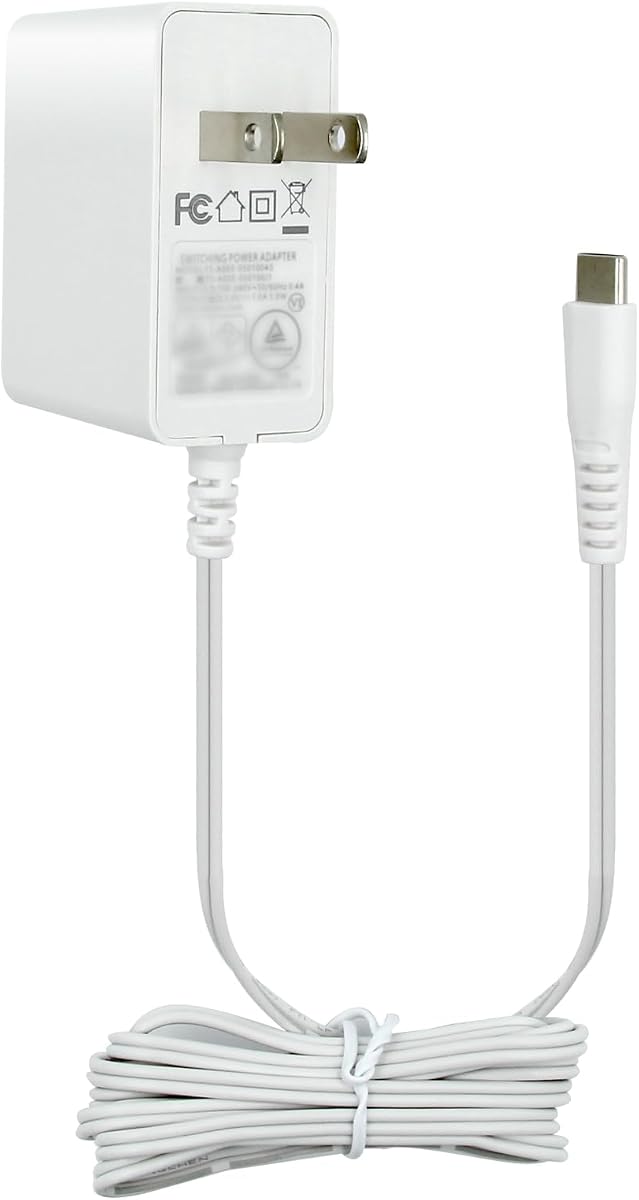
This 5V 1A Type-C adapter is a clean option for users who want a dedicated USB-C supply without a box of interchangeable tips. It has a 4.4 rating, a compact wall-plug body, and a five-foot attached cable. Its output supports 5V devices drawing up to one amp, including selected baby monitors, routers, speakers, Kindles, and small accessories.
We may earn a commission when you buy through this link, at no additional cost to you.
The wall unit accepts 100V-240V AC input and provides 5V DC output with a 5W maximum. The fixed connector is USB Type-C, so there is no guessing between barrel sizes once the target port has been confirmed. The stated intelligent current identification supports 0.5A, 0.8A, and 1A devices, making it appropriate for low-power equipment that accepts standard 5V Type-C connections.
The product is restricted to Type-C and cannot serve devices with Mini-USB, Micro-USB, or round barrel ports. The one-amp limit also rules out higher-current Type-C equipment. Although a Type-C connector can fit physically, compatibility still depends on the device accepting a 5V supply and the connector being wired in the expected orientation. The adapter should be treated as a 5V power source, not a general fast charger for every USB-C product.
It is best for a small, clearly defined group of Type-C devices that need a replacement low-power adapter. The stated ETL and RoHS certifications, along with overcurrent, overvoltage, and overheat protection, make it appealing for regular indoor use. Confirm the device’s input specification before ordering and avoid using it where more than 5W is required.
The attached Type-C cable removes the need to sort and attach interchangeable tips. It is a straightforward replacement for compatible low-power USB-C devices.
Stated ETL and RoHS certifications add useful context, while the built-in protections cover overcurrent, overvoltage, and overheating. Device compatibility still requires a 5V input and no more than one amp.
We may earn a commission when you buy through this link, at no additional cost to you.
This dual-port 5V 1.5A adapter has the highest customer rating in the roundup at 4.7. It combines a fixed USB Type-C connection with a separate Micro-USB cable, giving it more everyday flexibility than a one-amp dedicated Type-C adapter while remaining smaller and simpler than a multi-tip barrel supply.
We may earn a commission when you buy through this link, at no additional cost to you.
Maximum output is 5V at 1.5A, or 7.5W. Intelligent current identification is stated for 0.5A, 1A, 1.2A, and 1.5A loads. The package includes one AC/DC adapter with an attached Type-C cable and one Type-C-to-Micro-USB connector. That makes it relevant to 5V Kindles, selected smartphones, baby monitors, Android tablets, power banks, MP3 players, controllers, mice, and earbuds.
The absence of barrel support is the main restriction. It cannot power devices that require Mini-USB or a round DC connector. Users should also consider how much power the connected equipment actually consumes and whether the adapter’s 1.5A ceiling is adequate. This is a 5V supply, not a high-power USB-C fast-charging brick for laptops or demanding tablets.
Stated CE, ETL, and RoHS certifications, along with overvoltage, overcurrent, short-circuit, and overcharge protection, make this a well-rounded option. The five-foot lead aids placement, and the ABS housing is described as flame-retardant. It is an excellent pick for a mixed collection of modern Type-C and legacy Micro-USB accessories, especially where the devices stay below the stated current limit.
Supporting both Type-C and Micro-USB reduces the need for separate wall supplies for many modern and older accessories. The included adapter cable makes the secondary connection straightforward.
The 1.5A maximum and 7.5W output suit many small electronics, but power-hungry USB-C devices remain outside its scope. Check device labels before connecting them.
We may earn a commission when you buy through this link, at no additional cost to you.
This 5V 1.5A adapter provides Type-C and Micro-USB connections in a simple two-cable package. Its 4.4 rating and 7.5W output position it as a practical low-power supply for mobile accessories, compact electronics, and older or newer devices that use those two connector formats.
We may earn a commission when you buy through this link, at no additional cost to you.
The adapter accepts 100V-240V AC and provides 5V DC at up to 1.5A. Its stated intelligent identification covers a wide range of current demands from 100mA to 1500mA. A five-foot attached Type-C cable and a separate Micro-USB cable provide enough reach for home, office, or travel use, while the complete package avoids the need for another cable immediately after purchase.
Compatibility claims cover numerous 5V smartphones, tablets, game consoles, power banks, MP3 devices, and Kindles. These broad claims still need to be narrowed by voltage and current. The fixed 5V output is not suitable for equipment expecting 9V, 12V, or another voltage, and the 1.5A limit may be insufficient for demanding devices. Barrel-powered electronics are not supported because the package contains only Type-C and Micro-USB connections.
Shortage, overload, and overvoltage protections provide basic safeguards for compatible equipment. This model is best for users replacing a 5V Type-C or Micro-USB supply, particularly when both connector types are needed around the home. Confirm that the target device requests 5V and no more than 1.5A, and do not use it as a substitute for a device-specific fast charger.
The included Type-C and Micro-USB cables cover two widely encountered formats. This is especially handy for collections containing both newer and older portable accessories.
The fixed 5V output is straightforward and predictable. It suits compact devices but not laptops, high-voltage electronics, or products designed for a higher-current USB-C profile.
We may earn a commission when you buy through this link, at no additional cost to you.
This 5V 3A adapter has the highest output capacity in the guide. It provides up to 3A and 15W, making it the most accommodating option for compatible 5V devices that draw more current than 1A or 2A models can supply. Its 4.2 rating is tied for the lowest in the list, but the specification breadth and connector set distinguish it from smaller adapters.
We may earn a commission when you buy through this link, at no additional cost to you.
The mains input accepts 100V-240V at 50/60Hz, and the output is 5V DC up to 3000mA. Its main power cord measures 1.8 meters, or approximately 5.9 feet, giving users more reach than most alternatives. The base connector is stated as 5.5×2.5mm and compatible with 5.5×2.1mm, while the eight supplied tips cover 4.0×1.7mm, 3.5×1.35mm, 3.0×1.1mm, 2.5×0.7mm, Micro-USB, Mini-USB, Type-C, and an LED terminal connection.
The listed application range includes compatible massage guns, selected record-player replacements, smartphones, Kindle Fire tablets, Bluetooth speakers, game-console accessories, MP3 devices, and power banks. Those examples should still be checked against the original equipment’s power requirements. The adapter is strictly 5V, so it cannot replace a 9V or 12V supply, and high-current devices that exceed 3A remain unsuitable.
This is the most flexible option for a mixed setup containing several current levels, provided the device’s voltage, polarity, and connector are compatible. It is also useful when purchasing one higher-output supply to cover equipment that might otherwise need separate 1A, 1.5A, or 2A adapters. For dependable use, follow the device’s labeling and the included compatibility guidance rather than assuming every 5V accessory can safely draw the full 3A.
A 3A maximum allows the adapter to serve compatible 0.5A, 1A, 1.5A, 2A, 2.5A, and 3A devices. A device still draws only the current it needs.
The set includes common barrel connectors, USB formats, an LED terminal, and tips described for selected 5V accessories. Specialized tip descriptions do not guarantee universal device compatibility.
We may earn a commission when you buy through this link, at no additional cost to you.
The safest choice is the charger that matches a device’s required voltage, current, connector dimensions, and polarity. Output capacity, included tips, cable design, and protection features should be considered only after those electrical requirements are confirmed.
Every device in this category should require a steady 5V DC input. Some products use 5V while others need 6V, 9V, 12V, or another level, and a 5V supply is not a safe substitute for those alternatives. Read the label on the original adapter, the device manual, or the marking near the power socket. Also distinguish a DC input from an AC input: a cord that physically fits is not necessarily electrically compatible. Some wall adapters and USB cables carry data as well as power, while others are power-only, and some equipment expects a regulated barrel connection rather than a USB protocol.
In short, verify 5V DC before considering connector size, current, or any included accessories.
The charger’s maximum current should meet or exceed the device’s required current. A 1A adapter may work for a 500mA device, while a 1.5A adapter is generally more flexible for a device that lists 1.2A. Do not treat the largest current printed on a charger as a requirement for the device; a higher-capable supply can provide the current the device actually consumes. The output must also remain stable. Chargers advertised for 2A or 3A are useful when one supply must cover several devices, but they are not automatically better for every product.
In short, match the amperage to the device, not the marketing claim, and use the same voltage.
Barrel connectors must match both the inner and outer diameters, not merely the visible opening. The supplied listings include common sizes such as 5.5×2.1mm, 5.5×2.5mm, 4.0×1.7mm, 3.5×1.35mm, 3.0×1.1mm, and 2.5×0.7mm. A plug that enters partially can still be the wrong size. Recessed sockets also need enough clearance for the connector body. Measure the opening with a caliper when possible and compare both dimensions with the charger’s tip specification. USB-C, Micro-USB, and Mini-USB are different formats, and a round-tip list should not be interpreted as including every USB connector.
In short, measure the socket, check its depth, and make sure the exact connector format is included.
Polarity describes the arrangement of positive and negative conductors. The wall adapters in this guide generally state center-positive, meaning the center contact is positive and the outer barrel is negative. A device designed for center-negative polarity can be damaged by a reversed supply. USB-based outputs have their own wiring arrangement, and the physical shape of a USB-C plug does not reveal whether a cable carries power as expected. The original adapter is the best reference because symbols on it often show the polarity diagram. If the markings are missing or unreadable, do not guess.
In short, use the original adapter’s polarity symbol as the model. Never connect a supply when positive and negative cannot be confirmed.
A broad tip set can be valuable when several devices use different connectors. Wall adapters generally include a fixed barrel base plus interchangeable tips, while dedicated Type-C products are simpler and more compact. USB-to-DC cables provide flexibility because they can draw from a wall charger, power bank, computer, or other suitable USB source, but the chosen source must deliver enough current. If the goal is to run one product only, a dedicated adapter with the correct connector may be less confusing than a large tip kit. If maintaining several devices, count the connector formats and sizes that are actually needed.
In short, choose broad coverage for mixed equipment and a fixed connector for a single known device.
Cable length determines whether a device can sit near its wall socket or must remain close to the outlet. Most products here provide leads between five and six feet, while the 3A model reaches approximately 5.9 feet. A longer cable adds placement flexibility but can occupy more desk space and is less convenient to pack. USB-to-DC cables also require a separate power source, which can be useful for travel but inconvenient when a wall plug is all that is available. The wall-adapter design is more self-contained and usually simpler for permanent installations.
In short, balance reach with portability, and account for whether a separate USB power source is required.
Look for stated safeguards against overvoltage, overcurrent, short circuits, and overheating. Several products also mention CE, ETL, FCC, or RoHS certifications, while the Type-C 1A and dual-port 1.5A models specifically identify ETL and RoHS. These details provide useful context, but they do not remove the need to match voltage, current, connector, and polarity. Protection circuits help manage certain faults; they do not make an incompatible charger safe. For continuously powered equipment, select a model with a stable regulated output and a wattage comfortably above the expected draw.
In short, favor credible protection claims and certifications, but treat correct electrical matching as the first requirement.
A universal replacement lead and a dedicated wall adapter serve different needs. USB-to-DC cables are convenient for repair kits and setups with access to USB power, while wall adapters are easier for permanent installations. Dedicated Type-C or Micro-USB products are convenient for portable accessories, whereas multi-tip models make sense for routers, cameras, LED equipment, webcams, and other mixed peripherals. Avoid using any of these chargers for laptops, record players requiring other voltages, or devices that need more current than the output provides. The lowest current a device draws may also be less important than the voltage and connector, but it still belongs in the compatibility check.
In short, choose the format that matches how the device will be powered and where it will be used.
Begin by identifying the device’s input label, original connector dimensions, current requirement, and polarity. Disconnect the old power supply before changing tips. Select the matching attachment, connect it firmly to the device, and inspect the fit without forcing it. A connector that feels loose, enters only partway, or requires unusual pressure should be removed and checked again.
Plug the charger into a suitable wall outlet, then turn on or test the device. If the device does not power normally, disconnect the supply immediately and recheck the voltage, amperage, connector, and polarity. Do not repeatedly reconnect a setup that causes unusual behavior, heat, odor, or visible damage. For USB-powered cables, use a reputable source capable of supplying the required current, and avoid unpowered USB ports when the target device expects more output.
Keep the adapter uncovered, away from moisture, heat, and flammable materials, and avoid placing strain on the cable or connector. Unplug it when it will not be used for an extended period. If a tip becomes loose, the cable is damaged, or the housing shows heat discoloration, stop using it and replace the supply. Routine care is simple: keep connections clean, avoid sharp bends at the plug, and use the charger only within its stated input and output limits.
No. A device must accept 5V DC, require no more current than the charger can deliver, and use a compatible connector. USB-C in particular can support several voltage and current profiles, so a physically fitting plug does not guarantee full compatibility with fast charging. Check the device and original adapter labels before substituting a 5V supply.
A higher maximum current can provide useful flexibility, especially when one charger will serve several devices. The connected device will still draw according to its own requirements, provided the supply maintains a stable 5V output. However, a higher current rating does not make a 5V charger suitable for equipment that requires 9V, 12V, another voltage, or a different polarity.
A barrel tip is a round connector identified by its inner and outer diameters, such as 5.5×2.1mm. USB-C is a smaller symmetrical connector used by many modern devices. They are not interchangeable, and a product listing a range of barrel tips may not include a USB-C attachment unless the specifications expressly state that it does.
The symbol shows which conductor carries positive voltage. Connecting a center-positive supply to a center-negative device can reverse polarity and may damage the electronics. The original adapter usually has the clearest marking. If the symbol cannot be identified, use a properly rated replacement or seek device-specific guidance rather than relying on guesswork.
Some compatible cameras and accessories can use a 5V supply, but laptops generally require much more power and higher voltages. Record-player compatibility depends entirely on the original adapter, because many use 9V or 12V and some are center-negative. The listed devices are examples rather than guarantees, so the original output label, connector, and polarity always take priority.
A multi-tip wall adapter can replace several 1A and 2A cords when the devices share the same 5V requirement and use the supplied connector sizes. USB-to-DC cables offer even more source flexibility but require a separate USB charger or other suitable power supply. For simplicity, users with only one known device may prefer a dedicated fixed-connector adapter.
Some warmth can occur in a switching power supply, particularly under sustained load, but excessive heat, odor, discoloration, buzzing, or a damaged plug is not normal. Disconnect it, stop using the connected device, and inspect the voltage, current, connector, and polarity. Replace the charger if the problem persists or any physical damage is visible.
No tip is universally safe because a matching diameter does not confirm voltage, current, or polarity. Use the included tip only after checking all three electrical and physical requirements. Some product descriptions list specialized tips for particular accessories, but those examples do not guarantee compatibility with every model bearing the same name or product category.
The 5V 2A adapter with 11 tips is the most balanced overall selection because it combines a useful ten-watt ceiling, broad connector coverage, protection features, and a six-foot cable. The 5V 1A adapter with eight tips is a lower-capacity alternative for small devices, while the 5V 3A adapter with eight tips offers the most current headroom for compatible mixed equipment.
Prioritize the device’s original label over any broad compatibility claim. Confirm 5V DC, required current, connector dimensions, and polarity before buying. Then consider whether a wall adapter or USB-powered cable better suits the setup, followed by cable length, tip coverage, certifications, and built-in protections. For Type-C and Micro-USB accessories, the dedicated dual-port adapters offer a simpler alternative to a large barrel-tip kit.
Ratings, connector bundles, cable versions, and market conditions can change, so confirm the latest product details before ordering. Current prices and promotions also vary, and the best value is the charger that meets the device’s exact requirements without paying for output or accessories that will never be used.