
Odatay 1000X Digital Kids Microscope Kit
4.6Editor score
100X–1000X magnification range
Twelve prepared plastic slides
Rechargeable portable design
A digital microscope for kids turns ordinary leaves, coins, fabric, insects, and household objects into large, vivid images that children can explore on a screen. The best models combine useful magnification, bright adjustable lighting, simple controls, dependable battery life, and an easy way to save discoveries for later learning.
This guide compares ten kid-oriented digital microscopes using their stated specifications, included accessories, portability, recording functions, safety features, and customer ratings. It covers models with screens ranging from 2.0 to 4.0 inches, magnification levels reaching 1000X or 1600X, and different approaches to storage, prepared slides, and computer connectivity.
Each pick highlights the experience a particular microscope is best suited to deliver, from compact field exploration to larger-screen viewing and classroom-ready kits. Ratings and product details reflect the supplied information, while features may evolve between revisions. Prices change frequently, so compare the current listing, included accessories, and warranty terms before purchasing.
4.6Editor score

4.5Editor score
4.6Editor score
As an Amazon Associate we earn from qualifying purchases.
The table below compares all ten microscopes by magnification, display size, core imaging features, and portability, making it easier to identify the model that matches a child's interests, storage needs, and favorite exploration setting.



The 1000X Handheld Digital Microscope for Kids earns a 4.5 customer rating and stands out as the most balanced option in this guide. It combines 1000X optical and digital magnification, a 2MP camera, a 2.0-inch IPS screen, manual focus, and eight adjustable LEDs in a body designed for children over age three. It offers enough capability for serious observation without presenting the learning process as complicated.
We may earn a commission when you buy through this link, at no additional cost to you.
Its strongest benefits are the large focus dials, shock-absorbent rubber casing, anti-shake design, and three LED brightness modes. The 600mAh battery supports about two hours of continuous exploration and can be charged through USB. Internal storage can hold more than 200 high-resolution photos or AVI videos, while the included lanyard makes the microscope convenient to carry outdoors or to a museum.
The 2.0-inch screen is smaller than the displays offered by several competing models, and exporting the full internal library may be less convenient than using an included memory card. Some children may also need initial help mastering focus and distance. These are reasonable compromises for a compact, approachable microscope with a broad feature set and no complicated accessory requirements.
This is the strongest general recommendation for a child who wants to inspect natural objects, record discoveries, and learn basic microscope technique. It works particularly well for backyard observations, household investigations, and beginner STEM projects. Parents prioritizing easy handling, clear lighting, and useful recording functions should start with this model.
Oversized focus dials, an anti-glare diffuser, and an anti-shake housing reduce the physical challenges that can make digital microscopes frustrating. Children can begin with familiar objects such as fabric, coins, and leaves, gradually building the steady hand and close-distance skills needed for more demanding specimens.
Photo and video capture turn brief observations into lasting records that can support a nature journal, classroom report, or science-fair project. USB transfer to Windows and Mac systems makes captured material useful beyond the handheld screen.
We may earn a commission when you buy through this link, at no additional cost to you.
The Kids Digital Microscope STEM Toy has a 4.4 rating and is the most self-contained kit among the ten products. It combines a handheld microscope, a 32GB memory card, five real glass prepared slides, a custom EVA case, charging cable, neck strap, and manual. A child can begin examining supplied specimens while also collecting leaves, insects, coins, fabrics, rocks, and other everyday materials.
We may earn a commission when you buy through this link, at no additional cost to you.
The package is particularly useful because it removes the need to buy storage or a separate case. Its widened 3mm slide slot is designed to accept the included glass specimens more smoothly, while five adjustable magnification levels extend from 200X to 1000X. The focus wheel, adjustable distance, and LED lighting give beginners several ways to resolve an unclear image without requiring advanced equipment.
Portability is another strength. At 0.34 pound, the unit is light enough for children to carry during backyard exploration, camping, field observation, road trips, or classroom projects. The rechargeable battery provides about 2.5 hours of continuous use, and the included Type-C cable supports convenient recharging. The main limitation is that the supplied listing does not specify the display dimensions, so buyers who prioritize a very large screen may need to consult the current product details.
Choose this set for a child who benefits from having a complete, organized science kit ready to use. It is especially attractive for families, homeschoolers, and gift buyers who want prepared glass slides, substantial storage, and a protective case in one package rather than assembling the accessories separately.
The five real glass slides provide a controlled way to introduce young learners to biological specimens. Children can compare what they see on a prepared slide with textures found outdoors, building observation skills without depending entirely on finding suitable material.
The 32GB card and fitted EVA case make this one of the most convenient kits for travel and ongoing use. Images can be kept in a predictable location, while every main component has a designated place inside the protective case.
We may earn a commission when you buy through this link, at no additional cost to you.
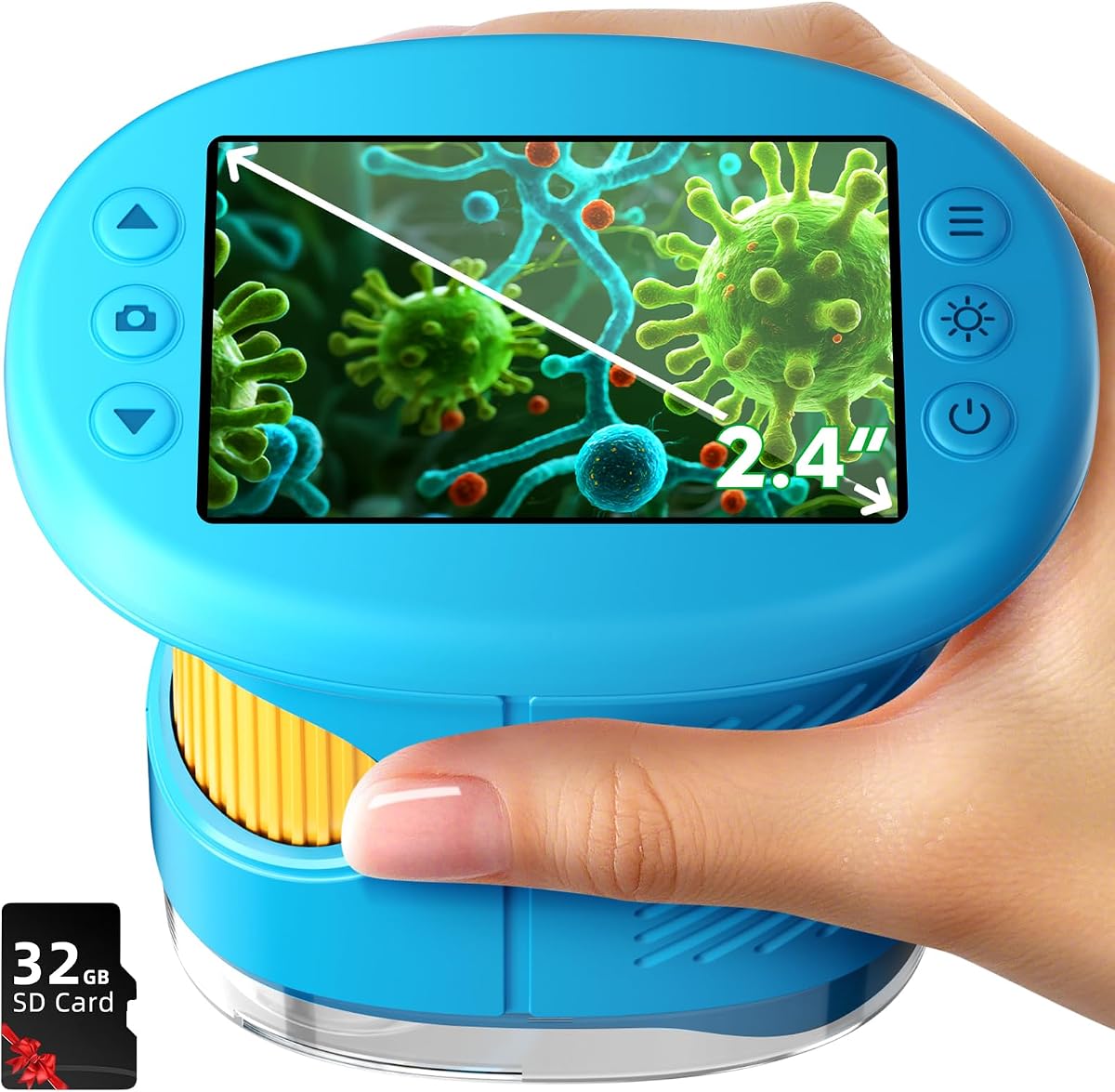
The Odatay 4K 1000X Digital Microscope carries a 4.5 rating and offers an unusually complete combination of imaging, viewing, storage, and accessory support. Its 4K HD camera appears on a 2.4-inch screen, while four magnification levels cover 200X to 1000X. The lowest setting supports longer-distance viewing, allowing children to scan an object before moving closer.
We may earn a commission when you buy through this link, at no additional cost to you.
This model includes a 32GB TF card, twelve prepared slides, a data cable, lanyard, slide viewing cover, and protective silicone screen cover. It supports photo capture, video recording, browsing, and deletion, while three brightness levels and eight LED lights help illuminate specimens in different environments. A tripod hole adds another way to steady the microscope for close work.
The device weighs 0.5 pound and includes a neck strap, making it manageable for children to carry to a classroom, garden, or outdoor trip. PC connectivity allows file transfer and extended use, which is helpful for a child creating a digital collection. At the same time, 1000X magnification can produce diminishing returns on inexpensive consumer microscopes, and children still need to adjust focus, lighting, and distance to obtain clear images.
This is a good all-around pick for a child who wants more resolution and a broader accessory set than the simplest models. Its long-distance setting, 32GB card, tripod support, and twelve slides make it particularly well suited to mixed indoor and outdoor exploration, from a first look at insects to organized specimen projects.
The four magnification levels help children change their relationship to a specimen rather than committing to one fixed zoom. They can first locate a feature, then move closer and refine the image using focus and lighting controls.
The included card provides substantial recording capacity, while the screen cover, lanyard, data cable, slides, and viewing cover create a portable setup. This reduces the chance that an otherwise capable microscope sits unused because essential accessories are missing.
We may earn a commission when you buy through this link, at no additional cost to you.
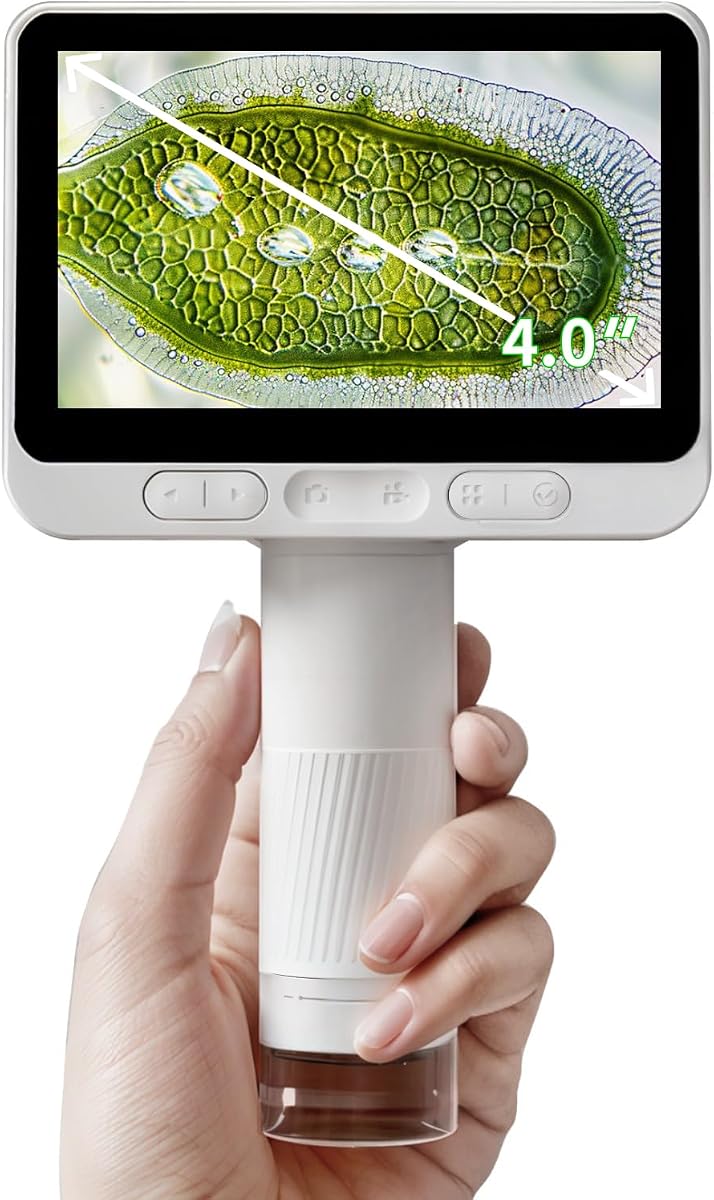
The BEAVERLAB Finder 4.0-Inch Microscope has a 4.6 rating and offers the most spacious viewing experience in this lineup. Its 4.0-inch IPS display is larger than the screens on the other picks, making it easier for children to inspect fine details, show findings to family members, or examine a specimen together without crowding around a compact screen.
We may earn a commission when you buy through this link, at no additional cost to you.
Magnification extends from 100X to 1600X, and a 2MP CMOS chip captures full HD video and photos at 1920 by 1080 resolution. The built-in hotspot is a distinctive feature: it allows observations to be uploaded to a mobile phone for sharing with relatives or classmates. Eight adjustable lights help maintain visibility across different subjects and environmental conditions.
Its premium capabilities come with a steeper learning curve than the simpler 2.0-inch models. Children will need practice controlling focus and maintaining an appropriate distance, particularly at the upper end of the magnification range. Setting up and managing hotspot sharing may also require adult guidance, and the listing does not describe a dedicated carrying case or large removable storage option.
This microscope is best for a child who regularly studies specimens, makes school presentations, or likes comparing and sharing discoveries. The large display, full HD capture, and broad magnification range justify considering it over more compact models when screen comfort and advanced viewing are priorities.
The 4.0-inch IPS display gives children more room to distinguish edges, fibers, veins, and insect features. That additional visible area can make the process of comparing a live image with a prepared slide or a photograph feel more intuitive and less frustrating.
The built-in hotspot provides a direct route from the microscope to a phone, reducing the need for cables when a child wants to show family or classmates what was found. It is a useful feature for budding researchers who think in terms of projects and presentations.
We may earn a commission when you buy through this link, at no additional cost to you.
The Cat-Shaped 1000X Digital Microscope has a 4.5 rating and emphasizes ease of use for children ages three to 12. Its playful cat-shaped housing distinguishes it from conventional science equipment, while the oversized textured focus wheel helps small hands make precise adjustments. A 2.4-inch IPS HD screen provides a larger, eye-friendly view than many compact alternatives.
We may earn a commission when you buy through this link, at no additional cost to you.
Three viewing modes broaden its usefulness. Computer observation mode lets the microscope serve as a live camera on a larger computer display, memory card recording mode supports photo and video capture, and device observation mode permits standalone use while charging. A 600mAh rechargeable battery supports up to three hours of exploration and can be charged by USB or a power bank.
The main storage caveat is important. The device holds roughly 200 photos internally, but those files cannot be transferred directly to another device. A compatible memory card is required for export, and that card is not included. The listing also recommends checking the manual for compatible software before computer use, which means the computer workflow is less seamless than a model with straightforward built-in transfer.
This microscope suits a younger child who may respond enthusiastically to a friendly design and simple physical controls. It is particularly useful for home exploration, computer-assisted demonstrations, and children building early confidence with a microscope. Buyers who plan to save and export large collections should purchase an appropriate memory card in advance.
The cat-shaped enclosure and large focus control give the product a playful identity without sacrificing the core functions of a digital microscope. These visible design choices may make the device more approachable for children who are not yet interested in traditional science equipment.
Standalone observation, computer viewing, and memory card recording each support a different kind of exploration. A child can begin with immediate on-device results and graduate to computer demonstrations or organized file storage as their projects become more involved.
We may earn a commission when you buy through this link, at no additional cost to you.
The Odatay 1000X Digital Kids Microscope Kit has a 4.6 rating and delivers a well-rounded beginner set. It provides 100X to 1000X magnification, a 2MP 1080P camera, a 2.0-inch IPS screen, eight LED fill lights, photo and video capture, and twelve prepared slides. That combination makes it useful for both immediate experiments and curated specimen viewing.
We may earn a commission when you buy through this link, at no additional cost to you.
The slides cover plants, vegetables, insects, and animals, giving a child a varied introduction to microscope observation. Internal storage can hold up to 500 photos, and a Micro SD card can expand that capacity, although one is not included. The microscope can also connect to a computer for real-time viewing on a larger screen, which is valuable for sharing a discovery during a lesson.
Its compact body is designed for small hands, with top-positioned buttons that allow viewing and operation at the same time. A lanyard supports neck or backpack carrying, and the rechargeable battery makes it suitable for outdoor exploration. The trade-offs are a 2.0-inch display and the need to supply a memory card if a child expects extensive video storage or file transfers.
This is the best budget-oriented starter choice in the guide because it includes twelve slides, an expandable storage path, PC connectivity, and a broad magnification range. It suits children ages five to seven and remains engaging for older beginners, particularly those interested in insects, plants, and comparing prepared specimens.
Twelve prepared slides give children more material to examine than a typical minimal microscope package. Organisms and structures from four categories make it easier to build curiosity through comparison rather than limiting every session to the same sample.
The combination of internal photo storage, Micro SD expansion, and computer connectivity allows a child to move from quick observations to saved projects. Families can also use the larger computer display to discuss what the microscope is showing in real time.
We may earn a commission when you buy through this link, at no additional cost to you.
The 1600X Digital Microscope with 4.0-Inch Screen has a 4.3 rating and is notable for its detachable three-mode design. It can function as a desktop microscope, a handheld viewer, or a compact portable microscope. This makes it adaptable to table-based projects, close handheld inspection, and outdoor collecting without requiring several separate devices.
We may earn a commission when you buy through this link, at no additional cost to you.
The 4.0-inch IPS screen and 100X to 1600X magnification range provide a large, detailed view. The product listing describes a built-in 48MP 1080P camera, although those two figures represent different kinds of resolution and may create confusion. Six LED fill lights offer three brightness levels, while the rechargeable battery is stated to provide up to four hours of continuous use.
Computer connectivity expands the viewing area for study, presentation, and shared exploration. The detachable construction is more versatile than that of a fixed handheld scope, but it also introduces more ways for the components to be handled or separated. The 4.3 rating is the lowest among these ten products, and the mixed camera-resolution wording means buyers should check the current listing details before making assumptions.
This model is a good fit for a child who uses a microscope both indoors and outdoors or wants to alternate between a stable desktop setup and handheld exploration. The large display and long battery life are especially appealing for sustained sessions, while the three-mode design provides useful flexibility as a child's interests develop.
Desktop mode offers stability for prepared slides and sustained investigations, while handheld mode gives children a closer connection to natural specimens. Portable mode provides a compact option for collecting and examining objects away from a table.
The stated four-hour battery supports extended exploration, and six adjustable LEDs help maintain visibility across different subjects. Together, these features can support longer science sessions without making frequent charging or lighting adjustments the main concern.
We may earn a commission when you buy through this link, at no additional cost to you.
The 4K 1000X Handheld Digital Microscope has a 4.2 rating and offers a simple set of functions for children who want to examine and record familiar objects. Four magnification levels span 200X to 1000X, and a 4K HD camera feeds a 2.0-inch IPS display. Photo capture, video recording, playback, and file management are all supported.
We may earn a commission when you buy through this link, at no additional cost to you.
Eight built-in LEDs and three brightness levels help children see detail in shaded or low-light settings. At 0.5 pound, the device is light enough to fit in a pocket or bag, and the included neck strap supports hands-free carrying. PC connectivity provides a way to transfer files or use the microscope for extended viewing, which broadens its usefulness for classroom work.
Compared with several highly bundled alternatives, the feature list is relatively focused. The supplied information does not mention prepared slides, a protective case, a tripod, or a large removable memory card. The 2.0-inch display may also become less comfortable during long projects, particularly once a child starts comparing many captured images or sharing the screen with family.
This is a straightforward choice for a child who wants to explore leaves, coins, fabric, and other everyday subjects without a large accessory collection. It is particularly useful for portable recording and household discovery. Families should review the current storage format and included accessories to confirm that the package fits their preferred workflow.
The 200X to 1000X range gives children room to move from general observation to closer inspection. Adjustable illumination then helps maintain visibility as the viewing distance and subject characteristics change.
The low weight, pocket-friendly body, neck strap, and PC connection support exploration at home, outdoors, or in class. Children can capture a discovery and move it to a larger screen for closer review or presentation.
We may earn a commission when you buy through this link, at no additional cost to you.
The 1000X Digital Handheld Microscope has a 4.4 rating and is designed with outdoor discovery in mind. It offers 100X to 1000X magnification, a 2MP camera, a 2-inch color display, eight adjustable LEDs, and four brightness levels. An anti-glare diffuser helps control harsh reflections while the enhanced stabilization design supports steadier images in active outdoor conditions.
We may earn a commission when you buy through this link, at no additional cost to you.
The oversized textured focus wheel is designed for small fingers and supports quick sharpening. Built-in storage can hold more than 200 photos and AVI videos without requiring an SD card. The included USB-C cable enables file transfer to Windows and Mac computers, making the device useful for documenting specimens, creating a nature journal, or assembling a digital school project.
Safety and portability are clearly emphasized. The body uses BPA-free ABS, carries CPC, CE, and FCC certifications, weighs 200 grams, and includes a detachable neck strap. Its 600mAh rechargeable battery supports up to three hours of continuous use. The main limitations are the compact display and the absence of a stated removable-card option, so long-term storage may eventually require selective file management.
Choose this microscope for a child who frequently explores gardens, trails, camping sites, or museum visits. Its stability, lighting, portability, and straightforward file transfer make it a dependable tool for children who want to record natural specimens without assembling a larger classroom system.
The stabilization design and textured focus wheel help a child maintain a usable view when specimens or hands are moving. These practical details are particularly valuable during energetic backyard expeditions rather than tabletop-only use.
Four brightness levels and an anti-glare diffuser make it possible to examine objects in shaded locations without relying solely on strong external light. Children can adjust illumination as they compare different materials and surfaces.
We may earn a commission when you buy through this link, at no additional cost to you.
The WINWEND Pocket Microscope has a 4.6 rating and delivers a compact, uncomplicated package for young scientists. It provides 100X to 1000X magnification, a 2-inch digital display, fine and coarse focusing, eight LED lights, and six brightness levels. The combination of focus styles and lighting options gives children several ways to bring unclear specimens into view.
We may earn a commission when you buy through this link, at no additional cost to you.
Built-in storage holds as many as 400 photos, while a personal storage card is needed for video. USB connectivity allows the microscope to be connected to a PC for a broader field of view and shared exploration. It can be used with plants, insects, coins, jewelry, stamps, and many other small objects, giving children a wide range of subjects without requiring prepared slides.
The body weighs less than 300 grams, making it one of the lighter options here, and the included wrist band helps prevent accidental drops while carrying it. The 2-inch screen is modest, and the absence of listed prepared slides makes it less suitable as a ready-made biology kit. Adult assistance may also be useful when children transfer files or configure the storage card for video.
This microscope is a good pick for a child who wants a lightweight device for coins, stamps, fabric, jewelry, and other accessible household specimens. It works especially well for families seeking a simple pocket microscope with generous internal photo storage, multiple focus settings, and straightforward computer viewing.
Fine and coarse focusing give children a way to move between a broad initial view and smaller adjustments. This can make the learning process feel more manageable when they are just learning how distance and focus affect an image.
Internal capacity for 400 photos means a child can document many discoveries without immediately managing removable storage. The included wrist band adds a practical layer of protection for a device that is likely to travel through pockets and backpacks.
We may earn a commission when you buy through this link, at no additional cost to you.
The right digital microscope balances magnification with ease of use, image quality, lighting, portability, and storage. Age, preferred subjects, and whether the child will work independently or with an adult also matter.
Magnification ratings describe how much a subject can be enlarged, but a high number does not automatically produce a sharp or informative image. Most kid-oriented models in this guide reach 1000X, while two reach 1600X. Lower settings are often more useful for locating a subject, and greater magnification can make focus and lighting more difficult. A child should be able to recognize the difference between a clear image and one that is simply enlarged.
Prioritize a broad usable range rather than focusing only on the maximum. Models offering several magnification levels make it easier to move from an initial overview to fine detail. Look for manual focus controls that are large and textured, since they are central to achieving a clear result with inexpensive digital equipment.
Screen size affects how comfortably a child can examine subtle patterns and share discoveries with others. The models here range from 2.0 inches to 4.0 inches. Compact screens improve portability, while larger IPS displays provide a more comfortable view of fine structures and are helpful for presentations. Color, brightness, and the ability to display a live image remain important regardless of size.
Choose a larger screen for frequent study, shared observation, or classroom presentations. A smaller screen may be sufficient for a child who mainly takes short-lived outdoor observations and values a lightweight device. Check whether the screen can be viewed comfortably at close range and whether controls are positioned so the child can adjust settings without breaking focus.
Built-in LED illumination is essential for viewing small objects indoors and in shaded outdoor locations. The strongest options in this guide provide eight LEDs and multiple brightness settings, often with a diffuser to reduce glare. Adjustable lighting helps a child see transparent or textured subjects, but too much brightness can also wash out fine detail.
Look for several brightness levels rather than a single fixed light. Diffusers and light controls positioned close to the lens can improve image consistency. If the child will frequently inspect insects, leaves, or fabric, lighting quality may contribute more to a satisfying experience than the difference between two high magnification settings.
Storage requirements depend on whether a child wants quick snapshots, long recordings, or organized project files. Some microscopes include a 32GB card, some use built-in memory, and others require a separately purchased memory card. Internal storage can be convenient for simple use, but removable media generally makes large collections easier to transfer and archive.
Check exactly what is included before purchasing a card or cable. Video consumes considerably more space than photographs, and some models only support video when a personal card is inserted. For school projects, favor a model with easy Windows or Mac transfer, or one that can broadcast a live view to a larger screen. A built-in hotspot can also make phone sharing more convenient.
A child who explores outside needs a microscope that is easy to carry, comfortable to hold, and dependable for the length of an outing. Most models weigh about 0.34 to 0.5 pound and include a neck strap, lanyard, or wrist band. The included case matters when accessories must stay organized. Battery runtimes range from about two to four hours in the supplied specifications.
Match the product to the setting rather than simply selecting the longest stated runtime. A compact scope with a protective case may work well for organized family trips, while a lighter pocket model may be more convenient for spontaneous walks. USB or USB-C charging adds flexibility, and a tripod connection can improve steadiness when a child examines a stationary specimen.
Prepared slides provide an immediate activity when live specimens are difficult to collect or when children need a controlled comparison. One model includes five real glass slides, while two others include twelve slides covering plants, vegetables, insects, animals, or broader specimen categories. These accessories can teach slide handling, labeling, and comparison before outdoor collecting begins.
Consider a model with prepared slides when the child is new to microscopes or enjoys organized activities. Real glass slides provide a different handling experience from plastic examples, although they require more careful supervision. For spontaneous exploration, a simple magnifier with no slides may be sufficient. A broad kit is useful only if the included materials match the child's interests.
Young users need controls they can reach and understand. Oversized focus wheels, top-positioned buttons, clear adjustment steps, and simple beginner workflows reduce frustration. Stabilization or anti-shake features also help children maintain a steady view. The housing should be smooth, appropriately sized for small hands, and free from rough edges that could make extended use uncomfortable.
Look for materials described as ABS, BPA-free, or food-grade silicone, along with applicable safety certifications. A 12-month warranty and responsive support can add reassurance for gift buyers. A playful design may be especially helpful for younger children, while older children may value PC connectivity, a larger display, or more advanced magnification.
A digital microscope is an educational tool that may be used repeatedly, so warranty coverage and support are worth considering alongside the initial feature set. Several products in this guide include a 12-month warranty, while accessory quality, replacement parts, software compatibility, and storage availability influence long-term usefulness. A model with all necessary cables and slides can offer better value than a cheaper unit that requires several additions.
Review the complete package rather than comparing headline magnification alone. Confirm the charging cable, storage medium, carry strap, slides, and transfer method. For a child who will use the microscope beyond the initial novelty period, reliable support and replaceable or widely supported storage are practical signs of a stronger long-term purchase.
Start with a simple object, such as a printed letter, leaf, coin, or fabric swatch. Place it on a clean, well-lit surface, power on the microscope, and choose the lowest magnification. Place the lens close without pressing it against the specimen, then adjust the focus wheel slowly until the image becomes sharp. Use the lighting controls whenever details appear dim, hazy, or washed out.
Move outward when beginning an outdoor investigation. Scan an insect, flower, or rock at a lower magnification to locate an interesting feature, then adjust the distance and focus for a closer view. Hold the microscope steadily, vary the lighting, and capture photos or video when the image looks clear. Keep specimens on a separate tray and avoid placing live insects directly against the lens.
After use, disconnect power, remove any memory card, and wipe the lens gently with a soft dry or lightly dampened cloth. Keep the device away from dust, moisture, extreme heat, and drops, and do not immerse it. Store accessories in the supplied case where one is provided, charge the battery periodically according to the manual, and back up important files before formatting a card.
For most children, a microscope with adjustable levels from roughly 100X to 1000X offers a useful balance of discovery and control. Lower power helps locate a subject, while higher power reveals finer textures. A 1600X maximum may be appealing for advanced projects, but focus and lighting become harder to manage. Clear results at moderate magnification are generally more educational than a blurred image at the highest setting.
It can reveal cellular-looking structures in suitable plant material, particularly thin specimens and prepared slides, but the result depends on sample preparation, lighting, focus, and image quality. It should not be treated as a substitute for a classroom laboratory microscope. Children can still gain valuable observation skills by comparing leaf veins, skin cells in onion samples, fibers, and other visible structures.
Many models in this guide support USB or USB-C computer connectivity for file transfer or real-time viewing. The exact process varies: some use standard file transfer, while others require compatible software or a memory card. Check the manual before connecting, especially when internal files cannot be exported directly. PC support can make a microscope useful for presentations, shared observation, and organizing larger photo collections.
It depends on the model and the type of content being saved. Several products include a 32GB card or provide internal photo storage, while others require a separately purchased SD or Micro SD card for video and file export. Confirm whether a card is included, what capacity the device supports, and whether a card is necessary for the features you want to use.
They are helpful but not essential. Prepared slides provide immediate, repeatable subjects and let children practice positioning and focusing before collecting their own specimens. Kits with five glass slides or twelve categorized slides may suit children who enjoy organized activities. A child primarily interested in outdoor exploration may be just as engaged by leaves, insects, coins, fabric, stamps, or other accessible objects.
Begin at the lowest magnification, place the subject on a stable contrasting surface, and adjust the lens distance before turning the focus control. Move the focus wheel slowly until details become distinct, then reduce lighting if the image appears overexposed. Stabilizing the microscope with both hands or a tripod can also reduce blur, especially at higher magnification.
The lightest models, including the 0.34-pound STEM kit and the WINWEND pocket microscope, are especially convenient for spontaneous outdoor observations. The 200-gram 1000X handheld model is also lightweight and includes a detachable neck strap. Consider battery life, wrist attachment, weather exposure, and a protective case in addition to weight when choosing for regular outings.
No. Higher magnification can make small details appear larger, but it also narrows the field of view and makes focus, lighting, and steady positioning more difficult. Children generally learn more when they can compare multiple levels, identify a feature at a lower setting, and then refine the view. A reliable 1000X model with good lighting can be more useful than a higher-power model that produces unstable images.
The 1000X Handheld Digital Microscope is the strongest overall choice because it combines 1000X magnification, a 2MP camera, adjustable LEDs, child-friendly controls, recording, and straightforward file transfer. The Odatay 1000X Kids Microscope Kit stands out as the best budget-oriented starter with twelve slides and expandable storage, while the BEAVERLAB Finder earns the premium recommendation for its 4.0-inch screen, 1600X range, and hotspot sharing.
Prioritize the experience your child will actually use. Consider screen size for presentations, prepared slides for structured lessons, storage capacity for ongoing projects, and portability for outdoor collecting. Easy controls and reliable lighting are often more valuable than a dramatic magnification headline, particularly for a younger child who is just learning how focus and viewing distance affect an image.
Product details, ratings, package contents, and prices can change, so review the current listing before ordering. Check that the charging cable, memory card, slides, case, and transfer features are included or compatible with your plans. With the right balance of usability, observation capability, and creative potential, a digital microscope can become a doorway to a lasting interest in science.