
ATSC Digital Converter Box HW250STB
3.8Editor score
Records over-the-air television
Supports external USB hard drives
Delivers 1080p HDMI output
This guide compares the best DVR recorders for TV, comparing tuners, recording capacity, connectivity, media support, and ease of use.
A DVR recorder can make television viewing more flexible by preserving broadcasts, supporting pause-and-replay functions, and storing programs for later. The right model depends on whether you receive over-the-air channels, cable TV, or another video source, as well as how many shows you want to record at once.
We compared all ten products by examining their recording functions, tuner counts, storage options, supported video sources, playback capabilities, network features, and important compatibility restrictions. The list includes network-connected over-the-air DVRs, standalone HDMI and analog capture recorders, a USB-recording converter box, and a traditional DVD/VHS recorder.
Each review explains the product's strongest use case, practical trade-offs, and ideal buyer. Ratings reflect the supplied customer feedback, while specifications and compatibility details come from the product information. Availability, configurations, and prices can change, so confirm the current listing and requirements before purchasing.
3.8Editor score
4.0Editor score

4.1Editor score
The table below compares all ten recorders by their primary recording method, tuner capacity, storage approach, and most important source or compatibility limitation. It is designed to help distinguish over-the-air DVRs from general-purpose video capture and legacy recording devices.


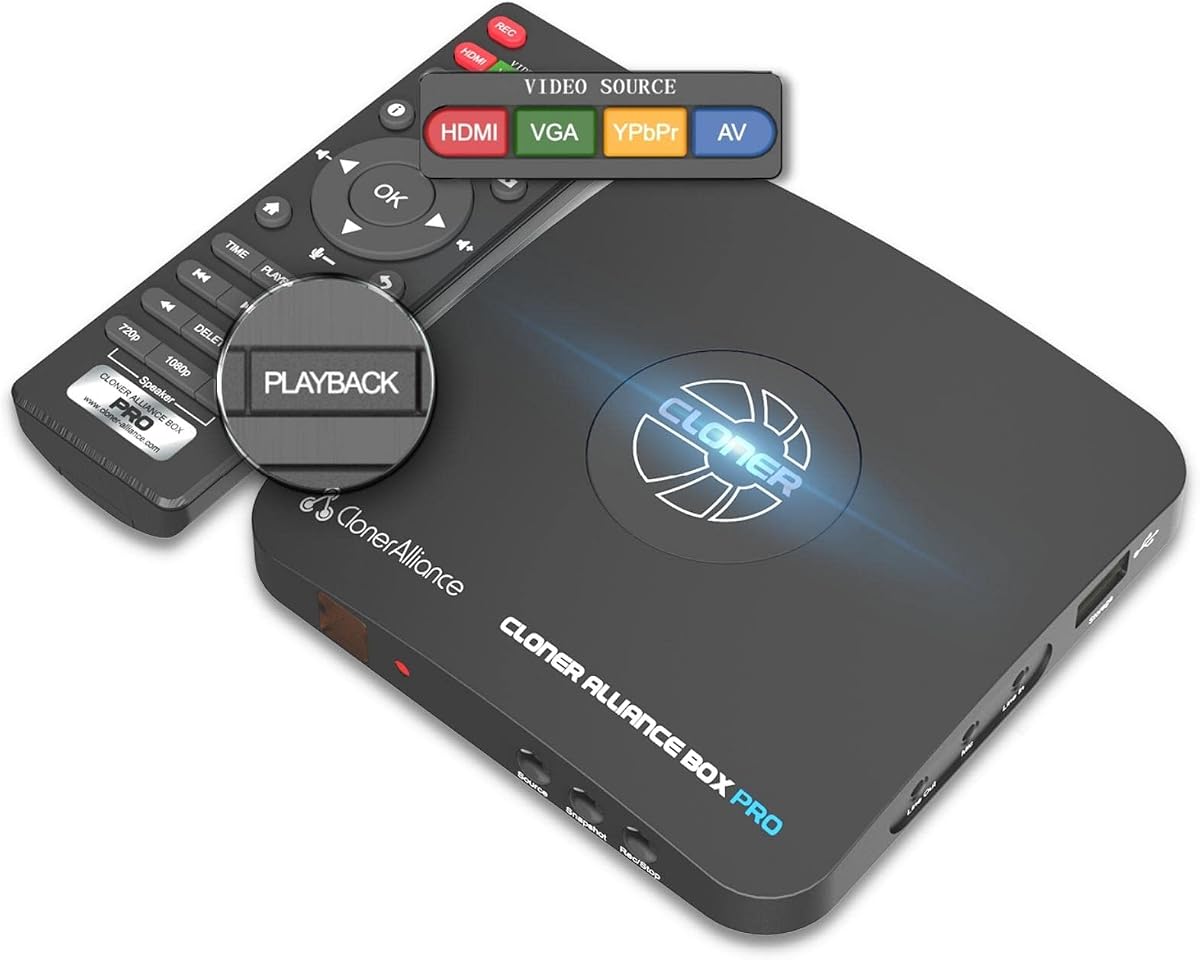
The ClonerAlliance Box Pro is a standalone video recorder with a 4.0 customer rating. It distinguishes itself from ordinary television tuners by accepting HDMI, RCA composite, component, YPbPr, and VGA sources, then recording the selected video to removable USB storage without requiring a PC.
We may earn a commission when you buy through this link, at no additional cost to you.
Its strongest attributes are flexibility and independence. The recorder can preserve broadcasts from cable receivers, set-top boxes, PVRs, and DVRs, but it can also digitize VHS tapes, camcorder footage, game consoles, media players, and other devices. Recordings save as MP4 files using widely supported file systems, while the included remote permits direct playback on a television.
The product is not a universal solution for every television signal. HDCP-protected sources may produce an error message or no output, and the supplied information notes that a smart television or television antenna cannot serve as a video source. Analog conversion is also limited by the quality of the incoming signal and original recording.
This is a compelling choice for someone who wants a self-contained recorder for legacy media, set-top-box capture, presentations, or game-console footage without building a computer-based capture system. It is also well suited to a TV setup where direct HDMI or analog input selection matters more than scheduled over-the-air channel recording.
The Box Pro combines a capture device, analog-to-digital converter, recorder, and TV playback player in one enclosure. That makes it useful for users who want to move between VHS, legacy camcorders, cable receivers, consoles, and modern HDMI sources without repeatedly changing software or relying on a computer.
Recording directly to a USB storage device keeps the workflow simple and produces files that can be moved to retro or modern computers. The recorder supports common file systems including exFAT, NTFS, FAT/FAT32, MBR, and GPT, provided the storage device is prepared appropriately.
We may earn a commission when you buy through this link, at no additional cost to you.
The Tablo TV 4th Gen 4-Tuner is a network-based over-the-air DVR with a 3.2 customer rating. Its four tuners let a household record several broadcasts at once, and its onboard storage provides more than 50 hours of recorded television for later viewing.
We may earn a commission when you buy through this link, at no additional cost to you.
This model is designed for homes with an antenna and a reliable internet connection. After connecting the DVR to an antenna and home network, users can manage live TV, recordings, and replay functions through the Tablo app on compatible smartphones, tablets, smart televisions, and streaming platforms. It can also offer a curated selection of free ad-supported streaming channels, subject to availability.
The main drawback is ecosystem dependency. Tablo is not compatible with non-smart televisions, certain television models, computers, or Apple TV Voice over, so buyers should check the current compatibility list before buying. An antenna and HDMI cable are not included, and the 3.2 rating suggests that setup or software experiences may vary considerably.
It is best for viewers who want many live channels recorded simultaneously and who already use a compatible smart television or streaming device. Choose the four-tuner version when family members regularly watch different broadcasts, especially if pausing and replaying live television is a priority.
The four-tuner configuration is the Tablo model's main advantage over two-tuner alternatives. It can record one live channel while viewers watch another, with capacity to watch, pause, record, and replay up to four channels at once when programming and storage allow.
Live and recorded content can reach compatible devices throughout the home through the network. The subscription-free model appeals to users who want over-the-air DVR functions without a recurring service charge, although consistent high-speed internet remains necessary.
We may earn a commission when you buy through this link, at no additional cost to you.
The Tablo TV 4th Gen 2-Tuner is an over-the-air DVR with a 3.4 customer rating. It provides a two-channel recording configuration, onboard capacity for more than 50 hours, and the ability to watch, pause, record, and replay local broadcasts alongside supported free streaming channels.
We may earn a commission when you buy through this link, at no additional cost to you.
Its appeal lies in the balance between recording capacity, tuner count, and network flexibility. One channel can be recorded while another is watched, and the DVR can stream content to compatible smartphones, tablets, smart televisions, and media devices. The product works with an existing antenna and connects through Wi-Fi or Ethernet.
Users must accept several limitations. It is not compatible with non-smart televisions, certain models including some named Vizio televisions, computers, or Apple TV Voice over. Recording some free streaming channels may also be disabled because of licensing restrictions, which prevents every advertised channel from behaving like a standard broadcast recording.
This model suits a household that wants pause-and-replay convenience without needing four simultaneous recordings. It is especially appropriate for viewers with one or two favorite live channels who also appreciate network access and no ongoing subscription requirement.
Two tuners allow viewers to record one program while watching another and support up to two channels being watched, paused, recorded, or replayed at once. This is ample for many individuals and couples while remaining simpler than a four-tuner network.
More than 50 hours of onboard storage gives users a practical library of recorded programs. The mobile app guides setup and controls viewing, while Wi-Fi or Ethernet provides flexible placement of the DVR within the home network.
We may earn a commission when you buy through this link, at no additional cost to you.
The Tablo TV 4th Gen 2-Tuner + Antenna package combines a two-tuner over-the-air DVR with an included 35-mile-range antenna. It has a 3.4 customer rating and targets buyers who want a more complete antenna-TV setup rather than adding a separate tuner and antenna.
We may earn a commission when you buy through this link, at no additional cost to you.
The DVR can receive local broadcasts, watch and record live television, and support simultaneous viewing and recording. Its 50-plus hours of onboard storage keep the core experience simple, while Wi-Fi or Ethernet connectivity enables access from compatible smartphones, tablets, smart televisions, and streaming platforms.
Antenna performance is never guaranteed by the stated range alone. Reception depends on geography, terrain, obstructions, station transmission strength, and placement, so users in difficult locations may need a better antenna or a different signal strategy. The package also does not resolve the broader compatibility restrictions associated with certain televisions and streaming devices.
This bundle is a sensible starting point for first-time antenna users who want DVR functions and a tuner in one purchase. It is less suitable for households that already own a capable antenna or those who need four concurrent recordings and stronger whole-home streaming options.
The included antenna removes the need to choose a separate indoor antenna during the initial setup. The DVR can use any compatible antenna, however, so users are not locked into the included model if a different antenna later proves better for their location.
The two ATSC 1.0 tuners handle live broadcast recording with practical flexibility for viewing one channel while recording another. A front-panel-led setup process and included coaxial cable make the package approachable for new antenna users.
We may earn a commission when you buy through this link, at no additional cost to you.
The Mediasonic HomeWorx HW250STB is a dedicated ATSC converter box with television recording and a 3.8 customer rating. It combines over-the-air reception, pause and record functions, HDMI output, and USB multimedia playback in a single metal enclosure.
We may earn a commission when you buy through this link, at no additional cost to you.
Recording requires a USB 2.0 or USB 3.0 external hard drive of up to 2TB; a flash drive is not recommended. The box can also receive unencrypted cable channels through Clear QAM, provided the provider supplies an unencrypted signal. Its front display shows the channel, sub-channel, and standby clock.
There are important exclusions. It does not support ATSC 3.0 and is not compatible with TiVo, Comcast, DirecTV, DISH Network, Time Warner Cable, or other cable-company systems. Its lack of built-in storage also makes the initial setup less convenient than a DVR with internal memory.
The HW250STB is a good choice for an older television or a simple antenna setup where recording and pause functions are wanted without a network subscription. It also works as a multimedia player for compatible photos, music, and video files stored on USB media.
The integrated tuner and external-drive recording provide the core DVR experience without a recurring service. Once a compatible hard drive is connected, users can pause live television and save broadcasts for later viewing through the TV output.
1080p HDMI output, Clear QAM support, and compatibility with older televisions through channel switching broaden the device's utility. Its USB multimedia function also lets it play common photo, music, and video files when they are stored on a compatible drive.
We may earn a commission when you buy through this link, at no additional cost to you.
The Toshiba DVR670 is a 2009 DVD/VHS recorder with a built-in television tuner and a 3.9 customer rating. It combines a DVD player and recorder, VCR, digital tuner, and media player in one unit, making it a distinctive option for households that still handle physical media.
We may earn a commission when you buy through this link, at no additional cost to you.
Its strengths center on legacy recording workflows. It can record and play DVD+R, DVD+RW, DVD-R, DVD-RW, and VHS cassette formats, with dubbing from disc to tape and from tape to disc. Front DV and RCA inputs plus rear RCA and S-VHS connections support recording from camcorders and other analog sources.
The built-in ATSC, NTSC, and QAM tuner receives digital broadcasts, while HDMI output upconverts DVD resolution to 1080p and supports Dolby Digital and DTS surround formats. Its age is the primary limitation: this is a 2009 model, and it does not offer the app-based, network-streaming, or large internal storage experience of modern DVRs.
Buy the DVR670 when preserving VHS tapes, recording to DVD, or dubbing between formats is the priority. It is best suited to an older home theater or a collection of physical media, rather than a household seeking modern streaming, multi-tuner recording, or flexible cloud-style access.
Recording from VHS or other analog sources to writable DVD creates a durable physical copy, while dubbing transfers content between VHS and DVD. This remains useful for preserving tapes and sharing recordings without depending on a network service.
Combining a tuner, DVD recorder, VCR, and media player reduces the number of separate components needed for a legacy television setup. DVD upconversion to 1080p provides a practical improvement when connecting the unit to a modern television.
We may earn a commission when you buy through this link, at no additional cost to you.
The Tablo TV 4th Gen 4-Tuner + Antenna is a complete over-the-air DVR package with a 3.3 customer rating. It combines four ATSC 1.0 tuners, onboard recording storage, and an included 35-mile-range antenna, giving users the core components needed to receive and record local television.
We may earn a commission when you buy through this link, at no additional cost to you.
Four tuners make this model better suited than the two-tuner version to households that follow several live broadcasts. Users can record one channel while watching another, and the supplied information indicates support for viewing flexibility across up to four channels at once. The DVR also streams to compatible smart televisions, streaming players, phones, and tablets.
The included antenna's stated range should not be treated as guaranteed coverage. Terrain, obstructions, station power, and antenna placement all affect reception, so buyers outside strong over-the-air markets may need to test or improve their antenna setup. An HDMI cable is not included, and compatibility with specific television models and streaming platforms must also be checked.
This package is appropriate for a new antenna household that wants the highest tuner count among the listed Tablo bundles. It is a less efficient choice for someone who already owns a suitable antenna, needs only one or two recordings, or primarily wants a device with very simple local-only operation.
The four ATSC 1.0 tuners offer the strongest simultaneous-recording configuration in this Tablo range. That makes the DVR more practical for families with several different schedules or viewers who regularly want to watch one program while others record elsewhere.
The bundled 35-mile antenna provides a convenient starting point for locating local channels. Because reception varies, users should position the antenna carefully and be prepared to upgrade if local transmitters are obstructed or distant.
We may earn a commission when you buy through this link, at no additional cost to you.
The ClonerAlliance UHD Pro is a standalone 4K UHD video recorder with a 4.1 customer rating, the highest rating among the products in this guide. It combines HDMI capture, flexible recording codecs, direct television playback, and support for USB storage devices or TF cards in one unit.
We may earn a commission when you buy through this link, at no additional cost to you.
Its premium capability is the ability to record ultra-high-definition video at cinematic frame rates, including 4K at 24fps and up to 4K at 30fps. It also passes 4K at 60fps through HDMI and supports H.264 or H.265 recording, along with selectable output and recording resolutions and bitrates up to 50Mbps.
The recorder cannot capture HDCP-protected content, and Dolby audio formats and HDR should be disabled at the source during recording. Its bundled editing and conversion utility is Windows-only, with no Mac support. A TV or antenna also cannot act as a direct video source, and the recording destination must be prepared with a supported file system.
This model is ideal for creators, educators, gamers, and archivists who want 4K capture without a dedicated recording computer. It is the premium choice in the guide when image resolution, codec choice, passthrough, and standalone operation are more important than scheduled over-the-air channel recording.
Recording at 4K without relying on a personal computer makes the UHD Pro notably flexible. It can also serve as a 4K 60fps passthrough path to a television, while pause and resume controls help keep separate moments within a continuous recording.
H.264 and H.265 support lets users choose between widely compatible files and more efficient encoding. Recordings can go to a USB storage device or TF card and remain compatible with modern computers when prepared using exFAT, NTFS, FAT/FAT32, MBR, or GPT.
We may earn a commission when you buy through this link, at no additional cost to you.
The Tablo TV 4th Gen 2-Tuner Renewed is a 128GB over-the-air DVR with a 3.8 customer rating. It combines two broadcast tuners, onboard recording, expandable USB storage, and Wi-Fi streaming without requiring an ongoing subscription.
We may earn a commission when you buy through this link, at no additional cost to you.
Its standout feature is storage flexibility. The 128GB internal drive can hold more than 50 hours of recordings, while an external USB drive can add up to 8TB. This is helpful for households that want to preserve a large program library without deleting older recordings. Two tuners allow one live channel to be recorded while another is watched.
The renewed designation means buyers should consider cosmetic wear, packaging, and warranty details carefully, although no specific condition is stated in the supplied information. USB flash drives and memory cards are not supported for expansion, and recording some free streaming channels may be disabled due to licensing restrictions.
This is a practical option for a value-conscious buyer who values expandable storage more than four-tuner recording. It is well suited to a compatible smart-television or streaming-device household with a reliable network and a TV antenna that can receive the desired local channels.
The combination of 128GB onboard storage and support for up to 8TB of external USB storage provides unusually broad capacity for a network DVR. Users can retain more broadcast recordings and organize them around a larger viewing schedule.
A renewed unit can make an established DVR platform more attainable, but the purchase should be evaluated as a distinct condition. Buyers should review the seller's return policy, warranty coverage, and description of the unit's physical and functional condition.
We may earn a commission when you buy through this link, at no additional cost to you.
The Tablo TV 4th Gen 4-Tuner Renewed is a network DVR with four broadcast tuners, 128GB onboard storage, and a 3.6 customer rating. It is designed for households that need several simultaneous recordings and also value time-shift viewing for programs already in progress.
We may earn a commission when you buy through this link, at no additional cost to you.
With the DVR, a user can begin watching an in-progress recording from the beginning or skip ahead to preferred moments. The four tuners support watch, pause, record, and replay functions across up to four channels, while the internal drive preserves more than 50 hours. External USB storage can expand the library to as much as 8TB.
The renewed status calls for a careful look at condition, included accessories, seller guarantees, and warranty terms. A separate TV antenna and a high-speed internet connection are required, and recording some free streaming channels may be disabled under licensing rules. Content availability also depends on the user's area.
This model is a strong fit for a busy household that wants the four-tuner flexibility of a new Tablo model with renewed-unit availability. It is less appropriate for buyers requiring a brand-new condition, those without a suitable antenna, or households that cannot use compatible smart devices and streaming platforms.
Time-shift viewing allows users to rewind an in-progress program rather than waiting until the recording is complete. That makes the DVR more useful for busy schedules and viewers who discover a show while it is already airing.
Four tuners and 128GB of internal storage form a capable household combination. USB expansion provides long-term room for more recordings, while the 50-plus-hour internal library keeps frequently watched content readily available.
We may earn a commission when you buy through this link, at no additional cost to you.
The right DVR depends first on your television source, then on recording capacity, tuner count, storage, and playback needs. Reviewing compatibility before buying can prevent limitations involving encrypted content, antennas, smart devices, or external media from becoming problems later.
Begin by identifying exactly how your television receives programming. A dedicated over-the-air DVR is designed to scan ATSC broadcasts received through an antenna. It may also support selected free streaming channels, but it is not automatically compatible with encrypted cable packages, satellite television, or every streaming application.
Choose a model that explicitly supports your provider and signal. The HomeWorx HW250STB includes Clear QAM support for unencrypted cable signals but explicitly does not work with TiVo, Comcast, DirecTV, DISH Network, Time Warner Cable, or other cable-company systems. When in doubt, check the provider and device compatibility lists before ordering.
Tuner count determines how many live broadcasts the DVR can receive at the same time. A two-tuner model is generally enough to record one channel while watching another. Four tuners are more useful for families with conflicting schedules, multiple favorite shows, or a desire to watch, pause, record, and replay several channels at once.
Two-tuner choices include the Tablo TV 4th Gen 2-Tuner, its antenna bundle, and the renewed two-tuner model. Four-tuner choices include the Tablo TV 4th Gen 4-Tuner, the four-tuner antenna bundle, and the renewed four-tuner unit. Pay attention to the limits of each plan, especially where some free streaming channels cannot be recorded.
Storage determines how much recorded programming remains available without deletion. The Tablo 4th Gen products described here include more than 50 hours of onboard recording capacity. The renewed models identify 128GB of internal storage and permit external USB expansion up to 8TB, which can be valuable for building a larger archive.
Standalone capture recorders use removable USB storage or, in the case of the ClonerAlliance UHD Pro, a TF card. The HomeWorx HW250STB also records to an external hard drive of up to 2TB, although flash drives are not recommended. Match the media to the recorder and format it with a supported file system.
Resolution matters when the goal is to preserve fine detail, archive a camcorder recording, or capture a modern game console. The ClonerAlliance UHD Pro leads this list for 4K recording, offering 4K at 24fps and up to 30fps, H.264 and H.265 codecs, and 4K at 60fps passthrough. The Box Pro focuses on standalone 1080p at 60fps capture.
For ordinary over-the-air television, the resolution delivered by the local broadcaster is the deciding factor. A DVR cannot create detail that the broadcast does not contain. For source-specific capture, also check the input resolution, color settings, audio format, and whether the source protects its content with HDCP.
A DVR may receive channels directly, or it may need to capture the output of another device. The ClonerAlliance Box Pro accepts HDMI, RCA composite, component, YPbPr, and VGA, making it versatile for VHS, VCR, camcorder, set-top-box, console, and media-player sources. The UHD Pro accepts HDMI and supports comparable device categories.
Some restrictions apply across the guide. HDCP-protected content may produce an error or no output. Dolby audio and HDR should be disabled at the source during 4K recording. A smart television or antenna cannot itself be a video source, and the Toshiba DVR670 focuses on physical media and analog A/V connections rather than HDMI source capture.
Networked DVRs offer more than local channel recording: they can deliver live and recorded programming to compatible phones, tablets, smart televisions, and streaming devices. The Tablo models use Wi-Fi or Ethernet and are controlled through the Tablo app. This can be particularly useful when a television is in another room from the antenna.
Network features also introduce dependencies. Tablo devices require a Wi-Fi-enabled router and a consistent high-speed internet connection, and they are not compatible with every television or streaming platform. The standalone ClonerAlliance recorders and the HomeWorx converter emphasize direct local output instead. Decide whether mobile access and whole-home streaming justify a network-centered setup.
The products in this guide use two very different storage philosophies. The Toshiba DVR670 records broadcasts and analog sources to DVDs and VHS tapes, making it ideal for preserving physical media. Its built-in tuner and A/V inputs support traditional dubbing workflows, while HDMI upconversion helps display DVDs on modern televisions.
Modern DVRs instead record to internal drives, network services, or removable flash media. This approach is more convenient for on-demand viewing and multi-device access but is less useful for creating a physical disc or tape. Consider whether the desired output is a lasting physical copy, a collection of digital files, or simply a library available through an app.
A simple television can still require several setup steps. The Tablo units need an antenna or suitable antenna connection, a home network, the mobile app, and compatible playback devices. Their antennas and HDMI cables are not included in the listings described here. The ClonerAlliance recorders need a prepared USB device and an appropriate source connection.
Also distinguish a one-time purchase from a recurring service. Tablo explicitly advertises no subscription or hidden fees, and the HomeWorx and ClonerAlliance devices are conventional hardware purchases. Review required accessories, file-system preparation, update procedures, and the availability of any free streaming content before finalizing the setup.
Begin by confirming the source, output television, and storage method. For an antenna DVR, connect the antenna securely, link the unit to the home network, download the appropriate app, and complete the guided setup before scanning for channels. For a standalone capture recorder, connect the source to the correct input, prepare a supported USB device or TF card, and test a short recording before committing to a longer session.
Organize recordings around the device's actual capabilities. Use scheduled recording features for predictable broadcasts, but monitor tuner conflicts when multiple channels overlap. For analog or legacy media, test each input type separately and confirm that the resulting MP4 file plays correctly. When recording 4K, disable HDR and Dolby audio at the source, particularly on the ClonerAlliance UHD Pro, and allow for more storage consumption.
Protect the recorder and its recordings by keeping the unit ventilated, using a stable power source, and handling the hard drive or flash media carefully. Do not unplug a drive while recording or transferring files. Periodically review storage, back up important standalone captures, and keep the device's firmware and viewing app updated. Renewed products should be handled with extra care and kept within the seller's warranty and return terms.
A TV tuner receives broadcast or cable television signals directly and organizes them into viewable channels. A video capture recorder instead captures the output of another source, such as a cable box, VHS player, camcorder, game console, or computer. The HomeWorx and Tablo products are built around television reception, while the ClonerAlliance models are designed primarily for source capture.
Not automatically. A smart television or streaming application is not itself a capturable video source for the ClonerAlliance devices, and streaming content may be protected by HDCP. The listed ClonerAlliance recorders cannot capture HDCP-protected content, which may result in an error message or no output. Check the service's own recording features and content-protection rules before assuming a third-party DVR can capture it.
Two tuners are generally sufficient for recording one show while watching another. Four tuners are more appropriate when several household members follow different live channels or when you want to record and replay up to four channels at once. The Tablo 4-Tuner and 4-Tuner with Antenna models provide four tuners, while the 2-Tuner versions cover more typical individual or couple use.
The Tablo DVRs in this guide are explicitly described as subscription-free, and the ClonerAlliance and HomeWorx devices operate as standalone hardware without a listed recurring DVR fee. A reliable internet connection is still needed for the networked Tablo features. Free streaming channels may be included, but their availability and recording permissions can vary by location and licensing restrictions.
Yes, when the recorder has compatible analog inputs. The ClonerAlliance Box Pro accepts RCA composite, component, YPbPr, and VGA sources and is explicitly compatible with VHS players and VCRs. The Toshiba DVR670 can record to VHS and writable DVD formats and offers several analog inputs. Conversion quality will depend on the original tape, source equipment, and selected connection.
The ClonerAlliance Box Pro records to a USB storage device, while the ClonerAlliance UHD Pro can use USB storage or a TF card. Compatible file systems include exFAT, NTFS, FAT/FAT32, MBR, and GPT. Prepare the media correctly and confirm adequate capacity before recording. The HomeWorx HW250STB uses a USB 2.0 or USB 3.0 external hard drive up to 2TB and does not recommend flash drives.
No. Tablo over-the-air DVRs require access to a suitable antenna, and some listed bundles include one, while other listings do not. The ClonerAlliance recorders capture output from another source and are not designed to use a smart television or antenna as their video source. The HomeWorx and Toshiba DVR670 include television tuners and also require an appropriate connected signal.
Check the seller's description of cosmetic condition, included accessories, warranty coverage, and return window. Renewed status can vary between units, so the listing should be evaluated separately from a new-condition model. For the Tablo renewed products, also confirm antenna availability, network requirements, and compatibility with the televisions and streaming devices in your home.
The HomeWorx HW250STB is the budget-focused choice for basic over-the-air recording, while the ClonerAlliance Box Pro is the most versatile standalone option for HDMI, analog, and legacy media capture. For households that need more simultaneous television recording, the Tablo 4-Tuner and 4-Tuner with Antenna models provide four broadcast tuners, network streaming, and no listed subscription fee.
Prioritize the source before comparing features. Choose an antenna DVR for local broadcasts, a capture recorder for a set-top box or legacy source, and the Toshiba DVR670 when preserving VHS and DVD media is central. Then match tuner count, storage, output resolution, and compatible playback devices to the way your household actually watches television.
Finally, check the current listing, included accessories, compatibility notices, and seller terms before purchasing, especially for renewed units or antenna bundles. Product configurations, channel availability, software behavior, and prices can change, so current details should guide the final decision.