
Airthereal R500
4.2Editor score
Compact 2.5L capacity
Four-hour processing cycle
Dishwasher-safe cast aluminum
Biodegradable carbon filters
Explore the best electric kitchen composters, comparing capacity, odor control, noise, composting modes, cleaning, and performance to find your ideal model.
Electric kitchen composters offer a convenient way to process food scraps without maintaining an outdoor pile or repeatedly carrying smelly scraps to a bin. A worthwhile model combines useful capacity, effective odor control, quiet operation, and straightforward cleaning while producing material appropriate for household plants or further composting.
We compared the ten featured electric kitchen composters by examining their stated capacity, processing methods, noise levels, filtration systems, operating modes, maintenance requirements, and intended scale. The guide includes compact drying models, larger microbial systems, and machines designed to handle demanding food waste without claiming that any product was personally tested.
Each review highlights the details that distinguish one model from another, including bucket size, daily throughput, ease of cleaning, and what type of household may benefit most. Product ratings and specifications can change over time, and prices fluctuate, so shoppers should confirm current listings and feature details before making a final purchase.
4.2Editor score

4.3Editor score

4.0Editor score
The table below compares all ten electric kitchen composters by capacity, processing approach, odor-control hardware, and operating convenience, making it easier to identify the model that fits your kitchen and waste volume.




The Reencle Prime combines a 14L countertop bucket with aerobic microbial decomposition, setting it apart from many compact machines that primarily dry and grind food scraps. Its 4.3 rating reflects a strong overall balance of capacity, odor control, quiet operation, and a stated ability to process up to 2.2 pounds of waste each day.
We may earn a commission when you buy through this link, at no additional cost to you.
The largest attraction is the patented microbe-based approach. Rather than relying only on high-temperature dehydration, the machine creates an environment intended to accelerate microbial decomposition into nutrient-rich compost. The included carbon filter, compost starter pack, and shovel make it possible to begin using the system without separately sourcing basic setup materials.
Its three-layer filtration system addresses the smell problem that discourages many people from keeping food waste on the counter, while operation at as low as 28 dB is suitable for kitchens where background noise matters. The main drawback is its larger 14L body, which may consume more counter space than a 2.5L or 3L alternative. Buyers should also follow the manufacturer’s guidance about proper startup and material preparation.
This is the strongest all-around choice in the guide for households wanting true compost rather than only a dry waste-reduction powder. It suits medium-sized households that generate enough scraps to justify a 14L unit but do not need the exceptional capacity of the GEME PRO 19L or Reencle Gravity. For most shoppers, its balance of features makes it a practical starting point.
The aerobic microbial system is designed to break food scraps down into compost, making this model appealing to users who want to enrich soil rather than merely reduce the volume of kitchen trash. Faster decomposition is another meaningful benefit for households that do not want to wait months for an outdoor pile.
A three-layer filter works together with the enclosed aerobic process to limit odors, making the machine more suitable for an open kitchen. At a stated 28 dB, it also offers a relatively discreet operating profile for evening processing.
We may earn a commission when you buy through this link, at no additional cost to you.
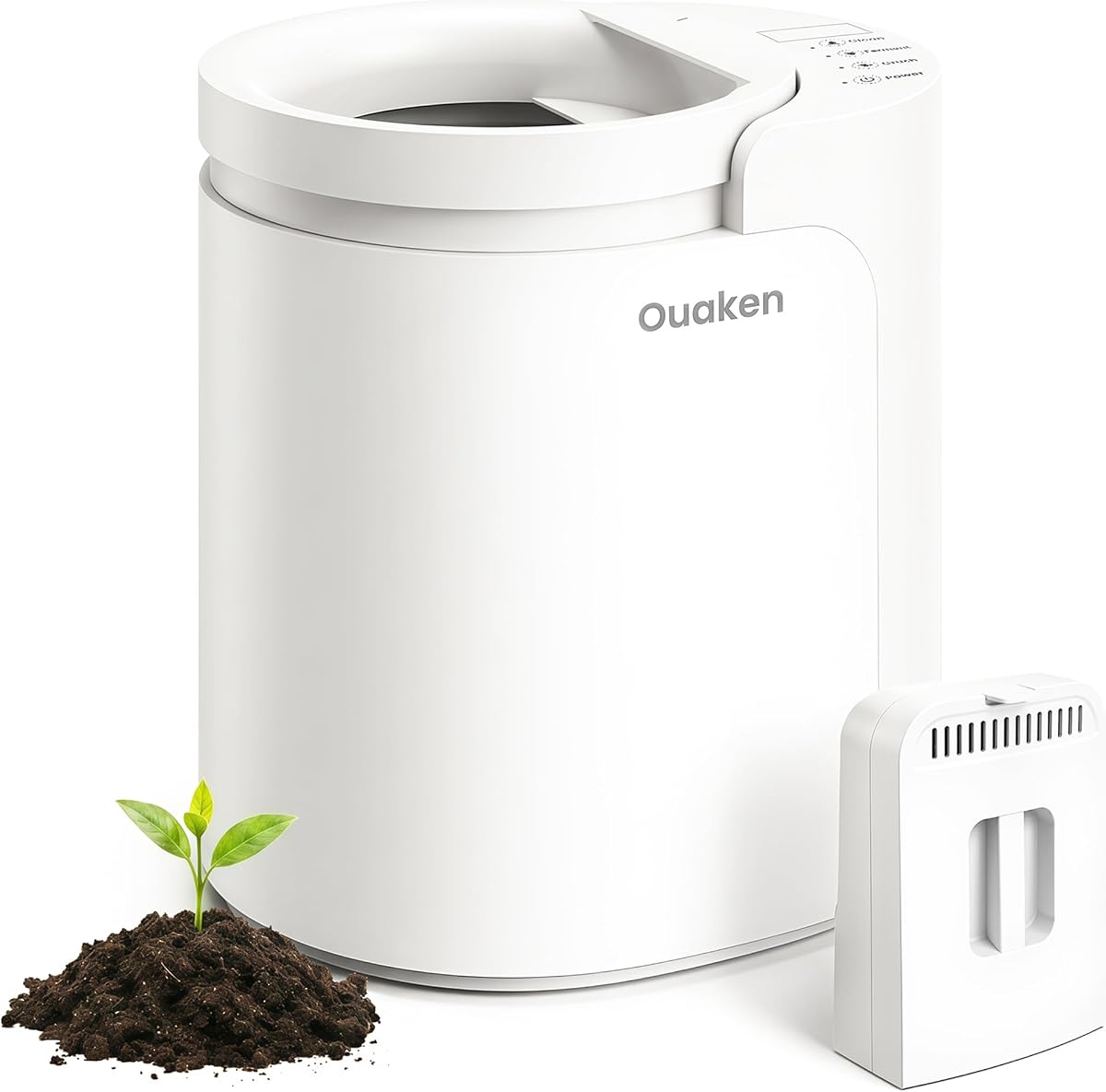
The Airthe-real R500 is a compact 2.5L food recycler designed for people who want a simple way to reduce kitchen waste without paying for a larger microbial composter. Its 4.2 rating reflects a straightforward product with a dishwasher-safe bucket, one-touch operation, and a clearly explained four-hour cycle.
We may earn a commission when you buy through this link, at no additional cost to you.
Instead of creating nutrient-rich compost through microbial decomposition, this model dries and grinds food scraps into powder. That powder can be used around plants or discarded to reduce both trash volume and odor. The SHARKSDEN Trinity Blade design and blender-like movement are intended to crush food from multiple directions and handle larger quantities within the small bucket.
The main advantage is the simplicity of the entire experience. Collect scraps during the day, start the machine before bed, and empty the processed material the next morning. The cast aluminum bucket is easy to rinse and dishwasher safe, while biodegradable carbon filters help prevent odors between cycles. Its limited 2.5L capacity means it works best for individuals, couples, or smaller households.
This is the budget-conscious choice for anyone whose priority is odor reduction and convenient waste processing rather than producing finished compost. It will not suit a large family generating frequent kitchen waste, and its powder output may not meet expectations for home gardening. Even so, it delivers a useful and understandable countertop solution at a fraction of the scale and complexity of larger models.
The four-hour schedule fits neatly into an evening routine, allowing the machine to process scraps while the household sleeps. One-button operation removes guesswork and makes this an approachable option for first-time electric composter owners.
The cast aluminum bucket removes for rinsing or dishwasher cleaning, which helps prevent residue from becoming a maintenance problem. Since the output is a dry powder, users who do not want fertilizer can discard it with less concern about adding moisture to household waste.
We may earn a commission when you buy through this link, at no additional cost to you.
The 4L Electric Composter is a versatile countertop unit with a 4.3 rating, three operating modes, and a removable dishwasher-safe bucket. It uses high-temperature drying, grinding, and cooling to reduce food waste by as much as 90%, making it a practical middle ground between tiny recyclers and larger aerobic systems.
We may earn a commission when you buy through this link, at no additional cost to you.
Crush mode focuses on reducing volume and odor with lower energy use, while Ferment mode is designed to create compost or fertilizer through accelerated fermentation. Clean mode simplifies routine maintenance. These choices give the machine more flexibility than a single-cycle product, and the easy-touch interface plus transparent lid make starting, stopping, and checking progress straightforward.
Its large carbon filter is listed as lasting up to five months, which helps control odor without demanding frequent replacement. Low-speed, high-torque blades operate below 40 dBA, making nighttime processing feasible. The important maintenance rule is to empty the bucket before starting another cycle. Repeatedly reprocessing material left in the bucket can lengthen run time, increase power consumption, and contribute to clumping that may affect the fan and blades.
This composter is a good choice for households that want several processing options without moving to a large premium model. The 4L bucket is advertised as suitable for a family’s daily waste, though actual fit depends on how much the household scraps. Buyers comfortable learning the differences between Crush and Ferment will gain more from it than those seeking one completely automatic workflow.
Crush is useful for routine volume reduction, Ferment focuses on producing pre-compost or fertilizer, and Clean supports upkeep. The flexible design lets users choose the level of processing that suits their schedule and intended use.
Emptying the removable bucket between cycles is essential for consistent operation and equipment care. The dishwasher-safe construction makes that reset more convenient, while Clean mode helps reduce the effort required after a processing run.
We may earn a commission when you buy through this link, at no additional cost to you.
The Electric Composter Smart 3L earns a 4.9 rating, making it the most highly rated model in this comparison. Its 3L body is compact, yet it combines automated drying, crushing, a four-to-six-hour processing time, and three operating modes in a package that also includes a removable bucket and activated carbon filter.
We may earn a commission when you buy through this link, at no additional cost to you.
The touch interface eliminates manual settings, while the non-stick bucket can be rinsed or cleaned with Auto Clean mode. A smart reminder alerts users when the carbon filter needs replacement, which is a helpful feature in a category where odor control is essential. The advertised filtration period is up to three months, and the system operates below 40 dB for relatively discreet use.
Safety is another differentiator. The machine pauses automatically when its lid is opened and resumes after the lid closes, reducing the chance of accidental operation during loading or cleaning. A Storage mode provides a 12-hour cycle for deeper decomposition, while the other modes support faster processing and routine maintenance.
This model is best suited to individuals, couples, and smaller households seeking a low-maintenance machine with useful automation. Its compact 3L capacity may fill quickly in an active family, and the carbon filter is a recurring maintenance item despite the convenient reminder. Still, the high rating, safety behavior, and simple controls make this one of the most approachable options in the guide.
Touch operation, automatic cleaning, and replacement reminders reduce the amount of attention required during normal use. The visible window also helps users monitor the contents without opening the lid or interrupting an active cycle.
Automatic lid detection pauses the machine as soon as it is opened, a practical protection for homes with children or anyone adding scraps frequently. The below-40 dB specification also allows processing during quieter evening hours.
We may earn a commission when you buy through this link, at no additional cost to you.
The 2.5L Electric Composter has a 5.0 rating and is explicitly positioned for small households and kitchens producing less food waste. It combines a space-saving 2.5L body with high-temperature drying, grinding, cooling, and a stated reduction of up to 90% within hours.
We may earn a commission when you buy through this link, at no additional cost to you.
Crush, Ferment, and Clean modes make the unit more versatile than a basic recycler. Crush prioritizes lower-energy volume and odor reduction, while Ferment is intended to create pre-compost for further composting. Clean mode supports routine hygiene, and a transparent lid allows users to check the contents. The high iodine-value carbon filter is listed as providing odor control for up to five months.
Maintenance is where its detachable blade assembly becomes especially useful. Removing the blade group lets users rinse away food residue and buildup, while the removable bucket and Clean mode help keep the interior fresh. Low-speed, high-torque blades operate below 40 dB, so the machine can run without excessive disruption at night.
This is an attractive option for one-person or two-person households with limited counter space and modest waste output. It is less suitable for large families because the bucket may require multiple batches, and the output in Ferment mode is pre-compost rather than a finished soil amendment. For a small kitchen, however, its clean design and well-rounded feature set are compelling.
The one-touch mode selection gives a small machine more control over the processing result. A transparent lid improves visibility while the compact shape keeps the unit manageable on a crowded countertop.
A detachable blade assembly addresses one of the most important upkeep concerns in a food recycler: trapped residue. Pairing it with a removable bucket and dedicated Clean mode creates a more manageable maintenance routine.
We may earn a commission when you buy through this link, at no additional cost to you.
The Food Cycler Eco 5 pairs a 5L removable bucket with a powerful grinding system, earning a 4.5 rating. It is designed as an indoor alternative to a traditional compost bin, quietly processing food waste into plant food while reducing odors, mess, and the quantity of trash taken outside.
We may earn a commission when you buy through this link, at no additional cost to you.
Its patented Vortech grinding system is the defining feature. According to the product information, it can grind materials that other systems may struggle with, including pits, peels, bones, and leftovers. The bucket can hold substantial quantities of food waste and is designed to reduce its volume by almost 90% within hours. Users can add scraps and later use the resulting plant food around their plants.
A refillable carbon filter absorbs odors while the machine operates, and the one-touch control keeps the process uncomplicated. The removable bucket can also sit near the food preparation area and move with the user as they cook. The modern exterior is intended to make the appliance look more like part of the kitchen than a traditional compost container.
This is a strong fit for medium-sized households that want ample capacity without moving to a 19L or 22L system. It is not a microbial composter producing finished compost; its output is ground plant food. The refillable filter also requires periodic attention. Even so, the large bucket, versatile grinder, and attractive design make the Eco 5 a convincing all-around recycler for serious home cooks.
The Vortech system is designed to process a broad range of kitchen discards rather than restricting users to soft produce peels. This broad ingredient compatibility makes it useful for households that regularly prepare mixed meals.
Because the bucket is removable, it can remain close to the cutting board and move around the work area during cooking. That flexibility can make collecting scraps more convenient than using a fixed bin beside the appliance.
We may earn a commission when you buy through this link, at no additional cost to you.
The Reencle Gravity is the largest countertop composter in this guide by stated capacity, with a 22L bucket and a daily processing capacity of up to 3.3 pounds. Its 4.0 rating does not lead the category, but the machine offers a distinctive combination of microbial decomposition, built-in tracking, and exceptionally quiet operation.
We may earn a commission when you buy through this link, at no additional cost to you.
Like the Reencle Prime, it uses patented microbial technology in an aerobic environment to create nutrient-rich compost. The stated transformation window ranges from two to 24 hours, and waste volume can be reduced by up to 90%. A carbon filter, Compost Starter 2.0, booster pack, and two types of shovels are included to help users begin the process.
The built-in weight and time tracking system adds useful information that many competing models do not emphasize. It can help users monitor processing progress and efficiency. A three-layer filter controls odor, while operation at as low as 24 dB makes the unit among the quietest products featured. Its energy-efficient design is intended to limit power consumption.
This model suits larger households or committed composters who want to produce genuine compost without maintaining an outdoor pile. The 22L body is a substantial countertop commitment, and proper startup materials are central to the microbial process. Buyers with limited space should measure the available counter area first. For high-volume users, however, the capacity and tracking features are compelling.
A 22L bucket and a stated ability to process 3.3 pounds per day make this model more relevant to active households and frequent home cooks. It reduces the likelihood of filling the container between short processing cycles.
Integrated weight and time tracking gives users a clearer picture of the batch than a simple on/off indicator. This is especially helpful while learning how much material the machine can handle in a single cycle.
We may earn a commission when you buy through this link, at no additional cost to you.
The OK-255 combines a 5.5L capacity with five operating modes and a 4.4 rating. Its low-profile oval body is intended for larger households that need meaningful capacity while fitting the machine into varied countertop layouts, particularly where a deep cylindrical unit would be inconvenient.
We may earn a commission when you buy through this link, at no additional cost to you.
Standard, Quick, Crush, Clean, and Store modes cover everyday processing, accelerated waste reduction, maintenance, and longer storage or decomposition needs. The machine uses high-temperature drying, grinding, and cooling to reduce waste volume by up to 90% within a few hours. Low-speed, high-torque blades and a stated noise level below 45 dBA support use during evening hours.
Odor and moisture management receive particular attention. A higher iodine-value activated carbon filter and enhanced airflow structure are paired with a new moisture collection tray and bottom ventilation outlet. These additions are intended to control condensation, protect internal components, and extend durability. The filter replacement interval is approximately five months.
The redesigned blade assembly uses a reinforced 9H-hardness non-stick coating to reduce residue and clogging. A flip-top transparent lid allows loading without full removal, and the detachable fan module simplifies maintenance. This is a well-equipped model for medium-sized households, though its 45 dBA ceiling is slightly higher than several competitors. The larger footprint and numerous modes also make it less minimalist than smaller options.
The moisture tray, bottom ventilation outlet, upgraded carbon filter, and enhanced airflow work together to address moisture accumulation as well as smell. These details are particularly relevant in humid kitchens where sealed processing can amplify condensation.
Five modes provide more control than most similarly sized competitors, while the detachable fan and coated blade assembly support long-term upkeep. The flip-top lid balances convenient loading with a less cumbersome daily workflow.
We may earn a commission when you buy through this link, at no additional cost to you.
The Electric Kitchen Composter is a 100-ounce countertop recycler distinguished by its patent-pending detachable blade and auto-flush cleaning system. It carries a 4.4 rating and places maintenance at the center of the design, offering a potentially easier cleaning process than machines with permanently mounted cutting assemblies.
We may earn a commission when you buy through this link, at no additional cost to you.
The blade can be removed without tools and rinsed in seconds, directly targeting the difficult task of washing trapped food residue. A ceramic-coated bucket is described as durable, free of Teflon, and suitable for producing garden-safe compost results. The included brushless motor is rated for 10,000 hours, reflecting a focus on long-term mechanical reliability.
Odor control is handled by 800 grams of activated carbon, described as twice the industry standard, combined with optimized airflow. The unit operates at 40 dB, allowing it to run during normal household activity. Its modern Japanese-inspired design is intended to blend into contemporary kitchens without the visual bulk of a traditional outdoor-style tumbler.
This model is a good choice for users who prioritize easy cleaning, strong filtration, and a modern appearance. Because the product information does not highlight several programmed modes, buyers seeking granular control may find simpler alternatives more transparent. Capacity is listed as 100 ounces rather than liters, so shoppers should compare actual dimensions and usable bucket volume before ordering.
A detachable blade allows water to reach surfaces that are difficult to clean in a fixed assembly. Combined with the auto-flush system, this is a meaningful advantage for households that do not want to scrub around exposed cutting hardware.
The ceramic-coated bucket and 10,000-hour brushless motor emphasize longevity, while 800 grams of activated carbon provide substantial odor-control media. Together, these features target two common concerns with countertop food recyclers: upkeep and kitchen smells.
We may earn a commission when you buy through this link, at no additional cost to you.
The GEME PRO 19L is the premium, high-throughput model in this guide, with a 19L capacity and a stated ability to process as much as 11 pounds of food waste daily. Its 4.0 rating is tied for the lowest in the comparison, but the appliance distinguishes itself through continuous operation, large-scale processing, and genuinely minimal maintenance.
We may earn a commission when you buy through this link, at no additional cost to you.
Microbial Degradation Technology is used to break food waste into nutrient-dense organic compost rather than merely producing a dehydrated imitation. The stated cycle takes six to eight hours, and the product information claims a 95% reduction rate. It is designed for a family of three and is said to support up to one year of continuous, cleaning-free operation.
Unlike models that depend on replaceable cartridges, the GEME PRO has a permanent built-in filter intended to last for the life of the composter. An industrial-grade deodorization system neutralizes odors, while ultra-quiet operation is designed to avoid disturbing the home. Its add-and-go workflow requires no buttons and no waiting for a manually selected cycle.
This is the most substantial option for active households, frequent home cooks, or anyone who views food-waste processing as an ongoing kitchen system rather than occasional batch work. The tradeoff is its very large countertop footprint and greater upfront commitment than compact models. The continuous design also encourages users to think carefully about ventilation and available space before purchase.
The combination of a 19L bucket and an 11-pound daily capacity separates this model from standard countertop recyclers. It is designed for households that generate enough waste to make frequent emptying and small batches inconvenient.
Microbial degradation creates nutrient-dense organic compost rather than a dry waste-reduction powder. A permanent filter and cleaning-free continuous workflow further reduce the number of consumables and maintenance tasks.
We may earn a commission when you buy through this link, at no additional cost to you.
The right electric kitchen composter depends on your available space, typical food-waste volume, tolerance for countertop appliances, and whether you want finished compost, pre-compost, or a dry fertilizer-like output.
Electric kitchen composters generally use one of two broad approaches. Drying and grinding machines reduce scraps to a dry powder that can be discarded or used around plants, while microbial systems use aerobic fermentation or degradation to create compost or pre-compost. The distinction matters because a small recycler may perform its waste-reduction role well without producing the nutrient-rich compost promised by a larger microbial composter. Buyers who want to enrich garden soil should prioritize a genuine microbial process, whereas those focused mainly on reducing trash and odor can consider a simpler grinder.
Bucket capacity is one of the clearest indicators of the machine’s intended scale. Compact models with capacities between 2.5L and 3L suit individuals, couples, and light waste generation. A 4L to 5.5L bucket fits medium households, while 14L, 19L, and 22L systems accommodate active families and frequent home cooks. Also consider the stated daily processing limit, because nominal bucket volume does not always match the amount that can be processed in one cycle. Measure counter space and confirm how often you are willing to empty the container before choosing a large model.
Odor control depends on the active filter, airflow, sealing, and overall processing method. Carbon filters are common because they absorb odors effectively, but their replacement schedules differ substantially. Some models use replaceable filters lasting approximately three to five months, while the GEME PRO features a permanent integrated filter. Pay attention to reminders and refillable systems that make upkeep easier. A machine can also reduce smells through high-temperature processing, but an effective filter remains important for a closed kitchen or homes located near cooking and dining areas.
Noise matters when the composter runs in a kitchen used for work, meals, or relaxation. Listed operating levels in this guide range from as low as 24 dB to below 45 dBA. Lower-noise models are useful for late-night processing, but a slightly higher rating may still be acceptable if the machine runs away from seating areas. Cycle duration is also important. A four-hour process may be convenient overnight, while a six-to-eight-hour or continuous system requires less attention. Choose a schedule that matches when your household can empty the bucket and use the output.
Food residue eventually affects hygiene, odor, blade performance, and airflow, so maintenance deserves careful attention. Look for removable buckets, dishwasher-safe components, detachable blades, non-stick surfaces, and dedicated cleaning modes. A larger carbon filter may reduce odor but introduce a replacement expense, whereas a built-in permanent filter lowers ongoing maintenance. The 4L Electric Composter specifically requires users to empty its bucket before each cycle to avoid clumping, so clear operating rules should influence your choice. More automation can simplify life, but it is useful only if the machine is cleaned according to the manufacturer’s guidance.
Simple one-button operation is effective for consistent users, but multiple modes can extend a machine’s usefulness. Crush modes focus on rapid volume reduction, Ferment or Store modes support decomposition, Quick modes shorten processing, and Clean modes assist with upkeep. More choices are not automatically better; they are most useful when a household understands their purpose. A transparent lid, easy-touch interface, and simple status display can make operation clearer than a technically complex panel. Buyers should also verify whether the machine is batch-based or designed for continuous add-and-go use.
An electric composter should fit comfortably near a food preparation area without crowding outlets or blocking essential workspace. Some models pause automatically when the lid opens, adding a useful layer of safety, while others require the user to follow standard operating instructions. Consider ventilation, heat, moisture, and access to a nearby outlet as well as aesthetics. A modern design may make the appliance easier to leave on display, whereas a large unit can dominate the counter. Always follow the provided placement and operating instructions, especially when moisture collection or ventilation components are involved.
Begin by reading the manual for your specific model, removing packaging, installing any required filter, and checking whether the unit needs a starter pack or initial conditioning cycle. Place the composter on a level, dry, accessible countertop with adequate clearance around the lid, vents, outlet, and any moisture tray. Wash the removable bucket and applicable components before the first use, and prepare the required filter or starter materials exactly as directed. Avoid placing food scraps into an unprepared machine simply because the control panel is ready.
Collect and sort food scraps according to the manufacturer’s guidance, removing packaging, plastics, and unsuitable materials. Cut unusually large pieces into smaller portions, drain excess liquid when instructed, and avoid overfilling the bucket. For batch-style models, run the recommended mode and wait for completion before emptying. For continuous systems, add scraps as directed and monitor the output. Treat the processed material according to its type: apply dry powder carefully around plants, use pre-compost in a soil mix, or add finished compost to an outdoor bed only if the manufacturer confirms it is suitable for that purpose.
After each cycle, allow the machine to cool as directed, remove the bucket or output, and rinse away residue before it dries. Clean the blades, filter area, lid, and moisture components at the frequency specified in the manual, taking advantage of dishwasher-safe parts and cleaning modes where available. Replace disposable carbon filters on the stated schedule, and never bypass an odor-control component. A dry, clean machine left uncovered between cycles is generally less favorable for odor control than one kept closed, but it should always be stored according to its manual.
Some models produce genuine compost through microbial decomposition, while others dry and grind scraps into a powder that can be used around plants or discarded. The Reencle Prime, Reencle Gravity, and GEME PRO use microbial approaches, whereas the Airthe-real R500 and Food Cycler Eco 5 emphasize reduction and grinding. Check the output description carefully because terms such as compost, pre-compost, plant food, and powder do not represent the same result.
No electric composter should be assumed to be completely odorless in every circumstance, but good filtration and sealed processing can greatly reduce smells. Look for carbon filters, effective airflow, and a design that keeps moist scraps enclosed. Airtight seals, timely emptying, and regular filter replacement also help maintain odor control.
A 2.5L or 3L model is generally most practical for individuals, couples, and households with low waste production. Medium households may prefer 4L to 5.5L capacity, while active families can consider 14L to 22L systems. Daily throughput and the number of batches required are just as important as the bucket’s nominal size.
Food compatibility varies significantly by model and can include restrictions involving meat, dairy, oily foods, bones, and large quantities of liquid. Read the manufacturer’s accepted-material list before loading scraps. Even when a product can physically grind a material, the operating system may not be designed to process it effectively or hygienically.
Emptying frequency depends on capacity, waste volume, and the chosen cycle. Batch models generally require emptying after each completed run, while continuous machines are designed to accept scraps as they accumulate. Large-capacity units can reduce trips to the outdoor bin, but the finished material still needs to be transferred to an appropriate destination.
Finished compost can generally be mixed into potting soil or added to garden beds when the product is explicitly described as compost. Pre-compost usually needs further curing or mixing before direct application. Dry output powders can be used sparingly around suitable plants, but users should follow the product instructions and avoid assuming every fertilizer-like output has been tested for every plant.
Consumption varies with capacity, processing method, run time, and the features used during a cycle. The Food Cycler Eco 5 is specifically described as consuming less power than an average clothes dryer, while the Reencle models emphasize energy-efficient operation. For an accurate comparison, check the manufacturer’s power specifications and estimated run time rather than relying on category-wide assumptions.
Empty processed material promptly, rinse the bucket and blades after each batch, and clean removable components according to the manual. Use the machine’s cleaning mode when available, and replace carbon filters on schedule. Avoid leaving a completed batch inside a machine that is designed to be emptied before its next cycle, since retained material can increase odor, run time, and clogging.
The Reencle Prime stands out as the most balanced overall option, combining 14L capacity, true aerobic microbial composting, three-layer filtration, and quiet operation. The Airthe-real R500 is the practical budget choice for small households that primarily want a simple recycler, while the GEME PRO 19L is the premium option for high-volume users who value continuous operation and finished compost.
Most buyers should prioritize the output they actually want, the amount of food waste they generate, and the space available on the counter. Noise, cleaning, filters, and operating modes matter too, but a smaller machine with a maintenance routine you will follow is usually more useful than a larger system that is difficult to accommodate. Measuring the intended location and checking the accepted food list can prevent avoidable disappointments.
Ratings, specifications, promotions, and prices can change, so shoppers should review the current product listing and user feedback before ordering. This guide is designed to make the underlying trade-offs easier to understand, but the final choice should reflect your household’s waste volume, kitchen layout, composting goals, and maintenance preferences.