
KOSMEGAL SUP Pump
4.0Editor score
Up to 20 PSI
Seven interchangeable nozzles
Backlit LCD display
An electric paddle board pump can remove much of the effort from inflating a rigid or inflatable SUP, particularly when a board must reach 12 to 15 PSI. A useful model combines a capable motor, accurate pressure control, reliable auto-off, and enough battery or vehicle power to suit the way you travel.
The pumps in this guide were compared using the information supplied for pressure capacity, inflation and deflation performance, power options, displays, cooling, nozzle compatibility, portability, and intended outdoor uses. The list includes compact cordless models, vehicle-powered pumps, and higher-capacity rechargeable systems for different budgets and trip types.
Each review explains the product's strongest features, practical trade-offs, and ideal use case. The top selections emphasize value, speed, and advanced capacity, while the full ranking shows how the options differ in battery size, inflation stages, and accessories. Prices and availability can change, so confirm current listings before buying.
4.0Editor score

4.6Editor score
4.2Editor score
As an Amazon Associate we earn from qualifying purchases.
The comparison below highlights the major differences in maximum pressure, inflation technology, power source, and portability, making it easier to match a pump to your boards and travel routine.




The KOSMEGAL SUP Pump is a straightforward 12-volt electric pump aimed at paddlers who want automatic pressure control without a large rechargeable system. It carries a 4.0 rating and supports pressures up to 20 PSI, which gives it ample ceiling for typical inflatable paddle boards. The supplied information reports that a 10.6-foot board can reach 12 PSI in approximately eight minutes.
We may earn a commission when you buy through this link, at no additional cost to you.
Its standout qualities are flexibility and simplicity. The LCD screen supports PSI, KPa, BAR, and KG/CM², while the plus and minus controls make target-pressure selection direct. Auto-off ends inflation at the selected setting, and the manual deflation control helps prepare a board for folding and storage. Seven nozzles broaden the supported equipment list to include kayaks, air mattresses, tents, inflatable pools, and yoga balls.
The important limitation is its dependence on a 12V DC vehicle outlet. Unlike the cordless selections in this guide, it does not include a rechargeable battery, so users must remain close to a vehicle or carry a compatible power source. Its single-stage approach also makes it less sophisticated than dual- or three-stage pumps, although that simplicity reduces the number of operating considerations.
This is the most approachable choice for a paddler who regularly inflates at a lake reached by car and wants broad accessory compatibility at a modest entry point. It is less suitable for someone who needs to launch from a remote beach, carry a heavy battery, or spend minimal time inflating. For those priorities, consider a cordless model in the ranking.
The multi-unit display and adjustable target make it easier to select the correct pressure without repeatedly checking an analog gauge. Automatic shut-off reduces the need to monitor the pump continuously once the target is reached.
The integrated flashlight and backlit screen add practical visibility around a vehicle, campsite, or launch area after dark. These features are especially helpful when reading the hose connection and confirming valve position.
We may earn a commission when you buy through this link, at no additional cost to you.
This portable rechargeable SUP pump combines a 13,500mAh battery with dual-stage inflation, making it a balanced choice for beach, poolside, and campsite use. It has a 4.3 rating, reaches up to 20 PSI, and provides automatic shut-off. The supplied information states that one charge can inflate three or four 10.6-foot boards to 12 PSI.
We may earn a commission when you buy through this link, at no additional cost to you.
Inflation performance is well suited to typical recreational use. The pump reportedly takes seven minutes to fill a 10.6-foot board to 12 PSI and nine minutes to reach 15 PSI. Dual-stage operation handles initial volume more efficiently before moving into high-pressure inflation, while three adjustable settings give users some control over the process. A 12V DC connector extends operation when the battery is depleted.
The tradeoff is that it is not the fastest model listed. The premium OutdoorMaster Shark 3 advertises a much shorter inflation time, while some 50 PSI models offer additional vehicle-use functions. Cordless convenience also creates a maintenance consideration: the battery should be fully charged before long storage, and the product must be recharged before resumed use after sitting unused.
The pump is well suited to travelers who want to avoid carrying hoses, pumps, or cables from a vehicle to the water. Its 2.86-pound weight, compact dimensions, carrying case, LCD display, and fast deflation function support that use case. Choose it for strong battery capacity and balanced everyday performance rather than outright speed.
A large internal battery removes the need to remain beside a vehicle during inflation. That makes the pump convenient for parking areas, remote launches, beach setups, and camping trips where carrying a 12-volt power supply would be inconvenient.
The digital display shows real-time pressure and supports easy target selection. The included 12V DC connector, 12A safety fuse, and three inflation settings provide useful alternatives when battery life or different equipment requirements call for them.
We may earn a commission when you buy through this link, at no additional cost to you.
The OutdoorMaster Shark 2 is a vehicle-powered high-pressure pump with a 4.3 rating and a maximum output of 20 PSI. It uses two stages to balance rapid volume filling with final pressure, reportedly reaching 15 PSI on a 10.6-foot paddle board in 12 minutes. Its active cooling system is designed to support repeated inflation sessions.
We may earn a commission when you buy through this link, at no additional cost to you.
A major advantage is the specified airflow. The first stage provides 350 liters per minute, while the second operates at 70 liters per minute for pressure refinement. Auto-off ends the process at the selected target, and the digital display allows users to set and monitor pressure in real time. A full nozzle collection supports paddle boards, air beds, kayaks, boats, arches, pools, and tents.
The main compromise is dependence on a vehicle outlet. Although the three-meter cord provides more reach than a short cable, the pump cannot offer the launch-site freedom of a cordless model. The listed operating sound reaches 85 dB, so it may be noticeable in quiet launch areas. It also does not advertise a large built-in battery.
This pump suits families or groups that regularly inflate multiple boards beside a vehicle and value cooling and a broad accessory set. It is a practical alternative to premium battery models for people who would rather keep a stable external power source than periodically charge an internal battery.
The active cooling system is designed to limit heat buildup during consecutive pumping jobs. That makes the Shark 2 relevant to group outings, lessons, or rentals where several boards may be prepared in sequence.
The high-volume first stage moves substantial air quickly, and the lower-flow second stage adds pressure. This arrangement is more refined than a basic single-stage pump while remaining straightforward to operate through automatic settings and the digital display.
We may earn a commission when you buy through this link, at no additional cost to you.
This 50 PSI rechargeable pump offers one of the broadest capability sets in the guide. It carries a 4.5 rating and can handle paddle boards, kayaks, air mattresses, cars, and bicycles. A high-performance dual-stage motor is reported to inflate a 10.6-foot board to 12 PSI in about six minutes or 15 PSI in approximately eight minutes.
We may earn a commission when you buy through this link, at no additional cost to you.
Its defining advantage is the combination of high pressure and dedicated tire mode. The 10,000mAh rechargeable battery can reportedly handle up to four board inflations, while Type-C charging restores it in roughly 3.5 to 4.5 hours. A 12V DC connection permits continuous use, and the accessory kit includes a tire hose, charging cable, vehicle power cord, and seven adapters.
The 50 PSI maximum is more than many paddlers require, but it adds flexibility for tires and other inflatables. That versatility also makes the unit bulkier than many 20 PSI models. Users relying on the battery must maintain its charge, while those who want unrestricted operation must carry a suitable vehicle power lead.
Choose this pump if you want a single device that spans watersports and roadside inflation. Its large LED display, real-time readings, automatic shut-off, emergency lighting, and fast deflation make it particularly well rounded for family gear, camping equipment, and mixed vehicle-based trips.
Dedicated SUP, tire, and deflation modes make the pump useful beyond a single board. The tire hose and seven universal adapters broaden compatibility for road bikes, cars, kayaks, mattresses, and other inflatable equipment.
White illumination, a red warning flash, and an SOS mode provide distinct lighting choices. These are useful for roadside use, dark campsites, and early-morning launch preparations.
We may earn a commission when you buy through this link, at no additional cost to you.
The 50PSI three-stage pump stands out with the highest rating in the guide, 4.6, and a balanced feature set for frequent paddlers. It supports up to 50 PSI, carries a 12,000mAh rechargeable battery, and offers both inflation and deflation. The supplied information states that a single charge can inflate and deflate up to four 10.6-foot boards at 12 PSI.
We may earn a commission when you buy through this link, at no additional cost to you.
Its three-stage system is designed for efficient progression from low pressure to high pressure. Incremental flow is listed at 350 to 420 liters per minute, with a 70-liter-per-minute high-pressure stage. A board can reportedly reach 12 PSI in 8.5 minutes or less and deflate in about two minutes. Vehicle power support extends runtime when needed.
The active cooling system is particularly relevant because it is described as capable of supporting four consecutive board cycles without overheating. The main tradeoff is that three stages and a 50 PSI ceiling add sophistication beyond the basic needs of a typical paddle board. The 2.9-pound weight and 6.88-by-3.54-by-6.88-inch body remain portable, however.
This is the strongest all-around recommendation for someone who regularly inflates boards and values battery capacity, cooling, and quick turnaround. It is particularly appropriate for warm-weather group trips, shared equipment, and paddlers who want the option to handle car tires or inflatable boats without purchasing another pump.
The staged approach moves large volumes of air quickly, then reduces flow as pressure increases. That design supports both rapid setup and more controlled final inflation without requiring the user to manage every stage manually.
The large rechargeable battery and upgraded cooling system complement each other during repeated use. Together they make the pump a sensible option for group outings where several boards may need preparation in one session.
We may earn a commission when you buy through this link, at no additional cost to you.
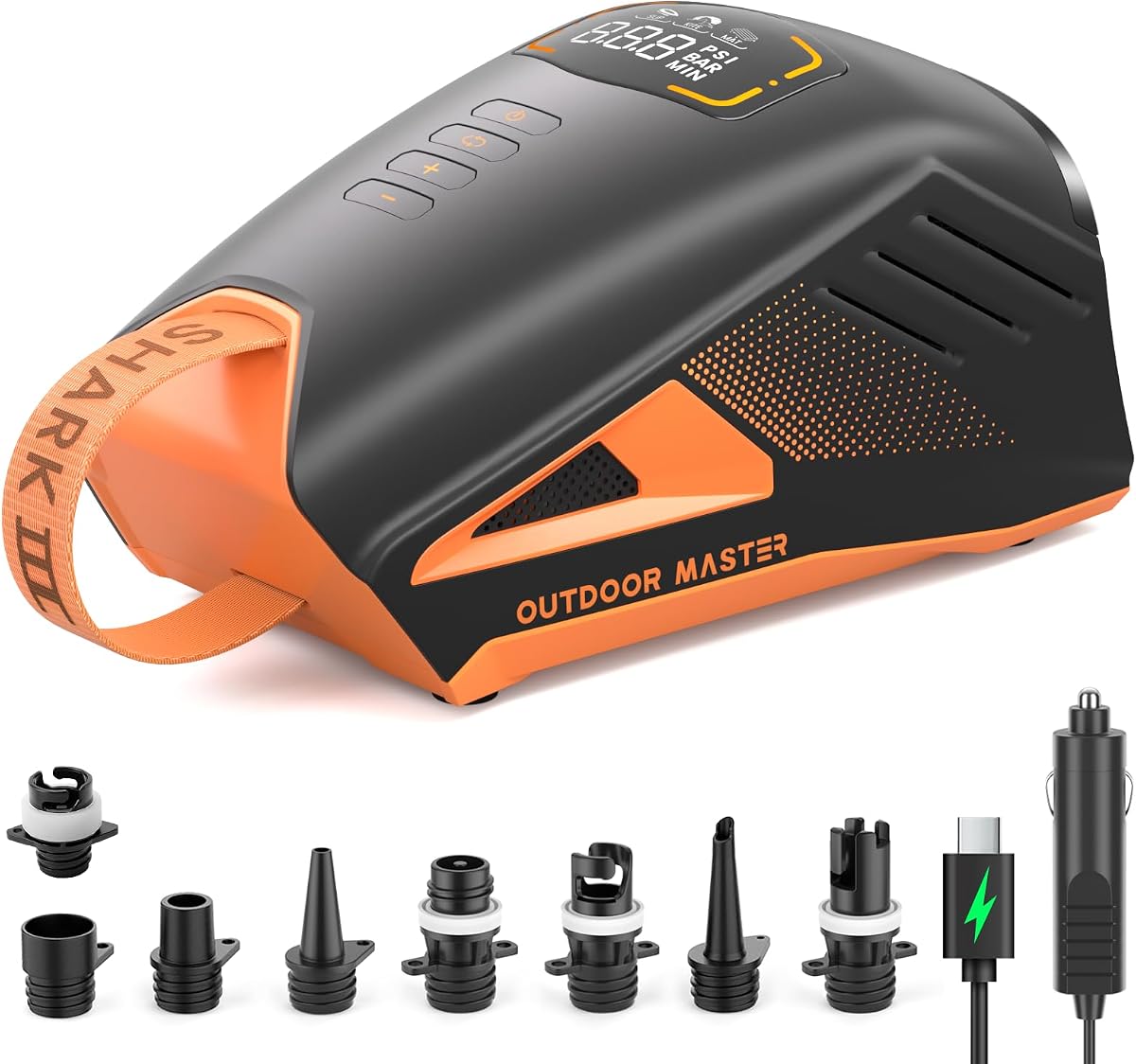
The OutdoorMaster Shark 3 is the speed-focused premium option in this guide. It has a 4.2 rating, a 74Wh rechargeable battery, and a maximum pressure of 20 PSI. Its most striking claim is a 3-minute-50-second inflation time for a 10.6-foot board at 15 PSI, with deflation reported in 1 minute 20 seconds.
We may earn a commission when you buy through this link, at no additional cost to you.
Its charging system supports 45W Type-C fast charging, with a full charge listed at 1 hour 40 minutes. A 12V or 15.8V DC input allows operation from compatible vehicles, and the unit can also serve as an emergency phone power bank. The built-in cooling system is designed to support four complete board inflation and deflation cycles from one charge.
The main drawbacks are size and noise. The pump weighs 3.2 kilograms and measures 18.7 by 17.2 by 32.3 centimeters, making it larger than the most travel-oriented choices. High-pressure operation can reach 88 dB, a meaningful consideration at quiet beaches and residential launch areas. Despite these factors, the speed advantage is substantial.
The Shark 3 is best for paddlers who prioritize minimal setup time, have a vehicle nearby, and expect repeated high-pressure use. It also makes sense for a premium travel kit where weight is acceptable in exchange for fast charging and rapid turnaround. For those who need a more compact design, the lighter cordless options may be preferable.
The three-stage inflation arrangement allows the pump to fill a board rapidly and then increase pressure efficiently. For users who want to launch without spending several minutes at the vehicle, this is the leading performance advantage in the ranking.
Type-C fast charging, vehicle input, and emergency power-bank functionality give the battery broader utility. The 74Wh capacity also supports multiple board cycles, making it suitable for shared outdoor equipment rather than a single-board outing.
We may earn a commission when you buy through this link, at no additional cost to you.
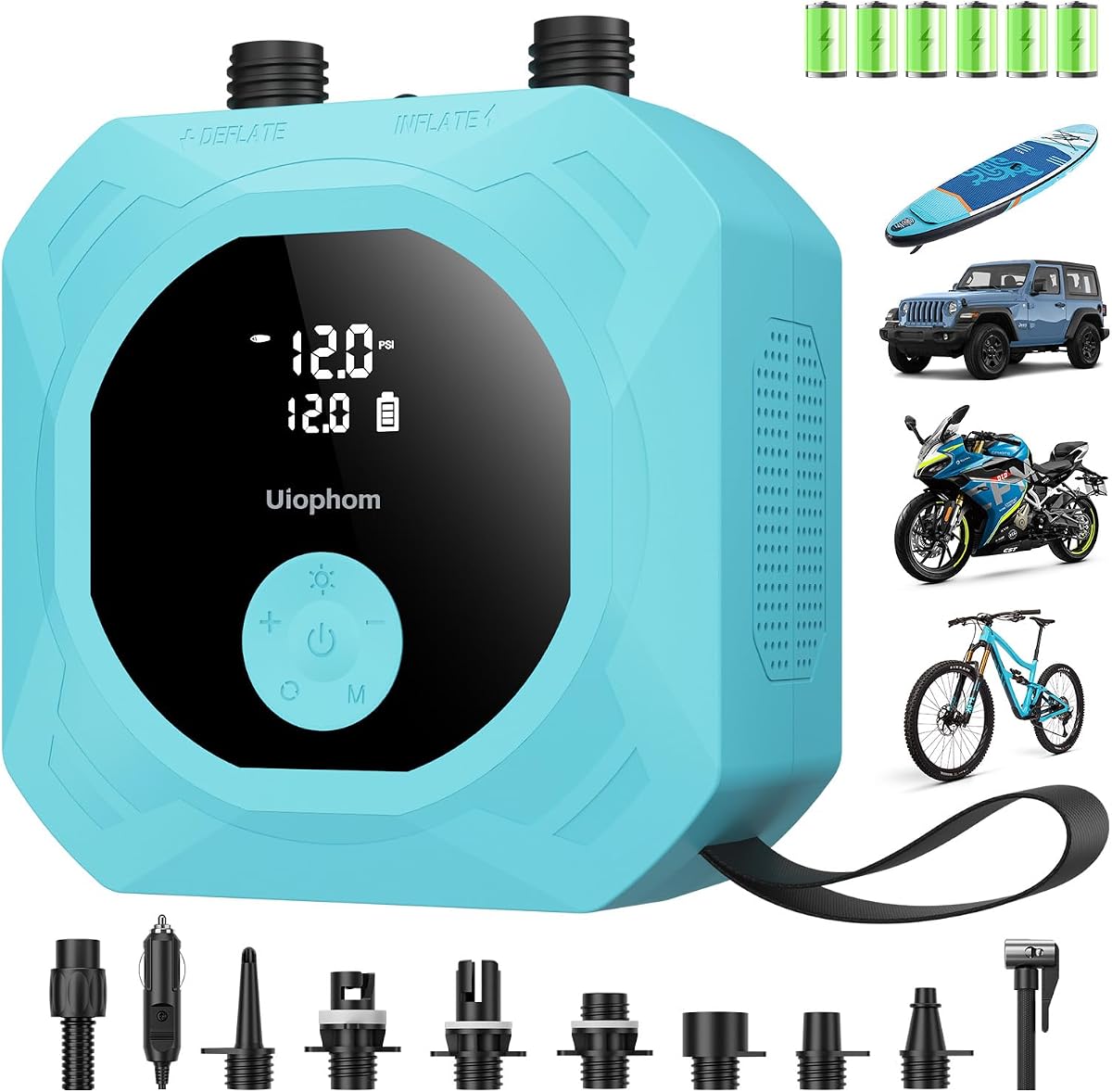
This 50 PSI pump is built around endurance, with a stated 15,600mAh battery made from six 2,600mAh cells. It has a 4.2 rating and can inflate a 10.6-foot board up to five times at 12 PSI or four times at 15 PSI on a single charge. A 12V DC connection is also available for extended operation.
We may earn a commission when you buy through this link, at no additional cost to you.
The dual-stage system provides 420 liters per minute for initial filling and 100 liters per minute for pressure refinement. A 10.6-foot SUP can reportedly reach 12 PSI in under seven minutes. The large LED screen shows both current and target pressure, while automatic shut-off stops inflation at the selected level. A multifunctional light supports low-light operation.
Its high capacity is the primary benefit and the primary bulk. The pump weighs three pounds, which remains manageable, but its 15,600mAh battery differentiates it from more compact options. The 18W charging system is also less powerful than the premium 45W arrangement offered by the OutdoorMaster Shark 3. A factory-reset procedure is available if readings appear abnormal.
Choose this model for frequent paddlers, instructors, or families who want fewer charges between boards. It also appeals to users who want one pump for SUPs, motorcycles, mountain bikes, air beds, boats, pool floats, and tents. The storage bag, built-in handle, and active cooling system support its role as a portable but high-capacity system.
The battery is designed for repeated full-board cycles, reducing dependence on a vehicle outlet. It is especially useful for long outings, group instruction, or locations where charging opportunities are limited.
The manufacturer recommends pressing the connector vertically into the valve until it clicks and then waiting for the final stable reading after inflation stops. Following those steps helps the pressure display provide a more dependable result.
We may earn a commission when you buy through this link, at no additional cost to you.
The 22 PSI rechargeable SUP pump emphasizes portability, weighing 2.73 pounds and including a carrying bag. It has a 4.0 rating and offers dual-stage inflation and deflation with automatic shut-off. According to the supplied information, it can inflate a 10.6-foot board to 12 to 15 PSI in approximately 8.5 to 10.5 minutes.
We may earn a commission when you buy through this link, at no additional cost to you.
Its dual power arrangement is useful: a built-in rechargeable battery supports cordless operation, while a 12V car outlet can provide extended use during group trips. The pump includes seven nozzles for paddle boards, kayaks, air mattresses, kites, and other inflatables. A digital pressure sensor tracks the selected target and stops inflation when the pressure is reached.
The upgraded metal pump core and temperature control are intended to cool more quickly and resist overheating. However, the pump is not designed around the premium category's fastest possible inflation. It also lacks the high-capacity battery and tire hose found in some higher-output models, so its versatility is focused more heavily on portable inflatables.
This pump is a good fit for a paddler who carries equipment on foot or uses a small vehicle with limited storage. The combination of low weight, cordless freedom, and vehicle backup makes it flexible for both shoreline and campsite setup. Choose it when portability matters more than extreme speed or multi-purpose tire inflation.
At 2.73 pounds, the pump is among the lightest models in the ranking and can move comfortably between a vehicle, campsite, and launch. The included bag keeps the unit and accessories together during transport.
The metal core is designed to dissipate heat more effectively and cool quickly. Smart temperature protection is a useful safeguard during longer inflation or deflation sessions.
We may earn a commission when you buy through this link, at no additional cost to you.
This 13,500mAh SUP pump combines a 4.2 rating with a useful mix of pumping and emergency functions. It reaches up to 20 PSI and uses dual-stage inflation with an initial 400-liter-per-minute flow and a 100-liter-per-minute precision stage. The supplied information reports 12 PSI in five minutes on a 10-foot board and 15 PSI in seven minutes.
We may earn a commission when you buy through this link, at no additional cost to you.
It is unusually versatile for a portable unit. Inflation, deflation, LED lighting, and a 5V/2A emergency power bank are integrated into the design. The battery is reported to handle four 10.6-foot boards at 12 PSI or three at 15 PSI. Type-C fast charging takes about four hours, and a 12V DC connector provides another power option.
The model is limited to 20 PSI and does not include the dedicated high-pressure tire capability of the 50 PSI selections. It is also larger than the lightest 22 PSI pump. Even so, the 400-liter-per-minute first stage delivers strong initial airflow, while the enlarged cooling system and ABS construction with a stainless-steel air intake are designed for durability.
This is a good match for campers and paddlers who want more than an air pump but do not need maximum tire pressure. The storage bag, gift box, flexible hose, seven nozzles, and English manual create a complete kit. Its power-bank capability adds particular value when the pump doubles as emergency equipment for a remote outing.
The 5V/2A power-bank function can be useful when a phone needs a charge during an outdoor trip. It gives the internal battery utility beyond inflation and can reduce the need to carry a separate power bank for some trips.
The supplied hose, seven replacement nozzles, storage bag, gift box, and manual cover the main needs for a portable setup. The bag also helps keep the relatively large accessory set organized.
We may earn a commission when you buy through this link, at no additional cost to you.
The AIRBANK Puffer Pro combines a 4.5 rating with one of the more compact designs in the guide. It weighs 2.78 pounds and measures 6.46 by 3.39 by 7.48 inches. Maximum pressure is 20 PSI, and the dual-stage system is rated at 400 liters per minute for initial filling and 75 liters per minute for high-pressure inflation.
We may earn a commission when you buy through this link, at no additional cost to you.
Its most distinctive feature is the differential barometer. The supplied information states that the digital reading can remain within plus or minus 0.2 PSI, compared with a plus or minus 1 PSI range for the reference used in the description. The pump is reported to reach 12 PSI on a 10.6-foot board in 7.5 minutes and 15 PSI in 9.5 minutes.
Portability is well handled through the nylon strap handle, compact measurements, and storage bag. Seven nylon-and-fiberglass nozzles cover paddle boards with C7 and D7 valves, wing foils, kites, kayaks, pools, swimming rings, and other inflatables. The main limitation is that the listing does not specify the rechargeable battery capacity, which makes runtime comparisons less direct.
The Puffer Pro is a strong choice for paddlers who prioritize accurate pressure display, compact dimensions, and a broad nozzle set. It is also supported by professional technical assistance and a stated two-year manufacturer warranty. Choose it when confidence in the pressure reading and easy portability matter more than having the largest stated battery.
The differential barometer is the model's defining feature. Its stated reading tolerance provides a useful reason to select this pump for users who want a precise target setting and digital confirmation throughout inflation.
Support for C7 and D7 valves, plus the included range of durable nozzles, allows the same pump to handle boards and other inflatables. The compact bag-and-handle format keeps the entire setup easier to transport.
We may earn a commission when you buy through this link, at no additional cost to you.
The right electric paddle board pump depends on where you launch, how many boards you inflate, and how much pressure or equipment versatility you need. Battery capacity, inflation stages, power connections, cooling, and carry weight should be weighed together.
Prioritize enough capacity for your group and a sensible charging method, not simply the largest stated number.
Choose faster stages when setup time is costly, and favor a simpler single-stage design only when basic value matters most.
For boards alone, 20 to 22 PSI is ample; choose 50 PSI when one pump must also handle tires.
Prioritize a readable live display, dependable auto-off, and clear instructions for obtaining a stable final reading.
Choose active cooling for repeated inflation, hot conditions, or group use; lighter single-board users can prioritize portability instead.
Measure your transport space and carrying comfort, especially if you walk from a parking area or pack into a small vehicle.
Confirm the valve type and every accessory you plan to inflate before purchasing.
For night launches or emergency preparedness, choose a model with a bright screen and dedicated lighting modes.
Begin by confirming the pump is fully charged if it has a built-in battery, or connect the appropriate 12V DC lead if you plan to use vehicle power. Inspect the hose and nozzle for damage, select the correct valve adapter, and check that the pump's maximum pressure is appropriate for the inflatable. Set a realistic target based on the board manufacturer's guidance rather than automatically selecting the highest available PSI.
Attach the nozzle securely to the pump hose, open the board's valve, and connect the fitting vertically until it locks into place. Start inflation and monitor the digital display. During dual- or multi-stage operation, the pump will move from higher-volume airflow to a lower-flow pressure stage as required. Auto-off should stop the motor at the target, but allow a few seconds for the final stable reading and check the board for firm, even inflation.
For storage, switch the pump to deflation mode and remove residual air before rolling or folding the board. Disconnect the hose, wipe away sand or moisture, and keep the pump in its bag with accessories organized. Recharge a battery fully before long-term storage, inspect cables for wear, and allow the unit to cool before packing it. Tire use may add heat and abrasion, so check the pump's pressure rating and avoid inflating beyond that limit.
Many inflatable paddle boards are commonly inflated to around 12 PSI, while some are designed for 15 PSI. The correct target depends on the board manufacturer's instructions, valve design, and rider requirements. Use the pump's digital display to reach the specified level, and allow the reading to stabilize after the motor stops. Do not select the pump's maximum pressure simply because it is available.
A cordless pump is usually more convenient at remote beaches, lakes, and campsites because it can be carried away from a vehicle. A 12V pump can provide continuous power and may appeal to users who inflate beside their car. The best choice depends on access to an outlet, desired portability, and whether the added weight of a battery fits your travel needs.
A single-stage pump uses one airflow setting for both volume and pressure. A dual- or three-stage system begins with a higher flow to fill the inflatable rapidly, then reduces airflow as pressure rises. The additional stages can improve efficiency and make high-pressure inflation more controlled, particularly for large paddle boards.
Timing depends on board size, target pressure, pump design, and whether the battery is fully charged. The products in this guide list times ranging from less than four minutes to approximately twelve minutes for a 10.6-foot board around 12 to 15 PSI. The fastest claims come from premium high-output models, while basic and vehicle-powered units generally take longer.
Some can, particularly the models with a 50 PSI maximum and dedicated tire mode. A tire hose and suitable adapters are included with those specified models. Always follow the vehicle or tire manufacturer's pressure guidance and avoid exceeding the pump's maximum rating. Boards do not require anything close to the pressure used for modern car tires.
The supplied product information does not specify operating-temperature limits, so cold-weather performance should be confirmed with the manufacturer. Batteries generally lose effectiveness in cold conditions, and a cold inflatable can require more air to reach the same pressure. Store the pump and board before use, keep the battery away from freezing conditions, and allow the pump to warm gradually if it has been exposed to a cold environment.
Complete deflation is generally useful for folding and compact storage, and every product in this guide includes a deflation function. First release the valve and allow the board to deflate, then attach the pump hose if the valve permits active evacuation. Make sure the board is fully dry before packing it, and avoid folding it while damp.
Recharge the battery fully before prolonged storage and recharge it again before using the pump after a long period of inactivity. Keep the unit dry and away from extreme heat, and use the supplied charging and vehicle connections as intended. The portable rechargeable model specifically advises a full charge before storage, which helps ensure available runtime on the next trip.
The KOSMEGAL SUP Pump is the budget-focused choice for vehicle-based paddlers who want a 20 PSI limit, automatic shut-off, and a broad nozzle set without paying for a large battery. The 50PSI three-stage pump is the best overall option because it combines a 12,000mAh battery, active cooling, three-stage inflation, and quick deflation. The OutdoorMaster Shark 3 is the premium selection for anyone who prioritizes exceptionally fast inflation and fast Type-C charging.
Most buyers should first decide between cordless and vehicle-powered operation, then match battery life to the number of boards they expect to inflate. Multi-stage airflow, active cooling, and a stable digital display become increasingly valuable for repeated use, while portability matters more for solo paddlers carrying gear away from a vehicle. Confirm valve compatibility and included accessories before ordering.
Product specifications, customer ratings, and availability can change, and current prices are worth checking before making a purchase. Use the comparison and reviews to identify the operating style that fits your routine, then review the latest listing for final details, included accessories, warranty information, and current availability.