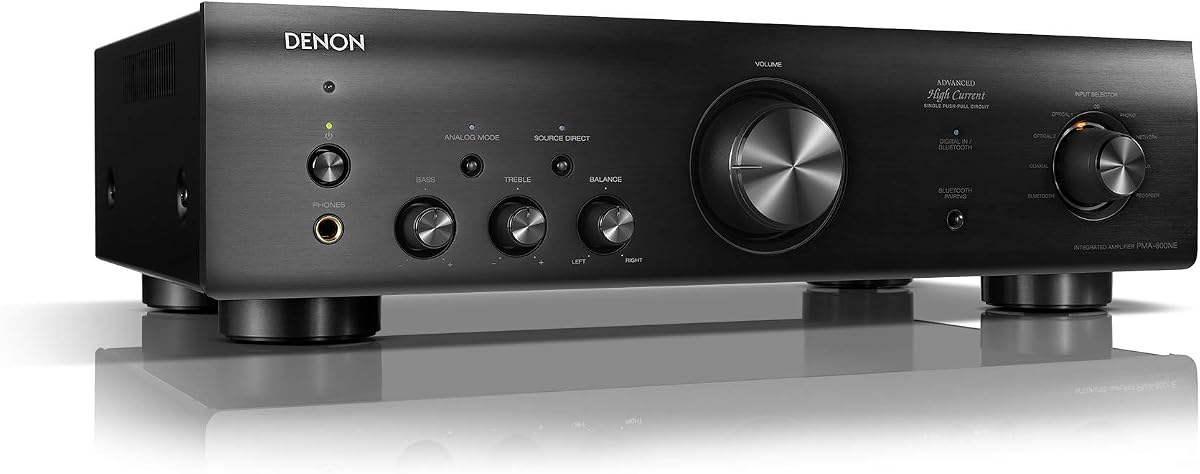
Denon PMA-600NE Bluetooth Stereo Amplifier
4.6Editor score
Slim 70-watt integrated design
Bluetooth and digital connectivity
Dedicated phono input
Advanced High Current circuitry
This guide compares the best hi end amplifier for audiophiles, including power, connectivity, streaming, DAC quality, phono support, and build.
A hi end amplifier for audiophiles is the central nervous system of a serious two-channel listening setup, shaping how music feels as well as how it sounds. The right model should provide clean power, faithful signal handling, useful connectivity, and enough refinement to reveal subtle differences between recordings without turning the buying process into a technical puzzle.
This roundup compares ten highly rated components across power output, amplifier architecture, speaker-driving capability, digital and analog connectivity, built-in DAC performance, vinyl support, streaming functions, and construction. It covers integrated amplifiers, network receivers, a compact streaming model, and a dedicated tube preamplifier, helping readers match equipment to a room, speakers, and listening priorities.
The selections reveal that audiophile performance is not defined by one feature alone. The list includes practical entry points, powerful hybrid designs, pure analog amplification, high-resolution network models, and a preamp for listeners who already own a power amplifier. Product configurations and current prices can change, so confirm specifications and availability before purchasing.
4.6Editor score

4.8Editor score

4.5Editor score
The following comparison highlights the most important differences in output power, signal routing, source support, and system flexibility. It also distinguishes complete amplifiers from the dedicated preamplifier at number nine.


The Marantz PM6007 combines a conventional integrated amplifier with an unusually broad collection of source options, earning a 4.3 rating and earning a place as a versatile starting point for audiophile systems. Its 45-watt rating is modest, but Marantz HDAM-SA3 discrete modules, a high-current power supply, and a built-in AK4490 DAC make it more interesting than a simple minimalist design.
We may earn a commission when you buy through this link, at no additional cost to you.
The amplifier accepts five analog inputs alongside coaxial and optical digital connections, so it can serve a turntable, CD player, television, computer, and network streamer. The MM phono stage uses FET circuitry and provides a convenient way to connect a moving-coil-compatible cartridge through an external step-up device. A subwoofer output, speaker A/B switching, and gold-plated terminals add everyday flexibility.
The main limitation is power. The PM6007 is best suited to reasonably efficient bookshelf speakers or a stereo pair in a normal-sized room. Its slim enclosure also means that it may not offer the thermal headroom of a large power amplifier, and the digital filter modes are selectable internally rather than exposed as a broad user-facing menu. Even so, the feature set is unusually complete for its class.
This is an appealing choice for a listener who wants Marantz character, a built-in DAC, vinyl support, and many connection options without moving to a large network receiver. It works especially well when speakers are sensitive and the listening room is not enormous. For more demanding loads, consider the higher-output Advance Paris models or a dedicated power amplifier.
The unusually broad input selection makes the PM6007 useful as a system hub. It can handle a traditional analog setup, a digital computer source, a TV, and a turntable without requiring several separate components.
The AK4490 DAC supports high-resolution files up to 192 kHz/24-bit and includes two selectable digital filter modes. That makes it a practical bridge between computer audio and a conventional speaker system.
We may earn a commission when you buy through this link, at no additional cost to you.
The Advance Paris A12 Classic is one of the most capable conventional integrated amplifiers in this guide, carrying a 4.8 rating and a stated output of 190 watts per channel into eight ohms. Its dual Class A/AB architecture is designed to combine the perceived warmth and natural presentation of Class A with the efficiency and dynamic reach of an AB design, making it suitable for speakers that need more control than a small desktop amplifier can provide.
We may earn a commission when you buy through this link, at no additional cost to you.
Connectivity is unusually extensive for a model centered on high-end amplification. Balanced XLR inputs sit alongside multiple RCA connections, optical and coaxial digital inputs, and USB-B, while an integrated phono stage supports vinyl playback. Oversized toroidal transformers and audiophile-grade internal components support the claim of a stable, low-noise power supply with strong dynamics.
The visual design is as distinctive as the circuitry. A brushed aluminum enclosure and twin VU meters give the A12 Classic a recognizable French aesthetic, though the large chassis may be less convenient in a compact media unit than a slim integrated model. It also does not foreground network streaming, so users of major streaming platforms may need an external streamer.
Choose the A12 Classic when speaker control, balanced connectivity, and substantial power matter more than a compact footprint or built-in wireless streaming. It is a particularly logical option for a dedicated two-channel room with medium-sized or demanding floorstanding speakers. The result is a confident, flexible centerpiece for an audiophile stereo system.
The stated 190-watt eight-ohm and 280-watt four-ohm output provides a useful margin for demanding loads. That power reserve can help an amplifier maintain composure on musical peaks while reproducing low-frequency transients with greater authority.
XLR inputs are valuable for reducing interference on longer cable runs, while USB-B, optical, coaxial, RCA, and phono connections cover most conventional source requirements. The A12 Classic can therefore anchor a broadly equipped analog and digital system.
We may earn a commission when you buy through this link, at no additional cost to you.
The Denon PMA-600NE delivers 70 watts at four ohms and carries a 4.6 rating, making it one of the strongest practical choices for a compact stereo system. Its Advanced High Current push-pull amplifier circuit is intended to balance usable power with detail, while the vibration-resistant enclosure and clean styling help it fit comfortably in a living room or listening area.
We may earn a commission when you buy through this link, at no additional cost to you.
The amplifier supports two optical inputs, one coaxial input, a phono connection, and Bluetooth with a built-in DAC. This allows it to serve a CD player, Blu-ray component, turntable, computer, and phone. A divided-circuit design can disengage the digital sections for a more purist analog listening path, which is a thoughtful feature in a product that also embraces wireless convenience.
Compared with the larger Advance Paris units, the Denon has less power and no network radio or integrated multi-room platform. Its stated output may also be insufficient for low-efficiency speakers in a large room or at higher playback levels. For most listeners using efficient bookshelf speakers, however, those limitations are unlikely to dominate the listening experience.
The PMA-600NE is a strong recommendation for anyone seeking a slim, attractive amplifier that can combine vinyl playback, digital sources, and Bluetooth without extensive setup. It also works well as a second-zone system. Buyers prioritizing network streaming should examine the Marantz Model M1, Model 60n, or Yamaha R-N2000A instead.
The slim form factor preserves shelf or cabinet space, while the source selection covers common listening habits. Digital, analog, and wireless playback can all be handled without adding a separate preamplifier or streaming box.
The divided circuit allows digital sections to be disengaged for analog listening. This design acknowledges purist preferences without sacrificing the practical appeal of Bluetooth and the amplifier's built-in conversion capability.
We may earn a commission when you buy through this link, at no additional cost to you.
The Marantz Model M1 combines 100 watts per channel with a compact enclosure and a 4.4 rating, offering a different kind of audiophile amplifier from the larger integrated models. Designed and built at Marantz's Shirakawa Audio Works facility in Japan, it places emphasis on musical performance while adding HEOS, AirPlay 2, Spotify Connect, Bluetooth, USB, and television integration.
We may earn a commission when you buy through this link, at no additional cost to you.
High-resolution PCM up to 24-bit/192 kHz and DSD support make it suitable for modern digital libraries. Marantz Musical Digital Filtering is included to shape oversampled digital playback, and a dedicated subwoofer output allows the Model M1 to serve a compact 2.1 system. HDMI eARC and onboard Dolby Digital+ decoding add a practical route for improving television sound.
Its compact dimensions and soft-touch finish, metal grille, and dimmable front panel make the Model M1 visually discreet. That same compactness means it does not offer the broad bank of analog inputs, balanced connections, and preamp outputs found on larger integrated amplifiers. Listeners with several legacy components may need a separate preamplifier or switcher.
The Model M1 is ideal for modern, space-conscious systems where wireless access and high-resolution playback are priorities. It can also extend an existing Marantz system or form part of a multi-room HEOS setup. It is less suited to a traditional audiophile installation built around numerous analog components and exposed preamp functionality.
The Model M1 places streaming, wireless playback, and television support in a housing small enough for a shelf or sideboard. Its understated design also allows it to blend into a living room rather than dominate it.
HEOS integration, AirPlay 2, Spotify Connect, Bluetooth, network playback, and USB support cover the major paths for contemporary listening. High-resolution PCM and DSD compatibility make the wireless model relevant to more than convenience-oriented use.
We may earn a commission when you buy through this link, at no additional cost to you.
The Marantz Model 50 is built around a pure analog signal path and earns a 4.8 rating, reflecting its appeal to listeners who want deliberate separation from digital circuitry. Its 70-watt high-current Class A/B amplifier uses Marantz HDAM SA-3 modules, which are designed to improve speed, bandwidth, and distortion behavior compared with standard integrated operational amplifiers.
We may earn a commission when you buy through this link, at no additional cost to you.
Six analog inputs include dedicated CD and phono connections, and the MM phono stage combines HDAM technology with JFET input circuitry. The amplifier also provides stereo preamp outputs, a subwoofer output, a power amplifier input, and speaker A/B switching. Those features make it a practical centerpiece that can grow as a system changes.
The deliberate absence of digital circuitry is the Model 50's defining feature, but it also defines its main limitation. It cannot directly handle streaming services, Bluetooth, HDMI, or high-resolution computer files. Buyers with those sources need a streamer, DAC, or television output connected to one of the analog inputs.
The Model 50 is an excellent match for a dedicated analog stereo system built around a quality DAC, CD player, tuner, or turntable. It suits listeners who value deliberate signal routing and expandability over wireless convenience. With its combination of 70 watts, substantial connectivity, and a strong rating, it is one of the most persuasive traditional audiophile amplifiers here.
Keeping digital circuitry out of the Model 50 avoids the potential interference and complexity associated with combining multiple conversion and control domains. The result is a direct path from source to amplifier section.
Preamp outputs, a power amp input, subwoofer connection, and speaker switching allow the amplifier to serve as a central component. A separate streamer or DAC can be added without replacing the core analog amplifier.
We may earn a commission when you buy through this link, at no additional cost to you.
The Yamaha R-N2000A Silver is a network receiver built for listeners who want high-resolution conversion and streaming within one chassis. It carries a 4.4 rating and uses an ESS SABRE ES9026PRO Ultra DAC, while the USB DAC function supports DSD 11.2 MHz native playback and PCM up to 384 kHz.
We may earn a commission when you buy through this link, at no additional cost to you.
Its toroidal power transformer is intended to support a spacious, stable presentation with low noise, while MusicCast provides access to familiar music services and a connected listening ecosystem. The receiver format also suggests broader home-audio flexibility than a purely minimalist integrated amplifier, although the supplied information places particular emphasis on hi-fi music playback.
Because it is a receiver, buyers who want nothing more than a simple stereo path may find its broader control concept unnecessary. Its physical size may also be substantial for a small listening shelf. Those considerations should be weighed against the benefit of combining streaming, high-resolution playback, and robust network functionality in one unit.
The Silver R-N2000A is well suited to a modern home system where digital files and streaming are central. It pairs particularly well with a high-quality pair of stereo speakers and a television when more complex home entertainment is desired. Listeners focused exclusively on two-channel analog purity can instead consider the Marantz Model 50.
The dedicated USB DAC path supports very high PCM rates and native DSD playback, reducing the need for a separate converter. This simplifies the system while preserving access to detailed digital files.
A toroidal transformer and MusicCast integration position the R-N2000A as a complete contemporary source component. It is particularly useful for listeners who want network audio and high-resolution conversion under one roof.
We may earn a commission when you buy through this link, at no additional cost to you.
The Marantz Model 60n brings HDAM amplification together with HEOS networking in a relatively compact integrated amplifier. Its 4.4 rating reflects a balanced proposition for modern listeners, while support for high-resolution audio up to 24-bit/192 kHz makes it suitable for a range of digital music libraries.
We may earn a commission when you buy through this link, at no additional cost to you.
Built-in Wi-Fi, AirPlay 2, Bluetooth, and HEOS give the amplifier broad access to networked services and local content. Roon Ready support can appeal to subscribers of that platform, while a 2.1-channel output allows a subwoofer to complement the main stereo speakers. The dedicated subwoofer connection is especially useful for smaller speakers in a larger room.
The supplied product information is concise and does not describe the amplifier's output power or full analog input selection in the same detail as several other models. As a result, it is important for buyers to verify the full rear-panel specification and ensure that it provides the required connections for their existing components.
The Model 60n is a good candidate for a modern two-channel system that prioritizes streaming, wireless access, and a relatively compact footprint. It also complements an existing Marantz setup. Buyers needing multiple analog inputs, balanced connections, or a more fully specified power amplifier may prefer the Model 50, A12 Classic, or A10 Classic.
The Model 60n concentrates on stereo playback, streaming, and subwoofer flexibility rather than home-theater surround channels. That focus can make it easier to integrate in a dedicated music room.
HEOS, AirPlay 2, Bluetooth, and Roon Ready support place familiar network functions alongside Marantz's HDAM circuitry. It is a practical option for listeners transitioning from separate streamers to a more integrated music system.
We may earn a commission when you buy through this link, at no additional cost to you.
The black Yamaha R-N2000A is the same network receiver platform as the silver model, distinguished here by its finish and its 4.5 rating. It combines an ESS SABRE ES9026PRO Ultra DAC with USB playback reaching 384 kHz and native DSD 11.2 MHz, making it one of the strongest digital-conversion options among the streaming-capable products in the guide.
We may earn a commission when you buy through this link, at no additional cost to you.
MusicCast enables network streaming, and the toroidal power transformer supports a stable, spacious presentation. The phono input and integrated DAC reduce the need for multiple source components, while the receiver design can serve as a broader centerpiece than a simple two-channel integrated amplifier.
As a premium and relatively large component, it may demand more shelf space than the compact Marantz streaming models. It also requires network configuration and compatible source services, so the ownership experience extends beyond simply connecting speakers. Buyers who want a visually understated black component may find that finish easier to coordinate with other dark-finish equipment.
Choose the black R-N2000A when high-resolution digital playback, streaming, and a substantial home-audio chassis are all priorities. It is especially compelling for a modern system serving both music and television. Its specification set is more oriented toward digital convenience than the strictly analog approach of the Marantz Model 50.
The ES9026PRO Ultra DAC and support for 384 kHz PCM and DSD 11.2 MHz create a clear technical advantage for listeners who maintain a broad collection of high-resolution files.
With streaming, phono playback, and digital conversion built in, the receiver reduces the number of separate boxes required. It can form the center of a more comprehensive home listening setup.
We may earn a commission when you buy through this link, at no additional cost to you.
The Flyinsky PRT13A-BAL is a dedicated balanced vacuum tube preamplifier rather than a complete power amplifier. It holds a 5.0 rating and is designed with reference to a classic US Audio Research balance circuit, using two ECC82 6N11 tubes in a fully balanced architecture for listeners who already own or intend to own a suitable power amplifier.
We may earn a commission when you buy through this link, at no additional cost to you.
Its power supply uses a capacitor array and high-voltage MOS regulation, a design intended to provide low internal resistance, strong dynamic transient behavior, and low operating noise. A customized 50VA pure copper tape-shielded R-Core transformer supplies the left and right channel DC filament through independent stabilization, helping reduce crosstalk. The chassis is sandblasted aluminum, adding a refined physical finish.
This product has a different role from the other selections. It does not directly power speakers, so it needs a compatible power amplifier with balanced inputs. A listener interested in the warm presentation and adjustability often associated with tube preamplifiers will need to account for that additional equipment and the space it requires.
The PRT13A-BAL is most appropriate for a mature two-channel system with a dedicated power stage, balanced source components, and a preference for tube-based signal control. It is particularly interesting to listeners who value a dedicated analog control component rather than an all-in-one integrated amplifier. Everyone else should focus on the nine complete source-and-amplification products in the roundup.
The fully balanced design preserves the benefits of balanced source-to-power-amplifier connections. It is best used with components that offer matching XLR outputs and inputs.
The capacitor-array supply, MOS regulation, and independently stabilized filament supply are designed to control the noise and crosstalk that can challenge a tube preamp. The result is a more specialized approach to analog control.
We may earn a commission when you buy through this link, at no additional cost to you.
The Advance Paris A10 Classic combines 130 watts per channel into eight ohms with a 4.5 rating, offering a balanced middle ground between modest integrated amplifiers and the more powerful A12 Classic. Its Class A and Class D hybrid architecture is designed to blend the musical character of analog Class A amplification with the efficiency and control of digital amplification.
We may earn a commission when you buy through this link, at no additional cost to you.
The output rises to 190 watts per channel into four ohms, giving it useful authority with lower-impedance speakers. Dual toroidal transformers, premium components, and meticulous French engineering are central to the design. Connectivity includes RCA and XLR analog inputs, optical and coaxial digital inputs, USB-B, and a built-in phono stage.
The amplifier does not include major streaming platforms or Wi-Fi, so it is better suited to a system assembled around physical sources, a television, or an external streamer. Its brushed aluminum front panel and retro-inspired VU meters give it a strong visual identity, while the relatively large chassis may need more shelf space than a compact model.
The A10 Classic is a good recommendation for listeners who want more robust power than entry-level integrated amps provide but do not need the A12's extra output. It suits medium-sized rooms, efficient floorstanding speakers, and systems that value balanced inputs, digital connections, and vinyl support. A dedicated streamer can complete the source side.
Combining Class A and Class D allows the design to balance musical presentation with power efficiency. The result is a potentially useful compromise for speakers spanning conventional and lower-impedance loads.
Dual toroidal transformers and premium internal components support low-noise operation and stable delivery. XLR, RCA, optical, coaxial, USB-B, and phono connections provide a flexible foundation for a mixed-source system.
We may earn a commission when you buy through this link, at no additional cost to you.
The right audiophile amplifier depends on speaker efficiency, room size, source flexibility, and preferred signal path. Power ratings matter, but architecture, connectivity, thermal capability, and ease of use are equally important.
Begin with the speakers rather than the amplifier's headline wattage. A model rated at 45 or 70 watts may work beautifully with sensitive bookshelf speakers, while less efficient floorstanding models may benefit from the greater current capability of a 130-, 190-, or 280-watt design. Check the manufacturer's minimum speaker recommendations, impedance requirements, and sensitivity, then consider the room's dimensions and preferred listening levels.
Prioritize stable, controlled output rather than a large number on paper. A clean 70-watt amplifier is preferable to an underpowered or poorly controlled alternative. Choose more power when the speakers demand it, the room is large, or dynamic headroom is important.
Decide how the amplifier fits into the source chain. A pure analog model offers deliberate signal routing, while a digital or hybrid design can accept computer files, streaming services, television audio, and wireless playback. Some products include a DAC but omit network functions, so verify the complete feature set before deciding.
Pure analog suits listeners with separate DACs, streamers, or other sources. Integrated digital models are more convenient for modern homes, but a built-in DAC does not automatically guarantee better performance than an external one.
HEOS, MusicCast, AirPlay 2, Bluetooth, Spotify Connect, and Roon Ready support can make an amplifier substantially easier to use with phones, computers, and networked services. Consider whether multi-room control is important and whether the required platform works with the rest of the system. Wireless convenience should complement, rather than dictate, the quality of the analog output stage.
A dedicated external streamer can add flexibility later. Choosing an amplifier with network support now is useful when the goal is a unified and remotely controlled music system.
For digital listening, look for clear maximum-resolution specifications rather than vague references to high-resolution audio. The Marantz PM6007 includes an AK4490 DAC, the Yamaha R-N2000A uses an ESS SABRE ES9026PRO Ultra, and the Model M1 supports high-resolution PCM and DSD. These distinctions matter when the music library includes files above CD quality.
Also check which inputs carry high-resolution playback. USB, network, and streaming paths may have different format limits, and a coaxial or optical input may impose its own ceiling. Use the supplied specifications to confirm that the intended source can take full advantage of the converter.
A built-in phono stage is convenient for turntables with a moving-magnet cartridge. It does not automatically support every moving-coil cartridge, which may require a separate phono stage or step-up transformer. Inspect the grounding arrangement and available connection type to ensure compatibility with the turntable.
A dedicated MM stage can simplify the system and provide a convenient route for vinyl. Listeners with specialized cartridges should verify compatibility before treating the integrated phono stage as sufficient.
Balanced XLR connections can be valuable in systems with long cable runs, ground loops, or several linked components. The A12 Classic, A10 Classic, and PRT13A-BAL provide balanced paths, while the latter is a preamplifier and requires a separate power amplifier. Preamp outputs and power-amp inputs allow a system to be divided or expanded later.
Balanced operation requires compatible equipment at both ends. It should not be treated as a universal upgrade if source components provide only single-ended outputs.
A larger chassis can support heavier transformers, better heat management, and more elaborate connectivity, but it also consumes shelf space and may dominate a listening room. The A12 and A10 Classics are visually substantial, whereas the Denon PMA-600NE and Marantz Model M1 suit more compact installations. Consider ventilation, furniture load, and whether the equipment will be moved often.
Choose the largest model your space can comfortably support, not simply the one with the most features. A smaller amplifier that is easy to position and power correctly may suit a listener better than a flagship that crowds the room.
Premium components, vibration-resistant construction, aluminum finishes, and toroidal transformers can improve confidence in longevity and signal stability, although specifications do not reveal every aspect of long-term reliability. Look for clear warranty information, replaceable parts, and established service support. Tube products also require more consideration regarding warm-up time and tube availability.
Treat specifications as one part of the decision rather than a guarantee of sonic character. Speaker pairing, source quality, room acoustics, and system setup can influence the final result as much as the amplifier itself.
Place the amplifier on a stable, ventilated surface with adequate clearance around its vents. Connect speakers while the unit is powered off, check polarity, and use compatible speaker cables and terminated connectors. Keep the amplifier away from heat, direct sunlight, moisture, and power conditioners or surge protectors that could interfere with its performance.
Begin with moderate volume and use the front-panel controls or remote to select the correct source. For the Marantz PM6007, Denon PMA-600NE, and other models with digital inputs, configure the DAC and sampling settings according to the source. On the Advance Paris amplifiers, use the VU meters as a visual guide to power behavior while listening to familiar recordings at normal levels.
Clean the enclosure with a soft, dry cloth and avoid spraying cleaner directly onto controls or connectors. Do not open a chassis containing high-voltage components. For the Flyinsky PRT13A-BAL, allow the tubes to warm up naturally and follow the manufacturer's guidance for tube replacement and bias checks. For every product, update network software when applicable and preserve the original packaging and documentation for future service.
The correct wattage depends mostly on speaker sensitivity, impedance, room size, and listening preferences. Efficient bookshelf speakers may sound well with 45 to 70 watts, while less efficient floorstanding speakers may benefit from 130 watts per channel or more. The amplifier should also control the speakers cleanly, so power ratings should be considered alongside the manufacturer's compatibility guidance.
Neither architecture is automatically better for every listener. A hybrid or digital amplifier can offer convenient streaming, wireless playback, and high-resolution conversion, while a pure analog design can provide a direct and straightforward signal path. The best choice depends on the sources already in the system and whether convenience or analog purity is the higher priority.
A built-in DAC is useful if the system includes a computer, network streamer, television, or other digital source and you want fewer components. It may be unnecessary if the system already includes a dedicated DAC or relies entirely on analog sources. Comparing a well-integrated internal DAC with a separate converter can prevent avoidable spending.
No. A preamplifier controls volume and source selection but does not directly provide the power needed to drive ordinary passive speakers. The Flyinsky PRT13A-BAL in this guide must be paired with a compatible power amplifier. Integrated amplifiers combine preamplification and power amplification in one enclosure.
A balanced XLR connection can reduce the influence of interference and ground-related problems, particularly over longer cable runs. The benefit is most relevant when both source and destination support balanced operation. Connecting a balanced input to an unbalanced source offers fewer of the stated advantages, so matching the complete signal path matters.
A built-in phono stage is important because turntable signals are too low-level for a normal line input and require correct equalization. Most integrated phono stages are designed for moving-magnet cartridges. Moving-coil users may need a compatible stage or a step-up transformer, so cartridge requirements should be checked before purchase.
Large rooms and low-efficiency speakers usually benefit from an amplifier with more power and current capability. The Advance Paris A12 Classic and A10 Classic provide substantially greater stated output than the smaller models, which can help preserve dynamics and bass control. Room size alone is not the only factor, so speaker sensitivity and intended volume remain essential.
There is no universal requirement to leave an amplifier powered at all times. Leaving it on can reduce warm-up time, but modern digital and solid-state amplifiers are generally designed for normal power-management practices. Tube equipment may benefit from regular use, while switching off when the system is not being used can conserve energy and extend component life.
The Denon PMA-600NE stands out as the most approachable connected option, the Advance Paris A12 Classic offers the strongest combination of power and specialist integrated amplification, and the Yamaha R-N2000A provides premium high-resolution conversion and network functionality. Each serves a different system, so the strongest performer on paper is not automatically the best match for every room and source.
Start with speaker requirements, then decide whether the amplifier should emphasize analog purity, modern streaming, high-resolution conversion, balanced connectivity, or sheer power. A dedicated preamp such as the Flyinsky PRT13A-BAL is sensible only within a larger system that already includes a suitable power amplifier. Otherwise, one of the integrated or network models offers a more straightforward path to a complete stereo setup.
Specifications, configurations, and current prices can change, and the availability of different finishes or regional variations may also affect a purchase. Confirm the amplifier's current specifications, input availability, speaker compatibility, and warranty terms before ordering. The links in this guide point to the relevant product listings for the latest product details.
