
APC BX1500M
4.4Editor score
1500VA, 900W capacity
Ten protected outlets
68-minute runtime at 100W
Replaceable battery support
Our high wattage UPS battery backup guide compares capacity, runtime, wave quality, outlets, protection, monitoring, and expandability for every use case.
A high wattage UPS battery backup protects computers, network equipment, home-office systems, and other essential electronics from outages, voltage fluctuations, and surges. The right unit combines useful load capacity, clean output, enough outlets, clear monitoring, and a runtime appropriate for the equipment it supports.
This guide compares ten UPS systems ranging from 1500VA home and small-office models to 5000VA equipment for demanding installations. We evaluated capacity, continuous wattage, output waveform, voltage regulation, outlet configuration, battery support, monitoring options, connectivity, warranty coverage, and expansion potential.
Each review explains the most suitable use for its product while noting meaningful limitations. The recommendations reflect the supplied specifications and customer ratings, not personal testing. Product availability, configuration choices, accessories, and retailer terms can change, so verify the current listing before purchasing.
4.4Editor score
4.0Editor score
4.8Editor score
The comparison covers output capacity, waveform, runtime or battery flexibility, protection features, and monitoring capabilities. It is designed to help buyers match a UPS to a home office, network installation, small server room, or other high-power application.


The CyberPower CP1500PFCLCD is a 1500VA, 1000W line-interactive UPS with a customer rating of 4.5. It combines sine wave output, automatic voltage regulation, a detailed color LCD, and twelve NEMA 5-15R outlets. That balance makes it a practical option for a well-equipped home office, network corner, or small workstation where both power quality and outlet flexibility matter.
We may earn a commission when you buy through this link, at no additional cost to you.
Its strongest feature is the combination of pure sine wave output and Active PFC support. The output is designed to operate safely with Active PFC and conventional power supplies, reducing the compatibility concerns that can accompany basic simulated-wave units. Six outlets provide battery backup and surge protection, while six additional outlets provide surge protection for peripherals that do not need to remain running during an outage.
The multifunction color LCD gives users a clearer view of load, battery, and power conditions than a basic indicator light. The screen tilts up to 22 degrees for easier reading, and the included PowerPanel Management Software adds control options. A right-angle NEMA 5-15P plug on a five-foot cord may also simplify placement behind a desk or near other powered equipment.
The tradeoff is that this is primarily a local-use model. Unlike the CyberPower PR1500LCD, its supplied specifications do not describe a removable LCD or optional remote management card. It also does not advertise a clearly stated runtime figure, so buyers needing a specific number of minutes should calculate their load carefully. Even so, the 1000W rating, clean output, abundant outlets, and three-year warranty make this a strong general-purpose choice.
Pure sine wave output and Active PFC compatibility make this a sensible match for modern computers, workstations, routers, and telecom equipment. AVR corrects minor voltage fluctuations without unnecessarily transferring the load to battery power.
The color LCD presents detailed operating information at a glance, while the front USB-A and USB-C ports provide convenient charging for phones and tablets without occupying an AC outlet.
We may earn a commission when you buy through this link, at no additional cost to you.
The APC BX1500M is a 1500VA, 900W UPS rated at 4.4 stars by customers. It targets homes and small offices that need dependable protection for computers, routers, televisions, storage devices, and smart-home equipment. Its standout advantage is the stated runtime of up to 68 minutes at a 100W load, which is meaningful for users who want more than a brief grace period during an outage.
We may earn a commission when you buy through this link, at no additional cost to you.
The outlet arrangement includes five battery-backup outlets and five surge-only outlets, giving users a clear way to separate essential equipment from less critical peripherals. Built-in coaxial and Ethernet surge protection adds another layer for connected home entertainment and networking components. AVR corrects low-voltage brownouts and surges without draining the battery, helping preserve runtime when the incoming supply is unstable.
A user-replaceable battery improves long-term maintenance flexibility. The APCRBC124 battery is sold separately, allowing service without the unit being discarded when its internal battery reaches the end of service. The LCD displays battery charge, estimated runtime, load capacity, and input voltage, while ENERGY STAR certification indicates high operating efficiency.
The main limitation is its modified sine wave output. That format works with many standard electronics, and the listed Active PFC compatibility is valuable for modern gaming PCs, but sensitive or specialized equipment may benefit more from pure sine wave output. It is also important to remember that the replacement battery is an additional purchase. For a straightforward home setup that prioritizes runtime, replaceability, and comprehensive outlet protection, the BX1500M remains a well-rounded choice.
The stated 68-minute runtime at a 100W load gives this model a useful advantage for routers, modems, network storage, and other moderate-load systems. Actual runtime changes with load, battery condition, and the equipment connected.
The replaceable APCRBC124 battery and information-rich LCD support long-term ownership. Users can maintain the unit more easily and check important operating details without relying on indicator lights alone.
We may earn a commission when you buy through this link, at no additional cost to you.
The CyberPower PR1500LCD combines a 1500VA and 1500W rating with pure sine wave output, earning a 4.6 customer rating. It is aimed at corporate servers, storage appliances, network devices, and telecom installations, making it more of a small-infrastructure product than a basic desktop backup. Its unusually high listed wattage for a 1500VA unit offers useful headroom for equipment with substantial startup or operating demand.
We may earn a commission when you buy through this link, at no additional cost to you.
One particularly distinctive feature is the removable multifunction LCD. It connects through an attached 4.5-foot cable and can be relocated when the UPS itself is installed in a difficult-to-reach location. This gives system builders better access to battery, load, and power information. The unit also supports an optional RMCARD205 for remote management, although that card is not included.
Eight NEMA 5-15R outlets all provide battery backup and surge protection. This is simpler than the split backup-and-surge arrangements found on many competing models, but it also means fewer outlets dedicated strictly to surge suppression. A six-foot cord and straight NEMA 5-15P plug provide straightforward installation in common North American environments.
The main limitation is that the 1500W maximum should not be confused with a guarantee of 1500W runtime. Actual backup time depends heavily on the connected load, and high-consumption devices will reduce it quickly. Buyers needing remote management must also plan for the optional card. Even so, the combination of sine wave output, Active PFC support, flexible display placement, and a high power rating makes this a strong option for an experienced small-server or network installation.
The extendable LCD is valuable when the UPS sits inside a cabinet, below a desk, or near other difficult-to-access equipment. Operators can keep important status information visible without moving the main unit.
The 1500W rating gives this model more continuous-power potential than typical 1500VA units limited to 900W. That makes it a better candidate for storage, servers, and network infrastructure with higher load requirements.
We may earn a commission when you buy through this link, at no additional cost to you.
The CyberPower CP1500AVRLCD3 is a 1500VA, 900W intelligent LCD UPS with a customer rating of 4.5. It is designed for workstations, networking devices, and home-entertainment equipment. Its defining convenience is the combination of twelve NEMA outlets, a color display, and two front USB charging ports, which should appeal to users who want one box to handle protection, diagnostics, and low-power charging.
We may earn a commission when you buy through this link, at no additional cost to you.
Six outlets provide battery backup and surge protection, while six provide surge-only protection. This gives users flexibility to keep a computer, monitor, and network equipment alive during an interruption while protecting less essential devices from spikes. The six-foot input cord and standard NEMA 5-15P plug make the unit familiar to install in a home or office.
The color LCD presents immediate information about battery and power conditions and can warn users about potential issues before they interrupt operation. Automatic voltage regulation corrects minor fluctuations without transferring to battery mode, reducing unnecessary battery use during common voltage variations. Front USB-A and USB-C ports add convenient charging for mobile devices.
Its main compromise is the use of simulated sine wave output. This is suitable for many conventional computers, network products, and consumer electronics, but it is less appropriate for sensitive loads that specifically require pure sine wave power. The 900W limit also requires buyers to total their connected wattage carefully. For a desktop setup with many accessories and a preference for monitoring, outlet count, and convenient charging, this is a capable general-purpose UPS.
Splitting the twelve outlets between backup and surge-only positions makes it easy to decide which devices should remain operational. The result is practical control without requiring separate power strips for basic home-office systems.
The color display gives users immediate information about operating conditions. This can help identify overload, battery, or input-power issues before they become a larger interruption to the connected setup.
We may earn a commission when you buy through this link, at no additional cost to you.
The APC BR1500MS2 delivers 1500VA and 900W in a pure sine wave design, with a customer rating of 4.5. It is a strong fit for modern PCs, network-attached storage, and higher-end home-office equipment. Unlike basic UPS systems that rely on simulated sine wave output, this model supplies a waveform better suited to sensitive electronics and Active PFC computer power supplies.
We may earn a commission when you buy through this link, at no additional cost to you.
The stated runtime reaches 73 minutes at a 100W load. That figure gives users time to save work, complete a task, or maintain essential network services during a brief outage. Six outlets offer battery backup, four offer surge-only protection, and dedicated coaxial and Ethernet surge protection covers common data or media lines. AVR corrects high or low input voltage without switching to battery, helping reduce exposure to chronic fluctuations.
The angled LCD reports remaining runtime, load, and battery health, while a silenceable alarm keeps notifications useful without being intrusive. A replaceable APCRBC163 battery supports maintenance over the life of the system. USB-A and USB-C charging ports are also included for devices that can use the dedicated charging connections.
The main limitation is its 900W maximum output. A pure sine wave UPS does not automatically provide more capacity, so users should inventory startup loads and avoid operating a gaming system, large display, and other demanding appliances at the same time. The battery replacement must also match the specified model. Subject to those considerations, the BR1500MS2 is one of the most balanced options for a modern, electronics-heavy home office.
Pure sine wave output is the defining advantage of this model. It provides a more consistent supply for modern computers, NAS drives, and sensitive home-office electronics than a simulated-wave alternative.
The 73-minute runtime at 100W is useful for short outages, and the LCD shows runtime, load, and battery condition live. Users can make better shutdown decisions instead of relying on a basic alarm.
We may earn a commission when you buy through this link, at no additional cost to you.
The GOLDENMATE 1500VA/1000W Lithium UPS is a line-interactive, pure sine wave system rated at 4.2 stars. Its distinguishing feature is the 51.2V, 5.8Ah LiFePO4 battery pack, which the manufacturer states can last more than ten years and support over 3,000 charge cycles. That makes it especially interesting for owners who want to reduce recurring battery replacement and maintenance.
We may earn a commission when you buy through this link, at no additional cost to you.
The UPS provides 1500VA and 1000W of capacity, with eight NEMA 5-15P outlets offering both surge protection and battery backup. Wider spacing between outlets is intended to accommodate different plug shapes. A built-in battery management system monitors the lithium pack, and the intelligent LCD shows real-time battery and power information. The integrated control also supports muting the alarm and turning the display on or off.
A communication port and supplied USB cable enable automatic PC shutdown through Windows settings. The front panel includes one Type-A and one Type-C USB charging port with a combined 10W output, which is sufficient for many phones, tablets, and smartwatches. Pure sine wave output, AVR, and compatibility with computers, workstations, network devices, and telecom equipment broaden the intended use.
There are meaningful caveats. The larger battery and transformer make the enclosure bigger and heavier than comparable lead-acid designs. Input is limited to 90–140V AC, and generator power may not be recognized if its voltage, frequency, waveform, or grounding is unsuitable. Because the system may remain in battery mode under those conditions, the battery may not recharge. Buyers with standard 110V utility service can still find the long-life battery design compelling.
The LiFePO4 pack provides over 3,000 stated charge cycles and a lifespan of more than ten years. It reduces the routine replacement cycle associated with conventional lead-acid batteries.
The included communication cable and Windows integration can initiate an automatic shutdown during an outage. This adds operational value for desktop systems that would otherwise remain powered without coordinated shutdown.
We may earn a commission when you buy through this link, at no additional cost to you.
The APC SMT2200C is a 2200VA, 1980W pure sine wave line-interactive UPS with a customer rating of 4.2. It is designed for users who need more than a standard 900W desktop UPS, such as small offices, network cabinets, or equipment rooms supporting several high-draw devices. A 10% power margin over a 2000W load target provides useful installation flexibility.
We may earn a commission when you buy through this link, at no additional cost to you.
The unit accepts a NEMA 5-20P input and supplies eight NEMA 5-15R and two NEMA 5-20R outputs. Pure sine wave output is suitable for modern computers, network equipment, and other sensitive electronics. AVR adjusts high and low input voltage to a safer level, helping preserve the battery and reduce unnecessary battery-mode operation.
APC SmartConnect is the standout management feature. It provides remote visibility through a secure portal, automatic notifications, firmware updates, and access to advanced support services. The supplied information states that qualifying registered units are offered a six-month free trial of SmartConnect. This makes the model more appropriate for distributed installations where hands-on monitoring is inconvenient.
Its physical scale is substantial: the listed dimensions are 22.01 by 15 by 30 inches, and the weight is 134 pounds. That makes it closer to a small rack-oriented installation than a compact desktop accessory. APC also lists a three-year repair-or-replace warranty excluding the battery, plus a two-year battery warranty. Buyers who need remote monitoring, higher wattage, and pure sine wave output will find this model especially relevant.
SmartConnect can provide notifications, firmware updates, and support features through a secure portal. This is valuable where the UPS is installed in a closet, server room, or remote office.
Eight NEMA 5-15R and two NEMA 5-20R outlets support both standard and higher-current plugs. The NEMA 5-20P input also makes it more appropriate for appropriately rated dedicated circuits.
We may earn a commission when you buy through this link, at no additional cost to you.
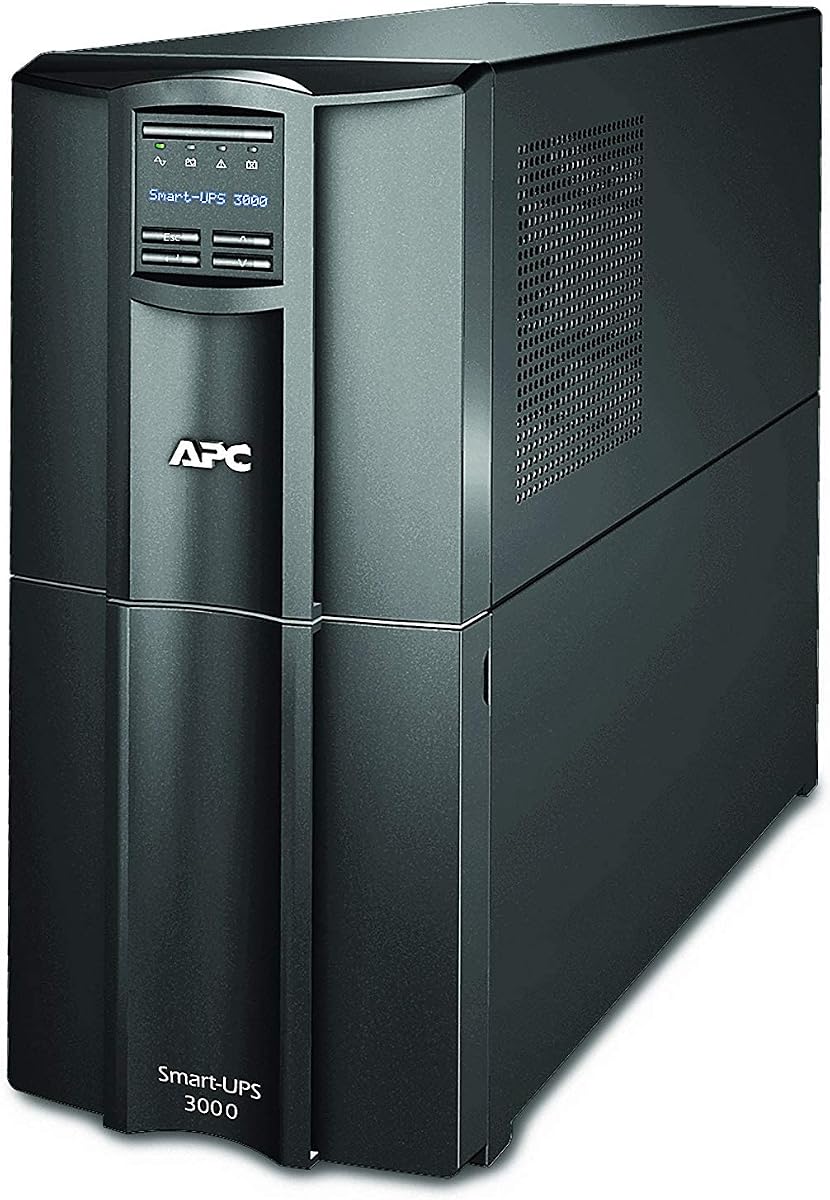
The APC SMT3000C is a 3000VA, 2700W pure sine wave UPS and one of the strongest capacity choices in this guide. It suits small business environments, server rooms, and serious home-office installations that need enough headroom for computers, displays, network infrastructure, and other high-power equipment. Its 4.0 customer rating reflects a useful product, but it is not the highest-rated option here.
We may earn a commission when you buy through this link, at no additional cost to you.
The UPS provides eight NEMA 5-15R and two NEMA 5-20R outlets. Its NEMA 5-30P input indicates that installation should be planned around a suitable higher-current circuit rather than an ordinary household receptacle. Automatic voltage regulation adjusts unusually high or low incoming voltage, helping stabilize the supply and preserve battery life.
SmartConnect adds secure remote monitoring, automatic notifications, firmware updates, and advanced support access. The supplied information notes a six-month free trial for qualifying units purchased or registered after August 1, 2023. This makes the model attractive for administrators who want visibility into a unit located away from the primary workstation.
The chief drawback is the infrastructure required. A 3000VA system is physically substantial and expects a more serious electrical connection than a 900W desktop UPS. The listed warranty is three years for repair or replacement excluding the battery, with two years for the battery, and the connected-equipment protection policy is listed at $150,000. Buyers should verify the intended circuit and equipment requirements carefully. For those who need true high-wattage capacity and remote management, it is a compelling fit.
A 2700W continuous rating gives users room for several connected devices and substantial startup loads. It is more appropriate for a complete office or equipment installation than a small desktop backup.
SmartConnect supports remote status awareness, alerts, and firmware management. These functions can simplify support and reduce the need for routine on-site inspections.
We may earn a commission when you buy through this link, at no additional cost to you.
The CyberPower PR5000RTXL2UC is a 5000VA, 5000W pure sine wave UPS built for servers, storage systems, networking hardware, and other sensitive high-load electronics. It is the highest-capacity model in the guide, offering a 5000W continuous output rating and dedicated high-current receptacles for enterprise equipment. It is best viewed as infrastructure for a serious installation rather than a conventional home-office accessory.
We may earn a commission when you buy through this link, at no additional cost to you.
Its output includes two 6-20R outlets, one L6-20R locking outlet, and one L6-30R locking outlet. The hardwired terminal-block input and included L6-30P power cord point toward a dedicated electrical setup. The EBM-ready design can support extended runtimes with compatible battery modules sold separately, allowing an installer to build runtime around a particular outage response plan.
A rotatable and tiltable multifunction LCD provides real-time status, configuration options, and control management. Built-in cloud monitoring adds remote visibility and alerts, while optional RMCARD205 support provides an additional remote-management path. Pure sine wave output supports both Active PFC and conventional power supplies, and AVR corrects minor fluctuations without unnecessary battery use.
Because this model lacks a customer rating in the supplied data, its evaluation must rely on specifications rather than customer feedback. It also requires more technical planning than a plug-and-play desktop UPS, particularly because of its hardwired input and high-current receptacles. For an installer supporting substantial server or network loads, however, the 5000W capacity, EBM expansion, and monitoring features create a clear advantage over smaller units.
The 5000W rating supports much denser installations than the 900W and 1000W models in this guide. It is designed to run multiple substantial pieces of IT and networking equipment simultaneously.
Hardwired input, locking outlets, cloud monitoring, and EBM readiness make this a professional-installation product. Compatible external battery modules can extend runtime as operational requirements grow.
We may earn a commission when you buy through this link, at no additional cost to you.
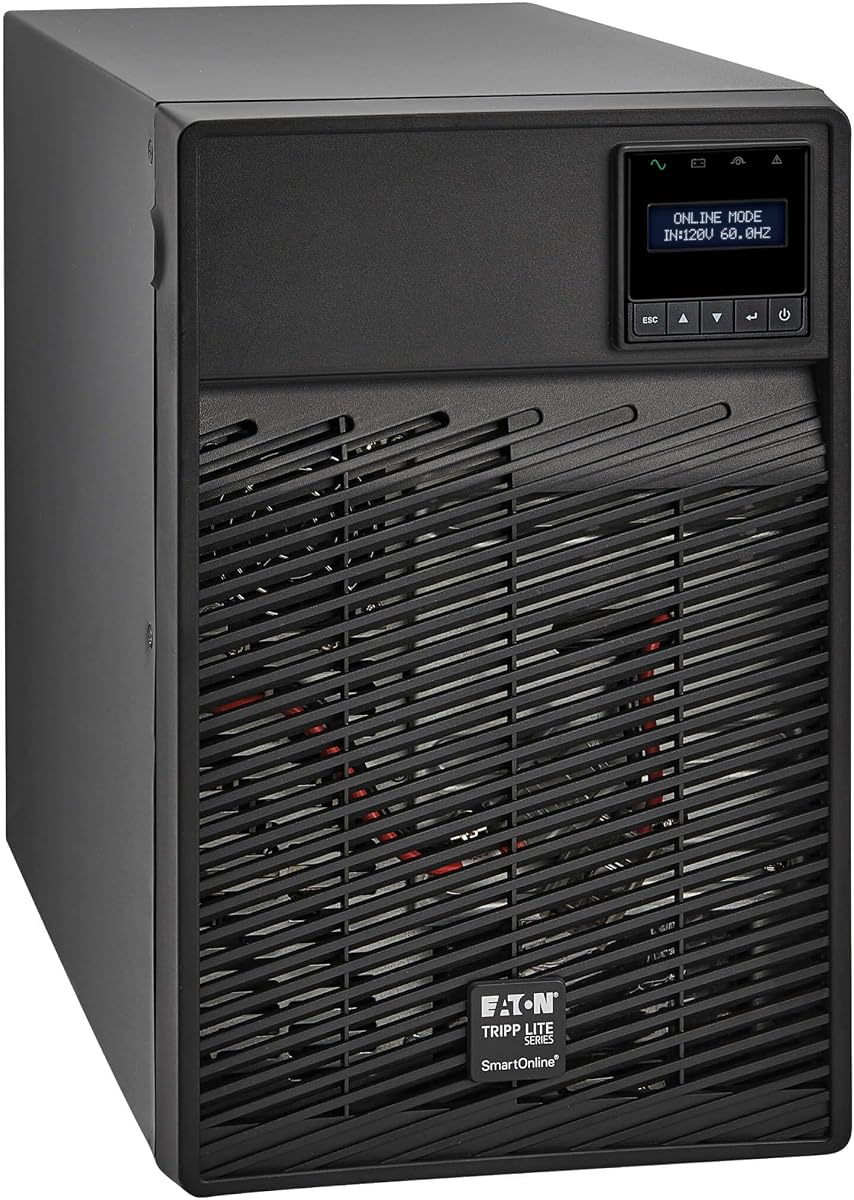
The Eaton Tripp Lite SU2200XLCD is a 2200VA, 1800W SmartOnline double-conversion UPS with a customer rating of 4.8, the highest among the listed products. Its defining feature is true online operation with pure sine wave output and zero transfer time to battery. This makes it a compelling choice for mission-critical equipment that cannot tolerate even a brief transfer interruption.
We may earn a commission when you buy through this link, at no additional cost to you.
Seven AC outlets include six 5-15/20R receptacles and one L5-20R. They are divided into two load banks of three outlets each, and the banks can be controlled individually through the software interface. This enables remote rebooting of equipment that has locked up, a useful feature for unattended systems and distributed installations.
The internal battery set provides 13 minutes of support at a 900W half load and 4.5 minutes at the 1800W full load. Hot-swappable batteries and expandability improve serviceability, while a 97% efficiency economy mode can reduce energy use in appropriate operating conditions. USB and DB9 ports support unattended, data-saving shutdown through Tripp Lite's PowerAlert software. Optional network-management cards broaden remote-control capabilities.
The trade-off is runtime under a full load, which is brief, and the complexity of double-conversion architecture compared with a basic line-interactive UPS. Users also need to confirm that the controlled outlet groups align with the equipment they intend to connect. For servers, network appliances, or other systems that prioritize uninterrupted transition and controlled shutdown over extended runtime, this is the strongest premium option in the guide.
True online operation and zero transfer time keep the load supplied by the UPS conversion system rather than allowing a brief switch to battery. This is valuable for sensitive equipment where even a small interruption can cause disruption.
Two independently controlled outlet banks can help isolate or reboot locked-up devices. Hot-swappable batteries and expansion support make the unit easier to maintain as its runtime requirements evolve.
We may earn a commission when you buy through this link, at no additional cost to you.
Choosing a high wattage UPS requires balancing usable continuous output, backup duration, waveform quality, electrical requirements, outlet layout, monitoring, and serviceability. The most important first step is to identify the equipment that must remain online and calculate a realistic load rather than selecting solely by VA capacity.
Start by identifying the maximum continuous wattage of every device that may operate at the same time. A UPS rated in VA can support different wattages depending on power factor, and starting surges can also matter for computers and other electronics. Compare the calculated load with the UPS's maximum wattage and leave reasonable headroom rather than operating continuously at the rating limit. A unit that is technically powerful but overloaded under normal conditions will provide less useful protection and may not behave as intended.
Runtime depends on total load, battery condition, inverter efficiency, and the UPS design. A runtime figure quoted at 100W can help compare smaller systems, but it will not apply to a heavily loaded installation. Estimate how long essential equipment should remain online, then use the manufacturer's runtime chart or calculator if available. Longer runtime may require more battery capacity, external battery modules, or a larger unit with a different battery architecture.
Pure sine wave output is the most consistent form and is appropriate for sensitive electronics, modern Active PFC systems, network storage, and specialized equipment. Simulated sine wave output is generally more economical and can support many conventional PCs and consumer devices, but it may be unsuitable for some audio equipment, motors, medical-adjacent electronics, or other sensitive loads. Review the full list of connected devices and choose a waveform that meets their requirements.
A high-wattage UPS may require a dedicated circuit or a higher-current receptacle than an ordinary desktop model. Confirm the input plug, supported input voltage, grounding, and the recommended branch circuit before ordering. Some units use hardwired terminal blocks and are better suited to professional installation than ordinary plug-and-play placement. Also consider whether the UPS can be positioned near the equipment without creating inconvenient or unsafe cable runs.
Count the outlets required for computers, monitors, routers, network storage, televisions, and other essential devices. Some models divide outlets between battery-backed and surge-only positions, which is useful for separating critical equipment from accessories. Others provide surge protection for coaxial, telephone, or Ethernet lines. Check plug shape and spacing as well as quantity, because bulky power adapters can block neighboring receptacles even when the nominal outlet count appears sufficient.
A detailed LCD is useful for checking load, remaining runtime, battery status, and input conditions without a computer. For networked equipment, cloud or remote monitoring can provide outage alerts, firmware updates, and visibility into systems located in another room or building. Some advanced features require an optional management card, while others use USB, DB9, or communication connections for local shutdown control. Confirm both the hardware capability and whether required software or accessories are included.
Traditional lead-acid systems may require periodic battery replacement, while lithium iron phosphate systems can offer a much longer service life and higher cycle count. Replaceable batteries improve maintenance flexibility in either design. Review the stated battery warranty separately from the overall product warranty, identify the compatible replacement part, and determine whether swapping can occur without creating unnecessary downtime. For extended-run systems, external battery compatibility is equally important.
AVR helps correct sustained minor overvoltage or undervoltage without switching to battery, which can improve stability and preserve battery life. True online double conversion provides continuous conversion and zero transfer time, making it appropriate for the most interruption-sensitive applications. For networked equipment, individually controlled outlet banks can support remote recovery of frozen systems. These features should be matched to the operational importance of the connected load rather than treated as interchangeable specifications.
Place the UPS on a stable, dry surface with ventilation around the housing and enough clearance for its power cord and connected equipment. Confirm input voltage and circuit requirements before energizing it. Connect only devices that fit within the continuous load limit, reserve battery-backed outlets for equipment that genuinely needs to remain running, and use surge-only outlets for less critical accessories.
After installation, check the display and set alarm, shutdown, and communication options as appropriate. For models that support USB or automatic PC shutdown, install the supplied management software and test the connection before an actual outage. A short planned test by placing the UPS into battery mode can confirm that critical equipment receives power and that linked computers begin their configured shutdown procedure.
Test the unit periodically according to the manufacturer's guidance, inspect cables for damage, and keep air vents clear. Check battery condition, estimated runtime, and load readings on the display. Recharge the unit after a controlled test and review warning alarms promptly. Use only the specified replacement battery, and have hardwired or higher-current installations handled by a qualified professional when the installation requires it.
High wattage refers to the maximum continuous power the UPS can supply to connected equipment, expressed in watts. It is separate from VA capacity, which combines apparent power and power factor. Buyers should calculate their expected connected load and compare it with the UPS's supported wattage, allowing headroom for startup surges and future equipment.
Pure sine wave output is generally the more consistent and compatible choice, especially for modern Active PFC computers, network storage, and sensitive electronics. Simulated sine wave output can support many ordinary home and office devices at a more basic level. The best choice depends on the equipment connected rather than on waveform quality alone.
Runtime depends on load, battery condition, unit efficiency, and battery design. A quoted figure at 100W does not apply to heavier equipment, and a heavily loaded UPS will run for a much shorter period. Use the manufacturer's runtime estimates and compare them with the load you intend to place on the unit.
It depends on the model and its input rating. Small desktop units may use a standard NEMA plug, while larger systems can require NEMA 5-20P, NEMA 5-30P, or even a hardwired connection. Confirm the input, voltage, grounding, and circuit recommendations for the exact model before installation.
No. Battery-backed outlets should be reserved for equipment that needs to remain powered during an outage, such as a router, network switch, main computer, or NAS. Monitors, speakers, printers, and other peripherals can often use surge-only outlets, reducing load and preserving longer runtime for critical devices.
A line-interactive UPS generally uses AVR and transfers to battery when a significant problem occurs. A double-conversion UPS continuously runs incoming power through an online conversion stage and provides zero transfer time to battery. Double-conversion models provide a stronger protection path for sensitive or mission-critical equipment.
Inspection frequency depends on the battery chemistry, age, operating temperature, discharge cycles, and manufacturer guidance. Lead-acid batteries commonly need replacement sooner, while a LiFePO4 system can support a much larger number of stated cycles. Use the display's battery-health information and replace the battery with the exact compatible model when required.
Several models include dedicated Ethernet or coaxial surge protection in addition to protected AC outlets. This helps guard network-connected devices from surges arriving through data cables. It does not replace a properly selected UPS for the attached equipment, but it adds useful protection for the complete connection.
The APC BX1500M stands out as the best budget-oriented option, with ten protected outlets, replaceable battery support, useful runtime, and detailed monitoring. The APC SMT3000C is the stronger choice for buyers who require more continuous capacity and SmartConnect remote visibility, while the Eaton Tripp Lite SU2200XLCD is the premium recommendation for true online double-conversion protection, zero transfer time, controlled outlets, and hot-swappable batteries.
Prioritize the needs of the connected equipment rather than selecting on capacity alone. A high VA rating without adequate wattage can still be insufficient, and a sophisticated UPS adds little value if it cannot support the required waveform, circuit, runtime, or monitoring setup. For a typical home office, a 1500VA model with pure sine wave output may be enough; for server rooms and high-density installations, 2200VA to 5000VA systems provide a more appropriate margin.
Before ordering, confirm the exact load, plug and circuit requirements, outlet count, battery replacement process, accessory needs, and current retailer listing. Product configurations and availability can change, and optional management cards, replacement batteries, and external battery modules are separate from many base systems.