
FNIRSI LCR-ST1
4.3Editor score
Three selectable test frequencies
Pointed and hook heads included
Automatic test-record storage
Color display for clear readings
Our Lcr Meter Tweezer guide compares ten models for accuracy, ranges, frequencies, displays, accessories, and repair workflows to help you choose with
An LCR meter tweezer combines a component tester with the handling convenience of precision tweezers, making it especially useful for inspecting tiny surface-mount parts. A capable model should identify components quickly, provide meaningful electrical parameters, and maintain dependable contact on densely populated circuit boards.
This guide compares ten LCR meter tweezers based on the specifications and feature descriptions supplied for each product. The comparison covers measurement ranges, test frequencies, accuracy claims, display behavior, probe designs, calibration options, data export, battery features, and the accessories included with each kit.
Each review explains who the product is best suited for, along with its most useful strengths and practical limitations. Ratings and product details can change over time, and current prices, availability, accessories, and manufacturer revisions should be checked before making a final purchase decision.
4.3Editor score

5.0Editor score

4.7Editor score
The table below provides a side-by-side view of all ten LCR meter tweezers, with particular attention to frequency selection, electrical ranges, measurement sophistication, and the physical features that affect everyday component inspection.
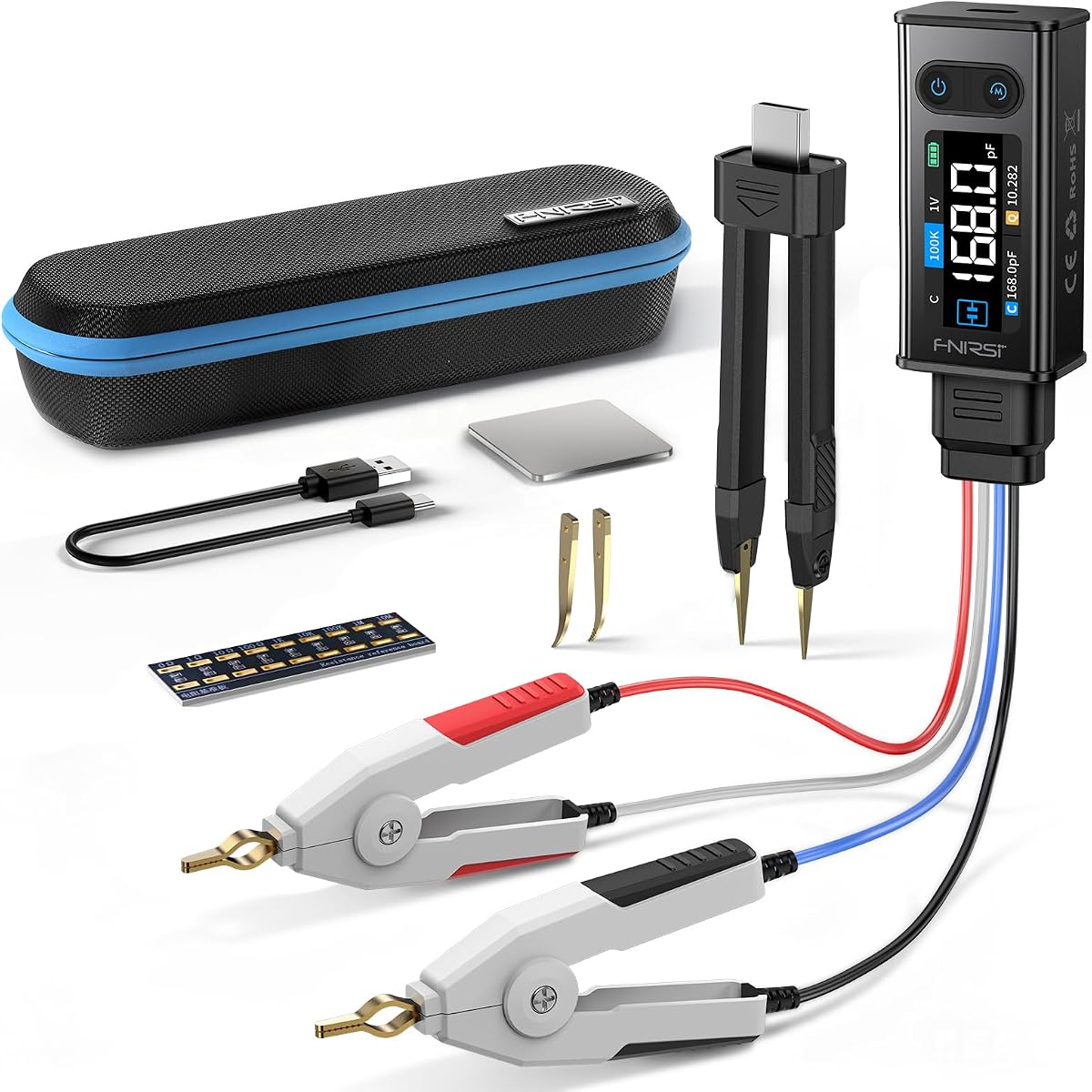
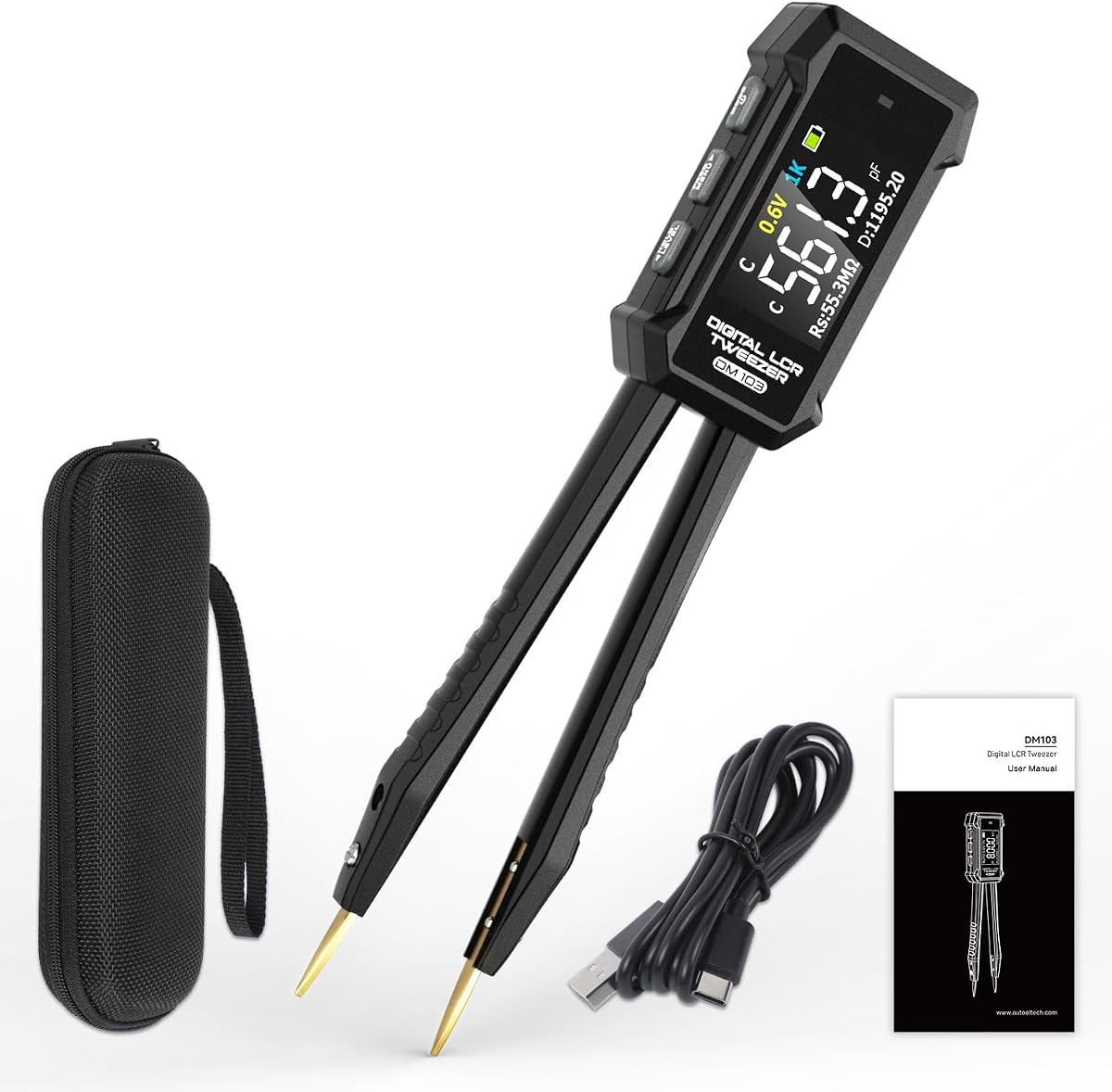


The FNIRSI LCR-ST1 is a portable LCR meter tweezer designed for component identification, circuit-board troubleshooting, SMD repair, and recovering parts from used boards. Its supplied 4.3 rating reflects a generally capable entry point, while the feature set goes beyond simple resistance checks by including capacitance, inductance, diode, impedance, quality factor, and ESR readings. The 1.14-inch HD color display makes the instrument practical for technicians who want a compact tool that can present a component's principal value and secondary parameters together.
We may earn a commission when you buy through this link, at no additional cost to you.
Its strongest attraction is the combination of automatic recognition, two test voltages, and three selectable frequencies. Resistance coverage extends from 10 milliohms to 10 megaohms, capacitance from 1 picofarad to 22 millifarads, and inductance from 1 microhenry to 10 henries. Pointed and hook-style heads allow the user to tailor the contact arrangement to different package shapes. Records can be saved automatically and transferred to a computer through Excel-compatible export, which reduces the inconvenience of documenting many inspections.
The most important compromise is the fixed, non-rotating screen. Some users may also prefer a model with 100kHz testing, voltage measurement, or a rotatable display. Those omissions make the LCR-ST1 less attractive for advanced RF characterization or workflows where the tweezer orientation changes constantly. Even so, the available ranges, head options, and export capability make it a well-balanced choice for routine electronics repair and component inspection.
Choose the FNIRSI LCR-ST1 when you want a capable tweezer-style tester without moving into the premium professional category. It is especially suitable for SMD repair, board-level diagnostics, education, and inspecting salvaged components. For users who only need a dependable way to clamp, identify, and measure common passives, its feature balance is more important than the absence of higher-frequency analysis.
The included pointed and hook heads are a meaningful advantage because tiny SMD resistors, capacitors, and inductors are not always comfortable to test with the same probe geometry. Switching heads can improve access in confined areas or around irregular component leads, although actual contact quality remains dependent on cleanliness and technique.
Automatic record storage and Excel-compatible transfer are especially useful for technicians performing incoming inspection, batch testing, or documenting repairs. The feature turns the meter from a spot-check instrument into a tool that can support a more organized documentation workflow.
We may earn a commission when you buy through this link, at no additional cost to you.
The FNIRSI LCR-ST2 expands the capabilities of the traditional bench LCR meter by putting resistance, capacitance, inductance, diode, continuity, and voltage testing into a portable tweezer format. Its supplied rating is 4.3, but the more consequential detail is the frequency range: 100Hz, 120Hz, 1kHz, 10kHz, and 100kHz can be selected for different classes of components. It is intended for both SMD and through-hole work, which broadens its appeal beyond a dedicated surface-mount inspection tool.
We may earn a commission when you buy through this link, at no additional cost to you.
The LCR-ST2 offers four RMS test levels of 0.1, 0.3, 0.6, and 1.0 volts. Series and parallel modes can help reduce the influence of parasitic effects, a meaningful consideration when measuring small capacitances or inductances. It displays primary R, C, L, and Z values together with secondary X, D, Q, and phase-related information. Kelvin clips, gold-plated tips, and hooks support different contact arrangements, while the plug-and-swap design makes changing the probe configuration straightforward.
Some of the advanced controls and parameter combinations may be unnecessary for a beginner, and the 1.47-inch display, although clear, is not exceptionally large. The integrated 300mAh rechargeable battery and automatic power-off function help with portability, while a strong rear magnet provides a practical way to secure the instrument on a work surface. No battery-life duration is supplied, so users needing all-day operation should verify it in real conditions.
Overall, the LCR-ST2 is a strong choice for repair technicians and serious hobbyists who want 100kHz testing without relying on leads and bench equipment. Its interchangeable contact accessories, multiple excitation levels, and voltage function make it more versatile than many compact alternatives. It is particularly well suited to inspecting a mixture of SMD and through-hole components across a broad frequency range.
Five frequency choices and four excitation levels give users more control over how a component is evaluated. This is useful when a default test condition does not produce a useful reading or when a particular part behaves differently under changing test signals.
Kelvin clips, gold-plated tweezer tips, and hooks make the package adaptable to different component sizes. The quick-swap arrangement also reduces the need to keep separate lead-based instruments open on a crowded electronics bench.
We may earn a commission when you buy through this link, at no additional cost to you.
The Smart Tweezers ST5S is positioned as a professional LCR and ESR meter, and its supplied 4.7 rating is among the strongest in this group. The headline specification is 0.1 percent accuracy, accompanied by a calibration certificate and Swiss-made 24K gold-plated test leads. Those details are especially relevant to buyers who care about repeatability, stable contact, and documented instrument performance rather than simply identifying a component.
We may earn a commission when you buy through this link, at no additional cost to you.
Automated component identification helps shorten the measurement process, while automatic and manual C, R, L, Z, and ESR modes provide both convenience and control. The ClearValue OLED display presents information on a compact screen suitable for a handheld tweezer format. Spare test leads reduce downtime if the original set becomes damaged or contaminated, and the included portable and clam-shell cases improve protection during storage or transport.
The supplied information does not list the ST5S's exact test-frequency choices, voltage levels, or minimum capacitance and inductance limits. That makes it harder to compare its measurement envelope directly with models that publish detailed ranges. For buyers performing advanced characterization, those omissions should be checked against the manufacturer's documentation before purchase. Its premium positioning also makes it less compelling for casual users who only need a rough component check.
The ST5S is best for professional electronics work, laboratory use, component validation, and users who value calibration documentation and durable contact accessories. Its 0.1 percent accuracy claim, included certificate, and spare leads justify a premium-oriented recommendation for users whose work depends on confidence in the result. For a simple first tweezer tester, one of the more affordable models would be more economical.
A stated accuracy figure is most useful when supported by calibration records and dependable probes. The included certificate and gold-plated leads give this model a stronger laboratory and service-bench identity than products that provide accuracy claims without comparable supporting details.
Spare leads and dedicated cases protect an instrument that is likely to be carried between work locations. These practical additions can matter as much as headline specifications when a precision tester is used regularly.
We may earn a commission when you buy through this link, at no additional cost to you.
The Pro1-100KHz combines smart SMD tweezers with precision-focused LCR measurements, and it holds a supplied rating of 5.0. Its most attractive combination is explicit accuracy by measurement type: 0.1 percent for resistance and 0.2 percent for both inductance and capacitance. Rather than relying on one generic accuracy statement, it gives users a clearer picture of where the instrument's precision claims apply.
We may earn a commission when you buy through this link, at no additional cost to you.
Five test frequencies—100Hz, 120Hz, 1kHz, 10kHz, and 100kHz—and three test voltages—0.2Vrms, 0.5Vrms, and 1.0Vrms—offer flexible measurement conditions. Resistance spans 20 milliohms to 10 megaohms, capacitance covers 0.1 picofarad to 10 millifarads, and inductance extends from 10 nanohenries to 1 henry. The frequencies make it useful for small capacitors and inductors, while diode testing adds a familiar troubleshooting function beyond basic LCR work.
The main limitation is the upper inductance limit of 1 henry, which is much lower than the 10-, 25-, or 60-henry ranges offered by several cheaper models. Its capacitance maximum is also 10 millifarads. Consequently, the Pro1 is strongest for precision-focused small-component analysis rather than testing very large magnetic components or high-capacitance electrolytic parts. The supplied warranty period is one year, with lifetime support also listed.
For technicians, engineers, and advanced hobbyists who want a high-accuracy instrument with fine frequency selection, the Pro1-100KHz is an excellent choice. Its strong rating and published limits make it easy to recommend as an all-around precision tweezer. Buyers whose work regularly involves very large inductors should instead choose a model with a higher inductance ceiling.
Separate resistance, inductance, and capacitance accuracy figures make the performance claim easier to interpret. This is helpful when comparing instruments for a particular component class rather than relying on a single headline percentage.
Multiple frequencies and test voltages make it possible to observe how a component responds under different excitation conditions. That flexibility is valuable when diagnosing questionable parts or comparing a measured value with an expected value.
We may earn a commission when you buy through this link, at no additional cost to you.
The DM103 LCR Meter Tweezer is a digital SMD tester centered on automatic component recognition, broad inductance coverage, and user-defined calibration. Its supplied rating is 4.2, placing it among the more approachable models in the group. It can identify resistors, capacitors, and inductors quickly while measuring L, C, R, D, Q, and Rs values, and it also supports diode and continuity testing for common bench diagnostics.
We may earn a commission when you buy through this link, at no additional cost to you.
A stated basic accuracy of 0.5 percent is supported by calibration with standard resistors across ten selectable ranges. That approach is intended to address long-term accuracy drift by allowing the user to compare the instrument against known references. Three frequencies—100Hz, 1kHz, and 10kHz—and three test voltages of 0.1, 0.3, and 0.6 volts are available. The measurement range is unusually broad, extending from 10 milliohms to 10 megaohms, 1 picofarad to 20 millifarads, and 1 microhenry to 60 henries.
The flip OLED screen, adjustable brightness, detachable gold-plated tips, and one-handed design support everyday bench use. Its 400mAh rechargeable lithium-polymer battery, Type-C charging, bilingual Chinese and English interface, and configurable five-to-120-minute auto power-off add convenience. However, the 10kHz frequency ceiling is lower than the 100kHz offered by several alternatives, and the available data does not mention voltage measurement or data export.
The DM103 is best for users who want broad ranges and the ability to perform periodic calibration without relying on a fixed screen orientation. It suits electronics technicians, makers, and SMD repair work where a 60-henry inductance range is useful. Those who need high-frequency characterization or comprehensive record export may find a more specialized model a better fit.
User-defined calibration across ten resistance ranges offers a practical way to check the instrument against known components. It can be particularly useful for a technician who wants to maintain confidence in readings over time.
The 60-henry upper limit is significantly above that of the Pro1 and the ST1. That makes the DM103 attractive for work involving larger coils or inductors while remaining capable of measuring 1 microhenry components.
We may earn a commission when you buy through this link, at no additional cost to you.
The Neoteck 10kHz LCR Meter Tweezers provide a broad six-in-one inspection package with resistance, capacitance, inductance, diode, continuity, and automatic component identification. The supplied rating is 4.7, which makes it one of the strongest-rated choices in the list. Its ranges—10 milliohms to 10 megaohms, 1 picofarad to 22 millifarads, and 1 microhenry to 10 henries—cover the common component sizes encountered in SMD repair and electronics development.
We may earn a commission when you buy through this link, at no additional cost to you.
Unlike a basic tester that provides only the primary value, the Neoteck displays D, Q, Z, X, and ESR information. These parameters help evaluate losses, component quality, and abnormal behavior. It also provides multi-point calibration: open calibration addresses stray capacitance and admittance, load calibration can improve particular resistance ranges, and short calibration reduces residual resistance and inductance at the terminals. Data hold, automatic storage, and Excel-compatible USB export support organized inspection records.
The 1.14-inch TFT color display rotates through 180 degrees, a useful contrast with fixed-screen designs. Type-C charging, a rechargeable battery, and auto power-off support portability. Three test frequencies and two test levels provide adequate control for routine analysis, although 10kHz is the maximum. The absence of a listed voltage function may matter to repair technicians who want one tweezer to cover more of their daily measurements.
Neoteck is a strong fit for electronics engineers, repair technicians, makers, SMT professionals, and students who value both component analysis and calibration. The included cable, spare tip, test board, and manual make it ready for use out of the box. Its greatest limitation is that its frequency range and measurement functions are more modest than those of higher-frequency or voltage-capable models.
Open, load, and short calibration address several different sources of measurement error. Using the applicable procedure can improve confidence when probing small components where stray capacitance and terminal resistance are most influential.
D, Q, Z, X, and ESR values reveal characteristics that a basic resistance or capacitance result cannot. They are useful for comparing nominal and suspect components, though interpreting them effectively requires some electronics knowledge.
We may earn a commission when you buy through this link, at no additional cost to you.
The ALIENTEK LT1 Mini is a versatile tweezer-style LCR meter with a supplied rating of 4.8. It handles resistance, capacitance, inductance, and diode testing, while automatic recognition, frequency sweeping, and a rotating display simplify component evaluation. Its unusual strength is the built-in signal generator, which can output square, sine, triangle, and step waveforms in addition to performing LCR measurements.
We may earn a commission when you buy through this link, at no additional cost to you.
Four test frequencies—100Hz, 120Hz, 1kHz, and 10kHz—and four test voltages of 0.1, 0.3, 0.6, and 1.0Vrms provide ample control for ordinary component work. The resistance range extends from 10 milliohms to 10 megaohms, capacitance from 1 picofarad to 25 millifarads, and inductance from 1 microhenry to 25 henries. Primary and secondary values are shown, automatic component sorting reduces menu selection, and the screen rotates according to left- or right-hand use.
The signal generator and sweep function make the LT1 more than a simple identification tool, but they also create a steeper learning curve for beginners. The listed 10kHz maximum is lower than that of the Pro1, ST2, and ZT-MD2. Although voltage measurement is included in the product title, no voltage range is supplied, so buyers needing a specified production-test range should verify it before use.
The LT1 is well suited to engineers, DIY enthusiasts, students, and advanced repair work where both measurement and controlled excitation are useful. It can also function as a multimeter and ESR tester, reducing the number of separate bench instruments needed for a compact workbench. Its rating and feature breadth make it one of the most attractive non-premium options, although users focused exclusively on high-frequency component analysis should look elsewhere.
The built-in generator can provide square, sine, triangle, and step signals, allowing a user to observe component behavior beyond a static measurement. That makes the LT1 useful for informal bench experiments and frequency-characteristic checks.
Left- and right-hand recognition combined with an automatically rotating screen removes the need to reorient the instrument during sustained inspection work. Automatic record saving and Excel transfer also support users testing larger batches.
We may earn a commission when you buy through this link, at no additional cost to you.
The AUTOOL DM103 is a smart digital LCR tweezer designed around automatic component identification, simultaneous primary and secondary readings, and a high-visibility IPS display. Its supplied rating is 4.5, and the product targets repair, troubleshooting, and laboratory diagnostics. The screen is self-luminous and described as HD IPS color, a useful combination for reading fine component values in both brightly lit workshops and dimmer repair environments.
We may earn a commission when you buy through this link, at no additional cost to you.
Accuracy is stated at plus or minus 0.5 percent. Users can select 100Hz, 1kHz, or 10kHz and excitation levels of 0.3 or 0.6Vrms. Alongside resistance, capacitance, and inductance, the meter displays RS, D, Q, Z, and X. This dual-parameter view allows a technician to examine both the principal component value and a related electrical characteristic without repeatedly changing modes. Automatic identification recognizes resistors, capacitors, and inductors without manual selection.
Gold-plated precision probes are intended to maintain stable contact on tiny SMD parts and high-density boards. Type-C firmware upgrades are also listed, potentially allowing the instrument's software to evolve. However, the maximum frequency is only 10kHz, and the supplied feature list does not mention automatic record storage, Excel export, a rechargeable battery, voltage measurement, or included calibration accessories.
The AUTOOL DM103 is a good choice for professionals who spend significant time reading small component values and want a clear, modern display. Its contact tips and rich secondary parameters suit serious bench and repair work. Buyers who need a 100kHz option or a documented record-export workflow may prefer the ST2, Pro1, or ZT-MD2 instead.
A high-contrast IPS screen can reduce eye strain during extended testing sessions. Its fast response and color presentation also help distinguish primary results from supporting parameters at a glance.
Gold-plated precision probes are intended to support repeatable contact on tiny components. Cleanliness remains essential, since flux residue, oxidation, or poorly seated parts can influence readings regardless of probe finish.
We may earn a commission when you buy through this link, at no additional cost to you.
The Global Specialties LCR-58 is a comparatively straightforward tweezer LCR meter built around DCR measurements and straightforward bench controls. Its supplied rating is 4.5, giving it a favorable user response despite a more compact feature description than several newer competitors. Instead of emphasizing data export, advanced signal generation, or expansive displays, it focuses on core protection, operating modes, and practical handling.
We may earn a commission when you buy through this link, at no additional cost to you.
Parallel and series modes allow users to select the configuration most appropriate for the component and measurement goal. Overload protection helps guard the instrument from unsuitable input conditions, while low-battery indication and automatic power-off reduce avoidable interruptions. Data hold is useful when a reading needs to remain visible while the user repositions the tweezers or prepares to record the result.
The main limitation is that the supplied information does not specify measurement ranges, accuracy, frequency choices, test voltages, secondary parameters, battery capacity, display type, or calibration features. Automatic component recognition is also not mentioned. Consequently, this model requires more careful comparison against the manufacturer's documentation than products with comprehensive published specifications.
The LCR-58 is best for a technician or hobbyist who values a straightforward, protected instrument and does not require advanced analysis or automatic sorting. It may be particularly useful for basic DCR checks and repeated work where series and parallel modes are important. For automated identification, extensive parameter displays, or modern data workflows, a more fully specified newer model would be the safer choice.
Overload protection, a low-battery warning, and automatic power-off provide practical safeguards during regular testing. These features help preserve usability and reduce unexpected interruptions without requiring complicated setup.
Switching between series and parallel modes allows the user to account for different measurement arrangements. That control is important when component characteristics or test connections make one configuration more appropriate than the other.
We may earn a commission when you buy through this link, at no additional cost to you.
The ZT-MD2 Mini Smart Tweezer combines LCR measurement, ESR testing, continuity, diode testing, voltage measurement, and a buzzer in a compact CNC metal housing. It has a supplied rating of 5.0, matching the highest rating in this comparison. Automatic component recognition and automatic resistance identification make it quick to begin a test, while primary and secondary parameters provide a more detailed view of the component being examined.
We may earn a commission when you buy through this link, at no additional cost to you.
Supported equivalent-circuit values include Rs, Rp, Cs, Cp, Ls, Lp, dissipation factor, Q, reactance, and impedance. The test level is listed as adjustable from 0.1 to 0.6 volts, and five frequencies are available: 100Hz, 120Hz, 1kHz, 10kHz, and 100kHz. This high-frequency ceiling places it alongside the strongest alternatives for inspecting components whose behavior changes meaningfully at elevated test frequencies.
The listing does not provide a stated accuracy percentage, measurement range endpoints, battery details, screen information, or data-export capability. Those omissions make the ZT-MD2 difficult to compare with the fully documented models on precision alone. The metal housing is a notable physical advantage for a portable instrument, but users who require a known accuracy certificate or particular connectivity should verify those details before purchasing.
The ZT-MD2 is best for advanced hobbyists and repair professionals seeking a compact, multifunction instrument with 100kHz capability, voltage measurement, and detailed equivalent-circuit output. It is particularly attractive to users who want more than basic identification without carrying a full bench LCR meter. Buyers prioritizing documented accuracy, calibration records, or data storage should consider the Pro1 or Smart Tweezers ST5S instead.
The inclusion of series and parallel equivalents, D, Q, X, and Z gives users several ways to characterize a component. It is valuable for advanced comparison and troubleshooting, although beginners may first need to learn what each parameter represents.
A CNC metal housing gives the compact instrument a more substantial feel and may better tolerate regular transport. It remains important to protect the precision tips and display from impact even when the body itself feels robust.
We may earn a commission when you buy through this link, at no additional cost to you.
The right LCR meter tweezer depends on the components you test, the accuracy you need, and how you want to document results. Compare electrical performance and contact design before considering convenience features.
Accuracy determines how closely a displayed result reflects the component's actual value. The products in this guide include claims from 0.1 percent to 0.5 percent, while some do not publish a clear figure. For precision work, examine whether the manufacturer states accuracy separately for resistance, capacitance, and inductance, because a single headline percentage may not apply uniformly across every range. Calibration documentation, repeatable probe contact, and the availability of open, short, and load procedures also influence confidence in the result.
Resistance is one of the most common measurements performed with a tweezer meter, but the practical range varies widely. Listed limits extend from around 10 or 20 milliohms to 10 megaohms. A low-end limit is useful for traces, shunts, and very small resistors, while a 10-megaohm ceiling supports many general-purpose circuits. Check the resolution and accuracy around the values you actually inspect, especially when working with low-resistance parts whose result can be affected by probe resistance.
Capacitance requirements vary from picofarad-scale ceramic parts to millifarad-scale electrolytic or supercapacitor devices. Models in this comparison generally begin near 1 picofarad, although the Pro1 reaches 0.1 picofarad, and maximum limits range from 10 to 25 millifarads. A higher maximum is useful for larger capacitors, but it should not be confused with accuracy at every point in the range. Electrolytic components can also be affected by test frequency, leakage, polarization, and the time allowed for the reading to stabilize.
Inductance range is one of the clearest distinctions among the ten products. Some stop at 1 henry, while others reach 10, 25, or 60 henries. Tiny RF coils and chip inductors need a low minimum, whereas power inductors, chokes, and transformer windings may require a much higher maximum. Also note the minimum inductance: models that begin at 10 nanohenries can reach smaller coils than devices whose range starts at 1 microhenry. Choose based on the physical component family you expect to inspect.
Test frequency affects how some capacitors and inductors behave, and test voltage can influence readings depending on the component and circuit. Most products offer 100Hz, 1kHz, and 10kHz, while the FNIRSI LCR-ST2, Pro1-100KHz, and ZT-MD2 extend to 100kHz. A broader selection is valuable for RF components, ceramics, and comparative analysis. Excitation voltage also matters when testing devices that are sensitive to test energy or when trying to replicate a particular operating condition.
Automatic identification can substantially reduce the time required to inspect many components, but it is most useful when paired with manual controls and readable secondary values. Parameters such as ESR, D, Q, Z, and X help reveal loss, reactance, and component quality beyond a basic capacitance or resistance result. The most versatile models display primary and secondary values simultaneously, allowing technicians to compare the main measurement with a supporting characteristic without changing modes after every clamp.
Tweezer contact design determines whether a component can be tested quickly and reliably. Pointed tips suit very small packages, hooks can help capture leads, and clips may provide better contact on some through-hole parts. Gold-plated tips and detachable heads can improve convenience and longevity. Look for spare tips or leads, a storage pouch, and a case if the instrument will travel. Before testing, ensure the contacts are clean and the component is seated on a conductive surface where appropriate.
A readable display matters during long inspection sessions, particularly when values are small or the work area is cramped. Rotating or flipping screens can make left- and right-handed use more comfortable, while OLED and IPS panels offer clear visibility in different environments. Battery capacity, charging connector, and automatic power-off determine portability. For production inspection or documentation, automatic storage and Excel-compatible export are valuable, but these features are not present on every model in the comparison.
Before the first measurement, read the included instructions, charge the instrument as directed, and inspect the tweezer tips for residue or damage. Verify that the device powers on, displays a stable open reading, and responds correctly to the controls. Perform any applicable open, short, or load calibration using suitable references and a clean contact surface. Allow the tool to warm up if the manufacturer's guidance recommends it, especially when taking measurements near a stated accuracy limit.
Identify the component and choose an appropriate resistance, capacitance, or inductance mode, or use automatic recognition when suitable. Select a test frequency and voltage that match the component type and the purpose of the measurement. Place the probes on opposite conductive surfaces without touching the body of the component, and maintain light, consistent pressure. For polarized electrolytics, confirm polarity before applying a test condition. Record the primary value and any relevant ESR, D, Q, Z, or X information.
After testing, disconnect the component and return the tweezers to their storage position. Clean the tips gently with an appropriate electronics-safe method, avoiding moisture near the display or charging port. Do not force a component that does not fit between the jaws. Store the tester away from excessive heat, moisture, impact, and conductive debris, and use its pouch or case during transport. Periodically check known components and recalibrate if readings have drifted.
An LCR meter tweezer measures resistance, capacitance, and inductance while holding the component directly between two probes. It is particularly useful for inspecting SMD parts, identifying components, checking diodes, and locating faults on populated circuit boards. Some models also measure voltage, continuity, ESR, and other secondary electrical parameters.
Yes, provided the probe tips or included accessories can make stable contact with the component leads. Hook-style tips and clips are often better suited to through-hole parts than narrow pointed tips. The FNIRSI LCR-ST2 is explicitly designed for both SMD and through-hole testing, while many other models are optimized primarily for small surface-mount components.
Capacitors can behave differently at different frequencies because parasitic inductance, resistance, and dielectric effects become more significant under certain conditions. A 10kHz or 100kHz test may reveal behavior that is not apparent at 100Hz. Choose a frequency that relates to the component's intended circuit or use several frequencies when comparing a suspect part with a known reference.
ESR is equivalent series resistance, a value that indicates real-world losses in a capacitor rather than its ideal capacitance alone. A rising ESR can reveal aging, electrolyte deterioration, or internal damage. Several models in this guide display ESR alongside capacitance, making it possible to evaluate component condition during repair or inspection.
Calibration can improve confidence, especially on instruments with user-adjustable procedures. Open and short procedures address stray capacitance and residual probe resistance or inductance, while load calibration can improve particular resistance ranges. The Neoteck supports open, load, and short calibration, and the DM103 provides user-defined calibration with standard resistors across ten ranges.
No. A higher maximum frequency is valuable for RF components, certain ceramic capacitors, and detailed frequency-response work, but it is not essential for every repair task. Simpler 10kHz models may be sufficient for identifying common passives. The better choice depends on whether your components behave differently at high frequencies and whether you need to compare results under multiple test conditions.
Start with clean, undamaged tips and make sure the component is properly seated on a conductive surface. Use the narrowest suitable probe geometry without excessive pressure, and avoid measuring while the tweezer jaws are still moving. Stable contact and a settled display matter as much as the meter's stated accuracy, particularly for low-resistance and very small capacitance measurements.
Data export is valuable for batch inspection, incoming quality control, research notes, and repair records that must be retained in a consistent format. The FNIRSI LCR-ST1, Neoteck, and ALIENTEK LT1 list automatic storage and Excel-compatible transfer. For occasional one-off testing, those features may be unnecessary, so display clarity and measurement performance can take priority.
The best choices serve different priorities. The FNIRSI LCR-ST1 offers a balanced, economical package with interchangeable heads and data export, while the FNIRSI LCR-ST2 adds 100kHz testing, voltage measurement, multiple excitation levels, and more adaptable probe accessories. For premium professional use, the Smart Tweezers ST5S pairs a 0.1 percent accuracy claim with calibration documentation, gold-plated leads, and spare accessories.
When choosing, prioritize the measurement range and frequency needed for your actual components, followed by accuracy, calibration support, and reliable contact. High ESR, D, Q, Z, and X values can improve diagnosis, but automatic identification, a rotating display, and signal generation are only worthwhile when they support a real workflow. A simpler instrument with clearly published limits may be more reliable for a beginner than a feature-dense model with unfamiliar menus.
Before purchasing, verify the current specifications, included accessories, firmware status, battery details, and warranty terms directly from the listing and manufacturer. Ratings, product revisions, and availability can change, and current prices should always be compared separately. The right LCR meter tweezer is ultimately the one that measures your chosen components accurately, contacts them comfortably, and fits the way you work.