
SUPER EMPOWER 12V 100Ah LiFePO4 Battery
4.6Editor score
Group 24 drop-in format
Integrated 100A battery management
Expandable to four series
Our guide compares the best lithium batteries for boats, covering marine protection, capacity, cycle life, cold-weather performance, charging, and expansion
Lithium batteries for boats can reduce weight, expand usable capacity, and simplify maintenance compared with traditional lead-acid batteries. The right marine battery depends on your trolling motor, electronics, cabin loads, battery box, charger, and the temperatures in which you fish. A battery that looks efficient on paper may still be unsuitable if its protection system, physical size, or charging requirements do not match your boat.
This guide compares ten 12V lithium iron phosphate options using the supplied specifications, customer ratings, marine safeguards, low-temperature controls, cycle claims, connectivity features, physical dimensions, and expansion support. Most selections are deep-cycle energy-storage batteries, while one is designed to combine starting and onboard power. The list therefore distinguishes trolling-motor and house-bank use from engine-cranking applications rather than treating every lithium battery as interchangeable.
The first three choices provide the clearest ways to approach the category: SUPER EMPOWER stands out as the budget-oriented Group 24 option, LiTime offers a feature-rich Group 31 alternative for marine and trolling-motor use, and the LiTime 165Ah model serves buyers who need both cranking and auxiliary power. Throughout the guide, prices and availability can change, so readers should confirm the current listing, dimensions, charger compatibility, and warranty terms before purchasing.
4.6Editor score

4.7Editor score
4.5Editor score
The comparison highlights the differences most likely to matter aboard a boat: battery-box fit, marine protection, low-temperature behavior, monitoring functions, starting capability, and expansion limits. All ten products use 12V lithium iron phosphate chemistry, but they serve distinctly different electrical roles.


The SUPER EMPOWER 12V 100Ah LiFePO4 combines a 4.6 rating with a conventional BCI Group 24 footprint, making it a practical upgrade for boats using standard lead-acid, AGM, or SLA battery boxes. Its specified dimensions are 6.49 inches deep by 10.24 inches wide and 8.98 inches high, with M8 terminals and a listed weight of 21.6 pounds. The result is a large-capacity deep-cycle battery that should be easier to accommodate than a similarly sized traditional marine battery.
We may earn a commission when you buy through this link, at no additional cost to you.
Its integrated 100A BMS is the central feature. The protection system manages charging, discharging, current, and temperature while guarding against overcharge, over-discharge, overcurrent, short circuits, and temperature extremes. Low-temperature operation is unusually specific: charging pauses below 32°F, discharge stops at minus 4°F, and charging resumes above 41°F. This makes the battery better suited to managed seasonal use than an unprotected lithium battery, although owners should not expect charging to continue in genuinely cold conditions.
The battery supports up to four units in series and four in parallel, producing a maximum 51.2V, 400Ah, 20.48kWh system. That scalability is useful for larger RV, marine, solar, or off-grid installations, while the BMS assists with cell balancing and multi-battery operation. Charging should use a compatible 12V lithium charger, and solar controllers must be set to lithium mode. The product is not appropriate for starting or cranking, which remains the most important limitation for boat owners.
This is our Best Budget recommendation for boaters who want useful capacity, a familiar physical size, and extensive expansion support without paying a premium for app connectivity or purpose-built trolling-motor surge protection. It is a strong candidate for house banks, fish finders, and trolling systems when paired with appropriate charging equipment. Confirm that the battery box, terminal orientation, hold-down hardware, charger, and wiring satisfy your installation before ordering.
The five-year warranty and stated technical support add confidence, but the absence of Bluetooth monitoring means troubleshooting must be handled through external equipment or direct support. For buyers prioritizing simplicity, dimensions, and expandable deep-cycle performance, this remains a well-balanced choice.
Because the battery is built around the BCI Group 24 format, it simplifies the physical side of replacing a traditional deep-cycle battery. The listed M8 terminals and dimensions should still be checked against the exact compartment, including clearance above the terminals and space for secure restraint.
The BMS protects cells by preventing charging below 32°F and discharge below minus 4°F. In cold climates, plan to charge only when the battery has warmed sufficiently, and use a charger with lithium-specific charging profiles rather than an ordinary lead-acid charger.
We may earn a commission when you buy through this link, at no additional cost to you.
The BUKNUWO 12V 100Ah Bluetooth battery offers 1.28kWh of nominal energy in a 22-pound package and carries a 4.2 rating. Its defining feature is Bluetooth 5.0 connectivity through the BUKNUWO app for iOS and Android. Within the stated 33-foot range, owners can view state of charge, voltage, current, power, temperature, charging or discharging status, and protection status without running a wired display from the battery compartment.
We may earn a commission when you buy through this link, at no additional cost to you.
The 100A BMS protects against overcharging, over-discharging, short circuits, overheating, and overcurrent. Operating limits are listed as minus 4°F to 140°F for discharge and 32°F to 113°F for optimal charging. Cycle claims vary with depth of discharge: up to 4,000 cycles at 100% depth of discharge, 6,000 at 80%, and 15,000 at 60%. These figures make careful charging discipline and realistic capacity assumptions important when comparing the product with other 100Ah options.
The ABS casing is described as dustproof, weather-resistant, and lightly waterproof, while the battery supports up to 4S4P arrangements for a maximum 51.2V, 400Ah configuration. A stated monthly self-discharge rate below 5% and a recommendation to charge and discharge the battery every six months help maintain readiness during extended storage. The supplied information also notes that voltage and current readings can vary by one to five percent depending on temperature, humidity, and instruments.
This battery makes the most sense for boaters who value remote diagnostics and want to see remaining state of charge without installing a conventional monitor. It also fits a broad set of uses, from fish finders and trolling motors to RV appliances and solar storage. The 4.2 rating is lower than those of the other products in this guide, so prospective buyers should weigh that feedback carefully and ensure their charging system is configured appropriately for lithium chemistry.
The app provides more than a simple charge percentage, including current, power, temperature, operating status, and protection alerts. That level of detail can help identify a persistent draw or unusual condition, although readings still should not replace safe electrical inspection practices.
The battery is advertised at up to 95% capacity utilization and 1.28kWh of energy. Since the largest cycle-life figure applies at 60% depth of discharge, owners seeking the longest service life should avoid routinely taking the battery to complete depletion.
We may earn a commission when you buy through this link, at no additional cost to you.
With a 4.7 rating, the LiTime 12V 100Ah trolling motor battery is the strongest all-around marine choice in this group. It meets the stated ABYC E-13 standard and uses a triple-protected BMS covering dust, water, salt spray, overcharge, overheating, and short circuits. That marine-specific emphasis gives it a clearer purpose than a general-purpose lithium battery that is merely advertised for boats.
We may earn a commission when you buy through this link, at no additional cost to you.
The listed weight of 22.16 pounds is 64% lighter than a 12V 100Ah lead-acid battery, reducing the amount of mass carried by the boat. Its Group 31 format may be particularly useful in hulls designed around larger marine battery boxes. A built-in TVS component is included to shield compatible 12V to 36V trolling motors from voltage spikes, while the low-temperature system stops charging below 32°F and discharging below minus 4°F.
The battery supports 4P4S expansion to a 51.2V, 400Ah, 20.48kWh system and is advertised at more than 4,000 cycles at 100% depth of discharge. These are meaningful benefits for an angler planning a large house bank or for a boat that carries electronics, refrigeration, lighting, and other sustained loads. It remains explicitly designed for energy storage, not starting, golf-cart use, or powering jacks.
We recommend this model for boaters who want dedicated marine protection and a trolling-motor-focused feature set rather than general-purpose energy storage. Check the Group 31 space, terminal arrangement, and trolling-motor voltage before installation. It is also important to use a lithium-compatible charging setup, because a physically similar battery chemistry does not make every lead-acid charging profile appropriate. For the stated marine use case, it is the most balanced recommendation in the guide.
ABYC E-13 compliance and protection against salt spray, dust, and water distinguish this model from general RV and off-grid batteries. Those features are particularly relevant in a damp, exposed battery compartment where corrosion and contamination are persistent concerns.
The integrated TVS protection is designed to help defend compatible 12V to 36V motors against voltage spikes. As with any electrical component, it supplements—not replaces—correct fusing, secure connections, and manufacturer-recommended wiring.
We may earn a commission when you buy through this link, at no additional cost to you.
The DC HOUSE 12V 100Ah Bluetooth battery combines a 4.5 rating with a near-Group-24 design and a useful level of app-based visibility. It supports Bluetooth 5.1 over a stated range of five to ten meters, reporting state of charge, voltage, current, cell-level data, and faults. Push notifications for detected anomalies can be especially helpful for a trolling-motor bank or a boat with electronics that should not be left without power unexpectedly.
We may earn a commission when you buy through this link, at no additional cost to you.
Its upgraded low-temperature controls cut charging below 19.4°F, stop discharge below minus 4°F, and automatically recover once the battery rises to 32°F. The battery uses Class A lithium iron phosphate cells and is stated to have passed UL and UN38.3 testing. Cycle life is advertised at up to 15,000 cycles with a service life of 10 years, though real-world results depend on charging, temperature, depth of discharge, and maintenance practices.
Physical fit requires attention because the enclosure is described as approximately 0.32 inches taller than the standard Group 24 specification. That small difference can matter in a tightly fitted marine compartment. Expansion is supported with up to four batteries in series or four in parallel, but the instructions explicitly state that 4P4S arrangements are not allowed, making its maximum topology more restrictive than several competing models.
This is an appealing choice for a boat owner who wants remote fault information without choosing the largest dual-purpose battery. It can support trolling motors, fish finders, ice-fishing equipment, RVs, camping loads, solar systems, and home alarms. It is not a starting battery, and a dedicated lithium charger is recommended. Verify compartment clearance and the supported series-and-parallel topology before buying.
The app is designed to show data for individual cells and provide a dedicated fault page. That visibility can make an imbalance or abnormal operating condition easier to investigate before it becomes a no-start or no-power problem.
The approximately 0.32-inch height difference from a standard Group 24 battery is easy to overlook. Measure the full compartment, including the lid, cable bend radius, and hold-down hardware, rather than relying only on the nominal group designation.
We may earn a commission when you buy through this link, at no additional cost to you.
The Hey Future 12V 100Ah Bluetooth battery has a 4.4 rating and focuses on a familiar Group 24 format with a broad range of marine and mobile applications. Its deep-cycle design, stable energy density, and stated resistance to shock, sea exposure, rain, humidity, and dust make it a logical candidate for trolling motors, boats, yachts, RVs, and other off-grid systems.
We may earn a commission when you buy through this link, at no additional cost to you.
The upgraded intelligent BMS includes overcharge, over-discharge, overcurrent, and overheating protection, along with dustproof, waterproof, and low-temperature cutoff functions. These safeguards are relevant in a boat's battery compartment, where salt air, moisture, vibration, and changing temperatures can shorten the life of poorly protected equipment. The product description also positions the battery as a maintenance-free lithium option with a compact, lighter design.
Capacity can be expanded through series and parallel connections. The stated maximum is four series or four parallel, allowing a 48V, 400Ah storage system. The manufacturer recommends professional assembly and adherence to the instructions, which is sound advice for any high-energy installation. Bluetooth is included in the product designation, although the supplied details do not outline its range, app functions, or alert capabilities as specifically as they do for the BUKNUWO and DC HOUSE batteries.
The Group 24 format is convenient for owners replacing lead-acid, AGM, or SLA batteries, but the product is not compatible with some older lead-acid charging systems without upgrades. That caveat makes charger selection essential. We recommend this model for boaters wanting expandable capacity, rugged protection, and a standard physical format, provided the electrical system is updated or confirmed as lithium compatible.
The 100Ah Group 24 unit is suitable for sustained electronics and other onboard loads, and the four-series or four-parallel option provides room to grow. Boats with larger navigation, refrigeration, or comfort systems may use multiple batteries, but each installation should follow the wiring and balancing guidance supplied with the product.
The explicit warning that some older lead-acid charging systems are incompatible is a meaningful installation consideration. An older voltage-regulated charger may not provide the proper lithium profile, so identify the charger model and review its settings before replacing the battery.
We may earn a commission when you buy through this link, at no additional cost to you.
The Lithova 12V 100Ah Group 24 battery is a 4.4-rated option built for straightforward deep-cycle use. It is described as a drop-in-style lead-acid replacement with a 22.57-pound weight, a Group 24 format, and no need for complicated rewiring or routine maintenance. The absence of Bluetooth is not a defect in this design; it gives owners a simpler battery without an app, wireless link, or related electronics to manage.
We may earn a commission when you buy through this link, at no additional cost to you.
Its smart BMS includes cell balancing, overcharge, over-discharge, overcurrent, short-circuit, and cold-weather protection. Cycle claims are stated at more than 4,000 cycles at 100% depth of discharge, 6,000 at 80%, and 15,000 at 60%. The battery is designed for energy storage rather than engine startup. A broad charging section lists compatibility with Ionic, Noco Gen Pro, Dual Pro PS/Auto, Minn Kota Precision, Pro Mariner, Pro Tournament Elite, Stealth, Troll Bridge DC, and Power Pole chargers, subject to using appropriate lithium settings.
The expansion specification is unusually broad: up to 16 identical batteries in a 4P4S arrangement, from 1.28kWh to 20.48kWh. The stated power output range is listed as 1.28kW to 20.48kW. Those figures describe a configured system rather than a single battery's real-world output under every load, so actual performance still depends on the charger, inverter, wiring, and selected power electronics.
This model suits buyers who want a conventional Group 24 footprint, broad charger recognition, and easy scalability. The stated charging recommendation is 14.6 volts and 20 amps, with an approximately five-hour full-charge time under the described conditions. It includes a five-year warranty and 24-hour customer service. For a conventional trolling or house-bank installation, it is a flexible and approachable choice.
The list of compatible charger families is one of the product's most useful features for owners transitioning from lead-acid. Compatibility still requires confirmation of the exact model and correct lithium settings, since a name appearing on a list does not guarantee that every mode is appropriate.
A maximum 4P4S configuration lets owners scale capacity to 20.48kWh without adding a monitoring platform. This can be attractive for installations where physical reliability and straightforward bank management matter more than phone-based diagnostics.
We may earn a commission when you buy through this link, at no additional cost to you.
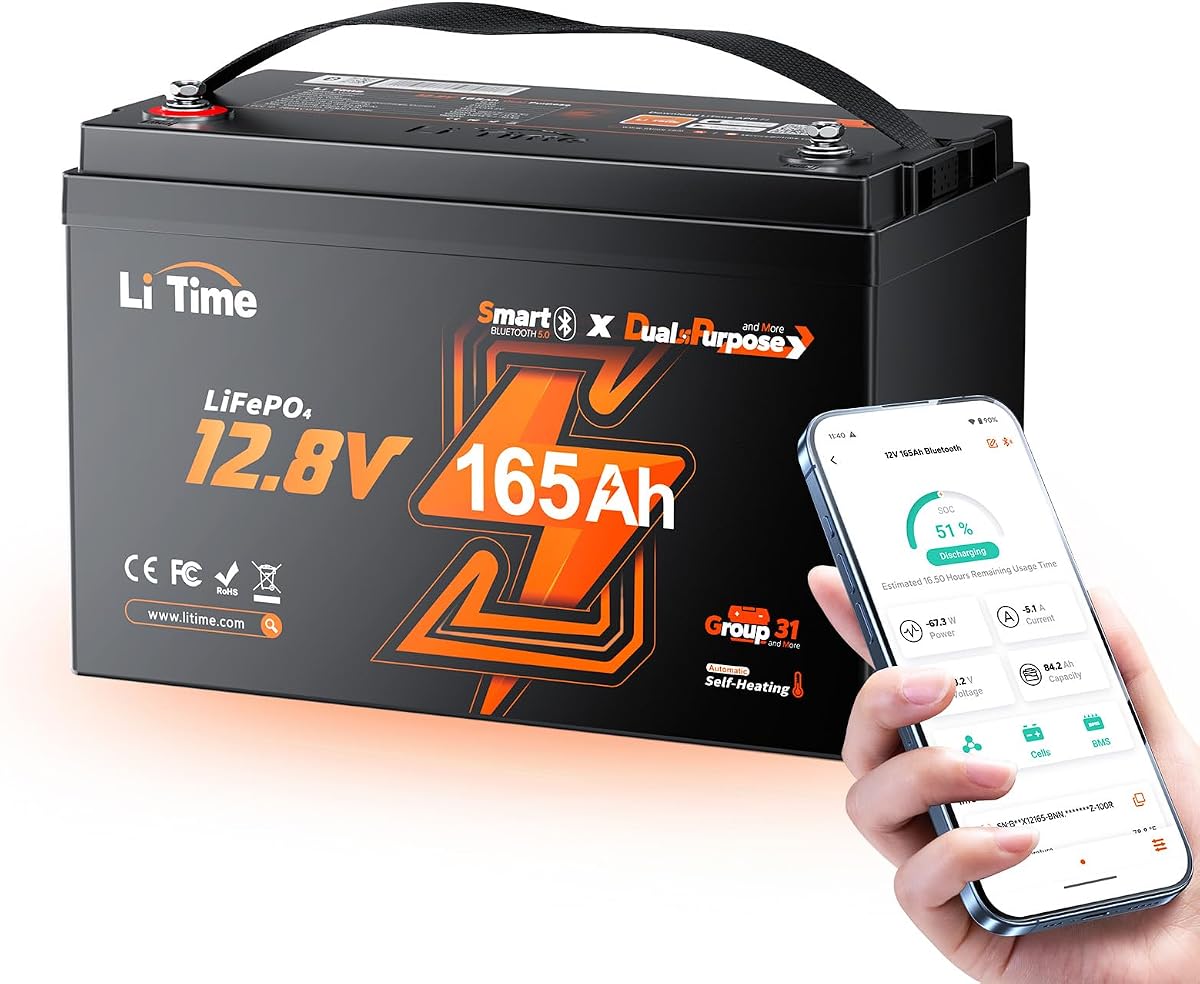
The LiTime 12V 165Ah Dual Purpose battery is the only selection here expressly designed to combine outboard engine cranking with marine device power. It carries a 4.5 rating, offers 2,112Wh of stated capacity, and provides 1,200 CCA at 14°F and 1,300 MCA at 32°F. The Group 31 format and half-weight claim relative to a 100Ah lead-acid design make it a potential one-battery solution for compatible boats.
We may earn a commission when you buy through this link, at no additional cost to you.
Unlike the energy-storage-only products, this model includes starting features. It retains approximately 15% state of charge as an emergency reserve and has automatic heating that activates below 32°F, warming the battery to 50°F to support normal charging. Discharge stops at minus 4°F. Bluetooth 5.0 monitoring through the LiTime app provides status information, discharge control, and remote over-the-air updates, with alerts for unexpected power conditions.
The battery is described as compatible with many Honda, Suzuki, Evinrude, Tohatsu, and other outboard motors, but the supplied information also lists important exclusions. It is not compatible with LiveScope fish finder system chargers, outboard motors without voltage regulators—including specified Evinrude, Johnson, and Mercury Black Max examples—or MerCruiser marine engines and inboard systems. ABYC E-13-compliant installation is stated, and buyers should request a compatibility guide before purchase.
This is the Best Premium recommendation for a boat with a compatible outboard that currently carries separate starting and deep-cycle batteries, provided the model has a suitable voltage regulator and charger. Consolidating the functions can reduce weight and free compartment space, but compatibility must be confirmed more carefully than with an ordinary house bank. It is also the heaviest and most specialized offering in this guide, so a simple energy-storage battery remains better for many installations.
The 2-in-1 design can power cranking loads while also supporting fish finders, trolling motors, and other marine devices. That versatility is valuable when compartment space is limited, though the engine and charging system must satisfy the stated compatibility requirements.
Automatic heating and a 15% emergency reserve are specifically intended to preserve usable starting power in cold conditions. The heating function addresses charging difficulty near and below freezing, while the reserve helps prevent a deeply discharged house bank from eliminating starting performance.
We may earn a commission when you buy through this link, at no additional cost to you.
The MARSENERGY 12V 100Ah Group 24 holds the highest customer rating in this selection at 4.8. It weighs 21 pounds and measures 10.16 by 8.46 by 6.54 inches, matching the stated BCI Group 24 standard. That makes it a direct physical option for an existing Group 24 battery box, while the lower mass can help a smaller boat remain responsive and make installation easier.
We may earn a commission when you buy through this link, at no additional cost to you.
Cycle-life figures are 4,500 cycles at 100% depth of discharge, 8,000 at 80%, and 15,000 at 60%. A-grade cells and a 100A BMS provide overcharge, over-discharge, overcurrent, short-circuit, and abnormal-temperature protection. The BMS may place the battery into sleep mode following an abnormal state, and it must be activated according to the manual before use. Owners should understand this behavior before installing the battery in an inaccessible compartment.
The cells contain low-temperature additives and are described as more resistant to cold than traditional lithium batteries. The technical allowance reaches minus 40°F, although the BMS cuts off discharge at minus 4°F and charging at 32°F to protect battery life and safety. The enclosure is described as completely waterproof, robust, and reliable, with a five-year after-sales service period.
This model is a strong all-round recommendation for a boat with a Group 24 compartment, particularly when low weight and a high customer rating influence the decision. It has no stated app connectivity, so owners who need remote state-of-charge information would need another monitoring method. Confirm that the terminal positions and physical clearances match the installation, and use a lithium-appropriate charger.
The stated 21-pound weight and exact Group 24 dimensions simplify both replacement planning and handling. Lower battery mass is especially relevant to smaller boats, where every carried item can affect balance, acceleration, and available space.
The protective BMS can place the battery into sleep mode after detecting an abnormal state. Because the battery must then be activated according to the manual, owners should select a model and compartment layout that allow any required recovery step.
We may earn a commission when you buy through this link, at no additional cost to you.
The Power Queen 12V 100Ah Group 31 combines a 4.6 rating with a 24-pound listed weight and a format suited to larger marine battery compartments. It uses Grade A lithium iron phosphate cells intended to deliver stable voltage and consistent power for RV, marine, solar, and backup-storage applications. The 100A BMS protects against overcharge, over-discharge, short circuits, and overheating.
We may earn a commission when you buy through this link, at no additional cost to you.
Compared with a traditional lead-acid battery, the product is described as approximately one-third the weight, making installation and repositioning easier. That handling advantage is valuable when a battery must be moved for inspection or maintenance. The Group 31 format also offers more physical room than a Group 24 in many installations, although boat builders should measure the actual compartment rather than assume it is sufficient.
Expansion is supported through up to 4S4P arrangements, creating a maximum 51.2V, 400Ah, or 20.48kWh system. The stated applications include RV use, 30- to 70-pound trolling motors, and home backup systems. Cycle-life claims include 13 times more cycles and three times the lifespan of lead-acid, along with twice the energy density and a 3% self-discharge rate.
This battery is best for a standard deep-cycle marine or RV installation where owners value a balanced combination of capacity, manageable weight, and expansion. It does not list Bluetooth monitoring, and it should be treated as an energy-storage battery rather than a dedicated engine-starting unit. The result is a straightforward option for larger onboard loads or a multi-battery bank when the compartment and charger are suitable.
At a listed 24 pounds, the battery is substantially easier to lift than a conventional 100Ah lead-acid unit. Easier handling can make installation safer, particularly where battery access is restricted or the compartment is below deck.
The unit is compatible with 30- to 70-pound trolling motors according to the supplied information, while the larger Group 31 enclosure may suit multi-device setups. Actual run time depends on the motor's current draw, battery age, operating temperature, and the depth to which the battery is discharged.
We may earn a commission when you buy through this link, at no additional cost to you.
The Power Queen 12V 100Ah Trolling Motor battery is designed specifically for marine electronics and larger trolling motors. It carries a 4.4 rating, meets the stated ABYC E-13 standard, and uses a triple-protected BMS covering dust, water, salt spray, overcharge, overheating, and short circuits. This makes it a purpose-built alternative to the company's more general Group 31 marine model.
We may earn a commission when you buy through this link, at no additional cost to you.
A built-in TVS surge protector is included to help block voltage spikes from compatible 12V to 36V trolling motors, including motors rated for up to 120 pounds of thrust. The listed weight is 22.16 pounds, described as up to 64% lighter than a 100Ah lead-acid battery. That reduction in carried mass can improve handling, while the Group 31 format offers a familiar and widely used marine footprint.
Low-temperature protection stops charging below 32°F and discharging below minus 4°F to reduce cold-weather damage. The battery supports up to 4P4S expansion, yielding a maximum 51.2V, 400Ah, 20.48kWh system, and is advertised at more than 4,000 cycles at 100% depth of discharge. As with the other trolling-focused options, the low-temperature cutoff makes weather-aware charging planning important.
This is a strong choice for an angler whose priority is trolling-motor surge protection and marine-focused safeguards rather than app connectivity. It should not be selected as an engine-starting battery. Before installation, confirm the compartment, charger, motor voltage, cable sizing, and fusing. For a large trolling motor or a boat exposed to salt and rain, the dedicated protection focus is particularly compelling.
The built-in TVS surge protection and stated support for motors up to 120 pounds of thrust make this model more specialized than a general-purpose 100Ah battery. The motor's voltage and current requirements should still be matched to the installation.
Triple BMS protection against dust, water, and salt spray addresses common marine hazards. Good terminal care, secure mounting, appropriate fusing, and periodic corrosion inspection remain necessary regardless of the battery's internal rating.
We may earn a commission when you buy through this link, at no additional cost to you.
The right battery begins with the loads you actually need to power, followed by physical fit, charging equipment, temperature exposure, and expansion plans. These factors prevent a technically capable lithium battery from becoming an unsuitable or unsafe boat installation.
Most 100Ah batteries in this guide are designed only for energy storage, expressly excluding engine starting, cranking, golf-cart use, or powering jacks. A dual-purpose lithium battery, such as the LiTime 165Ah model, is the exception in this selection, but it includes strict compatibility limitations involving engine regulators, chargers, and inboard systems. If your boat needs both cranking and house power, choose the battery specifically designed for both roles and verify the complete charging system before purchase.
Trolling-motor batteries should be matched to motor voltage, thrust, and expected current draw. Several products include a built-in TVS surge protector for 12V to 36V motors, and one is stated to support motors up to 120 pounds of thrust. This protection is useful, but it does not make every battery electrically appropriate for every motor. Review the motor instructions, cable gauge, fuse rating, and charger requirements to create a compatible system.
A Group 24 or Group 31 label helps narrow the search, but it does not guarantee an installation will fit. MARSENERGY lists exact Group 24 dimensions, SUPER EMPOWER gives detailed measurements, and DC HOUSE notes that its near-Group-24 design is about 0.32 inches taller than the standard specification. Measure length, width, height, terminal clearance, cable bend space, and the space needed for the compartment lid and hold-down hardware.
Lithium iron phosphate batteries require compatible charging profiles, and an old lead-acid charger may not be suitable. Some products recommend 14.4 to 14.6 volts with a constant-current and constant-voltage profile, while solar controllers should be placed in lithium mode. DC-DC charging can be used when properly paired. The Lithova model lists broad compatibility with several popular marine and trolling charger families, but exact model numbers and settings still matter.
Nearly every selection includes low-temperature cutoffs, although the exact thresholds differ. Most stop charging at 32°F, DC HOUSE lists charging cutoff at 19.4°F, and the LiTime dual-purpose battery adds automatic heating. Discharge cutoffs are commonly listed at minus 4°F. If you fish through winter, plan charging around these limits, store the battery in a suitable temperature range, and never attempt to bypass a protective cutoff.
A 100Ah 12V lithium battery provides a stated nominal energy capacity of approximately 1.28kWh, while the 165Ah dual-purpose model is rated at 2,112Wh. Actual runtime is affected by the connected loads, motor efficiency, depth of discharge, temperature, and battery condition. Calculate the wattage of electronics and continuous loads, estimate their use time, and provide headroom rather than sizing solely by the amp-hour label.
Most 100Ah selections support four units in series or four in parallel, and several can reach 51.2V, 400Ah, and 20.48kWh. DC HOUSE allows a maximum of eight batteries and does not permit 4P4S. Expansion requires matched batteries, correct wiring, appropriate fusing, and compatible power electronics. Use professionals for high-energy systems and follow the manufacturer's instructions, particularly because uneven battery states can create imbalance.
Bluetooth monitoring can provide state of charge, current, voltage, temperature, fault information, and alerts without a wired display. The BUKNUWO and DC HOUSE options provide the most detailed stated app functionality, while the LiTime cranking model includes app control. If remote diagnostics are not important, a non-connected battery may be simpler. A physical case, marine protection, and accurate low-temperature behavior are more important than connectivity in every installation.
Before installation, identify the battery's intended role, verify the voltage and physical fit, and review the boat's charger, DC-DC converter, inverter, fusing, and wiring. Never use a lithium energy-storage battery for engine cranking unless it is explicitly designed for that purpose. Keep terminals clear of tools and conductive objects, use properly rated cables and fasteners, and confirm that the battery is firmly restrained so it cannot move during rough water.
Charge the battery with a compatible lithium-profile charger and observe the stated temperature limits. Do not rely on a standard lead-acid charge setting unless the charger and its documentation explicitly support the battery's required lithium profile. For solar charging, set the controller to lithium mode. If the battery is exposed to temperatures below its charging cutoff, allow it to warm before charging and never bypass the BMS protection.
For long-term storage, use a charger that periodically maintains the battery and review the manufacturer's storage recommendations. The BUKNUWO product specifically recommends charging and discharging the battery every six months to prevent damage from prolonged inactivity. Inspect terminals for corrosion, keep the case clean and dry, check the hold-down hardware, and monitor the battery through the app or a suitable gauge before returning it to service.
LiFePO4 batteries can be appropriate for marine energy storage when their protections, construction, and installation match the use case. Products in this guide include BMS safeguards against issues such as overcharge, over-discharge, overcurrent, short circuits, and temperature extremes, while some add marine-specific dust, water, and salt-spray protection. Safe operation still depends on correct sizing, compatible charging, secure mounting, appropriate fusing, and regular inspection.
A 100Ah lithium battery can often serve as a deep-cycle replacement, but physical fit and charging compatibility must be checked first. Group 24 and Group 31 lithium models are available, though some are slightly larger than the nominal standard. A lithium-profile charger or properly configured solar controller is also important, and an energy-storage lithium battery should not be used to crank the engine.
The correct number depends on the motor voltage, thrust, current draw, available runtime, and whether other boat loads share the bank. A 100Ah 12V battery may suit many smaller systems, while larger or higher-thrust motors can benefit from parallel capacity. Match the batteries, use correctly sized cables and fusing, and avoid combining unmatched batteries or unsupported series-and-parallel arrangements.
Only when the battery is specifically designed for engine starting. Most 100Ah options listed here are restricted to energy-storage use, while the LiTime 165Ah dual-purpose model provides starting power for compatible outboard systems. Even with that model, confirm the engine has a suitable voltage regulator, review the charger, and check all stated exclusions before installation.
Cold-temperature charging cutoffs are a safety feature intended to protect lithium cells. Most products listed here stop charging at 32°F, while DC HOUSE lists a 19.4°F charging cutoff, and the LiTime dual-purpose model adds automatic heating. Let the battery reach an appropriate temperature, charge it in a protected environment, and never defeat the BMS cutoff.
Bluetooth batteries can provide state of charge, voltage, current, temperature, and fault information through a compatible phone app, which may reduce the need for a permanently installed display. The app still does not replace correct wiring, fusing, or periodic physical inspection. Bluetooth range is also limited, so the phone generally must be near the battery for a live connection.
Most products support series or parallel expansion, and several allow a maximum 4S4P configuration totaling 51.2V, 400Ah, and 20.48kWh. Exact restrictions differ; DC HOUSE permits up to eight batteries but not 4P4S. Use batteries with matching age, capacity, and condition, follow the wiring diagram, and have high-energy systems professionally installed.
Keep it securely mounted, inspect terminals and connections for corrosion, and use a compatible lithium charger. Respect the low-temperature charging and discharge cutoffs, and avoid routinely draining the battery to complete depletion. During extended storage, use an appropriate maintenance charger and follow the manufacturer's inactivity recommendations, including the BUKNUWO guidance to charge and discharge the battery every six months.
The SUPER EMPOWER 12V 100Ah is the Best Budget choice because it combines a standard Group 24 format, a 100A BMS, low-temperature controls, and broad 4S4P expansion potential. The LiTime 12V 100Ah earns the Editor's Choice designation for its 4.7 rating, ABYC E-13 marine compliance, lightweight Group 31 design, and built-in trolling-motor surge protection. The LiTime 12V 165Ah is the Best Premium option for compatible outboard boats that want starting and auxiliary power in one battery.
For most boaters, the correct starting point is the electrical role rather than capacity alone. Choose a pure deep-cycle model for fish finders, trolling motors, lighting, refrigeration, and house loads; choose the dual-purpose model only after confirming engine and charger compatibility. Then prioritize compartment fit, lithium-compatible charging, cold-weather behavior, marine protection, and the expansion requirements you realistically expect to have.
Current prices, availability, promotions, and product details can change, so check the live listing before buying. Compare the latest dimensions, charger instructions, warranty terms, and manufacturer notes with your boat's configuration, and avoid purchasing a battery solely on amp-hour capacity or customer rating. The best lithium battery for a boat is the one that safely fits its compartment, works with its electrical system, and has the protection required for the environment.