
Mission Darkness TitanRF Faraday Fabric Kit
4.3Editor score
One yard of conductive fabric
Includes 36-inch tape strip
Lab-tested shielding performance
Military Grade Faraday Fabric is a conductive textile used to build signal-blocking bags, cages, curtains, equipment covers, and other enclosures. Its effectiveness depends on the metal composition, shielding range, surface conductivity, and the skill with which every seam and opening is sealed.
This guide compares ten fabric kits using the supplied specifications, ratings, dimensions, included conductive tape, stated shielding performance, intended uses, and care requirements. It covers compact one-yard kits as well as larger rolls intended for multiple pouches, blankets, room treatments, and other DIY projects.
Each review explains the product's strongest attributes, practical trade-offs, and best-fit user. Ratings reflect the supplied marketplace feedback rather than personal testing, while prices and promotions can change, so readers should confirm current product details before purchasing.
4.3Editor score
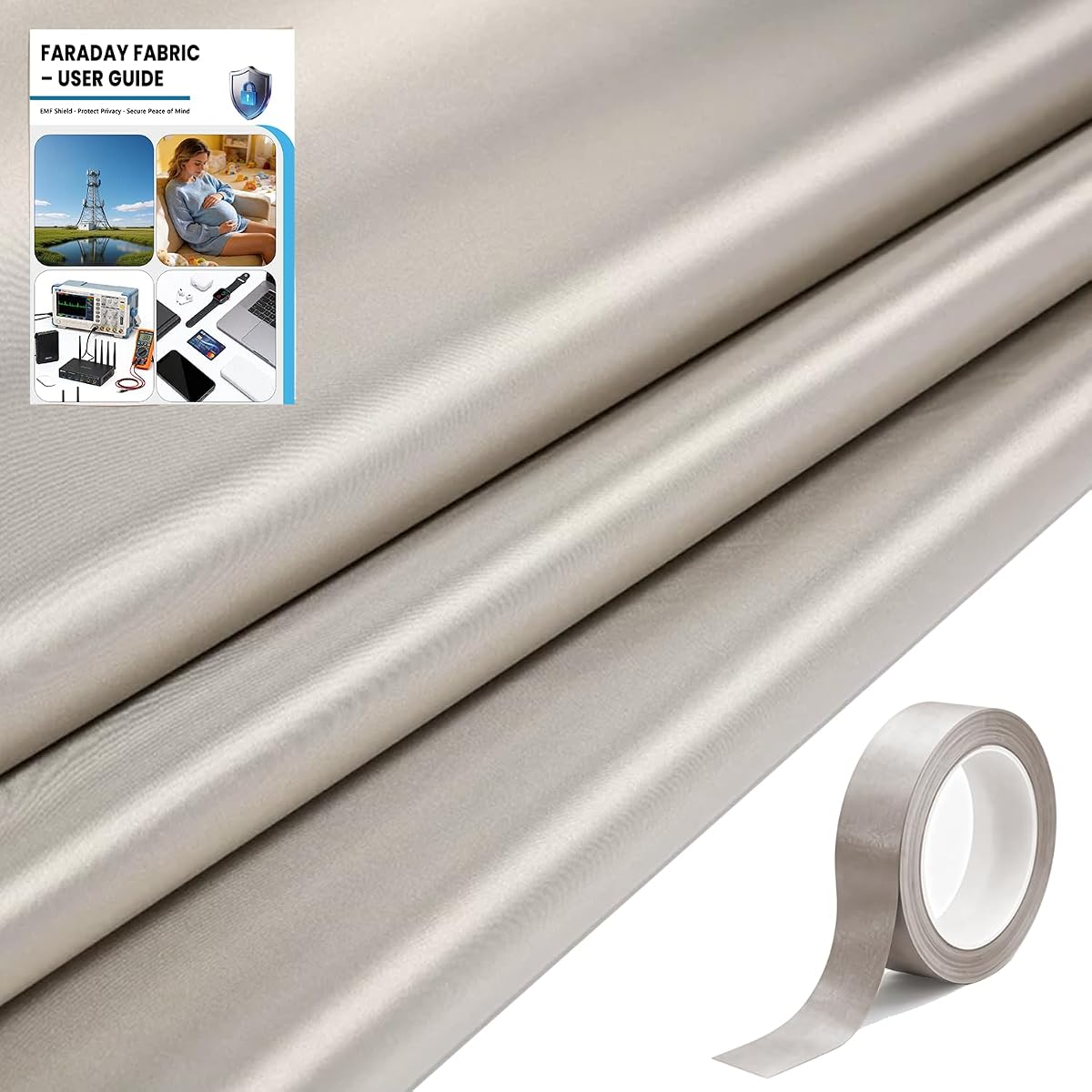
4.4Editor score

4.2Editor score
As an Amazon Associate we earn from qualifying purchases.
The comparison below highlights the major differences in sheet size, shielding specifications, construction, and included tape, making it easier to match a kit to small personal pouches or larger DIY enclosures.


The Mission Darkness TitanRF Faraday Fabric Kit is a compact one-yard sheet with a 4.3 rating and a strong reputation for documented shielding performance. Its standout qualification is the stated confirmation against MIL STD 188-125 and IEEE 299-2006, with full test reports reportedly available upon request. That makes it a particularly credible option for buyers who place more weight on recognized test standards than on broad marketing language alone.
We may earn a commission when you buy through this link, at no additional cost to you.
The material combines 62% polyester fiber, 25% metallic copper, and 13% metallic nickel, producing a conductive textile with an approximately 0.5-ohm-per-square surface resistance. The supplied information says it can address signals from low MHz through 40GHz, including cellular networks, WiFi, Bluetooth, GPS, RFID, and radio frequencies. The 44-by-36-inch sheet can be cut, sewn, or taped into custom bags and cages, while the included 36-inch strip helps join sections or reinforce an enclosure.
The trade-offs are size and included material. One yard is enough for a phone pouch, compact electronics case, key-fob sleeve, or a few smaller projects, but it is less convenient than the longer rolls for blankets, curtains, and equipment covers. The 36-inch tape strip may also be insufficient for a complex enclosure with several seams, making additional conductive tape advisable for larger builds. Users who react to metal materials may need to consider the stated recommendation to wear gloves while handling the fabric.
This kit is best for a first Faraday enclosure, a small travel pouch, or a focused electronics-protection project. It is also a sensible budget-oriented pick because the manufacturer supplies a more specific material composition, test standards, dimensions, surface resistance, and handling guidance than many competing listings. For shoppers who want documented laboratory specifications in a manageable quantity, Mission Darkness offers a particularly clear and practical package.
The stated MIL STD 188-125 and IEEE 299-2006 testing is the key reason this compact kit stands out. Buyers who need traceable performance information can request the available reports before deciding whether the material suits their enclosure.
At one yard, the sheet is sized for practical pouches and small cages rather than room-scale coverage. Its cut-and-sew compatibility also makes it easier to turn the material into a purpose-built shape rather than relying on a generic pre-made enclosure.
We may earn a commission when you buy through this link, at no additional cost to you.
This Faraday Fabric kit pairs a 43-by-130-inch sheet with 236 inches of conductive tape and earns a 4.2 rating. It is a larger and more ambitious package than a basic one-yard pouch kit, offering enough material for multiple bags, a substantial electronics sleeve, a shielding curtain section, or a customized RF enclosure. The supplied description also emphasizes an additional coating intended to protect the textile against corrosion.
We may earn a commission when you buy through this link, at no additional cost to you.
The stated construction uses polyester fiber, metalized nickel, metalized copper, and nickel-plated copper protection. According to the product information, the fabric was tested from 0.2GHz to 14GHz and provides 80 to 94.5dB of shielding within that range. The description also discusses complete signal shielding from low MHz through 40GHz, but buyers should distinguish the explicitly tested range from the broader blocking claim and evaluate the entire enclosure rather than assuming that any uncovered opening will be neutralized.
Its main advantage over smaller kits is usable surface area. A long piece can be divided among several projects or used to construct a more complete enclosure with fewer improvised joins. The 236-inch tape roll is also a meaningful addition because conductive continuity at seams is critical. Conversely, a larger textile can be more cumbersome to cut, position, and shape, and the product data advises avoiding water, direct sunlight, and excessive handling without gloves.
This is a strong choice for builders who want a generous sheet, detailed shielding figures, and enough tape for a multi-seam project. It is less attractive for someone needing only a small key-fob pouch, but for room components, equipment protection, or several DIY accessories, the balance of material size and documented performance makes it a premium all-around choice.
The 43-by-130-inch format gives builders room to create several smaller accessories or one larger lined enclosure. It also reduces the need to join short pieces, although every seam still must be sealed thoroughly with conductive tape.
The stated corrosion-protective layer is valuable for a material expected to be cut, folded, and stored before use. It does not make the fabric immune to damage, so careful storage and limited moisture exposure remain important.
We may earn a commission when you buy through this link, at no additional cost to you.
The 43-by-236-inch Faraday Fabric is one of the largest conventional sheets in this comparison, paired with a 4.2 rating. Its extended length provides substantial material for creating several phone cases, laptop covers, anti-theft wallets, passport sleeves, fanny-pack liners, curtains, or blankets. The supplied information describes a conductive grid formed by blending polyester with copper and nickel.
We may earn a commission when you buy through this link, at no additional cost to you.
The product's strongest selling point is flexibility of application. The included 40 pieces of Velcro and a measuring tape make it possible to construct a pouch with a repeatedly accessible opening, while the broad sheet can still be cut and sewn into custom shapes. That combination is useful for projects where a conventional zippered seam might be replaced with conductive hook-and-loop closures.
The main drawback is that the supplied product data does not provide a numeric shielding-effectiveness range, surface resistance, or specific tested frequency band. It therefore communicates less technical detail than the Mission Darkness or 43-by-130-inch kit. In addition, no conductive tape roll is listed among the contents, even though conductive sealing would still be necessary for many assemblies.
This fabric is best for a builder who wants abundant material and practical closure accessories. It is a compelling choice for making a family of small accessories from one purchase or working on larger sewn shapes. Buyers who require formal test references or prefer a ready supply of conductive tape may favor a better-documented kit, while those prioritizing flexibility and material quantity will find this one highly adaptable.
The forty Velcro pieces allow a DIY enclosure to open for repeated access while maintaining a conductive closure path. Buyers should still plan overlaps carefully so the closure does not create an unintended leakage gap.
A 236-inch length makes it possible to cut several standard-sized accessories from one sheet. It is especially appealing for users who want to make multiple wallets, pouches, or protective liners rather than a single isolated item.
We may earn a commission when you buy through this link, at no additional cost to you.
This Faraday Fabric listing combines a 4.2 rating with a 43.3-by-72-inch sheet and a generous roll of conductive tape. The product title references a different length than the detailed description, but the supplied bullet points identify the kit as two yards, or 43.3 by 72 inches. Buyers should therefore confirm the physical dimensions they need before ordering, particularly if the enclosure depends on a precise cut pattern.
We may earn a commission when you buy through this link, at no additional cost to you.
The material is described as 62% polyester, 26% copper, and 12% nickel, with an additional copper-layer upgrade intended to improve protection. The listed thickness is 0.08mm, while the stated shielding efficiency reaches 70–80dB. The kit includes 65 feet of 0.3-inch-wide Faraday tape intended for edge wrapping, which is especially useful for closing seams around a rectangular pouch or folding an open-ended sheet into a continuous enclosure.
The compromise is the limited quantity of fabric. Two yards is enough for a substantial phone sleeve, compact laptop project, router cover, or a few smaller accessories, but it cannot cover a broad wall or create many large projects without additional material. The edge tape is also narrow, so multiple passes may be required to create a robust conductive joint.
This product is best for beginners who want a clear composition, stated shielding efficiency, and a useful quantity without purchasing the longest roll. It also suits builders making a wallet, blanket-style pocket, or several small pouches. Users undertaking room-scale shielding should choose a longer sheet, while those who prioritize reproducible technical documentation may prefer the Mission Darkness listing.
The two-yard sheet sits between a pocket-sized piece and a large roll. That makes it a practical choice for a compact laptop cover, phone pouch, or a few coordinated accessories that still require careful conductive closure.
Sixty-five feet of narrow conductive tape gives a builder enough material to wrap many fabric edges. Multiple overlapping passes can create a more continuous seam than a single narrow strip across the full closure.
We may earn a commission when you buy through this link, at no additional cost to you.
The OMKHE Faraday Fabric has the highest supplied customer rating in the group at 4.4, and its product information is among the clearest. The kit includes a 43-by-118-inch sheet, 200 inches of specialized conductive tape, and an instruction manual. Its multi-layer construction uses polyester fiber with metallized nickel and copper layers, and the stated operating range extends from 10KHz to 30GHz.
We may earn a commission when you buy through this link, at no additional cost to you.
The claimed shielding effectiveness of up to 90dB is useful when comparing products that otherwise sound similar, though buyers should interpret it in the context of a properly sealed enclosure. The description recommends two to three layers for sensitive electronics such as hard drives and radios. It also provides a straightforward test method: wrap a phone completely and attempt a call, understanding that no signal or inability to connect indicates that the basic test is working.
Possible drawbacks include manual measurement variation, which the manufacturer explicitly asks buyers to allow for, and the absence of a machine-washable design. As with the other fabrics, a quick phone call is only a preliminary verification rather than a complete measurement across every frequency and orientation. The broad stated range should also not be confused with a guarantee against every possible signal under an imperfectly sealed build.
This is the strongest all-around option for someone who wants detailed range information, layered-enclosure guidance, included instructions, and a balanced amount of material and tape. It is particularly suitable for privacy pouches, laptop sleeves, key-fob protection, classroom demonstrations, curtains, tents, and repeated electronics-protection projects. The 4.4 rating and balanced package make it an especially practical editor's choice.
The two-to-three-layer recommendation is useful for hard drives, radios, and other devices where stronger isolation is desired. Extra layers should overlap generously and be bonded with conductive tape so the seams do not become weak points.
A phone-call test gives novice builders a simple way to identify a gross failure. It does not measure every frequency, but it is a practical first check after the enclosure has been fully covered and sealed.
We may earn a commission when you buy through this link, at no additional cost to you.
The 43-by-108-inch Faraday Fabric kit has a 4.3 rating and pairs a broad 43-inch width with 300 inches of two-inch-wide conductive tape. Its specification of less than 0.05 ohms indicates a highly conductive surface, while the listed shielding coverage runs from 10MHz to 5GHz. The fabric is composed from copper, nickel, and polyester fibers and is advertised as blocking 99% of wireless frequencies.
We may earn a commission when you buy through this link, at no additional cost to you.
The most striking feature is the quantity of tape relative to the sheet. At two inches wide and 300 inches long, it can cover long seams, wrap fabric edges, and bridge multiple joins more easily than a narrow strip. That makes the package useful for users building several medium-sized pouches, a curtain, a luggage liner, or a laptop cover. The stated applications also include maternity clothing, blankets, curtains, phone cases, and computer covers.
The stated frequency band is narrower than the 10KHz-to-30GHz range described for the OMKHE product, and 5GHz is only one portion of the modern radio-frequency landscape. Buyers should also follow the stated precautions: air-dry the material if it becomes wet, avoid direct sunlight, do not rub or soil it, and wear gloves during handling. These limitations matter because a conductive textile can still be compromised by physical contamination or a compromised seam.
This kit is well suited to DIY builders who value strong surface conductivity and abundant seam tape more than the broadest stated frequency range. It is a good candidate for a custom router pouch, travel-document sleeve, electronics bag, or family set of small protective accessories. The low-resistance specification and 300-inch tape allowance make it a well-balanced package for careful hands-on construction.
A 300-inch roll of two-inch-wide tape can reinforce broad joins and reduce the likelihood of gaps forming at edges. Overlapping the tape across the full seam is still necessary; simply placing a narrow strip over a wider opening is inadequate.
The stated resistance below 0.05 ohms is a strong technical attribute for a conductive textile. It supports consistent electrical contact between overlapping sections, although enclosure performance still depends on complete coverage.
We may earn a commission when you buy through this link, at no additional cost to you.
This 43.3-by-196.8-inch Faraday Fabric has a 4.3 rating and provides a long, flexible sheet for building custom signal-blocking structures. It is made from metallic copper, metallic nickel, and polyester fiber. The description states 99% efficiency when the phone is fitted tightly and no gaps remain, correctly emphasizing that the quality of the enclosure matters as much as the presence of conductive material.
We may earn a commission when you buy through this link, at no additional cost to you.
Its size makes it useful for more than phone sleeves. The material can be cut and sewn for laptops, car keys, cards, curtains, blankets, bags, mainframe chassis covers, and larger cages. With 196.8 inches of length, a builder can create several small products or use one continuous panel for a substantial equipment cover, reducing some of the seam burden associated with joining shorter sections.
The trade-offs are a lack of included conductive tape and no specific tested frequency range in the supplied data. A shopper will need to add suitable conductive seam material separately, and should not rely on a broad 99% statement without understanding the conditions required to achieve it. Sewing through the conductive layers may also affect continuity if the builder does not preserve sufficient conductive overlap.
The kit is a good fit for experienced DIY users who want length and flexibility without paying for a finished enclosure. It is particularly useful for sewing several coordinated privacy products or lining a larger area. A first-time builder may prefer a kit that includes tape and more explicit testing details, but this fabric provides a generous base material for customized work.
The nearly 197-inch length can be divided into several pouches, wallets, or liners, depending on the dimensions of each finished item. Planning the layout before cutting helps preserve enough material for folded and overlapping seams.
The product description directly connects effective shielding with a tight fit and no openings. That reminder is critical: a loose wrap may look protective while allowing signals to reach the enclosed device through gaps.
We may earn a commission when you buy through this link, at no additional cost to you.
Shielding Faraday Fabric is supplied as a 44-inch-wide by 18-foot-long roll, giving it the greatest continuous length in this selection. It has a 4.3 rating and uses polyester fiber, metallic copper, and metallic nickel. The description identifies EMI and RF shielding, as well as protection for WiFi, Bluetooth, cellular signals, GPS, NFC, and RFID, while noting the material is easy to cut and sew into custom coverings or mesh barriers.
We may earn a commission when you buy through this link, at no additional cost to you.
The long roll is the defining advantage. A continuous section can be more useful than several shorter pieces when lining equipment, creating a broad barrier, covering a large cabinet, or making multiple pouches from a single purchase. Its wrinkle-free handling is also useful when forming fitted covers around irregular shapes, although the product data does not state that the fabric is machine washable.
The listing includes some broad health-oriented claims that should be interpreted cautiously. Shielding radio-frequency energy is different from making medical claims or guaranteeing protection from every form of radiation. Its more concrete attributes are the conductive composition, stated signal types, professional certification reference, and suitability for Faraday bags, cages, boxes, and ID or financial-card storage.
This roll is best for users working on larger barriers, repeated custom covers, or a collection of accessories. It offers more material flexibility than a compact kit, but no conductive tape amount is specified, so extra seam-sealing supplies may be necessary. The product is most compelling for builders who prioritize area and continuous length over the convenience of an all-in-one smaller package.
Eighteen feet of material allows a builder to plan broad liners and multiple cuts without immediately joining short lengths. A continuous layout can reduce leakage paths, provided the finished enclosure is still fully sealed.
The stated coverage includes WiFi, Bluetooth, cellular, GPS, NFC, and RFID. These uses make the fabric relevant to electronics privacy, secure testing, and RF-isolated enclosures, provided each intended signal falls within the manufacturer's broader performance claims.
We may earn a commission when you buy through this link, at no additional cost to you.
The ATMOSURE Faraday Fabric & Tape Kit combines a 44-by-36-inch sheet with 197 inches of conductive tape and has a 4.2 rating. It is designed for DIY bags, wallets, blankets, pouches, router shields, and other custom enclosures. The manufacturer describes the copper-nickel material as corrosion-resistant and capable of repeated cutting, folding, and wrapping without losing shielding integrity.
We may earn a commission when you buy through this link, at no additional cost to you.
The technical specification is especially useful for comparison. The listing states 85–105dB shielding effectiveness from 1MHz to 10GHz when the fabric is fully enclosed and grounded, with up to 99% blocking of WiFi, Bluetooth, RFID, GPS, and cellular penetration. The grounding qualifier is important: it sets the conditions under which the supplied performance figure applies rather than presenting the fabric as a universal signal barrier on its own.
A one-yard sheet is compact and manageable, which can be an advantage for a simple phone pouch, key container, or lined compartment. The 197-inch tape allowance is generous relative to the fabric area and helps a builder form continuous seams. On the other hand, a small project may leave unused material, while a larger enclosure will quickly exceed the available sheet. Complete coverage also requires allowing extra material for seams, overlaps, and folded edges.
This kit is best for a focused first build that needs both fabric and conductive tape in one package. Its clearly stated test range and effectiveness make it attractive for technically minded buyers, while the compact dimensions avoid the storage demands of an 18-foot roll. It is a practical choice for small custom enclosures rather than broad room coverage.
The listed 1MHz-to-10GHz range and 85–105dB figure are tied to a fully enclosed and grounded construction. This specificity helps buyers distinguish real enclosure performance from the common mistake of treating a loose sheet as complete shielding.
A 197-inch tape roll is more than a beginner might need for a simple pouch, but it provides room to reinforce every seam and create overlapping conductive paths. The extra allowance also compensates for mistakes during fitting.
We may earn a commission when you buy through this link, at no additional cost to you.
This final kit combines a 43-by-236-inch sheet with 780 inches of conductive tape and has a 4.3 rating. It is one of the most generously equipped options in the comparison, both in textile area and seam-sealing material. The fabric is made from copper, nickel, and polyester fibers, with a stated surface resistance below 0.05 ohms and coverage from 10MHz to 5GHz.
We may earn a commission when you buy through this link, at no additional cost to you.
The 780-inch tape roll is the key differentiator. A long project involving a curtain, luggage liner, equipment case, or several pouches can require multiple seam lengths, and this amount leaves ample room for overlaps, edge wrapping, corrections, and extra accessories. The fabric itself can be cut, sewn, or taped to create bags, cases, curtains, and other enclosures.
There is some inconsistency in the supplied product text: the product title and product-list bullet identify a 43-by-236-inch sheet, while another bullet repeats 43 by 108 inches. This discrepancy should be checked with the listing before ordering. The stated frequency range also ends at 5GHz, making it narrower than several alternatives, and the information does not provide a specific dB shielding figure.
This product is best for builders who need lots of material and unusually generous tape, especially when constructing several projects from a single kit. It is less suitable for someone who requires a small quantity or highly specific laboratory documentation. Despite the description inconsistency, the combination of a large stated sheet, low resistance, and extensive tape makes it a capable option for extensive DIY shielding work.
The 780-inch allowance can cover long perimeter joints and repeated overlaps without requiring an immediate second purchase. This is helpful for large enclosures where every edge and closure must be electrically continuous.
The listing title says 43 by 236 inches, while one descriptive bullet says 43 by 108 inches. Confirming the actual package dimensions before cutting helps prevent a project from being built around the wrong measurements.
We may earn a commission when you buy through this link, at no additional cost to you.
Selecting conductive fabric means balancing usable area, stated shielding performance, material composition, seam-sealing supplies, and the type of enclosure you intend to build. A larger sheet is not automatically better if it is difficult to shape or lacks the technical detail needed for your application.
Start by comparing the manufacturer's stated frequency coverage and shielding effectiveness, while noticing whether the figures refer to the bare textile or a fully assembled enclosure. The selections in this guide range from a stated 0.2–14GHz test range to broader 10KHz–30GHz coverage, with several products offering low resistance or specific dB figures. These numbers are useful only when their test conditions are understood. A fabric can perform well as a material yet produce an imperfect shield if a phone cable, seam, zipper, or opening remains uncovered. Look for clear language about standard compliance, tested construction, and the need for complete enclosure and grounding where applicable.
Match the sheet dimensions to the finished project rather than to the largest possible enclosure. A 44-by-36-inch yard is practical for a small pouch, while 108- to 130-inch sheets can cover larger sleeves and several accessories, and 196-inch or longer rolls suit broad barriers and repeated construction. Remember to add material for seams, folds, tabs, and overlapping conductive closures. A technically excellent textile may still be the wrong choice if it cannot be cut into the required shape or if the available width is narrower than the object being covered.
Conductive tape is not an optional accessory for most DIY Faraday enclosures because ordinary adhesive tape does not create the same electrical continuity. The kits here include between 36 inches and 780 inches of conductive tape, with some using narrow strips and others supplying wider rolls. Estimate the perimeter of every seam, add overlap allowances, and budget for wrapping edges or replacing a faulty strip. Wider tape is easier to use across uneven or folded edges, while a long narrow roll can work well on straight joins when applied in multiple passes.
Most of the listed fabrics use a blend of polyester for structural support with copper and nickel for conductivity. These metals provide a conductive network through the textile, while the polyester makes the material easier to cut, sew, and shape. Listed surface resistance ranges from approximately 0.5 ohm per square to below 0.05 ohms. Lower resistance can improve continuity between conductive areas, but it is only one factor in final enclosure performance. Check whether the fabric includes a protective coating and note the handling guidance, especially the repeated recommendation to wear gloves and avoid moisture, rubbing, and direct sunlight.
A fabric that can be cut and sewn like standard textile gives you more freedom than a pre-cut bag or rigid enclosure. Some listings describe the material as wrinkle-free, while others emphasize a soft, cuttable construction. Before committing, consider the tools and skill involved: sharp fabric shears, a sewing machine that will not damage the conductive path, and conductive tape for joining pieces can be useful. Plan overlaps at the seams because stitching alone may not create a sufficiently continuous conductive connection. For frequently opened pouches, hook-and-loop components such as those included with the 43-by-236-inch option may be useful when properly integrated.
The listed uses range from phone and key-fob pouches to laptop sleeves, router covers, hard-drive protection, curtains, tents, room wall covering, medical-equipment shielding, and hardware or software testing. A material intended for a small privacy pouch may meet the same functional goal as a much heavier roll, while secure-facility or RF-testing work may call for greater area, grounding, or multiple layers. Match the product's stated signal coverage to the signals you actually need to address, including WiFi, Bluetooth, GPS, RFID, NFC, cellular networks, radio frequencies, and electromagnetic interference. Avoid buying a long roll for one wallet or a small sheet for an entire room.
Conductive fabric can be delicate even when it is described as military-grade. The supplied information repeatedly advises against machine washing, direct sunlight, rubbing, soiling, and unnecessary cleaning. If the material becomes wet, air-dry it in a cool place. Store it in a cool, dry environment away from prolonged sunlight and extreme heat, and wear gloves to reduce sweat-related marks. A protective coating can improve corrosion resistance, but seams, cut edges, and repeated flexing may still require inspection. For a reusable enclosure, allow room for inspection and replacement of damaged tape rather than assuming a cut sheet remains perfectly continuous.
Check that the listing's title, specification bullets, and package list agree before purchasing. Two of the products contain conflicting sheet-length descriptions, making this a meaningful step. Also verify whether tape, Velcro, a tape measure, or instructions are included. The Mission Darkness kit emphasizes laboratory reports available on request, while the OMKHE kit includes an instruction manual and several alternatives include substantial conductive tape. These extras can materially affect the ease and consistency of a build. Reliable dimensions, clearly identified accessories, and specific handling instructions are signs of a more considered product package.
Begin by defining the device or signal you want to isolate, then measure the object and sketch the enclosure before cutting. A pouch needs enough fabric to cover the object on every side, overlap at the opening, and form a conductive closure. A cage, curtain, or larger cover needs a more complex plan that accounts for corners, access points, and every cable entry. Use sharp fabric shears and work on a clean surface. Because the material contains conductive metals, wearing gloves helps prevent sweat marks and reduces the chance of contaminating the surface.
Cut panels from the fabric, then join them with overlapping conductive tape. If sewing is part of the design, preserve a broad conductive overlap and use the tape to bridge the seam, since thread alone may not establish a continuous low-resistance path. Fold edges inward or wrap them with conductive tape, and cover gaps, openings, and penetrations. The supplied product descriptions consistently emphasize that complete coverage and high-quality sealing are necessary for complete signal blocking. Multiple layers can improve isolation, but the layers should overlap generously so the shifted edges of one layer do not align with a gap in another.
Test the finished enclosure with an inexpensive phone and a familiar call or cellular connection. No signal or an inability to connect is an encouraging preliminary result, but it is not a laboratory measurement across every frequency or orientation. Recheck after adding an object, changing the closure, or moving the enclosure. For care, keep the fabric dry, clean, and cool; avoid machine washing, direct sunlight, rubbing, and soiling. If it gets wet, let it air-dry in a cool place, then inspect seams and tape for damage before relying on the enclosure again.
No fabric should be treated as a perfect barrier without considering its tested range, construction, and operating conditions. A fully covered, well-sealed enclosure can greatly reduce the listed wireless signals, but gaps, loose closures, and cables may create leakage paths. The relevant frequency specifications should also be checked for the signal you want to block.
Conductive tape is strongly recommended because it helps maintain electrical continuity where fabric pieces meet. Ordinary household tape may hold the pouch together but does not provide the same conductive connection. Overlap the fabric and bridge every seam with the supplied or separately purchased conductive tape, then inspect the closure for gaps.
Most products in this guide are described as cuttable and sewable, but their conductive metal layers require more care than standard fabric. Use clean, sharp tools, preserve overlapping conductive areas, and reinforce stitched seams with conductive tape. Sewing can form the shape, while conductive joining material helps preserve shielding continuity.
One properly sealed layer may suit a basic pouch, while the OMKHE product specifically recommends two to three layers for sensitive electronics such as hard drives and radios. Additional layers can improve isolation, but their seams and edges must overlap so they do not create aligned gaps. The result also depends on the original fabric and how completely the enclosure is sealed.
The supplied product guidance generally advises against machine washing, scrubbing, and heavy cleaning. If the fabric becomes wet, air-dry it in a cool place away from direct sunlight. Frequent washing or abrasion can damage conductive coatings, cut edges, or seam connections, so minimizing cleaning helps preserve performance.
A pouch can often be made from one or two relatively small fabric panels with a carefully sealed opening. Room-scale shielding requires far more material, continuous coverage of walls, doors, windows, vents, and service penetrations, and often grounding or specialized construction. A large fabric roll is useful for the project, but complete room shielding demands much more than simply covering one surface.
A phone test is a useful preliminary check, especially when the phone normally has reliable service. It is not a complete test of every frequency, direction, or leakage path. A stronger evaluation may require an RF meter or professional testing, and the phone should be fully enclosed without an exposed cable or opening.
Look for a stated tested frequency range, clear material composition, surface resistance, exact sheet dimensions, and enough conductive tape to seal all seams. Long rolls are useful for curtains, liners, and multiple projects, but storage and handling become more difficult. Verify any conflicting dimensions in the listing before ordering.
The OMKHE 43-by-118-inch kit stands out as the editor's choice because it combines the highest supplied rating with a broad stated 10KHz-to-30GHz range, up to 90dB of shielding effectiveness, 200 inches of tape, and clear guidance on layering and testing. The Mission Darkness TitanRF kit is the best budget option, combining a compact one-yard sheet with laboratory-tested performance references, a specific composition, and a 40GHz upper frequency claim. The 43-by-130-inch kit earns the premium designation through its large sheet, protective coating, detailed 0.2–14GHz testing, and 236 inches of tape.
The right choice for most buyers depends less on the word military grade and more on a few practical factors: the signals involved, the size of the finished enclosure, the amount of conductive tape, and whether the supplier provides useful test conditions. A small pouch can be made with a compact kit, while repeated projects or larger barriers justify long rolls. Prioritize complete coverage, overlapping seams, conductive closures, and realistic handling instructions rather than relying on a percentage or decibel figure in isolation.
Finally, verify the current listing details before purchasing because dimensions, package contents, specifications, and marketplace offers can change. The supplied information includes a few inconsistent length descriptions, and broader claims should always be compared with the product's stated test range. Checking the latest rating, dimensions, accessories, care requirements, and current price will help ensure that the chosen military-grade Faraday fabric still fits the intended project.
