
Fosi Audio TP-02
4.4Editor score
Maximum 220W output
Low-pass frequency control
Compact home-audio design
This guide compares the best plate amplifier for subwoofer options, including power ratings, inputs, controls, protection, and installation needs.
A plate amplifier for subwoofer turns an ordinary passive speaker cabinet into a dedicated powered subwoofer, giving DIY builders control over power, crossover settings, phase, and room integration. The right unit depends on enclosure design, driver impedance, source connections, and whether the finished system is intended for home audio, car audio, or mobile sound reinforcement.
This comparison evaluates ten plate amplifiers and amplifier boards across their stated output power, amplifier topology, input and output options, filtering controls, protection features, thermal design, and installation requirements. It includes enclosed Class-D and Class-AB models, compact home-audio units, exposed automotive boards, and higher-power professional units for PA and DJ subwoofer cabinets.
Each review reveals which use case best fits a particular model, from the WAudio SUA-350 with its extensive integration controls to the Fosi Audio TP-02 for compact systems and the Sound Town STPA11-G900 for professional applications. Product ratings, specifications, features, and availability can change, so readers should verify current listings and requirements before purchasing.
4.4Editor score

4.3Editor score

5.0Editor score
The table below compares all ten products by core output, amplifier type, primary connections, and practical use, making it easier to identify the correct model for a home, car, or professional subwoofer project.



The WAudio SUA-350 is a 350-watt Class-D plate amplifier rated at 4 ohms, and its 4.3 rating reflects a balanced package of power, flexible integration controls, and extensive connection options. It is particularly compelling for a home-theater or DIY powered subwoofer because it gives the installer access to crossover, phase, gain, EQ modes, power-state controls, and multiple input options in one enclosure.
We may earn a commission when you buy through this link, at no additional cost to you.
Its standout strength is the ability to integrate a subwoofer with an existing speaker system rather than merely powering a driver. The crossover is adjustable from 50 to 180Hz, phase covers 0 to 180 degrees, and EQ and gain modes help blend low-frequency output with main speakers. Right- and left-mono RCA inputs support common source connections, while balanced input and output support can suit compatible systems and longer signal runs. Automatic signal sensing, always-on operation, and manual off are available from the rear power switch.
The amplifier also includes protection against short circuits, overheating, and overload. A bass boost adds up to 6dB at 45Hz when additional low-end weight is desired, while standby consumption is listed below 0.5W. The rear voltage selector supports 110V and 230V operation, although installers must set it correctly before connecting power. These protections do not excuse poor ventilation or unsafe wiring, but they add useful safeguards for a permanently installed subwoofer.
This is the strongest general recommendation for a reader building or upgrading a powered subwoofer in a home setting. The 350W RMS rating offers more headroom than small entry-level units, while the controls make alignment with existing speakers substantially easier. It is not the simplest option for a novice who has never wired a passive subwoofer, but the installation process becomes more predictable once power, grounding, source level, and impedance are handled correctly.
The adjustable crossover, phase control, gain, and EQ modes make the SUA-350 more useful for aligning a subwoofer with floorstanding speakers, bookshelf speakers, or a home-theater receiver. These controls provide the variables most often needed during the final placement and calibration stage.
RCA, balanced, and left- or right-mono inputs accommodate more source arrangements, while the three-way rear power switch supports automatic, always-on, and off operation. These options are particularly helpful when the amplifier lives inside a cabinet where convenient front-panel access would be difficult.
We may earn a commission when you buy through this link, at no additional cost to you.
The Dayton Audio SPA100-D is a straightforward 100W RMS Class-D plate amplifier for 4-ohm subwoofers. Its 4.3 rating places it among the stronger compact options in this guide, while its simpler feature set makes it a practical choice for a small home subwoofer, a secondary listening zone, or an uncomplicated replacement plate amplifier.
We may earn a commission when you buy through this link, at no additional cost to you.
The core controls are well chosen for basic room integration. Users can adjust gain, crossover, and phase, allowing the amplifier to be aligned with the room and neighboring speakers. A 6dB bass boost at 30Hz provides an extra low-frequency shelf, while manual and automatic on/off modes make operation flexible. The switchable 120V and 240V input is useful for projects that may move between regions, provided it is set correctly before power-up.
Efficiency is another advantage of the Class-D design. It suits installations where the amplifier operates for extended periods and the user wants a straightforward subwoofer without a large collection of specialized inputs or routing options. The information supplied does not list a broad range of balanced or professional connections, so the SPA100-D is better aligned with a conventional home-audio source than with a complex PA system.
Buyers should consider the 100W RMS specification carefully against their driver and enclosure design. It is a sensible choice for modest bass demands, not a solution for a very large driver operated near its limits. For first-time powered-subwoofer builders seeking uncomplicated controls and an automatic power option, however, it remains one of the most approachable products here.
Gain, crossover, and phase adjustment cover the essential tasks for matching a subwoofer to a room. The result is a useful control set without requiring the more involved setup associated with professional DSP equipment.
Automatic signal detection can switch the amplifier on with the source and off when the signal disappears. This behavior is convenient for permanently installed home subwoofers where manual power switching would be inconvenient.
We may earn a commission when you buy through this link, at no additional cost to you.
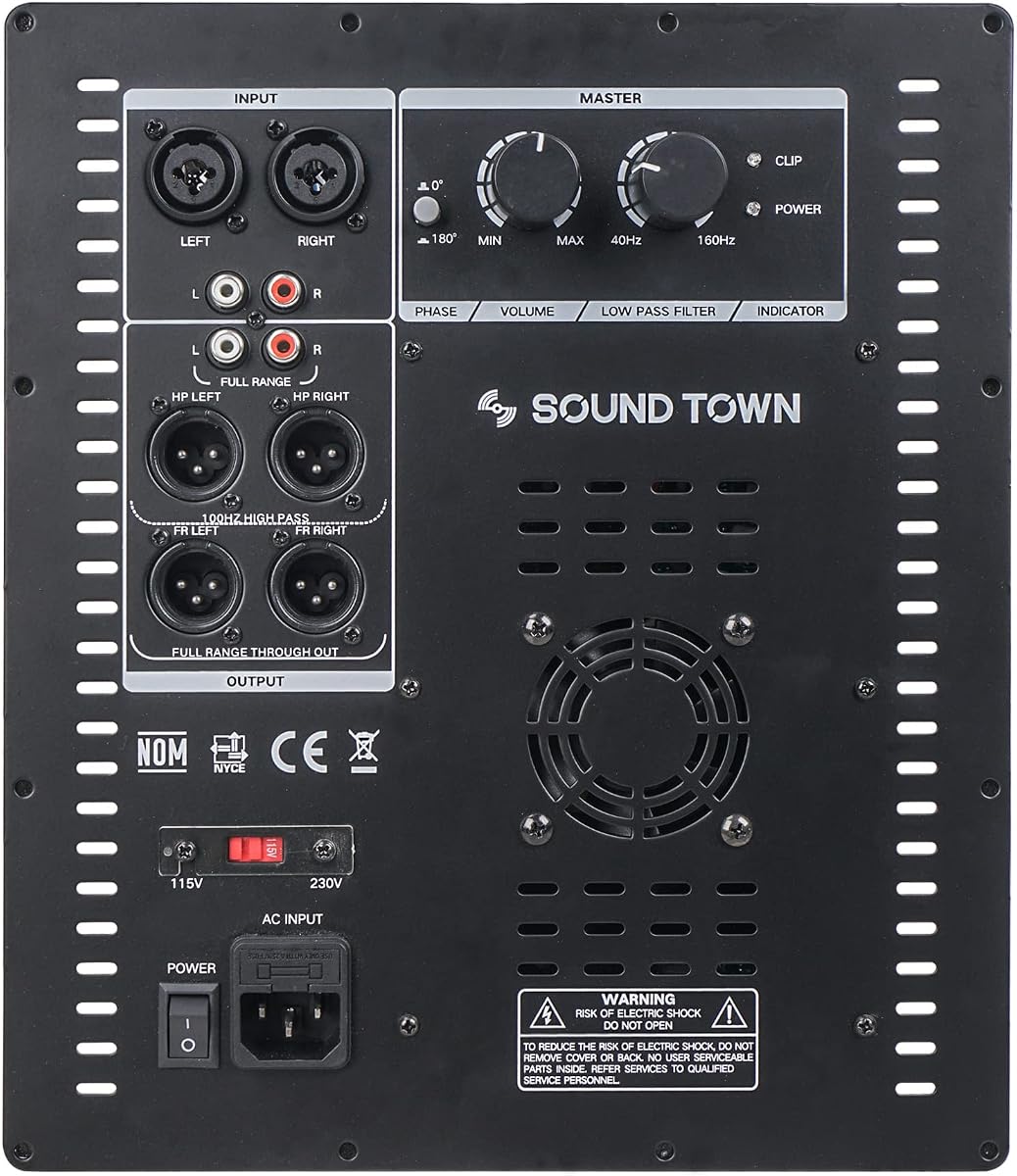
The Sound Town STPAS-G800 is a 700W RMS Class-D plate amplifier designed for PA and DJ subwoofer cabinets. Its 4.1 rating may not lead the group, but the specification reflects a specialized professional product with substantial output, flexible routing, and several filter-related features that go beyond a typical home subwoofer plate.
We may earn a commission when you buy through this link, at no additional cost to you.
Its input selection is a major advantage. Two XLR-1/4-inch combo connectors and two RCA inputs give the installer several ways to bring audio into the amplifier. Outputs include two XLR connections, one described as a through output and another providing a 100Hz high-pass filter, plus RCA outputs. That flexibility can simplify system design when a mixer, crossover, or additional powered cabinet is part of the installation.
The built-in processing includes dynamic bass enhancement, an RMS dynamic processor, and a second-order IIR low-pass filter. Overcurrent and short-circuit protection are included, while an integrated aluminum heat-sink panel supports thermal management. These details make the STPAS-G800 more appropriate for a mobile DJ, club-style installation, or serious live-sound project than a small living-room subwoofer.
This amplifier is a strong fit for users who need professional connections and more substantial continuous power than the compact home-audio models provide. Its specialized layout and high-pass output demand a more intentional setup, but that complexity becomes an advantage when the goal is a flexible PA or DJ signal chain rather than a simple stereo-living-room installation.
Combination XLR and quarter-inch inputs, RCA inputs, XLR outputs, and RCA outputs give installers several paths for connecting a mixer and additional system components. The through and filtered outputs are especially useful in larger subwoofer arrays.
Dynamic bass enhancement, an RMS dynamic processor, and a second-order IIR low-pass filter are tailored to the demands of powerful subwoofer output. Together with the integrated heat sink, these features support a performance-oriented professional installation.
We may earn a commission when you buy through this link, at no additional cost to you.
The Sound Town STPAS-600D is a 350W RMS Class-D plate amplifier intended for PA and DJ subwoofer cabinets. Its 3.9 rating is the lowest among the ten products, but the model remains relevant for builders who want a conventional professional plate amplifier with balanced connections and built-in low-pass filtering.
We may earn a commission when you buy through this link, at no additional cost to you.
The amplifier provides two XLR-1/4-inch combo inputs and two RCA inputs, followed by two XLR through outputs. This makes it easier to connect a professional mixer, use balanced signal paths, or pass audio onward to another component. Its low-pass filter is a useful built-in feature because it helps restrict the plate amplifier's output to the low-frequency range expected by a subwoofer.
Overcurrent and short-circuit protection add safeguards, and the construction is described as sturdy and reliable. Compared with the STPAS-G800, the feature list is less extensive: the supplied information does not mention dynamic processing, high-pass outputs, or the same variety of routing. That makes the STPAS-600D a more focused choice for a straightforward professional subwoofer system.
Its lower rating deserves attention, so buyers should consider user feedback and the overall installation requirements before making a final decision. Even so, it may deliver good value for someone who prioritizes 350W RMS, XLR connectivity, and a low-pass filter over deeper processing. It is also easier to integrate than a complicated DSP system when the goal is a single dedicated subwoofer cabinet.
The combination inputs and XLR through outputs support balanced professional signal flow. This is useful when the amplifier sits farther from the mixer or when other powered cabinets need to receive the same source signal.
The integrated low-pass filter provides the frequency restriction needed for subwoofer operation without requiring a separate outboard filter. That streamlines a system built around a single dedicated cabinet.
We may earn a commission when you buy through this link, at no additional cost to you.
The Fosi Audio TP-02 earns a 4.4 rating by combining a compact mono format with useful bass-focused controls and a maximum output power of 220W. It is a compelling choice for home audio, desktop subwoofer builds, bass shakers, and compact passive subwoofer projects where a full rack-style plate amplifier would be excessive.
We may earn a commission when you buy through this link, at no additional cost to you.
Its built-in low-pass filter removes high-frequency content to create a cleaner subwoofer signal, and the listed frequency response extends from 20Hz to 250kHz. Low-frequency adjustment covers 30Hz to 260Hz, allowing the crossover point to be matched to different main speakers and room conditions. The specifications also list total harmonic distortion at or below 0.04%, signal-to-noise ratio of at least 98dB, and input sensitivity of 775mV.
At the heart of the amplifier is a Texas Instruments TDA7498E chip paired with an NE5532 op-amp. The product description notes speaker protection, a pop-free startup, and silence when inactive. These details matter in a home installation because transient pops or unwanted background behavior can be distracting even when the basic bass performance meets expectations.
The TP-02 is best suited to projects using the included low-voltage power approach and a compatible passive driver or bass shaker. It is not intended to replace a professional PA plate with multiple balanced outputs and extensive protection. For the defined category of small and medium home subwoofer builds, though, it offers an unusually attractive combination of compactness, control, and stated electrical performance.
The small enclosure is easier to conceal near a passive subwoofer, desktop setup, or media console. It also includes a 24V adapter and manual, making it approachable for a builder creating a secondary bass zone rather than a permanent high-output installation.
A 30Hz-to-260Hz low-pass adjustment offers more range than many compact alternatives. This lets the installer set the transition between the subwoofer and full-range speakers more precisely while maintaining a clean low-frequency signal.
We may earn a commission when you buy through this link, at no additional cost to you.
The Dayton Audio SPA1000 is a 1000W subwoofer plate amplifier with a high-power Class-AB output stage and a 4.0 rating. It stands apart from most of the Class-D models in the guide, making it an option for a builder who values substantial output, a conventional linear amplifier architecture, and detailed low-frequency equalization.
We may earn a commission when you buy through this link, at no additional cost to you.
Its patented tracking downconverter power supply and toroidal transformer are designed to support high output while improving efficiency. The amplifier also includes advanced soft-clip circuitry, which is intended to increase usable headroom and protect connected woofers when the amplifier approaches its limits. These characteristics make it appealing for a large home-theater subwoofer, a dedicated music subwoofer, or an ambitious passive enclosure.
The most significant control is the low-frequency parametric EQ, which can boost or cut selected bass regions for a more tailored response. Parametric equalization is more precise than a general bass-boost control because it targets a defined frequency area rather than applying a broad increase across the low end.
Class-AB output stages are larger and may produce more heat than compact Class-D amplifiers, so enclosure space, ventilation, and electrical requirements deserve careful attention. The SPA1000 is not as compact or connection-flexible as some professional Class-D alternatives, but it fills an important gap: a high-power, feature-rich plate for a serious subwoofer enclosure with room for a substantial internal amplifier.
The parametric EQ allows targeted boosts and cuts, making it easier to compensate for room boundaries, cabinet response, or source-dependent bass behavior. This is more useful for precise final tuning than a fixed bass-boost switch.
Advanced soft-clip circuitry is intended to preserve headroom and reduce the risk of overdriving connected woofers. Combined with the tracking power supply, it supports use in an ambitious high-output subwoofer project.
We may earn a commission when you buy through this link, at no additional cost to you.
The Hosyond ZK-6001 is an exposed mono amplifier board intended for experienced builders creating a custom home, car, or professional audio system. It carries a 4.1 rating and combines a TPA3255-based design with substantial stated output, including 600W peak at 2 ohms and 300W rated power at 4 ohms under the specified 48V DC conditions.
We may earn a commission when you buy through this link, at no additional cost to you.
Power-supply requirements are a defining consideration. The board accepts an 18–50V DC range, with 36–48V recommended and at least 10A of DC current required. Because it is a bare board rather than a complete mains-powered plate amplifier, the user must provide a suitable power supply, enclosure, wiring, grounding, and appropriate input connections. That flexibility makes it attractive to builders who already have a reliable system architecture.
Thermal management and protection are comprehensive for a DIY board. A large heat sink is intended to maintain stable operating temperature during prolonged high-power use, while input undervoltage, overheating, overcurrent, and short-circuit protection are listed. The product information explicitly warns that there is no input reverse-connection protection, so correct positive and negative wiring is essential.
Stereo input through an XH2.54-3P interface, along with a matched double-ended shielded cable, provides a convenient route for integrating the board with a source. Its stated wide frequency response and low distortion are attractive, but users should not treat peak output as continuous output. The ZK-6001 is best for a confident DIY builder who can safely construct a power, cooling, grounding, and enclosure system around it.
The broad 18–50V DC input range allows the builder to select a supply appropriate for the installation, subject to the recommended operating range and current requirement. This makes the board more adaptable than one designed around a single fixed supply.
Undervoltage, thermal, overcurrent, and short-circuit safeguards help protect the board during abnormal conditions. The lack of reverse-polarity protection means correct wiring remains the installer's responsibility.
We may earn a commission when you buy through this link, at no additional cost to you.
The 300W 12V Car Amplifier Board is a slim, exposed dual-channel board designed for vehicle subwoofer and car-audio installations. Its 4.2 rating suggests generally favorable user reception, while its low-voltage design makes it relevant to builders creating a custom car subwoofer enclosure rather than a conventional household powered subwoofer.
We may earn a commission when you buy through this link, at no additional cost to you.
Its most notable physical feature is the thickened pure-aluminum exposed cooling panel. In a compact vehicle installation, efficient heat dissipation is essential because the board may be mounted in a sealed enclosure where airflow is limited. The slim design also gives the installer more freedom when positioning the amplifier near the subwoofer, although a secure mount and protection from vibration remain important.
The product is described as a 300W high-power dual-channel vehicle amplifier board with a design aimed at powerful, high-reproduction subwoofer output. Compared with the finished plate amplifiers in this guide, its supplied specifications are much less detailed. The listing does not provide a clear continuous-power definition, impedance-specific output ratings, crossover controls, input types, or a full protection list, so buyers should seek those details before finalizing a design.
This board is most appropriate for a custom car-audio build with practical experience in vehicle electrical systems. It offers an exposed, flexible approach rather than a ready-made powered subwoofer plate. Confirming continuous output, impedance behavior, signal connections, and thermal requirements is essential because peak marketing language alone is not enough to size a speaker system safely.
The slim board format and 12V design suit custom car subwoofer projects where space is limited. Its exposed construction also gives the builder direct control over enclosure layout and mounting.
A thick aluminum cooling panel helps dissipate heat from the exposed design. It is an important feature for vehicle installations, but the board still requires stable mounting, airflow, and correct electrical protection.
We may earn a commission when you buy through this link, at no additional cost to you.
The Sound Town STPA11-G900 is a two-channel Class-D plate amplifier with a 5.0 rating, the highest in this comparison. It combines 2x600W continuous output, 2x1200W peak output, digital signal processing, professional connections, and Bluetooth TWS, making it the most feature-rich premium option here.
We may earn a commission when you buy through this link, at no additional cost to you.
Its DSP is a major differentiator. Presets and manual EQ and delay settings are accessible through an easy-to-read LCD screen, allowing more deliberate system tuning than a basic gain-and-crossover plate. DSP can help manage response, timing, and speaker behavior across a more complex setup, although correct configuration and measurement remain necessary to achieve useful results.
Connectivity is also versatile. The plate includes two XLR-1/4-inch combo inputs, one XLR output, one Speakon power output, and TWS Bluetooth connectivity. That selection supports professional mixers, conventional powered speakers, subwoofer cabinets, and wireless stereo configurations. Overload and overcurrent protection add safeguards, while an integrated aluminum heat-sink panel supports the substantial power rating.
This amplifier is an excellent choice for a serious PA or DJ system in which both subwoofer and full-range applications may be needed. It is less attractive for a tiny home subwoofer that requires only one input and a basic low-pass control. Even so, the combination of continuous power, clean routing, DSP, and a 5.0 rating makes it the strongest premium recommendation for a professional or advanced multi-purpose installation.
EQ, delay, presets, and an LCD interface make system configuration faster and more repeatable. These controls are useful for aligning multiple speakers and organizing a mobile PA with repeatable settings between performances.
XLR-1/4-inch combo inputs, an XLR output, Speakon connection, and TWS Bluetooth allow the amplifier to serve both wired professional systems and convenient wireless configurations. That versatility supports a broader range of event and rehearsal applications.
We may earn a commission when you buy through this link, at no additional cost to you.
The 1000W 12V Amp Board is a compact, exposed circuit board marketed for high-power vehicle subwoofer systems. Its 4.5 rating is the second highest in the guide, but the supplied information focuses on construction and general capabilities rather than a complete set of electrical performance specifications. It is therefore best evaluated as a custom-build component rather than a turnkey household plate.
We may earn a commission when you buy through this link, at no additional cost to you.
Thermal design is central to the product. The vehicle power amplifier housing uses an aluminum alloy structure with cooling holes designed to increase contact with air and accelerate heat dissipation. This supports the claimed high-power use, while the slim format makes it easier to fit into a compact custom enclosure. A two-color coil transformer and Black Diamond capacitors are also highlighted as part of the internal design.
The board is described as a 1000W high-power 12V car amplifier, but the listing does not clarify RMS output at a specific impedance, continuous power limits, input configuration, crossover controls, or protection circuitry. Those omissions make it especially important for buyers to request additional specifications before connecting a driver. A large headline output figure should never be treated as a substitute for a continuous, impedance-specific rating.
This board is a potentially interesting option for an experienced car-audio builder who values a compact, high-output design and is prepared to validate its specifications and construct a suitable enclosure. It is less suitable for a first-time builder who needs a complete power supply, protected wiring plan, filtering, and installation guidance in one package.
The slim exposed-board format is useful where a traditional amplifier chassis will not fit. It gives experienced vehicle builders a way to develop a custom subwoofer enclosure around the available space.
Aluminum alloy construction and ventilation openings are designed to move heat away from the amplifier. Effective cooling remains essential whenever a high-output board operates in a closed vehicle enclosure.
We may earn a commission when you buy through this link, at no additional cost to you.
Choosing a plate amplifier requires matching amplifier topology, output capability, filtering, connections, and thermal design to the subwoofer enclosure, driver, source, and intended environment. The following factors help separate a convenient home-audio solution from a specialized professional or automotive build.
Begin with the amplifier's continuous output at the impedance of the planned driver, not a headline peak-power figure. A plate rated at a stated wattage for a particular load may produce less output at another impedance, and a compact or budget board may lack the clean continuous power suggested by its marketing name. Match the amplifier to the subwoofer manufacturer's recommendations, enclosure design, and the volume level required for the room or vehicle.
Use a continuous, load-specific rating to compare products fairly and choose an amplifier with reasonable headroom for the intended system.
Class-D amplifiers are generally compact and efficient, making them well suited to subwoofer enclosures with limited space and to mobile installations. Class-AB designs can be desirable in high-fidelity home systems because of their conventional linear output topology, but they usually require more heat management and a larger enclosure. The choice should reflect enclosure dimensions, cooling, electrical efficiency, and the system's performance priorities.
Choose Class-D for efficiency and compactness, or Class-AB when a traditional output stage and substantial home-system power are priorities.
A subwoofer plate should offer a low-pass filter so high frequencies do not reach the driver, and many systems also benefit from adjustable phase and level control. The WAudio SUA-350 offers a 50–180Hz crossover range, the Dayton Audio SPA100-D includes gain, crossover, and phase adjustment, and the Fosi Audio TP-02 provides a 30Hz–260Hz low-pass control. Match the available range to the crossover point required by the main speakers and listening environment.
Prioritize adjustable low-pass filtering, phase, and gain when the amplifier must blend seamlessly with an existing audio system.
RCA inputs cover most home receivers and mixers, while XLR and quarter-inch combo connections are more common in PA systems. Balanced inputs can help maintain signal integrity over longer runs and in noisier environments. Some plates also provide pass-through outputs, high-pass outputs, Speakon connections, or stereo input boards. Consider how the amplifier will connect to the source, whether other powered cabinets need a copy of the signal, and which connectors are already present in the cabinet.
Choose connectors that match the source and planned signal chain, including pass-through or filtered outputs when the system must expand.
Basic gain, crossover, and phase controls are sufficient for many single-subwoofer systems. DSP becomes more valuable in multi-speaker or mobile PA installations because it can organize equalization, delay, and presets. The Sound Town STPA11-G900 includes manual EQ, delay, and presets with an LCD interface, while the STPAS-G800 includes dynamic bass enhancement, an RMS dynamic processor, and an IIR low-pass filter. More processing offers control, but it also requires correct setup.
Use DSP for complex, repeatable multi-speaker systems and stick to basic analog controls when the installation needs only one well-aligned subwoofer.
Short-circuit, overload, overcurrent, and thermal protection help prevent an installation fault from becoming a damaged amplifier or speaker. Passive housings, sealed boxes, and vehicle enclosures need airflow because heat can build quickly under sustained load. An integrated aluminum heat sink helps dissipate heat, while soft-clip circuitry can improve headroom and protect woofers near the output limit. Exposed boards need additional enclosure planning and secure mounting.
Confirm both electrical protection and an appropriate cooling plan before installing a powerful plate amplifier in a confined cabinet.
A complete plate amplifier may include or integrate a mains power supply, whereas a bare board generally requires the builder to provide one. The Hosyond ZK-6001 accepts an 18–50V DC range and recommends 36–48V with at least 10A, demonstrating how significantly supply requirements can vary. Automotive boards are designed around 12V systems, while some finished plates include a 120V/240V selector. Always verify the supply, switch position, grounding, and local electrical requirements.
Determine whether the product is a complete mains unit or a bare board, and provide the correct supply before connecting power.
The best amplifier on paper may still be unsuitable if it will not fit, ventilate, or mount correctly. Home users may prioritize a compact, low-maintenance unit with simple controls. PA and DJ builders may need balanced connections, filtered outputs, DSP, and a durable heat sink. Car-audio projects require 12V compatibility, compact dimensions, secure mounting, and protection against vibration. Consider the complete system rather than treating the amplifier as an isolated component.
Select a plate amplifier whose dimensions, power needs, connectors, and cooling method suit the cabinet and operating environment.
Before installation, confirm that the amplifier's continuous output, load rating, crossover controls, and input type match the subwoofer driver and source. Check the voltage selector on models that provide one, and never assume the supplied setting is correct. Connect the speaker output with the proper polarity, use adequate wire for the amplifier's current requirements, and ensure the enclosure contains the amplifier's specified power supply or an appropriately rated supply for a bare board.
Begin with the source volume low, the amplifier gain at its minimum setting, and the crossover or low-pass filter adjusted for the main speakers. Connect the audio input, apply power, and raise the source level gradually. Set gain so the subwoofer blends with the rest of the system rather than dominating it, then adjust crossover frequency and phase. For complex DSP systems, apply a preset, make incremental EQ or delay changes, and verify the result with familiar material across different program types.
Care for the amplifier by leaving adequate clearance around heat sinks and ensuring that vents are not blocked by insulation, carpeting, or cabinet walls. Check connections periodically, particularly on mobile or vehicle systems exposed to vibration. Do not leave the amplifier powered while changing wiring, and avoid operation beyond the intended load or supply. If distortion, abnormal heat, intermittent silence, or protection-related shutdown occurs, reduce output and inspect the load, cabling, source, and ventilation.
A plate amplifier is a compact amplifier module intended to be installed inside a passive subwoofer cabinet. It accepts an audio input, applies filtering and level controls, and provides power directly to the connected driver. Finished models may include a power supply, while some amplifier boards require the builder to supply one separately.
The correct power depends on the driver's rated impedance, manufacturer recommendations, enclosure design, and desired output level. Compare continuous power at the actual speaker impedance rather than relying on peak-wattage claims. A modest amplifier matched to a small driver can sound better than an oversized amplifier operated aggressively beyond the driver's limits.
Only if the amplifier's supported load range and continuous output rating are compatible with the driver. Check impedance, RMS power, and any manufacturer limits before connecting a speaker. Also verify that the amplifier's crossover settings and power supply are appropriate for the planned system.
A low-pass filter is highly desirable because it keeps high-frequency content away from a subwoofer driver. Some plate amplifiers include an adjustable low-pass filter, while others provide fixed filtering or more advanced DSP. If the included filter range does not suit the main speakers, a separate crossover may be needed.
RCA inputs are common in home audio and provide an inexpensive unbalanced connection. XLR inputs support balanced signal paths and are standard in professional PA equipment. Balanced connections can be advantageous over longer cable runs or in noisy environments, but the source and output wiring must support the selected connection method.
Yes, provided the builder supplies a correct power supply, enclosure, cooling system, wiring, input connection, and filtering. Bare boards offer flexibility but require more enclosure and electrical planning than a complete plate amplifier. Automotive boards are usually designed around 12V vehicle power and may not be suitable for direct household use.
Common causes include excessive heat, an overloaded or shorted speaker connection, an unsuitable speaker impedance, insufficient power supply capacity, or incorrect wiring. Verify the load and connections, improve ventilation, and check that the supply meets the manufacturer's requirements. Persistent shutdown behavior warrants troubleshooting before increasing output again.
Phase can help align the subwoofer with main speakers when placement and crossover settings create timing issues. It should be adjusted by ear after setting level and crossover frequency, not treated as a substitute for correct placement. Small changes around the normal listening position can reveal whether a phase change improves bass blending and clarity.
The WAudio SUA-350 is the most well-rounded general recommendation because it combines 350W RMS output with crossover, phase, EQ, gain, balanced and RCA inputs, multiple operating modes, and protection. The Fosi Audio TP-02 is a compact home-audio alternative with useful frequency control, while the Sound Town STPA11-G900 is the premium pick for professional users who want continuous power, DSP, flexible routing, and wireless connectivity.
Prioritize the details that match the installation rather than the largest headline wattage. Verify continuous output at the driver's impedance, confirm the required crossover functions, choose connectors appropriate to the source, and make sure the amplifier can cool itself inside the cabinet. Professional systems should also consider balanced inputs, filtered outputs, DSP, and system protection, while bare boards demand additional electrical and enclosure planning.
Ratings, feature details, and product availability can change, so readers should review the current listing before making a final decision. Confirm dimensions, load requirements, power-supply needs, included accessories, and manufacturer instructions against the intended subwoofer design.
