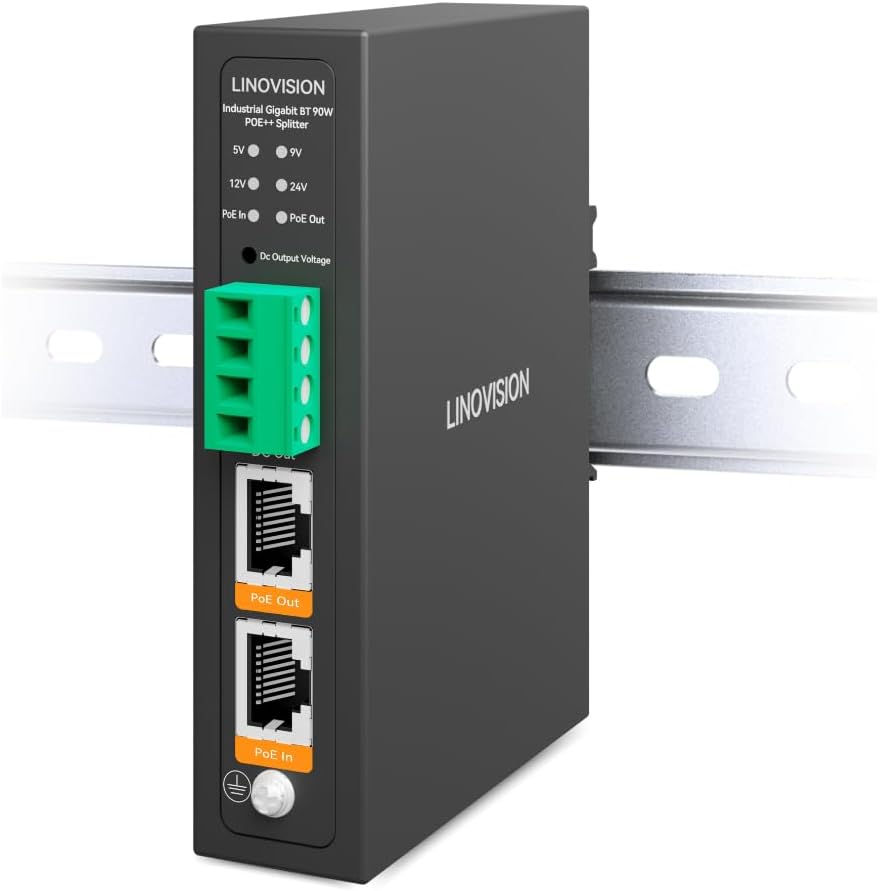
LINOVISION Industrial PoE++ Splitter
4.6Editor score
Up to 90W POE input
Switchable DC voltage output
Industrial temperature tolerance
Active PoE detection
Explore the best POE splitters for cameras, access points, and USB-C devices, with expert guidance on compatibility, power output, speed, and weather resistance
POE splitters make it possible to deliver power and network data through one Ethernet cable, reducing the need for nearby outlets and simplifying surveillance, access-point, and low-voltage device installations. A useful splitter must match your device voltage, connector, power class, and data requirements without introducing reliability or compatibility problems.
We compared these ten products by examining their supported POE standards, input and output arrangements, power budgets, Ethernet speeds, cable reach, protection features, and intended installation environments. The list covers passive-device adapters, two-output extenders, camera combiners, USB-C power solutions, and an industrial 802.3bt splitter.
Each review shows which installation the product is best suited to, along with the compromises that matter before purchase. The top selections range from a broadly useful 12-volt adapter to a premium industrial model and a budget camera combiner. Product availability, configurations, and prices can change, so verify current listings before ordering.
4.6Editor score

4.6Editor score

4.1Editor score
The table below places all ten POE splitters side by side, emphasizing the distinctions that affect installation planning: whether the unit powers one non-POE device, feeds two PoE devices, combines camera runs, delivers USB-C power, or supports high-power industrial loads.


The PS5712TG is a 48V-to-12V POE splitter with a 4.6 rating and a strong balance of useful specifications. It separates standard POE power and data, providing a 12V, 2A DC output through a 5.5-by-2.1mm connector while maintaining network rates of 10, 100, or 1000Mbps. That combination makes it especially relevant to security cameras and other non-POE devices that accept conventional DC power.
We may earn a commission when you buy through this link, at no additional cost to you.
Its principal strength is straightforward compatibility. The unit can deliver up to 24W, automatically selects the appropriate output, and is described as compliant with IEEE 802.3af/at standards. A separate RJ45 cable handles network transmission, while the DC lead supplies power. Isolation, short-circuit, and overvoltage protection add practical safeguards that are useful in permanent installations.
The main limitation is that this is a one-device splitter rather than a two-output switch. A second camera or access point would require additional wiring or a different product. Buyers must also verify that their equipment uses a 5.5-by-2.1mm barrel connector, correct center polarity, and accepts 12V at the available current. The network speed depends on the connected source, cable, and endpoint.
This is the strongest general recommendation for someone who needs reliable 12V power and gigabit data from a standard POE source. It suits a broad range of CCTV and low-voltage equipment without requiring complex configuration. If the application needs multiple PoE outputs, selectable voltage, USB-C power, or a passive 802.3bt source, one of the more specialized alternatives will be a better fit.
The splitter lets equipment that lacks native POE receive both network connectivity and regulated low-voltage power through an existing Ethernet run. It is particularly useful where adding a local outlet would be inconvenient.
Supporting 10/100/1000Mbps keeps the unit suitable for modern camera traffic, while its isolation, short-circuit, and overvoltage protections help guard connected equipment during use.
We may earn a commission when you buy through this link, at no additional cost to you.
This sender-and-receiver set is built for a specific but valuable installation pattern: running two nearby IP cameras through one long cable back to a POE switch or NVR. It carries a 4.3 rating and includes a combiner near the network equipment plus a splitter near the cameras. The approach is particularly helpful when a second camera is located around a corner or near an existing camera.
We may earn a commission when you buy through this link, at no additional cost to you.
Unlike a conventional one-to-two PoE extender, this product combines two active POE feeds at the source and separates them at the remote end. It is described as compatible with standard 802.3af/at active POE switches and NVRs across many brands. Mode A and Mode B support makes it less dependent on one vendor's preferred method of power delivery, while the two short camera cables keep final device connections simple.
The receiver's weatherproof RJ45 connectors and full IP68 rating allow it to be exposed to rain, sleet, snow, ice, and sunlight. That makes the remote unit more appropriate for outdoor installations than a basic indoor splitter. However, the design is less flexible when devices are far apart or more than two cameras need service. It also depends on active POE rather than passive power sources.
Choose this kit when both cameras are near one another and reducing the number of long cable runs is the priority. It is a practical alternative to pulling separate home-run cables back to a switch. Users should confirm that the cameras, switch or NVR, and cabling use compatible active POE, and should protect the receiver according to its environmental installation requirements.
The two-camera arrangement can save installation time and materials when both endpoints are close to each other. One long run carries the combined installation to the remote location.
Weatherproof connectors and an IP68 receiver give this set an advantage over basic indoor adapters when the remote splitter must withstand outdoor conditions.
We may earn a commission when you buy through this link, at no additional cost to you.
The LINOVISION 2-port model is a compact 1-in-2-out POE extender with a 4.2 rating. It divides one PoE input into two PoE outputs, allowing two IP cameras or other compatible devices to receive power and data through existing network cable. It also extends the signal by as much as an additional 330 feet over Cat5e or Cat6 wiring.
We may earn a commission when you buy through this link, at no additional cost to you.
Its industrial design is one of the most attractive elements. The metal casing improves heat dissipation, the IP53 enclosure suits harsh environments, and the stated operating range is -22°F to 149°F. DIN-rail mounting, 4kV surge protection, and a compact enclosure measuring 1.02 by 3.26 by 2.09 inches make it practical for junction boxes and outdoor-rated cabinets.
The device supports IEEE 802.3af/at, gigabit transmission, and plug-and-play operation. Its limitations center on power distribution and environmental tolerance. Unlike the 90W industrial splitter, this unit does not offer selectable DC outputs or a large 802.3bt power budget, and its temperature range is less broad. The extra 330-foot capability is an extension figure rather than a guarantee for every combination of source, cable, and endpoints.
This is a strong choice for installers who need two POE outputs, long cable reach, and a compact housing that can fit in a constrained enclosure. It suits surveillance and access-point networks where standard 802.3af/at power is enough. Buyers should compare endpoint power draw carefully and ensure the enclosure receiving the unit provides appropriate environmental protection.
Its small dimensions allow the extender to fit in wall-mount brackets, junction boxes, and other outdoor waterproof enclosures where a full-size switch would be impractical.
The one-input, two-output arrangement expands one active POE feed into separate power-and-data feeds for cameras, phones, or access points without local configuration.
We may earn a commission when you buy through this link, at no additional cost to you.
This Type C splitter converts 48V POE into a 5V, 3A USB-C output while passing network data over RJ45. It has a 4.3 rating and is designed for non-POE equipment that accepts USB-C power. Its most useful combination is 15W of power with support for 10, 100, and 1000Mbps network speeds.
We may earn a commission when you buy through this link, at no additional cost to you.
The adapter follows a familiar topology: an Ethernet cable carries POE into the splitter, a second Ethernet connection handles data, and a USB-C cable supplies power to the endpoint. Automatic output selection, isolation, short-circuit protection, and overvoltage protection make the unit straightforward to deploy around cameras, compact computers, or other compatible USB-C devices.
There are important limits. A 5V, 3A rating does not make every USB-C device charge faster, and the product description does not claim support for USB Power Delivery or Quick Charge protocols. High-power laptops, demanding cameras, and equipment requiring USB-C Power Delivery may not be satisfied. The endpoint must also accept a 5V USB-C supply while communicating over the separate Ethernet connection.
This splitter is a good fit for a powered device that specifically uses 5V USB-C and has a separate network connection. It is particularly attractive for small computing or surveillance projects where a nearby outlet is inconvenient. Confirm the device's voltage, current, connector, and charging requirements before buying, and use a compliant active POE source.
The adapter removes the need for a nearby power connection while preserving a conventional Ethernet data path. That makes it useful in remote or retrofit installations.
The stated 5V and 3A output is appropriate for compatible USB-C equipment, but it is not equivalent to full USB Power Delivery. Device requirements should control the purchase decision.
We may earn a commission when you buy through this link, at no additional cost to you.
The UCTRONICS adapter is a 4.6-rated splitter aimed at 5V USB-C devices, including Raspberry Pi 4 setups, compatible wireless networking equipment, and security cameras. It divides an active IEEE 802.3af POE feed into 5V USB-C power and gigabit Ethernet delivered through RJ45.
We may earn a commission when you buy through this link, at no additional cost to you.
Its documentation is unusually clear about requirements. A compliant 802.3af switch or injector must provide the POE source, and the attached Ethernet cable must carry active POE. The splitter provides up to 2.4A under 802.3af rules. If data is unnecessary, the Ethernet lead can be set aside, and the split Ethernet connection no longer carries power.
The crucial tradeoff is that passive or non-standard POE can overvolt and damage the connected device. The adapter also does not support PD or QC fast-charging protocols. This means it should not be chosen merely because the connector looks right; the attached device must work with a 5V supply and the source must negotiate standard POE correctly.
For makers and technically minded users, this is one of the clearest choices in the roundup. It offers good documentation, recognizable use cases, and a high rating. It is best for a Raspberry Pi 4 or similar device that accepts 5V USB-C and needs a separate wired network connection, provided the POE source is active and IEEE 802.3af compliant.
Supplying 5V and Ethernet over a POE run can simplify a remote Raspberry Pi installation where a conventional power adapter and outlet would be inconvenient.
Standard negotiation is essential because passive sources can apply an inappropriate voltage. The product's compatibility warnings are central to safe operation.
We may earn a commission when you buy through this link, at no additional cost to you.
The NICGIGA extender divides one POE input into two outputs for devices such as IP cameras, IP phones, and wireless access points. It holds a 4.4 rating and uses automatic recognition for IEEE 802.3af/at devices. Its most attractive practical feature is the ability to extend an installation by 100 meters, or 328 feet.
We may earn a commission when you buy through this link, at no additional cost to you.
Both power and data travel over RJ45 network cable, and the unit supports gigabit transmission. It can be deployed in a cascade with two or three extenders, allowing installers to push the network farther or distribute endpoints at intermediate locations. Automatic detection means connected devices can receive power and network connectivity without software setup or configuration.
The product description states that only 48V POE devices are supported, and the listed class figures of 15.4W and 30W reflect the power that can be negotiated and distributed. Users must not assume that either output can independently receive the maximum class value. Cable quality, endpoint requirements, and the source's available power all influence performance.
This is a practical recommendation for a standard 802.3af/at surveillance or access-point network that needs two POE endpoints and a modest cable extension. The compact plug-and-play format makes it easier to deploy than a configured network switch. Ensure all endpoints are 48V-compatible and that their combined demand remains within the source's power budget.
A single unit extends the run by 100 meters, while the stated two-to-three-unit cascade capability can cover larger properties with intermediate distribution points.
Recognition and automatic power delivery reduce configuration work, making the extender suitable for straightforward camera, phone, and wireless access-point expansion.
We may earn a commission when you buy through this link, at no additional cost to you.
This LINOVISION model is the most capable high-power entry in the roundup, earning a 4.6 rating. It accepts a 90W IEEE 802.3bt POE source and can split that power into an active 802.3bt PoE output and a selectable DC output. The combined maximum output is listed as 72W, allowing demanding devices to be powered without introducing a separate high-wattage supply.
We may earn a commission when you buy through this link, at no additional cost to you.
The DC terminal block can be switched among 5V at 14A, 9V at 7.8A, 12V at 5.9A, or 24V at 3A. An intelligent indicator shows the selected output. The active PoE side follows detection, classification, and power-on procedures, which helps protect standard powered devices, while the industrial construction includes short-circuit protection, thermal cutoff, DIN-rail mounting, and a -40°F to 167°F operating range.
Compatibility must be treated seriously. The unit needs standard IEEE 802.3bt/at equipment, and the description explicitly warns against nonstandard 802.3bt switches or injectors, including passive 90W versions. Its 72W total ceiling also means that the PoE and DC outputs cannot both be loaded without accounting for the shared budget. Installation requires attention to terminals, voltage selection, grounding, and enclosure suitability.
This splitter is the premium recommendation for industrial cameras, PTZ equipment with heaters or illuminators, video servers, access points, LED lighting, VoIP phones, and other loads that exceed ordinary 802.3at limits. It suits installers who need selectable voltage, active POE, and rugged construction. For simple one-camera 12V jobs, the basic adapter is more economical and easier to deploy.
Choosing 5V, 9V, 12V, or 24V lets one industrial POE source serve equipment with different low-voltage requirements, subject to the shared power ceiling.
Active detection, thermal cutoff, short-circuit protection, wide temperature tolerance, and DIN-rail mounting make the unit better suited to demanding infrastructure than a basic plastic adapter.
We may earn a commission when you buy through this link, at no additional cost to you.
The Tliffpaco extender is a 4.4-rated 1-in-2-out device that draws both power and data from a POE switch or injector. It supports IEEE 802.3af/at, operates on DC input from 44V to 57V, and provides gigabit rates on 10/100/1000Mbps networks. No local power supply is required at the remote location.
We may earn a commission when you buy through this link, at no additional cost to you.
Its stated 30W input ceiling and maximum output of 25.5W per port describe the power available for the two attached devices, with intelligent allocation between them. Although each output is listed at up to 25.5W, the total cannot exceed the input, so one high-draw camera reduces the power remaining for the other. This is a fundamental POE budget consideration rather than a defect.
Cable reach is a major selling point. A single hop can span up to 200 meters, and two cascaded extenders can extend the total distance to 300 meters. The compact housing is presented as suitable for surveillance systems, and installation requires only plugging in the Ethernet ports without software or configuration.
This extender is a strong choice for two PoE endpoints that are far from a switch and still need gigabit connectivity. It works particularly well for CCTV installations where long runs are unavoidable. Make sure the source can supply the combined endpoint demand and remains active 802.3af/at; otherwise, the two outputs cannot distribute power as intended.
A 200-meter single-hop capability reduces the need for repeaters in large surveillance runs, while cascade support extends the total reach further.
The unit intelligently divides a 30W input between two outputs. Checking each endpoint's consumption prevents one device from reducing the power available to the other.
We may earn a commission when you buy through this link, at no additional cost to you.
The Waterproof PoE Combiner Splitter is a budget-oriented camera kit with a 4.1 rating. Like the higher-rated combiner in this list, it uses a sender near the POE switch and a receiver near two nearby cameras. One long network cable reaches the camera location, while two short cables connect the receiver to the individual endpoints.
We may earn a commission when you buy through this link, at no additional cost to you.
This arrangement is useful when a second camera is added near an existing installation and pulling another home run to the switch would be burdensome. The sender plugs into two open POE switch ports, the long run connects to the remote receiver, and the camera leads complete the installation. The design is simple, understandable, and aimed specifically at reducing cable work.
The receiver has weatherproof RJ45 connectors and is intended to withstand outdoor exposure. However, the product's stated compatibility is limited to standard POE network switches, and it does not claim the same broad switch, NVR, camera, and Mode A/Mode B coverage as the rank-two model. That narrower claim is the main reason to consider the more flexible kit when compatibility is uncertain.
For two nearby cameras, a standard active POE switch, and a straightforward budget installation, this is a practical choice. It can reduce material and labor without requiring a central switch at the camera location. Buyers should still confirm standard POE behavior, cable lengths, and environmental installation details. It is less appropriate for heterogeneous equipment or long-term industrial environments.
A single long run to two adjacent cameras is especially helpful around corners, shared walls, or other locations where each device would otherwise require its own home run.
The remote unit's weatherproof connectors support outdoor placement, although the rest of the installation still needs suitable cable and enclosure protection.
We may earn a commission when you buy through this link, at no additional cost to you.
The PS5712BG combines a 12V, 3A DC output with 2.5Gbps Ethernet in a compact splitter format. It has a 4.1 rating and is intended for non-POE devices such as IP cameras that need both conventional power and a high-speed network connection. Its 36W maximum output exceeds the 30W ceiling associated with ordinary IEEE 802.3at delivery.
We may earn a commission when you buy through this link, at no additional cost to you.
To obtain the full output, the connected source must support IEEE 802.3bt. The unit separates POE into power and data, automatically detects the power sourcing equipment, and delivers the appropriate output to the endpoint. Its 5.5-by-2.1mm DC plug and 12V requirement make it a direct upgrade path for compatible equipment that cannot use USB-C or terminal-block power.
The source requirement is the decisive constraint. An ordinary 802.3at switch or injector cannot provide the full 36W, and connecting the splitter to an unsuitable source may prevent the expected output. The 2.5Gbps data rate also depends on every component in the path, including the POE source, cabling, switch, and endpoint. Only one DC device can be powered by this unit.
This splitter is most appropriate for a modern camera or other endpoint that specifically benefits from 2.5G networking and accepts a 12V barrel connection. It is a sensible specialized choice when a confirmed 802.3bt source is already available. Users with standard 802.3at infrastructure should choose a lower-wattage 12V splitter instead.
The 2.5Gbps capability is useful for newer equipment that can benefit from faster local network traffic, provided the source, cables, and endpoint also support that rate.
Reaching the stated 36W output requires a compatible IEEE 802.3bt power source. Users should confirm the upstream equipment before assuming full output is available.
We may earn a commission when you buy through this link, at no additional cost to you.
The right POE splitter depends on the endpoint's voltage, connector, power consumption, networking needs, and physical environment. Start with the source and device specifications, then narrow the field by output type, PoE standard, cable reach, and protection features.
A conventional splitter powers one non-POE device while carrying its data over Ethernet. A 1-in-2-out extender powers two PoE endpoints, while a camera combiner separates two camera feeds at a remote location. The LINOVISION industrial unit goes further, providing active 802.3bt and selectable DC output. These architectures are not interchangeable: a camera combiner does not replace a one-device voltage adapter, and a one-to-two PoE extender does not provide an isolated low-voltage output for an arbitrary device.
PoE sources commonly provide 48V, while endpoints may need 5V, 9V, 12V, or 24V DC. Check the equipment's required input voltage and maximum current before selecting a converter. Connector diameter alone is not enough: confirm whether the device uses a 5.5-by-2.1mm barrel plug, USB-C, a terminal block, or another interface, and verify center polarity where applicable. Feeding the wrong voltage or polarity can prevent startup or damage equipment.
PoE power is finite. IEEE 802.3af and 802.3at devices have lower class limits than 802.3bt equipment, and a one-to-two extender must divide its incoming budget between both outputs. The stated per-port output can exceed what is available at both ports simultaneously. A 24W single output may be adequate for one camera, while a PTZ camera with a wiper, infrared illumination, or other accessory may need the 72W total capability of an industrial 802.3bt splitter.
Standard active POE negotiates power before energizing a powered device, while passive POE applies power without the same negotiation process. Several products in this guide explicitly require IEEE 802.3af, 802.3af/at, or 802.3bt and warn against nonstandard sources. Mode A and Mode B compatibility can broaden camera and switch compatibility, but those labels should not be confused with full support for passive operation. Matching the standard is one of the most important reliability safeguards.
Most cameras need only 100Mbps, but gigabit support provides more headroom for future equipment, high-resolution traffic, and modern access points. One product supports 2.5Gbps. Cable distance claims also require context: a 100-meter or 200-meter figure may describe a single extender hop, while a 330-foot claim may describe an additional extension beyond an initial run. Cascading changes the data budget and should be planned with the manufacturer's limits in mind.
A compact indoor adapter may be sufficient for a dry, protected location. Outdoor camera installations benefit from weatherproof connectors or a suitably sealed enclosure. Industrial sites may require a wide operating-temperature range, metal housing, surge protection, DIN-rail mounting, and terminal-block connections. Environmental ratings apply to the relevant part of the product; they do not automatically make every attached cable, connector, or power adapter weatherproof.
Isolation, short-circuit, and overvoltage protection can improve reliability around connected equipment. Active detection and classification procedures are particularly valuable in higher-power systems because they help establish a safe connection before power is applied. LED indicators are also useful when selecting operating modes or confirming that a high-voltage DC output is active. Protection features are useful, but they do not replace correct voltage selection or proper wiring.
A splitter is only one part of the installation. The POE source, cable category and length, connectors, endpoint power requirements, and data speed all influence performance. A product may advertise 1000Mbps but still operate at a lower negotiated rate when paired with older switches or cables. For camera combiners, plan how the sender connects to two switch ports, how the long run reaches the receiver, and how the two short camera leads are terminated.
Begin by identifying the POE source and confirming that it is active, standards-compliant, and powerful enough for the intended load. Disconnect power before changing connections. Connect the incoming Ethernet cable to the splitter's POE input, attach the appropriate Ethernet path for the endpoint when data is needed, and connect the specified DC or USB-C power lead to the device. For multi-output extenders, verify the source budget before attaching both endpoints.
Read every voltage, current, connector, and polarity marking before energizing the system. A passive 802.3at source should not be connected to a product that requires 802.3bt, and a 5V USB-C device should not be treated as a full Power Delivery load. For the industrial splitter, select the required DC output with the system unpowered, then confirm the selection through the indicator before connecting a load.
Route Ethernet cables away from sharp edges, excessive heat, standing water, and strong sources of interference. Use weather-resistant receptacles, conduit, or a suitable outdoor enclosure wherever required. Periodically inspect barrel plugs, RJ45 latches, terminal blocks, and seals. If a device disconnects, overheating appears, or data becomes unstable, disconnect the affected cable, review the power budget and connector fit, and test the source and endpoint independently before reinstalling the splitter.
A POE splitter typically divides one POE connection into separate power and data outputs for a single non-POE device. A POE extender usually receives power and data over one cable and passes or redistributes them to a remote endpoint, sometimes with two outputs. A one-to-two extender is therefore closer to a small remote switch than to a conventional low-voltage power adapter.
Only if the USB-C device accepts the exact voltage and current offered by the splitter and does not require a faster charging protocol. The 5V, 3A product is not equivalent to full USB Power Delivery, while the UCTRONICS model is limited to 5V and 2.4A. Check the device's power requirements and avoid assuming that a USB-C connector alone guarantees compatibility.
No. Several listed splitters explicitly require standard active IEEE 802.3af, 802.3af/at, or 802.3bt power. Passive POE does not negotiate in the same way and can deliver an inappropriate voltage, particularly to USB-C and other sensitive low-voltage devices. Always compare the splitter's required standard with the source's specification.
The usable distance depends on the product, cable, source, endpoints, and whether the unit is an extender or a conventional one-cable splitter. Individual products in this guide list 100-meter, 200-meter, 300-meter, or 330-foot capabilities, with some describing a single hop or an added extension. Treat these as maximum figures and follow the stated configuration, especially when cascading.
It depends on the desired arrangement. A 1-in-2-out extender provides two PoE outputs from one active source over shared wiring. A camera combiner instead combines two switch or NVR connections at the source and separates them near two nearby cameras. The combiner can reduce long cable runs, while a two-output extender is useful for remote distribution.
Most two-output devices share the incoming POE budget. If one camera or access point consumes most of the available watts, less remains for the second output. Check the source's negotiated class, the combined device draw, and any stated per-port limits. Upgrading the source or choosing a higher-power 802.3bt model may be necessary.
No. The voltage must match the equipment's specified input. A 12V output can damage a 5V device even when the barrel plug appears to fit. A selectable industrial splitter may be appropriate if its current and thermal limits are suitable, but the correct voltage and polarity must be selected and confirmed before connection.
Not always. A weatherproof receiver or connector protects only the components and interfaces specifically designed for exposure. The POE source, cables, terminations, and any standard power components may still need a sealed enclosure. Follow the product's environmental instructions and use an enclosure with an appropriate ingress rating when required.
The Gigabit PoE Splitter 12V 2A is the most versatile general choice, delivering up to 24W and gigabit data to a compatible 12V device. The LINOVISION Industrial PoE++ Splitter is the premium option for demanding loads, selectable voltages, and harsh environments, while the Waterproof PoE Combiner Splitter provides a budget-friendly way to connect two nearby cameras through one long run.
For two remote PoE endpoints, compare the 1-in-2-out extenders by power budget, reach, environmental construction, and source standard. USB-C models are best reserved for devices that accept their stated 5V output, while the 2.5G splitter is most useful with a confirmed IEEE 802.3bt source. The first step in every installation should be matching the exact source, voltage, connector, current, and data requirements.
Compatibility details matter more than a broad compatibility label. Verify active POE negotiation, connector dimensions, polarity, endpoint power consumption, and cable length before installation. Product configurations, availability, and prices can change, so review the current listing and source specifications immediately before making a final purchase.