
Autel PowerScan Automotive Circuit Tester, 12-24V Power Circuit Probe Tool
4.7Editor score
Voltage and polarity testing
Continuity and signal testing
Component activation functions
Built-in short-circuit protection
Compare Power Probe Circuit Tester options for auto work, covering voltage, ground checks, component activation, cable length, and circuit protection features.
A power probe circuit tester gives automotive technicians a faster way to check live circuits, identify grounds, activate components, and investigate wiring faults. The best model balances useful diagnostic functions with clear displays, dependable protection, and enough cable length to reach comfortably around a vehicle without making the job more complicated.
This guide compares ten automotive circuit-test tools according to voltage capabilities, continuity and resistance functions, polarity identification, component activation, signal analysis, tracing functions, lead length, accessories, and stated operating ranges. It covers both established Power Probe models and feature-rich alternatives, from compact all-in-one testers to kits with expanded back-probe access.
Each product entry explains the most useful capabilities, practical strengths, and limitations. Ratings and specifications reflect the supplied product information, while availability and pricing can change at any time. The first choice suits a broad range of diagnostic work, the budget option prioritizes core functions, and the premium selection adds advanced load-testing capability.
4.7Editor score

4.7Editor score

4.8Editor score
The table below compares the ten featured tools by their principal diagnostic modes, operating scope, cable arrangement, and standout diagnostic features.


The Power Probe 3 PP3CSRED carries a 4.7 rating and stands out as a balanced, general-purpose diagnostic probe. Its combination of power and ground supply, digital voltmeter, Min/Max readings, and audible monitoring covers the essential tasks involved in checking automotive electrical circuits without presenting an overly complicated feature set.
We may earn a commission when you buy through this link, at no additional cost to you.
The twenty-foot cord gives the technician room to move from the battery connection to components deeper inside the vehicle. Battery hookup clips form part of the package, while the auxiliary ground and standard 4mm banana-jack arrangement support hands-on component testing. The 12–24 VDC compatibility makes the tool suitable for the broad vehicle electrical environments described in its specifications.
Its main limitation is that it does not present the same specialized tracing or load-testing tools as the ECT3000 or the PowerFlow-equipped PP3PFRED. Users who primarily need to locate a hidden short or actively load a circuit may want a more specialized product. For everyday voltage checks, ground testing, and functional component work, however, that trade-off is reasonable.
This is the most balanced recommendation for technicians and serious do-it-yourself users who want a recognizable power-and-ground probe with dependable core functions. It is particularly useful when a diagnostic routine requires checking whether a circuit is live, supplying a controlled source to a component, or monitoring voltage while a system operates.
The ability to supply power or ground makes the PP3CSRED useful for functional component testing rather than simple voltage measurement alone. This gives a technician more options when checking components without immediately running to a separate lead or test light.
Min/Max readings and audible circuit monitoring are especially useful when a fault appears intermittently. The audible indication can reduce the need to stare at the display continuously while operating a switch, motor, or other circuit load.
We may earn a commission when you buy through this link, at no additional cost to you.
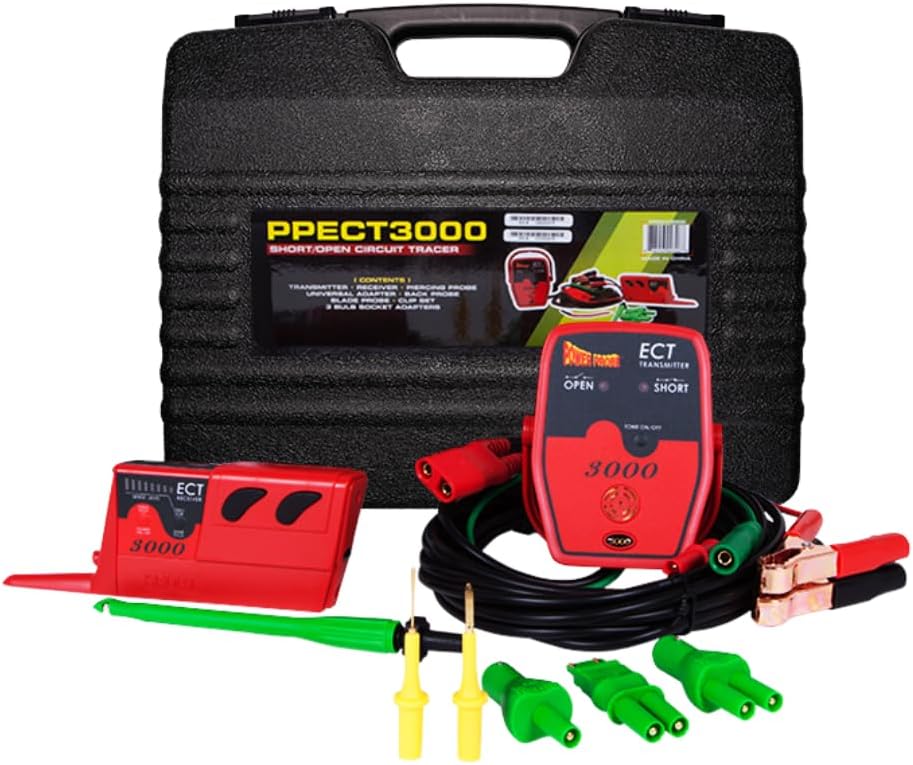
The ECT3000 has a 4.5 rating and is built around a clear specialty: tracing wiring shorts and open circuits. Its intelligent transmitter and receiver, direction indicators, and set of connection accessories make it a compelling choice when the problem is hidden inside a harness, panel, molding, or carpet and ordinary voltage checks are not enough.
We may earn a commission when you buy through this link, at no additional cost to you.
The complete kit includes an alligator clip, blade probe, piercing probe, back-probe adapter, universal adapter, and blow-molded case. That range of connections gives the user several ways to approach a circuit. The stated 6–48 VDC operating range also sets it apart from tools limited primarily to conventional 12- and 24-volt vehicle systems.
Its emphasis on tracing means it may be more than a user needs for basic component activation or everyday voltage checks. Accessories add bulk, and the specialized receiver/transmitter arrangement may require a slightly different workflow from a straightforward handheld power probe. Even so, those factors are modest concerns when locating an inaccessible open or short is the priority.
Choose the ECT3000 when tracing is central to the job or when panels have already been removed and the next step is isolating the exact section of wiring at fault. For broad everyday diagnostics, a simpler power probe may be easier to manage, but this kit offers the most purpose-built tracing package in the group.
The transmitter and receiver setup is intended to help locate shorts and opens without taking apart surrounding vehicle panels. This can reduce invasive disassembly and make repeated checks more practical, particularly in crowded harness routes.
Blade, piercing, back-probe, and alligator connections make it easier to adapt the tracer to different access points. The supplied case also helps keep this larger assortment organized between jobs.
We may earn a commission when you buy through this link, at no additional cost to you.
This Autel PowerScan holds a 4.7 rating and offers an unusually broad diagnostic set for a budget-oriented model. It supports voltage and polarity tests, continuity, signal-circuit testing, component activation, ground checks, short-circuit location, and overload protection, making it more than a simple volt display with a probe tip.
We may earn a commission when you buy through this link, at no additional cost to you.
Its four operating modes cover DC voltage, AC voltage, resistance, and adjustable tone. AC measurements can display minimum and maximum voltage, duty cycle, and frequency, while the tone setting provides audible feedback in dim workspaces. The additional twenty-foot extension cable expands the stated reach to forty feet when both lengths are used.
The breadth of features can also make the tool less straightforward than a minimalist probe. A user focused only on basic voltage checks may not use many of its capabilities, and the long leads require thoughtful winding and storage. The built-in flashlight and red/green polarity indicators help offset those practical drawbacks.
For a technician building a capable toolkit without purchasing several separate tools, this Autel is a strong value-oriented choice. It particularly suits users who want component activation, signal analysis, and polarity guidance in one package, while the long cable arrangement helps when working around larger vehicles or trailers.
DC and AC voltage, resistance, and tone modes provide a practical foundation for routine troubleshooting. AC mode adds min/max, duty-cycle, and frequency information for users investigating more dynamic vehicle signals.
The activation function can test components such as blower motors, window motors, wipers, defrosters, lights, fans, and injectors. The stated capability allows those components to be checked in hand, in the vehicle, or against ground.
We may earn a commission when you buy through this link, at no additional cost to you.
The PP319FTCRED has a 4.8 rating, the highest numerical rating among the listed tools, and provides a strong combination of power testing, continuity checking, and component testing. Its principal advantage is a complete package that includes a case and accessories, reducing the need to source separate leads immediately.
We may earn a commission when you buy through this link, at no additional cost to you.
The probe can supply power or ground for functional component checks, while DC voltmeter indicators provide active feedback. Its resettable eight-amp circuit breaker adds a layer of protection during powered diagnostics, and the 20-foot power cable provides practical access around a passenger vehicle.
Compared with the PPROKIT01, this kit does not advertise the same comprehensive multimeter measurements, including high resistance, current, and temperature functions. Its eight-amp breaker also has a lower rating than the ten-amp protection featured by several alternatives. These distinctions matter mainly for users who perform load testing or require broad standalone meter functions.
The PP319FTCRED is a strong all-around selection for a technician who values a straightforward probe, a protective breaker, and a ready-to-store kit. It is especially appealing when a complete basic setup matters more than having advanced tracing or a large digital measurement screen.
The included case and accessories make the product easier to organize and transport than a bare probe. That convenience can matter for mobile technicians who need to keep leads together between calls.
A resettable eight-amp breaker helps protect the tool and vehicle circuitry if the output is overloaded. It provides a practical safeguard while power is being applied during component diagnostics.
We may earn a commission when you buy through this link, at no additional cost to you.
The V200 Pro earns a 4.5 rating by combining a conventional power-circuit probe with a dedicated breaker-finding mode. Its first mode handles AC/DC voltage, resistance, and diode testing, while Mode II is designed to locate breaker points, open connections, broken wires, and current leaks using tone changes.
We may earn a commission when you buy through this link, at no additional cost to you.
The product also supports polarity, continuity, ground, relay, fuse, and trailer-light tests. Component activation can be used with lights, motors, wipers, radiator fans, relays, and fuel injectors, while signal testing provides another route to evaluating sensor-related circuits after diagnostic trouble codes have been recorded.
Its 6–42 VDC operating range and 40-foot combined cable reach are useful for cars, SUVs, vans, trucks, tractors, boats, and recreational vehicles. The trade-off is that the dual-mode design adds a learning curve, and Mode II requires a nine-volt battery even though the main probe can be powered through the vehicle.
Choose the V200 Pro when one device must cover both conventional testing and circuit tracing without adding a separate tracer. It is particularly compelling for broad automotive work where different jobs call for powered probing, breaker-location work, and component activation.
The power-circuit mode supplies familiar voltage, resistance, and diode functions, while the breaker finder adds tone-based fault location. Combining both roles can reduce the number of separate tools needed for mixed automotive work.
The stated six-to-42-volt range extends beyond ordinary 12- and 24-volt systems. The included twenty-foot extension cord further improves access around long vehicles, trailers, and other mobile systems.
We may earn a commission when you buy through this link, at no additional cost to you.
The Autel PowerScan PS100 2.0 combines a 4.7 rating with a backlit digital display and four advanced modes: DC voltage, AC voltage, resistance, and tone. It is a strong fit for technicians who want visible numerical readings and color-coded polarity guidance during routine vehicle diagnostics.
We may earn a commission when you buy through this link, at no additional cost to you.
AC mode can present maximum and minimum voltage, frequency, and duty cycle, which helps when evaluating changing signals. Resistance mode supports continuity and open-circuit checks, while the signal function can observe a sensor while it operates. The red and green polarity LEDs provide immediate feedback, and a sharp stainless-steel probe assists with tight access and insulation piercing.
Unlike the ECT3000, V200 Pro, or V200 upgrade package, this model does not advertise a dedicated circuit-tracing mode. It does, however, include a resettable ten-amp circuit breaker for locating shorts and protecting the battery during powered tests. The twenty-foot lead, extra twenty-foot extension, and cigarette-lighter plug provide flexible vehicle access.
This PS100 version is ideal when screen clarity, polarity identification, and comprehensive routine testing matter most. It is less suited to a technician whose main goal is tracing a buried wire, but for voltage, resistance, activation, and signal work it combines several useful capabilities in a readable format.
The backlit LCD provides clear voltage and resistance information while dual head lights illuminate the work area. Those visibility features are useful under a dashboard, inside a dark engine bay, or around a trailer connection.
Red and green LEDs distinguish positive, negative, and open conditions without requiring the user to interpret every result from the screen alone. This makes initial checks quicker and easier to communicate.
We may earn a commission when you buy through this link, at no additional cost to you.
The PP3PFRED carries a 4.8 rating and adds PowerFlow technology to the familiar power-and-ground approach. Instead of limiting the tool to basic voltage indications, its standout feature actively loads a circuit during testing, which can help reveal how a line behaves when current is drawn.
We may earn a commission when you buy through this link, at no additional cost to you.
It can power components using battery voltage or ground, measure resistance from 1 ohm to 25 kilohms, and maintain continuous power through a built-in latch. The latch reduces the need to keep a button depressed during a longer functional test, making the probe more convenient when hands are occupied with a component or vehicle control.
A self-resetting ten-amp circuit breaker provides robust overload protection. Compared with the PPROKIT01, however, this model is less of a full standalone multimeter because it does not advertise the same broad current, temperature, or 60-megohm resistance measurements. Its additional value comes specifically from active loading and continuous power application.
This is the premium choice for a technician who regularly performs functional testing and wants a tool designed to apply and monitor power in a more deliberate way. It is also suitable for advanced do-it-yourself users who understand circuit loading and can use that capability safely.
PowerFlow actively loads the circuit instead of merely confirming that voltage is present. That added behavior can make intermittent voltage-drop and load-related problems easier to investigate.
The built-in latch keeps power applied without continuous button pressure. This improves control when testing a motor, lamp, relay, or another component that requires time to stabilize.
We may earn a commission when you buy through this link, at no additional cost to you.
The V200 Pro Upgrade Kit has a 4.4 rating and is differentiated by its substantial 30-piece back-probe assortment. It combines the V200 Pro power-circuit functions with the breaker-finder mode, giving users both a conventional diagnostic probe and a wire-tracing tool in one package.
We may earn a commission when you buy through this link, at no additional cost to you.
The accessory set includes 15 back-probe pins, five banana-plug-to-alligator-clip leads, five wire-piercing probes, and five nickel-plated alligator clips. Three back-probe angles—90 degrees, 135 degrees, and straight—help address connectors, fuel injectors, and automotive sensors where a standard probe cannot reach comfortably.
The tester itself supports voltage, resistance, diode, polarity, continuity, ground, component activation, signal, relay, fuse, and trailer-light checks. Its breaker finder is stated to work from 6 to 42 VDC and can identify open connections, broken wires, and current leaks through tone changes. This makes the package comprehensive but more complex to organize than a basic probe.
This upgrade kit is best for technicians who routinely back-probe connectors and need a broad assortment of physical connections. The 4.4 rating is the lowest among the listed products, so buyers should place greater emphasis on the included accessories and their compatibility with their typical diagnostic tasks.
Multi-angle stainless-steel back probes can reach connector cavities and sensor pins that are difficult to contact with a standard probe. The fine needles are specified for testing up to 30 volts in automotive applications.
The included wire-piercing probes connect through 4mm banana plugs and allow contact with conductors without removing substantial insulation. This can be useful when access to a clean test point is limited.
We may earn a commission when you buy through this link, at no additional cost to you.
The PPROKIT01 has a 4.7 rating and is the most explicitly integrated multimeter-and-probe solution in the group. It can supply power and ground for functional component testing while also measuring voltage, resistance, current, and temperature, reducing the need to move between separate instruments for some diagnostics.
We may earn a commission when you buy through this link, at no additional cost to you.
Its CAT-IV 600V hybrid-safe AC/DC voltmeter is a notable specification for a professional diagnostic package. Resistance reaches 60 megohms, current measurements span 0.001 to 10 amps, and the temperature range extends from -4 to 1832 degrees Fahrenheit, equivalent to -20 to 1000 degrees Celsius.
Those capabilities make the kit broader but less focused than the compact PP3CSRED or the feature-oriented Autel models. A technician who only needs to check a live circuit may find some functions unnecessary. In return, the PPROKIT01 offers a more consolidated instrument for users who already recognize the value of multimeter functions alongside power-probe work.
Choose this model when a full range of electrical measurements is likely to be used regularly. It is a logical premium professional choice for a mobile technician who wants one package to cover functional testing, current checks, resistance evaluation, and temperature-related diagnostics.
Resistance, current, and temperature functions turn the device into a broader diagnostic instrument. This reduces equipment requirements when a workflow includes more than power delivery and basic voltage checks.
The stated CAT-IV 600V hybrid-safe rating supports use in demanding diagnostic environments. That specification is particularly relevant for professional users who understand measurement-category limits and safe probe placement.
We may earn a commission when you buy through this link, at no additional cost to you.
The PP3CSCARB has a 4.7 rating and delivers the essential Power Probe III experience without adding advanced tracing, load-testing, or extended multimeter functions. It supports power and ground supply, includes a digital voltmeter, and provides Min/Max and audible circuit monitoring for basic automotive electrical diagnosis.
We may earn a commission when you buy through this link, at no additional cost to you.
The package contains the handheld tool, a 20-foot cord, battery hookup clips, and an instructional DVD. That arrangement is approachable for a new technician or a do-it-yourself user who wants a straightforward way to check circuits and operate components. Compatibility with 12–24 VDC systems covers standard automotive electrical applications.
The lack of a dedicated breaker finder, detailed AC signal analysis, and a large measurement display limits it for advanced diagnostics. Compared with the PP319FTCRED, it also lacks a stated resettable breaker in the supplied specification, so users should review the manual and confirm the protections relevant to their workflow before applying power.
This is a sensible starting probe for uncomplicated electrical checks, particularly when portability and ease of use matter more than an extensive function list. Experienced users chasing hidden shorts, advanced sensor analysis, or a complete multimeter package should consider one of the specialized alternatives.
Audible monitoring provides immediate feedback while a circuit is operated. The digital display and Min/Max tracking add visual confirmation when intermittent changes need to be captured.
The twenty-foot cord and battery hookup clips provide a workable combination for passenger-vehicle diagnostics. Users can keep the probe connected while moving around the vehicle without managing only a short lead.
We may earn a commission when you buy through this link, at no additional cost to you.
The right power probe depends on the electrical tasks you perform, the vehicles you service, and the level of access available around the circuits you need to diagnose. Comparing measurement modes, protection, cable reach, and accessories is more useful than selecting on the broadest feature count alone.
A useful power probe should do more than measure voltage. Power-and-ground capability lets the technician supply a controlled source to a component and determine whether that component responds correctly, which can narrow the diagnosis before replacing expensive parts. The PP3CSRED, PP319FTCRED, PP3CSCARB, and PP3PFRED all explicitly support power or ground application.
Prioritize a model that fits your most common work. Basic component checks may only require controlled power, while active load testing demands more deliberate current control and a strong protective system.
Voltage measurement is the foundation of electrical diagnosis, but AC and DC data can support different jobs. The Autel models and V200 Pro offer AC measurements with minimum and maximum readings, frequency, and duty-cycle information, which can be valuable when observing a changing sensor or control signal. Basic Power Probe III models emphasize DC voltage, Min/Max, and audible monitoring.
Choose a display that makes the needed values easy to read. Numerical data is useful for comparisons, while an audible indication can help when watching a component or operating a switch away from the probe.
A standard probe can identify that a circuit is faulty, but a tracer can help locate the faulty section. The ECT3000 focuses on shorts and opens with an intelligent transmitter and receiver, while the V200 Pro and its upgrade kit use a separate breaker-finder mode. These are more useful when the wiring is concealed or the exact break is unclear.
If hidden-fault diagnosis is central to your work, choose tracing capability. If your tasks mainly involve voltage checks and component activation, a simpler probe may be easier to carry and operate.
Any tool capable of applying power should have clearly stated overload protection. Several products include resettable circuit breakers, with ratings of eight or ten amps, while the Autel PowerScan also describes a built-in short-circuit protection system. The exact protection design matters when the tester will be connected directly to vehicle circuits.
Read the instructions, confirm the operating voltage, and never assume a tool is safe for every electrical environment. Protection reduces risk but does not replace correct setup, care around high-current circuits, or attention to the manufacturer's warnings.
Cable reach determines how easily a technician can work around a vehicle. A fixed 20-foot lead is adequate for many passenger cars, while the Autel PowerScan and V200 Pro include an additional 20-foot extension. The latter reaches 40 feet when both cables are used, making them more convenient for long vehicles, trailers, and remote connection points.
Longer leads improve access but require more careful winding and storage. Consider the size of the vehicle, the location of the battery or accessory connection, and whether you often work outside the passenger compartment.
Activation functions can test motors, lights, relays, wipers, fans, injectors, and other components by applying an appropriate signal. This is especially useful when a component has been removed from the vehicle or when the goal is to confirm that the component itself responds. The Autel and VDIAGTOOL products emphasize this capability.
Check which components are supported and how activation can be performed. A good workflow should let the user test the part in hand, in the vehicle, or against ground when appropriate.
Modern vehicle connectors can be narrow, sealed, or positioned in difficult places. Back probes, piercing probes, blade probes, and alligator clips expand the ways a technician can make contact with a circuit. The V200 Pro upgrade package is particularly focused on this need, providing multiple back-probe angles, wire-piercing tools, and color-coded alligator leads.
Match the accessories to the access problems encountered in your work. A large kit adds convenience, but it also creates more items to organize and can include options you will rarely use.
A user who needs only a live-circuit check may be well served by a compact display and audible tone. A technician who routinely measures resistance, current, or temperature needs a broader meter specification. The PPROKIT01 stands apart with 60-megohm resistance, current from 0.001 to 10 amps, and a wide temperature range, while the Autel models emphasize AC signal details and diode testing.
Avoid choosing a broad tool solely by the number of printed functions. Favor a set of measurements that matches your diagnostic routine, with a display you can interpret quickly in real working conditions.
Begin by reviewing the tool's instructions and confirming that its voltage range matches the vehicle or system being tested. Inspect the probe, cables, clips, and display for visible damage, connect the tester to the correct reference point, and select the mode required for the initial check. Establish a known-good ground before drawing conclusions from polarity or continuity results.
For routine voltage diagnostics, begin with the lowest-risk test that can answer the question. Check voltage at the relevant points, note the reading, then operate the suspected circuit while watching the display or listening for the tone. When component activation is appropriate, confirm the correct pin or connection first and keep the supplied current protection within its stated limits.
After use, disconnect power, remove probes from live circuits, and inspect the leads for pinching, cuts, or heat damage. Wind cables without creating tight kinks, store accessories in the supplied case where one is provided, and keep moisture or dirt away from connectors. Replace a damaged probe or cable rather than using it for another test, and service the unit according to the manufacturer's instructions.
A power probe circuit tester is used to check automotive circuits for voltage, polarity, continuity, resistance, and ground faults. Depending on the model, it can also supply power or ground, activate components, measure signal behavior, and help locate shorts or opens. It therefore brings several common electrical checks into a single handheld workflow.
A tester that supports 12–24 VDC systems is generally suited to standard 12-volt automotive electrical work, but compatibility should always be confirmed. Some listed models operate from 6 to 30, 42, or even 48 volts. Check the tool's instructions, vehicle requirements, and connection instructions before applying power.
A multimeter primarily measures voltage, resistance, current, and other electrical quantities. A power probe adds the ability to supply power or ground and often includes component activation, audible monitoring, or circuit-tracing functions. The PPROKIT01 bridges both categories by combining power-and-ground delivery with broad multimeter measurements.
A circuit breaker is highly desirable when the probe applies power to a vehicle circuit because it can interrupt an overload and reduce the chance of damage. Products such as the PP319FTCRED, PP3PFRED, and Autel PowerScan PS100 specify resettable protection. Always follow the manufacturer's limits and never bypass an internal safety device.
A longer cable improves access to components farther from the battery or power connection, which is useful on trucks, trailers, and recreational vehicles. The Autel PowerScan and V200 Pro include twenty-foot extension leads for a stated forty-foot combined reach. The trade-off is additional bulk, cable management, and the need to store the leads carefully.
Some models can help locate shorts using a resettable breaker, tone changes, or dedicated tracing functions. The ECT3000 specializes in tracing shorts and opens, while the V200 Pro adds a breaker-finder mode. A standard voltage probe may only reveal that a circuit is overloaded rather than pinpointing the exact section of wiring.
Back probes with several angles are useful for reaching terminals inside narrow connectors. Wire-piercing probes can provide contact without removing substantial insulation, while banana-to-alligator leads help connect the tester to a known ground. The V200 Pro upgrade package offers a particularly broad assortment of these accessories.
Disconnect the tool from the vehicle, remove debris from the probe and cables, and clean only with methods approved by the manufacturer. Store cables loosely wound and accessories in their case. Inspect the insulation and connections regularly, and do not use a tester with a cracked display, damaged lead, or loose probe tip.
The Power Probe 3 PP3CSRED is the most balanced general recommendation, combining power-and-ground capability, a digital voltmeter, Min/Max tracking, audible monitoring, and a practical 20-foot cord. The Autel PowerScan Circuit Tester is the strongest budget-oriented option for users who also want activation, signal analysis, and extended reach.
For specialized work, the ECT3000 concentrates on tracing shorts and opens, while the PowerFlow-equipped PP3PFRED adds active load testing and continuous power. The PPROKIT01 suits professionals who need full multimeter measurements, and the V200 Pro upgrade package is particularly useful for technicians who require a large assortment of back-probe accessories.
Prioritize the functions and access methods your work actually requires rather than the longest specification list. Check the current product listing, included accessories, operating range, warranty details, and available protection features before purchasing, since pricing and package contents can change.