
OVONIC D15 Dual LiPo Charger
4.3Editor score
Dual 15-watt charging channels
One to three-cell LiPo support
Detailed abnormal-battery detection
We compare the best Rc Battery Pack Charger Station options for battery compatibility, charging power, safety, balance features, portability, and ease of use.
An RC battery pack charger station is more than a convenient way to top up batteries between runs. A capable unit should match your battery chemistry, deliver suitable current, balance multi-cell packs, and include dependable protection against common charging mistakes. The best charger also fits the way you use your cars, planes, boats, drones, and other hobby equipment.
This guide compares ten RC battery chargers across supported chemistries, cell counts, charge and discharge modes, connector coverage, input options, display design, portability, and safety functions. The list includes compact NiMH and NiCd chargers, portable LiPo balance chargers, and dual-channel high-power stations for users who regularly maintain multiple battery packs.
Each recommendation reflects the specifications and supplied customer rating for its model, with particular attention to useful charging capacity rather than headline wattage alone. The badges identify three standout choices for different needs, while the detailed reviews explain who each charger suits best. Product availability and prices can change, so confirm current details before purchasing.
4.3Editor score

4.7Editor score

4.4Editor score
The comparison below highlights the principal differences among these chargers, including supported battery families, channel count, charging capacity, balance functions, and intended level of portability.




The Venom Power Pro Duo is a substantial multi-chemistry RC charger with a 4.6 customer rating and a design aimed at users who want one unit to handle several kinds of hobby packs. Its two independent 80-watt circuits provide enough flexibility to service more than one battery at a time while still supporting LiPo, LiHV, Li-ion, LiFe, NiMH, NiCd, and lead-acid chemistries.
We may earn a commission when you buy through this link, at no additional cost to you.
Two charging ports are the model's most useful feature for active hobbyists. Each channel has its own 80-watt circuit, allowing two packs to charge concurrently when the battery types and settings are correct. The included alligator, Deans, EC3, EC5, JST, receiver, Tamiya, and XT60 leads reduce adapter shopping and make it easier to connect equipment from different manufacturers.
The program set includes balance charging, fast charging, discharge, cycling, storage charging, and a battery meter. Up to five battery profiles can be saved, which is less than the twenty offered by several newer models, but still useful for recurring pack types. Internal temperature monitoring stops charging when the configured level is reached, adding a practical layer of protection against overheating.
This charger is best for drivers and hobbyists who maintain a mixed collection of RC batteries and value a generous accessory bundle. It is less attractive for anyone seeking the latest compact screen interface or extensive internal resistance diagnostics, but its chemistry support, dual-channel layout, and included leads make it a dependable all-round choice. Confirm connector polarity and battery specifications before each session.
The Venom also weighs two pounds and includes an integrated handle, making it easier to transport than a large stationary unit. That portability is valuable at the race track or field, although users should still provide a stable surface and adequate ventilation during charging.
The independent charging circuits let users prepare two compatible packs at the same time. This is particularly useful when matching a spare battery to a vehicle already in use.
Eight supplied leads and support for seven battery families make this a practical one-stop station for mixed RC fleets. Always verify the battery label and connector orientation before connecting.
We may earn a commission when you buy through this link, at no additional cost to you.
This 150-watt RC battery charger combines a high 4.7 customer rating with extensive chemistry support and a feature set that approaches larger multi-function units. It handles one to six cells of lithium batteries, up to fifteen cells of NiMH or NiCd packs, and 2-20V lead-acid batteries, making it suitable for a wide assortment of vehicles and equipment.
We may earn a commission when you buy through this link, at no additional cost to you.
Its 10-amp charge capability provides meaningful headroom for higher-capacity packs, while the cooling fan helps manage heat during sustained work. AC input supports charging at home, while the 11-20V DC input allows use with a suitable field power source. The LCD provides real-time status information, and the shell is described as fireproof for added physical protection around the electronics.
Beyond ordinary charging, this model supports balance charge, fast charge, discharge, storage, cyclic charging, and a digital DC power mode. Twenty memory profiles reduce repeated manual configuration, while a battery meter, internal resistance check, and automatic lithium cell detection help users inspect their packs. Safety features include short-circuit, overcharge, overcurrent, overheat, low-voltage, auto-current, delta-peak, capacity, and time-limit protections.
The included balance board, power cords, and octopus harness cover Tamiya, mini Tamiya, JST, T-plug, EC3, TRX, and Deans connections. This makes it a strong choice for users who want one compact station spanning RC cars, drones, airplanes, helicopters, and boats. The main compromise is that it does not charge two packs simultaneously, so owners of several vehicles may need to schedule sessions or buy a dual-channel model.
The combination of competitive output, numerous modes, generous profile storage, and extensive protections makes this charger particularly attractive to users who regularly alternate between battery types. Correct cell-count and chemistry selection remain essential, especially when operating advanced or adjustable settings.
Short-circuit, thermal, overcharge, overcurrent, voltage, and time protections reduce common charging risks. They complement rather than replace correct battery selection and careful connector checks.
AC and DC inputs let the charger serve as a bench unit or a field companion when paired with an appropriate DC source. Users should not connect both input cables simultaneously.
We may earn a commission when you buy through this link, at no additional cost to you.
The Universal NiMH NiCd RC Battery Charger is a straightforward option for drivers still using nickel-based packs. It carries a 4.4 customer rating and supports 2-10S NiMH or NiCd configurations from 2.4V through 12V. It is explicitly incompatible with LiPo, Li-ion, and LiFePO4 batteries, so correct chemistry identification is essential.
We may earn a commission when you buy through this link, at no additional cost to you.
One of its standout features is the collection of eight prewired connectors: standard Tamiya, mini Tamiya, JST, SM 2P, XH, Huanqi, T-plug, and Futaba/JR receiver plug. This broad coverage can replace several single-purpose chargers and is especially helpful for owners of older RC cars, helicopters, and airsoft equipment.
The charger automatically adjusts current to 800mA for two- to six-cell packs and 500mA for seven- to ten-cell packs. Negative-delta and zero-delta auto-stop technology helps end the charge appropriately, while negative-pulse cooling is intended to reduce heat. It also offers zero-voltage dead-battery activation and protection against short circuits, reverse polarity, and overcurrent.
Its 100-240V AC input supports international use, and the compact 77 by 44 by 28mm size is easy to store. However, this is not a balance charger and cannot serve lithium packs. The best fit is a hobbyist with a dedicated collection of NiMH or NiCd batteries who values connector coverage and straightforward automatic charging over advanced diagnostics.
Because nickel cells tolerate a less involved setup than lithium packs, the compact design can be a practical advantage. Users should still follow the battery maker's charging guidance and avoid assuming that a similar-looking battery is compatible with the same chemistry.
The prewired Tamiya, JST, XH, T-plug, and receiver options make the unit convenient for common legacy RC equipment. Check that the connector fully seats and that the polarity matches.
Automatic current selection provides 800mA for lower-cell packs and 500mA for higher-cell packs. The LED changes when charging ends, giving a simple indication of status.
We may earn a commission when you buy through this link, at no additional cost to you.
The Dual 10A RC Fast Balance Battery Charger Discharger offers two independent channels in a relatively compact package. Its 4.3 rating reflects a versatile design aimed at users who want simultaneous charging without moving to a larger high-output station. Each channel offers a charge-current range from 0.1 to 10A, with 150 watts of combined AC power.
We may earn a commission when you buy through this link, at no additional cost to you.
DC input raises the combined maximum to 240 watts, which can be valuable when operating from a suitable field power supply. The charger supports 1S-6S lithium chemistries, 1S-15S nickel chemistries, 2-20V lead-acid packs, and three categories of smart batteries. Automatic cell-count identification simplifies setup once the correct battery type has been selected.
Modes include charge, balance charge, discharge, storage, cycling, and battery meter functions. The unit can monitor and balance individual cells during discharge, while twenty memory profiles save common battery configurations. Its large display provides access to voltages, currents, and other parameters without navigating a complicated menu.
The accessory package is extensive, including AC power, XT60 and Tamiya cables, Deans-compatible banana connections, crocodile clips, balance extensions, and a manual. Two users can charge compatible batteries at once, although packs requiring different currents should be assigned to separate channels. The AC and DC cables must never be connected simultaneously.
This is a strong choice for RC competitors and hobbyists who alternate between cars, planes, and boats. Its two-channel design and broad program support offer flexibility, while the modest discharge specification makes it less suited to intensive pack testing. Correct battery type, cell count, polarity, and balance-lead order remain critical.
Two separate channels allow two compatible packs to charge at once, reducing downtime between runs. Different battery types may be used, but the settings for each channel must be configured independently.
Twenty stored profiles save time when a hobbyist repeatedly charges the same chemistry and cell count. Stored settings still deserve a quick check after changing connectors or battery types.
We may earn a commission when you buy through this link, at no additional cost to you.
The Prettyia 19-Group RC Car Charger is built around connector variety. Its 3.8 customer rating is the lowest among the selected products, but the supplied specifications show a broad nickel-battery charger with a useful collection of connection options. It supports NiMH and NiCd packs from two to ten cells, covering 2.4V, 3.6V, 4.8V, 6V, 7.2V, 8.4V, 9.6V, 10.8V, and 12V.
We may earn a commission when you buy through this link, at no additional cost to you.
The connector list includes T-plug, Huanqi, Tamiya, mini Tamiya, JST, SM, Futaba/JR receiver, XH, Traxxas, Molex 51005, PH 2.0 two-pin and three-pin, XH 2.54 three-pin, EL-2P, S557 three-pin, EC3, and 4mm banana plug. This makes it attractive for collectors of older or unusual RC equipment.
An intelligent charging system detects the battery voltage, selects a suitable current, and shuts off when the pack is full. Protections cover overcharging, overcurrent, short circuits, and reverse polarity. The charger also uses a 100-240V AC input and a compact housing, with CE certification and a twelve-month warranty stated in the product information.
The central limitation is chemistry. This model must not be used with LiPo, Li-ion, or other lithium batteries, and it does not offer individual cell balancing. It also lacks the sophisticated displays, internal resistance testing, and discharge features found on the multi-function lithium chargers in this guide.
For a hobbyist who owns several nickel-based packs and wants the broadest simple connector selection, the Prettyia remains a functional choice. For users with lithium batteries or a need for regular pack maintenance, one of the balance-capable stations will be a better long-term investment.
The unusually broad plug collection reduces the need to hunt for one-off adapters. Match both the plug housing and polarity carefully before inserting a battery.
Automatic voltage detection and automatic shutoff simplify routine charging. The unit remains limited to rechargeable NiMH and NiCd packs and should never be connected to lithium chemistry.
We may earn a commission when you buy through this link, at no additional cost to you.
The 150W 10A Balance Fast Charger is a capable single-channel station with a 4.5 rating. It supports 1S-6S LiPo, Li-ion, LiHV, and LiFePO4 packs, 1S-15S NiMH and NiCd batteries, 2-20V lead-acid batteries, and smart batteries. That range makes it a practical choice for drivers, drone pilots, and aircraft hobbyists with a varied collection.
We may earn a commission when you buy through this link, at no additional cost to you.
The charger accepts 100-240V AC or 11-18V DC input and provides up to 150 watts of output. Charge current ranges from 0.1 to 10A, while discharge current ranges from 0.1 to 2A with a 10-watt maximum discharge power. A cooling fan, power switch, fire-resistant shell, and five-volt 2.1A USB output improve convenience and thermal management.
Charge, balance charge, discharge, and storage modes are available, with automatic identification of lithium cell counts. The battery meter displays total voltage, capacity percentage, and each cell's voltage, while internal resistance checking and a balancer support routine maintenance. Digital DC power can also provide a useful auxiliary output.
One noteworthy feature is adjustable charge and discharge end voltage, with the LiPo charging endpoint adjustable from 3.85V to 4.3V per cell. This is powerful but advanced, and incorrect configuration can damage a battery. It should be used only by someone who understands the chemistry and cell specification of the pack being connected.
This model provides strong power and useful diagnostic features without expanding to dual-channel operation. It suits a user who charges one pack at a time but wants a broad feature set and field-friendly DC input. Always choose the correct battery type, and never use the AC and DC cables together.
Individual cell readings, internal resistance checks, balancing, and a battery meter provide useful visibility. These tools help identify imbalance or degradation before the pack returns to service.
The DC input and USB output make the charger more adaptable away from a wall outlet. A suitable power source must still meet the stated input range and wiring requirements.
We may earn a commission when you buy through this link, at no additional cost to you.
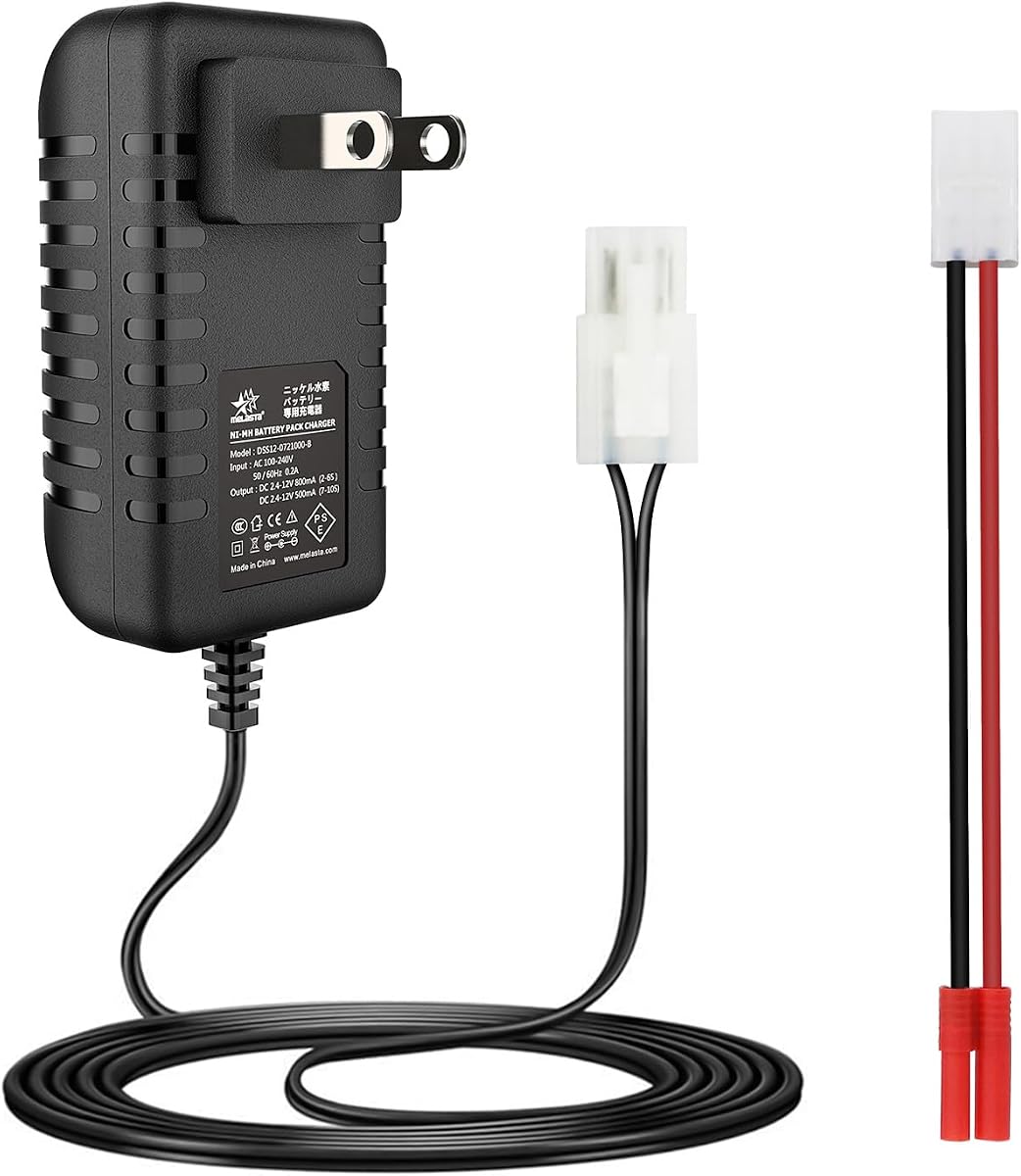
The Melasta Universal RC Charger focuses on uncomplicated NiMH and NiCd charging. It carries a 4.6 customer rating and supports packs from 2.4V to 12V. A standard Tamiya connector is included, along with an extra HXT 4mm banana-plug cable for compatible Redcat Hexfly NiMH batteries.
We may earn a commission when you buy through this link, at no additional cost to you.
The unit automatically detects pack voltage and shuts off when the battery reaches a full charge. It uses 800mA for 2.4V-7.2V batteries and 500mA for 8.4V-9.6V batteries. Typical charging time is listed as six to ten hours, depending on capacity, which reflects the slower pace associated with this type of charger.
Its LED status system is refreshingly easy to understand: red remains on during charging, green indicates a full charge, flashing red signals a bad connection, and no light means the charger is defective. Overcharge, overcurrent, short-circuit, and reverse-polarity protections help guard both the charger and connected battery.
The charger is limited compared with the balance-capable models because it is designed specifically for nickel-based batteries. The product information explicitly warns against charging any Li-ion batteries with it, and it should not be used with LiPo or LiFePO4 packs. There is also no individual cell balancing or battery diagnostic screen.
It is best for an RC car owner who wants a straightforward nickel charger with a clear status light and minimal controls. The included Tamiya and banana connections cover common applications, but owners with unusual connectors may need an adapter. Confirm chemistry, voltage, and polarity before every charge.
Color and flashing patterns communicate charging, completion, and connection problems without navigating menus. The indicator should be checked regularly, especially after attaching a new pack.
The broad nickel-voltage range covers common RC car packs, while the explicit lithium warning prevents an expensive chemistry mismatch. Nickel-only charging rules are not a limitation if that matches the batteries already owned.
We may earn a commission when you buy through this link, at no additional cost to you.
The 300W Dual Balance Charger is the most powerful high-output station in this guide and pairs that capability with two independent channels. Its 4.7 rating is tied for the highest listed. Each channel can deliver up to 16A, with 300 watts of combined AC input power and 400 watts available from a 7-28V DC source.
We may earn a commission when you buy through this link, at no additional cost to you.
Battery support is extensive: 1S-6S LiPo, LiHV, Li-ion, LTO, and LiFe; 2-20V lead-acid; and 1S-15S NiMH and NiCd. The charger can simultaneously handle two different batteries when each is assigned to the correct channel. Balance current is specified at up to 1600mA per channel, supporting efficient individual-cell management.
Operating modes include charge, balance charge, discharge, storage, and balance-only. The balance function can also monitor and balance cells during discharge. Additional tools include cycling for nickel batteries, a battery meter, adjustable parameters, and automatic lithium cell identification. The two-button control scheme keeps navigation relatively direct despite the broad feature set.
The package includes an AC cable, XT60-to-EC3, EC5, and T-plug leads for both channels, two balance extension cords, a screen protector, and a manual. Its stated portability and competitive suitability make it appealing for model-airplane competitions, RC competitions, and users who need multiple high-capacity packs ready in sequence.
This premium recommendation is most justified when charging speed, parallel work, and extensive mode selection matter. Users must respect total channel and input power limits, select the proper chemistry, and use the correct balance connection. The AC and DC cables should never be attached at the same time.
Two independent channels allow different batteries to charge simultaneously without sharing settings or output. Each pack still needs its own correct voltage, current, and connector configuration.
Balance-only, discharge, storage, and cycling functions extend the charger beyond basic top-ups. These tools are useful for owners who routinely inspect, condition, and store several packs.
We may earn a commission when you buy through this link, at no additional cost to you.
The 80W Mini B6 Charger is a portable balance charger designed for users who want meaningful maintenance features in a smaller package. Its 4.6 rating reflects a well-rounded feature set. It supports one- to six-cell LiPo, LiHV, Li-ion, and LiFe batteries, one- to fifteen-cell NiCD and NiMH packs, and 2-20V lead-acid batteries.
We may earn a commission when you buy through this link, at no additional cost to you.
Charge current adjusts from 0.1 to 6A, and discharge current reaches 2A. Operating modes include standard charging, smart balance charging, discharge, and storage. The balance mode can automatically identify cell quantity, voltage, and current parameters, while independent cell balancing helps keep multi-cell lithium packs aligned.
The large LCD makes mode selection and parameter adjustment more accessible. The charger can measure battery voltage and capacity and test reference internal resistance in lithium batteries, reducing the need for separate measuring equipment. An audible alarm provides an additional warning when parameters exceed configured limits or a setup error is detected.
The package contains a DC power cable, EC3, Futaba JR servo, DC, XT60, JST, T-crocodile clip, Tamiya, and T-plug connections, plus a manual. It does not include a mains power supply, so users need a compatible source. Its compact size makes it especially convenient for competitions, travel, and field charging.
This is a strong middle-ground option for users who want more than a simple nickel charger but do not need a high-output dual-channel station. It is especially appropriate for maintaining a modest collection of one- to six-cell lithium packs. The balance connector must be attached in the correct order, and the battery type must be confirmed before charging.
Cell balancing, voltage and capacity measurement, and lithium internal-resistance checks help users manage battery health. The LCD provides the feedback needed to interpret those results.
The small housing and broad accessory selection make the charger easier to carry than a full-size station. Because it uses a DC input cable, a suitable power supply must be sourced separately.
We may earn a commission when you buy through this link, at no additional cost to you.
The OVONIC D15 is a compact dual charger designed specifically for one- to three-cell LiPo batteries. It carries a 4.3 rating and provides two 15-watt channels, each capable of 1.2A. The design lets a user charge two small LiPo packs simultaneously, which is convenient for lightweight drones, small aircraft, and compatible RC vehicles.
We may earn a commission when you buy through this link, at no additional cost to you.
Its stated five-per-mille balancing accuracy is finer than the typical ten-per-mille figure cited in the product information, and both channels provide balancing. An abnormal-battery indicator remains red when a fault is detected, prompting the user to stop charging the affected pack. This behavior is a useful safety cue rather than a substitute for inspecting the battery.
GaN technology is used to create a smaller, more efficient design with lower heat and energy loss. Synchronous rectification is listed as delivering up to 98 percent conversion efficiency. These characteristics make the D15 appealing for a compact charging area where two specialized lithium packs need routine preparation.
Protections include overvoltage, overtemperature, overcharge, overcurrent, and short-circuit handling. The package contains the D15 balance charger, an AC input cable, a user manual, and a packaging box. There is no DC input, broad chemistry support, or high-current discharge function, so the charger is purpose-built for small LiPo packs.
The D15 is best for owners of one- to three-cell LiPo equipment who prioritize two-channel convenience, compact construction, and battery balancing in a simple unit. Its low current means larger packs will take longer, and it should not be used with NiMH, NiCd, or lead-acid batteries. Always match the charger to the battery's cell count and rated charging method.
Independent 15-watt channels make it convenient to prepare two lightweight LiPo packs together. The 1.2A per-channel limit is best matched to smaller battery capacities.
GaN components and synchronous rectification reduce heat and improve conversion efficiency. The result is a focused charger for small lithium packs rather than a universal hobby station.
We may earn a commission when you buy through this link, at no additional cost to you.
The right charger depends on your battery chemistries, pack capacities, connector styles, and charging habits. Review the following factors before deciding which model deserves space on your workbench.
Start with the labels on the batteries you already own. Some compact chargers support only NiMH and NiCd, while the more capable balance chargers add LiPo, LiHV, Li-ion, LiFe, lead-acid, and smart-battery options. A broader chemistry list is useful, but it also means the user must select the correct program every time. Never assume that a similar voltage or connector guarantees compatibility.
Match the charger strictly to the chemistry printed on the battery. Lithium packs should never be placed on a nickel-only charger, and nickel packs should not be assumed compatible with a lithium balance program.
Cell count determines the voltage a charger must handle. A charger advertised for one to six lithium cells may not support a 15S nickel pack, even if its wattage rating appears sufficient. Check both the maximum cell count and the supported voltage range for every chemistry. This is especially important when combining older RC cars, high-cell-count aircraft packs, and small drone batteries.
Choose a charger whose stated cell range covers every pack in your collection. Adding occasional future packs is more convenient than discovering a limit during a rushed session.
Balance charging is important for multi-cell lithium packs because it brings individual cells toward a consistent voltage. A charger with balance mode, internal resistance checks, and cell-level readings provides a clearer view of pack condition than a basic charger. It also makes the station more useful for storage preparation and maintenance rather than merely topping up a battery.
Look for a balance port and a correctly sized balance lead for your cell count. If accurate lithium maintenance is important, favor a model with explicit individual-cell balancing.
Charging current has a direct effect on how long a pack takes to recharge. A charger with an adjustable range can serve small and large batteries, but its actual output is also limited by total wattage and the capabilities of the connected pack. Fast current is not automatically better: battery manufacturers often specify a safe maximum, and excessive current can create heat or an uneven charge.
Prioritize adequate and adjustable current rather than the largest headline number. For active users, dual-channel output can be more valuable than extra power in a single channel.
A single-channel charger handles one pack at a time, which may be sufficient for occasional users. Dual-channel units can charge two compatible batteries simultaneously and may accept different battery types on separate channels. This reduces downtime when maintaining a vehicle fleet, but it does not remove the need to configure each pack independently. Users should never connect two batteries to one channel.
Choose two channels when you regularly rotate multiple vehicles or aircraft. Choose one channel when portability, simplicity, or a lower power requirement matters more.
The correct chemistry is useless if the charger cannot physically connect to the battery. Common RC connections include Tamiya, mini Tamiya, Deans, EC3, EC5, XT60, JST, T-plug, and receiver plugs. Some products arrive with many leads prewired, while others provide only a main cable and a balance connector. Check both the power connector and the separate balance-port connection.
Prefer a bundle that includes the connectors used by your current equipment. Optional adapters can add clutter, and low-cost adapters may introduce a poor or unsafe connection if they are not securely seated.
A good charger should include protection against overcharge, overcurrent, short circuits, reverse polarity, and overheating. Automatic shutoff, cell-count detection, abnormal-battery warnings, and audible alarms add further layers. Controls should also be clear enough to confirm the selected chemistry, cell count, current, and voltage before starting a long charge.
Treat safety features as a safety net, not permission to neglect setup. A correctly selected battery program and sound connections remain the first line of protection.
Where the charger will be used affects the best design. A compact unit with a DC input is convenient at competitions or in the field, provided a suitable power source is available. A larger station with AC input, cooling, and two channels may be better suited to a home workbench. Some chargers offer both AC and DC, but their manuals warn against connecting both power cables at once.
Compare size, weight, included power supply, cooling, and input voltage together. The best station is one that fits the user's actual charging location and available power.
Begin by identifying the battery manufacturer, chemistry, rated capacity, cell count, and required charging method. Inspect the pack for swelling, cracks, damaged wires, corrosion, or a questionable history. A charger cannot make an unsafe battery safe. Keep the charger on a stable, nonflammable surface with ventilation around its housing and away from combustible materials.
Set the input power correctly, select the exact battery chemistry and cell count, and then choose a charge current within the battery maker's recommended range. Connect the main power plug with the polarity marked by the charger. For a balance charge, connect the balance lead to the correct cell count and follow the charger's indicated order, often requiring the main connector to be attached first. Check every visible wire and connector before beginning.
Do not leave a charging session unattended when possible, particularly for an unfamiliar battery or charger. Watch the display or indicator for unusual temperature, current, voltage, or fault messages. When charging finishes, disconnect the battery according to the manual, inspect it again, and store it on a nonconductive surface away from direct sunlight. For storage mode, use the charger's storage function rather than leaving a lithium pack fully charged for long periods.
Not every charger can. Some inexpensive models are limited to NiMH and NiCd, while multi-function units may also support LiPo, LiHV, Li-ion, LiFe, lead-acid, and smart batteries. You must select the exact program specified for the connected pack. Using the wrong chemistry program or a nickel-only charger on a lithium battery can cause serious damage.
A normal charge treats the battery pack as one combined voltage, while balance charge monitors and adjusts individual cells. Balancing is especially useful for multi-cell lithium packs because it helps cells reach similar voltages. It normally requires a separate balance connector and a charger with a balance port and a lead appropriate for the pack's cell count.
No. A higher maximum wattage only matters if the battery, connector, power source, and safe charge current can use it. A compact charger may be more convenient for small packs, while a high-output dual-channel station can prepare several large batteries faster. Correct chemistry and safe current remain more important than the largest headline specification.
Many dual-channel chargers can charge different batteries on separate channels because each channel has independent settings. The two batteries must still be configured correctly, and the total output may be shared according to the manufacturer's limits. Never connect two batteries to one channel, and check whether the included leads support the connectors and cell counts you need.
For multi-cell lithium packs, using the balance connection is generally advisable when the charger supports it and the lead matches the cell count. It allows the charger to monitor and balance individual cells. A single-cell pack may not require a multi-cell balance lead, and attempting to connect an incompatible balance plug can damage the charger or battery.
Only if the model explicitly supports DC input and the output voltage, polarity, and current capacity fall within its stated range. Some dual-input chargers include an AC cable and a DC cable for different locations, but their instructions warn against using both at once. Check the manual and charger markings before connecting an external power source.
Stop charging and disconnect the pack according to the charger's instructions. Inspect the connector, balance lead, cell count, and battery condition for visible damage or swelling. If the fault continues with a known-good pack and connection, do not bypass the warning or repeatedly restart the process. The charger may need service or replacement, and the battery should be evaluated separately.
Use the appropriate storage charge level for the chemistry and keep the pack in a cool, dry, nonconductive location away from direct sunlight and metal objects. For lithium packs, a charger with a dedicated storage mode can be useful. Check the battery periodically, remove it if it becomes hot, swollen, damaged, or unusually heavy, and follow the battery manufacturer's storage recommendations.
The best general-purpose option in this guide is the Venom Power Pro Duo because it combines two independent channels, broad chemistry support, balance charging, discharge functions, and a generous set of charging leads. The 150W 10A AC/DC Balance Charger is another versatile performer with extensive modes, memory, diagnostics, and a 4.7 rating, while the compact OVONIC D15 delivers focused dual LiPo charging for smaller one- to three-cell packs.
Prioritize correct chemistry, safe current, and connector compatibility before considering output wattage. A dual-channel charger is valuable for maintaining multiple packs, a balance-capable unit is important for multi-cell lithium maintenance, and a simple nickel charger can be sufficient for a dedicated collection of NiMH or NiCd equipment. Advanced voltage controls and high-current discharge functions should be used only with a clear understanding of the connected pack.
Finally, check the current listing, included accessories, warranty information, and charger instructions before ordering. Product configurations and prices can change, and the supplied ratings reflect customer feedback at a particular point. Confirm that the chosen station supports the cell count, chemistry, connector, balance lead, and power source required by your specific RC equipment.