
Dual-Lens 4K AI Glasses
4.2Editor score
Dual interchangeable lenses
165-language translation
Built-in AI assistant
Our 2026 guide compares 10 cheap AI smart glasses, covering cameras, translation, assistants, audio, batteries, lenses, and everyday comfort for travel.
Cheap AI smart glasses combine first-person cameras, open-ear audio, voice assistants, translation, and hands-free controls in eyewear that is intended to be more approachable than premium mixed-reality devices. The right pair depends on camera quality, supported functions, battery life, lens options, comfort, and how often you expect to wear the glasses.
This guide compares ten models across the features that matter most in daily use. We considered camera resolution, stabilization, AI translation, object recognition, Bluetooth calling, music playback, water resistance, charging, storage, lens design, and weight. We also identify important differences, such as products with no camera, models that support replaceable prescription lenses, and listings with ambiguous photo-resolution claims.
Each review explains the strongest reasons to consider that model and the compromises involved. The top recommendations lead the list because they combine useful functions, competitive ratings, and sensible everyday specifications. Product availability, software behavior, language support, accessories, and prices can change, so confirm the current listing and feature set before ordering.
4.2Editor score

5.0Editor score

3.7Editor score
The comparison below highlights the main hardware and AI differences among all ten pairs, from camera capability and video resolution to translation coverage, battery specifications, lens protection, and water resistance.



This model is the strongest all-around choice in the group because it pairs a 13MP camera with 4K video, electronic stabilization, a ChatGPT voice assistant, real-time translation, object recognition, and open-ear Bluetooth audio. Its 5.0 rating also gives it the strongest numerical feedback here. The transparent-lens design keeps it looking more like ordinary glasses than a specialized headset.
We may earn a commission when you buy through this link, at no additional cost to you.
The camera specification is particularly useful for buyers who want first-person travel footage, family moments, and outdoor activity recordings without holding a phone. EIS helps reduce ordinary shake, while the 13MP sensor provides more detail for still images than the 8MP cameras used by several alternatives. The companion app is also used to adjust settings and access smart features, providing a central place for managing the device.
The audio and AI functions make this more than a camera disguised as eyewear. Dual open-ear speakers handle music, voice guidance, and hands-free calls without sealing the ears, which helps preserve awareness of nearby traffic and conversations. AI recognition can identify plants, animals, landmarks, and everyday objects, while real-time translation targets travel, business meetings, and multilingual conversations. The main limitation is that the listing does not state how much internal storage is available, so buyers should confirm their recording workflow and transfer method.
This is the most balanced recommendation for someone who wants meaningful camera hardware, translation, calling, music, and AI assistance without moving into the category's most expensive models. It is particularly appealing to travelers, vloggers, commuters, and outdoor users. Confirm app compatibility and current feature availability, but based on the supplied specifications, it offers the strongest combination of versatility and apparent user satisfaction.
The 13MP still camera and 4K EIS video pairing gives this model more flexibility than the 1080P alternatives. It suits everything from quick still captures to stabilized travel footage, although buyers should check storage and file-transfer details before relying on extended recording.
Real-time translation, object recognition, and a voice assistant reduce the need to pull out a phone for quick information or communication. The companion app provides the control and setup layer, so compatibility and permission settings should be reviewed before first use.
We may earn a commission when you buy through this link, at no additional cost to you.
This compact model delivers a 4K camera, real-time translation, a ChatGPT voice assistant, object recognition, Bluetooth music, and hands-free calls. It earns a 4.1 rating, placing it comfortably above the lower-rated budget options. Its broad travel-and-commuting feature set makes it a practical choice for people who want camera, communication, and AI functions in a conventional pair of glasses.
We may earn a commission when you buy through this link, at no additional cost to you.
The 4K video capability is the centerpiece for a buyer interested in sightseeing, outdoor activity, or first-person documentation. Meanwhile, the open-ear listening design allows music and calls without the isolation created by conventional earbuds. That environmental awareness can be useful while walking, cycling, or traveling through busy areas, though it also means audio quality will be shaped by outside noise.
Its 290mAh battery and IP65 protection align it with the practical requirements of daily wear. IP65 is intended to resist sweat, rain, and dust, not submersion. The app supports setup, feature control, and file management, which is important for a camera-centered device. The listing mentions a long battery life but does not provide a precise playback or recording duration, so users wanting a known runtime should verify the current product details.
This is a sensible choice for travelers and everyday users who value 4K video, translation, and app-managed storage. It is not the best selection for someone seeking a higher-resolution still camera, interchangeable lenses, or maximum customer feedback. Its appeal comes from balancing several useful functions in a straightforward, relatively compact design.
The built-in 4K camera is well suited to travel and outdoor recordings where first-person video is the main goal. Electronic stabilization is not claimed in the supplied information, so stabilization quality should not be assumed from the video resolution alone.
A companion app handles setup, file management, and feature control. This is useful for moving recordings to a phone and adjusting smart functions, but buyers should ensure the app supports their chosen mobile platform.
We may earn a commission when you buy through this link, at no additional cost to you.
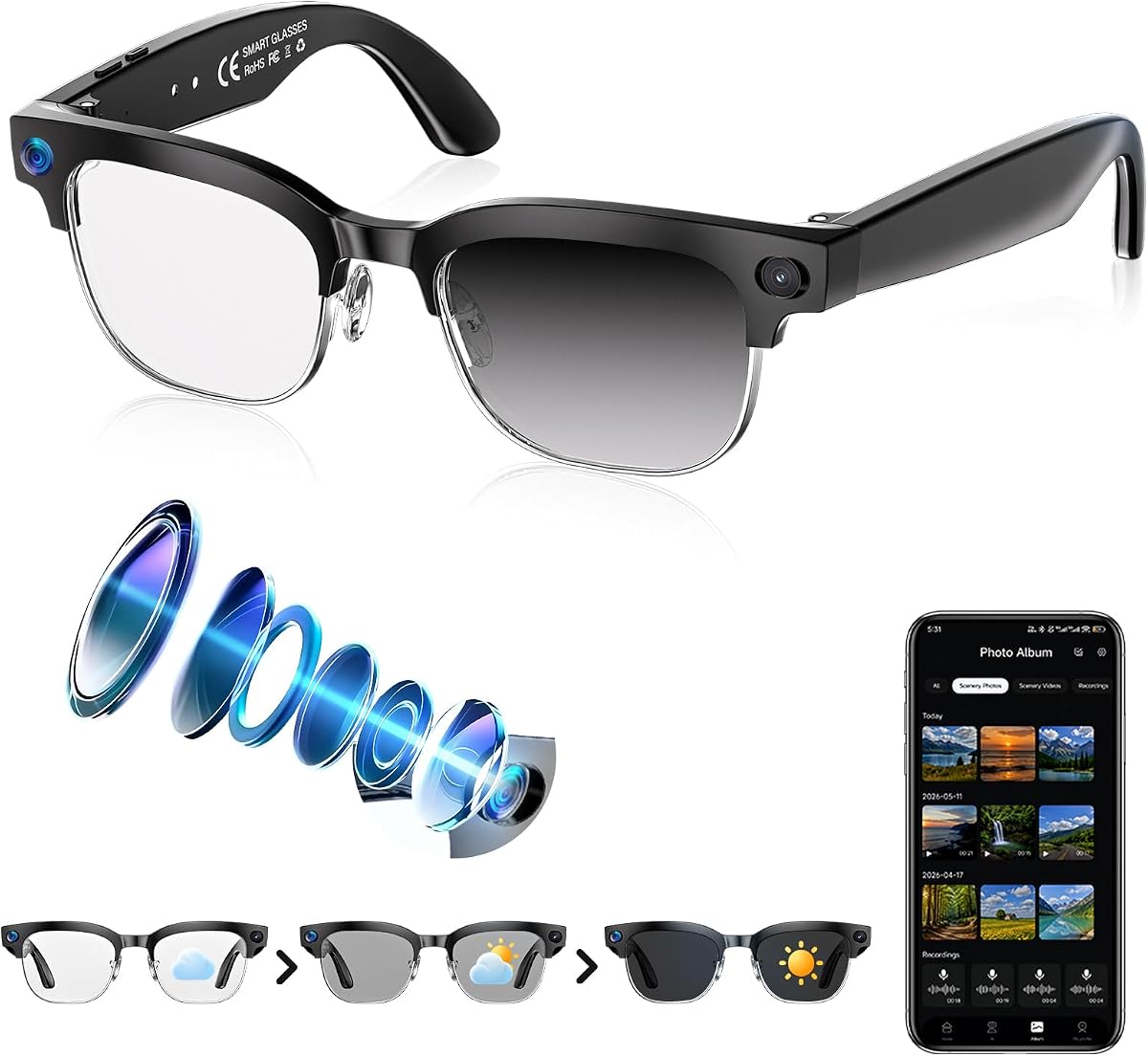
This is the most feature-dense model in the collection, combining 4K stabilized video, four speakers, dual microphones with environmental noise cancellation, a built-in AI assistant, real-time translation, and two lens choices. Its 4.2 rating reflects solid user reception, while the translation matrix across more than 165 languages gives it a clear advantage for international travel.
We may earn a commission when you buy through this link, at no additional cost to you.
The supplied description claims both 32MP photos and an 8MP lens using the IMX219 sensor, creating an important ambiguity. The product title itself only references 4K HD video, and no still-image resolution appears in the title. Buyers should examine the current listing carefully and ask the seller which photo mode and output settings are actually included rather than relying on the conflicting claim.
Its lens system is a major practical strength. The frame includes sunglass lenses and an anti-blue-light clear lens designed to avoid color distortion, allowing the same electronics to shift between outdoor and screen-oriented use. Four speakers provide more substantial open-ear audio, while dual-mic ENC is intended to improve call clarity in noisy environments. Wi-Fi and Bluetooth 5.3 syncing make file transfer more convenient.
The battery specification lists up to 10 hours of music playback, 80 minutes of total video recording, and standby of up to a week. Translation also extends beyond a simple conversation mode, with photo translation, glasses-to-phone translation, and video-call translation. This is an excellent choice for frequent travelers or users who value lens flexibility, but the unresolved photo-resolution claim and the limited stated recording time deserve attention.
Support for more than 165 languages and several translation modes make this one of the strongest choices for international travel or remote communication. The app-based photo and video-call functions extend translation beyond face-to-face conversations.
Interchangeable sunglass and anti-blue-light clear lenses provide useful flexibility for outdoor activity and indoor screen use. The anti-reflection feature is intended to preserve color accuracy, which matters when using a camera in the glasses.
We may earn a commission when you buy through this link, at no additional cost to you.
This model combines a 4K camera with EIS, open-ear speakers, Bluetooth calling, real-time translation, a voice assistant, photochromic lenses, and an IP66 rating. Its 4.0 rating places it among the better-reviewed products, and the listed 35g weight is the lightest frame in this comparison, making it particularly interesting for extended wear.
We may earn a commission when you buy through this link, at no additional cost to you.
Video quality is supported by a built-in 4K sensor and electronic image stabilization, aimed at sports, cycling, travel, and daily recordings. Open-ear speakers handle music, guidance, and calls without blocking surrounding sound. Noise-reduction microphones are included to improve voice pickup, which is relevant for outdoor calling and commuting.
The photochromic lenses adapt to changing sunlight and help reduce UV exposure, making the glasses more useful across indoor and outdoor environments. The 290mAh battery and IP66 water resistance are also sensible for an active lifestyle. A drawback is that the listing does not provide the camera's still-image resolution or an exact battery runtime, so buyers should seek clarification when those details affect the purchase.
Choose this pair if low weight, 4K recording, adaptive lenses, and translation are your priorities. It is especially suitable for users who expect to wear glasses throughout the day and need one frame for commuting, office use, and outdoor activity. The clear 35g specification and well-rounded feature set make it easier to recommend for comfort-focused shopping.
At a listed 35g, this frame is designed to reduce the bulk associated with many camera glasses. That makes it a good candidate for commuters and travelers who expect to wear smart eyewear for long stretches.
Photochromic lenses respond to sunlight by darkening and become clearer indoors, helping one pair serve multiple environments. Actual response speed can vary with ultraviolet levels, so they should not be treated as instantly interchangeable sunglasses.
We may earn a commission when you buy through this link, at no additional cost to you.
This is the most affordable route into the category because it concentrates on AI, translation, Bluetooth audio, and photochromic lenses rather than first-person imaging. It supports assistants powered by ChatGPT, Gemini, and DeepSeek, translates more than 160 languages, and records up to 10 hours of music or eight hours of talk time. Its 3.7 rating is the lowest here, but the core feature set is substantial.
We may earn a commission when you buy through this link, at no additional cost to you.
The meeting assistant is a useful differentiator. It can turn recordings into text and generate mind maps, which may appeal to students, remote workers, and business travelers. Voice, video, and photo translation are also listed, although the product does not include a camera, so the exact workflow for photo translation likely depends on an external phone or image source rather than imagery captured by the glasses themselves.
Its most important limitation is explicitly stated: there is no camera. That removes first-person recording and reduces some privacy concerns, but it also means buyers who want visual capture, object recognition through a camera, or vlogging should choose another model. The product listing also warns that photochromic lenses generally do not darken inside most vehicles, which is an important expectation for commuters.
This model is best for buyers whose priority is inexpensive hands-free translation, voice assistance, music, and calling rather than recording. It may also suit sensitive environments where having no camera is preferable. Fully charge both temples before first use, and review the listed app and language access, but for a non-recording AI glasses design it offers a compelling set of functions.
Support for ChatGPT, Gemini, and Deepseek gives users a choice of assistants rather than locking the device to one ecosystem. Voice activation, translation, and meeting transcription make the glasses useful for hands-free productivity tasks.
The lack of a camera means the glasses cannot capture first-person photos or video, a meaningful advantage in privacy-sensitive settings. It also simplifies the feature set for users who only want a wearable translator and open-ear headset.
We may earn a commission when you buy through this link, at no additional cost to you.
The Coucur model pairs an 8MP camera with stabilized 1080P video, a voice assistant, image recognition, translation across more than 139 languages, and open-ear audio. Its 4.7 rating is the second highest among the ten products, making it one of the strongest choices based on customer feedback. It also includes a visible recording LED, a thoughtful privacy and awareness feature.
We may earn a commission when you buy through this link, at no additional cost to you.
The camera is suitable for travel, city walks, hiking, and everyday documentation. EIS supports smoother footage, while the recording light provides a clear indication when video capture is active. The app is used for image recognition, allowing users to point, take a picture, and check recognized information. That combination is especially useful for shopping, sightseeing, and unfamiliar environments.
Its two-lens arrangement includes sunglasses and an interchangeable clear lens, giving users a conventional-looking option for daily wear. Dual ENC microphones help reduce background noise during calls, while the open-ear speakers keep surrounding audio audible. The 270mAh battery is smaller than many competing designs, but the supplied information states up to seven hours of music and seven days of standby, with a 1.5-hour fast charge.
This is a strong recommendation for buyers who value customer ratings, obvious recording status, flexible lens options, and balanced everyday features. The main limitation is that video tops out at 1080P, so 4K-focused vloggers should look elsewhere. It is otherwise a compelling all-rounder for travel, calling, and casual first-person recording.
A visible LED remains on during video recording, providing an important cue for bystanders. It is a simple hardware feature that supports privacy awareness and responsible use in public spaces.
The included sunglass lenses and interchangeable clear lenses let the same frame serve outdoor and everyday settings. This is useful for users who do not want photochromic lenses or need a more traditional appearance indoors.
We may earn a commission when you buy through this link, at no additional cost to you.
The Osawalla model combines an 8MP camera, stabilized 1080P video, a ChatGPT-based assistant, object recognition, real-time translation, open-ear music, and hands-free calls. Its 3.9 rating is solid for a relatively new style of product, and its 40.8g weight remains low. The TR90 frame, ABS temples, and PMMA components are designed to avoid nose pressure during long sessions.
We may earn a commission when you buy through this link, at no additional cost to you.
Object recognition can identify objects, menus, landmarks, and plants in real time, while translation covers more than 139 languages. These tools are targeted toward travel, study, and work. Selectable recording clips of 15 seconds, 30 seconds, one minute, three minutes, nine minutes, and 12 minutes make it easier to choose a capture duration suited to different activities.
Bluetooth 5.4 supports music, calls, and voice-assistant control, and touch controls handle playback, volume, and call answers. The photochromic lenses automatically darken in sunlight, although the product warns that they may react more slowly indoors or during winter because ultraviolet levels are lower. IP65 protection handles ordinary splashes, and the 290mAh battery is rated for up to seven hours of music and seven days of standby.
Choose this pair for a light, comfortable frame with useful translation and object recognition at a more modest video resolution. It is well suited to travelers and students who prioritize low weight and natural open-ear audio. Buyers seeking 4K footage or maximum customer feedback should consider a higher-resolution or more highly rated alternative.
Real-time recognition of objects, menus, landmarks, and plants adds practical value during travel and daily exploration. It is faster than manually searching when the glasses correctly identify what the camera is pointed toward.
A 40.8g frame and nose-pressure-focused construction make these glasses suitable for long wear. IP65 splash resistance adds everyday durability, though the rating does not make the glasses suitable for swimming.
We may earn a commission when you buy through this link, at no additional cost to you.
This model offers an 8MP camera, 30fps video, multi-frame noise reduction, upgraded stabilization, 164-language translation, object recognition, and a voice assistant. Its 4.0 rating reflects dependable user reception. The interchangeable sunglass and clear business lenses make it particularly adaptable for commuting, meetings, travel, and outdoor activities.
We may earn a commission when you buy through this link, at no additional cost to you.
Dual-mic environmental noise cancellation is designed to keep calls clear while cycling, running, or commuting. Open-ear Hi-Fi audio offers music without blocking awareness of the surroundings. The AI layer includes voice wake-up, object recognition, smart dialogue, and question-and-answer functions through built-in ChatGPT and DeepSeek models.
Its 300mAh battery supports up to eight hours of music and 60 minutes of continuous video per session. Wi-Fi and Bluetooth 5.4 support backup and manual file transfer to a phone album. That recording time is short for extended events, making the glasses more appropriate for short clips than all-day continuous documentation.
The interchangeable lenses and broad translation coverage are the strongest reasons to choose this model. It suits users who need a smart-glasses camera for travel, sports, fishing, family moments, or work while still wearing conventional-looking clear lenses indoors. Confirm your preferred lens style and accept the limited stated recording duration if the camera is a secondary rather than primary feature.
Switching between sunglasses and clear business lenses helps the frame fit both outdoor use and office settings. This versatility may be more valuable to some buyers than photochromic lenses, particularly when a consistently clear appearance is preferred.
Translation across 164 languages and dual-mic noise cancellation support travel and communication in active environments. Open-ear audio preserves ambient awareness, though very loud surroundings can still affect the listening experience.
We may earn a commission when you buy through this link, at no additional cost to you.
This model combines an 8MP camera, EIS stabilization, a ChatGPT-powered assistant, real-time translation, object recognition, open-ear calling, and a 5.0 rating. Its standout feature is support for replaceable prescription lenses, making it one of the most practical options for buyers who already wear corrective eyewear.
We may earn a commission when you buy through this link, at no additional cost to you.
The camera can capture first-person photos and stabilized video for travel, workouts, and daily life. Open-ear audio handles music, calls, and voice interaction while keeping users aware of their surroundings. A voice assistant and object recognition are useful for quick questions and identifying unfamiliar things without reaching for a phone.
Its 300mAh battery is listed for up to seven hours of music playback and approximately four hours of phone calls, with an approximate two-hour charging time. The glasses also include 2GB of internal storage, which makes direct capture convenient, although that capacity may be limited for users who record often. TR90 and PC materials are used for a lightweight, durable frame, while IP65 protection handles sweat and light rain.
Choose this pair if prescription compatibility is a priority, you want a higher-rated model with internal storage, and you need a balance of camera, AI, translation, and calling functions. It is less suitable for someone who wants extensive video storage or long call sessions. The replaceable-lens design makes it especially attractive for established eyewear users.
Replaceable prescription lenses address a major practical obstacle to adopting smart glasses. Buyers should confirm the available lens options and fitting process with the seller before ordering.
Built-in 2GB storage allows the camera to hold some content without immediate transfer. It is convenient for everyday snapshots, but frequent recorders should plan to move files regularly to avoid running out of space.
We may earn a commission when you buy through this link, at no additional cost to you.
The final model pairs an 8MP camera, EIS-assisted video, 32GB of storage, photochromic lenses, translation across more than 144 languages, and a ChatGPT voice assistant. Its 4.8 rating is the highest in the group. The combination of built-in storage and flexible elastic temples makes it particularly attractive for users who want to record more before transferring files.
We may earn a commission when you buy through this link, at no additional cost to you.
EIS helps reduce everyday camera shake during sports, cycling, travel, and outdoor activities. Dual microphones with noise reduction support clearer hands-free calls, while open-ear speakers provide music and navigation audio without blocking nearby activity. Real-time translation and object recognition add useful travel and learning functions, while the assistant can answer questions without requiring a phone.
Photochromic lenses adjust between darker outdoor and clearer indoor conditions, helping reduce UV exposure and making the glasses adaptable to different environments. The frame weighs about 42g and uses elastic temple arms that expand and contract to fit different head shapes. That flexibility may improve stability during movement, although the product does not state an exact battery capacity or a precise maximum video resolution.
This is a well-rounded choice for someone prioritizing customer feedback, storage capacity, adaptive lenses, and a secure adaptable fit. It is especially suitable for travelers and active users who want first-person recording and translation. Verify the current battery and recording specifications, but its high rating, 32GB capacity, and comfortable-design details make it a compelling final recommendation.
A stated 32GB of included storage reduces the urgency to transfer every capture immediately. It is a meaningful advantage for longer outings, although available storage can still be affected by file format, duration, and other device functions.
Elastic temple arms expand and contract to accommodate different head shapes and reduce constriction. The roughly 42g weight helps the frame remain unobtrusive during extended wear and movement.
We may earn a commission when you buy through this link, at no additional cost to you.
The right affordable AI smart glasses depend on whether you prioritize recording, translation, audio, prescription support, privacy, or comfort. Compare the hardware specifications and software claims carefully because similarly named models can differ substantially in camera resolution, battery capacity, and included accessories.
Camera resolution is one of the clearest ways to separate the otherwise similar products in this category. The strongest options offer a 13MP sensor and 4K video, while several alternatives use an 8MP camera with 1080P footage. For still images, a higher stated resolution can provide more detail and greater flexibility for cropping or printing. For video, 4K captures more visual information, but stabilization and frame rate can have a greater effect on whether footage looks usable while walking or cycling. EIS is especially valuable for travel and active recordings because it reduces ordinary hand and head movement.
Choose a 13MP and 4K combination for maximum detail, or prioritize EIS and 1080P when steadier footage matters more than resolution. Check the listing carefully for contradictions: one product claims 32MP photos while also describing an 8MP IMX219 sensor, so the actual output mode should be confirmed.
Translation is a central selling point of inexpensive AI glasses, but the listed language counts do not tell the entire story. Products in this group advertise support across approximately 139, 144, 160, 164, or more than 165 languages. Some also distinguish real-time conversation translation from glasses-to-phone, photo, or video-call translation. These modes may use different software pipelines and can differ in latency, vocabulary, and how naturally they handle accents. A large headline language count is useful, but travelers should consider whether the languages and translation situations they need are included.
Prioritize real-time conversation mode for travel, then check whether photo or video-call translation is useful for your work. Verify whether the glasses translate independently or depend on a phone app, and review the service terms if continuous translation is part of your intended routine.
The AI assistant can provide quick answers, weather information, reminders, conversation support, and voice-assisted queries. Some models use one platform, while the no-camera budget model supports ChatGPT, Gemini, and Deepseek. Object recognition is a separate function that uses the camera to identify landmarks, menus, plants, animals, or everyday items. It is more useful when the glasses can be pointed directly at a subject and can be verified quickly through the companion app.
Start with the function you will use most: assistant access, recognition, translation, or meeting transcription. Check wake-word support, voice controls, app availability, and whether extra subscriptions are required. A broader AI description is not automatically better if the most important feature does not work smoothly on your phone.
Battery capacity alone does not tell the whole story because camera use, display-free AI requests, calls, translation, and Bluetooth music consume power differently. The listed capacities range from 270mAh to 300mAh, while stated music runtimes vary from seven to ten hours. Continuous video recording is much more demanding: some listings specify only 60 or 80 minutes, even when music playback lasts much longer. The charge time also matters, ranging from an approximate 1.5 hours in one case to around two hours in another.
For everyday use, compare music and call runtimes with the charging time. For recording, treat the stated video duration as the meaningful limit rather than assuming the music runtime applies. Models with 290mAh or 300mAh batteries are sensible all-rounders, while the smaller 270mAh design is acceptable only if its fast charging and seven-hour music estimate meet your routine.
Open-ear speakers let users listen to music, directions, and calls while remaining aware of traffic, announcements, and nearby conversations. That awareness is valuable for commuting, cycling, and jogging. Dual-microphone environmental noise cancellation can improve voice pickup in noisy places, although the open design will never isolate audio as completely as an active-noise-cancelling earbud. The dual-lens model goes further with four speakers, while the other camera glasses generally use integrated open-ear audio.
Consider audio a core feature if you plan to take calls or listen for long periods. For primarily camera-focused use, it may be less important. Anyone wearing the glasses in sensitive public locations should also consider how audible the speakers are at moderate volume.
Lens design affects both comfort and versatility. Photochromic lenses darken in sunlight and clear indoors, offering a convenient single-frame solution, although they can react slowly when ultraviolet levels are low. Some products instead include separate sunglass and clear lenses, making them a better fit for users who want a traditional business appearance indoors. Anti-blue-light versions may be preferable for extended screen use. One product supports replaceable prescription lenses, which can be the decisive feature for established eyewear users.
Choose photochromic lenses for convenience, interchangeable clear lenses for a fixed indoor look, and prescription-compatible frames if you need corrective vision. Confirm lens availability, tint, anti-blue-light claims, and whether replacement lenses are sold separately. Do not assume a photochromic lens will darken sufficiently inside every vehicle.
Recording glasses need a practical way to move files to a phone or computer. Some models include internal storage, ranging from 2GB in the prescription-compatible pair to 32GB in the final recommendation. Others emphasize companion-app file management or Wi-Fi and Bluetooth synchronization without stating a capacity. Bluetooth 5.3 or 5.4 is used for audio and device connection, while a companion app commonly handles setup, recognition, translation, and file transfer.
Frequent recorders should favor a known storage capacity and direct transfer workflow. Occasional users may be satisfied with app-based management, but should confirm export options, file formats, and platform compatibility. A good camera is less useful if transferring large files is slow or awkward.
Smart glasses are most useful when they can be worn consistently, and listed weights range from 35g to 42g across the lightweight models. Construction details such as TR90 frames, adjustable elastic temples, and pressure-focused nose pads can affect comfort over several hours. Fit is still personal, so a lightweight specification cannot guarantee a secure fit for every face. Water-resistance ratings of IP65 or IP66 add protection from sweat, rain, dust, and ordinary splashes, but none should be treated as suitable for swimming or submersion.
Prioritize a comfortable weight, secure temples, and a lens style suited to your routine. For active use, IP65 or IP66 is useful, but leave the glasses out of pools and deep water. If possible, review the current size information and return terms before ordering.
Begin by fully charging the frame according to the manufacturer's instructions, particularly if the listing recommends charging both temples before first use. Install the companion app, connect the glasses over Bluetooth, and complete the setup process before attempting recording or AI functions. Review permissions for camera access, microphone use, contacts, notifications, location, and cloud services. Test the wake word, translation mode, object recognition, calls, and touch controls in a quiet environment before relying on them during travel.
For recording, start with short clips and confirm the selected resolution, stabilization, and clip length. Make sure the lenses are clean, the recording indicator is visible when applicable, and storage space is available. Keep the camera aware of private people, signage, and sensitive surroundings, and comply with local rules concerning recording in public. Open-ear audio should be kept at a moderate level, while rain, dust, and sweat can generally be tolerated under the stated IP65 or IP66 protection.
Clean the lenses and camera with a soft, lint-free cloth and avoid harsh chemicals, abrasive pads, and liquid being pushed into openings. Remove the glasses before swimming, showering, or submerging them. Store the frame in its supplied case or a protective pouch, keep charging ports free of debris, and replace damaged or badly scratched lenses. Periodically update the companion app, remove unused recordings, and recheck AI, translation, and privacy settings because software behavior can change.
They can be worthwhile for basic recording, translation, Bluetooth audio, calls, and voice assistance at a much lower entry point. Premium models may offer better displays, sensors, optics, processing, and overall polish, but many users do not need a full mixed-reality headset. The best value comes from choosing a model whose camera, audio, translation, and comfort features match your actual routine rather than paying for capabilities you will never use.
No. The no-camera model in this guide is designed around translation, AI assistance, music, and calls, and it cannot record first-person photos or video. Every other product reviewed has a listed camera. If visual recognition, travel memories, or vlogging are important, verify that the listing explicitly includes a camera before buying.
The listed models advertise support for approximately 139, 144, 160, 164, or more than 165 languages. Counts can vary by mode, and a headline total does not guarantee identical quality across every language. Travelers should confirm that their required languages are included and test the relevant real-time, photo, or video-call function before an important trip.
It depends on the model. One product explicitly supports replaceable prescription lenses, making it the strongest choice for corrective eyewear users. Other models include clear lenses or anti-blue-light lenses but do not clearly state prescription compatibility. Contact the seller and confirm the available lens options rather than assuming a clear lens can accommodate vision correction.
Continuous video time is usually much shorter than music playback because the camera, stabilization, and wireless functions consume additional power. The supplied specifications list around 60 minutes for one model and 80 minutes for another, while music runtimes reach seven to ten hours. Check the specific model's recording limit and available storage before filming an extended event.
The products carry IP65 or IP66 water-resistance ratings, which help against sweat, rain, dust, and ordinary splashes. Those ratings do not mean the glasses are safe for swimming, showering, or submersion. Remove the glasses before entering water, and follow the manufacturer's cleaning and charging instructions even if the frame appears dry.
Open-ear audio allows users to hear music, calls, and navigation while remaining aware of surrounding sounds, which can be useful during cycling, running, and commuting. The speakers can still be audible to people nearby, and external noise may affect call quality. Dual-microphone noise cancellation helps some models improve voice pickup, but athletes should also use safe, reflective cycling practices and keep volume moderate.
Most models use Bluetooth and a companion app for setup, AI requests, translation, object recognition, or file management. Although some functions may work directly through voice commands, a compatible phone is generally part of the intended setup. Confirm iOS or Android support, required permissions, and the transfer process before buying, particularly if you plan to store or edit long recordings.
The 13MP camera model is the strongest all-around recommendation because it combines a 13MP sensor, 4K EIS video, translation, a ChatGPT assistant, object recognition, open-ear audio, and a 5.0 rating. The dual-lens model leads for travelers who value extensive translation modes and interchangeable lenses, while the no-camera model offers the most budget-friendly path to AI assistance, translation, music, and calls.
Prioritize the function that will determine whether you use the glasses. Choose higher resolution and storage for recording, no-camera simplicity for privacy, prescription compatibility for vision needs, photochromic or interchangeable lenses for changing environments, and longer music runtimes for all-day audio. Also consider comfort, app support, weather resistance, and the practical limits of continuous video recording.
Ratings and prices can change, and software language support, app behavior, accessories, and availability may also vary over time. Before purchasing, review the current listing carefully, confirm the exact camera and battery specifications, test the required AI functions if possible, and check that the glasses meet your privacy, lens, and recording needs.