
PRORECK DC21
5.0Editor score
Passive transformer design
Ground-lift switch
Thru and balanced outputs
Input attenuation control
Works without external power
Direct boxes convert instrument- or line-level signals into balanced microphone-level output, making them essential for clean recording and live sound. A well-designed model can reduce hum, manage ground loops, handle demanding sources, and connect guitars, basses, keyboards, and stereo equipment to recording mixers, audio interfaces, and consoles.
We compared ten passive and active direct boxes across transformer design, channel count, input options, isolation features, attenuation, ground-lift controls, output connectivity, portability, and suitability for studio or stage work. The list includes single-channel, dual-channel, and USB-recording options so readers can find the right model for different recording setups.
Each review explains the product's most useful capabilities, practical limitations, and ideal applications. Ratings and specifications are based on the supplied product information, while recommendations consider how each direct box fits common recording workflows. Product details and availability may change, so readers should verify the current listing before purchasing.
5.0Editor score
4.8Editor score

4.6Editor score
As an Amazon Associate we earn from qualifying purchases.
The comparison covers passive transformer boxes, active dual-channel units, and a USB recording interface, highlighting the most important differences in channel count, isolation, attenuation, outputs, power requirements, and recording flexibility.


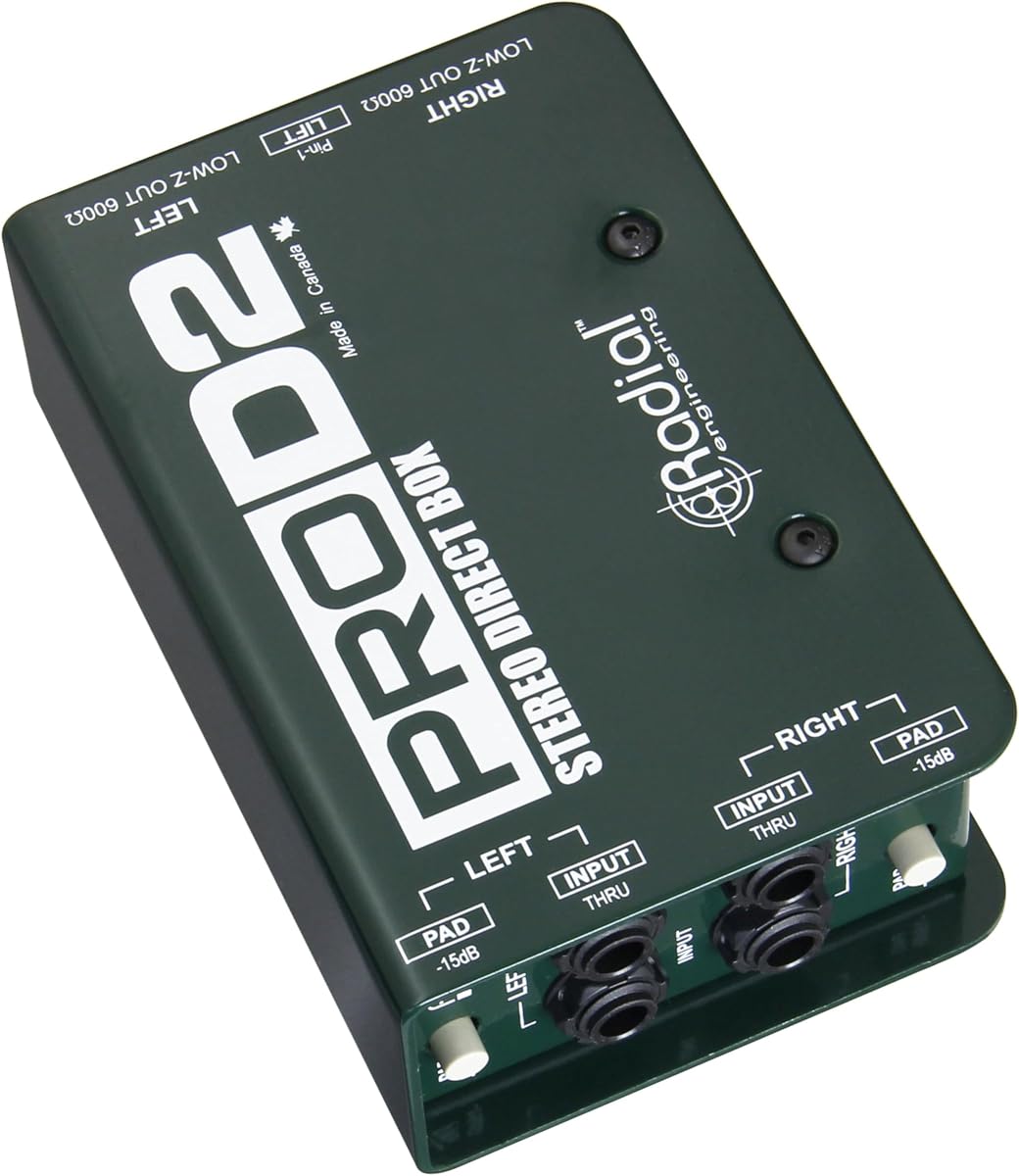
The Radial ProD2 is a passive, two-channel direct box built for recording applications that benefit from balanced conversion and isolation. Its supplied rating is 4.8, and the combination of a stereo configuration, isolation transformer, ground-lift switch, and 15 dB pad gives it the most complete feature set among the passive boxes in this guide.
We may earn a commission when you buy through this link, at no additional cost to you.
Its isolation transformer is particularly valuable when a guitar, bass, keyboard, or stereo source shares electrical connections with other equipment. Transformer isolation can interrupt ground-loop paths and reduce unwanted hum or buzz. The ground-lift control provides another way to manage grounding problems, while the 15 dB pad helps accommodate hot outputs without overloading the next device in the signal chain.
As a passive design, the ProD2 does not depend on batteries, phantom power, or USB power. That makes it straightforward to move between a rehearsal room, stage, and home or project studio. The tradeoff is that a passive box cannot add gain or provide the digital conversion, headphone monitoring, and computer connectivity offered by the active USB-Pro. It also occupies more space than a single-channel direct box.
This is an especially strong choice for musicians recording stereo keyboard parts, paired guitar tones, synthesizer outputs, or two independent instruments. It also suits engineers who want a dependable passive path in a rack or pedalboard-adjacent setup. For most listeners and recording users seeking a broad, professional set of functions without power requirements, the Radial ProD2 is the most balanced overall recommendation.
Two channels let a keyboard player or synthesizer user preserve left and right signals without summing them into one mono path. The passive transformer design keeps setup simple because no power supply is required.
The isolation transformer and ground-lift control provide complementary approaches to grounding issues. The input pad adds headroom protection when the source is hotter than a typical recording input can comfortably accept.
We may earn a commission when you buy through this link, at no additional cost to you.
The Pyle Premium DI is a compact passive box for converting an unbalanced quarter-inch source into a balanced recording signal. It carries a supplied rating of 4.5 and includes an input attenuator, impedance transformer, and connection to a balanced XLR output, covering several essential needs in a small enclosure.
We may earn a commission when you buy through this link, at no additional cost to you.
The unit is designed for guitars, basses, keyboards, sub-mixers, effects processors, and other line-level sources. Its transformer-based approach provides a familiar route from unbalanced equipment into recording mixers and professional audio systems. The stated hum and buzz-cancellation capability makes it useful when the source and destination are connected through different power systems or long cables.
Its main limitation is that it is a single-channel solution. Users recording stereo keyboard parts or two simultaneous instruments will need either a suitable multichannel interface or another box. The supplied information also provides less detail about the exact transformer specifications and switching arrangement than some premium alternatives, so it may appeal more to a straightforward user than a technically exacting engineer.
This Pyle model is a practical option for a home studio, rehearsal space, mobile recording kit, or compact live setup that needs reliable unbalanced-to-balanced conversion. It works particularly well for electric guitar, bass, keyboard, and effects-pedal recordings. Buyers should confirm the physical controls and connection layout against their existing equipment before choosing it for a specialized setup.
The quarter-inch input and balanced XLR output provide a familiar connection between ordinary instruments or line-level gear and professional recording hardware. This makes the box useful when an interface has limited unbalanced inputs.
The included attenuator offers a way to reduce stronger signals before they reach the recording input, while the impedance transformer is intended to support cleaner conversion from unbalanced equipment.
We may earn a commission when you buy through this link, at no additional cost to you.
The Whirlwind IMP 2 is a one-channel passive instrument direct box with a supplied rating of 4.8. It converts line- or instrument-level unbalanced signals into low-impedance balanced microphone-level signals, placing it squarely between basic utility boxes and more elaborately featured studio models.
We may earn a commission when you buy through this link, at no additional cost to you.
A major construction detail is Whirlwind's use of a riveted transformer rather than a glued installation. That approach can help the transformer remain mechanically secure and supports the product's emphasis on durability. The in-line design also allows the source to pass toward an amplifier or monitor while a separate balanced feed goes to a recording mixer.
The trade-off is a more focused feature list. The supplied information does not identify a built-in pad, phase switch, or ground-lift control, so the IMP 2 is best viewed as a clean and durable passive converter rather than a comprehensive signal-conditioning unit. It also cannot capture two independent channels simultaneously.
This direct box is an excellent fit for recording a single guitar, bass, or other line-level source when reliable balanced conversion and straightforward construction matter most. It is also attractive to users assembling a mobile recording rig who want a small passive box that requires no power. Within those parameters, its rating, compact footprint, and durable transformer mounting make it a confident selection.
The compact enclosure and riveted transformer mounting suit musicians who frequently move between rehearsal rooms, stages, and recording locations. Passive operation means there is no battery or supply to manage during a session.
Instead of crowding the box with extra controls, the IMP 2 concentrates on converting a line- or instrument-level signal into a balanced recording output. That simplicity can make the signal path easier to understand.
We may earn a commission when you buy through this link, at no additional cost to you.
The PYLE-PRO PDC22 is a passive dual-channel direct box aimed at users who want to record more than one unbalanced source without adding separate boxes. Its supplied rating is 4.4, and its listed features include quarter-inch connections, attenuation, impedance transformation, and a steel chassis.
We may earn a commission when you buy through this link, at no additional cost to you.
The two-channel format makes it relevant to stereo keyboardists, players with dual-output instruments, or engineers capturing two separate instruments at once. An input attenuator is useful for managing levels from sources with different output strengths, while the transformer circuitry supports balanced conversion for recording mixers and professional audio equipment.
The all-steel construction should appeal to users who want a box that feels more substantial than a lightweight plastic accessory. However, passive passive designs provide no active gain, digital recording function, or built-in monitoring. The supplied information is also less detailed about switch placement and per-channel operation than it is for premium models such as the Radial ProD2.
The PDC22 is best for a budget-conscious home studio, rehearsal recording setup, or compact stage box that may need to handle multiple line-level sources. It gives users more flexibility than a mono passive unit while remaining straightforward. It is not the leading choice when advanced per-channel switching, exact transformer specifications, or computer connectivity are essential.
The dual-channel layout can reduce the number of boxes needed for stereo or paired-instrument recording. It is particularly convenient when both sources use conventional quarter-inch unbalanced connections.
Because the chassis is made from steel, the unit is suited to mobile use where equipment may be moved frequently. Its passive operation further reduces setup requirements by eliminating external power.
We may earn a commission when you buy through this link, at no additional cost to you.
The Bolanle J22 is an active stereo direct box offering an unusual degree of power-source flexibility. Its supplied rating is 4.6, and it can operate from 48-volt phantom power, a 9-volt battery, or 5-volt USB power, making it adaptable to stages, studios, rehearsal rooms, and location-recording setups.
We may earn a commission when you buy through this link, at no additional cost to you.
The dual-channel architecture supports stereo keyboards, dual-output synthesizers, or two independent instruments. Balanced XLR outputs maintain left-right separation, while unbalanced quarter-inch inputs accept common instrument and line-level sources. A ground-lift switch helps address interference caused by ground loops, and a 180-degree polarity reversal control provides additional phase management.
Unlike a passive transformer box, the J22 requires power. That is not a serious disadvantage in most professional environments, where phantom power is readily available, but it can matter in an unplanned session. Although a 9-volt battery option is offered, batteries are not included, so users relying on battery operation should plan accordingly. USB power also requires an available source, such as a power bank.
The J22 is a strong recommendation for a working musician who records stereo sources or two instruments and values power-source flexibility. It is also useful for mobile performers who need more than one possible way to power a direct box. Users who require only a single passive conversion path can find simpler and smaller alternatives, but this model delivers the broadest active connectivity in the group.
Phantom power suits most recording mixers and consoles, battery power supports setups without console power, and USB power offers another option for compact or mobile rigs. This variety reduces the chance that a recording session is interrupted by a lack of suitable power.
Separate XLR outputs preserve stereo routing, while the ground lift and polarity reversal give engineers useful tools for resolving hum, phase conflicts, and inconsistent source polarity without altering the main connection chain.
We may earn a commission when you buy through this link, at no additional cost to you.
The Radial ProDI Bundle combines a passive Radial ProDI with a Pig Hog microphone cable and Liquid Audio polishing cloth. It has a supplied rating of 5.0 and is positioned as a straightforward, high-performance solution for recording a single instrument or line-level source.
We may earn a commission when you buy through this link, at no additional cost to you.
The custom-wound transformer is specified with a 140-kilohm input impedance and is designed to handle high signal levels without distortion across the frequency range. Transformer-isolated output helps remove ground-loop noise, while the plug-and-play approach minimizes setup complexity. The included cable means a new user may have everything required for a basic connection to a recording mixer or interface.
Because it is a single-channel passive box, it does not capture a stereo source as two independent channels and does not provide digital conversion or a headphone monitor. Users who already own a suitable balanced cable may see less value in the bundle, although the extra accessories remain useful for maintenance and transport. It also cannot offer the phase, pad, or multiple power choices of more feature-rich models.
This bundle is a compelling option for a guitarist, bassist, producer, or home-studio owner who wants a recognized direct box and a durable cable as one purchase. It is particularly good for simple tracking sessions where fast setup, clean conversion, and physical accessories matter. Its supplied rating and transformer-focused design make it one of the strongest premium single-channel choices.
The included microphone cable removes the need to source a separate connection cable for a basic recording setup. The polishing cloth is a small but convenient addition for maintaining equipment between sessions.
The stated 140-kilohm input impedance is designed for demanding source levels and consistent signal handling. Transformer isolation addresses unwanted grounding noise while the passive design keeps the operating process uncomplicated.
We may earn a commission when you buy through this link, at no additional cost to you.
The PRORECK DC21 is a passive direct box with a supplied 5.0 rating and an unusually useful set of controls for a basic model. It includes a 50-kilohm impedance transformer, input attenuation, ground lift, a quarter-inch input, balanced XLR output, and a Thru output for simultaneous stage or amplifier use.
We may earn a commission when you buy through this link, at no additional cost to you.
The combination of a Thru output and balanced recording output makes the DC21 convenient for performers who want to monitor through an amplifier while feeding a mixer or interface. Its input attenuation gives users room to handle stronger guitar, bass, or line-level sources, and the ground-lift switch can help reduce hum caused by ground loops.
The passive transformer is described as isolating input and output signals, which supports cleaner transmission over longer cable runs. The box is compatible with guitars, basses, keyboards, effects processors, sub-mixers, and even consumer stereo outputs used for sampling. What it does not offer is stereo capture, active gain, USB connectivity, or direct computer recording.
The DC21 is a strong budget recommendation for a musician who wants flexible outputs and grounding control without powering another device. It can serve as the central converter in a small home studio, a rehearsal-room recording setup, or a live rig that also sends a clean feed to a recorder. Among single-channel passive boxes, its controls make it particularly versatile.
The Thru output sends the original unbalanced signal toward an amplifier or monitor, while the XLR output provides a balanced feed to the recording mixer or interface. This makes it possible to perform and capture without splitting the source into separate devices.
The isolation transformer and ground-lift control help manage hum and buzz introduced by ground loops or extended cable runs. These controls are valuable when moving a direct source into a larger recording system with interconnected equipment.
We may earn a commission when you buy through this link, at no additional cost to you.
The Radial USB-Pro is a two-channel active direct box and stereo USB recording interface for musicians who want to capture instruments or line-level sources directly on a computer. It has a supplied rating of 4.6 and includes 24-bit/96-kHz converters, balanced low-impedance outputs, switchable isolation, and a built-in headphone amplifier.
We may earn a commission when you buy through this link, at no additional cost to you.
Its USB connection simplifies the recording chain by reducing the need for separate external converters in some home-studio setups. The stereo converters preserve independent left and right channels, while the headphone output gives the performer immediate monitoring. Balanced outputs also allow the same device to feed a console, active speakers, or other professional audio equipment.
This is more specialized than a conventional passive direct box. It requires suitable power, normally comes from the USB bus, and depends on computer compatibility for its principal recording function. Users who only need a reliable transformer path into an analog mixer may prefer a smaller passive unit. It also does not provide the analog pad, filtering, or detailed phase controls seen on some competing designs.
The USB-Pro is a strong choice for a project studio, home recording room, or mobile production setup that records keyboard, synth, guitar, or stereo line sources directly into a computer. It combines conversion, monitoring, and balanced output in one enclosure, reducing the number of separate devices needed. For users seeking a premium, integrated digital workflow, it is the most specialized recommendation in this guide.
Dual 24-bit/96-kHz converters provide separate high-resolution channels for computers. This is useful for preserving stereo keyboard parts, paired synths, or left and right line-level feeds without a separate multi-channel interface.
The built-in headphone amplifier provides a practical way for performers to hear the captured signal. Balanced low-impedance outputs also extend the unit beyond computer recording when a console or powered monitor system is more appropriate.
We may earn a commission when you buy through this link, at no additional cost to you.
The ART DualZDirect is a dual-channel passive direct box with one of the most comprehensive analog control sets in this roundup. Its supplied rating is 4.6, and its features include switchable input attenuation, a low-pass filter, phase inversion, a ground lift, and transformer-based conversion from 50-kilohm inputs to 600-ohm balanced outputs.
We may earn a commission when you buy through this link, at no additional cost to you.
The three attenuation positions—0, -20, and -40 dB—give the user considerable control over hot instrument or line-level sources. The low-pass filter can remove unwanted high-frequency content before it enters the recording chain, while phase inversion helps address polarity mismatches between microphones, DI signals, or other recorded sources.
Its ground lift fully isolates inputs from the chassis and outputs, which is valuable for reducing ground-loop interference. As a passive device, it needs no battery and remains ready to work in any environment with a suitable input. The limitation is that it does not convert audio digitally, connect directly to a computer, or provide gain and headphone monitoring; users needing those functions need an active interface.
The DualZDirect is ideal for engineers who want flexible analog conditioning in a dual-channel recording setup. It works well for stereo sources, hot outputs, or sessions where phase and filtering decisions need to be made at the direct box. For a beginner recording a single clean guitar, some controls may remain unused, but for a versatile studio tool the range is substantial.
The 0, -20, and -40 dB settings let the user match attenuation to the source and downstream recording gear. This is particularly helpful when capturing hot instrument outputs or using a preamp with limited headroom.
Ground isolation addresses noise caused by shared electrical paths, phase inversion helps reconcile conflicting polarities, and the low-pass filter can reduce unwanted high-frequency energy before recording.
We may earn a commission when you buy through this link, at no additional cost to you.
The Radial Pro DI is a rugged passive mono direct box built around a custom transformer and I-beam construction. Its supplied rating is 4.7, and it offers a traditional approach to converting an instrument or line-level source into a balanced signal for recording.
We may earn a commission when you buy through this link, at no additional cost to you.
The custom transformer is the defining element, providing passive isolation and level conversion without batteries or external power. Rugged I-beam construction makes the enclosure appropriate for mobile rigs and repeated handling. The design remains focused, which can be an advantage for users who want a dependable conversion tool without many switches to manage.
Because it is a single-channel box, it cannot preserve a stereo instrument on two independent outputs. It also does not include the explicit attenuation, phase, or filtering controls listed for products such as the ART DualZDirect. Passive operation means it cannot restore signal level after a particularly long cable, add gain, or provide digital conversion and monitoring.
The Radial Pro DI is a strong recommendation for a guitarist, bassist, keyboardist, or engineer who wants a durable transformer box for one source at a time. It is particularly useful in mobile recording environments where simple setup and physical toughness matter. For stereo or computer-based recording, a dual-channel or USB-equipped model would offer a more natural fit.
The rugged I-beam construction is designed for equipment that travels between locations. Its compact mono format also keeps the signal path simple when only one instrument needs a balanced recording feed.
A custom transformer converts the source signal and provides passive isolation between connected systems. That can help reduce grounding problems while eliminating the need for a separate power supply.
We may earn a commission when you buy through this link, at no additional cost to you.
The right direct box depends on the sources being recorded, the number of channels required, the recording destination, grounding conditions, and the level of signal control needed. Review these factors before comparing connector layouts and features.
A passive direct box converts a source using transformer circuitry and generally requires no external power. This makes passive units dependable, portable, and easy to deploy, but they cannot add gain or provide digital conversion. Active boxes add electronics that may offer greater signal control, multiple power options, and computer connectivity. Choose passive when simplicity, transformer isolation, and reliable analog conversion are the main requirements. Choose active when you need stereo routing, USB recording, or features that depend on powered circuitry.
A mono direct box handles one independent signal and is ideal for a single guitar, bass, microphone, or other source. A dual-channel box can record stereo keyboards, a dual-output synthesizer, or two separate instruments at once. The channel count also affects footprint, cable management, and the amount of signal control available. Avoid paying for unnecessary channels if every session is mono, but choose stereo when preserving the left-right image is essential.
Transformer isolation helps interrupt ground-loop paths that can produce hum, buzz, or noise when instruments, amplifiers, mixers, and computers share power connections. It is especially useful in live rooms with complex electrical systems and when recording through long cable runs. Passive transformer boxes are naturally suited to this role, while some active models also offer switchable isolation. Review the grounding and isolation features alongside the source and destination rather than assuming every direct box solves noise in the same way.
Input attenuation is important when a guitar or line-level source produces more signal than the recording preamp can handle comfortably. A passive pad reduces the level without requiring power, while active designs may provide electronic attenuation. Models with selectable settings offer more flexibility than a fixed box. Consider the output range of the instrument, the gain available in the interface, and whether the recording chain includes a loud amplifier or modeled amp that can send a hot signal.
A balanced XLR output is the most common route from a direct box into a recording mixer, powered monitor, or high-quality audio interface. A Thru output allows the original unbalanced signal to reach an amplifier or monitor at the same time. USB output serves a different purpose by connecting the box directly to a computer. Check the input and output formats used throughout the recording chain, and favor a model that can feed the mixer and performer monitor without inconvenient adapters.
Phase inversion can resolve polarity conflicts between a direct signal and a microphone recording of the same source. A low-pass filter may help remove excessive high-frequency content before it reaches the recorder. These controls are not essential for every session, but they make a direct box more adaptable across different instruments, rooms, and signal chains. They are especially useful in a reusable studio setup where one box may serve many different sources.
Passive boxes have an obvious portability advantage because they need no battery, phantom power, or USB power. Active units can offer more features, but they require a dependable supply. Phantom power suits most consoles, a battery can support mobile use, and USB power may fit compact computer-based rigs. Consider the size, available connections, and frequency of travel before choosing an active model. A slightly larger unit with broad power support may be more useful than the smallest option if it fits the recording case.
Quarter-inch inputs commonly accept electric guitars, basses, effect-pedal outputs, synthesizers, and other line-level equipment. Balanced inputs can support professional sources with lower noise and better level control. A stereo box should also offer two genuinely independent output paths rather than summing the channels. Consider whether the source is mono, stereo, instrument level, line level, or microphone level, and check whether the direct box is designed to handle that exact application.
Begin by identifying the source level and the destination. Connect the guitar, bass, keyboard, or other instrument to the direct box with an appropriate quarter-inch cable, then route the balanced output to a recording mixer or interface. If the source is extremely hot, engage the appropriate attenuation setting before raising the recording preamp gain. For passive models, confirm that the ground-lift and phase controls are in their intended positions before capturing a take.
When using a passive direct box alongside an amplifier, the Thru output can feed the amplifier while the balanced output feeds the recorder. Listen for hum as cables move and compare the signal with the ground lift engaged or disengaged. Do not change grounding settings while a live microphone is recording, because switching can produce an audible click. For the USB-Pro, install the necessary computer audio driver, select the USB-Pro as the recording device, and use its headphone output to monitor the source.
Store the box in a padded case and avoid placing heavy objects on its connectors. Keep the chassis dry, clean, and free of loose debris, and use the included polishing cloth where supplied. Inspect cables for damaged insulation, intermittent connections, and bent plugs. Before important sessions, record a short test with the intended source and monitoring chain, checking level, polarity, noise, and left-right assignment before committing to a full take.
A direct box converts an instrument-level or line-level unbalanced signal into a balanced microphone-level output suitable for a recording mixer or audio interface. This approach helps reduce interference, provides a professional connection, and can also isolate the source from ground-loop problems. It is commonly used with electric guitars, basses, keyboards, synthesizers, effects processors, and stereo line sources.
Passive direct boxes can be excellent for studio recording because they provide straightforward transformer conversion without needing power. They are particularly useful for clean instrument feeds and systems where isolation is important. Active boxes may be more convenient when you need gain, multiple power options, digital recording, or direct computer connectivity. The best choice depends on the recording destination and the controls your session requires.
Yes, but you need a direct box with two independent channels, such as the Radial ProD2, Bolanle J22, ART DualZDirect, or Radial USB-Pro. Route the keyboard's left and right outputs to the two inputs, then confirm that the recording device preserves the stereo channels. A mono direct box can capture a mixed stereo feed, but it will not preserve the original left-right separation.
Hum and buzz often come from a ground loop created when the instrument, direct box, amplifier, mixer, or computer shares electrical connections. Start by checking every cable and power connection, then use the direct box's ground lift or isolation control if it has one. Keep signal and power cables separated, and test a different outlet or power strip if the noise continues. Persistent noise may also indicate a faulty cable or poorly seated connector.
Use the setting that keeps the signal comfortably below the recording input's clipping level while leaving enough level for a healthy recording. The DC21 and ART DualZDirect offer adjustable attenuation, with the ART box providing several levels. If a source is not excessively hot, begin without heavy attenuation and adjust while watching the recorder's level meter rather than relying only on perceived loudness.
It depends on the interface. Some audio interfaces include instrument inputs designed for electric guitars and basses, making a separate direct box unnecessary for those sources. A direct box becomes more valuable when the interface has only line or microphone inputs, when balanced routing is required, when isolation is needed, or when the source's level does not match the interface input.
A passive direct box normally requires an audio interface or recording mixer with analog inputs before a computer can capture the signal. The interface converts the balanced analog output into a digital signal the computer can record. The Radial USB-Pro is different because it includes USB conversion and can connect directly to a computer as a two-channel recording interface.
A direct box converts and conditions a source signal for recording or live-sound routing, while a headphone amplifier drives headphones so a performer or engineer can monitor the result. Some recording units, such as the Radial USB-Pro, include both functions. Conventional passive direct boxes do not normally provide headphone monitoring, so a separate monitor path or interface may be needed.
The Radial ProD2 stands out as the most complete passive option, combining two channels, transformer isolation, a ground-lift switch, and a 15 dB pad. The PRORECK DC21 delivers especially useful value with attenuation, grounding control, and simultaneous Thru and XLR outputs, while the Radial USB-Pro is the clear choice for a direct, high-resolution computer-recording workflow.
For most stereo or paired-instrument recording needs, prioritize two independent channels, reliable balanced outputs, and grounding features. Single-source users can often get the necessary performance from a compact mono passive box, while computer-focused musicians should consider a model with integrated USB conversion and headphone monitoring. Match the box to the source, recording destination, and transport needs rather than choosing only on the number of features.
Before ordering, review the current product listing, connector arrangement, included accessories, and compatibility with the rest of the recording setup. Product specifications and availability can change, and the latest user feedback may offer useful context. A short test with the actual instrument and intended mixer or interface is the best final way to confirm that the direct box meets the session's requirements.
