DS18B20 Waterproof Probe Set
4.4Editor score
Five waterproof probes
Wide -55 to 125°C range
0.5°C stated accuracy
Arduino and Raspberry Pi ready
Explore the best Arduino Temperature Sensor options, comparing accuracy, ranges, interfaces, waterproofing, voltage, and ideal project applications for makers.
Arduino temperature sensors range from simple classroom modules to precision digital probes designed for damp rooms, outdoor installations, and demanding monitoring projects. A useful sensor must match your board, power supply, environment, and required accuracy while fitting the physical space available.
This guide compares ten temperature and temperature-humidity modules using their documented specifications, measurement ranges, accuracy, communication methods, voltage requirements, and installation styles. It covers DHT11, DHT22, AHT30, SHT31-D, and waterproof DS18B20 options for Arduino and related platforms.
Each review explains the sensor's strongest use case, practical limitations, wiring considerations, and suitability for common projects. Ratings reflect the supplied customer feedback, while technical characteristics come from the listed product information. Product availability and pricing can change, so confirm current details before purchasing.
4.4Editor score

5.0Editor score

4.9Editor score
The comparison below organizes every sensor by its most important documented characteristics, helping you distinguish basic single-wire modules, precision I2C devices, and waterproof probes before choosing the right model for your project.


The HiLetgo DHT11 five-pack is a straightforward Arduino temperature sensor for anyone who needs a dependable digital reading from an inexpensive module. It combines temperature and humidity sensing in a compact board, and its listed 4.5 rating indicates generally positive user reception. The five-module format also makes it practical for classroom activities, multi-location monitoring, or keeping spare boards on hand.
We may earn a commission when you buy through this link, at no additional cost to you.
Its strongest quality is accessibility. The module operates from 3.3 to 5.5V, provides a single digital signal, and includes an onboard pull-up resistor and bypass capacitor. That combination reduces the number of separate components required for a basic build. The documented temperature range is 0 to 50°C with ±2°C accuracy, while humidity coverage extends from 20 to 90%RH with 1%RH resolution.
The limitations are equally important. A 0 to 50°C range is unsuitable for frost monitoring, outdoor winter conditions, high-temperature equipment, or industrial environments where readings outside a mild indoor range are needed. The ±2°C specification is also less compelling when a project calls for fine thermal control. Its digital output and relatively simple sampling behavior mean it should be viewed as a basic environmental sensor rather than a laboratory instrument.
Despite those constraints, this is one of the most approachable options for first-time Arduino builders, indoor weather displays, and simple automation demonstrations. The included cables reduce setup friction, and five units allow more than one location to be monitored. Choose it when ease of use, humidity measurement, and a moderate indoor temperature range matter more than precision.
The three labeled connections—VCC, GND, and digital output—make this module approachable for breadboard prototypes. A compatible library and a small amount of code are generally all that is needed to begin displaying readings on a serial monitor or display.
Temperature and humidity in one module is convenient for room monitors, storage alerts, and classroom experiments. The stated 20-90%RH range is broad enough for many ordinary indoor environments, although readings near the limits should be interpreted cautiously.
We may earn a commission when you buy through this link, at no additional cost to you.
The two-pack AHT30 module stands out for combining strong specifications with a useful set of two sensors. Its supplied rating is 5.0, the highest among the listed products, while the documented temperature accuracy of ±0.3°C and humidity accuracy of ±2%RH provide a compelling specification set for makers. It is a particularly interesting choice when a project needs more precision than a basic DHT11 can offer.
We may earn a commission when you buy through this link, at no additional cost to you.
The AHT30 uses I2C communication, allowing it to work with multiple compatible I2C devices when the bus and addressing are configured correctly. Its 2.0 to 5.5V operating range is unusually flexible, including compatibility with lower-voltage systems. The module also provides a -40 to 85°C temperature range, 0 to 100%RH humidity range, and high resolution readings of 0.01°C and 0.024%RH.
I2C introduces more setup considerations than the familiar single-wire interface used by many beginner sensors. Users need compatible wiring, appropriate libraries, and potentially an I2C multiplexer if several modules share a bus or use the same address. The product information also notes four-pin test-line connections, which can simplify hookup but still requires attention to pin order. These are learning requirements rather than fundamental flaws.
This is an excellent choice for indoor climate dashboards, precision environmental logging, and projects that benefit from both temperature and humidity. It may be less convenient for a very first breadboard lesson, but the added measurement capability and strong published accuracy make it a compelling Arduino temperature sensor for more ambitious builds.
The ±0.3°C temperature accuracy and fine 0.01°C resolution make this module useful when small thermal changes matter. It is better aligned with room-comfort monitoring and controlled indoor experiments than with basic on-off demonstrations.
Operation begins at 2.0V, offering broad compatibility with embedded systems. Because I2C is a shared bus, use short connections, common ground, and correct pull-up arrangements for dependable operation.
We may earn a commission when you buy through this link, at no additional cost to you.
The Teyleten SHT31-D three-pack is built around the SHT31 measurement platform and offers an unusually broad -40 to 125°C temperature specification. Its 4.7 rating reflects strong customer feedback, while ±0.3°C temperature accuracy and ±2%RH humidity accuracy make it suitable for projects that need both resolution and environmental range. The three-module bundle supports distributed monitoring with a consistent sensor family.
We may earn a commission when you buy through this link, at no additional cost to you.
Its operating voltage of 2.4 to 5.5V covers common Arduino and embedded-system supplies. I2C output provides a clean digital connection and permits coexistence with other I2C peripherals, provided the addressing and bus wiring are handled properly. A humidity range of 0 to 100%RH is useful for general environmental sensing, while the extended temperature range is considerably more useful than that of the DHT11.
As with the AHT30, I2C is less plug-and-play than a one-wire module. Users will need appropriate software support and should avoid assigning the same address to multiple devices unless the configuration permits it. The broad specifications also describe sensor capability, not guaranteed performance in every enclosure or installation. Airflow, self-heating, placement, and environmental exposure can influence real readings.
Choose this set for multi-point industrial-style monitoring, controlled experiments, climate logging, or installations that may experience temperatures beyond ordinary room conditions. It is less compelling for a simple classroom display when a basic DHT11 would suffice, but its range, accuracy, and three-unit format make it a strong all-around precision platform.
A -40 to 125°C range makes the SHT31-D suitable for projects where environmental conditions can vary widely. The usable range of the entire system may be narrower if wiring, enclosure materials, or the connected board cannot tolerate the same extremes.
Three modules can monitor separate rooms, containers, or machine locations without mixing unrelated sensor families. Consistent wiring and configuration simplify data logging and make the set practical for comparative experiments.
We may earn a commission when you buy through this link, at no additional cost to you.
The Gikfun DS18B20 set combines three waterproof one-meter probes with adapter modules, making it one of the more turnkey options for Arduino temperature sensing. Its 4.4 rating indicates solid user reception, and the included adapters reduce the need to assemble separate breakout boards. The probes are particularly suitable for fish tanks, greenhouses, equipment, machinery, and other temperature-sensitive installations.
We may earn a commission when you buy through this link, at no additional cost to you.
Each probe uses the familiar three-wire arrangement, with yellow for data, red for power, and black for ground. The operating range is 3.3 to 5V, and the sensing range extends from -55 to 125°C. The adapter includes a pull-up resistor, allowing it to connect to many microcontrollers with less extra circuitry. That convenience is a major benefit for beginners working directly with breadboards or compact mounting areas.
A crucial limitation is that the probe leads are rated to a maximum of 85°C, even though the sensor itself is described as capable of measuring up to 125°C. The complete cable assembly should not be exposed beyond its lead rating. In addition, DS18B20 devices use a one-wire bus, and multiple sensors require unique addressing and suitable wiring rather than simply connecting every data pin together.
This set is ideal for makers who want usable probe lengths and ready-made adapters without sourcing five separate parts. It is less appropriate when humidity is also required or when multiple probes would be difficult to identify on a shared bus. For aquarium, greenhouse, and appliance-style temperature monitoring, however, the package is practical and versatile.
The integrated pull-up resistor on each adapter reduces setup work and makes the probes easier to connect to common microcontroller inputs. The labeled leads also reduce the chance of reversing power and ground during repeated installations.
One-meter leads allow the sensing tip to sit away from the Arduino, electronics, or a warm power supply. This separation is important because the controller's heat can influence readings when the probe is mounted too close to the board.
We may earn a commission when you buy through this link, at no additional cost to you.
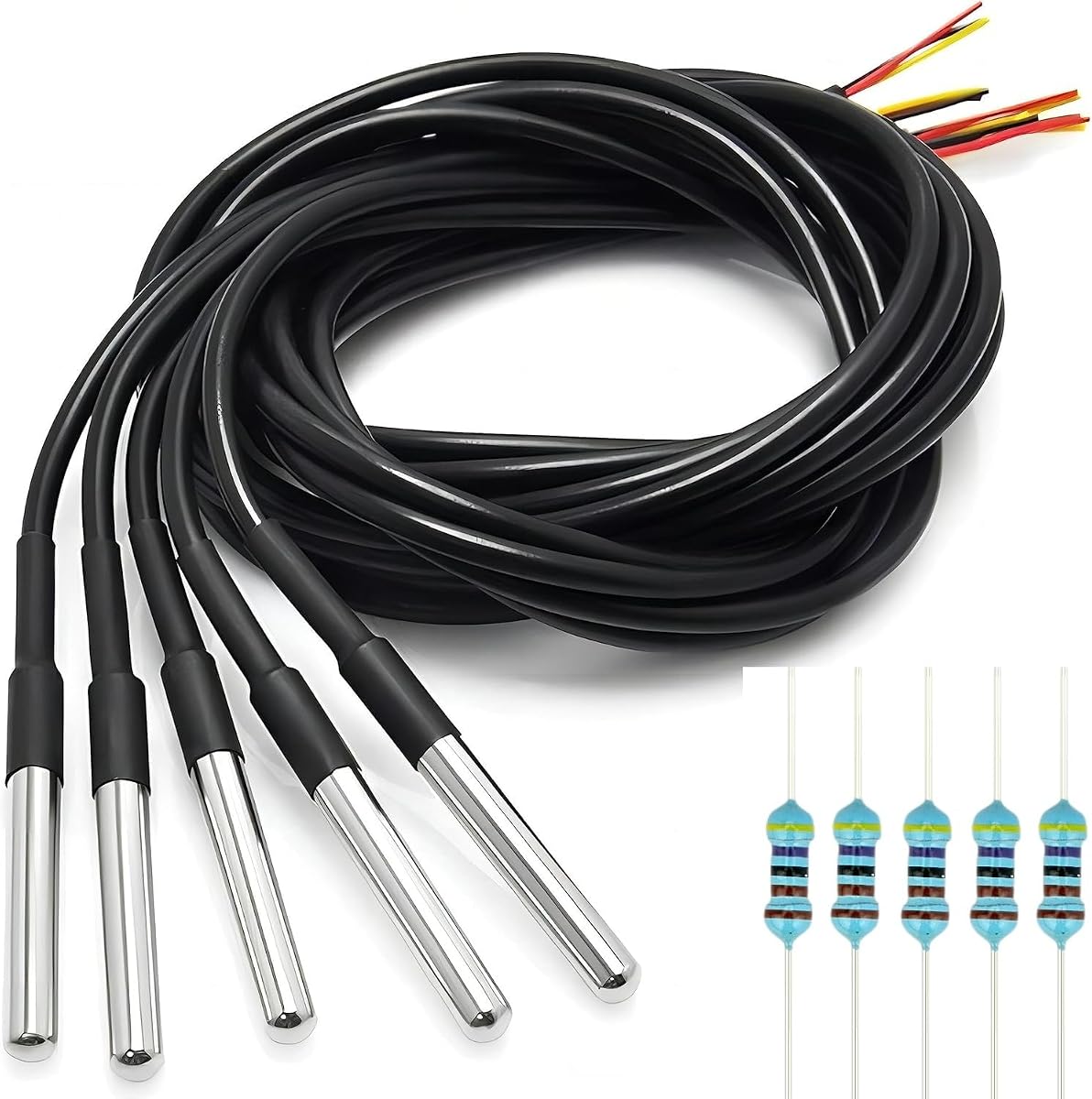
The WWZMDiB DS18B20 five-pack is a strong choice for projects that need several temperature points without assembling a custom set of probes and resistors. It has a 4.4 rating, five waterproof sensors, and five 4.7K resistors. The combination supports Arduino, Raspberry Pi, ESP32, and STM projects, giving makers flexibility across common embedded platforms.
We may earn a commission when you buy through this link, at no additional cost to you.
The listed operating voltage is 3 to 5.25V, and the documented temperature range extends from -55 to 125°C with a stated accuracy of ±0.5°C. Red, yellow, and black leads identify power, data, and ground. Waterproof construction allows the probes to operate in wet or moist environments, making the set relevant to tanks, plant-growing systems, and outdoor monitoring boxes.
The probes still require correct one-wire handling. Each sensor must be identified by its unique address, and the data bus needs a pull-up resistor. Including the 4.7K resistors is helpful, but it does not remove the need to plan the bus topology carefully. Long cables, nearby heat sources, and condensation at exposed connections may also affect reliability.
For a maker building a multi-location temperature logger, this package offers a useful balance of quantity and included components. It is less suitable if humidity readings are required or if the project requires only one probe. Compared with adapter-equipped sets, it offers more raw components and slightly more circuit-planning responsibility.
Five probes and matching resistors eliminate the need to buy those items separately. The bundle is well suited to comparative tests, multi-zone monitoring, and projects that may later add or replace sensors.
The probes are designed for moist conditions and can be submerged according to the listed description. Their electronics remain outside the enclosure, so the connection area should still receive suitable moisture protection.
We may earn a commission when you buy through this link, at no additional cost to you.
The two-pack DHT11 with wires is a practical choice for a first Arduino climate monitor or a beginner who wants two inexpensive sensing locations. Its 4.3 rating remains positive, and the modules combine calibrated temperature and humidity sensing with a straightforward digital output. Supplied cables make the package approachable immediately after unpacking.
We may earn a commission when you buy through this link, at no additional cost to you.
The sensor measures 0 to 50°C with an error specification of ±2°C. Humidity coverage is listed as 20-95%RH, with a ±5% error. A 3.3 to 5V operating range makes it compatible with common Arduino and Raspberry Pi arrangements. The single-wire protocol also reduces the number of signal connections, making this less complicated than many I2C configurations.
Its specifications are considerably less impressive than those of the AHT30, SHT31-D, and DHT22. The temperature range excludes sub-zero environments and hotter operating conditions, while humidity accuracy is relatively coarse. The DHT11 also requires appropriate timing and library handling, and readings should not be sampled more frequently than the sensor's measurement cycle permits.
Choose this product for education, simple room displays, basic fan or heater demonstrations, and projects where inexpensive components matter. It is best when the goal is to learn a familiar sensor interface rather than to achieve high measurement precision. Two modules are enough for comparing separate indoor locations, while the DHT22 or AHT30 makes more sense for demanding environmental control.
A single data lead, shared power, and common ground create a simple circuit. The broad software support for DHT11 libraries makes it easy to find examples tailored to common Arduino boards and displays.
Two modules are useful for checking whether separate rooms or storage areas differ in temperature or humidity. Because each sensor has limited accuracy, larger differences are generally more informative than tiny variations between readings.
We may earn a commission when you buy through this link, at no additional cost to you.
The DROK set is the most feature-complete rugged option in this list, combining two waterproof DS18B20 probes, adapter boards, jumper wires, and 4.7K resistors. Its 4.9 rating is the second-highest listed, making it stand out for customer satisfaction as well as physical construction. The stainless steel probe housing and thermally conductive sealant are designed for wet environments and continuous submersion.
We may earn a commission when you buy through this link, at no additional cost to you.
Temperature readings cover -55 to 125°C with a stated accuracy of ±0.5°C, and the sensors operate from 3.0 to 5.5V. Clearly separated red, yellow, and black wires make field connections easier to identify. The included adapter has an integrated pull-up resistor, although the product guidance still recommends a 4.7K resistor between data and power for optimal stability.
The package offers more than a basic temperature probe, so users should follow the complete wiring guidance rather than connecting only the three probe leads and overlooking the bus resistor. The metal housing also increases thermal mass, meaning the sensor may take longer to reflect rapid temperature changes than a very small exposed sensing element. That is beneficial for stable measurements but relevant when quick transients matter.
This is an excellent selection for aquariums, hydroponic systems, greenhouse monitoring, outdoor nodes, and other installations where moisture resistance and a complete accessory set are important. Choose it over a generic probe bundle when physical durability is central to the project. Its strong rating, broad range, and organized wiring accessories make it particularly attractive for multi-location builds.
The stainless steel enclosure and sealant are intended to withstand humid, wet, and submerged conditions. This construction makes the probe more practical for aquariums and outdoor monitoring than an exposed sensor board.
Adapter boards, jumper wires, and resistors cover the essential connection hardware in one package. This reduces component shopping and helps builders create consistent installations across multiple probe locations.
We may earn a commission when you buy through this link, at no additional cost to you.
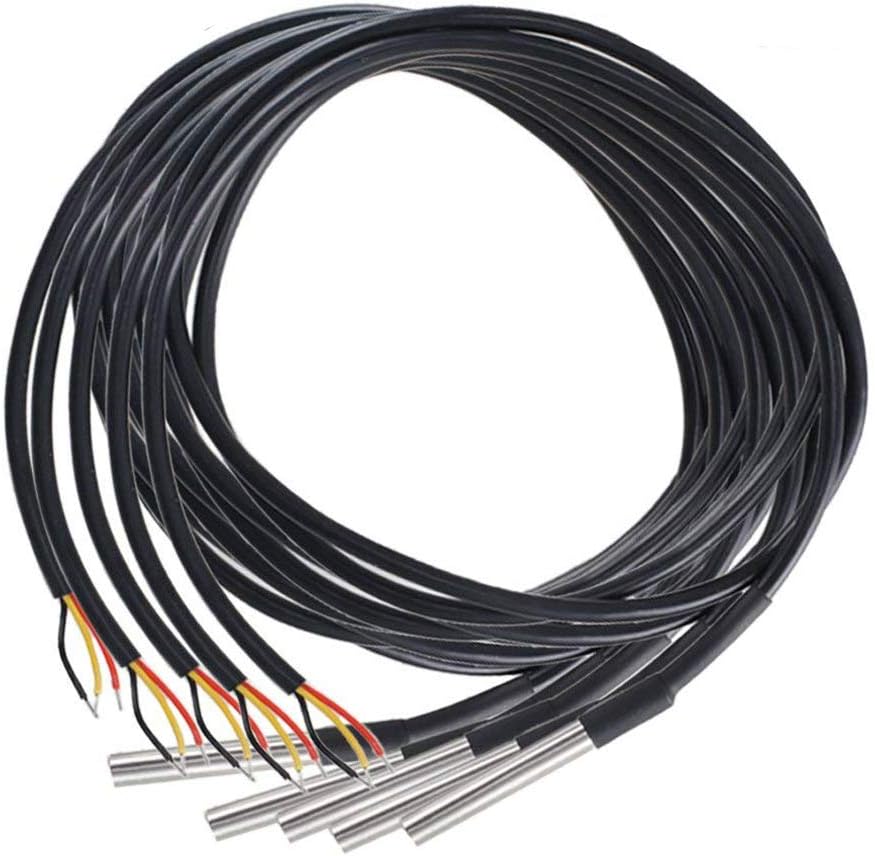
The Gikfun five-pack contains five one-meter waterproof DS18B20 probes and has a 4.5 rating. It is well suited to Arduino temperature logging, environmental comparison, and distributed monitoring where several remote sensing points are required. The common one-meter length makes it easier to standardize an installation across containers, rooms, or plant beds.
We may earn a commission when you buy through this link, at no additional cost to you.
Power requirements range from 3.0 to 5.5V, and each probe identifies red VCC, yellow data, and black ground. The sensors use a single-bus interface, allowing multiple units to share signal wiring when they receive unique addresses. This can simplify physical wiring, although the software must identify each probe correctly and report readings separately.
A 4.7K resistor between data and power is recommended for easier and more reliable testing. That component is not included according to the supplied information, so builders should obtain one if the board or connected setup does not already provide suitable pull-up support. Long runs and numerous sensors can make signal integrity more sensitive to correct bus design.
This package is a good fit for makers building scalable temperature arrays or comparing conditions around a greenhouse, aquarium, or machine. It offers more probes than a single-sensor solution and fewer bundled accessories than the DROK set. Its simplicity and established sensor platform make it a dependable general-purpose choice for multi-point Arduino projects.
Five equal-length probes make it convenient to create a uniform monitoring array. Consistent placement can also make comparisons more meaningful when the objective is to identify different thermal zones.
The one-wire architecture reduces the number of signal cables, but each sensor still requires proper identification. Confirm unique addresses and use a suitable pull-up resistor before relying on readings from every probe.
We may earn a commission when you buy through this link, at no additional cost to you.
The HiLetgo DHT22/AM2302 two-pack is a capable middle ground between the basic DHT11 and higher-precision I2C modules. Its 4.4 rating reflects solid customer feedback, and the listed specifications include a -40 to 80°C temperature range, ±0.5°C accuracy, and complete 0-100%RH humidity coverage. It is a natural upgrade for makers who recognize the DHT11 interface but want better measurements.
We may earn a commission when you buy through this link, at no additional cost to you.
The AOSONG AM2302 sensor produces a single-bus digital signal with bidirectional serial data. That architecture remains approachable and can be compatible with familiar Arduino libraries. Fixing screw holes improve its suitability for permanent installations, while two modules allow basic comparisons between locations without requiring an entirely different sensor platform.
The DHT22 is not necessarily the most flexible choice for a densely connected system because its one-wire interface differs from I2C, and the product information does not list a broad operating-voltage range. Actual sampling intervals also matter: code should not attempt to read the module continuously faster than the sensor can provide meaningful new measurements. The advertised accuracy should be viewed as a specification under defined conditions rather than a guarantee in every installation.
Choose this set for home climate monitoring, controlled storage, greenhouse readings, or a DHT11-style project that needs greater range and precision. It is also useful when bidirectional digital communication is desired. For multiple I2C devices, smaller electronics, or the highest documented accuracy, the AHT30 or SHT31-D offers a more modern bus arrangement.
The DHT22 expands the temperature range and improves the listed accuracy while retaining a familiar single-bus style. It is an intuitive step for builders who understand the DHT11 but need more capable environmental measurements.
The included screw holes allow a module to be fixed inside an enclosure or near a controlled measurement point. Stable mounting also reduces the chance that airflow or accidental movement will distort comparisons.
We may earn a commission when you buy through this link, at no additional cost to you.
The HiLetgo DS18B20 five-pack provides five waterproof, one-meter stainless steel temperature probes with a 4.5 rating. It is a versatile set for Arduino projects that need temperature readings at several remote points. Compared with combined temperature-humidity modules, the DS18B20 focuses entirely on temperature, which can simplify projects that do not need humidity data.
We may earn a commission when you buy through this link, at no additional cost to you.
The probes use red for VCC, yellow for data, and black for ground. A 3.0 to 5.5V power supply and -55 to 125°C measurement range make them broadly compatible with common embedded systems. The one-meter leads provide enough separation to place each probe in a different container, away from the Arduino or other heat-producing electronics.
The product guidance recommends a 4.7K resistor between data and power, but the supplied information does not list one as included. The data connection also supports multiple sensors through the one-wire bus, assuming each device is assigned a unique address and the wiring remains practical. As with other waterproof probes, the lead's temperature rating should be respected even if the sensing specification reaches a higher number.
This set is a good option for temperature logging, environmental comparisons, home automation demonstrations, and robust outdoor or damp-location projects. It is less useful for humidity monitoring and less convenient for a first project than a module with an integrated adapter. Its value lies in the number of usable probes, consistent lead length, and broad temperature capability.
Using a dedicated temperature probe avoids unnecessary humidity circuitry and can simplify both wiring and data interpretation. It is a sensible choice when humidity is not relevant to the control decision.
One-meter probes make it easier to separate the sensor tip from the Arduino, voltage regulator, or display. This arrangement reduces the influence of board heat and creates more representative readings.
We may earn a commission when you buy through this link, at no additional cost to you.
The right Arduino temperature sensor depends on the measurements you need, the environment, the number of sensing points, and how comfortable you are with different communication interfaces. These factors narrow the field before you compare individual specifications.
Begin by deciding whether temperature alone is enough. DS18B20 probes are dedicated temperature sensors, while the DHT11, DHT22, AHT30, and SHT31-D also provide humidity measurements. If your project monitors a room, garden, food enclosure, or HVAC system, combined readings can be useful. If you only need a thermal reading for a thermostat or safety cutoff, a dedicated probe may reduce complexity. Do not select a combined sensor solely because it offers more measurements if humidity data will never be used.
Choose temperature-only for the simplest focused design, or temperature-humidity for a broader environmental picture.
The listed operating or measurement range should comfortably cover every condition your project may encounter. The DHT11 is limited to 0-50°C, which is suitable for many indoor demonstrations but not cold outdoor or hot industrial use. The DHT22 extends from -40 to 80°C, while the AHT30 covers -40 to 85°C. DS18B20 and SHT31-D products list upper limits of 125°C, but cable, sealant, and installation materials may have lower ratings. Compare the complete assembly rather than focusing only on the sensing chip.
Select a range with margin beyond the expected extremes, and verify that every connected material can tolerate them.
Accuracy describes the closeness of readings to the true value, while resolution indicates how finely a digital reading can change. The DHT11 lists ±2°C temperature accuracy, the DHT22 ±0.5°C, and the AHT30 and SHT31-D ±0.3°C. DS18B20 options in this list state ±0.5°C. These figures are most meaningful when the environment is stable and the sensor is placed correctly. Large case temperature changes, airflow, condensation, self-heating, and poor electrical connections can affect real-world results.
For general indoor awareness, moderate accuracy is usually adequate; for fine control or data logging, favor tighter specifications and careful placement.
The DHT11, DHT22, and DS18B20 families use a one-wire or single-bus style connection, while the AHT30 and SHT31-D use I2C. One-wire wiring can be simple for one sensor, but multiple devices require unique addresses and a pull-up arrangement. I2C supports multiple peripherals on a shared bus, although address conflicts may require configuration or a multiplexer. Whichever protocol you choose, use the correct library, maintain a common ground, and follow the sensor's timing requirements.
Favor the interface your software and board can support reliably, and plan pull-ups, addressing, and cable length before building.
Voltage compatibility determines whether the sensor can operate directly with your Arduino or whether a regulator or level arrangement is required. Listed supplies range from 2.0V on the AHT30 to 5.5V across several modules and probes. Some older Arduino boards use 5V logic, while many newer boards and common microcontroller modules operate at 3.3V. Check the board's GPIO voltage and the sensor's stated operating range. Using the wrong supply can prevent operation or create a risk to connected electronics.
Confirm board logic and supply levels before wiring, and power the sensor from a source that falls within its documented range.
The physical installation determines how well a sensor represents the environment you want to monitor. A small open module responds quickly but may be affected by airflow and nearby heat. A waterproof stainless steel probe is better for tanks, damp rooms, or outdoor points, although it may respond more slowly because of its mass and insulation. Enclosures should permit representative airflow without exposing electronics to condensation. For probes, keep connectors dry and respect the maximum temperature of the cable and sealant.
Match the housing to the environment, protect connections, and place the sensing element away from the Arduino's heat.
A single module is often enough for a demonstration, but multiple sensors enable comparisons, zoning, and more complete environmental mapping. Two-pack options suit basic room-to-room comparisons, while five-probe sets support larger arrays and have spare units available. More sensors do not automatically mean a better project: one-wire buses can become harder to manage over long distances, while multiple I2C devices may share one address. Plan whether every probe needs independent readings or whether a simpler point measurement is sufficient.
Buy the number of sensing points the project genuinely needs, and verify that the communication method can identify each one reliably.
Some packages include adapter boards, jumper wires, and pull-up resistors, while others provide only the basic sensor modules or probes. A preassembled adapter can substantially reduce setup work, especially for beginners, while raw probes offer more flexibility for permanent installations. Check the package description carefully before assuming that a resistor or connector is included. The difference between a convenient kit and a collection of separate components is often the difference between a first successful build and unnecessary troubleshooting.
Confirm every required resistor, cable, adapter, and connector is included, or budget time to source and assemble missing parts.
Begin by identifying the sensor family's required protocol, voltage, and pin arrangement. For a DHT11, DHT22, or DS18B20, connect power and ground as documented and attach the data lead to the appropriate digital input. For an AHT30 or SHT31-D, use the stated SDA and SCL connections, confirm the I2C bus is enabled, and check for address conflicts. Verify pull-up requirements before powering the circuit, particularly when using several one-wire sensors or connecting the modules to boards with limited I2C support.
Install the appropriate software library and begin with a minimal sketch that prints raw values to the serial monitor. Confirm that readings change when the sensing element is warmed or cooled, and compare the displayed value with a trusted thermometer when accuracy matters. Avoid reading DHT-family sensors continuously, and give DS18B20 devices enough conversion time when the library requests it. For calibrated measurements, record readings at known temperatures, note placement differences, and treat factory specifications as references rather than perfect substitutes for a local comparison.
Care for the installation as carefully as the electronics. Mount open modules in moving air without exposing connections to condensation, and place them away from processors, regulators, displays, and direct sunlight. Keep the tip of a waterproof probe at the intended measurement depth, but protect the cable joint and adapter board from water. Periodically inspect seals, connectors, and supports; recalibrate or replace a probe if readings become erratic, and always disconnect power before changing wiring.
A DHT11 module is generally the easiest familiar option because it uses a simple digital connection and has broad library support. It is best for basic indoor temperature and humidity demonstrations rather than precision control. The AHT30 is more advanced but offers better accuracy and a broad operating range through I2C.
A pull-up resistor is generally needed on the one-wire data line, and 4.7K ohms is the commonly recommended value used in the supplied product guidance. Some adapter boards already include the resistor, so inspect the board before adding another. Correct pull-up support helps the data signal communicate reliably with the Arduino.
Yes, but the wiring method depends on the sensor. DS18B20 devices can share a one-wire bus when each has a unique address, while I2C sensors can share SDA and SCL as long as their addresses do not conflict. Very long cables, many devices, or duplicate addresses can make communication less reliable.
Accuracy describes how close a measurement is to the actual value, often expressed as plus or minus a number. Resolution describes the smallest change that the digital output can represent. A sensor can have fine resolution without perfect accuracy, so both specifications matter when choosing a model for a project.
The listed waterproof DS18B20 sets are suitable for applications such as aquariums, where the probe can be submerged while the electronics remain outside the water. Confirm the probe's immersion and temperature limits, protect the connection from moisture, and position the tip where it will represent the water temperature.
Many models can, provided their voltage and signal interface are compatible. DHT modules and DS18B20 probes are commonly used with Raspberry Pi GPIO, while the AHT30 and SHT31-D use I2C and require suitable bus configuration. Follow the sensor's wiring guidance and use the correct pull-up arrangement.
Differences can come from sensor accuracy, placement, airflow, direct sunlight, nearby electronic heat, humidity, or the reference thermometer itself. For meaningful comparisons, place both devices in the same stable environment, allow them to settle, and take several readings. Calibrating one reading directly against another does not guarantee accuracy across every temperature.
Choose temperature-only when humidity is irrelevant to the project, such as a simple thermostat, aquarium probe, or equipment monitor. Choose a combined sensor when relative humidity provides useful context for comfort, storage, plant care, or environmental analysis. A combined module also requires suitable humidity accuracy and ventilation around the sensing element.
The HiLetgo DHT11 five-pack is an approachable option for basic indoor learning, while the AHT30 two-pack is the strongest all-around choice for projects seeking strong published accuracy, wide environmental coverage, and modern I2C communication. The SHT31-D three-pack is especially compelling when a broad -40 to 125°C range and multiple consistent sensing points are important.
For damp environments, remote probes, and multi-point installations, the DS18B20 sets are more appropriate. The DROK package is the strongest rugged all-in-one option, with stainless steel probes, adapters, jumper wires, and resistors. The Gikfun and WWZMDiB bundles also offer useful combinations of probe count, length, and accessories, while the HiLetgo DS18B20 set provides a focused five-probe solution.
Prioritize the measurement range, accuracy, interface, voltage, and physical environment that your project genuinely requires. After choosing a compatible sensor, verify the current product listing, included accessories, library support, and electrical requirements. Prices and package contents can change over time, so check current information before making a final purchase.