
GIGABYTE GC-WBAX210
4.6Editor score
Intel AX210 Wi-Fi 6E module
Tri-band 2.4, 5, 6 GHz
Up to 2400 Mbps link speed
Bluetooth 5.2 support
This Pcie WiFi Card guide compares Wi-Fi 6, 6E, and 7 adapters for speed, range, Bluetooth, compatibility, and setup.
A PCIe WiFi card can add fast, dependable wireless networking to a desktop that lacks a built-in adapter or has an outdated one. The right choice depends on your router, Windows version, case dimensions, Bluetooth needs, and whether you value 6 GHz connectivity or the newest Wi-Fi 7 standard.
We compared the ten featured cards using their stated wireless standards, supported bands, maximum link speeds, antenna arrangements, Bluetooth versions, security features, operating-system requirements, and installation details. The list covers AX3000, AXE5400, BE9300, and BE9400-class options so desktop owners can compare meaningful differences rather than simply looking for the largest number.
Each review explains who the card suits best and where it falls short, while the comparison table provides a quick reference. Ratings reflect the supplied customer feedback, but real performance depends heavily on the paired router, distance, walls, interference, drivers, and processor. Product availability and prices change, so confirm current details before buying.
Selecting the right PCIe WiFi card starts with matching the adapter to the wireless network already available at home or in the office. A fast card cannot create a faster connection if the router supports an older standard, while a newer Wi-Fi 7 card may offer little practical advantage without compatible infrastructure.
This guide evaluates the ten cards using their stated specifications, customer ratings, antenna designs, supported wireless generations, Bluetooth capabilities, security features, and operating-system requirements. The comparison includes entry-level Wi-Fi 6 models, tri-band Wi-Fi 6E adapters, and several Wi-Fi 7 options for newer desktops.
The reviews show how each card fits particular needs, from a straightforward upgrade for a Windows desktop to a high-bandwidth option for a Wi-Fi 7 network. Hardware specifications indicate potential rather than guaranteed real-world results, and current prices and availability can change at any time.
4.6Editor score

4.7Editor score
4.4Editor score
This side-by-side comparison highlights the most important differences among the ten cards, including wireless generation, available frequency bands, stated link rates, Bluetooth support, antenna style, and major platform limitations.
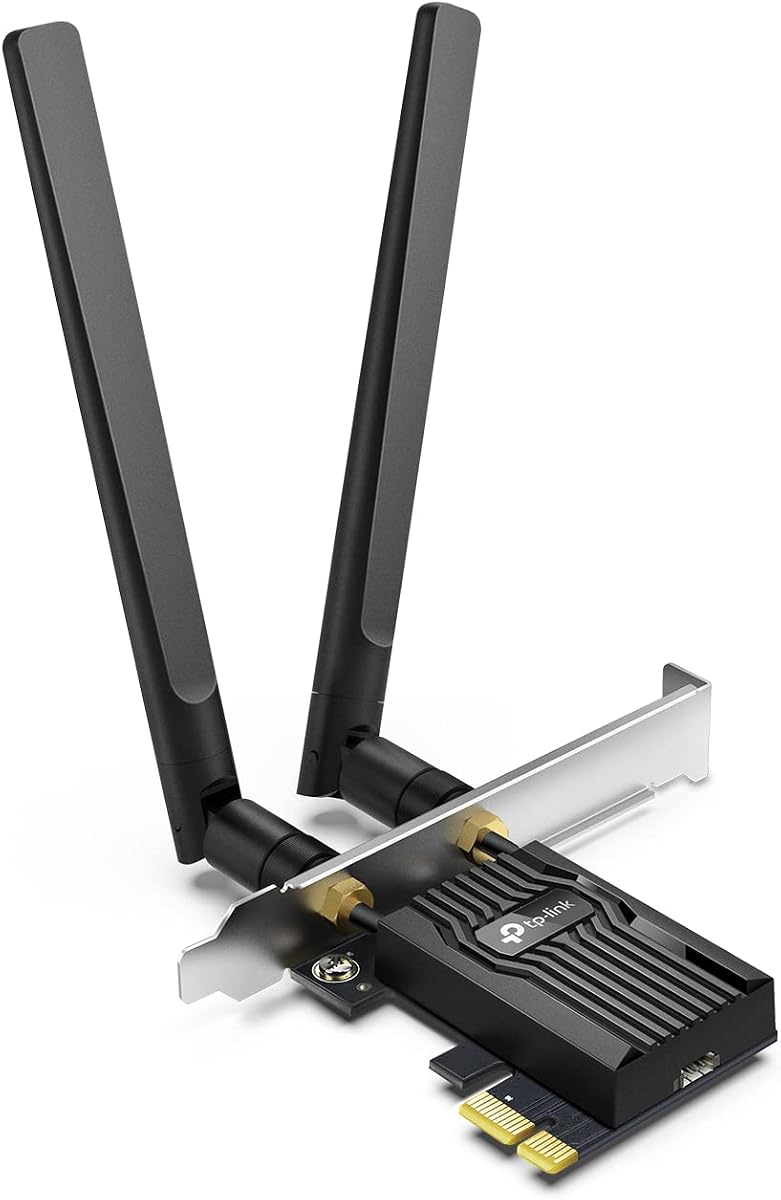


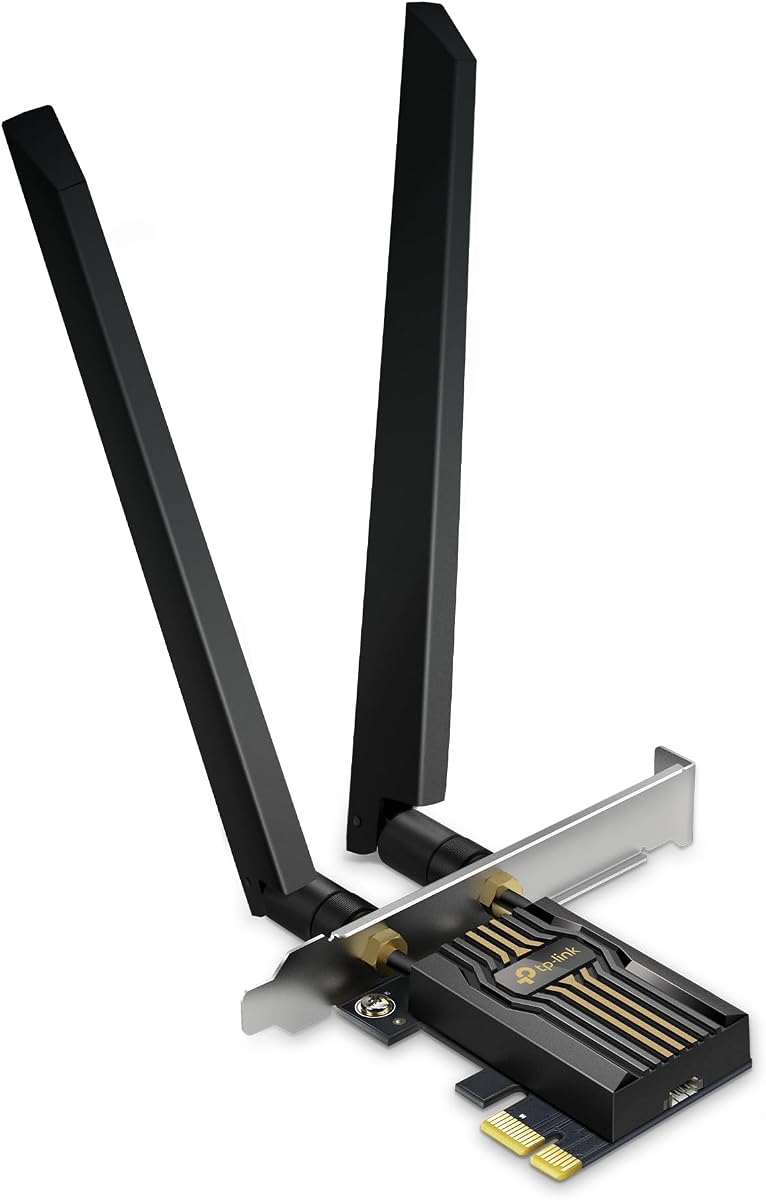
The TP-Link Archer TX55E is a dual-band Wi-Fi 6 expansion card built for desktops that need faster and more dependable wireless connectivity. It combines stated link rates of up to 2402 Mbps on 5 GHz and 574 Mbps on 2.4 GHz with OFDMA, MU-MIMO, WPA3 support, and Bluetooth 5.2. Its 4.5 rating reflects a generally positive customer reception, while the included standard and low-profile brackets make it adaptable to different desktop cases.
We may earn a commission when you buy through this link, at no additional cost to you.
The strongest feature is its balance of capability and simplicity. Wi-Fi 6 technologies are designed to help a network handle congestion more efficiently, while the two high-gain antennas are positioned to improve reception in a larger desktop installation. Bluetooth 5.2 allows the card to handle compatible controllers, keyboards, headsets, and other peripherals. The card therefore does more than provide internet access, reducing the need for a separate internal Bluetooth adapter when the USB lead is installed correctly.
Its main limitation is that it operates only on 2.4 and 5 GHz. That makes it a sensible choice for a Wi-Fi 6 router but prevents it from taking advantage of the cleaner 6 GHz spectrum available on Wi-Fi 6E systems. Bluetooth also requires the supplied USB cable to be connected to an internal F_USB header, which can be inconvenient in cases with limited internal USB connectivity. The card also lacks the magnetized antenna positioning offered by several alternatives.
This is an attractive choice for a gamer, creator, or general desktop user who wants a current Wi-Fi 6 upgrade without requiring the newest hardware. It is especially practical when the computer sits near the router, the existing adapter is unreliable, and a full-height or low-profile bracket is needed. For a Wi-Fi 6E network, however, choose one of the tri-band cards in this guide for access to 6 GHz.
With a maximum stated 5 GHz link of 2402 Mbps, the TX55E is designed for high-capacity local networks and fast internet connections. OFDMA and MU-MIMO can improve efficiency when several compatible devices are active on the same network.
Both standard and low-profile mounting brackets are included. This is useful for full-size towers as well as mini-tower and other compact cases that cannot accommodate a full-height card bracket.
We may earn a commission when you buy through this link, at no additional cost to you.
The TP-Link Archer TX3000E delivers the highest customer rating among the featured options, at 4.7. It is a dual-band Wi-Fi 6 card with stated link speeds of 2402 Mbps on 5 GHz and 574 Mbps on 2.4 GHz. OFDMA, MU-MIMO, Bluetooth 5.3, WPA3, and a magnetized antenna base give it a useful combination of efficiency, peripheral support, and practical signal positioning.
We may earn a commission when you buy through this link, at no additional cost to you.
The magnetized base is the card's most distinctive feature. Rather than forcing both antennas to remain in one fixed position, the user can move the antenna assembly to a clearer part of the desk or metal surface. That can help a desktop that sits behind a monitor, near a wall, or inside a crowded entertainment center. The included low-profile bracket also makes the adapter more appropriate for compact cases than a standard full-height-only design.
There are still some limitations. This is a dual-band adapter, so it cannot connect to a 6 GHz Wi-Fi 6E network. Driver installation is required, either from the supplied media or through TP-Link's support website, and firmware may be needed to enable Bluetooth 5.3. As with the other cards with a separate Bluetooth header, the internal USB cable must connect to an available F_USB connector for Bluetooth to work.
The TX3000E is an excellent general-purpose recommendation for a desktop owner who wants an easy Wi-Fi 6 upgrade and may need to optimize antenna placement. It is less appropriate when 6 GHz access is mandatory or when the computer has no accessible internal USB header. Even with those limits, its strong rating, clean feature set, and flexible installation make it one of the most convincing options here.
The magnetic antenna base can be moved away from obstructions, making it useful when the desktop is positioned in a corner or behind other equipment. Better physical placement can improve reception without changing the router.
Bluetooth 5.3 supports faster transfer and broader coverage than Bluetooth 4.2, according to the supplied specifications. Connecting the included internal USB lead allows compatible accessories to pair with the desktop.
We may earn a commission when you buy through this link, at no additional cost to you.
The GIGABYTE GC-WBAX210 uses the widely recognized Intel AX210 module to bring tri-band Wi-Fi 6E to a desktop. It supports 2.4, 5, and 6 GHz bands, with a stated maximum wireless connection rate of up to 2400 Mbps. Bluetooth 5.2 is also included. The card's 4.6 rating indicates favorable customer feedback, and its relatively simple specification list makes it a practical option for adding modern wireless capability.
We may earn a commission when you buy through this link, at no additional cost to you.
Using the AX210 module means the adapter supports an established wireless platform rather than an unidentified chipset. It offers two-stream operation across the three main frequency bands and complies with IEEE 802.11ac revisions and 802.11ax. For owners of a Wi-Fi 6E router, the important advantage is access to the 6 GHz band, which can provide more available spectrum and less congestion than the 2.4 and 5 GHz bands in suitable environments.
The product data is less detailed than that supplied for several TP-Link alternatives. It does not specify the supplied antenna configuration, bracket options, operating-system versions, or driver procedure, so buyers may need to inspect the package and manufacturer documentation before installation. Its stated maximum link rate of 2400 Mbps is lower than the combined tri-band figures used by some listings, although maximum figures across different bands are not directly comparable in every scenario.
This card fits users who specifically want an AX210-based PCIe option with 6 GHz capability and do not need a magnetized desktop antenna base. It is also a logical choice when Bluetooth 5.2 is sufficient for the intended accessories. For shoppers who prioritize detailed installation information, abundant bracket options, or Bluetooth 5.3, one of the more fully documented models may be easier to evaluate.
The built-in Intel AX210 module provides a recognizable chipset foundation for Windows desktops. It is particularly relevant for users who already use compatible Intel wireless drivers or want a standard PCIe implementation.
A 6 GHz-capable adapter can use additional channels when the router offers them. The benefit is strongest in crowded areas where 2.4 and 5 GHz networks overlap heavily.
We may earn a commission when you buy through this link, at no additional cost to you.
The TP-Link Archer TBE552E is a tri-band Wi-Fi 7 card aimed at systems that can exploit the newest generation of wireless networking. Its stated maximum link speeds reach 5764 Mbps on 6 GHz, 2882 Mbps on 5 GHz, and 688 Mbps on 2.4 GHz. MLO, Multi-RUs, 4K-QAM, 320 MHz channels, OFDMA, MU-MIMO, Bluetooth 5.4, and WPA3 make it a feature-rich premium option.
We may earn a commission when you buy through this link, at no additional cost to you.
The most important advantage appears when the card is paired with a Wi-Fi 7 router. Under that setup, 320 MHz 6 GHz channels can substantially increase available bandwidth, while MLO allows traffic to use multiple links for improved throughput, latency, and reliability. OFDMA and MU-MIMO also help the network accommodate numerous connected devices. Two high-gain antennas are supplied to strengthen reception, and both standard and low-profile brackets are included.
The major constraint is the operating system. The supplied information specifically says that this model is designed exclusively for Windows 11 and is not compatible with Windows 10 or earlier. A second limitation is infrastructure: without a Wi-Fi 7 router, many headline features will not be available, although the card remains a capable tri-band adapter. Its 4.4 rating is lower than the ratings of the leading Wi-Fi 6 and 6E options, so premium specifications do not guarantee the strongest customer consensus.
The TBE552E makes the most sense for a Windows 11 desktop owner who already has or plans to add a Wi-Fi 7 router. It is particularly compelling for a new high-end build where 6 GHz bandwidth, MLO, and Bluetooth 5.4 are priorities. For a mainstream Windows 11 PC on a Wi-Fi 6 router, one of the AX3000 or AXE5400 alternatives may deliver a more sensible balance.
MLO can combine multiple frequency links to improve responsiveness and consistency on a busy network. The greatest benefit appears with a router and network conditions designed to support those links.
The adapter supports 320 MHz channels when paired with compatible Wi-Fi 7 equipment. Wider channels can move more data simultaneously, although available spectrum and router configuration determine the result.
We may earn a commission when you buy through this link, at no additional cost to you.
The TP-Link Archer TXE5400 combines an Intel AX210-based Wi-Fi 6E design with a flexible magnetized antenna base. It supports the 2.4, 5, and 6 GHz bands, with stated link rates of 2402 Mbps on 6 GHz, 2402 Mbps on 5 GHz, and 574 Mbps on 2.4 GHz. Bluetooth 5.3, WPA3, OFDMA, and MU-MIMO round out a feature set aimed at modern Windows 11 desktops.
We may earn a commission when you buy through this link, at no additional cost to you.
Its placement-focused design is especially useful in challenging desktop arrangements. The two multi-directional antennas can be moved with the magnetic base to a location with a clearer line to the router. This can make a meaningful difference when the computer is behind a monitor or near a wall. The card also provides both standard and low-profile mounting brackets, allowing it to fit a broad range of tower and mini-tower cases.
The major requirement is a compatible network and operating system. The supplied data says Windows 11 is needed to use the 6 GHz band, so users on Windows 10 cannot access the adapter's full tri-band potential. Its feature set also overlaps closely with other TP-Link AX210 products, making the distinction meaningful mainly for buyers who specifically want the magnetic base alongside 6 GHz support.
This model is a strong recommendation for a Windows 11 desktop positioned awkwardly or installed in a home office where Wi-Fi reception matters more than having the newest Wi-Fi 7 standard. It also suits users who want both high-bandwidth wireless and Bluetooth 5.3. If the desktop is already connected by a reliable cable or positioned close to the router, a simpler dual-band card may be sufficient.
The adapter can use 2.4 GHz for range, 5 GHz for performance, and 6 GHz for additional bandwidth when the router and Windows version support them. Band selection helps balance speed with coverage.
The magnetic base allows the antennas to be positioned independently of the card's internal location. This is particularly helpful in tight cases or on desks where the computer sits against a wall.
We may earn a commission when you buy through this link, at no additional cost to you.
The TP-Link Archer TBE550E brings Wi-Fi 7, tri-band operation, and an expressive magnetic antenna base to desktop builders. Stated link rates reach 5760 Mbps on 6 GHz, 2880 Mbps on 5 GHz, and 688 Mbps on 2.4 GHz. The card supports 320 MHz channels, MLO, Multi-RU, OFDMA, MU-MIMO, 4K-QAM, WPA3, and Bluetooth 5.4, creating one of the most extensive feature lists in the roundup.
We may earn a commission when you buy through this link, at no additional cost to you.
Its magnetic base does more than improve antenna placement. Multicolored LED effects display network status, while a touch switch allows the user to control the lighting. Two adjustable antennas can be positioned to improve signal reception. These details make the card visually distinctive and potentially useful for a showcase build, although some buyers will prefer a more understated installation.
Like the TBE552E, this option is explicitly limited to Windows 11. It also needs a Wi-Fi 7 router to unlock features such as 320 MHz channels and MLO. The product rating of 4.2 is among the lower scores in this list, which may reflect early-adopter concerns or the usual friction associated with new networking hardware. USB driver installation is another step that users should account for.
The TBE550E is best suited to a Windows 11 enthusiast building around Wi-Fi 7 and wanting a coordinated, customizable setup. It is less compelling for a business desktop that only needs stable wireless access, or for a system on an older router. Shoppers should judge the illuminated base as a design benefit rather than a networking necessity and verify that their case has room for the external assembly.
LED effects and a touch control add visible status feedback to the installation. The base remains functional as a movable antenna platform even for users who prefer a subtler lighting setting.
MLO, Multi-RU, 320 MHz channels, and 4K-QAM are designed to improve throughput and responsiveness on compatible networks. Actual benefits depend on the router, client device, radio conditions, and available spectrum.
We may earn a commission when you buy through this link, at no additional cost to you.
The TP-Link AXE5400 AX210 is a conventional tri-band PCIe adapter built around the Intel AX210 platform. It provides Wi-Fi 6E support on 2.4, 5, and 6 GHz, with stated link rates of 2402 Mbps on 6 GHz, 2402 Mbps on 5 GHz, and 574 Mbps on 2.4 GHz. Bluetooth 5.3, WPA3, OFDMA, MU-MIMO, and two high-gain antennas give it a capable and familiar feature set.
We may earn a commission when you buy through this link, at no additional cost to you.
The fixed high-gain antenna arrangement is straightforward and should suit desktop users who want strong reception without repositioning a magnetic base. Both standard and low-profile brackets are included, so the card can be mounted in a conventional tower or a compact mini-tower. Intel's AX210 is also a well-established platform, which may be reassuring for buyers who prioritize a recognizable chipset and broad Windows support.
Full 6 GHz operation requires Windows 11, according to the supplied information. Bluetooth 5.3 also depends on connecting the USB cable to an internal F_USB header. The card's potential is therefore tied to both the operating system and internal case wiring. Compared with the Archer TXE5400, the main distinction is the fixed high-gain antennas rather than a magnetic desktop base.
This is a solid recommendation for a Windows 11 desktop that needs modern tri-band wireless and Bluetooth without the extra visual or functional complexity of a movable illuminated base. It also fits builders who want a known Intel AX210 solution and have already invested in a Wi-Fi 6E router. Users on Windows 10 should focus on the 2.4 and 5 GHz bands or consider a more explicitly supported alternative.
The adapter can use whichever band best suits the network. 2.4 GHz generally favors distance, 5 GHz balances speed and coverage, and 6 GHz provides additional spectrum when supported by the router and operating system.
Bluetooth 5.3 can support compatible keyboards, headsets, controllers, and other accessories. The internal USB connection must be present for this feature to operate.
We may earn a commission when you buy through this link, at no additional cost to you.
The AX210 5400Mbps WiFi Card offers an Intel AX210-based PCIe adapter with tri-band Wi-Fi 6E and Bluetooth 5.3. Its stated combined speed is up to 5400 Mbps, covering the 6, 5, and 2.4 GHz bands. The product supports Windows 10 and 11, includes a Bluetooth USB cable, and uses high-gain antennas. Its 4.5 rating suggests a generally favorable response from buyers.
We may earn a commission when you buy through this link, at no additional cost to you.
One useful feature of this listing is its straightforward explanation of compatibility. It supports both current Wi-Fi 6E and legacy Wi-Fi standards, which helps when the desktop may move between different networks. OFDMA and MU-MIMO are also available to improve efficiency in crowded wireless environments. The included Bluetooth cable allows the card to serve compatible peripherals in addition to providing network connectivity.
The branding is less informative than that of established models from TP-Link, GIGABYTE, or MSI, and the 5400 Mbps figure should be understood as a combined or aggregate specification rather than a guaranteed real-world transfer rate. Full 6 GHz functionality still requires a Wi-Fi 6E router and Windows 11. As with other AX210-based products, internal USB access is necessary for Bluetooth.
This card is a practical choice for a desktop owner who understands the fundamentals of Wi-Fi 6E and wants a clear combined speed specification. It may suit a mixed network where support for older Wi-Fi standards matters. Buyers seeking stronger brand-specific details, premium antenna positioning, Wi-Fi 7 features, or more extensive mounting information should examine the more fully documented alternatives.
Support for both Wi-Fi 6E and legacy Wi-Fi standards allows the adapter to remain useful across older and newer access points. This is helpful for offices, shared spaces, and homes with mixed equipment.
The 5400 Mbps number represents the stated potential across supported bands. Real transfer speed is governed by the router, signal quality, congestion, and the bandwidth of the internet service.
We may earn a commission when you buy through this link, at no additional cost to you.
The MSI Herald WiFi 7 is a tri-band PCIe card designed around Wi-Fi 7 connectivity. It offers stated link rates of 5764 Mbps on 6 GHz, 2882 Mbps on 5 GHz, and 688 Mbps on 2.4 GHz. MLO, support for 320 MHz channels, and Bluetooth 5.4 form the core feature set, while external antennas with a magnetized base help optimize reception. Its customer rating is 4.3.
We may earn a commission when you buy through this link, at no additional cost to you.
MLO is the most important networking feature for multi-device use. By combining multiple links, a compatible setup can seek faster, more stable, and more seamless connectivity when traffic changes or one band becomes congested. The 320 MHz 6 GHz channel capability is also valuable because wider channels can provide more throughput, provided the router and local spectrum allow them.
The supplied description does not specify detailed operating-system support, mounting-bracket options, or the exact Windows configuration required. Those details should be confirmed with MSI before installation, particularly for an older PC. The card also needs compatible Wi-Fi 7 infrastructure to realize its most advanced capabilities. Its 4.3 rating places it behind the highest-rated Wi-Fi 6 and 6E models in customer feedback.
The MSI Herald is best for a modern desktop owner with a Wi-Fi 7 router who values MLO and high 6 GHz potential in a clean, focused design. It is less appropriate when detailed compatibility information is unavailable or when the network remains on Wi-Fi 6. Confirm case dimensions, drivers, and system requirements before finalizing the purchase.
MLO can reduce the effect of congestion by using more than one connection path. The feature is most valuable with a router, client configuration, and network load that support it effectively.
The stated 6 GHz link rate makes this card suitable for high-capacity local transfers and fast network access. Broad internet service remains limited by the provider, regardless of the adapter's maximum capability.
We may earn a commission when you buy through this link, at no additional cost to you.
The TP-Link Archer TBE553E is the most bandwidth-focused card in the guide. It uses Wi-Fi 7 to provide a stated total of 9.3 Gbps across three bands, with individual maximums of 5764 Mbps on 6 GHz, 2882 Mbps on 5 GHz, and 688 Mbps on 2.4 GHz. MLO, Multi-RU, OFDMA, MU-MIMO, 320 MHz channels, Bluetooth 5.4, and WPA3 round out a technically advanced specification list.
We may earn a commission when you buy through this link, at no additional cost to you.
Its single high-gain antenna is designed to extend stable reception farther from the router. The magnetic base provides placement flexibility, and the included standard and low-profile brackets support different case designs. The product also emphasizes cybersecurity through TP-Link's participation in the CISA Secure-by-Design pledge, while WPA3 is included for password protection.
The largest concern is platform eligibility. The supplied information says the adapter is designed for a compatible Intel Wi-Fi 7 CPU and is not compatible with AMD systems. It also supports Windows 10 and 11, but the advanced Wi-Fi 7 experience still depends on the CPU, motherboard, drivers, and router. The 4.2 rating is the lowest among the featured products, so buyers should examine recent customer feedback carefully.
This model is aimed at a specialized group: owners of a compatible Intel Wi-Fi 7 platform seeking maximum theoretical bandwidth and flexible antenna placement. It is not a general upgrade for AMD builders or systems without a suitable router. If those restrictions do not apply, the card is a compelling choice for high-end desktop builds, local data transfers, and low-latency networking.
The 9.3 Gbps total figure reflects the combined potential across all three bands. It does not mean every file will transfer at that rate, because real throughput depends on router capabilities, signal conditions, and the speed of other hardware.
The requirement for a compatible Intel Wi-Fi 7 CPU makes this a narrower choice than many alternatives. Buyers should verify processor, motherboard, operating system, and router support before installing it.
We may earn a commission when you buy through this link, at no additional cost to you.
Choosing a PCIe WiFi card involves balancing network standards, operating-system support, antenna design, Bluetooth needs, case clearance, and the capabilities of your existing router. The most advanced specification only helps when the rest of the system can support it.
Wi-Fi 6 cards operate on 2.4 and 5 GHz and are suitable for many current routers. Wi-Fi 6E adds the 6 GHz band, which can provide cleaner, wider channels in suitable areas, while Wi-Fi 7 adds features such as 320 MHz channels, MLO, Multi-RUs, and 4K-QAM. Match the adapter to the router rather than assuming a newer card will automatically create a faster connection.
Windows 11 is explicitly required for 6 GHz operation in the supplied information, and some Wi-Fi 7 products have stricter requirements. The Archer TBE552E and TBE550E are listed as Windows 11 only, while the TBE553E requires a compatible Intel CPU and excludes AMD systems. Check the exact operating-system version, driver availability, and processor support before buying.
A desktop's case, walls, furniture, and monitor can obstruct wireless signals. Fixed high-gain antennas are simple and can provide solid reception, while magnetized external bases let the user move the antenna assembly to a clearer location. Pay attention to desk space, case clearance, cable reach, and where the router is positioned before selecting a design.
All ten cards provide some form of Bluetooth, with versions ranging from 5.2 to 5.4. Bluetooth is useful for keyboards, headsets, controllers, mice, and other accessories. Most implementations also require the included USB cable to be attached to an internal F_USB header, so confirm that your case exposes one and that you are comfortable routing the lead.
Advertised link rates represent theoretical wireless capability under favorable conditions, not guaranteed file-transfer speeds. Some listings quote a maximum rate for one band, while others combine rates across 2.4, 5, and 6 GHz. Internet service, router hardware, signal distance, interference, channel width, and the client device all influence the result, so compare like-for-like specifications when possible.
PCIe wireless cards come in different heights and may use full-height or low-profile brackets. Several options here include both, but others provide limited information. Measure the available expansion-card clearance, check the case's slot layout, and allow room for the antennas or magnetic base. Also confirm that adding the card will not interfere with other internal components.
WPA3 support appears across the featured range and helps protect wireless passwords against brute-force attacks. Software support remains equally important: use the manufacturer's official driver source, confirm the card appears in the operating system's compatibility lists, and avoid unnecessary driver changes. Bluetooth may also require firmware updates after the initial driver installation.
Before installing the adapter, power off the desktop, unplug it, discharge residual electricity, and open the case according to the manufacturer's instructions. Locate an available PCIe expansion slot, remove the appropriate rear cover, and confirm whether the case requires a full-height or low-profile bracket. Install the correct bracket before inserting the card, then secure it and attach any antenna hardware.
Next, connect the supplied Bluetooth USB cable to an internal F_USB header if you intend to use Bluetooth. Route the cable carefully so it does not interfere with fans, graphics cards, or storage cables. Once the case is closed and the computer is running, install the wireless driver from the manufacturer's official website or supplied media. If Bluetooth 5.3 or another feature does not appear, check for the relevant firmware and restart the system.
For best results, place fixed antennas where they have a clear path to the router. If the card includes a magnetic base, experiment with several positions and keep the antennas away from metal objects, power supplies, and the rear of the monitor. Update drivers when needed, maintain the router's firmware, use WPA3 security, and avoid routinely unplugging the internal Bluetooth lead.
A PCIe card usually offers a more direct path into the desktop and commonly provides a larger antenna selection, making it a stronger choice for fixed installations. A USB adapter is easier to move between systems and may be more convenient if the desktop cannot be opened. The best choice depends on portability, case access, antenna positioning, and the desktop's existing hardware.
A Wi-Fi 6E card can operate on 2.4 and 5 GHz with an older Wi-Fi 6 router, but it will not unlock 6 GHz features. Wi-Fi 7 adapters similarly need compatible Wi-Fi 7 infrastructure to use 320 MHz channels, MLO, and related capabilities. Buying the newest card without upgrading the router may leave its headline specifications unused.
The PCIe slot carries the main wireless data connection, while the internal USB header provides the separate path needed for Bluetooth. Connect the supplied cable to an available F_USB header on the motherboard. If the case has no accessible header, Bluetooth will not work even when the Wi-Fi connection is functioning.
It depends on the card height and the case design. A low-profile bracket is required for many mini-tower cases, so confirm that the adapter includes one or can be fitted with the correct bracket. Also check whether external antennas or a magnetic base will fit inside the case or along the rear of the enclosure.
No. The advertised figure is a theoretical link rate, while actual performance depends on the router, internet plan, distance, walls, interference, channel width, drivers, and other connected devices. A faster card is most useful when the network and nearby clients can also handle higher throughput.
The supplied product information states that Windows 11 is required to use the 6 GHz band. Windows 10 may still use compatible 2.4 and 5 GHz connections, but it cannot unlock the adapter's complete tri-band potential. Individual drivers and hardware combinations should also be checked before installation.
A magnetic base is useful when the desktop is behind a monitor, against a wall, or otherwise surrounded by obstructions because it lets the user move the antennas. Fixed high-gain antennas are simpler and may work equally well in an open setup. The right choice depends on the physical placement of the computer and router.
Position the antennas away from metal and electronics, place the router in an open central location, and keep the wireless driver current. Using the 5 or 6 GHz band can favor speed, while 2.4 GHz can be useful for longer range. WPA3, router firmware updates, and recent firmware for the adapter also help maintain a stable setup.
The TP-Link Archer TX3000E stands out for its 4.7 rating, flexible magnetized antenna base, Wi-Fi 6 performance, and Bluetooth 5.3 support. The GIGABYTE GC-WBAX210 offers a straightforward Intel AX210-based path to tri-band Wi-Fi 6E, while the TP-Link Archer TBE552E represents the premium Wi-Fi 7 choice with 320 MHz channel support, MLO, Bluetooth 5.4, and a stated 9.3 Gbps class of total bandwidth.
Prioritize the parts of the network you can actually upgrade. Match the card to your router, confirm the operating-system and processor requirements, check for an internal USB header if you need Bluetooth, and make sure the antennas and bracket fit the case. If reliable Wi-Fi 6 on 2.4 and 5 GHz is enough, the TX55E or TX3000E may be more practical than a Wi-Fi 7 model that cannot use its advanced features.
Customer ratings can help narrow the field, but they do not replace compatibility checks or real-world testing in your building. Product prices, stock, firmware, and driver availability can change, so review the current listing and manufacturer information before purchasing. With the router, operating system, and physical installation aligned, a good PCIe WiFi card can provide a large improvement in desktop wireless convenience and performance.