
Powermaster 8500 Marine Alternator
5.0Editor score
Natural 100A alternator output
Designed for marine applications
Single V-belt pulley
Compare the best 100 Amp Marine Alternator options for durable charging, verified fitment, marine safety, and dependable performance across modern boat
A 100 amp marine alternator is built to keep a boat’s battery bank, navigation electronics, lighting, pumps, and accessories supplied with dependable power. The right unit must combine suitable output, marine-grade construction, correct pulley configuration, and verified engine compatibility rather than relying on broad replacement numbers alone.
This guide compares ten marine alternators listed for use around 100 amps, including options for Mercruiser, Indmar, Pleasurecraft, Cushman, and other marine engines. We examined voltage, rated output, regulator and fan arrangement, pulley type, certification claims, replacement numbers, application coverage, warranty information, and available ratings.
Each review explains the product’s strongest benefits, practical trade-offs, and the situations in which it makes the most sense. Ratings reflect the information available when this guide was prepared, while prices and listing details can change. Always verify the original alternator, engine family, mounting style, and wiring configuration before ordering.
5.0Editor score
4.2Editor score

5.0Editor score
The comparison below highlights output, electrical architecture, pulley arrangement, and intended marine applications. These differences determine which alternator fits a particular engine and charging system most appropriately.


This 100 amp marine alternator carries a 4.2 rating and stands out for its explicit SAEJ1171 marine certification and broad selection of Mercruiser-related replacement numbers. Its stated 12-volt, 100-amp high-output configuration makes it a serious candidate for boats that need more charging capacity than a small original equipment unit.
We may earn a commission when you buy through this link, at no additional cost to you.
The application range covers several familiar Mercruiser engine displacements and OEM references, including AC165610, AC165616, 805447, 805884, and several related suffixes. The manufacturer also states that the unit meets or exceeds OEM specifications and includes a one-year warranty, providing useful reassurance for a component expected to endure heat, moisture, vibration, and extended runtime.
Its main limitation is that the listing does not clearly describe every installation dimension, connector arrangement, or pulley detail. A broad replacement-number list is helpful, but it is not a substitute for comparing the physical housing, mounting ears, wire exits, and belt drive with the alternator being removed. Buyers should also confirm the alternator’s charging output at the battery under operating load.
This is our Editor’s Choice because it combines an exact 100-amp rating, a recognized marine certification claim, extensive application information, and warranty coverage in one listing. It is particularly attractive for owners of the listed Mercruiser engines who can verify fitment using their original alternator and OEM numbers.
SAEJ1171 certification is especially relevant because boat-mounted charging hardware operates near moisture, heat, vibration, and salt-laden air. The stated certification indicates that the product was designed and tested against a marine-oriented standard rather than marketed solely as a general automotive replacement.
The long list of OEM and legacy replacement numbers can simplify initial identification, especially on older boats whose original labels may be difficult to read. Confirming several references against the engine and alternator before purchase reduces the risk of choosing an incompatible housing or electrical arrangement.
We may earn a commission when you buy through this link, at no additional cost to you.
This Professional Grade Alternator is a 12-volt, 100-amp replacement for a wide range of Cummins Mercruiser marine engines from 2.8 to 8.2 liters. Although it does not have a published rating in the supplied listing, its technical description is unusually clear, specifying an internal regulator, external fan, six-groove pulley, and two bullet leads.
We may earn a commission when you buy through this link, at no additional cost to you.
The unit is said to meet or exceed OEM specifications, comes with a one-year warranty, and undergoes 100 percent computer load testing. Those are useful indicators of attention to electrical performance and manufacturing consistency. The six-groove pulley also makes it important to examine the boat’s existing belt and pulley system rather than assuming every serpentine-belt arrangement is interchangeable.
Compatibility is one of the main areas requiring diligence. The listing includes numerous engines and replacement numbers, but it does not state every physical dimension, mounting orientation, or connector position. A replacement number match should therefore be followed by a direct comparison of the original unit’s case, ears, pulley, and wiring arrangement.
This alternator is a strong option for a boat owner seeking a clearly specified 100-amp unit with modern marine application coverage. It is best suited to buyers who can verify the pulley and mounting setup and who value a defined regulator, fan, wiring, testing, and warranty configuration.
Knowing that the regulator is internal, the fan is external, and the wiring uses two bullet leads helps installers anticipate the connection process. These details should still be compared with the removed alternator because marine installations vary even when engine and replacement numbers appear similar.
The stated 100 percent computer load test is a meaningful quality-control claim for an alternator expected to operate continuously. It also helps distinguish this listing from replacements sold with little information beyond basic output and engine compatibility.
We may earn a commission when you buy through this link, at no additional cost to you.
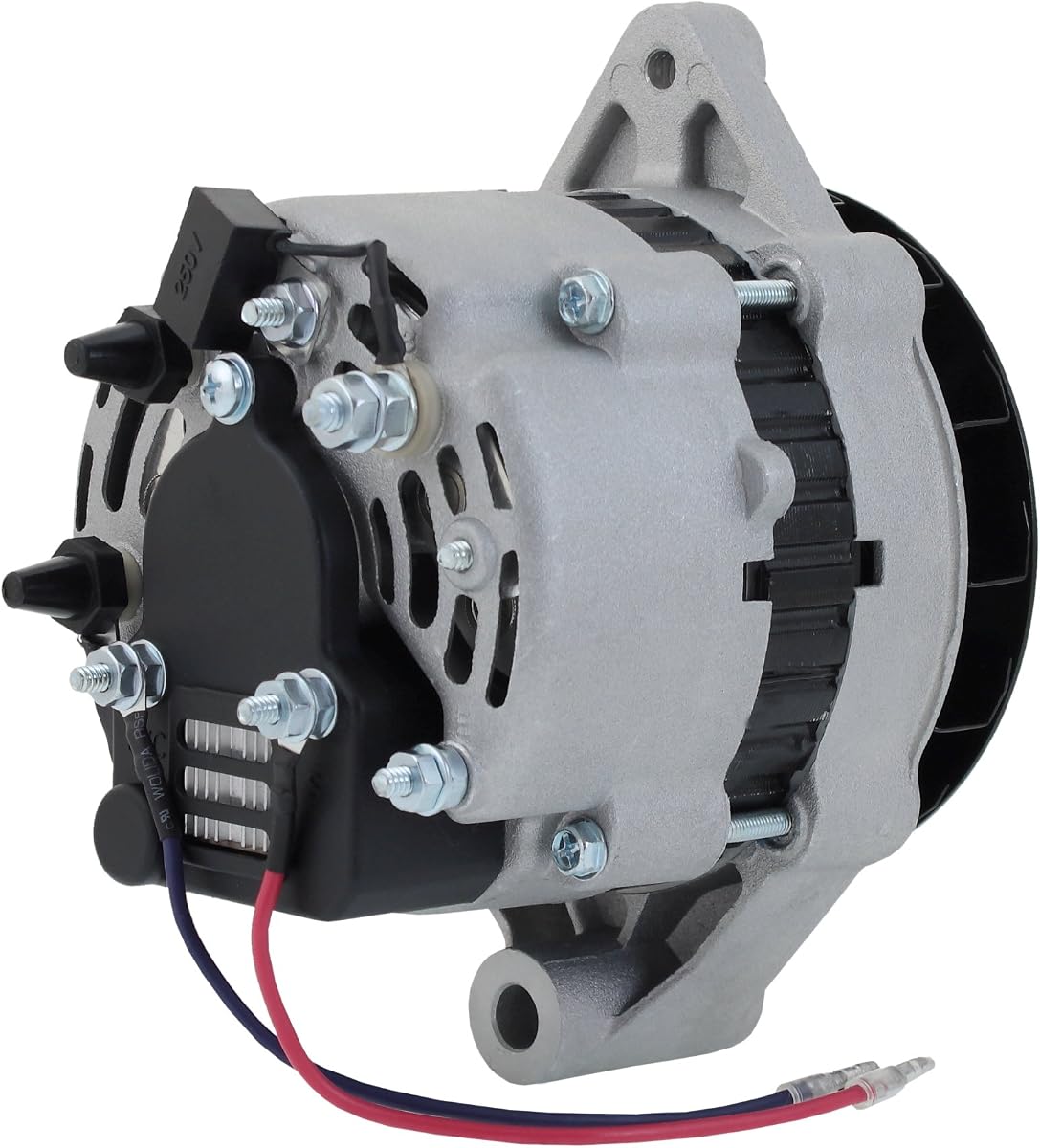
The Powermaster 8500 combines a 5.0 rating with an exact 100-amp output and a design intended for marine and off-road applications. Its GM 12SI natural case and one-groove V-belt pulley make it especially relevant to older or traditional belt-driven marine charging systems rather than newer multi-groove installations.
We may earn a commission when you buy through this link, at no additional cost to you.
The listing emphasizes high-quality materials and compliance with strict quality requirements, while also positioning the 8500 as a popular upgrade for boats that need reliable starting and sustained charging support. Its single-V configuration can be attractive for owners restoring a period-correct engine or replacing an alternator that already uses the same pulley format.
The primary trade-off is application specificity. The product title does not provide a long list of boat models or engine years, so buyers must confirm compatibility by physical dimensions and the original 12SI configuration. A single-pulley unit is not a drop-in match for a boat using a six-groove or multi-groove pulley arrangement.
This is our Best Budget pick because it offers a clear 100-amp marine-oriented design, a 5.0 rating, and a simple 12SI configuration without an expansive list of replacement numbers. It is a sensible choice for owners of a compatible older system who want a straightforward high-output replacement.
The 12SI natural case format can suit restorations and older systems that already use this alternator family. Matching the original case type and pulley arrangement is a more reliable approach than selecting solely by engine displacement.
A design aimed at both environments reflects the need for durable charging hardware beyond ordinary road use. The included screens further differentiate the package, although the listing should be checked for the exact contents and their installation positions.
We may earn a commission when you buy through this link, at no additional cost to you.
The OEG Parts 94A alternator has a 4.2 rating and extensive compatibility information for older Mercruiser and OMC pleasure-craft applications. It produces 94 amps rather than a full 100 amps, so it is most relevant to an owner restoring an older charging arrangement or replacing a similarly rated original unit.
We may earn a commission when you buy through this link, at no additional cost to you.
Its specification sheet is especially useful. It identifies a 12-volt 10SI unit with clockwise rotation, an internal regulator, external fan, V1 pulley class, one-wire system, and spark arrester. A lengthy list of replacement numbers supports identification, while the application list identifies specific 370, 400, 440, and 460 series engines and several OMC configurations.
The lower current rating is the central limitation for shoppers searching specifically for a 100-amp unit. A modest difference on paper can become more relevant when batteries, electronics, and accessories are added, so owners should calculate their expected electrical demand instead of assuming 94 and 100 amps are interchangeable. Mounting hardware is also not included.
This product is a good choice for a period-correct replacement in one of the listed legacy applications. It is less appropriate for a modern high-demand boat or for a buyer who requires a confirmed 100-amp rating, but its fitment detail and established replacement references make it useful for knowledgeable restorers.
The product information identifies specific models and years rather than relying on a vague claim of universal compatibility. That precision is valuable for restoration work, where case style, rotation, pulley class, and wire configuration must all agree with the original installation.
The one-wire, spark-arrester configuration reflects the electrical conventions used in many older systems. Installation should follow the original charging arrangement and local boating-electrical practices rather than assuming modern regulator connections are interchangeable.
We may earn a commission when you buy through this link, at no additional cost to you.
The Balmar listing carries a 5.0 rating and emphasizes compact construction, high-output charging, and advanced thermal management. Its standout features include patented Smart Ready internal regulator technology, dual fan cooling, and a high airflow frame, all of which are relevant in the confined engine spaces found on many boats.
We may earn a commission when you buy through this link, at no additional cost to you.
Rather than relying on a simple replacement-number list, this product is positioned around the benefits of its charging and cooling design. The dual-fan arrangement and high airflow frame are particularly useful for sustained charging demands, while the compact small-case package may make installation easier where space around the engine is limited.
The most important uncertainty is that the supplied product title and description do not state the exact amperage, voltage, pulley configuration, or detailed engine fitment. It therefore does not satisfy the 100-amp requirement as clearly as several other products in this guide. Buyers who need a confirmed 100-amp replacement should obtain the full model specifications before ordering.
This alternator is best considered for an informed buyer who recognizes the Balmar product family and values compact cooling performance. It is less suitable as a quick, cross-reference-driven purchase. The 5.0 rating and strong feature focus are encouraging, but exact electrical and mounting specifications remain the deciding factors.
Cooling is one of the most practical concerns for high-output marine alternators because engine compartments can become extremely hot. The stated dual-fan and high-airflow design is intended to help the unit maintain performance in those demanding environments.
A smaller case can create more clearance for hoses, wiring, and engine accessories. Space is helpful, but the compact format still needs to be matched carefully to the engine’s mounting points and belt system.
We may earn a commission when you buy through this link, at no additional cost to you.
This 12-volt, 100-amp alternator covers Cummins Mercruiser engines from 2.8 to 8.2 liters along with various Cushman models from 1995 through 2005. It shares the same clearly described internal regulator, external fan, six-groove pulley, and two-bullet-lead configuration as several other professional-grade replacements in this roundup.
We may earn a commission when you buy through this link, at no additional cost to you.
The product is stated to meet or exceed OEM specifications, includes a one-year warranty, and is computer load tested. That combination of specifications and testing language provides a useful foundation for a replacement intended to handle continuous charging in a marine environment.
The concern is overlap among its claimed OEM references and those listed for comparable products in this guide. A buyer should not order solely because a number appears in the listing. The alternator’s physical case, pulley, mounting ears, rotation, and electrical connections must be compared with the unit being replaced.
This is a versatile option for a compatible Cushman or Mercruiser installation, especially where the owner values a specified 100-amp unit and clear professional-grade features. The lack of a published rating means the listing provides less customer-history context, making direct fitment verification even more important.
The combination of model years and engine families makes this listing useful for older applications that may no longer have new-old-stock original alternators. Still, model-year coverage is only a starting point because production revisions can alter housings and connections.
The external fan works together with the internal regulator and is an important part of the unit’s overall electrical design. Matching the listed architecture to the old alternator makes installation planning more predictable.
We may earn a commission when you buy through this link, at no additional cost to you.
The RAREELECTRICAL unit is a 12-volt, 100-amp high-output alternator designed for selected 1997–2008 Crusader, Pleasurecraft, Marine Power, and Indmar applications. The listing identifies a 7SI series, clockwise rotation, internal regulator, internal fan, and six-groove pulley, while also describing it as an upgrade from a 70-amp original.
We may earn a commission when you buy through this link, at no additional cost to you.
Compatibility information is extensive, including replacement references associated with Delco, Hyster, Pleasurecraft, Crusader, Indmar, and Marine Power. Applications include several GM V8 inboard engines such as 305Ci, 350Ci, 364Ci, 454Ci, and 496Ci units. This level of cross-referencing is useful for boats with aged or missing identification labels.
The description contains some formatting irregularities and a partially truncated regulator field, which reduces confidence in the presentation. It also lacks a published customer rating. As a result, the buyer should rely on the physical specifications and manufacturer documentation rather than assuming every application line guarantees a direct fit.
This alternator is a strong candidate for a compatible late-1990s or 2000s GM V8 inboard that used a 70-amp charging system and can accept the listed 7SI arrangement. Its exact 100-amp rating and detailed reference coverage make it particularly relevant for owners addressing undercharged or aging electrical systems.
The stated increase from a 70-amp original can be valuable for boats with modern navigation, entertainment, pumps, and instrument loads. The upgrade should be considered alongside battery capacity, wiring condition, and the engine’s charging requirements.
References to several GM V8 displacements and multiple OEM families help narrow the original unit. A boat’s build sheet, service manual, and the numbers stamped on the removed alternator remain the most dependable sources for final confirmation.
We may earn a commission when you buy through this link, at no additional cost to you.
This High Output 100A Marine Alternator is designed as a 12-volt, 100-amp replacement with SAEJ1171 certification. Its application claims cover Mercruiser, Pleasurecraft, Chrysler Marine, Jacuzzi Jet, Indmar, Lehman, and other marine engines, making it one of the broadest choices in the guide.
We may earn a commission when you buy through this link, at no additional cost to you.
The listing describes compatibility with Mercruiser stern-drive, ski, and MIE models ranging from 3.0 to 8.2 liters. It also supplies several OEM references, including AC165610, AC165616, MES 3144M, 3145M, 3159M, RSM RA00123, RA00127, and Valeo TA000B32201. That combination of certification, output, and cross-references is compelling for a buyer who has already narrowed the fitment.
The broad claim also creates a need for careful verification. The supplied details do not clearly state the pulley configuration, terminal arrangement, mounting details, fan location, or regulator configuration. Those omissions make direct physical comparison essential, even when the original unit’s replacement number appears in the list.
This alternator is a promising choice for a compatible modern marine engine because it explicitly addresses output, certification, and brand coverage. It is best for a buyer who can access the original alternator and manufacturer documentation. The lack of a published rating means installation fitment and detailed specifications carry more weight than customer-review history.
Covering multiple stern-drive, ski, and inboard families can simplify a search when the original alternator has been changed or its label is unreadable. The buyer should still check the engine build year and every physical installation detail before finalizing the choice.
The stated certification is a central reason to consider this model for a saltwater environment. It also provides a useful point of comparison with other certified alternatives in this roundup.
We may earn a commission when you buy through this link, at no additional cost to you.
The DB Electrical 400-12300 has a 4.0 rating and is built around a 12-volt, 95-amp 11SI configuration for Indmar marine applications. It specifies a six-groove pulley with a 63mm outside diameter and is marketed as a direct-fit replacement requiring no vehicle modifications.
We may earn a commission when you buy through this link, at no additional cost to you.
Its replacement references cover Arco Marine, Arrowhead, Delco, EMP Parts, Indmar, J&N Electrical Products, and Lester numbers. This is helpful for owners who can identify the original alternator but may encounter multiple catalog references for the same physical unit.
Its 95-amp rating places it just below the target capacity. That may be appropriate for a direct restoration of a compatible 95-amp system, but it may not suit a boat owner who specifically needs a full 100 amps or has added substantial electrical demand. The direct-fit claim is convenient, although the absence of modifications does not remove the need to compare connectors, rotation, and mounting ears.
This alternator is best for an Indmar application that originally used the specified 11SI, 95-amp arrangement and whose pulley and wiring match the replacement. It offers a clear, well-referenced option for direct replacement, but it should not be treated as a confirmed 100-amp upgrade without verifying the complete model specifications.
The stated six grooves and 63mm outside diameter are more useful fitment details than a generic mention of a marine pulley. Measuring the original pulley and checking belt depth can help prevent installation problems.
The reference list covers several aftermarket and OEM catalogs, making it easier to identify an equivalent unit. Since catalog numbers can be reused or revised, physical dimensions and the original label should carry the final decision.
We may earn a commission when you buy through this link, at no additional cost to you.
The Premium 100 Amp alternator has a 5.0 rating and is specified for Mando Marine, Cushman, and Mercruiser applications from 1993 through 1999. It delivers 12-volt, 100-amp high output through an internal regulator and external fan arrangement, with a one-groove V-belt pulley.
We may earn a commission when you buy through this link, at no additional cost to you.
Its replacement list includes AC165617, AC165610, AC165616, 805447, 805884, 893876, and several common suffixes. The manufacturer states that the unit meets or exceeds OEM specifications, is computer load tested, and carries a one-year warranty. Those details support its positioning as a premium replacement rather than a generic low-spec unit.
The most consequential specification is the single V-belt pulley. It may be a perfect match for a period-correct drive system, but it cannot replace a six-groove serpentine configuration without appropriate and properly engineered adaptation. The listing also omits full mounting dimensions, so the case, ears, rotation, and clearance should be checked before purchase.
This is our Best Premium pick because it combines a perfect published rating with exact 100-amp output, professional load testing, a defined internal-regulator and external-fan architecture, broad OEM references, and a warranty. It is especially attractive for a compatible 1993–1999 marine installation using a single V-belt system.
Computer load testing is a relevant quality-control measure for a high-output charging component. Combined with the stated OEM-specification claim and one-year warranty, it gives the product a more complete quality narrative than many basic replacements.
The one-groove V-belt pulley makes this a logical option for older boats whose original charging arrangement used the same format. The broad OEM reference list helps identify likely applications, while physical comparison confirms the final fit.
We may earn a commission when you buy through this link, at no additional cost to you.
Choosing a marine alternator involves matching electrical output, construction, and mechanical connections to the boat. The most important step is to identify the original unit and understand how the charging system is configured before comparing replacement options.
A nominal 100-amp rating describes the alternator’s rated output, but the appropriate choice also depends on battery-bank size and the combined demand from engines, electronics, lighting, pumps, refrigeration, and entertainment systems. Replacing a lower-output original with a higher-output unit can be useful, provided the alternator, regulator, wiring, and battery cables are designed for the additional current.
Match the rating to the charging system. Choose 100 amps when the engine and electrical system require it, and avoid assuming that a 94- or 95-amp alternative is fully interchangeable for a modern accessory load.
Marine engines can use similar alternator housings while differing in pulley style, rotation, electrical connections, and mounting geometry. Use the engine family, model year, original OEM number, and alternator stamp together rather than relying on displacement or a single replacement number. The listings in this guide cover Mercruiser, Cushman, Indmar, Pleasurecraft, Crusader, and related applications, but each has a more limited exact-fit range.
Treat fitment as a final physical comparison. If the old alternator is available, compare its case, mounting ears, pulley, and terminals before ordering.
Pulley compatibility is more than a cosmetic detail because it affects belt type, alignment, diameter, and the amount of load transmitted from the engine. The roundup includes single V-belt, one-groove, and six-groove configurations. A marine alternator with the correct output can still be completely unsuitable if its pulley does not match the boat’s existing belt drive.
Check groove count, outside diameter, overall length, and belt depth. A six-groove unit should be compared against a serpentine system, while a single or one-groove unit may suit older V-belt installations.
The regulator controls voltage, while cooling affects how reliably the alternator can sustain output under heat. Several choices use an internal regulator with an external fan, while others use internal fans and different case families. Each arrangement is valid when matched to the intended installation, but connector layouts and sensing methods may differ.
Compare the regulator type, fan location, wire count, and connector type with the original. These details are essential for a direct replacement and for determining whether additional wiring or adaptation is required.
Marine certification standards address the harsh operating environment encountered by charging equipment, including heat, moisture, vibration, and corrosion exposure. Two products in this guide explicitly claim SAEJ1171 certification. That claim adds useful evidence, although certification markings and the exact standard revision should be confirmed on the physical product and its documentation.
Prefer clear marine construction information. A listing that says only “automotive” or provides no environmental certification is less reassuring than one specifically identifying marine certification and quality testing.
An alternator operates under sustained load and generates heat while the boat is running. High-quality materials, effective airflow, computer load testing, and a stated OEM-specification standard can provide better confidence in long-term performance. Several professional-grade choices in this guide state that they undergo 100 percent computer load testing and include a one-year warranty.
Balance claims with verifiable details. Warranty coverage, documented output, certification, and test procedures are more useful than broad promotional language without supporting specifications.
A direct replacement should reproduce the original alternator’s sensing and output connections. Some units use two bullet leads, while older 10SI systems may use one wire with an external regulator and spark-arrester arrangement. The connection style affects whether the existing wiring can remain unchanged and whether the boat’s charging layout must be modified.
Inspect the original harness, regulator, battery cables, and grounding points before ordering. Proper connections and sound wiring help the alternator deliver rated current efficiently and reduce troubleshooting difficulties.
The alternator and battery bank work together. A larger bank can accept more charging current, but only when the alternator, regulator, cables, switches, and battery condition are appropriate for the load. If a boat has gained electronics, refrigeration, electric outboards, or other high-draw equipment since leaving the factory, the original charging specification may no longer reflect real demand.
Consider both starting and sustained operation. Use the battery bank’s capacity and the boat’s measured electrical needs to determine whether a genuine 100-amp unit is the appropriate next step.
Begin with a complete system check. Confirm the battery voltage, inspect the battery for damage and corrosion, examine the alternator drive belt, and review the alternator wiring and regulator connections. Disconnect the battery according to the boat manufacturer’s instructions, record the existing wire locations, and compare the new alternator’s case, pulley, and terminals with the removed unit before installation.
Install the alternator according to the applicable service manual, taking care not to overtighten hardware or allow the belt to sit twisted. Reconnect all regulator, sensing, and output leads before applying battery power. Confirm rotation and belt tension, then start the engine and verify charging voltage at the battery rather than relying only on a dashboard warning lamp.
After installation, keep the alternator clean and inspect it periodically for salt, mud, belt dust, loose wiring, unusual heat, or damaged insulation. Use a marine-rated wire brush and suitable corrosion-protection measures where appropriate, but avoid introducing moisture into electrical connections. Recheck mounting bolts and belt condition, and have the charging system inspected if the battery repeatedly discharges, the alternator becomes unusually hot, or the output falls below expectations.
A 100-amp unit can be appropriate for a boat with a substantial battery bank or several high-draw accessories, but output alone does not determine compatibility. The replacement must match the engine, pulley, wiring, regulator, and charging system. If the original unit was rated at 100 amps, a comparable marine replacement is usually the most straightforward path.
It may be possible if the replacement matches mechanically and the boat’s regulator, wiring, cables, and battery bank can support the increased current. A higher-rated alternator does not automatically make every older electrical system suitable. Confirm the charging-system design and have a marine electrician check any substantial upgrade.
SAEJ J1171 is a marine-electrical standard associated with ignition-protection requirements and environmental protection for components used around marine engines. A listing that claims SAEJ1171 certification indicates attention to that standard. Buyers should still verify the product marking and consider local boating-electrical regulations.
Not necessarily. Some marine alternators use an external fan, while others use an internal fan or another cooling arrangement. The correct choice is usually the one designed for the specific alternator family and engine installation. Replacing an internal-fan unit with an external-fan model may also require changes to wiring, brackets, or connectors.
Check the groove count, outside diameter, overall width, and belt style against the original pulley. Single V-belt, one-groove, and six-groove systems are not automatically interchangeable. Also verify belt depth and alignment, because forcing the wrong pulley can create belt wear, vibration, and inadequate charging performance.
They may be suitable when replacing an equivalent original unit on an older or lower-demand boat, but they do not provide a confirmed 100-amp output. Their suitability depends on the existing battery bank, electrical loads, and charging architecture. A boat that has added significant electronics, refrigeration, or lighting should be evaluated for adequate charging capacity.
Marine alternators are designed for exposure to heat, moisture, vibration, and salt-laden environments. Relevant differences can include ignition-protected construction, corrosion resistance, specialized seals, cooling arrangements, and marine-certified testing. A cheaper unit may fit mechanically, but the listing and certification should support its suitability for the intended marine environment.
Measure voltage at the battery with the engine running and compare it with the resting battery voltage; consult the boat’s specifications for the expected charging range. A dashboard lamp can identify a serious fault, but it is not a substitute for a proper meter reading. If output is low, inspect connections, belt tension, ground paths, battery condition, and regulator operation.
The SAEJ1171 100 Amp Marine Alternator earns the Editor’s Choice designation for its exact output, certification claim, broad Mercruiser references, and warranty. The Powermaster 8500 stands out as the Best Budget option for compatible older 12SI systems, while the Premium 100 Amp unit combines a five-star rating, load testing, and a clearly defined high-output configuration.
The most important priorities are exact physical fitment, correct pulley type, suitable regulator and fan configuration, and enough output for the boat’s actual battery and accessory demands. A replacement number is useful evidence, but it should be combined with the engine model, original alternator markings, and a direct physical comparison before purchase.
Prices, availability, customer ratings, and listing details can change, so review the current product page and seller information before ordering. If any specification is unclear—especially amperage, pulley style, connector arrangement, or mounting dimensions—contact the seller or a qualified marine electrical specialist rather than assuming compatibility.