
Anker 8-in-1 USB-C Hub
4.5Editor score
Dual 4K HDMI support
Up to 85W pass-through charging
Ethernet and media card reader
Best docking station for Dell laptop guide comparing 10 top models for displays, charging, connectivity, compatibility, and everyday productivity for work.
A docking station can transform a Dell laptop into a much more capable desktop workstation, adding displays, wired networking, faster storage connections, charging, and room for everyday peripherals through one upstream cable. The right model depends heavily on your Dell series, USB-C capabilities, display configuration, and whether portability matters as much as desk use.
The ten docks in this guide were compared using their stated specifications, including charging capacity, display outputs, port selection, data speeds, supported operating systems, and stated Dell compatibility. The list includes purpose-built Dell docks, broadly compatible USB-C hubs, compact two-piece designs, and feature-heavy workstations for users who need more displays or faster transfers.
Each review explains the strongest reasons to consider a model, along with limitations that can affect display arrangements, charging, or laptop compatibility. Ratings reflect the supplied customer feedback and do not represent personal testing. Product availability, firmware, bundled accessories, and prices can change, so verify the current listing and your specific Dell model before ordering.
4.5Editor score

4.5Editor score
4.3Editor score
The comparison below highlights the major differences in charging power, display flexibility, port selection, and Dell compatibility. Dell-branded docks offer the most focused platform integration, while the Anker and HoDo models provide broader options for USB-C-equipped systems.




The Dell Pro Dock WD25 is a purpose-built desktop hub for modern Dell AI PCs and other compatible USB-C computers. With a 4.5 rating, it stands out for combining up to 100W of power delivery with native support for as many as four high-resolution displays. Its construction, cable arrangement, and stated compatibility make it a particularly logical choice for a fixed Dell workstation.
We may earn a commission when you buy through this link, at no additional cost to you.
The strongest feature is display flexibility. Rather than limiting users to a small set of two-monitor configurations, the WD25 is described as supporting up to four high-resolution displays, with both DisplayPort and HDMI connectivity. It also includes faster USB and network connections, allowing a laptop to serve as the central device for multiple screens, wired networking, storage, and input devices without requiring a separate collection of adapters.
Charging is another major advantage. Delivering as much as 100W can support demanding Dell notebooks and compatible non-Dell PCs while the workstation is in use. The ambidextrous upstream USB-C cable can be routed to either side, which is a small design detail that can materially improve desk arrangement. Dell also highlights standby power reduction, recycled materials, and commercial manageability as additional reasons to consider this model.
This is the most balanced recommendation for users who want a modern, integrated dock rather than a generic collection of ports. It is particularly appropriate for Latitude, Pro, XPS, and compatible business workflows, although the exact display and charging behavior should be checked against the selected Dell model. If you need maximum display expansion, straightforward Dell alignment, and 100W charging without assembling a travel hub and desktop dock separately, the WD25 is the strongest all-around choice.
Up to four-display support is the WD25's defining workstation advantage. Users running analysis dashboards, finance applications, creative timelines, or large document comparisons can distribute windows across several screens while keeping the laptop itself connected with one upstream cable.
The 100W power delivery supports a streamlined setup, while the reversible routing of the integrated USB-C cable makes it easier to position the dock beside either side of the laptop. This is helpful in shared offices and narrow desk arrangements.
We may earn a commission when you buy through this link, at no additional cost to you.
The Anker 8-in-1 USB-C PD Media Hub offers an approachable way to turn a compatible Dell laptop into a dual-monitor workstation. It carries a 4.5 rating and includes two HDMI outputs, three data ports, Gigabit Ethernet, a media card reader, and up to 85W of pass-through charging. The result is a focused set of features without the larger footprint of a full-size professional dock.
We may earn a commission when you buy through this link, at no additional cost to you.
Its display capability is the most appealing part for many Dell users. One HDMI output can stream or mirror content at 4K 60Hz, while two connected displays can each run at 4K 30Hz. The dock also works with USB-C, USB4, and Thunderbolt connections, making it useful with Dell systems that provide full-featured USB-C ports. A dedicated Ethernet connection is a major convenience for offices where wireless access is inconsistent or where users want consistent network performance.
There are some limitations to consider. The two-screen 4K mode is limited to 30Hz, which is fine for documents, browser windows, and many business applications but less ideal for high-motion video or demanding graphics. On macOS, the images on both external monitors are identical. Compatible Dell systems also need to support both DisplayPort Alternate Mode and Power Delivery for the full experience. In addition, an appropriate 100W USB-C wall charger and USB-C-to-C cable are required for the advertised 85W charging capability.
The Anker 8-in-1 is best for Dell Latitude, Inspiron, XPS, or other USB-C laptops that need two screens, reliable Ethernet, and a modest collection of peripherals. It is less appropriate for demanding three- or four-screen arrangements, and Linux is not supported. For users who want a compact and capable two-monitor upgrade without moving to a larger multi-device charging dock, it remains an especially practical choice.
The pair of HDMI outputs gives the hub a clear advantage over a basic USB-C adapter. It suits professionals who want email and documents on one screen while keeping a dashboard, spreadsheet, or browser on another.
Gigabit Ethernet creates a fast, stable alternative to Wi-Fi. The built-in media reader also makes the hub useful for photographers and content teams that routinely import image or video files.
We may earn a commission when you buy through this link, at no additional cost to you.
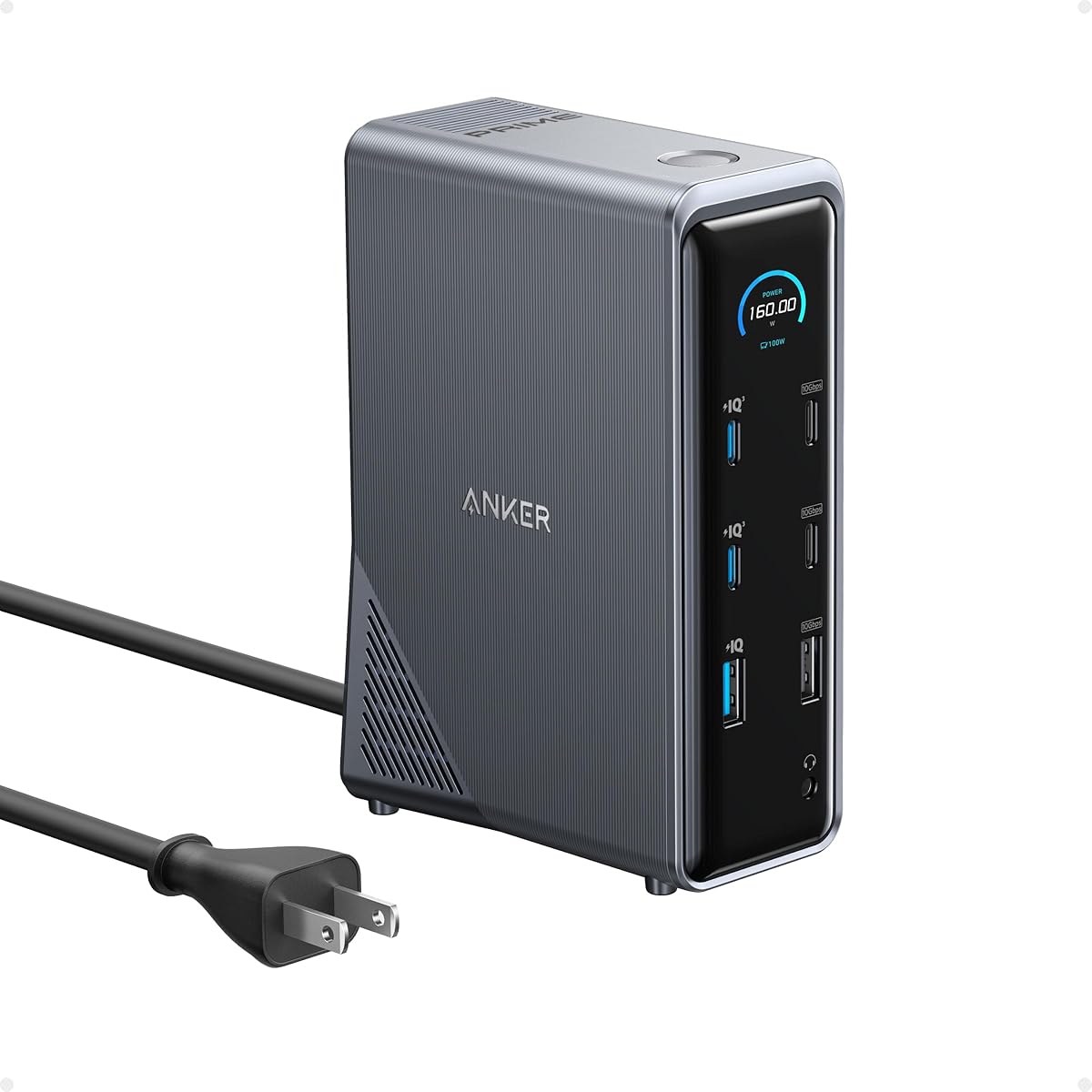
The Anker Prime 14-in-1 is a premium charging and connectivity hub aimed at demanding workstation setups. Its 4.3 rating reflects a broad feature set, including 160W of total output, support for charging as many as four devices, dual displays, 11Gbps data connections, and a full collection of USB, network, audio, and media ports.
We may earn a commission when you buy through this link, at no additional cost to you.
The most remarkable specification is the charging system. Three USB-C ports can each deliver up to 100W, while one USB-A port can provide up to 12W, allowing the dock to charge a Dell notebook and several smaller devices at once. A 100W, 10Gbps upstream cable is included. Data performance is also strong, with multiple ports offering transfer speeds up to 10Gbps for external storage, phones, and other high-bandwidth accessories.
Display limitations deserve careful attention. The dual HDMI configuration can support two 2K 60Hz displays when connected to a laptop with DisplayPort 1.4, while DisplayPort 1.2 systems are limited to 1080p 60Hz output. A 5120-by-1440 monitor is not supported. On macOS, the two external displays show identical content, and Linux compatibility is excluded. These restrictions do not affect every user, but they make the Prime less appealing for specialized ultra-wide or high-resolution color-critical workstations.
The Anker Prime is an excellent choice for power users who charge many devices and need fast data connections in addition to two screens. It works with compatible Windows, ChromeOS, USB4, and Thunderbolt Dell laptops that support DisplayPort Alternate Mode and Power Delivery. Choose it when charging capacity and port density matter more than supporting the highest possible dual-display resolution.
The ability to charge a notebook plus three additional devices makes the Prime useful in busy desks. It reduces the number of wall outlets and charging blocks needed for a phone, tablet, watch, and laptop.
Ten-gigabit connections can reduce waiting time when moving large files from compatible storage. The included 100W upstream cable also provides ample bandwidth for the dock's most demanding connections.
We may earn a commission when you buy through this link, at no additional cost to you.
The HoDo USB-C Docking Station is a video-output-heavy option for compatible Dell laptops. With a 4.3 rating, it provides two HDMI ports, DisplayPort, VGA, three USB 2.0 ports, and a USB-C power input. Its greatest distinction is the four-output video design, which gives users more ways to connect different monitors and presentation equipment.
We may earn a commission when you buy through this link, at no additional cost to you.
The dock can support dual high-resolution displays or triple-display arrangements when the laptop supplies the required DisplayPort 1.4 signal. Two HDMI, one DisplayPort, and one VGA connection create broad flexibility, particularly for offices that still rely on projectors or legacy displays. A single HDMI or DisplayPort output can reach 4K 60Hz under supported conditions, while multi-screen configurations may be limited to 1080p 60Hz.
Charging is handled through a USB-C power input that accepts up to 100W and safely delivers up to 87W to the laptop. The power adapter and cord are not included, and Dell recommends a minimum 65W charger for charging use. The three USB 2.0 ports are appropriate for keyboards, mice, and basic flash drives, but their 480Mbps transfer speed is modest compared with the faster ports offered by premium docks.
Compatibility is the most important consideration. The dock requires a full-featured USB-C port with DisplayPort Alternate Mode, and the supplied description specifically says it is not compatible with certain Dell Latitude, ThinkPad, XPS, and gaming models. It is best for a Dell with a suitable modern USB-C implementation and for users who value a wide selection of video connectors over fast USB expansion.
Having HDMI, DisplayPort, and VGA in one enclosure is useful for temporary presentations and mixed monitor environments. It saves the need to carry a separate multi-adapter when visiting another office.
Adding VGA can pull every attached display down to 1080p. Monitor resolution therefore depends on both the chosen output and the number of active screens, not simply the dock's headline capability.
We may earn a commission when you buy through this link, at no additional cost to you.
The Anker Nano 13-in-1 Docking Station is designed for people who divide their time between a permanent desk and mobile work. Its 4.2 rating reflects a distinctive two-in-one design: a desktop dock with a detachable 6-in-1 portable hub. The separation lets users retain a full workstation at home or in an office while carrying a smaller adapter for hotel rooms, client sites, and shared workspaces.
We may earn a commission when you buy through this link, at no additional cost to you.
The desktop section supports up to three monitors through two HDMI ports and one DisplayPort connection. Depending on the arrangement, users can select a single 4K 60Hz display, dual 2K 60Hz displays, or three 1080p 60Hz displays. It also includes two USB-C data ports at 5Gbps and 10Gbps, three USB-A ports, Gigabit Ethernet, audio, and SD and TF card slots. A 140W power adapter is included to support the dock's 100W laptop charging under full load.
The detachable hub makes the design more versatile than a conventional fixed dock, but it also introduces a few conditions. macOS supports mirrored mode only across multiple external displays. The desktop dock requires a connected laptop before its ports and blue light strip activate, so it is not a standalone USB hub. Users should also pay attention to the display capabilities of the specific Dell laptop because the operating system and source device must support the intended configuration.
The Nano is best for hybrid workers, frequent travelers, and anyone who dislikes carrying a full desktop dock. It is also well suited to compatible Dell XPS, ThinkPad, and mainstream USB-C Windows notebooks. The included 140W adapter, 10Gbps cable, plug-and-play setup, and no-driver operation make it particularly convenient for users who want a quick transition between desk and travel configurations.
The removable hub reduces the need for a separate travel adapter. Users can leave the heavier dock and power adapter at home while taking the compact section for travel.
The 10Gbps USB-C connection supports quick transfers from compatible storage, while the 100W charging capability keeps demanding Dell laptops powered during a full peripheral setup.
We may earn a commission when you buy through this link, at no additional cost to you.
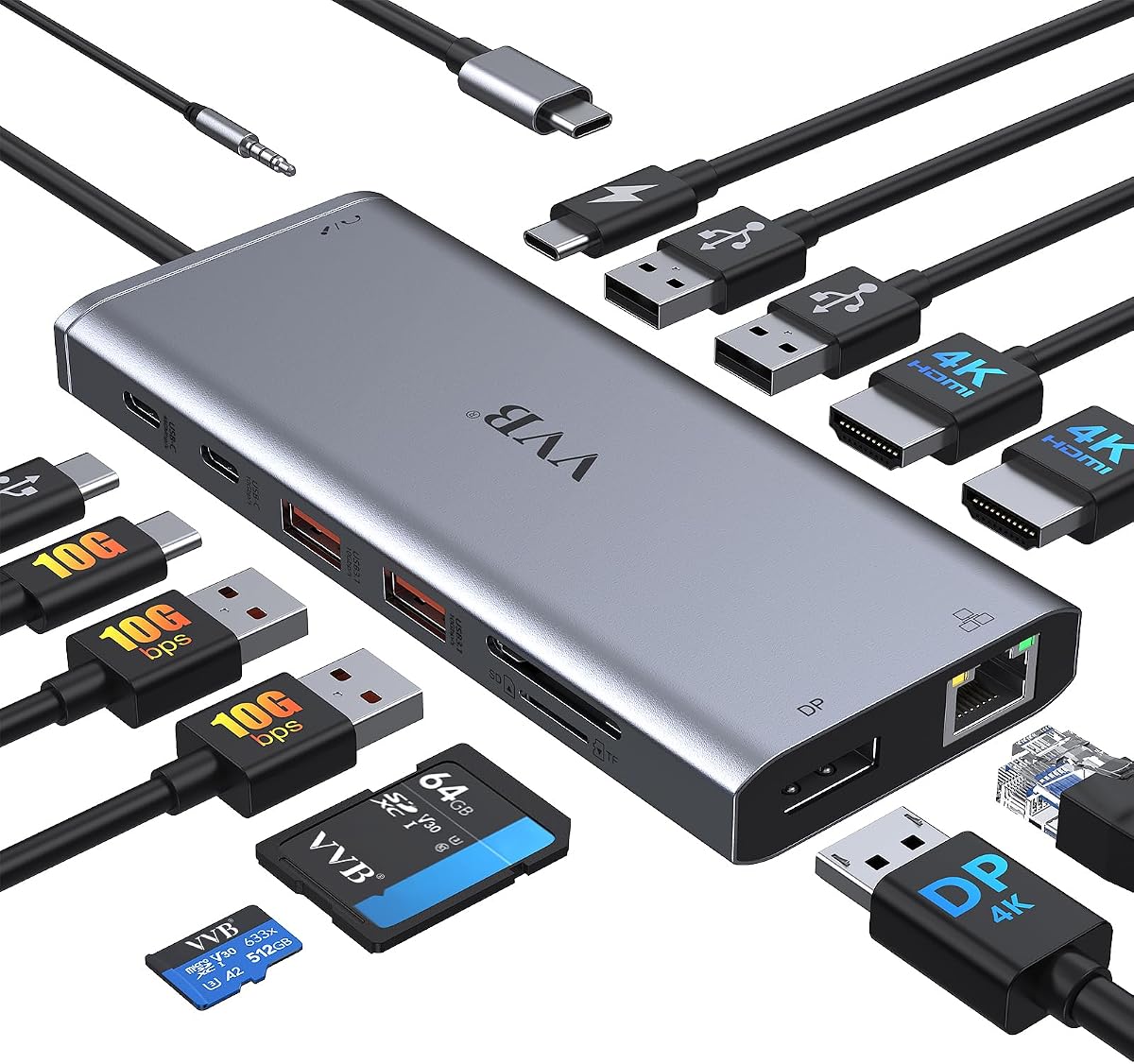
This 14-in-1 USB-C docking station provides a broad collection of connections in a single hub, giving it a practical appeal for Dell users who use several kinds of accessories. It has a 4.3 rating and includes two HDMI ports, DisplayPort, Gigabit Ethernet, audio, SD and microSD card slots, and a mixture of USB-A and USB-C data ports.
We may earn a commission when you buy through this link, at no additional cost to you.
The data connections distinguish it from simpler eight-port docks. One USB-C port and two USB-A 3.1 ports offer speeds up to 10Gbps, while additional USB 2.0 connections are available for keyboards, mice, and less demanding devices. On the display side, a single HDMI or DisplayPort output can reach 4K 60Hz, two displays can operate at 4K 30Hz and 1080p 60Hz with DisplayPort 1.4, and three Windows displays can run at 1080p.
The dock accepts up to 100W of input and safely supplies up to 87W to the laptop. However, neither the charging cable nor the power adapter is included, so buyers must account for those accessories and ensure that the laptop's USB-C port supports Power Delivery. macOS does not support extended multi-monitor mode, and the listing says that converters are not supported. The broad port count should therefore be evaluated alongside the missing accessories and platform-specific behavior.
The supplied compatibility information names many Dell Latitude, Inspiron, Vostro, and XPS 13, 15, and 17 models, along with systems from HP, Lenovo, Microsoft, and other brands. That makes it a practical choice for a compatible Dell laptop needing fast storage, Ethernet, audio, card reading, and two or three displays. It is less convenient for buyers who want a completely self-contained package.
The mix of 10Gbps and 480Mbps ports supports both performance-heavy storage and ordinary peripherals. It avoids forcing every mouse, keyboard, and drive onto a high-bandwidth connection.
The dock supports dual and triple-display arrangements in Windows, but macOS users are limited to mirrored images. Checking the operating system and laptop video-output standard is essential.
We may earn a commission when you buy through this link, at no additional cost to you.
The Dell WD19S 180W Docking Station is a traditional business-oriented dock built around abundant power and a direct connection to compatible Dell laptops. Its 3.8 rating is the lowest in this group, but the specification that matters most to a power user is clear: it includes a 180W adapter and provides 130W of host power delivery. HDMI and dual DisplayPort connections support a conventional multi-monitor office setup.
We may earn a commission when you buy through this link, at no additional cost to you.
This is a different proposition from a travel-oriented USB-C hub. The WD19S is designed to remain on a desk and power a demanding notebook, several displays, and attached devices as a coordinated workstation. The generous 130W host charging is especially relevant for Dell systems with high power requirements, although buyers should still confirm that their exact model accepts the dock's USB-C power profile and display outputs.
The supplied product information is much less detailed than it is for several competing docks. It does not enumerate data-port speeds, Ethernet support, audio connections, or exact monitor resolutions. As a result, it would be unwise to assume that every feature found on a newer multiport hub is present. The available information supports a focused recommendation: this is a Dell-oriented power and display dock rather than a connectivity hub chosen primarily for card readers or high-speed USB expansion.
The WD19S is best for businesses already standardized on Dell notebooks and power-hungry desktop replacements. Its 180W power supply and 130W host delivery can provide useful headroom, while the display outputs cover standard business monitoring needs. The lower rating and limited published detail deserve attention, so confirm current specifications and compatibility directly in the listing before purchasing.
A 180W adapter paired with 130W host delivery gives the dock substantial capacity. That margin can be valuable when a laptop is running performance-intensive software while also powering displays and peripherals.
For organizations that already manage Dell peripherals, a Dell-branded dock can simplify support and deployment. The trade-off is less published information about secondary features than many competing listings provide.
We may earn a commission when you buy through this link, at no additional cost to you.
The Anker 13-in-1 USB-C Docking Station is a compact vertical hub that prioritizes a surprisingly broad port selection. Its 4.0 rating reflects a solid all-around design offering two HDMI connections, DisplayPort, three USB-C connections, three USB-A ports, Gigabit Ethernet, SD and microSD readers, audio, and DC power input.
We may earn a commission when you buy through this link, at no additional cost to you.
The central use case is a three-screen desktop. On compatible Windows 10, Windows 11, and ChromeOS systems with MST, the dock can run up to three external monitors at 1080p 60Hz. It can also drive one 4K 60Hz display through HDMI or DisplayPort. Users who need many screens but do not require high-resolution extended output will appreciate the three-display capability in a relatively small 4.9-by-3.5-by-1.6-inch enclosure.
Power and data provisions are also useful. The host connection can charge a compatible Dell notebook at 85W, while a separate 18W USB-C port charges a phone or other device. One USB-C data port operates at 10Gbps, the USB-A ports reach 5Gbps, and the SD card reader is rated at 104MB/s. A 135W power adapter is included, which removes the need to source the main desktop power supply separately.
As with the other Anker models, display operating-system limits matter. Extended triple-display output is a Windows and ChromeOS feature, while macOS limits multiple external displays to mirrored content. The dock needs a full-featured USB-C port with DisplayPort Alternate Mode and Power Delivery, and it supports USB4 and Thunderbolt 3, 4, and 5 connections. It is a strong option for a compact three-monitor Dell desk.
The vertical enclosure saves desk area while providing three active displays. That balance makes the dock useful in home offices where a large horizontal dock would be inconvenient.
A 135W power adapter supports the dock's charging and high-bandwidth functions out of the box. Users still need a compatible upstream USB-C cable if one is not already included or available.
We may earn a commission when you buy through this link, at no additional cost to you.
The Dell WD19 130W Docking Station is an established business dock with clearly documented ports and broad device connectivity. Its 4.0 rating reflects a dependable option for compatible Dell laptops that need dual displays, USB devices, wired networking, and a single-cable connection to a desktop setup.
We may earn a commission when you buy through this link, at no additional cost to you.
The dock offers two DisplayPort 1.4 connections, HDMI 2.0B, one USB-C 3.1 Gen 2 multifunction port, three USB-A 3.1 Gen 1 ports, Gigabit Ethernet, a combo headset connection, and a separate audio output. This is a practical collection for office peripherals, including keyboards, mice, storage, networking, and audio. The dedicated DisplayPort outputs make it particularly suitable for users who prefer high-resolution digital monitor connections.
Its 130W AC power adapter supplies 90W of host power delivery over the USB-C docking interface. That is ample for many mainstream business notebooks, although newer high-performance Dell systems may require a dock with greater host charging capacity. The horizontal enclosure measures 8.1 by 3.5 by 1.1 inches and weighs 20.63 ounces, keeping it relatively easy to position behind a monitor or beneath a desk shelf.
This WD19 is best for organizations that value a familiar Dell platform, documented ports, and a straightforward permanent desk arrangement. It is a sensible choice when two DisplayPort outputs, HDMI, and 90W charging satisfy the user's needs. Users with more demanding power requirements or newer multi-display workflows should compare it with the WD25 and WD19S before making a final selection.
The complete port list allows administrators and users to determine whether the dock will support their existing keyboard, mouse, network, display, and audio setup without guessing.
Dual DisplayPort 1.4 outputs provide a direct path to modern high-resolution monitors. The 90W host charging is suitable for many mainstream Dell business notebooks.
We may earn a commission when you buy through this link, at no additional cost to you.
The renewed Dell WD19 offers a familiar business docking platform with a high-capacity 180W adapter and broad compatibility across selected Inspiron, Venue, Precision, XPS, and Latitude systems. Its 4.1 rating places it slightly above the other Dell WD19 listing in customer feedback. It is primarily aimed at buyers who recognize the platform and value its established port arrangement.
We may earn a commission when you buy through this link, at no additional cost to you.
The physical design uses the familiar WD19 footprint and includes a USB-C 3.1 Gen 2 connection, three USB-A 3.1 Gen 1 ports, a headset connection, and a separate audio output. Dual DisplayPort and HDMI video connections suit standard multi-monitor offices. The included USB-C cables and large power adapter make it a turnkey option for a compatible Dell notebook.
Renewed products require more attention to condition and warranty terms than newly manufactured docks. Cosmetic wear, prior use, and the availability of replacement accessories may differ. The listing also advises users to confirm USB-C or Thunderbolt compatibility and update dock firmware if a connection problem occurs. Firmware support can be especially relevant when pairing an established docking platform with a newer Dell operating system or notebook generation.
This renewed dock is best for a compatible Dell business system that needs dual monitors, standard USB expansion, and a high-capacity adapter. It is less suitable for buyers who prioritize the newest multi-display features, maximum compactness, or certainty about appearance. Reviewing the current condition description, warranty, included cables, and exact model compatibility is essential before purchase.
The WD19 interface is recognized across many Dell deployments. That familiarity can make deployment easier for offices that already own compatible peripherals and support procedures.
Inspect the condition details and warranty before ordering. Confirm that the necessary cables, firmware compatibility, and host charging behavior are clearly supported for the selected Dell model.
We may earn a commission when you buy through this link, at no additional cost to you.
Choosing a docking station for a Dell laptop begins with the computer's USB-C capabilities, followed by the number and resolution of monitors, power requirements, and peripheral needs. Checking these details before purchasing helps prevent an expensive mismatch between an ambitious dock and an unsupported laptop connection.
In short, verify both video output and charging before buying. Compatibility is the foundation of every other dock feature.
In short, judge display support by the complete arrangement, not by the number of ports. Resolution, refresh rate, operating system, and laptop capabilities work together.
In short, compare the laptop's power requirement with the dock's actual host output. Also verify that the necessary upstream cable and power supply are included.
In short, buy for the ports and transfer speeds you use. Extra connectors help only when their standards match your devices and workflow.
In short, prioritize the dock that matches your normal location. Frequent travelers benefit from portability, while desk-bound users usually gain more from a fixed design.
In short, verify operating-system support and firmware status. A connector that fits physically may still deliver only a subset of the dock's functions.
In short, compare the complete box contents, not just the dock. Account for any additional cable or power adapter needed to reach the advertised performance.
In short, fleet operators should evaluate management and sustainability alongside performance. Individual users can focus primarily on compatibility and everyday needs.
Begin by checking the laptop's manual, the dock's installation instructions, and the compatibility notes for the exact model. Connect the dock's power adapter first when the manufacturer recommends it. Then attach the upstream USB-C cable to a full-featured port on the Dell laptop and connect displays, Ethernet, storage, audio, and input devices to the appropriate dock ports. Allow the operating system a few moments to detect the new desktop arrangement before configuring the displays.
After connection, open the operating system's display settings and choose the resolution and refresh rate for each monitor. Arrange the screens to match their physical positions, select the primary display, and decide whether to mirror or extend the desktop. For multiple extended screens, connect displays one at a time and test each connection. This makes it easier to identify whether a resolution limitation comes from the selected output, the active monitor count, or the laptop's DisplayPort version.
For safe care, keep the dock and power brick on a stable, ventilated surface, and avoid placing heavy objects on top of the housing. Route the upstream cable without creating a tight bend near the connector. Clean the ports gently with a dry, soft tool, and update the dock firmware when the manufacturer provides a relevant update. If display or charging behavior changes, test the dock with a direct cable connection and review compatibility notes before assuming the hardware has failed.
No, not every USB-C dock will provide full functionality with every Dell model. The port should support DisplayPort Alternate Mode for external video and Power Delivery for charging, while the operating system and laptop generation must also support the intended display arrangement. Some Dell systems that have USB-C connectors are explicitly excluded by certain generic dock manufacturers, so check the exact model and the dock's compatibility list.
The limit depends on the dock, the laptop's video-output capabilities, the monitor resolutions, and the operating system. Docks in this guide range from two-display models to options supporting up to four displays, but active-screen count can reduce resolution or refresh rate. Windows generally offers the broadest extended-display support, while macOS may mirror multiple external screens instead of treating them as separate desktops.
It depends on the notebook, workload, and the number of connected devices. Many mainstream business Dell laptops work well with 85W or 90W host charging, while newer high-performance or workstation models may benefit from 100W or more. Also check whether the dock's listed wattage refers to adapter capacity or actual power delivered to the laptop, since those figures can differ.
It varies by product. The Anker Prime, Anker Nano, Anker 13-in-1, and Dell WD19 listings indicate that power adapters are included, while some other docks require a separate USB-C power supply and charging cable. Always read the package contents and compatibility notes. A dock cannot deliver its advertised host charging if the required upstream cable or adequately powered adapter is missing.
Many compatible Dell Latitude and XPS models can use a generic USB-C dock if their port supports video and charging. However, display resolution, extended-screen support, and charging behavior still depend on the laptop's processor, graphics configuration, firmware, and operating system. Dell gaming notebooks and some older or restricted models may not work with docks that only require DisplayPort Alternate Mode.
A dock does not increase the processor speed or graphics performance of a Dell laptop. It can improve workflow by enabling more displays, faster peripheral connections, wired networking, easier peripheral access, and continuous charging. Whether the overall experience feels faster depends on the applications, cooling, storage, and memory configuration of the selected laptop.
Yes, it is sensible to check for current firmware whenever using an established WD19 dock with a newer Dell system, operating system, or display arrangement. Firmware updates can address compatibility, charging, or display behavior. Follow Dell's official support instructions and use the correct dock model, because firmware intended for one WD19 configuration may not apply to another.
A renewed dock can provide the same core functions as a new unit when it has been inspected, tested, and covered by a valid warranty. The main differences are cosmetic condition, accessory availability, and the possibility of a shorter return or warranty period. Review the condition description and coverage carefully, and confirm that the included power adapter, cables, ports, and firmware meet your setup.
The Dell Pro Dock WD25 is the strongest overall choice for a modern, high-output Dell workstation because it combines up to 100W charging, extensive display support, and a design specifically oriented toward current Dell business systems. The Anker 8-in-1 USB-C Hub is a compelling budget-oriented option for compatible users who mainly need two displays and Ethernet, while the Anker Prime 14-in-1 stands out for exceptional multi-device charging and fast data connectivity.
Other models serve distinct needs. The HoDo and generic 14-in-1 docks offer broad video-output choices, the Anker Nano combines a desktop dock with a detachable travel hub, and the Anker 13-in-1 provides a compact three-screen arrangement. Older Dell WD19 and WD19S platforms can remain sensible for business fleets, while the renewed WD19 appeals to buyers who understand the condition and warranty considerations. Prioritize the laptop's USB-C functions, required monitor arrangement, and actual host charging output before comparing port totals.
Product listings, firmware, bundled accessories, ratings, and prices can change, so review the current information before ordering. Confirm your exact Dell model, verify the display mode you intend to use, and make sure the necessary power adapter and upstream cable are included. With those checks complete, the right dock can create a cleaner, faster, and more productive desk setup.