
Upgraded Watt Power Meter Plug
4.6Editor score
Seven detailed monitoring modes
Large backlit LCD display
Adjustable overload warning
This Electricity Meter for RV guide compares 10 digital, plug-in, surge, and hardwired meters for energy tracking, compatibility, and ease of use.
An electricity meter for RV can reveal how much energy your coach uses, help identify high-draw appliances, and make campsite electricity easier to verify. The right model should match your RV wiring, pedestal configuration, and monitoring goals while remaining safe, readable, and appropriately protected for mobile use.
The ten products in this guide cover several practical approaches: ANSI Form 2S sub-meters for RV pedestals, simple plug-in watt meters, a surge-protector meter, and a hardwired split-core monitor. We compared voltage, current, kWh tracking, installation method, display functions, communication options, environmental suitability, and RV-specific relevance.
Each review highlights the strongest feature of its model and also identifies practical limitations. Ratings and product details reflect the supplied listings, while availability and pricing can change at any time. Always verify socket type, electrical ratings, and installation requirements before purchasing equipment for an RV.
4.6Editor score

4.8Editor score

4.8Editor score
This side-by-side comparison evaluates each meter's electrical configuration, installation approach, measurement capabilities, data features, and most practical RV use. The list includes pedestal-compatible sub-meters, portable plug-in monitors, a surge-protection meter, and a hardwired panel monitor.


This digital sub-meter combines RV pedestal compatibility with a broad set of monitoring and integration features. Its supplied rating is 4.5, but the practical appeal comes from the balance between comprehensive measurement, clear LCD feedback, and support for both conventional loads and solar-oriented setups. It is designed for 120/240V single-phase, three-wire systems.
We may earn a commission when you buy through this link, at no additional cost to you.
The meter fits ANSI Form 2S four-jaw bases and uses labeled terminals for line, load, and neutral connections. Its LCD cycles through voltage, current, power, and energy information, while pulse and reverse LEDs help confirm operation and direction. EEPROM memory preserves consumption data through power interruptions, a useful feature for long stays where the RV may be disconnected temporarily.
Its strongest distinction is the combination of Modbus communication, pulse output, infrared programming, and import/export energy measurement. Those capabilities make it more versatile than a basic kWh display, particularly for users building a larger monitoring setup. The trade-off is that it is not a simple plug-and-play appliance, and anyone replacing a pedestal meter must work with compatible sockets and observe proper electrical procedures.
Choose this model when you want an RV electricity meter that can serve as a permanent sub-meter, communicate with compatible equipment, and track both consumption and reverse energy flow. It is a strong all-around choice for RV parks, rental units, cabins, mobile homes, and technically minded owners who need more than a basic watt reading.
Unlike a portable plug-in monitor, this unit is designed to remain part of a properly installed electrical system. Clear kWh readings help RV owners understand long-term consumption, compare campsite usage, and identify whether high-draw equipment is affecting overall demand.
Import and export measurement makes the meter relevant to RV solar, battery, inverter, and backup-power configurations. Modbus and pulse output also provide useful paths for connecting readings to compatible data loggers or energy-management systems.
We may earn a commission when you buy through this link, at no additional cost to you.
This model is a focused digital kWh meter for 240V single-phase, three-wire systems. It carries a 4.7 rating and is especially relevant to RV electrical setups that use a compatible ANSI Form 2S socket. Rather than emphasizing app connectivity or solar analytics, it focuses on dependable measurement, readable status information, and straightforward sub-metering.
We may earn a commission when you buy through this link, at no additional cost to you.
The display provides voltage, current, real-time power flow, accumulated kWh, and total energy information. A backlit LCD makes the readings easier to inspect in dim utility rooms, garages, and outdoor installations. The meter is also described as capable of monitoring systems up to 200A, which gives it useful headroom for many RV load scenarios when the rest of the installation is properly rated.
Stored data is retained during power outages, reducing the chance of losing accumulated readings. Rugged construction is another strength, as the product is intended for both indoor and outdoor applications. It does not list the same Modbus, pulse, or import/export functions found in the first sub-meter, so buyers prioritizing a more specialized or integrated design may prefer another option.
This is a compelling selection for an RV owner or property manager who wants a clear, durable energy monitor in a standard socket without a large learning curve. It is especially well suited to workshop, garage, rental-space, and conventional RV pedestal monitoring where voltage, current, power, and kWh are the important measures.
The backlit screen presents the information most RV owners need: current demand, real-time power, and cumulative consumption. Its larger display is practical for quick checks during a campsite setup or routine troubleshooting in a garage or utility area.
Retaining stored energy information through a power interruption makes the meter better suited to permanent monitoring. Users can return to the RV later and continue reviewing cumulative usage without starting from a blank total.
We may earn a commission when you buy through this link, at no additional cost to you.
This plug-in watt meter is the most approachable budget option for RV owners who want to examine an individual appliance rather than replace an entire energy sub-meter. It has a 4.6 rating and provides seven display modes covering power, energy, voltage, current, frequency, power factor, cost, minimum and maximum power, and operating duration.
We may earn a commission when you buy through this link, at no additional cost to you.
The 2.36-by-1.85-inch backlit LCD has a wide viewing angle, making it practical to read from different positions. Users can also select among five backlight timing options, from ten minutes to always on. The interface supports appliance-level troubleshooting, helping users see how individual heaters, refrigerators, chargers, or entertainment equipment affect demand.
Its overload warning threshold is adjustable from zero to 3680W, although the listing advises setting it to 1800W in general use. That limitation is important for RV planning because the product is not intended to serve as a full 240V pedestal meter. It also stores readings and settings when unplugged or interrupted by a sudden power failure, preserving the usefulness of its accumulated data.
Choose this meter when your goal is affordable appliance-level monitoring, quick load checks, and portable use around an RV. It is a good companion to a larger energy monitor rather than a substitute for one, particularly when you need to monitor higher-demand 240V equipment or campsite usage as a whole.
The plug-in format isolates a single device, allowing owners to compare draw without modifying their RV wiring. Seven modes provide a useful combination of instantaneous readings, maximum demand, accumulated energy, and other operating data.
Because the unit can move from outlet to outlet, it is useful for testing several appliances over time. Data memory makes the results more useful when the monitor is unplugged and used again during a later check.
We may earn a commission when you buy through this link, at no additional cost to you.
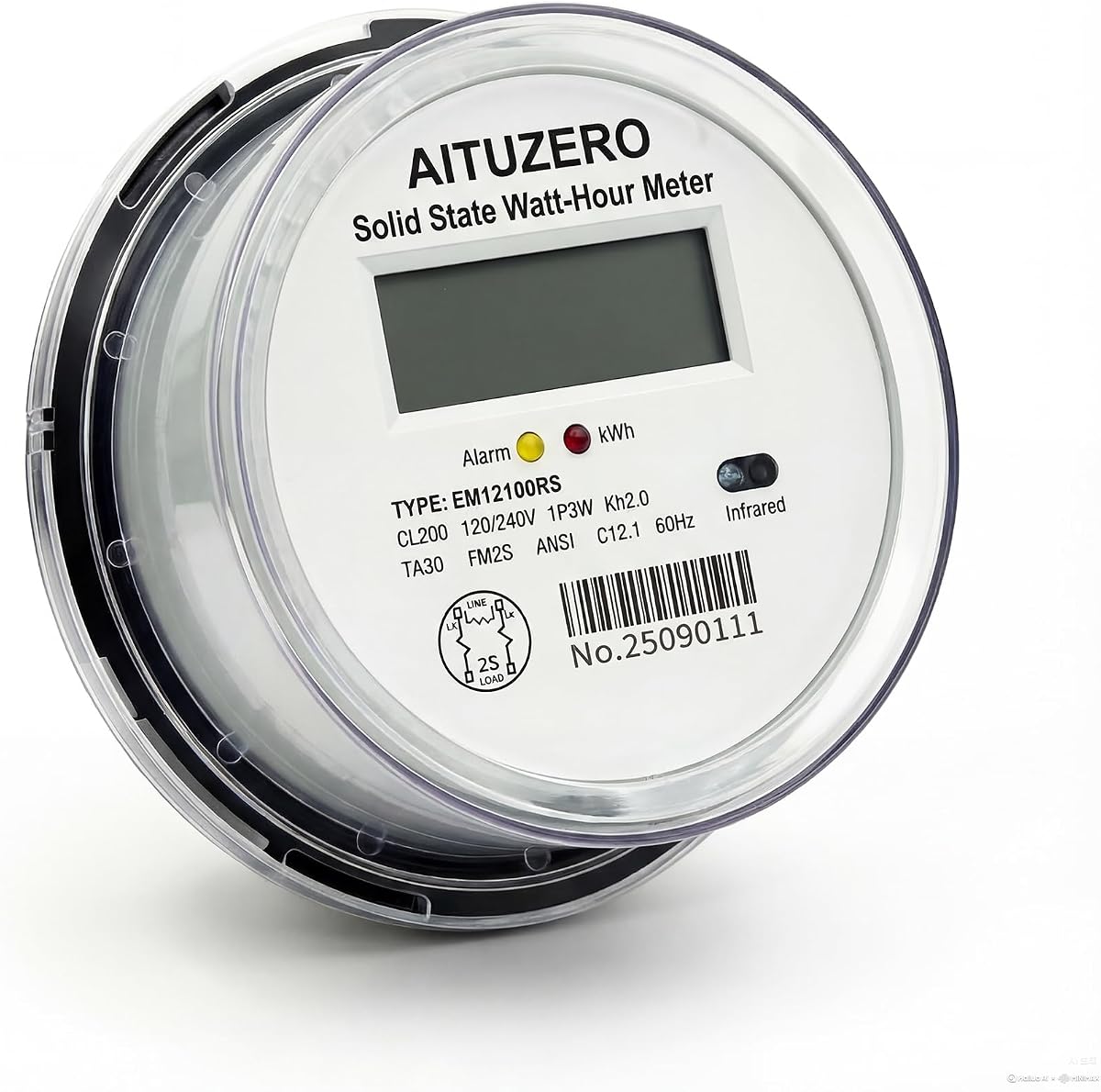
This digital electric meter combines an explicit RV focus with solid metering fundamentals. Its 4.8 rating reflects a strong customer reception, while its 240V, CL200, C1S configuration targets users seeking a meter for an RV pedestal or a home sub-panel. The high-definition LCD presents consumption information clearly without requiring additional equipment.
We may earn a commission when you buy through this link, at no additional cost to you.
The product uses TA30 current measurement and 0.5-level measurement accuracy. It is designed around ANSI C12.1 requirements and a Type C1S configuration compatible with four-jaw meter sockets. Those details make it particularly relevant to owners who want a conventional sub-meter rather than a consumer-grade outlet attachment.
Triple protection against dust, water, and pressure is another meaningful advantage for RV use. These claims are especially pertinent in outdoor pedestal environments where equipment may encounter humidity, dust, and changing conditions. The trade-off is that the listing does not identify Modbus, pulse output, or solar import/export capabilities, so advanced integrations are less explicit than with the first and seventh products.
For most buyers comparing dedicated RV pedestal meters, this offers the most balanced combination of rating, display clarity, stated compliance, and environmental protection. It is a strong recommendation for Class A, Class C, or towable RV owners who understand their electrical socket and want dependable kWh visibility without a complicated communication platform.
A sharp LCD makes the meter easier to consult during arrival, departure, or routine energy checks. The display focuses on practical consumption information rather than requiring an app or separate display for routine readings.
The listed dust, water, and pressure resistance features add confidence for outdoor RV pedestal use. Those protections supplement, rather than replace, correct installation in an appropriate electrical box or socket.
We may earn a commission when you buy through this link, at no additional cost to you.
This product is more than a conventional electricity meter: it combines 50-amp RV surge protection with digital energy monitoring. Its 3.5 rating is the lowest among the ten selections, so buyers should evaluate it primarily for the added protection rather than expecting the same product-family experience as the higher-rated dedicated sub-meters.
We may earn a commission when you buy through this link, at no additional cost to you.
The LCD displays accumulated kWh along with voltage, current, active power, power factor, and frequency. Real-time amperage helps RV owners balance loads and avoid exceeding a pedestal breaker. A built-in temperature sensor alerts the user to abnormal internal heat, while LEDs indicate whether the surge-protection module is active.
Its 16,000-joule protection rating is a substantial feature for Class A motorhomes and fifth wheels using a NEMA 14-50 outlet. That same plug-in arrangement also makes it less versatile than a hardwired monitor, and its lower rating suggests that some buyers may encounter concerns beyond the features described in the listing.
The best reason to choose this model is the combination of energy data and surge defense in one RV-oriented device. It is most appropriate for owners who connect to a 50-amp NEMA 14-50 pedestal and want load visibility at the point of connection. Those who need only an appliance meter can find simpler options elsewhere in the list.
The meter monitors electrical conditions while its surge module helps protect connected RV electronics from sudden power spikes. Combining the functions in one plug-in device can simplify a campsite setup.
Voltage, current, active power, power factor, and frequency readings help identify whether the RV is approaching its capacity. The internal temperature watch adds another useful warning indicator for high-load conditions.
We may earn a commission when you buy through this link, at no additional cost to you.
This second plug-in meter offers an accessible way to inspect individual RV appliances. It has a 4.6 rating and eight display modes for watts, kWh, voltage, frequency, current, power factor, unit cost, and total cost. It is particularly useful for owners who want to determine which refrigerator, heater, charger, or other device is responsible for a high reading.
We may earn a commission when you buy through this link, at no additional cost to you.
The white-backlit LCD automatically turns off after ten minutes without button input and can be reactivated or shut off manually. A flashing overload warning appears when demand exceeds the default 1800W threshold. That fixed limit is simpler than the adjustable threshold offered by the third-ranked plug-in meter, but it remains appropriate for many ordinary household-style loads.
Construction uses ABS material described as durable, fireproof, and resistant to drops. A five-second button press resets the device, clearing cumulative energy and cost information while restoring factory settings. Data and settings are retained after unplugging or a sudden power failure, although live readings such as voltage and current are not retained.
This meter is a practical secondary tool for RV energy troubleshooting rather than a whole-system solution. Pick it when appliance-level data and straightforward operation matter more than pedestal compatibility, bidirectional measurement, or communication outputs. Its low-installation approach also makes it convenient for temporary tests during a trip.
Eight modes let owners move beyond a single watt figure. Minimum and maximum demand are not listed for this model, but accumulated kWh, power factor, frequency, and cost information provide a broader view of appliance behavior.
A direct reset button clears old totals without a special tool. Automatic retention means a test can be interrupted or the meter unplugged without losing all previously collected usage information.
We may earn a commission when you buy through this link, at no additional cost to you.
This digital sub-meter is the most advanced integration-oriented option in the guide. Its 4.8 rating, bidirectional energy measurement, RS485 Modbus support, and pulse output distinguish it from basic RV energy displays. It is designed for 120/240V single-phase, three-wire systems installed in an ANSI Form 2S four-jaw socket.
We may earn a commission when you buy through this link, at no additional cost to you.
The large backlit LCD reports voltage, L1 and L2 current, active, reactive, and apparent power, power factor, frequency, and accumulated kWh. An automatic display cycle makes the information easy to review without a separate interface. The reverse-current LED provides a quick indication of changed energy direction, which is useful when assessing solar or backfeed behavior.
The defining premium feature is RS485 Modbus communication. Compatible gateways, data loggers, PLC systems, and energy-management platforms can collect information, and multiple meters can be placed on an RS485 network. Pulse terminals provide another route to external data collection, while the front IR interface and programming terminals support authorized configuration.
This meter is best for RV parks, shared properties, sophisticated RV solar installations, or owners who already operate compatible monitoring hardware. It is less convenient for a simple appliance test, and its technical capabilities demand careful setup. Buyers without external integration equipment can still benefit from the comprehensive LCD, but the extra communication features may go unused.
RS485 Modbus allows this meter to become part of a centralized energy-monitoring system. For users managing multiple spaces or collecting data over time, that capability can be more valuable than a basic standalone display.
Import and export measurements help distinguish energy drawn from the system from energy sent back toward it. Reverse-current indication makes the direction easier to verify in solar, battery, and backup-power arrangements.
We may earn a commission when you buy through this link, at no additional cost to you.
This digital kWh meter is purpose-built for 240V two-wire electrical systems and carries a 5.0 rating. Its two-wire configuration distinguishes it from most 240V RV sub-meters in the guide, making it especially relevant for owners with a compatible two-wire pedestal, camper, trailer, or residential system.
We may earn a commission when you buy through this link, at no additional cost to you.
The clear LCD simplifies routine energy checks, while CL200 kWh monitoring and TA30 current measurement provide the core metering functions. Its Type C1S and Form 2S structure is compatible with standard four-jaw meter sockets, and the plug-in design supports use in an appropriate RV pedestal or electrical panel.
The product description emphasizes straightforward setup, durable housing, and practical long-term tracking rather than complex communications. It does not list Modbus, pulse output, solar import and export, or a backlight, so buyers seeking those advanced features should choose one of the more specialized digital sub-meters instead. Its appeal is specialization and simplicity for the correct two-wire installation.
This is an excellent choice when an RV uses a 240V two-wire arrangement and the socket is compatible. The perfect 5.0 rating is encouraging, although the exact system configuration remains the decisive issue. Verify wiring, socket type, and required electrical qualifications before replacing an existing meter.
The meter's defining advantage is a design explicitly aimed at 240V two-wire applications. It is a better fit for those systems than a three-wire model merely because it shares a similar RV or kWh-meter label.
A direct LCD provides the essential information without requiring network equipment. That simplicity can make the model appealing for private RV use, small properties, and straightforward campsite monitoring.
We may earn a commission when you buy through this link, at no additional cost to you.
This model targets 240V three-wire systems and combines an RV-oriented design with a 4.8 rating. It uses CL200 kWh monitoring and TA30 current measurement, while its precision LCD provides clear real-time information. The product is intended for RV trailers, campers, and home electrical systems that use a compatible configuration.
We may earn a commission when you buy through this link, at no additional cost to you.
ANSI C12.1 compliance is a useful stated standard for buyers comparing the fourth, ninth, and similar digital sub-meters. The meter also lists triple protection against dust, water, and pressure, helping it address humid, dusty, and electrically variable RV environments. Its C1S structure is designed to work with four-jaw meter sockets.
The principal advantage is a clean, professional reading experience focused on core consumption data. It does not list bidirectional energy tracking, Modbus, pulse output, or retained data in the supplied description. As a result, it may be less suitable for sophisticated solar analysis or centralized monitoring than the seventh-ranked product.
Choose this meter for a straightforward 240V three-wire RV or residence that uses a compatible four-jaw base. It offers a strong balance of precision, display clarity, standards compliance, and environmental protection without requiring integrated communications. Confirm the socket and conductor arrangement before installation.
The high-definition LCD and 0.5-level measurement accuracy are centered on dependable, easy-to-interpret readings. This helps owners monitor routine consumption and make informed decisions about operating high-draw equipment.
ANSI C12.1 compliance and four-jaw socket compatibility give buyers clear technical criteria to compare. The protective design is also well aligned with outdoor RV pedestal requirements.
We may earn a commission when you buy through this link, at no additional cost to you.
This hardwired power meter offers a different approach from socket-mounted RV sub-meters. Its 4.4 rating is modest but reasonable for a specialized device intended for generator load, RV power, workshop circuits, and appliance monitoring. It operates across an 80-260VAC range and measures current from zero to 100A.
We may earn a commission when you buy through this link, at no additional cost to you.
The included 100A split-core current transformer clamps around a single live conductor, avoiding the need to cut the monitored wire. That makes it potentially useful in an RV electrical panel when the installation is handled by someone with appropriate electrical expertise. It can display voltage, current, wattage, kWh, frequency, and power factor in real time.
A rated capacity of up to 22,000W provides useful headroom for larger loads, while the wide voltage range covers many common AC systems. Memory preserves energy data and settings after power loss, and the display flashes when the preset power threshold is exceeded, offering a visible overload warning.
For 120/240V split-phase systems, the instructions specify monitoring one leg per meter or using separate meters. That arrangement is an important limitation for owners expecting one unit to display total coach consumption automatically. Nevertheless, this is a flexible option for generator, workshop, or individual-leg monitoring where a split-core installation is preferred.
The split-core sensor makes it possible to measure a live conductor without cutting it. This is useful for monitoring a selected leg or circuit when the meter is installed by a qualified technician.
The 80-260VAC operating range and 100A measurement capacity suit many RV, household, garage, and light-commercial circuits. A 22,000W rated maximum adds room for monitoring larger connected loads.
We may earn a commission when you buy through this link, at no additional cost to you.
Choosing an RV electricity meter starts with your wiring and installation environment, then depends on whether you need whole-system kWh data, appliance-level readings, surge protection, or advanced integration. The right meter should be compatible with the RV's electrical system and safe for the environment where it will operate.
RV electrical systems commonly involve 120V, 240V, or both, and dedicated energy meters may be designed for two-wire or three-wire arrangements. The eighth product is specifically a 240V two-wire model, while the first, second, seventh, and ninth products target three-wire or single-phase arrangements. Selecting by the word RV alone is not enough; compare the meter's voltage, conductor configuration, and intended connection with the actual equipment.
ANSI Form 2S and C1S sub-meters fit compatible four-jaw sockets, making them the most relevant options for many RV pedestals and permanent sub-panel installations. Plug-in watt meters are easier for temporary appliance tests, while the split-core model offers flexible hardwired monitoring. Consider whether you need a permanent whole-coach meter, a portable diagnostic tool, or monitoring of a specific leg or circuit.
A meter that displays watts can show immediate demand, but cumulative kWh is the more useful measurement for long-term campsite consumption and electricity-cost tracking. Dedicated sub-meters generally emphasize kWh, while plug-in models often provide it as one of several modes. Look for clear cumulative readings, useful backlighting, and data retention if the RV will be disconnected or monitored over multiple stays.
The maximum current rating must be appropriate for the RV service and the devices connected to it. Dedicated RV sub-meters may use CL200 and TA30 measurement designations, while the second product is listed for systems up to 200A and the hardwired model measures up to 100A. Plug-in meters have much lower capacity and can display an overload warning rather than support a complete RV pedestal.
A large, backlit LCD is valuable in dim garages, basements, and outdoor utility areas. The dedicated sub-meters commonly provide multi-parameter screens and automatic cycling, while the plug-in models use buttons to move among operating modes. Consider whether a quick glance at demand and kWh is enough or whether you need voltage, current, power factor, frequency, reactive power, and reverse-flow status.
RS485 Modbus, pulse output, infrared programming, and import/export measurement distinguish advanced sub-meters from basic models. These features are useful for RV parks, centralized logging, solar systems, and professional monitoring, but they may be unnecessary for an owner checking one appliance. Paying attention to the full measurement configuration can prevent buying sophisticated communications that will never be connected.
An RV energy monitor may also need to withstand humidity, dust, outdoor temperature changes, and voltage fluctuations. Several digital sub-meters advertise dust, water, and pressure resistance, while the fifth product adds 16,000 joules of surge protection. Protection does not make unsafe installation acceptable, and no monitor substitutes for correct wiring, grounding, breakers, and appropriately rated enclosures.
Data retention can be valuable when an RV loses power, gets disconnected, or uses several appliances over a period of time. EEPROM storage and automatic memory are listed among the dedicated digital meters and plug-in monitors. Decide whether you need only live readings or also want accumulated values, settings, and operating history to survive interruptions.
Begin by identifying the RV's supply voltage, number of conductors, socket style, and intended monitoring point. For a plug-in meter, connect it to a correctly rated outlet and the appliance being tested. For a socket-based sub-meter, switch off the relevant circuit, confirm there is no power, and follow the manufacturer's terminal and wiring instructions.
After installation, power the system and compare the meter's current, voltage, power, and kWh readings with other available information. Configure any overload thresholds, backlight timing, communication settings, or energy-rate values only after understanding what each option means. For a split-phase RV, remember that a meter on one conductor may not represent the total load of both legs.
Use the meter primarily for observation and troubleshooting. Avoid repeatedly resetting a unit that continues to show overload, and investigate high current readings before adding more appliances. Keep sockets dry, connections secure, and the display clean, and do not exceed the product's voltage, current, or power limits. All pedestal modifications or hardwired work should follow applicable electrical codes and be performed by a qualified professional.
A dedicated kWh meter is useful if you want to understand cumulative campsite electricity use, compare different sites, track an RV over time, or verify readings from a powered pedestal. A plug-in watt meter is better for isolated appliance tests. The right choice depends on whether you need whole-system information or temporary device-level data.
Many RV systems combine 120V and 240V power, while some connected equipment operates on only one of those voltages. Dedicated sub-meters in this guide are generally designed around 240V systems, with either two-wire or three-wire configurations. Verify the meter's specifications against the RV service and pedestal before installation.
A Form 2S meter is designed for compatible ANSI Form 2S four-jaw sockets, but not every RV pedestal has that configuration. Check the socket shape, number of jaws, voltage, and current requirements before purchasing. If the pedestal differs, do not force the meter or alter the connector without professional guidance.
Usually not. Plug-in watt meters are designed to measure a connected appliance within their listed power capacity, and some models warn or stop operating when the overload threshold is exceeded. For whole-system RV demand and cumulative kWh, use a properly rated sub-meter or a hardwired monitor with an appropriate current transformer.
Watts describe power at a particular moment, while kilowatt-hours measure energy used over time. A 1,000W appliance running for one hour consumes 1 kWh. Showing both values helps explain both immediate demand and longer-term electricity consumption.
Plug-in meters require no wiring and are generally straightforward to use. Replacing a pedestal or panel meter, working with 240V conductors, or installing a hardwired unit involves high-voltage work and should be performed according to local electrical codes by a qualified professional.
Only some models explicitly support bidirectional or import/export energy measurement. The first and seventh products include features relevant to solar energy flow, including reverse-flow or reverse-current indication. Other meters may show total consumption without clearly distinguishing imported from exported energy.
A split-core current transformer generally measures the current in one conductor. A 120/240V split-phase system has two live legs, and their loads may differ. To determine total system energy accurately, the guidance for the tenth product is to monitor one leg per meter or use separate meters as needed.
The Digital Electric Sub Meters are the strongest overall choice for RV power, combining 120/240V three-wire measurement, Form 2S compatibility, solar-relevant functions, data retention, and Modbus or pulse integration. The Digital Electric Meter for RV & Home is a well-balanced alternative with a 4.8 rating, ANSI C12.1 compliance, and strong environmental features, while the Digital Electric Sub Meter CL200 leads the premium category for advanced networked monitoring.
For temporary and budget-conscious appliance checks, the Upgraded Watt Power Meter Plug is the most useful starting point. The 240V two-wire and three-wire digital meters serve owners with matching RV systems, and the surge-protection model is worth considering for a 50-amp NEMA 14-50 installation. Prioritize correct voltage, wiring, socket style, and current capacity before any secondary feature.
Product ratings and availability can change, and current prices should be checked at the time of purchase. Compare the RV's actual electrical configuration with the manufacturer's installation instructions, and use a qualified electrician whenever the installation involves wiring, pedestal replacement, or hardwired equipment.