
DAXINGXING 10-Piece Universal Stylus
4.7Editor score
Dual rubber tip sizes
Universal touch compatibility
Ten pens with replacements
Stylus for Photo Editing buyer’s guide comparing ten options for pressure sensitivity, tilt response, accuracy, palm rejection, battery life, and device
A stylus for photo editing can make selection, masking, retouching, and brush control more precise than a fingertip, particularly on a touchscreen tablet. The right model should translate hand movement smoothly, offer accurate contact points, and feel comfortable during prolonged creative sessions. Pressure and tilt support are especially valuable for line-based and tonal editing work.
This guide compares ten styluses across pressure sensitivity, tilt response, tip accuracy, palm rejection, charging needs, shortcuts, and device compatibility. It covers active pens for supported graphics tablets as well as passive capacitive models for general touchscreens, clarifying where each belongs so readers can choose according to their editing setup rather than relying on a single feature.
Each recommendation identifies the product’s strongest use, important limitations, and compatibility requirements. The top picks represent three distinct priorities: detailed active-pen performance, dedicated tablet control, and an inexpensive multi-tip option. Product availability and prices can change, so confirm the current specifications and device support before purchasing.
4.7Editor score

4.6Editor score

4.6Editor score
This side-by-side comparison evaluates the included pens by pen technology, control features, tip design, battery requirements, and device support. The active Wacom models deliver the most advanced pressure and tilt behavior, while the capacitive models offer simpler touchscreen interaction across a wider range of devices.




The Lenovo Digital Pen 2 is a lightweight active pen designed for compatible Windows 10 and later devices using AES 1.0 pen technology. Its 4.3 rating reflects a practical combination of pressure sensitivity, shortcut buttons, and a comfortable 17.3 g design. It is particularly relevant to photo editing when masks, selections, and annotations are created directly on a supported Windows touchscreen.
We may earn a commission when you buy through this link, at no additional cost to you.
Pressure sensitivity reaches 4,096 levels, giving the pen enough range for brush-opacity changes, line-weight variation, and detailed selection work. The elastometer tip is designed to feel responsive, while two side buttons can be assigned to shortcuts that reduce repeated keyboard or interface navigation. Its frosted metal body is light enough for extended use without the bulk of a full-size tablet stylus.
The key limitation is compatibility. This is not a general-purpose iPad, Android, or Windows pen; it requires a device that supports the appropriate AES pen protocol. The AAAA battery also means it is not entirely maintenance-free, although the stated battery life is designed to reduce interruptions during a working session. Those constraints limit its value for users who edit across several device ecosystems.
This is a strong choice for someone who works primarily on a supported Windows touchscreen and values natural response, pressure control, and physical shortcut buttons. It is less appropriate as a universal photo-editing accessory or a replacement for an Apple Pencil. Confirm the exact laptop or tablet model before purchasing, then verify that the editing application recognizes the pen and its pressure input.
The 4,096 pressure levels provide a meaningful control range for opacity, brush size, and tonal adjustments. Combined with the elastometer tip, this makes the pen more suitable for precision work than a basic finger-driven interface.
Two customizable side buttons can call up frequently used editing commands, while the lightweight metal body supports comfortable mobile annotation. These qualities suit a compact workflow built around one compatible Windows device.
We may earn a commission when you buy through this link, at no additional cost to you.
The MEKO 3-in-1 Stylus combines two silicone rubber tips with a transparent disc tip, offering several ways to interact with capacitive touchscreens. Its 4.6 rating makes it one of the stronger general-purpose options in this guide, particularly for users who work across tablets, phones, e-readers, and other touch-enabled devices.
We may earn a commission when you buy through this link, at no additional cost to you.
The transparent disc tip makes its contact point visible, which can help with accurate icon selection, small masking adjustments, and direct touchscreen navigation. Two rubber tip sizes provide alternatives for scrolling, writing, and sketching, while the flexible 180-degree writing angle supports a more natural hand position. The package includes two styluses and multiple replacement tips without requiring batteries or Bluetooth.
These same characteristics reveal the central limitation. As a passive capacitive tool, it does not offer pressure sensitivity, and palm rejection is not listed. That means it cannot reproduce brush-pressure changes like a pressure-aware active pen. It is also less exact than a dedicated graphics-tablet stylus, particularly when a photo editor needs consistent line weight or delicate retouching at high resolution.
Choose this model if the goal is convenient, affordable touchscreen control across many devices rather than professional pen dynamics. It works well for opening menus, making coarse adjustments, annotating images, and performing basic touch editing. For advanced brush work or accurate pressure-based retouching, pair it with a pressure-sensitive tablet and reserve the MEKO for general navigation.
The disc tip improves contact-point visibility, while the 0.18-inch and 0.27-inch rubber tips cover fine interaction and broader scrolling or navigation. Having all three available makes it easy to adapt to different editing views and screen sizes.
Because the pen uses capacitive touch input and requires no charging or pairing, it can move easily among compatible tablets, phones, e-readers, and touch laptops. That flexibility is valuable for users who do not work within one dedicated device platform.
We may earn a commission when you buy through this link, at no additional cost to you.
The JAMJAKE Stylus is designed primarily for selected iPad and iPad Pro models, with compatibility listed from 2018 through 2026. Its 4.4 rating reflects useful features such as palm rejection, a 1.5 mm replaceable tip, and fast charging, although it explicitly lacks pressure sensitivity.
We may earn a commission when you buy through this link, at no additional cost to you.
Palm rejection is the feature that matters most for photo editing on an iPad. It allows the user’s resting hand to remain on the display while the pen is active, reducing accidental gestures and making detailed selection or brush work more comfortable. The 1.5 mm tip provides a useful level of precision, and replacement tips can be changed without tools.
The product uses Bluetooth activation even though pairing is not required, and a short charging period is said to provide up to 15 hours of use. Compatibility is model-specific: it is not intended for older iPads, iPhones, Android devices, or Microsoft tablets. The lack of pressure sensitivity also means it cannot dynamically vary brush opacity or line weight.
This is a practical choice for an iPad owner who values palm rejection and fine touchscreen control more than advanced pen pressure. Check the exact iPad model against the manufacturer’s compatibility list before ordering. It suits annotation, touch selections, and ordinary editing controls, while artists needing pressure response should choose a pressure-capable alternative.
Palm rejection lets the supporting hand rest naturally on the screen without being interpreted as touch input. This reduces unwanted gestures during prolonged editing sessions and makes precise selections easier to maintain.
A touch-activated control starts the pen, while its rechargeable design supports extended use. Bluetooth must be enabled, and the included charging guidance recommends a suitable 5V 2A adapter for dependable operation.
We may earn a commission when you buy through this link, at no additional cost to you.
This active stylus supports a broad collection of iPads, iPhones, and Android phones and tablets. Its 4.1 rating makes it a practical rather than exceptional choice, but tilt sensitivity, a 1.5 mm tip, and magnetic attachment on selected iPad Pro models set it apart from simple passive pens.
We may earn a commission when you buy through this link, at no additional cost to you.
Tilt sensitivity can help communicate orientation to compatible applications, while the fine nib supports close brush control, selection boundaries, and detailed touch input. The built-in battery provides up to 20 hours of use after roughly one hour of charging. Automatic sleep and power-off behavior help conserve energy during short pauses.
Compatibility is not entirely frictionless. Windows is not supported, and some applications may require users to disconnect the tablet’s Apple Pencil setting or change an app-specific input option. Magnetic storage is limited to specified iPad Pro 12.9-inch and 11-inch models, so buyers should not assume every supported device offers the same attachment benefit.
This pen fits mobile editors who need more expressive input than a finger without committing to a platform-specific active stylus. It works particularly well for tilt-aware apps on compatible iOS or Android hardware. Confirm the application’s input behavior and your device model first; Windows users and artists who depend on full pressure sensitivity should consider another category.
Tilt awareness can provide a more natural brush or shading response in applications that interpret pen orientation. The effect depends on software support, so the editing app should be checked before relying on this feature.
The rechargeable active design avoids the need to discover apps or complete a pairing process. Magnetic storage on selected iPad Pro models adds convenience without affecting use on other compatible mobile devices.
We may earn a commission when you buy through this link, at no additional cost to you.
The Bopomofo set includes five colored capacitive styluses, each with a rubber tip and transparent disc tip. Its 4.6 rating reflects dependable basic interaction, broad touchscreen compatibility, and a generous multi-pen format. It is aimed at shared offices, classrooms, homes, and other environments where several people need a pen.
We may earn a commission when you buy through this link, at no additional cost to you.
The rubber tip provides reliable contact with capacitive screens, including many devices protected by screen films, while the transparent disc gives users a clearer view of the exact contact point. The five-color assortment makes assignment easy, and replacement rubber and disc nibs help extend the useful life of the set. No battery, charging, Bluetooth, or app installation is required.
The manufacturer explicitly notes that this is a passive capacitive stylus without pressure sensitivity or palm rejection. As a result, it functions much like an improved fingertip rather than an advanced digital brush. The plastic section of the disc tip is also an integral component and cannot be removed, which is worth remembering when replacing tips.
This set is best for broad touchscreen navigation, basic annotations, scrolling, and shared creative work across compatible devices. It is not the right tool for pressure-dependent retouching or an artist seeking realistic brush dynamics. For those tasks, the savings should not outweigh the need for a pressure-sensitive active pen.
Five individually assigned pens reduce sharing friction in a classroom or studio. The included replacement nibs also make the set easier to maintain than five disposable-looking accessories.
The transparent disc improves visibility of the contact point, while the rubber tip offers a conventional pointed feel. Using the appropriate tip helps balance accuracy with comfortable screen interaction.
We may earn a commission when you buy through this link, at no additional cost to you.
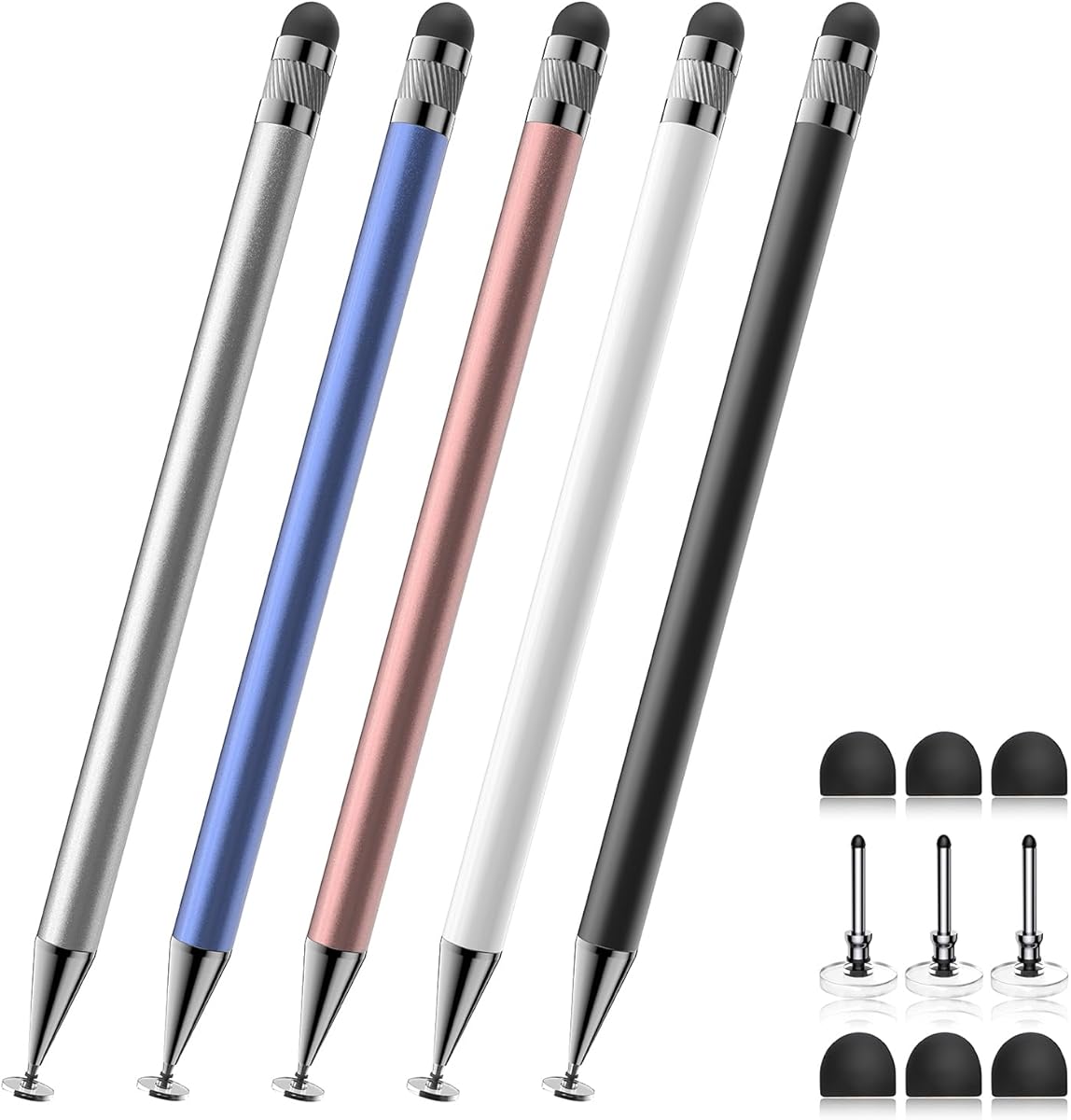
The DAXINGXING 10-piece set has a 4.7 rating, the highest listed among the products compared here. Every pen has a wider 0.27-inch rubber tip and a finer 0.21-inch tip, creating a versatile set for basic editing, annotation, handwriting, and navigation across capacitive touchscreens.
We may earn a commission when you buy through this link, at no additional cost to you.
The two diameters cover different jobs: the finer end suits small icon targets, handwriting, and detailed sketching, while the broader end is useful for scrolling, filling, and general screen control. A solid alloy body gives each pen a durable, balanced feel, and the mixed colors make it easy to assign separate pens. Replacement nibs can be changed without tools.
The pen remains a passive capacitive accessory. It does not add pressure sensitivity, tilt response, or palm rejection, so advanced photo-editing applications may still feel limited compared with a native active pen. Its strongest advantage is the unusually complete set: ten pens and twenty replacement tips support multiple users without repeated accessory purchases.
This is an excellent budget choice for a household, classroom, or small creative team that needs dependable touch input on many devices. It is also a sensible companion for basic on-device edits such as cropping, selecting, and annotating. Choose a dedicated pressure-sensitive pen when brush realism, dynamic opacity, or professional stylus shortcuts are priorities.
The smaller tip supports more detailed interactions, while the wider tip handles scrolling and broad gestures. Switching tips also lets users adapt quickly to different screen sizes and interface densities.
Ten colors and twenty spare nibs make this one of the most complete packages in the guide. It is particularly useful where several editors, students, or reviewers need separate touch pens.
We may earn a commission when you buy through this link, at no additional cost to you.
The MOSWAG 3-in-1 Stylus combines a transparent disc tip, a fine fiber-style tip, and a conventional ballpoint end. Its 3.7 rating is the lowest in this selection, so buyers should assess the multi-tool format against their need for reliable, precise photo-editing input rather than expecting dedicated pen performance.
We may earn a commission when you buy through this link, at no additional cost to you.
The disc tip supports browsing and scrolling, while the smaller fiber tip is intended for tapping, outlining, and precise editing gestures. The opposite end writes on paper, making the pen useful during a review session where notes and image edits are both required. Its aluminum body, anti-slip design, and included pouch support portable use.
The model uses passive conductive input and needs no charging, pairing, or extra application. Its listed compatibility includes particular iPhone, iPad Pro, Pixel, Huawei, and Honor models rather than an unrestricted promise for every current device. The product data also does not indicate pressure sensitivity, palm rejection, or advanced tilt behavior.
This is most useful as a compact general-purpose tool for someone who wants a touchscreen pen and paper pen in one object. It can support basic selections and annotations, but the lower rating and less comprehensive compatibility list make it a secondary choice for intensive editing. Users who need pressure-based brushwork should look to an active graphics tablet pen.
The disc and fiber ends cover different touchscreen interactions, while the ballpoint end adds traditional writing. This makes the stylus convenient for hybrid review and note-taking workflows.
No charging or pairing is required, and the included pouch helps protect the stylus while carrying it. Its compact dimensions also make it easy to keep alongside a tablet or phone.
We may earn a commission when you buy through this link, at no additional cost to you.
The 3-in-1 Precision Stylus upgrades a basic rubber-tip design with a sensitive transparent disc tip. Its 4.5 rating reflects a straightforward, versatile accessory for touchscreens. It supports writing, note-taking, general navigation, and light photo-editing tasks without charging or pairing.
We may earn a commission when you buy through this link, at no additional cost to you.
The 0.18-inch and 0.27-inch rubber tips serve finer selections and broader scrolling, while the transparent disc lets the user see where the stylus touches the display. Its flexible writing angle is intended to reduce lag and interruption when the pen is held at an oblique angle. Tool-free tip replacement extends the usable life of the main body.
Compatibility spans capacitive devices such as iPads, iPhones, Android tablets, Galaxy products, Kindles, Fire tablets, Chromebooks, and Nintendo Switch models. Nevertheless, it operates as a passive capacitive pen and does not supply pressure sensitivity or palm rejection. It therefore cannot reproduce advanced brush dynamics or offer the hand placement benefits of an active stylus with palm control.
This is a useful general-purpose pen for iPad and touchscreen navigation when the goal is inexpensive, replaceable tips and immediate use. It can manage basic masks, menus, and annotations across a wide device range. It is less suitable for intensive retouching or detailed brush illustration where pressure response is essential.
The transparent disc makes the touch point visible, helping users position small controls more confidently. This is especially useful on busy editing interfaces where icons and slider handles can be tightly packed.
All three tips can be replaced in seconds without tools. Moving between a fine rubber point, wider rubber point, and disc tip lets the user match the accessory to the task at hand.
We may earn a commission when you buy through this link, at no additional cost to you.
The Wacom One Standard Pen is the most versatile dedicated graphics-tablet pen in this guide for serious photo-editing work. Its 4.6 rating reflects a capable combination of 4,096 pressure levels, tilt response, two shortcut buttons, and battery-free operation. It is intended for the 2023 Wacom One 12, Wacom One 13 touch, Wacom One Small, and Wacom One Medium.
We may earn a commission when you buy through this link, at no additional cost to you.
Pressure sensitivity allows an editor to vary brush opacity, line weight, and other pressure-dependent values with direct hand control. Tilt response adds orientation information that can broaden shading and brush behavior. Two accessible buttons streamline common commands, and the EMR-based pen operates without batteries, eliminating charging interruptions during focused editing sessions.
Compatibility is the decisive consideration. This is a pen for supported Wacom tablets, not a general iPad or Android stylus, and it will not turn an arbitrary touchscreen into a pressure-sensitive graphics tablet. The 2023-edition restriction also means buyers should verify the exact Wacom One model rather than assuming compatibility with every tablet in the range.
For an artist or photo editor already using a listed Wacom One display, this is the strongest all-around recommendation. It supplies advanced pen dynamics, shortcuts, and maintenance-free operation in one package. It is also a sensible way to replace a lost or damaged original-style tablet pen, provided the hardware model matches the stated list.
The 4,096 pressure levels make the pen useful for opacity-based brushes, delicate mask edges, and variable line work. Direct pressure response is considerably more expressive than input from a passive capacitive stylus.
Two pen buttons place frequently used commands near the user’s fingers. Their support streamlines tasks such as switching tools, changing zoom, or invoking undo without repeatedly reaching for the keyboard.
We may earn a commission when you buy through this link, at no additional cost to you.
The Wacom Intuos Pen LP1100K is built for compatible Intuos graphics tablets rather than standalone touchscreens. Its 4.6 rating and dedicated construction make it an excellent precision tool for photo editors who work on a supported tablet and need dependable pressure control without a rechargeable battery.
We may earn a commission when you buy through this link, at no additional cost to you.
Its 4,096 pressure levels enable smooth variation in brush opacity, line thickness, and mask edges. EMR technology produces the pen response without requiring batteries, keeping the tool light and allowing uninterrupted use. Two buttons provide quick access to application shortcuts, which can be mapped to common editing actions.
Compatibility is tightly defined. The pen supports Wacom Intuos Small, including the CTL4100 and its Bluetooth variants, as well as Intuos Medium Bluetooth models. It cannot be used as a general stylus for an iPad, Android device, or standard PC display, so the tablet must be part of the purchase decision if one is not already owned.
This pen is the premium recommendation for users who already own a compatible Intuos tablet or specifically intend to build a workflow around one. Compared with capacitive alternatives, it offers far more expressive control for brush-based retouching and masking. It is a specialized precision instrument rather than a universal accessory, and that focused compatibility is its main trade-off.
The broad pressure range supports natural brush transitions and precise mask feathering. It is especially valuable for dodging, burning, spot removal, and other tasks where opacity changes benefit from gradual hand control.
Battery-free EMR technology removes charging from the workflow and keeps the pen comfortable for extended sessions. The two shortcut buttons further reduce reliance on the keyboard during repetitive edits.
We may earn a commission when you buy through this link, at no additional cost to you.
The best stylus for photo editing is the one that matches your software, display, and editing style. Begin with pressure and tilt support, then verify device compatibility, tip precision, palm handling, battery needs, and shortcut features before making a final choice.
Pressure sensitivity is one of the most important features for brush-heavy photo editing. It lets the software vary opacity, line weight, or brush size according to how firmly the pen is pressed. The Wacom One Standard Pen, Wacom Intuos Pen LP1100K, and Lenovo Digital Pen 2 each provide 4,096 pressure levels, while the active mobile stylus includes tilt sensitivity. These capabilities make delicate retouching and tonal corrections feel more controlled than a fingertip or passive rubber-tip stylus.
A stylus that feels excellent can still be unusable if it cannot communicate with the intended device. Dedicated Wacom pens require listed graphics tablets, the Lenovo Digital Pen 2 works only with compatible AES-enabled Windows devices, and the JAMJAKE model targets a specific range of iPads. Passive capacitive products offer broader phone and tablet support but usually lack advanced pen detection. Before purchasing, check the exact model number rather than relying on broad device-family wording.
For precision photo work, pressure granularity affects how smoothly a brush transitions from light to dark. A model with 4,096 levels offers substantially more dynamic range than a passive stylus that treats input like a fingertip. The user should also consider whether tilt is supported, since some brush engines use both pressure and orientation to shape the result. Dedicated EMR pens generally provide the most consistent implementation for supported graphics tablets.
On a touchscreen, accidental touches can create unintended brush strokes or move selections. Palm rejection allows the supporting hand to rest naturally while the active pen remains in use. The JAMJAKE Stylus explicitly includes this feature, whereas most passive capacitive alternatives do not. Editors working with graphics tablets often gain equivalent comfort because the tablet separates pen input from touch, but this must be verified for the specific model and application.
A small tip helps with precise selections, narrow masks, and interface buttons, while a broader rubber tip is better for scrolling and general navigation. Transparent disc tips improve contact-point visibility and can be useful on dense editing interfaces. Rubber tips also tend to glide more smoothly and reduce fingerprints compared with direct finger input. Active dedicated-pen tips are usually designed specifically for a tablet surface and offer a different consistency than universal capacitive accessories.
Battery-free styluses offer the fewest interruptions and are ideal for sustained work. Both Wacom recommendations use battery-free EMR technology, while several capacitive models need no power at all. Active mobile pens such as the JAMJAKE and 1.5mm touchscreen stylus require charging and may depend on Bluetooth activation. Check the stated charging guidance, sleep behavior, and application requirements because these details affect how quickly the pen becomes ready for work.
Side buttons can make repeated editing commands faster by keeping zoom, tool switching, undo, or other actions near the pen grip. The Lenovo Digital Pen 2 supports customizable buttons, and both Wacom recommendations include two shortcut buttons. Passive capacitive models generally lack physical controls because they emulate fingertip input. Programmable shortcuts can save time in a mature workflow, but they are most valuable when the editing software offers clear custom mappings.
A stylus used for hours should feel balanced and support a relaxed grip. The Lenovo Digital Pen 2 weighs 17.3 g including its battery, the MOSWAG is approximately 18 g, and the DAXINGXING pens measure 5.31 inches in length. Dedicated tablet pens are generally balanced around the display surface, whereas capacitive pens move among different devices. Consider desk space, grip style, screen size, and whether the pen must fit into a small carrying case.
Begin by confirming that the tablet, computer, or mobile device recognizes the selected pen. Dedicated graphics-tablet pens should be paired with their supported Wacom or Lenovo hardware, while capacitive models can usually be used immediately. Open the photo-editing application, select the intended brush or adjustment, and make a small test stroke to confirm pressure, tilt, and palm behavior before beginning detailed work.
Use light pressure for delicate edges and masks, then increase it gradually for stronger tonal or brush effects. Keep the tip clean and avoid dragging it across grit or abrasive surfaces. Replace passive rubber and disc tips when they become rough or miss inconsistently, and follow the manufacturer’s guidance for charging active models. Do not open a battery-powered pen unless the manufacturer specifically authorizes it.
Store the pen in its case or in a protected compartment so the tip does not contact keys, dust, or a rough tablet surface. Avoid prolonged high temperatures and follow the charging guidance for the specific product. When connecting a new stylus to a familiar tablet, use the bundled tips and charging equipment first; persistent connection problems can sometimes be linked to wear, debris, or an incorrect application setting.
A stylus is usually better when you need greater precision, steadier control, pressure variation, or fewer accidental touches. It can make small mask edges, brush adjustments, and interface selections more accurate than a fingertip. However, a passive capacitive stylus mainly replaces finger input and does not automatically provide pressure sensitivity. The largest improvement comes from an active pen or a supported graphics tablet.
Pressure sensitivity is most useful for dodging, burning, brushing, masking, and retouching tasks that benefit from gradual changes in opacity or line weight. It is less essential for cropping, rotating, basic exposure changes, or occasional annotations. If your workflow includes detailed brushwork, an active pen with 4,096 pressure levels and tilt support offers considerably more expressive control.
A pressure-sensitive graphics-tablet pen can serve both purposes because drawing applications are designed to interpret the same pressure, tilt, and shortcut data as editing software. A passive capacitive pen can also mark up images, but it behaves more like a fingertip and will not provide realistic brush dynamics. Choose based on the more demanding task and the device you already use.
Most passive capacitive models work with any screen that recognizes a fingertip, including many iPads, Android tablets, phones, Kindles, and touchscreen laptops. A few products still specify selected compatible models, so the manufacturer’s list should be checked. Hardware compatibility does not guarantee pressure sensitivity, palm rejection, or full support in every application.
Battery-free capacitive styluses generally require no pairing and work as soon as they touch the screen. Dedicated Wacom pens communicate with their compatible tablets through the tablet’s pen technology, while some rechargeable mobile pens use Bluetooth for activation or settings. Follow the setup instructions supplied with the model rather than assuming every stylus behaves the same way.
Palm rejection is valuable when your hand naturally rests on the display while you work. It prevents the tablet from treating the resting palm as a separate touch, which helps avoid unwanted strokes, selections, or gestures. It is particularly useful for detailed mobile edits, though a graphics tablet and its dedicated pen can provide an even more controlled separation between hand and screen.
Battery-free operation is simpler and avoids charging interruptions, making it attractive for long editing sessions. Rechargeable active pens can add useful features such as tilt awareness, activation controls, or mobile-device compatibility. Consider how often you work, whether interruptions are acceptable, and which software and hardware the pen officially supports before choosing.
Use the correct replacement tip and avoid dragging the pen across dusty or abrasive surfaces. Soft rubber tips on the capacitive models are designed to reduce scratching, while dedicated tablet pens should be paired with the surface specified by their manufacturer. Keeping the tip clean and replacing it when it becomes rough helps preserve both screen protection and input accuracy.
The DAXINGXING 10-piece set is the best budget choice for broad touchscreen access and shared use, the Wacom One Standard Pen is the most balanced option for supported Wacom One tablets, and the Wacom Intuos Pen LP1100K delivers dedicated graphics-tablet precision. Each serves a different editing environment, so the best recommendation depends heavily on the display already in the user’s workflow.
Prioritize pressure sensitivity and tilt when the work depends on expressive brushes or delicate masks. Choose palm rejection for hands-on touchscreen editing, battery-free operation for uninterrupted sessions, and shortcut buttons for repetitive commands. Passive capacitive pens remain useful for general navigation, annotation, and basic edits, but they should not be mistaken for full-featured creative pens.
Before purchasing, recheck the exact device model, required protocol, application support, and included accessories. Product specifications, accessory bundles, availability, and prices can change, so verify the current listing before buying. The right stylus is the one that integrates cleanly with your hardware and provides the level of control your editing style actually requires.