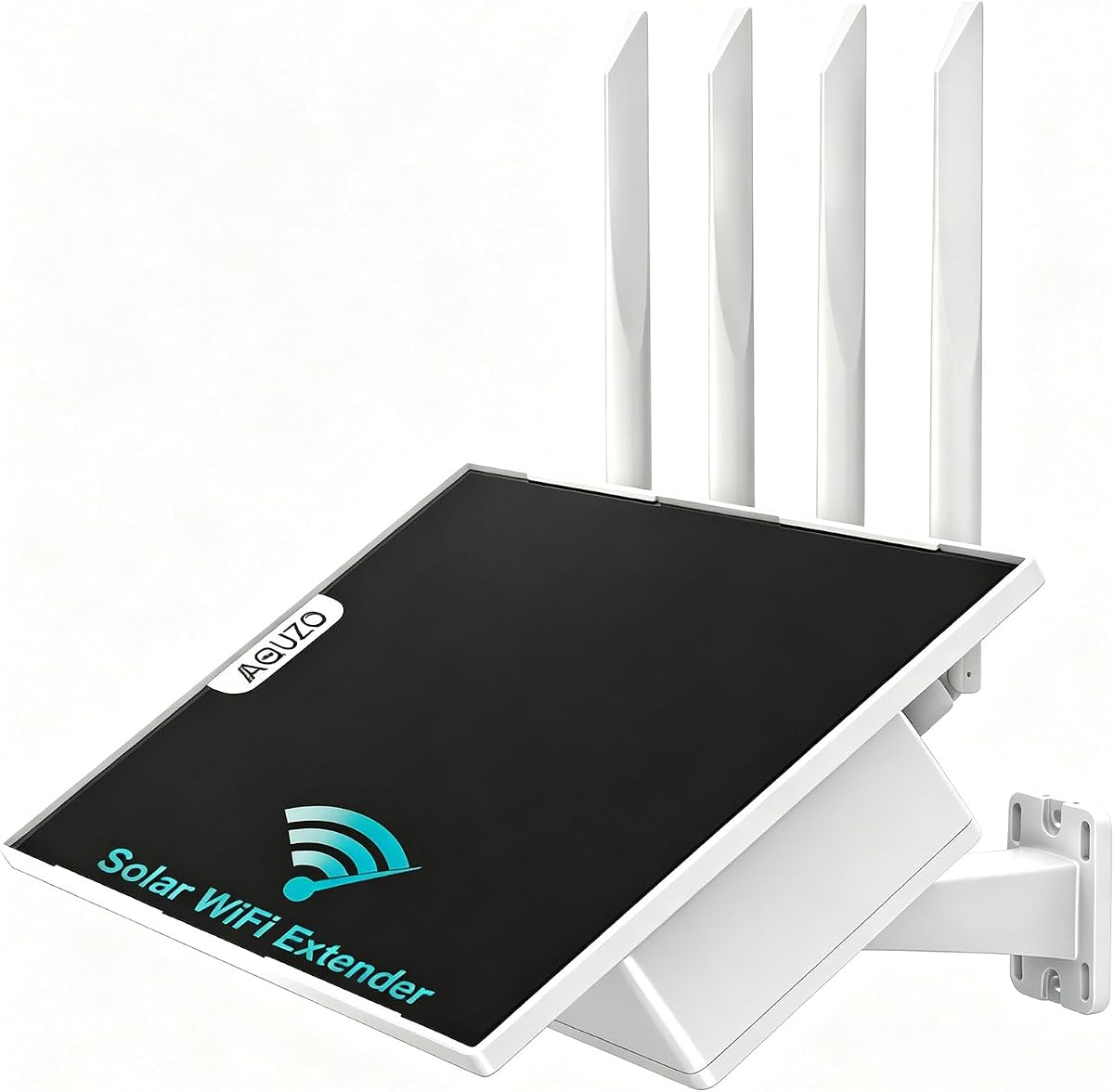
WiFi Extender Outdoor Solar Powered E8
4.5Editor score
Integrated 15W solar panel
27,000mAh built-in battery
IP66 outdoor-rated protection
Compare the best outdoor WiFi range extenders for long-range coverage, weather resistance, device capacity, easy setup, and flexible outdoor networking.
Outdoor WiFi range extenders help eliminate weak signals in yards, farms, garages, campsites, and other spaces where an indoor router cannot reach. The right model combines useful range with weather resistance, suitable antennas, flexible power options, and enough wireless capacity for the devices you actually use.
This guide compares ten outdoor WiFi range extenders based on their stated radio standards, coverage potential, outdoor protection, connection limits, operating modes, installation requirements, and management features. It includes purpose-built outdoor access points, solar-powered repeaters, wired dual-band models, and several indoor extenders that are also advertised for outdoor use.
Each review explains where the product stands out, what trade-offs may matter, and which users are most likely to benefit. Ratings and specifications reflect the supplied listing information, while availability, compatibility, and current pricing can change. Always confirm electrical, mounting, and network requirements before buying.
4.5Editor score
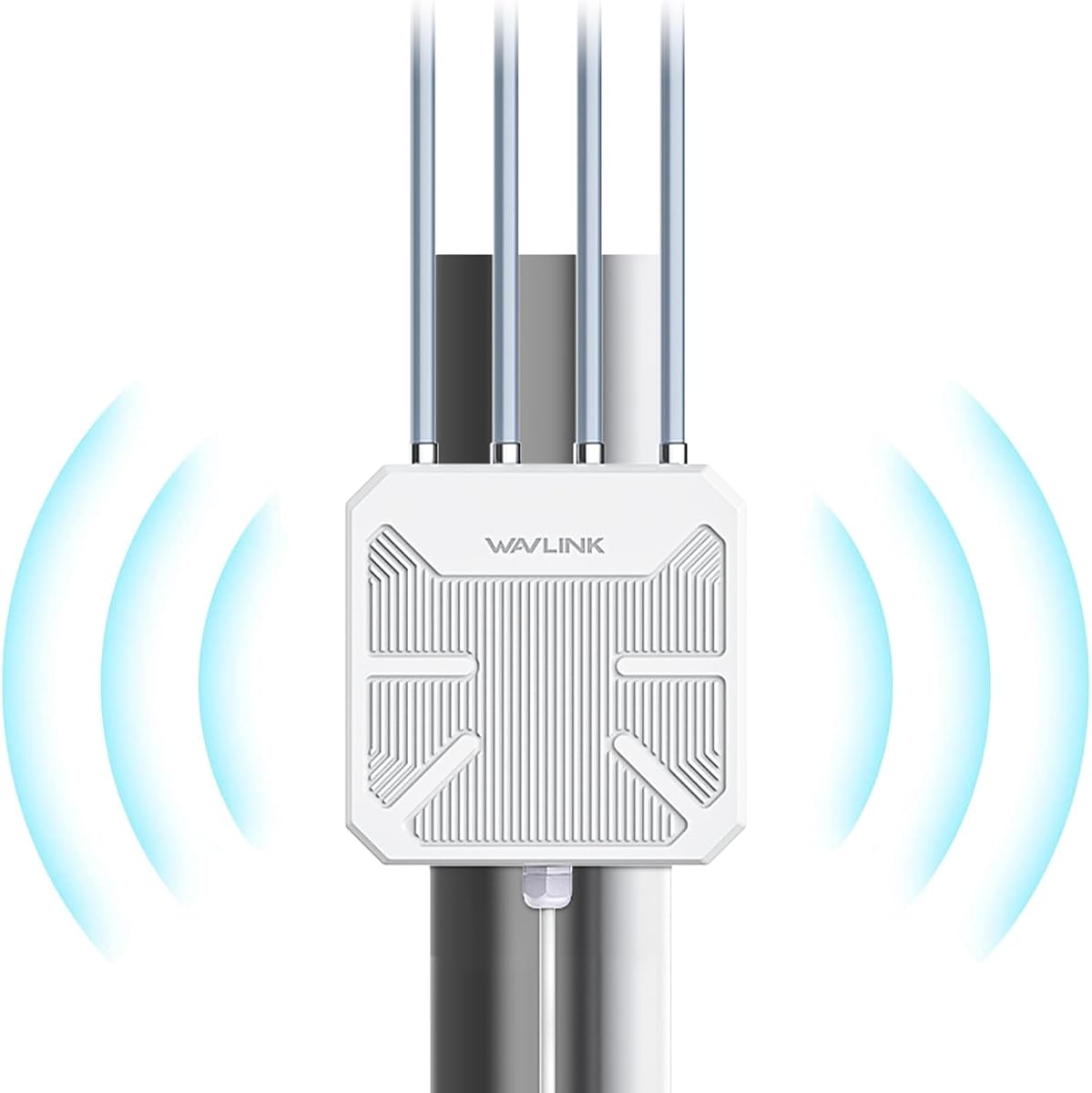
4.3Editor score

4.2Editor score
The table below compares the ten extenders by wireless generation, outdoor protection, coverage potential, and practical deployment features. The list includes weatherproof access points for permanent installations, solar equipment for off-grid use, and lower-cost dual-band repeaters for more conventional coverage needs.


The 2026 WAVLINK AX1800 Outdoor WiFi 6 Extender is the most complete general-purpose option in this guide. It carries a 4.3 rating and stands out through a combination of WiFi 6 dual-band performance, true IP67 protection, four detachable 8dBi antennas, flexible PoE, and numerous deployment modes. Those attributes make it a strong candidate for anyone extending a network across a yard, garage, farm, estate, or RV parking area.
We may earn a commission when you buy through this link, at no additional cost to you.
Its most important strength is the combination of coverage engineering and installation flexibility. The listing claims up to a 200- to 300-meter radius in line-of-sight environments, while the detachable fiberglass antennas give the installer some ability to orient the signal. Dual-band performance is specified at 1,201 Mbps on 5GHz and 574 Mbps on 2.4GHz, and the access point is listed as supporting as many as 256 devices. Active 802.3af/at and passive PoE options also allow a single Ethernet run to carry both power and data.
There are practical trade-offs. The product is designed for permanent or semi-permanent installation rather than casual indoor use, and the included passive PoE adapter is explicitly not waterproof. The stated coverage figure depends heavily on open sightlines, placement, local interference, and the speed of the upstream connection. Because it offers Mesh, AP, Router, Repeater, AP-plus-Repeater, and other modes, setup can also feel more complex than that of a basic WPS repeater.
This is the recommendation for a buyer who wants one capable device for a broad range of outdoor networking tasks. It is especially attractive when a wired Ethernet connection can be run from the building and when the goal is dependable coverage for cameras, phones, tablets, or smart outdoor equipment. For a simpler indoor dead-zone solution, the TP-Link RE315 is easier, but this WAVLINK model offers the stronger outdoor foundation.
The sealed IP67 housing, operating range of -20°C to 50°C, and stated resistance to moisture, dust, lightning, and static make this model more appropriate for exposed installations than a typical plug-in indoor extender. Placement still matters, but the enclosure is designed for conditions encountered in gardens, parking areas, barns, and other open environments.
Supporting active and passive PoE gives installers more choices when bringing service to a distant point. AP mode can create a dedicated wireless network, Repeater mode can extend an existing one, and compatible WAVLINK equipment can use Mesh features for a unified network name.
We may earn a commission when you buy through this link, at no additional cost to you.
The TP-Link RE315 is an indoor-focused dual-band extender that is useful when an outdoor search actually begins with a weak signal inside the home. It has a 4.2 rating, offers 867 Mbps on 5GHz and 300 Mbps on 2.4GHz, and uses adjustable external antennas to improve coverage. The fast Ethernet port also allows a nearby computer, television, or game console to receive a wired connection.
We may earn a commission when you buy through this link, at no additional cost to you.
Its main appeal is approachable setup. One-Touch Connection uses WPS to link the extender to a compatible router, while the TP-Link Tether app provides setup, management, and a signal indicator that can help identify a better position. The RE315 supports Repeater, Access Point, and related network arrangements, and it can join an EasyMesh-compatible router, although the listing specifically notes that it is not compatible with Deco mesh systems.
The main limitation is that the RE315 is not a purpose-built outdoor access point. It does not have a listed IP rating, so rain, dust, direct sun, and temperature extremes are not appropriate operating conditions. Its claimed 1,500-square-foot coverage is also more meaningful for extending through indoor walls than for crossing an entire rural property. Like all wireless extenders, it improves reach and signal reliability rather than increasing the underlying speed of an internet connection.
Choose the RE315 when the dead zone is mainly in a bedroom, basement, home office, or covered garage and you want a familiar, low-friction setup. It is not the best choice for a camera mounted beyond the reach of an indoor router. For genuinely exposed outdoor service, choose a model with a clearly stated weatherproof rating and outdoor power provisions.
The RE315 is designed to make broad household coverage easier without a complex networking background. Its app-assisted installation, WPS button, and adjustable antennas are useful when the goal is simply to improve a connection in a specific room rather than build a managed outdoor network.
The Ethernet port is useful for devices that benefit from a stable wired link near the extender. It can also make the unit easier to incorporate into a home network when extending a signal into a garage, workshop, or other covered area with an available cable.
We may earn a commission when you buy through this link, at no additional cost to you.
The Omada EAP225-Outdoor is a 4.2-rated outdoor access point designed for people who want centralized control rather than a simple one-button repeater. It offers 802.11ac Wave 2 dual-band performance, MU-MIMO, multiple SSIDs, and compatibility with Omada's software-defined networking platform. That makes it especially suitable for estates, campuses, farms, rental properties, or small businesses managing networked devices across several locations.
We may earn a commission when you buy through this link, at no additional cost to you.
The weatherproof enclosure supports an IP65 rating, and the listing claims outdoor range of more than 200 meters on 2.4GHz and more than 300 meters on 5GHz. It supports 802.3af/at active PoE and passive PoE, reducing the number of cables required at a remote mounting point. Seamless roaming, band steering, airtime fairness, beamforming, and Mesh support are additional advantages for administrators managing several access points.
The main disadvantage is complexity. A standalone configuration is possible, but the broader value appears when the device is integrated with compatible Omada access points, switches, and gateways under a hardware controller, software controller, or cloud-based controller. Controller compatibility matters: SDN controllers work with SDN-ready devices, while non-SDN controllers work with non-SDN access points. Buyers without prior experience may find the management environment more involved than a conventional extender setup.
This is the right recommendation for managed outdoor networks or users already invested in Omada. It is less compelling for a homeowner who only needs one or two outdoor access points and wants a simple standalone system. Compared with newer WiFi 6 or WiFi 7 models, it also lacks the newest radio standard, although its outdoor construction and management features remain substantial.
Omada's cloud access and app allow compatible equipment at different sites to be controlled from one interface. This is a major advantage for organizations that need consistent access-point configuration, monitoring, and network administration without visiting every installation.
The IP65 enclosure, dual PoE support, multiple SSIDs, and advanced radio features make this a more structured deployment option than a consumer repeater. It is especially suitable for a business property where access points, cameras, and user devices need dependable coverage across a defined area.
We may earn a commission when you buy through this link, at no additional cost to you.
The E8 is the most approachable option for extending coverage to a remote outdoor location without running a power cable. It has a 4.5 rating and combines a 2.4GHz 300Mbps repeater, four 5dBi antennas, a 15W solar panel, a 27,000mAh built-in battery, and an IP66-rated enclosure. The stated range is up to a 120-meter radius, making it a compelling choice for barns, farms, campsites, gardens, and the far corners of large properties.
We may earn a commission when you buy through this link, at no additional cost to you.
Its defining advantage is energy independence. The integrated battery stores solar energy for periods when the panel receives less sunlight, while the wireless design avoids the need to install outdoor electrical wiring. Setup is described as a phone or computer-based web configuration, with compatibility listed for mainstream routers and Starlink. That makes the E8 especially attractive for a security camera, smart garden equipment, or a work device in an area beyond the reach of the main router.
The trade-offs are significant and should guide the purchase. It is a 2.4GHz-only system with a listed maximum of 300Mbps, so it is not the right choice for modern high-bandwidth clients or a demanding outdoor entertainment area. The stated radius depends on clear line of sight and favorable conditions, and actual battery life will depend on sunlight, orientation, temperature, traffic, and how often the signal repeats. Weather protection also does not make every installation location safe, particularly where the panel may be shaded for long periods.
Buy the E8 if the priority is inexpensive, off-grid outdoor coverage rather than maximum speed. It is particularly good for intermittent-use devices such as cameras, sensors, and basic phones. Users needing high throughput, dense client capacity, or a permanently wired enterprise network should consider a higher-bandwidth outdoor access point instead.
The integrated 15W panel and 27,000mAh battery make the E8 a practical choice where running cable or installing an outdoor outlet would be inconvenient. Position the panel where it receives unobstructed sunlight, and confirm that the mounting surface and orientation suit your location.
At 2.4GHz and 300Mbps, the extender is better aligned with basic surveillance, smart-home, and general-access needs than with intensive file transfers or high-resolution multi-device streaming. Its four antennas help improve the link between the home network and the remote unit.
We may earn a commission when you buy through this link, at no additional cost to you.
The 2026 WiFi Extender Signal Booster for Home is the highest-rated product in this roundup at 4.9. It differentiates itself with a claimed coverage area of more than 18,888 square feet, four high-gain antennas, five operating modes, two Gigabit Ethernet ports, and support for more than 88 devices. It is also listed for both indoor and outdoor use, making it worth considering for patios, balconies, garages, and other semi-protected spaces.
We may earn a commission when you buy through this link, at no additional cost to you.
The hardware is unusually versatile for a consumer-style extender. Repeater, Access Point, Router, Bridge, and Client modes can address different network arrangements, while two Ethernet ports provide wired connections for desktops, consoles, and other devices. WPS one-touch setup is available for users who do not want to configure the device manually, and the listing states that it works with most routers. A smart signal chip is also promoted as a way to distribute connections more evenly when many clients are active.
The important concern is uncertainty around outdoor durability. Although the listing says indoor and outdoor use, it does not provide a clear IP67 or IP65 weatherproof rating comparable to the purpose-built access points in this guide. The 18,888-square-foot figure is also a marketing claim whose real-world result will depend on building layout, obstacles, mounting position, and the strength of the source router. WPA and WPA2 support provides standard encryption, but descriptions such as “military-grade” do not replace secure password practices.
This model is a good value-oriented choice for a large home, workshop, or covered outdoor area where a wired port and multiple modes are useful. Choose it for flexibility and high client capacity rather than for exposed installations where a verified weatherproof enclosure is essential. For direct rain, snow, and long-term outdoor exposure, a specifically rated outdoor access point is the safer purchase.
Two Gigabit Ethernet ports distinguish this model from many basic plug-in extenders. They can support wired devices in rooms where the wireless signal is marginal, while the five modes let the unit adapt to a home router, existing access point, or a dedicated local network.
The listed support for more than 88 devices is useful for households combining phones, tablets, computers, printers, cameras, and smart-home products. Actual performance still depends on the extender's radio, the upstream connection, and the traffic each device creates.
We may earn a commission when you buy through this link, at no additional cost to you.
The Baetaey 15000-square-foot wireless internet repeater has a 4.8 rating and is built around quick one-tap WPS setup. Its advertised coverage is up to 15,000 square feet, supported by four adjustable external antennas. It can connect more than 70 devices and includes an Ethernet port, making it a practical general-purpose unit for homes, small businesses, workshops, and travel-related use.
We may earn a commission when you buy through this link, at no additional cost to you.
Ease of use is its main attraction. Pressing WPS on the router and extender creates the wireless link, with the listing claiming a connection within approximately 30 seconds. Repeater, Bridge, Access Point, and Router modes cover common network arrangements, and the Ethernet port offers a wired option for a nearby device. Compatibility with standard routers, gateways, and access points is another advantage for users who do not know the exact model of their current equipment.
The main limitation is that the unit operates on 2.4GHz with up to 300Mbps. It can be effective for general browsing, cameras, and light streaming, but it will not offer the throughput of a dual-band or newer WiFi 6 system. The product has no stated IP67 or IP65 rating, so it should not be treated as a fully exposed outdoor access point. The broad 15,000-square-foot and 70-device claims are also maximum marketing figures rather than guaranteed performance in every environment.
Choose this extender when straightforward setup matters most and the target area is indoors or sheltered. It is a better fit for a garage with wall coverage, a home office, or a covered garden work area than for a camera exposed to rain. Buyers seeking true outdoor durability, 5GHz speed, or a larger wired-device count should choose a more purpose-built unit.
One-tap WPS setup removes much of the friction associated with traditional range extenders. It is particularly useful when the extender is being added by a family member or installed in a location where mobile app management would be inconvenient.
Repeater mode extends an existing wireless network, Access Point mode creates wireless service from a wired connection, Bridge mode links networks, and Router mode covers a more independent setup. The Ethernet port gives wired devices another way to join the extended network.
We may earn a commission when you buy through this link, at no additional cost to you.
The WAVLINK WiFi 7 BE5100 is the premium option in this list, offering the newest wireless standard and the strongest stated throughput class. It has a 4.2 rating, uses dual-band 802.11be four-stream technology, and lists 4,323 Mbps on 5GHz plus 688 Mbps on 2.4GHz. Its four 8dBi detachable fiberglass antennas, internal amplifiers, IP67 housing, and stated 300-meter radius are well suited to demanding outdoor deployments.
We may earn a commission when you buy through this link, at no additional cost to you.
The device targets buyers who want more than basic range. Its stated 256-device capacity is appropriate for estates, large farms, event grounds, parking areas, and other locations with a high concentration of clients. Mesh, AP, Router, Repeater, AP-plus-Repeater, and other modes provide different ways to integrate the unit, while 802.3af/at active PoE and passive PoE offer installation options for remote access points. The listing also highlights support for current high-end phones and laptops.
The crucial caveat is that WiFi 7 benefits require compatible clients and a suitable source network. Older devices can generally use the extender, but they will not receive the full benefits of the newer radio. As with other outdoor PoE products, the converter is not waterproof and must be sheltered. Maximum range also assumes a clear path, proper antenna orientation, and a high-quality upstream connection.
This is the recommendation for a premium outdoor network where modern devices, high throughput, large capacity, and long-term outdoor construction are priorities. It is unnecessary for a basic indoor dead zone, and the newer standard offers less value when every connected client is limited to WiFi 5 or WiFi 6. For those users, the standard AX1800 or AX3000 WAVLINK options provide a more balanced choice.
The four-stream WiFi 7 design provides ample capacity for modern high-bandwidth devices. Users with recent compatible phones, computers, and network equipment can benefit from faster local wireless transfers and a more capable long-range link than older WiFi 5 hardware can provide.
An IP67 housing, 6 kV lightning protection, 15 kV electrostatic-discharge protection, and fiberglass antennas support use in exposed areas. Install the unit with suitable cable management and keep the non-weatherproof PoE converter indoors or inside a protected enclosure.
We may earn a commission when you buy through this link, at no additional cost to you.
The WAVLINK AX1800 Outdoor WiFi 6 Extender is a highly capable 4.2-rated alternative for yards, farms, estates, garages, and remote properties. It uses dual-band AX1800 technology with MU-MIMO and beamforming, four custom 8dBi fiberglass antennas, and an IP67-rated enclosure designed to resist rain, snow, dust, wind, ultraviolet exposure, and temperature extremes.
We may earn a commission when you buy through this link, at no additional cost to you.
This model provides a broad selection of operating modes, including Access Point, Router, Repeater, and WISP. It can also participate in Mesh networking within the WAVLINK ecosystem, allowing a unified network name and password where compatible devices are used. Active 802.3af/at PoE and passive PoE support make it suitable for a permanent outdoor access point fed by one Ethernet run. Its stated Starlink compatibility adds value for rural homes and off-grid installations.
Its overlap with the first-ranked WAVLINK model is worth noting. Both use WiFi 6, four 8dBi antennas, and IP67 protection, so selection may depend on the exact installation needs, available modes, and listing details rather than headline specifications alone. The stated long-range performance is still subject to line of sight and placement, and the PoE converter is not listed as waterproof.
Choose this WAVLINK model when you want a permanent outdoor installation with flexible modes and strong weather protection. It is well matched to a home network, a wired outdoor access point, or a compatible Starlink setup. Buyers seeking the newest standard or the highest maximum throughput should step up to WiFi 7, while basic indoor users should consider a less specialized extender.
Access Point, Router, Repeater, WISP, and compatible Mesh modes let the same device serve different outdoor network structures. This is useful for extending coverage, creating a separate guest network, or connecting a location that has a wired internet feed but lacks nearby power.
The true IP67 enclosure and durable fiberglass antennas are important advantages over indoor repeaters. Secure the mount firmly, orient the antennas deliberately, and keep the power converter and terminations in a dry location.
We may earn a commission when you buy through this link, at no additional cost to you.
The 2026 WAVLINK AX3000 Outdoor WiFi 6 Extender combines a high theoretical speed class with rugged outdoor construction. It has a 4.2 rating, four detachable 8dBi antennas, two internal amplifiers, an IP67 enclosure, and support for as many as 256 connections. It is aimed at large properties and open spaces where a conventional indoor router leaves substantial coverage gaps.
We may earn a commission when you buy through this link, at no additional cost to you.
Its dual-band architecture is listed at up to 2,402 Mbps on 5GHz and 573 Mbps on 2.4GHz, while a Gigabit Ethernet port supports 1000, 100, and 10 Mbps connections. The access point offers Mesh, AP, Router, Repeater, and AP-plus-Repeater modes, along with seamless roaming, band steering, MU-MIMO, and beamforming. Active and passive PoE make it possible to place the unit in a garden, farm, or parking area without a nearby power outlet.
The listing's description of WiFi 6 standards is not completely consistent, and no specific 5GHz rate is stated, so buyers should verify the final hardware specifications before relying on the AX3000 label. Coverage claims of 200 to 300 meters are contingent on open line of sight. The product includes 15 kV ESD and 6 kV lightning protection, but the PoE converter remains non-weatherproof and must be installed under cover.
This is a strong selection for a high-capacity outdoor WiFi 6 network, particularly where a wired Gigabit connection will also be used. It suits owners who want more potential throughput than an AX1800 unit but do not need a WiFi 7 client ecosystem. For simpler needs, the standard AX1800 option may be enough.
The stated support for 256 devices and internal amplifiers make the unit suitable for properties where phones, cameras, tablets, and smart equipment may all connect. A reliable upstream feed and thoughtful placement remain necessary to realize that capacity.
A Gigabit port can support a nearby wired camera, computer, or network segment in addition to wireless clients. This makes the unit useful as a combined access point and network bridge when the installation includes local Ethernet infrastructure.
We may earn a commission when you buy through this link, at no additional cost to you.
The Outdoor WiFi Extender Dual Band is the simplest dedicated outdoor product in this guide. It carries a 5.0 rating and uses 802.11ac Wave 2 dual-band technology with stated speeds of 867 Mbps at 5GHz and 300 Mbps at 2.4GHz. Its IP65 housing is designed to resist water, dust, frost, high temperatures, and corrosion, while the listing states a 300-foot range and support for up to 30 devices.
We may earn a commission when you buy through this link, at no additional cost to you.
That combination makes the device relevant for a moderate outdoor extension project rather than a vast estate. Directional transmission and four listed client uses—laptops, phones, speakers, network cameras, tablets, and other connected devices—point toward a general-purpose access point for a patio, garage, workshop, or yard. WPA-PSK, WPA2-PSK, and WPA/WPA2 support cover common home security requirements.
Its lower capacity and shorter stated coverage distinguish it from the higher-end WAVLINK models. A 30-device limit may be ample for a household but restrictive for a busy commercial property. The 300-foot figure is also a maximum claim that will be reduced by walls, landscaping, terrain, antenna orientation, and interference. Since the listing does not describe as many installation modes as the managed and premium alternatives, buyers needing WISP, Router, or extensive Mesh functionality may prefer another device.
Choose this extender for a modest outdoor coverage need where a compact, dual-band, IP65-rated unit is sufficient. It is especially relevant for basic cameras and household clients in a medium-sized outdoor area. For large properties, very high client counts, Starlink integration, or more advanced deployment options, a WAVLINK or Omada model offers a more suitable foundation.
Separate 2.4GHz and 5GHz radios let compatible clients use the band best suited to their distance and interference environment. The 5GHz band generally provides higher throughput over shorter distances, while 2.4GHz can offer better reach for nearby outdoor devices.
The IP65 enclosure provides a clear outdoor protection rating without moving to a larger premium platform. It is a practical middle ground for users who need weather resistance and dual-band speed but do not require enterprise management or very high device capacity.
We may earn a commission when you buy through this link, at no additional cost to you.
The right outdoor WiFi range extender depends on where the signal must reach, how the unit will be powered, what clients will use it, and how much management complexity you want. Review radio generation, weather protection, range claims, installation modes, and Ethernet support before choosing.
A product advertised for outdoor use should have a clearly stated ingress-protection rating. IP65 indicates protection against dust and water jets, while IP67 adds temporary immersion protection and is generally more appropriate for fully exposed installations. The enclosure, antennas, cable entries, connectors, and mounting hardware all matter. Some products claim indoor and outdoor use but do not provide a verifiable rating; those units are better suited to covered patios, eaves, or sheltered garages than to direct rain, snow, dust, and prolonged ultraviolet exposure.
WiFi 5 devices provide a common and affordable baseline, while WiFi 6 improves efficiency and capacity through features such as MU-MIMO, OFDMA, and beamforming. WiFi 7 adds a newer radio framework and greater multi-link potential, but its benefits require compatible clients and source equipment. Consider the actual devices you expect to connect. A basic camera or sensor may not need a premium WiFi 7 access point, while modern phones, laptops, cameras, and work systems can benefit from higher-bandwidth dual-band hardware.
External antennas provide flexibility in aiming and replacing components, while high-gain or detachable fiberglass antennas can help distribute signal across open areas. Directional antennas are often better for a specific building or camera, whereas omni-directional antennas suit broad yards and properties. Range claims should be treated as ideal line-of-sight figures. Walls, trees, terrain, neighboring networks, and the quality of the upstream connection often determine the usable result. Installation height, cable routing, and antenna orientation can be as important as the stated specification.
PoE is the most practical way to install a wired outdoor access point because one Ethernet cable can carry both data and power. Active PoE standards and passive PoE are not interchangeable in every installation, so confirm what your switch or injector supplies. A solar unit can avoid cable installation entirely, but it depends on sunlight, battery condition, and seasonal weather. Battery-powered options may also throttle performance or become unavailable after prolonged darkness. Avoid relying on a long outdoor extension lead when a proper PoE run is possible.
The number of supported connections is only one part of capacity. Modern bands, MU-MIMO, processor resources, the source connection, and client traffic all affect the experience. A model advertising support for 30 devices may be appropriate for a small patio, while one rated for 70, 88, or 256 clients is better for busy properties. For constant video, large files, or numerous active users, look for dual-band or newer hardware rather than assuming any repeater can divide a limited upstream connection efficiently.
Repeater mode extends an existing wireless network, Access Point mode creates WiFi from a wired connection, Router mode can create a more independent network, and WISP or client modes can serve other arrangements. Mesh support is useful when combining compatible access points under one network name, but it is often limited to a particular brand. EasyMesh compatibility is a separate consideration from a manufacturer's dedicated Mesh ecosystem. Confirm the source router, existing access points, and desired client behavior before selecting a mode-dependent product.
Standalone access points are convenient for a home, while managed platforms help administrators configure multiple sites, SSIDs, schedules, and monitoring from one interface. A dedicated application can make placement and troubleshooting easier, and an intelligent signal indicator may prevent poor mounting decisions. Regardless of interface, use WPA2 or WPA3 where supported, create a strong unique password, keep firmware current, and change default administrative credentials. Security features are useful only when they are enabled correctly.
Begin by mapping the coverage problem. Identify where the existing router performs poorly, what walls or terrain separate it from the target area, and whether the intended clients need a wired or wireless link. Place the extender or access point roughly halfway along a usable signal path when repeating a signal, or close to the Ethernet source when using AP mode. For directional antennas, aim them toward the target area and adjust their height and orientation after testing.
Configure the device using the method that matches its role. Use WPS or the manufacturer's app for a basic extension, but create a dedicated access point and strong WPA2 or WPA3 password when separating outdoor clients from the home network is important. If using PoE, verify active versus passive requirements, use suitable outdoor-rated cable, and keep the converter or injector in a dry location. Do not exceed the stated cable length or run unprotected connections through standing water.
For solar equipment, place the panel in direct, unobstructed sunlight and orient it toward the available light rather than the area it needs to cover. Check battery behavior after cloudy periods and keep the panel free of dust, leaves, and snow. Weatherproof enclosures do not prevent condensation, corrosion, or damage from poor sealing, so inspect grommets, cable glands, and mounting points periodically. Tighten hardware after settling and keep firmware and management software updated.
An extender receives an existing wireless signal and retransmits it, while an access point usually creates WiFi from a wired Ethernet connection. Extenders can be convenient when running cable is difficult, but they lose some efficiency because the radio must receive and send the data. An access point with PoE is usually the better choice for a permanent outdoor installation.
Only when the manufacturer explicitly permits outdoor use and the environment is suitably sheltered. A standard indoor repeater should not be exposed to rain, dust, direct sunlight, or temperature extremes. Look for an IP rating and confirm that the power adapter, extension cord, and all connections remain dry.
Manufacturer range figures usually describe ideal open-area conditions. Trees, buildings, terrain, antenna orientation, interference, and the source connection can reduce the usable distance substantially. A clear line of sight is essential, and a strong signal at the extender's location matters more than its headline range. Test with the clients and applications you actually plan to use.
PoE provides the most consistent operation when a reliable Ethernet cable can be installed, because power and data arrive through one protected run. Solar is better for remote installations where cable and power access are difficult, but performance depends on sunlight and battery maintenance. Choose based on site access and reliability needs rather than installation convenience alone.
A 2.4GHz extender is often sufficient for basic web access, cameras, sensors, and occasional streaming at a distance. It is less suitable for high-resolution multi-camera viewing, large file transfers, or many simultaneous demanding clients. A dual-band WiFi 6 or WiFi 7 model provides more headroom when compatible modern devices are involved.
External antennas provide more installation flexibility than fixed internal antennas. They can be positioned, aimed, or replaced to suit a property, and detachable fiberglass antennas are commonly used on rugged outdoor models. Omni-directional antennas suit broad areas, while directional antennas are better when the signal should focus on one distant building or device.
It cannot increase the speed delivered by your internet provider. It can make a weak or unreliable connection usable, improve the signal reaching distant clients, and provide better overall throughput in dead zones. The final result depends on the source router, placement, interference, antenna quality, and how efficiently the extender shares the upstream connection.
A device with a suitable IP rating is designed for outdoor conditions, but the installation still needs care. Check the operating-temperature range, seal cable entries, protect the PoE converter, and secure the mount against wind. Snow, ice, standing water, and temperature-induced cable movement can still damage an otherwise weather-rated device.
The WAVLINK AX1800 Outdoor WiFi 6 Extender is the strongest all-around recommendation because it combines a rugged IP67 enclosure, four 8dBi antennas, flexible PoE, several operating modes, and support for as many as 256 devices. The solar-powered E8 is the most budget-friendly choice for off-grid locations, while the WAVLINK WiFi 7 BE5100 is the premium option for modern clients and demanding high-capacity networks.
Prioritize the installation rather than the largest range or speed number. A verified IP65 or IP67 enclosure, dependable power, clear line of sight, and a strong upstream connection will usually create a better result than an inexpensive unit placed in a poor location. Managed properties may benefit from Omada's centralized controls, while homes may prefer a straightforward WPS extender such as the TP-Link RE315.
Before making a final purchase, confirm router compatibility, PoE requirements, supported modes, the available cable route, and the current product listing. Customer ratings, software, hardware revisions, availability, and current pricing can change, so check the latest information and recent customer feedback before ordering.


