
Klein Tools 68216
4.4Editor score
Eight SAE sizes
90-tooth ratcheting mechanism
Pass-through ratchet design
Our best reversible ratcheting wrenches guide compares sets by tooth count, size range, offset design, steel construction, organization, and tight-space access.
Reversible ratcheting wrenches combine the speed of a ratcheting box end with the convenience of reversing direction without lifting the tool. The best examples offer tight fastener access, durable steel construction, clear size markings, and enough coverage for automotive, workshop, construction, and household maintenance.
We compared the ten sets in this guide by examining their tooth counts, tooth or ratchet sizes, offset geometry, reversing mechanisms, construction, finishes, storage options, and intended uses. The list includes compact multi-size designs, standard single-size combinations, SAE and metric collections, and sets aimed at professional workflows.
Each review identifies the product's strongest contribution and any practical limitations, while the comparison table makes the differences easier to scan. Product details and availability can change over time, so readers should verify the current listing, size coverage, and included components before purchasing.
4.4Editor score

4.5Editor score

4.6Editor score
This side-by-side comparison highlights each set's size system, ratchet mechanism, construction, and standout organization features so buyers can quickly identify the most suitable option for their toolkit.


The Klein Tools 68216 is a 4-in-1 reversible ratcheting box wrench set with a 4.4 rating and two forged steel tools. It combines eight common SAE sizes into a compact format, making it a practical choice for users who want fewer individual wrenches without sacrificing the fast adjustment provided by a ratcheting box end.
We may earn a commission when you buy through this link, at no additional cost to you.
Its 90-tooth mechanism requires less movement than a conventional 12-point box end, which is valuable when a fastener sits close to a wall, engine component, or other obstruction. Each wrench also has a reversing switch at both ends, color-coded markings, recessed I-beam handle areas, and a pass-through ratcheting design that accommodates longer threaded rods and bolts.
The principal limitation is that the set covers SAE sizes only and uses box ends without open ends. It therefore works best as a focused ratcheting-box collection rather than a universal combination-wrench kit. Even so, the consolidation of 1/4 through 3/4 inch in two tools makes it unusually space-efficient for repair kits and mobile tool bags.
This is an attractive recommendation for automotive enthusiasts, mechanics, contractors, and homeowners who regularly work with SAE fasteners and value accessibility. Those who need metric coverage or a combination of box and open ends should choose a more specialized set, but the Klein provides an unusually capable balance of compactness, construction, and practical features.
The two-wrench arrangement reduces the number of loose tools without confusing size selection. Bright markings make each of the eight SAE sizes easier to locate before the wrench is placed on a fastener.
The 90-tooth ratchet reduces the arc needed to turn a fastener, while the pass-through design adds flexibility when working around longer rods and bolts. These details are especially useful in crowded automotive and workshop environments.
We may earn a commission when you buy through this link, at no additional cost to you.
The ironcube 12-Piece Metric set carries a 4.5 rating and covers metric sizes from 8mm through 19mm. Its twelve individual ratcheting wrenches provide a complete-looking standard-size range for automotive, motorcycle, and general maintenance work without relying on a multi-size arrangement.
We may earn a commission when you buy through this link, at no additional cost to you.
The 72-tooth ratchets allow faster repositioning than standard box ends, and each tool uses a simple two-way reversing switch. A 12-point profile is designed to engage common fastener shapes, while the black matte finish helps disguise dirt and resist rust. The set is made from chrome vanadium steel and arrives with a treated wax canvas pouch.
Its main trade-off is specialization. The range is entirely metric, so owners of American-standard hardware will need another set for SAE fasteners. Also, a 72-tooth mechanism needs more movement than the 90-tooth designs elsewhere in this list, although it remains well suited to normal repair work.
The set is a strong recommendation for metric-focused mechanics, motorcycle owners, and workshop users who want a dedicated 8-to-19mm collection with organized storage. Buyers should favor it when straightforward size selection, durable construction, and a rugged pouch matter more than the smallest possible swing arc.
The 8mm, 9mm, 10mm, 11mm, 12mm, 13mm, 14mm, 15mm, 16mm, 17mm, 18mm, and 19mm selection covers common workshop sizes. Individual tools also make it easy to remove only the size needed for a job.
The wax canvas pouch gives the set a more durable home than a loose collection of wrenches. It also makes the tools easier to move between a bench, a mobile kit, and a job site without creating additional clutter.
We may earn a commission when you buy through this link, at no additional cost to you.
The Jaeger 16-Piece Metric set has a 4.5 rating and extends from 8mm to 25mm across sixteen sizes. It stands out for combining broad metric coverage with a 90-tooth ratcheting box end and a reversible end that can tilt as it approaches constrained spaces.
We may earn a commission when you buy through this link, at no additional cost to you.
The 12-point interior is intended for common hex-style fasteners, while the low tooth count of the ratchet system supports quick repositioning without removing the wrench. The set includes a lock-in rack designed to keep the wrenches organized and secure, and its construction is described as corrosion- and rust-resistant.
Compared with compact 4-in-1 designs, this is a much broader traditional set, so it occupies more room and may be more than a light-duty user needs. It is also restricted to metric sizes. Those limitations are offset by the useful 21mm, 22mm, 24mm, and 25mm coverage that many shorter sets omit.
This is a strong all-around choice for metric mechanics, technicians, and serious home workshops that need a broad range in a single organized package. The tilting reversible end and 90-tooth mechanism make it especially compelling for repairs where the handle cannot swing through a wide arc.
Most compact sets stop around 19mm, but this collection continues through 21mm, 22mm, 24mm, and 25mm. That extension makes it more useful for larger fasteners without requiring a separate specialist wrench.
The reversible box end can tilt up to 180 degrees, allowing the handle to approach awkward angles. Combined with the 90-tooth ratchet, this improves usability around closely packed components.
We may earn a commission when you buy through this link, at no additional cost to you.
The GEARWRENCH 86658 is a ten-piece SAE reversible ratcheting wrench set with a 5.0 rating. Its defining feature is the 90-tooth ratcheting system, which requires only a four-degree arc to turn a fastener and places it among the most compact designs in this guide.
We may earn a commission when you buy through this link, at no additional cost to you.
A 15-degree offset box end creates additional clearance and reduces the chance of the user's hand contacting nearby obstacles. The off-corner loading design used on the box and open ends improves grip and lowers the risk of rounding fasteners, while high-visibility ink improves size recognition.
The set remains metric-incompatible and offers fewer sizes than some competitors in this comparison. Some readers may also want information about included storage, because the supplied product details do not identify a specific rack or pouch. Nevertheless, the core wrench engineering is highly relevant to professional users.
It is a compelling recommendation for technicians who work with SAE fasteners and need a narrow, fast ratcheting swing. The combination of low arc, offset geometry, and rounding-conscious loading makes it especially well suited to confined repair spaces and repeated workshop use.
The 90-tooth mechanism can reposition with only four degrees of movement. That low arc helps when a wrench handle has very little room to move around a fastener.
Off-corner loading spreads contact away from fastener edges, improving grip and reducing the likelihood of rounding. This makes the design useful on stubborn hardware where a conventional wrench is more likely to leave the tool slipping.
We may earn a commission when you buy through this link, at no additional cost to you.
The DISEN 10-Piece Double Offset set has a 4.8 rating and uniquely combines metric and SAE coverage. Five wrenches each carry two sizes, providing ten tool bodies with twenty possible size ends without requiring buyers to choose between measurement systems.
We may earn a commission when you buy through this link, at no additional cost to you.
Both ends use a 25-degree offset, creating greater clearance when the handle approaches a fastener at an angle. A reversing lever is located at each end, allowing quick direction changes without removing the wrench. The 12-point design can re-engage after a 30-degree swing, supporting faster work in confined areas.
The paired format is the principal compromise. It covers 6 by 8mm, 10 by 12mm, 13 by 14mm, 15 by 17mm, and 19 by 21mm on the metric side, plus five common SAE pairs. Useful middle sizes are present, but the set does not offer every intermediate standard size and therefore cannot replace every single-size wrench.
This is a versatile recommendation for mixed-toolbox users, mobile mechanics, and hobbyists who encounter both metric and SAE fasteners. The double offset, reinforced handles, and easy-to-read markings make it particularly appealing when one compact set must serve several kinds of repair work.
The combination of metric and SAE sizes is unusual among compact ratcheting sets. It is especially practical for imported vehicles, mixed hardware kits, and general repair work where both standards may appear.
A 25-degree angle on both box ends provides clearance around obstructions. This approach can be more useful than a conventional straight wrench when a fastener is recessed or surrounded by other components.
We may earn a commission when you buy through this link, at no additional cost to you.
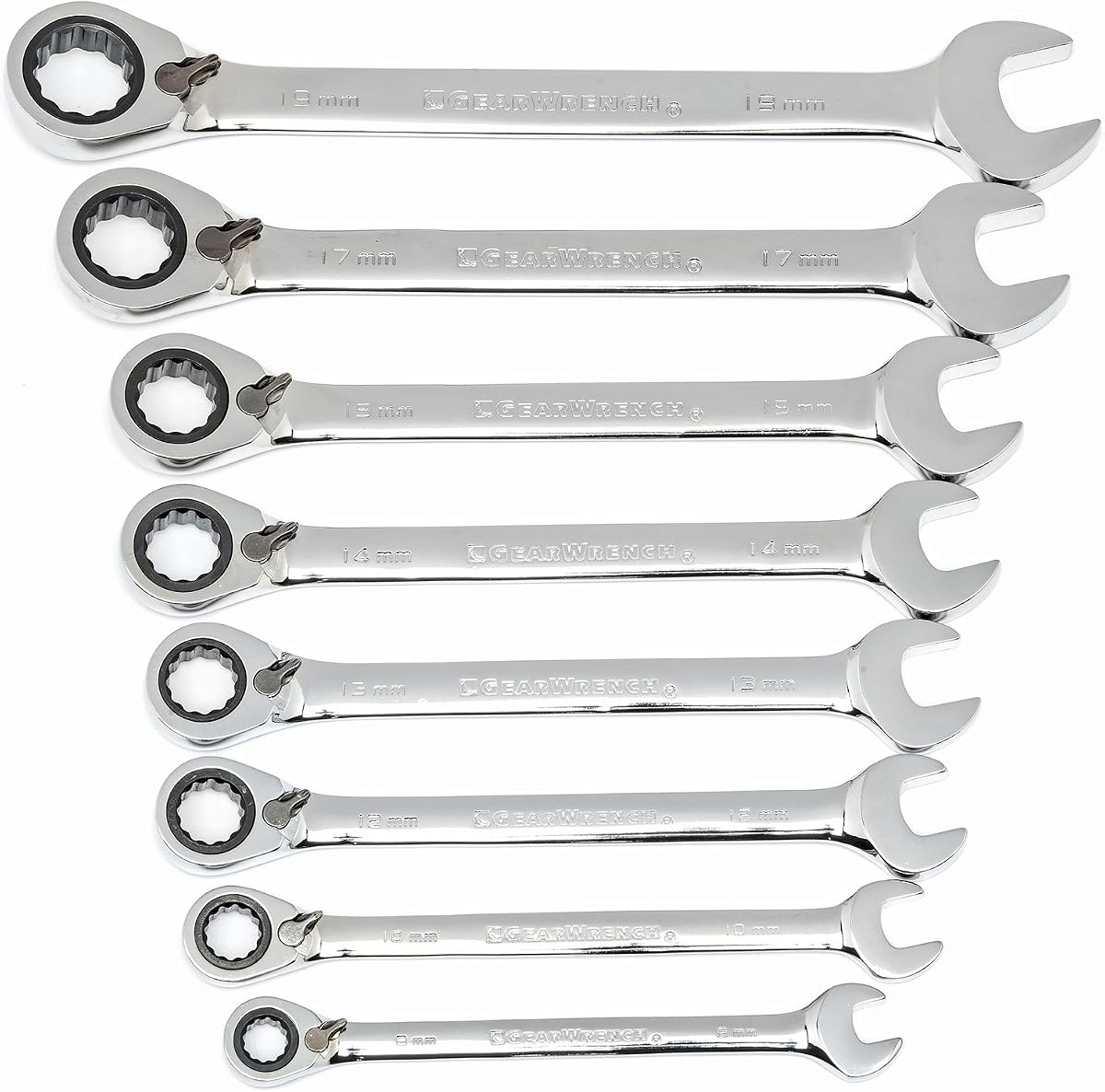
The GEARWRENCH 9509N is a 13-piece, 72-tooth reversible ratcheting combination wrench set for SAE fasteners. Its 4.7 rating reflects a traditional set format that gives each common size its own tool, avoiding the compromises sometimes associated with multi-size wrenches.
We may earn a commission when you buy through this link, at no additional cost to you.
The flush-mounted reversing lever is a practical detail because it permits direction changes without removing the wrench and remains less likely to interfere with the user's grip. The off-corner loading design on the box end provides better contact with the fastener and helps reduce rounding. As a combination set, it also provides an open end for tasks where a ratcheting box end is unnecessary.
The set does not include metric sizes, and its 72-tooth mechanism requires a larger repositioning arc than a 90-tooth design. The included individual wrenches will also take more space than multi-size tools. These are meaningful considerations for buyers with limited storage or very little working room around fasteners.
It is well suited to established SAE workshops that favor individual, easily identifiable sizes and the familiar utility of a combination wrench. Buyers should consider it when a broad conventional collection and dependable box-end engagement matter more than maximum compactness or the smallest possible swing.
The 13-piece format gives common SAE sizes dedicated tools. That makes it easy to select the correct wrench quickly and reduces the need to consult a multi-size chart before approaching a fastener.
Combining ratcheting box ends with open ends gives users more than one way to approach a fastener. The box end handles repeated ratcheting work, while the open end remains useful for quick placement and non-ratcheting tasks.
We may earn a commission when you buy through this link, at no additional cost to you.
The Der Erwachte 2-Piece set offers eight SAE sizes in just two 4-in-1 ratcheting box wrenches. Its 4.1 rating is the lowest among the products reviewed, but the design remains relevant for buyers who place a high priority on portability and tool consolidation.
We may earn a commission when you buy through this link, at no additional cost to you.
Each wrench provides four standard socket sizes, and the reversible ratcheting box ends allow tightening and loosening without repeatedly removing the tool. The wrenches are forged from CR-V steel and given a polished finish intended to resist corrosion. A portable storage pouch is included, adding convenience for job sites, garages, and emergency repairs.
The limitations are clear: there is no metric coverage, no open end, and no detailed tooth count in the supplied specifications. With only eight sizes, the set cannot cover the broader range offered by conventional thirteen- or sixteen-piece collections. Its multi-size design also requires more attention to size markings than a set of individual wrenches.
This set is best for a compact mobile kit, a basic home toolbox, or a technician who primarily works with a limited group of SAE fasteners. It is a sensible space-saving option, though the Klein 68216 offers a similar consolidation concept with a stated 90-tooth mechanism and broader color-coded identification.
The 4-in-1 layout covers 5/16, 3/8, 7/16, 1/2, 9/16, 5/8, 11/16, and 3/4 inch. It is a focused range, but the two-tool footprint is easy to carry and store.
The included pouch and compact construction make this set more portable than a broad rack of individual combination wrenches. That makes it useful for field repairs where carrying too many tools would be inconvenient.
We may earn a commission when you buy through this link, at no additional cost to you.
The TEKTON WRC94302 is a 14-piece metric reversible ratcheting combination wrench set with a 4.6 rating. Its strongest distinction is organization: four modular organizer pieces support a flexible storage system, and a dedicated label sheet covers both SAE and metric ranges for broader bench organization.
We may earn a commission when you buy through this link, at no additional cost to you.
The ratcheting box ends are offset 15 degrees to improve finger clearance and access around obstructions. A 12-point profile is compatible with 6-point, 12-point, and square fasteners, while an easy-to-operate drive switch changes ratcheting direction. Permanently stamped markings appear on both sides of every wrench, and the abrasive-blasted, trivalent chrome finish creates a textured satin surface.
This is a larger and more specialized set than the multi-size options, and it remains metric-only. The modular organizers add value, but buyers with very limited storage may prefer a smaller pouch-based set. It is also designed around standard individual sizes rather than the extreme consolidation offered by 4-in-1 tools.
It is an excellent recommendation for a well-organized metric workshop, professional service bench, or expanding toolkit. The combination of durable finish, readable markings, useful offset, and adaptable organizers makes it feel especially polished, while the drive switch and 12-point box ends support dependable everyday use.
The included three-tab and one-tab modular organizers allow the wrenches to be arranged in ways that suit different workspaces. This makes the set easier to integrate with a growing tool collection than a fixed single rack.
Permanent stamps on both sides of each wrench help users identify a size without rotating the entire tool. The offset box end then provides clearance for the fingers while a 12-point profile supports common fastener shapes.
We may earn a commission when you buy through this link, at no additional cost to you.
The 4 IN 1 Ratcheting Wrench Set uses three tools to provide twelve metric sizes from 8mm through 19mm. Its 4.4 rating reflects a useful balance of compact size, low ratcheting arc, and broad standard metric coverage.
We may earn a commission when you buy through this link, at no additional cost to you.
The 72-tooth mechanism requires only about five degrees of movement to turn a fastener. An off-corner box-end design improves grip and reduces rounding, while reversing levers at both ends let users change direction without removing the tool. The wrenches are drop-forged, heat-treated CR-V steel with chrome plating for corrosion resistance.
Its range stops at 19mm, so mechanics who regularly handle larger metric fasteners will need additional sizes. It is also metric-only, and the multi-size construction makes accurate selection more important than in a traditional individual-wrench set. Nevertheless, the three-tool footprint remains far smaller than the equivalent twelve individual wrenches.
This is a good recommendation for compact mobile toolkits, home mechanics, and repair kits that need common metric coverage without taking up excessive room. It is particularly useful for quick jobs and emergency repairs where carrying a smaller selection of properly sized tools is more important than full workshop coverage.
Each wrench carries four sizes, creating a total of twelve metric selections with only three tool bodies. The approach is particularly effective for compact repair kits and frequently transported tools.
The stated five-degree ratcheting arc helps in narrow areas where a standard box end would need substantially more movement. Double-ended reversing levers preserve that speed when the user changes direction.
We may earn a commission when you buy through this link, at no additional cost to you.
The GEARWRENCH 9543 is an eight-piece metric reversible ratcheting combination set with a 4.7 rating. It offers a middle-ground format: more focused than the three-tool multi-size kits but smaller and easier to manage than broad 13- or 16-piece collections.
We may earn a commission when you buy through this link, at no additional cost to you.
Its 72-tooth ratcheting box ends need as little as five degrees of movement compared with 30 degrees for a standard box end. A 15-degree offset improves clearance, and the flush-mounted reversing lever preserves access while changing direction. The combination format includes open ends, while off-corner box-end loading provides better grip and helps reduce fastener rounding.
With only eight metric sizes, it is not a complete solution for every workshop. It is also limited to metric fasteners, and the stated 72-tooth mechanism is less compact than the 90-tooth GEARWRENCH 86658. Buyers should therefore judge it according to whether its chosen size range matches their most common hardware.
It is a well-balanced recommendation for a smaller metric collection that still benefits from ratcheting convenience and combination-wrench versatility. The 9543 is particularly useful for maintenance work where eight correctly chosen sizes are enough and a modest tool footprint is a priority.
The 15-degree offset and five-degree ratcheting arc reduce the space needed around a fastener. These features make the set practical for automotive and workshop tasks where access is less than ideal.
The ratcheting box end supports fast, repetitive adjustments, while the open end provides a familiar alternative for initial placement or simple turning. This mix broadens the set's usefulness without adding separate tools.
We may earn a commission when you buy through this link, at no additional cost to you.
The right ratcheting wrench set depends on the fastener sizes you use, the space available around your work, and how often the tools will be transported. Tooth count, geometry, construction, markings, and storage should be considered together rather than in isolation.
SAE and metric sizes are not interchangeable, and the correct standard should match the hardware in your vehicle, equipment, or project. SAE tools use fractional inches such as 3/8 and 9/16, while metric tools use millimeter markings such as 12mm and 19mm. Buying for the wrong system can interrupt a repair and leave you without the correct tool.
For mixed work, the DISEN set includes both metric and SAE coverage. Otherwise, choose one system and confirm that the listed sizes match the fasteners you actually encounter.
More teeth generally allow a ratcheting box end to turn a fastener through a smaller arc. That matters when the handle has little clearance, such as inside an engine bay, against a wall, or between tightly packed components. Products in this guide range from 72 teeth to 90 teeth, with stated swing requirements varying accordingly.
Prioritize a high tooth count for crowded spaces. A 72-tooth design remains useful for normal work, but it generally needs more room to reposition than a 90-tooth mechanism.
Offset geometry angles the box end away from the user's hand and gives the handle a different approach angle. The JAEGER design can tilt up to 180 degrees, DISEN uses a 25-degree offset at both ends, and several GEARWRENCH and TEKTON sets use a 15-degree offset. These shapes can improve clearance around recessed fasteners.
For the most confined work, prioritize an offset or tilting design. For less restricted access, geometry is less critical, but it can still improve hand comfort and reduce the chance of contact with surrounding components.
A conventional set gives each common size its own wrench, making selection straightforward and providing a more complete size range. Multi-size tools reduce the number of pieces dramatically, but users must check markings carefully and may not receive every intermediate size. The ideal choice depends on whether compact transport or comprehensive coverage matters more.
Choose individual wrenches for a busy professional bench. Choose multi-size designs for mobile kits, emergency bags, or occasional use where carrying fewer tools is more valuable than having every size available.
A 12-point box end is common on the sets in this guide and can engage several hex-style fastener shapes. The TEKTON set specifically states compatibility with 6-point, 12-point, and square fasteners. Matching the box-end profile to the hardware improves engagement and reduces the chance that the tool will slip or round corners.
Check the specified profile before buying, especially for unusual fasteners. A ratchet is useful only when its teeth and box-end geometry engage the fastener correctly.
Forged or drop-forged steel is a common construction method among these products, while CR-V and chrome vanadium steel appear in several sets. A protective finish helps resist rust and dirt, which matters for tools stored in humid workshops, garages, and mobile kits. Black finishes may conceal grime, whereas polished chrome tends to show surface marks more readily.
Prioritize robust steel construction and a finish suited to your storage conditions. No finish replaces basic care, so wiping tools clean and dry remains important.
Fast identification prevents a wrong-size attempt and saves time on a crowded workbench. Color coding on the Klein set, high-visibility ink on the GEARWRENCH 86658, and permanent stamps on both sides of the TEKTON wrenches are all designed to make sizes easier to read. Multi-size sets benefit particularly from prominent markings because one tool can serve several fasteners.
Choose the set whose identification method matches your habits. Permanent or high-contrast markings are generally more dependable than small, low-contrast stamps, especially in poor lighting.
A reversing lever should be easy to locate and should not require the wrench to be removed from the fastener. Some sets place levers at both ends, while others use flush-mounted switches that reduce interference. Storage can range from a compact pouch to a lock-in rack or modular organizers that can be expanded and arranged around a bench.
For frequent mobile work, prioritize a secure pouch or compact rack. For a permanent workshop, modular organizers and clearly labeled sizes can provide a cleaner long-term arrangement.
Begin by selecting the exact size shown on the wrench and verifying that it matches the fastener. Seat the box end fully before applying force, then turn the reversing switch to the required direction. The ratcheting action allows the tool to move back and forth over the fastener without removing it, which is particularly useful in confined spaces.
Use smooth, controlled strokes and avoid striking the wrench with a hammer. Do not use a ratcheting wrench as a pry bar, chisel, or general-purpose striking tool, and avoid applying excessive force beyond the tool's intended mechanical use. If a fastener will not turn, inspect for rust, paint, corrosion, or debris before increasing force; the problem may require cleaner, penetrating assistance rather than more leverage.
After use, wipe the wrenches clean, remove moisture, and store them in their pouch, rack, or organizers. Periodically check the reversing switches and ratchet movement for smooth operation. Light lubrication can help maintain moving parts, but excess lubricant should be removed from the tool and from any area where it could contaminate the work.
A reversible ratcheting wrench can change direction without removing the tool from the fastener. Its ratcheting box end also allows the handle to be repositioned through a short arc, which speeds repetitive tightening and loosening and improves access in crowded spaces.
A 90-tooth mechanism generally requires less movement to reposition than a 72-tooth design. The difference is most noticeable where the handle has little clearance, although both types can be more convenient than a standard non-ratcheting box end.
Yes, especially in engine bays and other confined areas where a conventional wrench has limited room to swing. Automotive users should select the measurement system and fastener sizes used by the vehicle, and use the wrench only within its intended mechanical application.
Match the set to the fasteners you work with most often. SAE sizes are common on many American-made vehicles and equipment, while metric sizes are prevalent on imported vehicles and many other modern machines. A mixed-system set can be convenient for varied general-purpose work.
Multi-size wrenches save carrying space and reduce the number of loose tools, which is useful for mobile kits. Individual wrenches usually make size selection more intuitive and allow a set to cover more intermediate sizes, so the better choice depends on portability versus breadth.
An offset box end changes the angle between the handle and fastener. That can provide more hand clearance and improve access around obstructions, while a tilting or pivoting end can make a confined area more manageable.
Store them clean and dry in a pouch, lock-in rack, or modular organizer. Keeping sizes orderly makes selection faster and reduces the chance of grabbing the wrong tool, while limiting moisture helps protect the steel and moving mechanism from corrosion.
A ratcheting wrench is designed for fastening and unfastening, not for applying unusually high torque. It should not be used as a hammer, pry bar, or breaker bar unless the manufacturer expressly states that such use is permitted.
The Klein Tools 68216 stands out as the strongest overall value, combining eight SAE sizes, a 90-tooth mechanism, pass-through ratchets, and convenient color coding in only two tools. The Jaeger set is a leading metric choice because it combines a broad 8-to-25mm range with 90-tooth ratcheting ends and a useful tilting box design, while the TEKTON WRC94302 offers the most polished organization system with modular organizers and clear stamped markings.
The right choice for other needs depends on the work. DISEN is the most practical mixed-system option, GEARWRENCH provides several well-regarded SAE and metric combinations, and the 4-in-1 metric sets prioritize portability. Prioritize the measurement system and required sizes first, then consider tooth count, offset geometry, construction, visibility, and storage based on the spaces in which you work.
Before purchasing, verify the current product listing, included components, size range, construction details, and available finishes. Tool specifications and product availability can change, so checking the latest listing ensures that the selected set still matches your particular repair needs and current tool collection.