
TOOLIOM 135A Stick Welder Kit
4.5Editor score
Compact 135A 110V design
Stick and lift TIG operation
Includes torch, rods, gloves
Tig Welder guide comparing ten machines for aluminum capability, pulse control, output power, portability, and workshop versatility.
Tig welders are valued for precise, clean welds across stainless steel, mild steel, copper, aluminum, and other metals. A useful machine balances arc control, dependable ignition, duty-cycle capability, safety features, and the accessories needed for common fabrication or repair work. The right choice depends heavily on material thickness, welding frequency, portability, and control preferences.
This guide compares ten Tig welders using the supplied specifications, including operating modes, maximum output, voltage flexibility, pulse functions, aluminum compatibility, display design, foot-pedal support, and included equipment. It includes dedicated TIG machines, multipurpose welders, compact kits, and higher-end multiprocess units so shoppers can compare capability without relying on exaggerated claims.
Each review identifies the strongest reason to consider a particular model and any important limitations. The top picks emphasize value, broad feature coverage, and premium workshop capability, while the full list helps narrow the field for home projects, professional fabrication, thin metals, aluminum, and multipurpose shop setups. Product prices and availability can change, so confirm current details before buying.
4.5Editor score

4.8Editor score

5.0Editor score
The table below compares the ten featured machines by their core TIG capabilities, output class, material support, and major control features, making it easier to identify the right machine for a particular workshop or project.




The YESWELDER TIG-205P combines STICK, DC TIG, and Pulse TIG in one relatively portable package. Its 4.5 rating reflects a generally attractive balance of features, including independent pulse frequency, duty-cycle, and current controls, along with automatic dual-voltage operation. It is especially relevant for users who work primarily with stainless steel, mild steel, and similar DC-compatible materials.
We may earn a commission when you buy through this link, at no additional cost to you.
The machine delivers up to 200 amps and includes high-frequency non-contact arc starting, 2T, 4T, and spot operation, plus hot start, arc force, and anti-stick functions in STICK mode. A large LED display exposes operating parameters clearly, while the automatic memory feature restores previously used settings after power-off. These features make the unit convenient for repeated jobs involving different material thicknesses.
Its most consequential limitation is explicit: the TIG-205P cannot be used for aluminum. That removes AC TIG from the equation and narrows its appeal for fabricators who routinely work with aluminum or need to switch between AC and DC. The foot pedal is also only supported through a reserved interface, so buyers should verify whether a compatible five-pin pedal is already owned.
Despite that restriction, the TIG-205P is a compelling option for DC-focused hobbyists and shops seeking three processes, pulse control, and flexible voltage in a machine weighing 10.7 pounds. It is best recommended for steel, stainless steel, and other applications that do not require aluminum-capable AC output.
Independent pulse frequency, duty cycle, and current adjustments give operators meaningful control over heat input and bead consistency. Adding STICK mode broadens the machine's usefulness for repairs and fabrication tasks beyond TIG alone.
Automatic 110V and 220V sensing eliminates manual voltage switching, while the 10.7-pound weight and stored settings make the unit practical for mobile work and repeat setup.
We may earn a commission when you buy through this link, at no additional cost to you.
The Sunstac SS-250P is an AC/DC TIG machine built around a broad mode set and strong aluminum support. Its 4.1 rating reflects useful capability, though the supplied information specifically notes inconsistent AC balance and potentially inaccurate AC-mode current measurement. Those details deserve attention from operators who depend on exact amperage readings for aluminum work.
We may earn a commission when you buy through this link, at no additional cost to you.
Available functions include high-frequency AC, high-frequency DC, pulsed AC, pulsed DC, AC spot, DC spot, and STICK. The stated aluminum capacity reaches 5/32 inch at 110V and 6/25 inch at 220V. Pulse TIG, spot TIG, 2T, 4T, and foot-pedal operation expand control, while automatic parameter saving helps users resume previous jobs efficiently.
The LCD display presents voltage, current, and other settings in a format intended to remain visible while wearing a helmet. However, the stated AC current-measurement limitation may make empirical adjustment more important than relying entirely on the displayed number. The remote foot pedal is also not included, adding an accessory requirement for users who prefer pedal control.
This welder suits users who need to weld aluminum, alloy steel, copper, stainless steel, carbon steel, iron, and thinner materials. It is a strong fit for a growing shop or mobile fabricator seeking several TIG variants, but careful attention to actual AC behavior is advisable before standardizing a production process around it.
AC TIG, pulsed AC, AC spot, and dual-voltage operation make this machine more relevant to aluminum than a DC-only unit. The listed maximum aluminum thickness differs between 110V and 220V operation.
The LCD interface exposes more operating information than a basic LED panel, and automatic setting storage reduces repeated configuration. Users should still verify actual heat output, particularly in AC mode.
We may earn a commission when you buy through this link, at no additional cost to you.
The PRIMEWELD TIG225X earns the Editor's Choice position because it combines a strong 4.8 rating with a feature set aimed directly at serious TIG work. It supplies 225 amps, AC and DC TIG, pulse control, STICK operation, and a CK Worldwide 17 Series Superflex torch with a flex head, hose, and DINSE connector.
We may earn a commission when you buy through this link, at no additional cost to you.
Its pulse frequency and AC frequency reach 200 Hz, and the listed capability covers up to 1/4-inch aluminum and 3/8-inch mild steel. It also handles 7018 and 6013 electrodes in the applicable process. Both high-frequency-start hand-torch control and precise foot-pedal heat control are supported, giving users different ways to manage arc initiation and current.
The machine uses IGBT inverter technology with pulse-width modulation, a combination aimed at stable output and controllable performance. It is also dual voltage at 110/220 volts, allowing more flexible use across different power environments. The exact included package should be checked against the torch, connector, cables, and accessories needed for a particular setup.
For fabricators who want AC TIG for aluminum, DC TIG for stainless or mild steel, and meaningful pulse adjustments without assembling every accessory separately, this is a particularly complete option. It is best suited to users who value a capable TIG-focused package and a flexible torch over the simplicity of a basic entry-level machine.
The included CK17 flex torch, hose, and connector provide a more specialized starting point than a basic lift-torch kit. That makes the package attractive for operators who already understand TIG torch geometry and cable routing.
Pulse frequency and AC frequency controls reaching 200 Hz offer useful control for heat management. The stated material and electrode limits help define whether the machine fits a planned workload.
We may earn a commission when you buy through this link, at no additional cost to you.
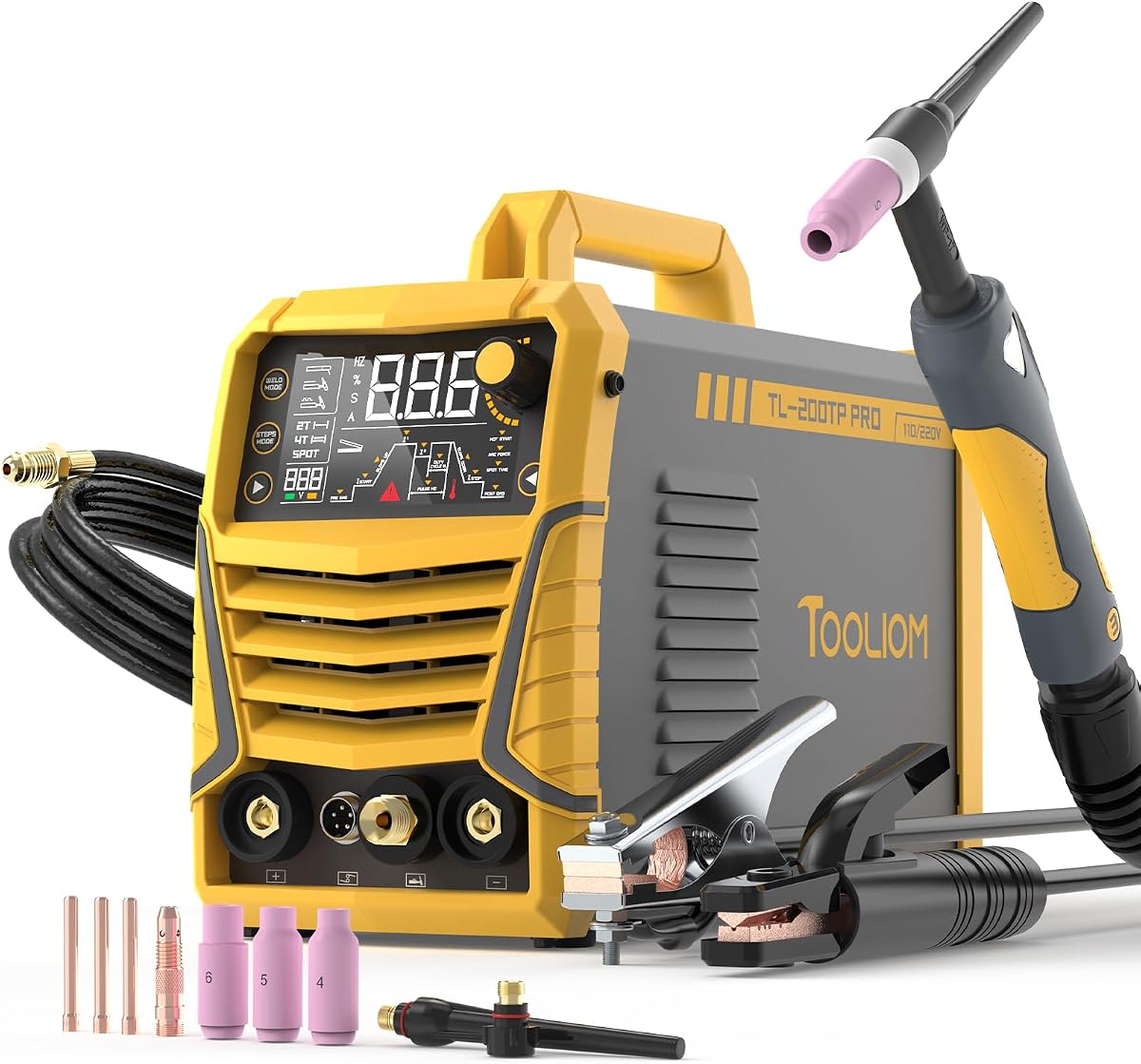
The TOOLIOM TL-200TP offers six welding modes in one dual-voltage package: AC TIG, DC TIG, AC Pulsed TIG, DC Pulsed TIG, STICK, and TIG spot welding. Its 4.1 rating indicates a broadly capable machine rather than one at the top of the field, but the range of functions is considerable for this class.
We may earn a commission when you buy through this link, at no additional cost to you.
The square-wave AC/DC inverter platform includes pulse features and a fish-scale waveform intended to improve weld quality and appearance. A large digital display keeps mode, voltage, and current visible, while compatible foot-pedal control—although sold separately—supports remote arc start and current adjustment.
Aluminum is an explicit capability, with maximum listed thicknesses of 1/8 inch at 110V and 3/16 inch at 220V. The machine also handles alloy steel, copper, stainless steel, carbon steel, and iron. That makes it useful for mixed-material shops, though users should not interpret the listed thickness as a guarantee for every joint, position, or technique.
This model is most appealing to a DIYer, repair technician, or small fabricator who wants AC TIG, pulse TIG, spot work, and STICK in one unit. It is less compelling for a specialist who requires a premium torch ecosystem, and buyers should budget separately for the compatible foot pedal if remote heat control is important.
Combining AC TIG, DC TIG, two pulse variants, STICK, and spot welding reduces the need for separate machines. That versatility is particularly useful for maintenance shops handling mixed repair jobs.
Stated aluminum limits scale from 110V to 220V, giving operators a useful distinction when planning where the machine will operate. Joint design and technique will still influence real-world results.
We may earn a commission when you buy through this link, at no additional cost to you.
The TOOLIOM 135A Stick Welder Kit is the most approachable TIG-capable option in the group. Rated 4.5, it supports STICK and lift TIG while running from standard 110V household current. Its included lift TIG torch, E6013 rods, and gloves make it a convenient package for a first machine or occasional repair work.
We may earn a commission when you buy through this link, at no additional cost to you.
VRD, hot start, and arc force help make ignition easier and reduce rod-sticking problems. The intelligent LCD display improves visibility into operating data, while the compact chassis and adjustable shoulder strap make the kit easier to carry between jobs or use in confined spaces.
Its limitations are substantial compared with dedicated TIG models. At 135 amps, it has less headroom for thick materials, and the absence of AC TIG makes it unsuitable for aluminum. Lift TIG also differs materially from the more controllable HF-start and pulse configurations found in higher-end machines.
The kit is best for a beginner, hobbyist, or maintenance worker who needs light TIG capability alongside STICK and values simple 110V operation. It is a sensible entry point for thin-gauge steel and light repairs, but a serious fabricator should look toward higher-output DC and AC models.
The supplied torch, electrodes, and gloves reduce the number of immediate accessories needed for basic work. It is an approachable way to learn TIG while retaining a useful STICK mode.
Household-voltage operation, compact dimensions, and an adjustable shoulder strap prioritize portability. The 135A output should be matched to thin materials and modest repair requirements.
We may earn a commission when you buy through this link, at no additional cost to you.
The Miller Multimatic 215 PRO is the premium selection in this guide and carries a 5.0 rating. It is a full multiprocess platform supporting MIG, pulsed MIG, TIG, pulsed TIG, and STICK. That combination makes it a long-term shop investment for users who want TIG without giving up efficient wire welding or stick work.
We may earn a commission when you buy through this link, at no additional cost to you.
BeadVision provides real-time bead monitoring, Auto-Set simplifies initial programming, and Smooth-Start is designed to reduce spatter during arc starts. Program Memory stores frequently used parameters, while Multi-Voltage MVP permits tool-free connection to either 120V or 240V. The supplied information also notes continually upgradable USB software.
Wire handling is unusually comprehensive for a compact multiprocess welder. The angled cast-aluminum drive includes a calibrated tension knob and Quick Select roll, supports 4- or 8-inch spools, and accommodates specified solid and flux-cored wire sizes. Fan-On-Demand cooling and automatic spool-gun detection further improve shop integration.
The trade-offs are cost and complexity. A premium multiprocess machine is not the logical choice for someone needing only a basic TIG function, and its menu-driven features may take time to learn. For professional fabricators, serious hobbyists, and growing shops that value TIG, MIG, automation, memory, and future software updates together, it is the strongest all-around option here.
Combining pulsed MIG, TIG, and STICK in one machine eliminates some equipment duplication. The machine is especially useful for shops whose work changes from sheet fabrication to tube repair or structural assembly.
Auto-Set, BeadVision, program memory, and software upgrade support help streamline repeated work. These features distinguish a premium platform from a basic process-focused welder.
We may earn a commission when you buy through this link, at no additional cost to you.
The TOOLIOM 200A TIG combines STICK, DC TIG, Pulse TIG, and TIG Spot in a balanced four-mode design. Its 4.3 rating and 200-amp output position it as a capable general-purpose unit for home DIY, professional fabrication, and outdoor repairs where stronger power than a compact lift-TIG kit is desired.
We may earn a commission when you buy through this link, at no additional cost to you.
DC TIG includes high-frequency ignition and 2T, 4T, and spot operation. Pulse TIG independently adjusts frequency, duty cycle, and current, while STICK mode adds hot start, arc force, and anti-stick functions. A large digital display presents amperage, mode, and parameter changes in real time, making the controls approachable despite the machine's range of functions.
Smart-sensing circuitry adapts to 110V and 220V sources, and a reserved five-pin interface allows a compatible pedal to control arc on/off and current. Thermal protection shuts the machine down during overheating or current overload while the fan continues cooling, reducing the risk of internal component damage.
The main limitation is DC-only TIG, which excludes aluminum from the machine's core use cases. It is a strong selection for stainless steel, alloy steel, iron, and other non-ferrous DC applications. Choose it when four dedicated TIG modes and thermal protection matter more than AC aluminum capability.
DC TIG, Pulse TIG, TIG Spot, and STICK cover fabrication, repeat spot placement, and repair work. The combination avoids the need for separate equipment for each of those common tasks.
Thermal shutdown and continued fan cooling help guard internal components during overload. That protection is particularly relevant for users planning extended work rather than occasional household projects.
We may earn a commission when you buy through this link, at no additional cost to you.
The YESWELDER MCT-520 is a six-in-one welder and plasma cutter aimed at complete shop setups. Its 4.2 rating reflects a broad feature set: gas MIG, flux-core MIG, cutting, HF TIG, MMA, and spool-gun aluminum welding are all represented, although the spool gun requires a separate purchase.
We may earn a commission when you buy through this link, at no additional cost to you.
The physical-control layout is designed for use with heavy gloves. Its extra-large LED screen is described as 30 percent larger than a standard model, and users can adjust MIG inductance, TIG heat settings, and MMA arc force. TIG mode is foot-pedal ready for remote amperage control, but the compatible pedal is also sold separately.
Welding output ranges from 20 to 200 amps, while plasma cutting covers 20 to 50 amps. The stated cutting capability reaches 5/16 inch with a listed maximum sever capacity of 5/8 inch. A smart parameter-matching system adjusts wire-feed recommendations based on voltage, supporting a faster beginner setup.
The MCT-520 is most useful for users building a versatile shop around one platform. MIG is often faster for fabrication, TIG provides finer control, and plasma cutting broadens shop capability. Its trade-offs are the additional costs of optional accessories and the need to choose the right process rather than receiving a highly specialized TIG-only system.
MIG, flux-core, TIG, MMA, plasma cutting, and spool-gun capability reduce equipment duplication. The platform is particularly attractive for maintenance shops and versatile hobbyists.
Large displays and physical dials remain practical when gloves are worn. Optional foot-pedal and spool-gun purchases should be considered when calculating the complete setup.
We may earn a commission when you buy through this link, at no additional cost to you.
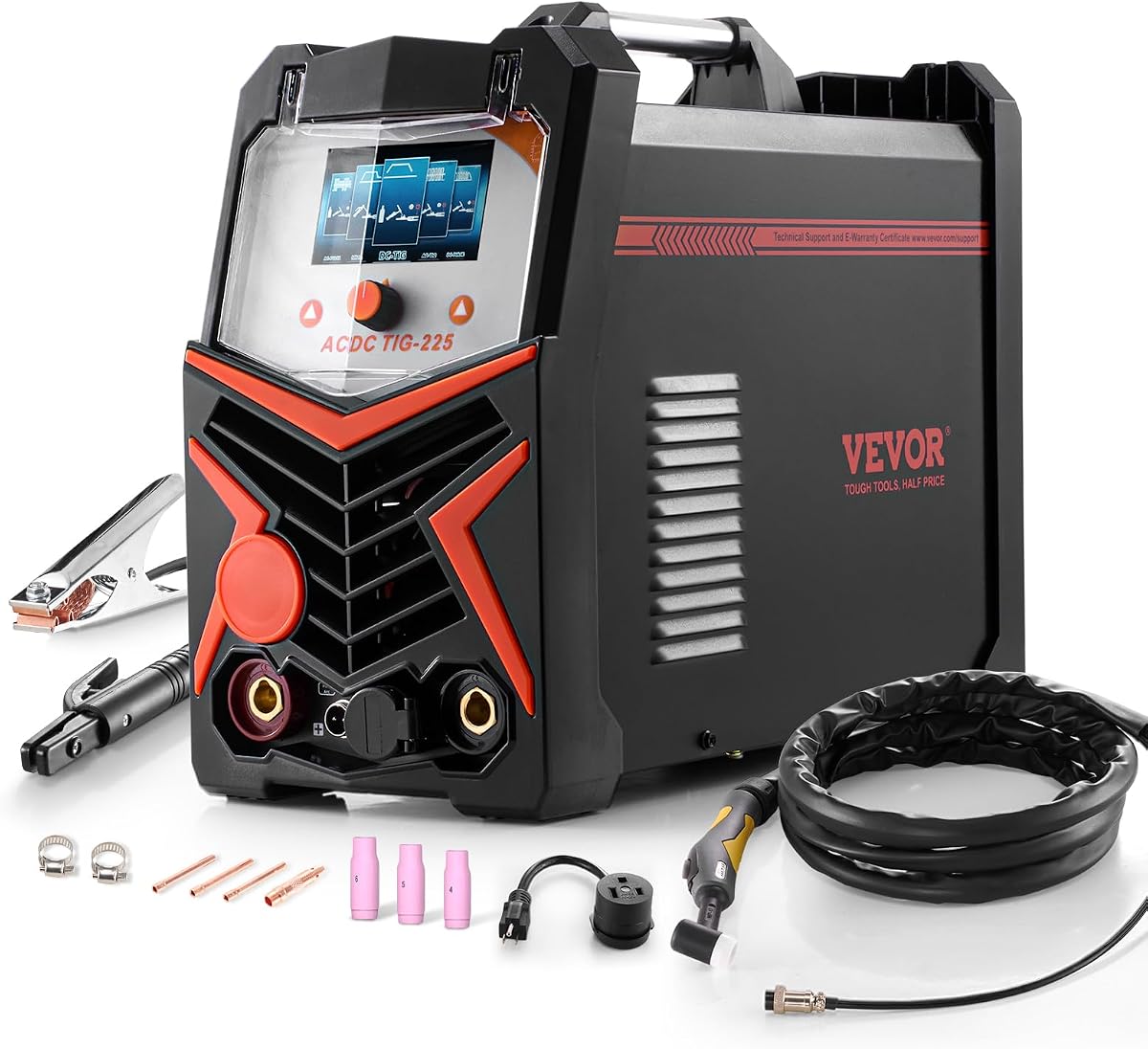
The VEVOR 225A 6-in-1 covers AC TIG, DC TIG, AC pulse TIG, DC pulse TIG, STICK, and spot TIG. Its 3.8 rating is the lowest among these selections, so buyers should weigh its broad specifications carefully and review current customer feedback for the exact application and material mix they have in mind.
We may earn a commission when you buy through this link, at no additional cost to you.
The IGBT inverter platform supports dual 110/220V operation and high-frequency non-contact arc starting. It is designed for carbon steel, copper, stainless steel, and titanium, and the listed capabilities include 1/4-inch aluminum and 3/8-inch low-carbon steel. Compatibility with specified spool guns is also noted for aluminum MIG work.
VRD, overcurrent, overvoltage, overload, and overheat protection provide a broad safety layer. The large digital LED display supports monitoring and parameter adjustment. As with several competitors, optional accessories and the precise limits of aluminum spool-gun work should be verified before purchase.
The machine is a reasonable option for a garage or maintenance shop that wants both AC and DC TIG, pulse modes, spot welding, and STICK in one unit. Its lower rating warrants more deliberate comparison, especially for users who can choose between it and a similarly equipped model with stronger customer feedback.
Supporting aluminum-oriented AC TIG alongside DC TIG broadens the range of suitable base materials. Separate pulse modes provide additional control for thin work and heat-sensitive joints.
Protection against voltage, current, overload, and overheating conditions supports safer operation. The large LED screen helps users monitor the machine while keeping setup changes visible.
We may earn a commission when you buy through this link, at no additional cost to you.
The YESWELDER 160A MIG is primarily a multipurpose wire welder with lift TIG available as an additional capability. Its 4.5 rating makes it a strong option for DIYers and fabricators who want MIG speed, STICK versatility, and occasional TIG control without purchasing a dedicated TIG machine.
We may earn a commission when you buy through this link, at no additional cost to you.
It handles flux-core MIG, gas MIG, STICK, and lift TIG, with a separate lift TIG torch required. The synergic control system automatically recommends voltage and wire-feed speed as thickness or amperage changes, while manual wire-feed and voltage adjustment remains available for experienced users. A clear LED digital display provides operating information.
The stated output is 160 amps with automatic 110/220V handling. It accepts specified 0.030-inch and 0.035-inch solid and flux-core wire on 2-pound or 10-pound spools, and common 6010, 6011, 6013, and 7018 electrodes in STICK mode. At 19.4 pounds, it remains portable without being as compact as the 135A kit.
This machine is best for users whose primary process is MIG but who occasionally need lift TIG for light sheet-metal touchups. It does not offer the dedicated HF-start TIG, pulse controls, or AC aluminum capability found in higher-ranked machines, so TIG should not be its only reason for purchase.
Synergic recommendations simplify setup while preserving manual control for experienced operators. The result is a flexible machine for fabrication, automotive repair, construction, and general DIY work.
Automatic 110V and 220V operation and an 8.8-kilogram weight support use at different job sites. The optional lift TIG torch limits convenience for TIG-focused work.
We may earn a commission when you buy through this link, at no additional cost to you.
Choosing a Tig Welder means balancing material compatibility, output capacity, heat control, portability, and the accessories needed to complete the work. The following factors help narrow the field before comparing final features.
Begin by matching the machine's electrical modes to the metals you expect to weld. DC TIG handles stainless steel, mild steel, and many other materials, while AC TIG is the standard choice for aluminum because it balances penetration and heat. Pulse TIG can further improve control on thin material, but a DC-only model cannot substitute for AC aluminum capability.
Maximum amperage provides a useful indication of headroom, but it is not the only factor in real-world performance. Match the machine to the thickest workpiece and joint design in your typical workload, then account for voltage, accessories, duty cycle, and the technique being used. A compact 135A unit may suit thin projects, while 200A to 250A machines offer more flexibility for fabrication and repair work.
Pulse controls can regulate average heat input and help stabilize an arc over thin or heat-sensitive work. Independent controls for pulse frequency, duty cycle, and peak or base current provide more precise adjustment than a single pulse setting. For aluminum and thin stainless or mild steel, these controls can be valuable, although they add setup complexity for beginners.
Dual-voltage machines can adapt to different home, job-site, and workshop power sources, while 110V-only units are simpler and often more portable. Consider the machine's weight, handle or strap design, ventilation requirements, and whether it will remain in one shop or move regularly. More output and additional modes generally increase size and complexity.
A readable display helps operators monitor current, voltage, mode, and pulse settings. Larger displays and logical parameter menus are particularly useful while wearing a welding helmet. Program memory and automatic setting recall save time on repeated jobs, while physical controls are generally easier to adjust with heavy gloves than touchscreens.
The difference between a lift torch and an HF-start gas torch can be substantial in control, cleanliness, and setup. Foot-pedal support enables remote current control, but several machines reserve the interface without including a pedal. Check whether the torch, connector, work clamp, electrode holder, rods, gas, and regulator are included before comparing complete setups.
Thermal protection, overload safeguards, voltage regulation, and residual-voltage reduction can help protect the operator and internal electronics. These features are especially valuable for users running the machine near its stated limits or working in variable environments. Proper ventilation, sound grounding, suitable protective equipment, and correct cylinder handling remain essential regardless of built-in safeguards.
MIG, flux-core MIG, TIG, STICK, and plasma cutting cover different jobs with varying efficiency and control. A multipurpose machine can save shop space, especially for maintenance work, but a dedicated TIG welder may offer more specialized controls and accessories. Decide which process will handle most of your workload before paying for additional modes.
Begin by reading the machine's manual and identifying the correct process for the material and joint. Install the proper ground clamp, torch, electrode holder, gas equipment, or accessories specified for that mode. Check the input voltage and amperage range before connecting power, and ensure the work area is dry, ventilated, and protected from combustible material.
For TIG work, clean the joint and select an appropriate tungsten, electrode, filler rod, and shielding-gas arrangement. Set the machine to a conservative starting amperage for the material thickness, establish a stable arc, and adjust pulse, current, or heat control gradually. Use the foot pedal only when it is compatible with the machine and the response matches the planned technique.
After work, turn off the power and allow the machine to cool, especially after extended operation. Inspect cables, torch components, connectors, and the work clamp for damage, clean away spatter carefully, and store the welder in a dry location. Periodic inspection of consumables, connections, ventilation openings, and protective features helps preserve safe and consistent operation.
DC TIG is commonly used for stainless steel, mild steel, chrome, and other materials that benefit from a stable, focused arc. AC TIG is specifically important for aluminum because the alternating current helps balance penetration and heat. A machine that offers both is more versatile, while a DC-only model is not a practical choice for routine aluminum TIG work.
You need an AC-capable TIG welder for the most common aluminum TIG techniques. Some spool-gun MIG machines can also weld aluminum, but their wire process differs from TIG and may not suit fine, precise, or highly cosmetic joints. Check the machine's stated aluminum thickness limits and required consumables before purchasing.
Lift TIG can be a practical starting point because it reduces equipment requirements and can work on light sheet metal. It generally offers less precise arc control than a gas-shielded HF TIG setup and may be less comfortable for prolonged work. Experienced users often move to HF TIG when they need greater control, cleaner shielding, or more demanding production work.
A compact 110V machine may handle many hobby tasks involving thin steel and stainless steel, while higher-output dual-voltage machines provide more room for thicker materials and varied workshop use. Choose based on the thickest expected workpiece rather than the highest possible marketing figure. Joint position, technique, filler, and heat management also influence the appropriate setting.
A foot pedal is optional for many users but valuable when precise remote current control is desired. Some machines support a pedal only through a specific connector, and the pedal may not be included. Verify compatibility, connector type, and supported functions before ordering one separately.
A dedicated TIG welder generally concentrates features and accessories on welding control, making it attractive for specialized fabricators. A multiprocess machine is more efficient when most work involves MIG or STICK and TIG is occasional. Consider your most frequent process, the importance of pulse and aluminum functions, and the cost of any accessories not included.
Most DC TIG welders in this guide are suitable for stainless steel, while AC/DC models provide additional aluminum capability. Use the correct tungsten, filler, shielding setup, and cleaning procedure for the alloy. The material thickness ratings still provide only a starting point because joint design and technique affect the final result.
Keep the machine dry, ventilate its cooling paths, inspect cables and connectors, and replace worn torch parts and consumables as needed. Avoid pulling on cables to move the unit, and let it cool after demanding work. Periodic servicing and careful storage help preserve output consistency and protect internal components.
The TOOLIOM 135A Kit is the practical budget starting point for light TIG and STICK work, while the PRIMEWELD TIG225X stands out as the best dedicated package for users who need AC/DC TIG, pulse control, and a proper torch. The Miller Multimatic 215 PRO takes the premium position by combining TIG with MIG, STICK, automation, bead monitoring, memory, and software upgradability.
Prioritize AC capability if aluminum matters, separate pulse controls for thin or heat-sensitive materials, and adequate output for your thickest work. Also account for torch type, foot-pedal compatibility, display readability, accessories, safety protections, and whether your workload is better served by dedicated or multiprocess equipment.
Ratings, configurations, accessories, and prices can change, so review the latest listing and seller details before ordering. Confirm material compatibility, included components, connector requirements, warranty coverage, and current technical specifications to ensure the selected Tig Welder matches your workshop.